Choosing a meter for automotive troubleshooting is not as simple as picking the device with the largest display. You need to decide whether a basic voltage reading is enough or whether you want dedicated battery-health, cranking, and charging-system information. This guide compares the best multimeter for testing car battery applications and explains which type fits different vehicles and skill levels.
My first choice is KAIWEETS Digital Multimeter Voltmeter. It measures AC/DC voltage, DC current, resistance, continuity, and diodes, while data hold and a backlight make readings easier to manage around a vehicle.
My second choice is AstroAI TRMS 4000-Count Auto-Ranging Digital Multimeter. Its auto-ranging operation, true-RMS measurement, non-contact voltage detection, flashlight, and dedicated 1.5V, 9V, and 12V battery modes make it especially convenient for mixed household and automotive use.
My third choice is TOPDON BT100 12V Automotive Car Battery Load Tester. TOPDON BT100 12V Automotive Car Battery Load Tester takes third place because it is more focused on vehicle batteries than a general multimeter. It can report state of health, state of charge, voltage, current, and rating information for compatible 12V lead-acid batteries, along with cranking and charging checks.
The comparison below is followed by individual product details, selection reasoning, setup instructions, safety advice, maintenance guidance, and answers to common buying questions. By the end, you should know whether a general-purpose multimeter or a dedicated 12V battery tester makes more sense for your garage.
Best Multimeter for Testing Car Battery
I selected these products according to their relevance to automotive electrical work, the usefulness of the supplied features, stated safety protections, compatibility information, and available customer-feedback evidence. I also included both general-purpose meters and dedicated battery testers so the comparison reflects the different ways a driver may diagnose a weak battery or charging problem.
| # | Image | Product | Price on Amazon |
|---|---|---|---|
| 1 | 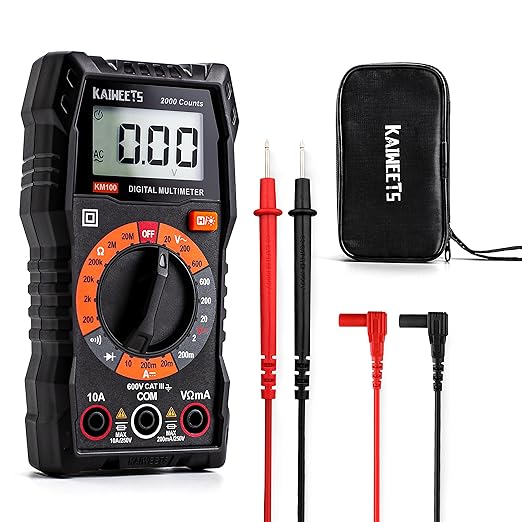 |
KAIWEETS Digital Multimeter Voltmeter | Check Price |
| 2 |  |
AstroAI TRMS 4000-Count Auto-Ranging Digital Multimeter | Check Price |
| 3 |  |
TOPDON BT100 12V Automotive Car Battery Load Tester | Check Price |
| 4 |  |
ANCEL BA101 12V Car Battery Tester and Alternator Diagnostic Tool | Check Price |
| 5 |  |
MOTOPOWER MP0515A 12V Automotive Battery Load Tester | Check Price |
KAIWEETS Digital Multimeter Voltmeter
The KAIWEETS meter is a practical starting point for checking battery voltage and troubleshooting simple electrical faults. It measures DC voltage for the battery itself, along with AC voltage, DC current, resistance, continuity, and diode function. That range makes it useful beyond the car, whether you are checking a household circuit, a fuse, a wire, or a small electronic component.
For automotive use, the data-hold button can freeze a reading when the display is awkward to see, and the backlight helps in a dim garage or under a dashboard. Two pre-installed AAA batteries, two test leads, and a carrying case also mean the basic kit is ready to organize and store without immediately buying accessories.
Safety is a meaningful strength here. The meter is listed as IEC CAT III 600V, CE and RoHS certified, and protected by double fuses with overload protection on all ranges. Those protections do not make incorrect probe placement harmless, but they add an important layer of defense for a beginner who is still learning which port and dial setting to use.
The main limitation is that it measures DC current but not AC current, and it is still a manual-range meter rather than a dedicated battery analyzer. Anyone who wants a clear state-of-health or starter-cranking diagnosis may prefer one of the specialized testers below. It suits DIY owners who want one inexpensive, versatile tool for voltage checks and basic electrical diagnosis.
Pros
- Measures DC voltage, resistance, continuity, diodes, and DC current.
- Includes a backlight, data hold, case, leads, and two AAA batteries.
- Double-fuse protection and overload protection support safer operation.
- Useful for automotive, household, and general electrical tasks.
Cons
- It cannot measure AC current.
- It does not provide dedicated battery-health or cranking analysis.
- Manual range selection requires attention from new users.
My Opinion
This is the strongest all-around choice when the goal is to own a general multimeter that can check a car battery and handle other small electrical jobs. Choose a dedicated tester instead if battery condition and starting performance are your primary concerns.
AstroAI TRMS 4000-Count Auto-Ranging Digital Multimeter
AstroAI s meter is a convenient step up for buyers who would rather let the instrument select the measurement range It measures AC DC voltage up to 600V current to 10A and resistance to 40MΩ while also supporting continuity diode battery and live-wire testing The true-RMS design is useful when readings involve less straightforward AC waveforms although a car.
Its dedicated battery modes are a notable advantage for a household that uses more than one battery format. The meter supports 1.5V, 9V, and 12V battery tests, and the light reportedly changes color for low-voltage indication. That does not replace a full automotive load test, but it makes quick screening easier and reduces the need to interpret every number from scratch.
The non-contact voltage function adds another layer of convenience for household troubleshooting. A red indicator and buzzer signal a strong AC field without requiring contact through the leads. A backlit LCD, flashlight, continuity buzzer, max function, data hold, low-battery indicator, and automatic shutoff round out a feature set aimed at occasional DIY use.
There are still boundaries to understand. The included battery modes should not be mistaken for a complete assessment of a vehicle battery’s capacity or starting ability. Also, auto-ranging is convenient but may feel slower than a knowledgeable user’s preferred manual setting. The silicone cover and double ceramic fuse help protect the meter, but safe lead placement remains essential.
Pros
- Auto-ranging operation is approachable for beginners.
- True-RMS measurement and a 600V measurement rating broaden its use.
- Dedicated 1.5V, 9V, and 12V battery modes simplify quick checks.
- Includes non-contact voltage detection, backlight, flashlight, and two AAA batteries.
Cons
- Battery modes do not replace a dedicated load or cranking test.
- The feature-rich interface may take time to learn.
- It is less specialized for automotive battery health than TOPDON or ANCEL.
My Opinion
This is my preferred alternative for someone who wants one accessible meter for car checks, household projects, and several common battery types. Its automation and convenience features are persuasive, but a dedicated automotive analyzer remains the better fit for diagnosing a recurring no-start problem.
TOPDON BT100 12V Automotive Car Battery Load Tester
The TOPDON BT100 takes a different approach from the first two products. Rather than serving mainly as a general electrical meter, it concentrates on 12V lead-acid battery diagnosis. It supplies state-of-health, state-of-charge, voltage, current, rating, and other analytical information, which can be more useful to a driver deciding whether a battery is aging, discharged, or worth replacing.
It supports regular flooded and AGM flat-plate or spiral batteries within a stated 100–2000 CCA range. That compatibility covers many cars, SUVs, trucks, motorcycles, boats, RVs, ATVs, lawnmowers, and golf carts, but buyers should confirm both battery chemistry and rating before connecting it. It is not a universal tester for every battery technology.
Three testing functions give the BT100 a clear automotive purpose. A battery-health test examines general condition, a cranking test checks whether the electrical system can provide enough starting power, and a charging test helps assess the alternator, rectifier diode, and charging current. This makes the tool more informative than simply seeing whether the engine-off voltage looks acceptable.
The device powers on only after proper connection and its passive testing design does not require charging the tester first Polarity-reversing prevention copper clamps a menu interface and three colored LEDs help make the process easier to follow Its compact size is convenient for a glove box or center console although its specialized nature means it is not a replacement for a general multimeter when you need resistance continuity or.
Pros
- Provides battery health, charge, cranking, and charging-system information.
- Supports compatible 12V batteries rated from 100 to 2000 CCA.
- Works across many vehicle types, including cars, trucks, boats, and motorcycles.
- Compact, menu-driven, and powered by the vehicle battery during testing.
Cons
- It is limited to compatible 12V lead-acid battery applications.
- It cannot replace a general multimeter for broader electrical diagnosis.
- Correct battery type and rating selection still matters for useful results.
My Opinion
Choose the BT100 when the central question is, “Is this 12V battery or charging system causing my starting problem?” Its focused results are more actionable than a simple voltage number, provided the battery falls within its stated compatibility range.
ANCEL BA101 12V Car Battery Tester and Alternator Diagnostic Tool
The ANCEL BA101 is another dedicated automotive tester, but its broad battery-standard support makes it particularly interesting for owners of varied vehicles. It reports state of health, state of charge, voltage, current, CCA, cranking information, and charging information. That combination can help separate a weak battery from a starting-system or alternator issue.
Compatibility is one of its strongest points. The tester supports standards such as JIS, EN, DIN, SAE, BCI, GB, CA, MCA, and IEC, and it is intended for 12V batteries over 30Ah in cars, trucks, boats, RVs, ATVs, lawnmowers, golf carts, and motorbikes. It supports flooded, AGM, GEL, and EFB batteries. It is not for lithium batteries or non-12V batteries, including 6V, 8V, and 24V applications.
Accurate setup matters because the user must enter the correct battery type, rating value such as CCA or Ah, and temperature according to the battery information. That creates a little more responsibility than a basic voltage check, but it also gives the tester the information needed to interpret the battery appropriately.
The black-and-white screen has adjustable contrast and a white backlight for bright or dim conditions. One-handed operation, multiple languages, direct power from the vehicle battery, and no internal battery to charge are practical ownership advantages. Four-in-one protection addresses reverse polarity, short circuits, overcurrent, and overvoltage, while the reinforced ABS housing is intended to withstand routine garage handling.
Pros
- Reports SOH, SOC, voltage, current, CCA, cranking, and charging information.
- Supports flooded, AGM, GEL, and EFB 12V batteries over 30Ah.
- Recognizes many international battery-rating standards.
- Includes polarity, short-circuit, overcurrent, and overvoltage protection.
Cons
- Not compatible with lithium, non-12V, or 6V, 8V, and 24V batteries.
- Incorrect battery type, rating, or temperature entry can undermine the result.
- It is specialized rather than a general-purpose multimeter.
My Opinion
The BA101 is a strong choice for a vehicle owner or small garage that handles several conventional 12V battery types. Its compatibility is broad, but the buyer must be willing to read the battery label and enter the data carefully before trusting the diagnostic output.
MOTOPOWER MP0515A 12V Automotive Battery Load Tester
The MOTOPOWER MP0515A is aimed at the same practical problem as the other dedicated automotive testers: determining whether a 12V battery can support a vehicle and whether the charging system deserves attention. Its stated 100–2000 CCA range places it in the useful territory for many passenger vehicles and larger recreational or utility applications.
Unlike a general multimeter, a battery load tester is intended to make automotive results easier to interpret. A buyer considering this model is likely looking for a quick garage tool for battery, cranking, and charging-system checks rather than a device for measuring resistance, diodes, or household voltage. That focus can be an advantage when the tool will live in a vehicle or workshop.
The supplied product information identifies it as a 12V automotive tester with 100–2000 CCA capacity and functions for battery load, cranking, and charging-system testing. Those are the details that matter most for its intended use. However, the available data does not specify its supported battery chemistries, display features, protection system, included power arrangement, or exact vehicle list.
That missing detail is the main reason it ranks below the more fully documented choices Before purchasing confirm that the battery type and rating fall within the tester s intended range and check the current listing for connection instructions and safety information It may suit a buyer who wants a dedicated 12V automotive instrument and does not need the broad.
Pros
- Dedicated to 12V automotive battery and charging-system checks.
- Supports a stated 100–2000 CCA testing range.
- Useful for buyers focused on load, cranking, and charging diagnosis.
- Its specialized purpose can be simpler than using a general meter.
Cons
- Supplied information does not identify detailed battery-chemistry compatibility.
- It is not a general multimeter for resistance, continuity, or diode testing.
- Important display, protection, and accessory details should be confirmed before purchase.
My Opinion
The MOTOPOWER is worth considering when a straightforward 12V automotive tester is the priority. Because fewer technical and compatibility details are supplied here, I would choose it only after confirming the current product documentation matches the battery and vehicles you intend to test.
How I Selected These Products for Car Battery Testing
The selection balances two categories rather than pretending that one tool serves every buyer. KAIWEETS and AstroAI are general-purpose digital multimeters that can measure battery voltage while also helping with continuity, resistance, and other electrical tasks. TOPDON, ANCEL, and MOTOPOWER are dedicated 12V automotive testers, so their value comes from interpreting battery condition, cranking performance, or charging behavior more directly.
For the best multimeter for testing car battery needs, I gave weight to measurement usefulness, safety information, ease-of-use features, compatibility, and the amount of product detail available. I also considered customer-feedback evidence supplied for the listings, including ratings and customer-feedback volume, but those figures are signals rather than proof that every user will get the same result.
Selection takeaway: A general multimeter answers “What voltage is present?” A dedicated battery tester is more likely to answer “Is the battery healthy enough to start the vehicle?”
Brand diversity also matters because KAIWEETS, AstroAI, TOPDON, ANCEL, and MOTOPOWER approach the problem differently. That gives shoppers a more useful decision than five nearly identical meters, especially when some owners need a glove-box diagnostic tool and others want a versatile instrument for several electrical jobs.
Compatibility takeaway: Always match the tester to battery voltage, chemistry, capacity, and rating range before connecting the clamps or probes.
How to Choose the Right Tool for Car Battery Testing
The best multimeter for testing car battery work depends on what you want to learn. If you only need a resting-voltage check and occasional electrical troubleshooting, a protected general multimeter is usually the more flexible purchase. If you need state-of-health, starting, and alternator information, a dedicated 12V battery analyzer is the more direct option.
- Choose a multimeter for voltage, continuity, resistance, diode, and broader electrical checks.
- Choose a battery tester for CCA, state-of-health, cranking, and charging-system information.
- Confirm compatibility with the battery’s voltage, chemistry, capacity, and rating standard.
- Prioritize protection such as fuses, overload protection, reverse-polarity prevention, and insulated leads.
- Consider the display and controls if you will work in darkness, outdoors, or tight engine bays.
General multimeter or dedicated battery analyzer?
A multimeter is the more useful long-term tool for many households. It can tell you whether the battery has an appropriate voltage, whether a fuse is open, whether a circuit has continuity, and whether a charging circuit is producing voltage. However, a voltage reading alone cannot fully reveal how a battery behaves under starting load.
A dedicated analyzer is more focused. It may ask for the battery’s CCA rating and type, then use that information for a health or cranking assessment. It can reduce guesswork for no-start problems, but it will not replace a multimeter when you need to trace a wire or check an individual component.
Check the battery label before buying
Look for the battery’s nominal voltage, chemistry, capacity, and rating information. Most ordinary cars use a 12V lead-acid battery, but battery construction can vary between flooded, AGM, GEL, EFB, and lithium designs. The ANCEL BA101 specifically lists several conventional 12V types but excludes lithium and non-12V batteries.
For testers that use CCA, find the CCA number and the relevant rating standard on the label. Entering the wrong standard or number can produce an interpretation that does not fit the battery. If the label is damaged or unreadable, a simple voltage check may be more honest than guessing.
Safety ratings and protective features
Automotive electrical systems can deliver high current even though the battery voltage is relatively low. A short across the terminals can create sparks, heat, or damaged equipment. Look for insulated probes or clamps, correctly rated fuses, overload protection, and reverse-polarity safeguards.
A CAT rating describes the measurement environment for which a meter is designed, but it does not permit careless use. The AstroAI and KAIWEETS meters list CAT III 600V protection, while the dedicated testers describe other protective measures. Keep the red and black leads in the correct ports, select the correct function, and never measure current by placing a meter across the battery terminals.
How to Set Up a Meter for a Battery Check
Park the vehicle safely, switch off the engine and accessories, and open the hood. Let the vehicle sit for a while after driving if you want a resting-voltage reading; lights, fans, and recent charging activity can affect what the meter shows. Make sure the battery posts and clamps are accessible without allowing the probes to touch each other.
- Turn the meter on and select DC voltage, not AC voltage or current.
- Insert the black lead into the common socket and the red lead into the voltage socket.
- Touch the black probe to the negative terminal and the red probe to the positive terminal.
- Hold the probes steadily and read the display without letting the tips bridge the terminals.
- Remove the red probe first, then the black probe, and switch the instrument off.
Auto-ranging meters may choose the range automatically. With a manual meter, select a DC-voltage range above the expected battery voltage before connecting. If the display shows a minus sign, the probes may be reversed; remove them, correct the connection, and try again rather than forcing the tips against the terminals.
How to Interpret a Basic Battery-Voltage Reading
A voltage reading is useful screening information, not a complete verdict. A battery can show a reasonable voltage with no load and still fail when the starter demands substantial current. Likewise, a recently charged battery may show a temporarily elevated reading that does not represent its settled condition.
- A stable reading near the battery’s normal 12V nominal range suggests the battery has voltage available, but does not prove strong capacity.
- A noticeably low reading after the vehicle has rested may indicate discharge, an aging battery, or a problem that needs further investigation.
- A rising voltage with the engine running suggests the charging system is contributing, but a dedicated charging test or qualified diagnosis may still be needed.
- A dramatic drop during starting points toward a battery, cable, connection, or starting-system concern.
Do not diagnose from one number taken at one moment. Check terminal cleanliness, cable tightness, recent driving conditions, temperature, and whether accessories were left on. A battery that has been deeply discharged may need proper charging before its condition can be judged fairly.
How Dedicated Battery Testers Improve Diagnosis
Dedicated testers are valuable because they organize several automotive questions into a guided process. Depending on the model and compatible battery, they may assess state of charge, state of health, CCA, cranking performance, and charging operation. This helps narrow the problem when a vehicle turns over slowly or repeatedly needs a jump.
Use the battery information requested by the tester, including type, rating, and sometimes temperature. The TOPDON BT100 and ANCEL BA101 are not generic devices for every battery; both require attention to 12V compatibility and supported lead-acid designs. A result is only as meaningful as the information entered and the quality of the connection.
Cranking and charging checks also need context. A poor result may involve corroded terminals, loose ground connections, a failing starter, an alternator issue, or a battery that is simply undercharged. Treat the tester as a diagnostic aid rather than an automatic replacement recommendation.
Common Mistakes to Avoid
Most beginner problems come from selecting the wrong function, using the wrong port, or assuming a single voltage number explains the entire starting system. Slow down before every connection, especially if you move from voltage measurement to current measurement.
- Do not set a multimeter to current and place the probes directly across the battery terminals.
- Do not use an AC-voltage setting when checking a conventional automotive battery’s DC output.
- Do not guess a battery tester’s chemistry, CCA, Ah, or rating standard.
- Do not test a non-12V or lithium battery with a tool that excludes that application.
- Do not let metal tools bridge positive and negative terminals.
- Do not rely on a good resting voltage as proof that the battery can crank the engine.
- Do not ignore loose, dirty, or corroded cable connections.
When uncertain, stop and verify the manual, terminal markings, lead sockets, and battery label before continuing. A few seconds of setup can prevent a blown fuse, damaged meter, or dangerous spark.
How to Maintain and Store the Tester
Keep probes, leads, and clamps clean and dry. Dirt or oxidation on the contact surfaces can create unstable readings, while damaged insulation can expose you to an avoidable hazard. Replace or stop using a lead if the insulation is split, the plug is loose, or the probe tip is bent.
Store a general multimeter in its case when available, especially if it will ride in a vehicle. Avoid leaving it where heat, moisture, or heavy tools can damage the housing or display. Remove ordinary batteries from a meter that will sit unused for an extended period if the product instructions recommend doing so, and replace low batteries before an important roadside check.
Dedicated testers powered from the vehicle battery should be disconnected promptly after testing. Do not pull on the cable to remove a clamp. Release the clamp from the terminal, inspect it for contamination, and coil the lead without sharp bends. Basic care preserves reliable contact and makes the tool ready for the next diagnosis.
When to Replace the Car Battery
A test result should be considered alongside symptoms and history. Repeated jump-starts, slow cranking, dimming lights during startup, a battery that will not hold a charge, or a failed health and cranking assessment all justify closer attention. A single low reading after lights were left on does not automatically mean the battery has reached the end of its life.
Before replacing the battery, inspect the charging system and cable connections. An alternator problem can leave a healthy battery undercharged, while resistance at a terminal or ground strap can imitate a weak battery. The TOPDON and ANCEL testers can help distinguish battery and charging concerns, while a general multimeter is useful for additional circuit checks.
When replacement is appropriate, match the vehicle’s required size, terminal arrangement, battery type, and rating. Do not substitute a different chemistry or capacity simply because it physically fits. The tester is only one part of making a correct replacement decision.
FAQS About Best Multimeter for Testing Car Battery
Can a regular multimeter test a car battery?
Yes. A regular multimeter can measure the battery’s DC voltage and help check related circuits, fuses, continuity, and charging voltage. It generally cannot provide the same battery-health or cranking analysis as a dedicated automotive battery tester.
Should I use AC or DC voltage for a car battery?
Use DC voltage. A conventional vehicle battery supplies direct current, so select the DC-voltage function and connect the black probe to negative and the red probe to positive.
Is a voltage reading enough to diagnose a weak battery?
No. Voltage is an important first check, but it does not prove that the battery can deliver sufficient starting current. A dedicated load, cranking, or battery-health test provides more relevant information when the vehicle has starting trouble.
What type of meter is safest for a beginner?
A meter with correctly rated leads, fuses, overload protection, clear controls, and a backlit display is easier to use responsibly. Auto-ranging can simplify setup, but beginners still need to learn the correct function and input sockets.
Can these testers check an alternator?
The TOPDON BT100 and ANCEL BA101 include charging-system testing functions according to the supplied product information. A general multimeter can also help check charging voltage, but interpreting the result may require additional vehicle-specific knowledge.
Can a 12V battery tester be used on a lithium battery?
Only if the product specifically supports that chemistry. The ANCEL BA101 is stated not to support lithium batteries, and buyers should never assume that a tool intended for conventional lead-acid batteries is suitable for lithium.
Final Thoughts
The KAIWEETS Digital Multimeter Voltmeter is my top choice for flexible electrical work and straightforward battery checks, while the AstroAI TRMS 4000-Count Auto-Ranging Digital Multimeter is the convenient alternative for mixed household and automotive use. For focused 12V diagnosis, the TOPDON BT100 Automotive Car Battery Load Tester is a strong pick. Choose according to whether you need the best multimeter for testing car battery voltage or a dedicated tool that interprets battery health, cranking, and charging performance.