Finding the best professional car scanner diagnostic tool is harder than simply choosing the device with the longest feature list. A basic code reader may be perfect for checking a dashboard light, while a serious DIY mechanic or repair shop may need access to ABS, SRS, transmission modules, service resets, and bidirectional controls.
My first choice is ANCEL AD310 Classic Enhanced Universal OBD II Scanner Car Engine Fault Code. Its compact wired design supports the major OBDII protocols, reads and clears emission-related codes, and works with many 1996-and-newer vehicles.
My second choice is FOXWELL NT301 OBD2 Scanner Live Data Professional Mechanic OBDII Diagnostic Code Reader. It is a practical step up for drivers who want more information than a basic code reader provides.
My third choice is BLCKTEC 460T OBD2 Scanner Car Code Reader Engine ABS SRS Transmission Diagnostic. It can scan engine, transmission, ABS, and SRS systems while also offering functions such as battery registration, throttle relearn, DPF reset, and ABS bleeding on supported vehicles.
This guide compares all five tools by diagnostic depth, compatibility, ease of use, update policy, and likely buyer fit. It also explains what scanner terms mean, how to check vehicle compatibility, how to use a new tool safely, and when paying more for bidirectional or all-system capability makes sense.
Best Professional Car Scanner Diagnostic Tool
I selected these products for their relevance to automotive diagnosis, the practical value of their stated functions, available customer-feedback evidence, and variety of intended users. The group includes simple wired OBDII readers, broader handheld scanners, and advanced tablet-style equipment so that a first-time buyer can compare capability rather than judging every tool by the same standard.
| # | Image | Product | Price on Amazon |
|---|---|---|---|
| 1 |  |
ANCEL AD310 Classic Enhanced Universal OBD II Scanner Car Engine Fault Code | Check Price |
| 2 |  |
FOXWELL NT301 OBD2 Scanner Live Data Professional Mechanic OBDII Diagnostic Code Reader | Check Price |
| 3 | 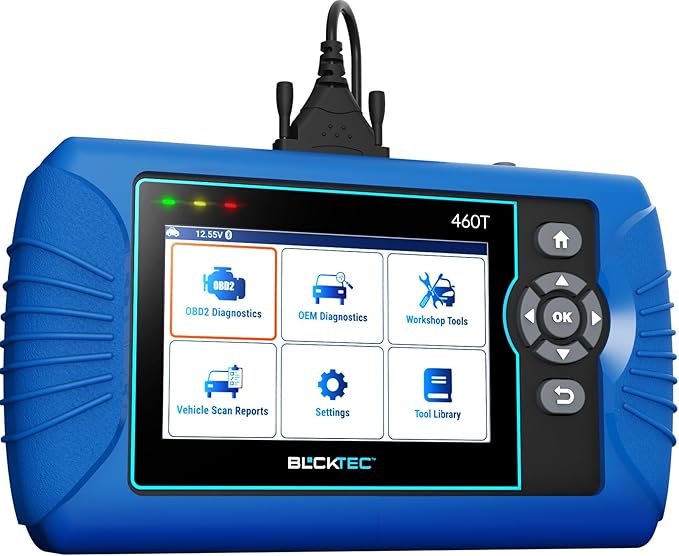 |
BLCKTEC 460T OBD2 Scanner Car Code Reader Engine ABS SRS Transmission Diagnostic | Check Price |
| 4 |  |
XTOOL A30D Bidirectional OBD2 Scanner Diagnostic Tool All System | Check Price |
| 5 |  |
TOPDON ONE Bidirectional Scan Tool | Check Price |
ANCEL AD310 Classic Enhanced Universal OBD II Scanner Car Engine Fault Code
The ANCEL AD310 is a compact wired code reader aimed at drivers who mainly need to understand and clear a check-engine light. It supports KWP2000, J1850 VPW, ISO9141, J1850 PWM, and CAN protocols, giving it broad coverage across many 1996-and-newer US vehicles and many 2000-and-newer European and Asian vehicles.
Its strongest quality is simplicity. The scanner draws power through the vehicle’s OBDII port, so there is no battery charging, app pairing, or subscription to manage. A 2.5-foot insulated cable gives useful reach around the front seats, while the sturdy, compact housing is easy to keep in a glove box or emergency kit. It can read and clear emission-related trouble codes and display live data after a repair.
That simplicity is also the main limitation. The AD310 is not an all-system professional scanner, and the supplied information specifically limits it to emission-related diagnosis through an OBDII interface. It will not replace a tool that accesses ABS, SRS, transmission, or other manufacturer-specific systems. A buyer should also confirm that the vehicle uses OBDII rather than assuming an adapter can make an older OBDI vehicle compatible.
Pros
- Supports the major OBDII communication protocols.
- Compact, lightweight design with a durable 2.5-foot cable.
- Reads and clears engine emission codes without an app or subscription.
- Broad compatibility with many cars, SUVs, and light trucks.
Cons
- Limited to emission-related engine diagnosis.
- Does not provide ABS, SRS, transmission, or other advanced-system access.
- Requires a physical cable connection.
My Opinion
The AD310 is the sensible starting point for a household that wants a trustworthy check-engine-light tool rather than a complete workshop platform. Choose it when low complexity matters more than advanced module coverage, and verify the vehicle’s model year and OBDII status before buying.
FOXWELL NT301 OBD2 Scanner Live Data Professional Mechanic OBDII Diagnostic Code Reader
The FOXWELL NT301 keeps the plug-and-play convenience of a wired OBDII reader but gives the user more information during diagnosis It reads and clears engine fault codes displays live sensor data and can graph items such as oxygen-sensor readings fuel trims coolant temperature and engine speed That makes it more useful when a warning light is intermittent.
A dedicated I/M readiness shortcut and red-yellow-green indicator are particularly helpful before an emissions inspection. Instead of merely erasing a light, the owner can see whether the vehicle’s monitors are ready for testing. The NT301 also provides O2-sensor and EVAP-related testing modes, which may help narrow down fuel-system or emissions concerns without immediately paying for a diagnostic appointment.
The 2.8-inch color screen is intended to remain readable in daylight, and the tool includes a speaker for audible feedback. It supports the major OBDII protocols and is listed for most 1996-and-newer US gasoline vehicles, many 2000-and-newer European and Asian models, and certain 12V diesel vehicles with OBD2. Compatibility still needs checking because supported tests and data vary by vehicle.
Although the name includes “professional,” this remains primarily an engine and emissions scanner. It should not be purchased with the expectation that it will diagnose every airbag, brake, or transmission module. Lifetime free updates and one-year seller assurance improve ownership value, but buyers should confirm the current update procedure and vehicle coverage before relying on it for a specific repair.
Pros
- Live-data graphing provides more diagnostic context than a basic reader.
- Includes I/M readiness, O2-sensor, and EVAP testing modes.
- Bright color display and simple plug-and-play operation.
- Lifetime free updates are included according to the supplied information.
Cons
- Mainly focused on engine and emissions diagnosis.
- Vehicle-specific data and test availability can vary.
- Wired operation limits movement around the vehicle.
My Opinion
The NT301 is the better choice for a curious DIY owner who wants to interpret sensor behavior instead of only reading a stored code. It offers meaningful extra depth without moving all the way into expensive all-system equipment, but it is not the right tool for body, restraint, or chassis-module work.
BLCKTEC 460T OBD2 Scanner Car Code Reader Engine ABS SRS Transmission Diagnostic
The BLCKTEC 460T marks a major jump from engine-only readers by offering all-system diagnostics across engine, transmission, ABS, and SRS modules. Its AutoScan and AutoReLink functions are intended to find vehicle control units and reconnect with them automatically, while AutoVIN can retrieve the vehicle identification number to reduce manual setup.
For a home garage the service functions may be more valuable than the headline scan coverage Supported vehicles can receive oil-maintenance EPB SAS DPF throttle-body battery TPMS transmission and fluid-change resets along with ABS bleeding The scanner also supplies freeze-frame information and real-time OBD2 or OEM live data which can help connect a fault code with the conditions.
Pairing the tool with the RepairSolutions2 app adds access to a verified-fix database, parts information, maintenance schedules, technical service bulletins, warranty details, and recall information where available. That can make the diagnostic result easier for a nonprofessional to interpret. Still, a code is not automatically a failed part, and a reset function does not guarantee that every procedure works on every vehicle.
The 460T is listed for OBD2-compliant vehicles sold and registered in the United States and Canada from 1996 onward. Its use is restricted to those regions, and not all functions are available on all cars. Buyers should use the compatibility checker before purchase, particularly if they need a specific reset, diesel function, or module-level test.
Pros
- Accesses engine, transmission, ABS, and SRS systems on supported vehicles.
- Includes more than a dozen useful service and reset functions.
- AutoVIN and automatic system scanning simplify initial setup.
- Free lifetime updates and RepairSolutions2 integration add ownership value.
Cons
- Coverage and reset functions vary by vehicle.
- Product and companion app are limited to the United States and Canada.
- Its larger feature set may require more learning than a basic code reader.
My Opinion
The 460T is a strong middle ground for an advanced DIY mechanic who wants more than check-engine access but does not need a full tablet workstation. It deserves careful compatibility checking, yet its combination of all-system scanning, service functions, and repair information makes it substantially more versatile than the first two options.
XTOOL A30D Bidirectional OBD2 Scanner Diagnostic Tool All System
The XTOOL A30D is a wireless scanner that uses an Android or iOS device as its display Its Bluetooth connection can reach up to 33 feet allowing the user to move around the vehicle without carrying a handheld reader or managing a cable It supports Android 9 0 and newer and iOS 10 0 and newer so the buyer should confirm that a compatible phone or.
Its most important upgrade is bidirectional control. Rather than only asking the vehicle what faults are stored, the A30D can send commands to supported components such as fuel pumps, valves, wipers, windows, doors, sunroofs, and headlamps. Watching a component respond can help separate an electrical-control problem from a mechanical failure, although the available commands remain vehicle-specific.
The scanner also provides all-system access, eight-parameter live data, and 19 service functions. Those functions include EPB, TPMS, ABS bleeding, oil, SAS, BMS, throttle, injector, gear, and crankshaft or camshaft relearns. CAN-FD and FCA support broaden its usefulness with newer vehicles, while 22 language options may help households or shops serving multilingual customers.
Lifetime software updates, lifetime technical support, and a two-year repair warranty are notable ownership advantages in the supplied information. Even so, wireless hardware depends on a charged and functioning phone or tablet, and advanced functions should not be started without following the vehicle-specific procedure. A missed relearn or interrupted service operation can create a new problem instead of solving the original one.
Pros
- Bidirectional tests can command supported components and observe their response.
- All-system diagnostics and 19 reset functions provide broad coverage.
- Wireless range reduces cable clutter around the vehicle.
- Supports CAN-FD, FCA functions, multiple languages, and lifetime updates.
Cons
- Requires a compatible Android or iOS device.
- Vehicle coverage varies for individual active tests and service functions.
- More advanced operations demand careful procedure and user attention.
My Opinion
The A30D is a compelling choice for technically confident DIY users who want active testing without buying a dedicated tablet. It offers a lot of capability for its format, but the phone-dependent setup and vehicle-specific function coverage make it less immediately simple than a standalone code reader.
TOPDON ONE Bidirectional Scan Tool
The TOPDON ONE is the most shop-oriented option in this group. Its 10.1-inch touchscreen and dual-Wi-Fi connection are intended to make large diagnostic sessions easier to navigate, especially when several control modules, live-data screens, or guided procedures are involved. The wireless connection is described as faster than Bluetooth, which may benefit technicians who need a stable link while moving around a vehicle.
Its coverage extends well beyond ordinary code reading OE topology mapping displays the vehicle s ECU network visually helping the user see communication relationships and focus on a particular module More than 50 service functions are listed including ADAS calibration DPF regeneration TPMS reset ABS bleeding.
J2534 pass-through support allows the included VCI to work with OEM diagnostic software through TOPDON’s RLink platform. The scanner also provides ECU coding and flash-related functions for selected brands, including BMW, Volkswagen, Audi, Mercedes-Benz, Porsche, Toyota, and Nissan. VAG guided functions, FCA AutoAuth, Nissan AutoAuth, and VAG SFD access can help with newer vehicles when the necessary accounts and permissions are available.
CAN-FD and DoIP support target newer networks, with listed coverage examples reaching certain BMW, Volkswagen, Volvo, Jaguar, Mercedes-Benz, GM, and Chrysler vehicles. This is powerful equipment, but it may be excessive for someone who only wants to clear an occasional engine code. Buyers should also account for the learning curve and verify brand-specific coverage before depending on a particular coding or calibration task.
Pros
- Large touchscreen and fast wireless communication suit extended diagnostic work.
- Supports topology mapping, J2534 pass-through, and advanced coding functions.
- Offers more than 50 service functions on supported vehicles.
- CAN-FD and DoIP support improve relevance to newer vehicle networks.
Cons
- Advanced capability may be unnecessary for basic household diagnosis.
- Vehicle, brand, and service coverage can vary significantly.
- Coding, calibration, and pass-through work require greater technical understanding.
My Opinion
The TOPDON ONE is the logical pick for an independent shop or highly capable technician who can use its topology, coding, guided-function, and pass-through tools. It is not the economical answer for a single check-engine light, but it offers the deepest professional workflow among these five products.
How I Selected These Best Professional Car Scanner Diagnostic Tool Options
The selection balances capability against the likely needs of different buyers. The ANCEL and FOXWELL readers cover straightforward engine and emissions work, the BLCKTEC adds multiple vehicle systems and maintenance functions, the XTOOL introduces wireless bidirectional testing, and TOPDON represents a broader shop-level platform. This range makes the comparison more useful than listing five nearly identical code readers.
I also considered compatibility information, update policies, operating method, screen or app requirements, and the consequences of each tool’s limitations. Customer-feedback volume is useful as supporting evidence for the more established basic models, while newer or more specialized products have less feedback represented in the supplied data.
Do not judge a scanner by the word “professional” alone. The most important question is whether it can access the system and perform the function needed on your specific vehicle.
The best value depends on the problem being solved. A simple tool can be the smarter purchase when the goal is only to understand an emissions light, while a broader scanner becomes worthwhile when brake, airbag, transmission, battery, or service-reset work is part of regular ownership.
A diagnostic trouble code identifies a monitored fault, not necessarily the failed part. Use the code, live data, wiring information, and physical inspection together before replacing components.
How to Choose the Best Professional Car Scanner Diagnostic Tool
Start with the vehicle, not the scanner. Identify the model year, market, engine, and systems you want to access, then compare that information with the manufacturer’s compatibility checker. After that, decide whether you need code reading, live data, all-system access, service resets, bidirectional testing, or professional coding.
- Choose basic OBDII scanning for check-engine and emissions diagnosis.
- Choose live data when you need to observe sensor values and fuel trims.
- Choose all-system capability for ABS, SRS, transmission, and body-module faults.
- Choose bidirectional control only when active component tests are genuinely useful.
- Confirm update terms, regional restrictions, phone requirements, and vehicle coverage.
Match the scanner to the warning light
A check-engine light usually points toward the functions covered by the ANCEL AD310 or FOXWELL NT301. An ABS or airbag light requires access to those separate modules, making a tool such as the BLCKTEC, XTOOL, or TOPDON more appropriate when the vehicle is supported. A transmission warning may require both code access and live data from the transmission control module.
Understand code reading versus active testing
Code reading is a passive function: the scanner retrieves information already stored by the vehicle. Bidirectional control is different because the scanner sends a command to a component. This can save diagnostic time, but it also carries more responsibility. A component may fail to respond because of wiring, power, software conditions, a safety interlock, or a mechanical problem—not only because the component itself is defective.
Consider wired, wireless, and tablet formats
Wired readers are generally simple and ready whenever the vehicle powers the port. Wireless tools provide better movement around the car but depend on a phone, tablet, Bluetooth or Wi-Fi connection, and an app. A dedicated touchscreen tablet is easier to use for large data sets and guided functions, but it usually demands more learning and may be unnecessary for occasional home use.
Check Vehicle Compatibility Before Purchase
“1996 and newer” is a useful starting point, not a promise that every feature works. OBDII compatibility generally supports standardized emissions communication, while ABS, SRS, transmission, coding, reset, and active-test functions often depend on the exact make, model, year, engine, and control-module configuration.
Use the product’s official compatibility search when available. For the BLCKTEC 460T, remember that the supplied information limits the product and RepairSolutions2 app to the United States and Canada. For the XTOOL A30D and TOPDON ONE, check whether the specific service or brand function is supported rather than relying only on general OBD2 compatibility.
First-Time Setup and Safe Use
Park on a stable surface, switch off unnecessary electrical loads, and locate the 16-pin diagnostic connector. Read the scanner’s instructions before entering service or coding menus. For a phone-based tool, install the required application, enable the appropriate wireless connection, and make sure the phone has enough battery for the session.
- Confirm the vehicle identification and select the correct model information if required.
- Plug the scanner into the diagnostic port with the ignition off unless instructions say otherwise.
- Turn the ignition on and wait for the tool to establish communication.
- Run a code scan before clearing anything.
- Save or photograph codes, freeze-frame data, and relevant live data.
- Investigate the underlying fault before using a reset or clearing the warning light.
Never disconnect the scanner during a coding, programming, relearn, or reset operation unless the instructions specifically require it. A stable vehicle battery is especially important during longer diagnostic sessions and module-related procedures.
How to Interpret Diagnostic Information
Read the full code description, but do not treat it as a final diagnosis. For example, an oxygen-sensor-related code may result from a sensor, exhaust leak, wiring issue, fuel mixture problem, or another upstream fault. Freeze-frame data can show engine speed, temperature, and operating conditions when the fault appeared.
Live data is most helpful when compared with expected behavior and related readings. Look for patterns rather than one unusual number. Fuel trims, coolant temperature, oxygen-sensor activity, and engine speed can tell a more complete story when viewed together. If the scanner provides graphing, use it to spot changes over time instead of relying only on a single displayed value.
Using Service Resets and Relearn Functions
Service functions are convenient, but they are not universal shortcuts. An oil reset may simply update the maintenance reminder, while a battery reset may tell the vehicle that a replacement battery has been installed. EPB, SAS, throttle, injector, transmission, and crankshaft relearns can have more serious consequences if started with the wrong vehicle selection or without completing the required mechanical work.
Before using a reset, confirm that the underlying service has actually been completed. Replace or service the relevant component first, connect a stable power source when appropriate, and follow the on-screen instructions exactly. If the scanner says a function is unavailable, do not attempt to force it through a different vehicle profile.
Keeping a Diagnostic Scanner Reliable
Store a wired reader with its cable loosely coiled rather than sharply bent at the connector. Keep scan tools away from moisture, extreme heat, oil, and loose metal objects. For wireless adapters, protect the connector from impacts and keep the companion app updated through the appropriate source.
Clean the housing with a soft, lightly damp cloth and never spray cleaner directly into ports or buttons. Inspect the OBDII connector for bent pins before use. If a tool stops communicating, check the vehicle’s diagnostic-port fuse, ignition position, phone permissions, wireless connection, and update status before assuming the scanner has failed.
Common Mistakes to Avoid with Automotive Scanners
Many disappointing results come from choosing the wrong level of equipment or clearing information too early. A scanner can provide useful evidence, but it cannot replace safe mechanical diagnosis or confirm compatibility by itself.
- Do not buy an engine-only reader expecting ABS, SRS, or transmission access.
- Do not clear codes before recording them and saving freeze-frame information.
- Do not assume every reset or active test works on every supported vehicle.
- Do not replace a part solely because its name appears in a trouble-code description.
- Do not interrupt coding, programming, or relearn operations.
- Do not ignore regional limits, app requirements, or phone compatibility.
When Should You Upgrade Your Scanner?
Upgrade when your current tool repeatedly stops at the system you need to inspect. Moving from the ANCEL AD310 to the FOXWELL NT301 makes sense when live data or inspection readiness matters. Moving to the BLCKTEC 460T is more appropriate when ABS, SRS, transmission, or maintenance resets become regular needs.
The XTOOL A30D is a logical next step when active component tests and wireless operation are valuable. The TOPDON ONE is better suited to a shop or advanced user who needs coding, topology mapping, pass-through support, guided functions, and broad service coverage. Paying for unused capability rarely improves ownership, so upgrade based on repeated diagnostic limitations rather than on feature count alone.
FAQS About Best Professional Car Scanner Diagnostic Tool
What is the best professional car scanner diagnostic tool for basic check-engine problems?
The ANCEL AD310 is the simplest first choice for reading and clearing emission-related engine codes on compatible OBDII vehicles. The FOXWELL NT301 is better if live data, O2 testing, EVAP checks, and I/M readiness information are important.
Which professional car scanner diagnostic tool can access ABS and SRS codes?
The BLCKTEC 460T, XTOOL A30D, and TOPDON ONE offer broader system access on supported vehicles. Exact ABS and SRS coverage varies by make, model, year, and software support, so verify the specific vehicle before purchase.
Is a bidirectional automotive scanner worth buying?
It can be worthwhile for advanced DIY work or professional service because it can command supported components and observe their response. It is unnecessary if the only goal is reading and clearing a basic engine code.
Do all OBD2 scanners work on every 1996-and-newer vehicle?
No. Standardized emissions communication is broad, but enhanced modules and functions are vehicle-specific. Some products also have regional restrictions or require a compatible phone, app, account, or update.
Can a professional scanner clear a warning light permanently?
A scanner can clear stored codes after a repair, but it cannot permanently suppress a fault that remains present. If the underlying issue is not fixed, the vehicle will usually detect it again and illuminate the warning light.
Final Thoughts
The best professional car scanner diagnostic tool depends on the work you actually need to perform. Choose the ANCEL AD310 for simple engine-code access, the FOXWELL NT301 for live data and emissions-focused guidance, or the BLCKTEC 460T for broader system coverage and service resets. For active testing, choose the XTOOL A30D; for advanced shop-level coding and guided diagnostics, the TOPDON ONE is the strongest fit.