Choosing the best tpms tool for toyota can be confusing because some devices only reset the vehicle computer, while others activate sensors, diagnose faults, or program replacement sensors. The right choice depends on your Toyota’s year, the sensor type, and whether you need a simple seasonal wheel swap tool or a more complete service device.
My first choice is Autel Maxitpms TS501 PRO TPMS Programming Tool. Its three relearn methods, 315/433MHz support, health checks, and lifetime updates make it the most capable all-around pick in this group.
My second choice is ATEQ Quickset TPMS ECU Reset Tool. That makes it attractive to Toyota owners who regularly switch between summer and winter wheels rather than program sensors from scratch.
My third choice is XTOOL TP150 TPMS Programming Tool. It supports automatic, OBD, stationary, and copy-sensor relearn modes, while also reading pressure, temperature, battery status, sensor IDs, and TPMS trouble codes.
This guide compares all five choices, explains the differences between a dedicated TPMS tool and a general Toyota scanner, and covers compatibility checks, setup, relearning, maintenance, storage, and common mistakes. The goal is to help you choose a tool that matches the work you actually expect to perform.
Best Tpms Tool for Toyota
I selected these products based on Toyota relevance, the depth of their TPMS functions, supported sensor and vehicle coverage, practical ownership details, and available customer-feedback evidence. I also included different tool types, from simple ECU reset equipment to full programming and diagnostic devices, so the comparison reflects several realistic buying situations.
| # | Image | Product | Price on Amazon |
|---|---|---|---|
| 1 |  |
Autel Maxitpms TS501 PRO TPMS Programming Tool | Check Price |
| 2 | 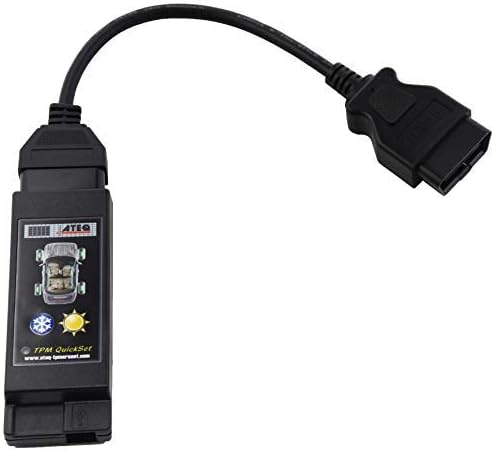 |
ATEQ Quickset TPMS ECU Reset Tool | Check Price |
| 3 |  |
XTOOL TP150 TPMS Programming Tool | Check Price |
| 4 |  |
Apex Tool Group Apex Tool Group GEARWRENCH Universal TPMS Programming | Check Price |
| 5 |  |
OBDMATE OM701 OBD2 Scan Tool | Check Price |
Autel Maxitpms TS501 PRO TPMS Programming Tool
The Autel MaxiTPMS TS501 PRO is the strongest choice when a Toyota owner wants more than a warning-light reset. It can activate known OEM and aftermarket sensors and display useful information such as sensor ID, pressure, temperature, battery condition, position, and frequency. That gives you a way to investigate whether a warning is caused by low inflation, a weak sensor battery, an incorrect ID, or a communication problem.
Its biggest advantage is the combination of service functions in one handheld device. The TS501 PRO supports automatic, manual, copy-by-activation, and copy-by-input programming for Autel MX-Sensors. It also offers automatic, OBD, and stationary relearn procedures for compatible vehicles and sensors. The added OBD relearn method can be especially useful after replacing a sensor, although the correct method still depends on the Toyota model and its system.
A complete TPMS health scan and the ability to read and clear TPMS diagnostic trouble codes make this more informative than a basic reset tool. Tire type and pressure selection is another useful function when the warning remains after a fault has been addressed. The trade-off is that sensor programming is specifically for Autel MX-Sensors, so it is not a universal programmer for every aftermarket sensor brand.
Pros
- Supports activation, diagnostics, reset, and multiple relearn methods.
- Programs Autel MX-Sensors at 315 and 433MHz.
- Reads sensor ID, pressure, temperature, battery, position, and frequency.
- Offers broad stated vehicle and sensor coverage with lifetime updates.
Cons
- Programming functions are limited to Autel MX-Sensors.
- Its advanced features may be unnecessary for simple seasonal wheel changes.
My Opinion
This is the best fit for Toyota owners, independent garages, and serious DIY users who want one tool for diagnosis and sensor work. Confirm your vehicle and sensor compatibility before purchase, and remember that a relearn procedure may still require the exact Toyota-specific sequence shown by the tool.
ATEQ Quickset TPMS ECU Reset Tool
The ATEQ Quickset takes a more focused approach than the Autel and XTOOL devices. Its main purpose is to reset the TPMS system and transfer new sensor IDs to the vehicle ECU on supported vehicles. It is listed for Toyota along with Lexus, Scion, Acura, Honda, Hyundai, Infiniti, Mitsubishi, Nissan, Pontiac, Subaru, and Suzuki, making it relevant to owners of several Asian-import platforms.
The standout feature is its ability to store two sets of wheels. If you keep a separate winter and summer set, the Quickset can make the changeover less frustrating because the stored sensor information can be transferred for the wheel set currently installed. It is also useful when rotating tires or changing wheels, provided the vehicle and sensor arrangement are supported.
This focused design is both a strength and a limitation. Owners who only need ECU management may appreciate the simpler purpose and avoid paying for functions they will not use. However, the supplied information does not describe the same level of live sensor data, sensor activation, comprehensive TPMS health scanning, or universal sensor programming offered by the more advanced tools in this list. It should therefore be viewed as a reset and ID-transfer solution rather than a complete sensor workshop device.
Before buying, check the exact Toyota year, model, wheel configuration, and replacement sensor IDs. A device can support the Toyota brand while still having limitations for a particular vehicle generation or sensor setup.
Pros
- Works with Toyota and several other Asian-import brands.
- Stores two wheel sets for seasonal changes.
- Transfers new sensor IDs to the vehicle ECU.
- Well suited to repeated wheel swapping and rotation routines.
Cons
- More specialized and less comprehensive than full TPMS programming tools.
- May not provide the same diagnostic detail or sensor data as advanced alternatives.
My Opinion
The Quickset is a sensible second choice for a Toyota owner whose main problem is managing two known sets of wheels. It is less compelling if you need to test unknown sensors, program universal sensors, or diagnose a wider range of TPMS faults.
XTOOL TP150 TPMS Programming Tool
The XTOOL TP150 offers a broad middle ground between a seasonal reset device and a professional-style TPMS service tool. It supports OEM and universal sensors and provides four relearn modes: automatic, OBD, stationary, and copy-sensor relearn. Having several procedures available matters because Toyota systems do not all use the same process after a tire replacement or sensor change.
For routine diagnosis, the TP150 can activate compatible pre-programmed sensors and show sensor ID, tire pressure, temperature, battery status, and frequency. It can also read and clear TPMS trouble codes and reset the warning light. That combination is useful when you want to determine whether the issue is simply low pressure or something more specific, such as a sensor that is not transmitting or a stored system fault.
The device also supports sensor programming with XTOOL TS100 sensors and covers dual-frequency 315 and 433MHz applications across stated domestic, Asian, and European vehicle coverage. That makes it attractive for a household with more than one vehicle or for a small service operation. The important limitation is that its programming support is tied to XTOOL TS100 sensors, so buyers should not assume it can program every universal sensor sold under another brand.
Its physical-button interface should be approachable for users who prefer direct controls instead of navigating a phone app. Still, compatibility should be confirmed by year, make, model, and sensor brand before ordering, especially if your Toyota has an unusual wheel package or an aftermarket sensor already installed.
Pros
- Supports OEM and universal sensor relearn procedures.
- Provides four relearn modes for different vehicle systems.
- Reads pressure, temperature, battery status, frequency, and sensor IDs.
- Combines diagnostics, activation, reset, and programming in one device.
Cons
- Sensor programming is intended for XTOOL TS100 sensors.
- Broad coverage does not remove the need for vehicle-specific compatibility checks.
My Opinion
The TP150 is a strong third-place pick for DIY users who want substantial TPMS capability without choosing a narrowly focused ECU tool. It is especially appropriate when the vehicle list includes several makes, but the sensor-brand limitation should be part of the buying decision.
Apex Tool Group Apex Tool Group GEARWRENCH Universal TPMS Programming
The GEARWRENCH GWTPMS is aimed at buyers who want a straightforward combination of TPMS programming and diagnostics. It works with both 315MHz and 433MHz sensors, which covers the two frequencies most often relevant to the vehicles and replacement sensors listed for this category. It can also clear TPMS warning lights and read sensor ID, position, pressure, temperature, and battery status.
One notable feature is the ability to program up to eight sensors simultaneously. That can save time when servicing a complete set of wheels instead of handling each sensor as a separate job. It also makes the tool more interesting for a small garage, tire service area, or experienced DIY owner who frequently works on multiple vehicles.
The tool seamlessly programs GEARWRENCH-branded TPMS sensors, so the best fit is a buyer who intends to use that sensor ecosystem. The 315/433MHz support does not automatically mean that every sensor brand or every Toyota model is programmable. Frequency is only one part of compatibility; the sensor protocol, vehicle year, relearn method, and installed sensor type also matter.
Compared with the Autel and XTOOL options, the supplied information gives less detail about the number of relearn procedures, update policy, or broad vehicle coverage. That does not make it unsuitable, but it does mean buyers should verify the exact application before treating it as a universal answer. The data display should be useful for identifying a weak or inactive sensor before replacing parts.
Pros
- Supports both 315MHz and 433MHz sensors.
- Can program up to eight sensors at the same time.
- Reads sensor position, ID, pressure, temperature, and battery status.
- Programs GEARWRENCH-branded TPMS sensors.
Cons
- Programming is most clearly aligned with GEARWRENCH sensors.
- Exact Toyota coverage and relearn procedures should be confirmed before purchase.
My Opinion
The GWTPMS is a practical option for buyers already using GEARWRENCH sensors or servicing several sensor sets. Its simultaneous programming capability is appealing, but a Toyota owner seeking the clearest combination of broad diagnostics and documented relearn choices may prefer Autel or XTOOL.
OBDMATE OM701 OBD2 Scan Tool
The OBDMATE OM701 is different from the other products because it is primarily a Toyota-focused diagnostic scanner rather than a dedicated TPMS programming tool. It is intended to provide full-system diagnostic access for Toyota vehicles from 1996 through 2022, Lexus vehicles from 1996 through 2022, and Scion vehicles from 2003 through 2016. That broader vehicle access can be valuable when the TPMS warning is part of a larger electrical or module-related problem.
For Toyota owners, the scanner can read and clear faults across available electronic control modules and display large amounts of live data. Its AutoVIN function, graphic data display, battery-voltage test, cranking test, and DLC pin test add useful troubleshooting context. It also offers maintenance functions such as oil reset, ABS bleeding, throttle-body relearn, battery-management reset, steering-angle reset, electronic parking-brake reset, fuel trim, injector coding, and more, although the available menu varies by vehicle.
The important limitation is that the supplied information does not identify the OM701 as a dedicated sensor activator, TPMS sensor programmer, or universal TPMS relearn tool. It may help with Toyota system diagnostics and warning-code clearing, but it should not be purchased expecting the same sensor-level functions as the Autel TS501 PRO or XTOOL TP150.
The included hard case, USB cable, and manual support convenient ownership. Confirm the VIN and available functions before purchase, especially if TPMS sensor programming is your primary goal rather than full Toyota diagnostic access.
Pros
- Provides Toyota-focused full-system diagnostics for stated model years.
- Also supports Lexus and Scion coverage.
- Offers live data, AutoVIN, battery tests, and multiple maintenance functions.
- Includes a hard case, USB cable, and manual.
Cons
- Not presented as a dedicated TPMS sensor activator or programmer.
- Functions vary according to the vehicle year, make, model, and system.
My Opinion
The OM701 is the best choice here for a Toyota owner who wants broad vehicle diagnostics and maintenance functions alongside TPMS-related troubleshooting. Choose a dedicated TPMS tool instead if your main task is activating, programming, or relearning replacement sensors.
How I Selected These Best Tpms Tool for Toyota Options
For this comparison, I separated TPMS jobs into three categories: identifying sensor problems, relearning sensor IDs to the vehicle, and programming replacement sensors. A tool that does one job well is not automatically the right choice for all three. I also considered Toyota and related-brand coverage, frequency support, stored wheel sets, diagnostic information, sensor-brand limitations, and whether the product suits a beginner or a more advanced operator.
Customer-feedback volume and rating information supplied for these products provided additional context, but those numbers do not replace a compatibility check. A well-rated tool can still be the wrong purchase if it cannot work with the sensor brand or Toyota generation in your driveway.
The most important selection question is not “Which tool has the most functions?” It is “Which TPMS job do I need to perform, and does the tool support my exact Toyota and sensor?”
The ranking favors versatility at the top. The Autel TS501 PRO and XTOOL TP150 cover activation, diagnosis, relearning, and some sensor programming, while the ATEQ Quickset is ranked highly for a narrower but very useful wheel-set management task. GEARWRENCH earns a place for sensor programming and multi-sensor workflow, and OBDMATE is included because Toyota owners often need module-level diagnosis rather than only a TPMS reset.
Frequency alone is not enough. A 315MHz or 433MHz label must be matched with the correct sensor protocol, vehicle application, and relearn procedure.
How to Choose the Best Tpms Tool for Toyota
The best tpms tool for toyota depends on whether you are maintaining one vehicle, rotating two wheel sets, replacing individual sensors, or diagnosing several Toyota-family vehicles. Start with the exact year and model, then identify whether the replacement sensor is original equipment, pre-programmed, or a programmable universal unit.
- Choose Autel or XTOOL for the broadest combination of activation, diagnosis, relearn, and programming functions.
- Choose ATEQ Quickset when storing and transferring two known wheel sets is the priority.
- Consider GEARWRENCH if you plan to use its branded sensors or program several sensors together.
- Choose OBDMATE when full Toyota module diagnostics matter more than sensor programming.
- Confirm sensor brand, frequency, model-year coverage, and relearn method before purchase.
Sensor programming versus sensor relearning
These terms describe different steps. Programming writes vehicle-specific or sensor-specific data into a programmable replacement sensor. Relearning teaches the vehicle ECU the ID of a sensor that is already correctly configured. Some Toyota repairs require only a relearn, while others require a replacement sensor to be programmed first.
A reset may clear a stored warning or initiate a procedure, but it does not necessarily repair a dead sensor or create a valid sensor ID. If a tool cannot detect pressure, temperature, battery status, or an ID from the sensor, resetting the light repeatedly is unlikely to solve the underlying problem.
OEM, aftermarket, and universal sensors
OEM sensors are made for the original vehicle application, while aftermarket sensors may be direct replacements or programmable units. Universal sensors are often blank until configured with a compatible tool. Autel’s programming function is tied to Autel MX-Sensors, XTOOL’s is tied to TS100 sensors, and GEARWRENCH’s stated programming support centers on GEARWRENCH sensors.
That distinction should influence the entire purchase. If you already bought a replacement sensor, identify its brand and part information before selecting a tool. A device that activates many sensors may still program only its own compatible sensor family.
Vehicle coverage and model-year checks
Brand-level coverage is only a starting point. A 2010 Toyota and a 2022 Toyota may use different TPMS communication and relearn procedures. Equipment descriptions can also list broad coverage while individual functions vary by trim, region, wheel package, or system.
Use the product’s compatibility lookup, provide the vehicle identification number when the seller requests it, and verify the sensor frequency and protocol. This is especially important for the OBDMATE OM701, whose maintenance and diagnostic menus vary by vehicle, and for the ATEQ Quickset, whose value depends on supported ECU and wheel-set behavior.
How to Set Up a TPMS Tool for a Toyota
Begin with a charged tool, a vehicle parked safely, and the correct tire pressures set according to the vehicle’s recommended specification. Do not start by changing sensor IDs or clearing codes before recording what the tool currently sees.
- Turn the ignition on as instructed by the tool, without guessing between accessory and engine-running modes.
- Select the exact Toyota year, model, and system from the device menu.
- Activate each sensor in the requested order and record its ID, pressure, temperature, and battery status.
- Compare the detected sensor position with the actual wheel position.
- Use the recommended relearn method, then confirm that the ECU accepts every sensor.
- Clear relevant codes only after the underlying problem has been corrected.
Keep the tool close enough to the tire valve area for reliable activation, but avoid placing it where it can be damaged by moving traffic or a running vehicle. If the instructions call for an OBD connection, make sure the connector is fully seated and do not disconnect it during data transfer.
How to Relearn Toyota TPMS Sensors
A relearn procedure varies by Toyota model, so the tool’s displayed instructions should take priority over a generic internet sequence. Some vehicles use automatic learning, some require an OBD transfer, and others may use a stationary process or a particular order around the vehicle.
After tire rotation, confirm whether the tool or vehicle can identify sensor positions automatically. If positions are wrong, the warning may return even though every sensor is transmitting. For a complete wheel change, check all four or five sensors if the vehicle uses a full-size spare with a sensor.
When the process finishes, drive only when the tires are properly inflated and the tool indicates that the relearn has completed. A warning light that remains on can indicate an incorrect ID, a missing sensor, a sensor battery problem, an unresolved pressure condition, or a system fault rather than a failed reset.
Using a TPMS Tool After a Tire Rotation
Tire rotation can change the physical position of each sensor, even when the sensors themselves are healthy. If the Toyota system tracks positions, use the tool to scan each wheel and compare the reported position with the new location.
The ATEQ Quickset may be particularly convenient for owners who repeatedly change between two known wheel sets. The Autel, XTOOL, and GEARWRENCH devices offer more sensor-level information for confirming that each unit is transmitting. The OBDMATE may help investigate related vehicle codes, but it should not be assumed to perform the same dedicated wheel-by-wheel functions.
How to Troubleshoot a Toyota TPMS Warning
First check the actual tire pressures with a reliable gauge. A cold-temperature pressure drop, a slow puncture, or a leaking valve can trigger the warning even when the electronics are working correctly.
If one sensor does not respond
- Confirm that the selected Toyota model and year are correct.
- Move the tool directly beside the valve stem and attempt activation again.
- Check whether the sensor is the correct frequency and protocol.
- Inspect for a weak or exhausted sensor battery.
- Verify that the sensor was not damaged during tire installation.
If all sensors respond but the light remains on
Read the TPMS codes and complete the required relearn. Check for a stored tire type or pressure setting where supported, since the Autel TS501 PRO specifically provides a tire type and pressure selection function. If the warning returns after driving, scan again rather than repeatedly clearing it.
Maintenance and Storage Tips
TPMS tools are electronic diagnostic equipment, so basic care helps preserve reliable operation. Keep the display, buttons, and sensor activation area clean and dry. Do not leave the device loose in a hot vehicle, exposed to moisture, or underneath heavy tools.
- Store the device in its case when it is not being used.
- Charge it before a tire-service appointment instead of waiting until the battery is empty.
- Use the supplied cable or an appropriate connection for updates and charging.
- Keep software current when the product supports updates, especially for newer vehicle coverage.
- Protect the OBD connector from bending, dirt, and impact.
- Do not use a damaged cable or housing near a running vehicle.
For tools with lifetime update support, such as the Autel TS501 PRO and OBDMATE OM701 according to the supplied information, updates can improve access to newer applications. They do not guarantee that every older or newer Toyota will support every function, so compatibility remains important after an update.
Common Mistakes to Avoid with Toyota TPMS Tools
Most TPMS problems after a tool purchase come from mismatched expectations rather than a defective device. Buyers often confuse a warning-light reset with sensor programming or assume that a dual-frequency tool can program every sensor.
- Do not buy based only on “315/433MHz”; verify the complete sensor application.
- Do not assume a general OBD scanner is a dedicated TPMS activator.
- Do not program a sensor before confirming the correct Toyota model and wheel position.
- Do not clear codes while ignoring low pressure, leaks, or damaged valve stems.
- Do not assume a tool that activates a sensor can also program that sensor.
- Do not interrupt an OBD relearn or update while data is being transferred.
When to Replace Toyota TPMS Sensors
A TPMS sensor may need replacement when it will not activate, repeatedly reports an implausible value, has a depleted battery, or is damaged during tire service. A tool that displays battery status can help distinguish a sensor problem from a simple inflation issue, but the reading should be considered alongside the vehicle’s symptoms and physical inspection.
Replacing one sensor can create a mismatch if the remaining sensors are much older. Ask whether the vehicle uses replaceable batteries or sealed sensor units; many sensor designs are replaced as a complete assembly when the internal battery is exhausted. After installing a replacement, program it if required, perform the correct relearn, and verify its data before returning the vehicle to normal use.
Which Tool Is Best for Different Toyota Owners?
For a single Toyota and occasional tire service
The ATEQ Quickset is appealing when the vehicle uses two established wheel sets and the main objective is seasonal swapping. If you expect to replace sensors or investigate warning causes, the Autel TS501 PRO offers more room to grow.
For DIY sensor replacement
The Autel TS501 PRO and XTOOL TP150 are the more suitable choices because they combine activation, diagnostics, and relearn functions with sensor-programming support for their respective sensor families. Confirm the sensor brand before ordering either one.
For Toyota electrical troubleshooting
The OBDMATE OM701 is the logical choice when TPMS is only one part of a larger diagnostic need. Its Toyota, Lexus, and Scion focus, live data, module access, and maintenance functions can be more valuable than a TPMS-only device.
For repeated multi-sensor work
The GEARWRENCH GWTPMS deserves attention when programming GEARWRENCH sensors and handling several sensors at once are central to the job. Its ability to program up to eight sensors simultaneously may reduce repetitive work.
FAQS About Best Tpms Tool for Toyota
Can a Toyota TPMS tool reset the warning light?
Some can reset the warning light, but the exact function depends on the Toyota model and the cause of the warning. A reset will not repair low pressure, a dead sensor, an incorrect sensor ID, or a damaged valve assembly.
Does a Toyota TPMS tool program every aftermarket sensor?
No. Activation coverage and programming coverage are different. The Autel TS501 PRO programs Autel MX-Sensors, the XTOOL TP150 supports XTOOL TS100 sensors, and the GEARWRENCH tool is stated to program GEARWRENCH sensors. Always match the tool to the sensor brand.
Is the ATEQ Quickset suitable for Toyota winter and summer wheels?
It is specifically suited to storing two wheel sets and transferring sensor IDs on supported vehicles. Confirm the exact Toyota application before purchase, especially if the wheels use replacement sensors from a different source.
Can the OBDMATE OM701 relearn Toyota TPMS sensors?
The supplied information presents the OM701 as a Toyota-focused full-system diagnostic scanner, not as a dedicated sensor activator or programmer. It may assist with Toyota system diagnostics, but buyers seeking sensor-level programming should choose a dedicated TPMS tool.
Why does a Toyota TPMS light stay on after relearning?
Possible causes include incorrect tire pressure, an unregistered sensor ID, a sensor that cannot transmit, a wrong relearn method, a damaged sensor, or a stored system fault. Scan the sensors and codes again rather than repeatedly clearing the warning.
Should I choose a 315MHz or 433MHz TPMS tool?
Choose based on the vehicle and sensor application, not on frequency alone. Some tools support both frequencies, but the correct protocol, sensor brand, and Toyota model-year coverage must also match.
Final Thoughts
For the broadest capability, the best tpms tool for toyota is the Autel MaxiTPMS TS501 PRO TPMS Programming Tool. The ATEQ Quickset TPMS ECU Reset Tool is the better focused choice for two wheel sets, while the XTOOL TP150 TPMS Programming Tool is a strong alternative for multi-mode relearn and compatible sensor programming. Confirm your Toyota and sensor compatibility first, then choose the tool that matches the actual TPMS work you plan to perform.