Yes, a bad MAF sensor can cause a no-start condition, but it’s relatively uncommon. On some vehicles, a faulty Mass Air Flow (MAF) sensor can send incorrect airflow data to the Engine Control Unit (ECU), causing an air-fuel mixture that’s too rich or too lean for the engine to start. However, in many cases, the ECU can compensate by using default airflow values, allowing the engine to start even if the MAF sensor has failed.
If your car suddenly won’t start, it’s easy to assume the worst. A no-start condition can leave you stranded without warning, and replacing the wrong part can quickly become expensive. While a bad battery or failed starter motor is often the culprit, a faulty MAF sensor is another possibility that’s frequently overlooked—especially if your vehicle was already showing symptoms such as rough idle, hesitation, poor acceleration, or a check engine light.
The good news is that a bad MAF sensor is not one of the most common causes of a no-start condition. In fact, issues such as a weak battery, failed fuel pump, faulty crankshaft position sensor, or ignition system problems are responsible far more often. That’s why proper diagnosis is essential before replacing any components.
In this guide, I’ll explain when a bad MAF sensor can prevent an engine from starting, why it happens on some vehicles but not others, how to identify the warning signs, and the steps you can take to determine whether the MAF sensor is actually causing the problem.
Learn More: What Causes a MAF Sensor to Go Bad?
What Does a No-Start Condition Mean?
Before blaming the MAF sensor, it’s important to understand what a no-start condition actually means.
Many drivers use the phrase “my car won’t start” to describe different problems, but there are two distinct situations:
The Engine Doesn’t Crank
When you turn the key or press the start button, nothing happens or you hear only a clicking sound. This type of no-start is usually caused by:
- A dead or weak battery
- A faulty starter motor
- Corroded battery terminals
- A bad starter relay or fuse
A MAF sensor does not cause this type of problem because it isn’t involved in cranking the engine.
The Engine Cranks but Won’t Start
In this case, the starter motor turns the engine normally, but the engine never begins running on its own.
This is the type of no-start condition where a bad MAF sensor can sometimes be involved. If the ECU receives airflow readings that are far outside the expected range, it may inject an incorrect amount of fuel, making combustion difficult or impossible.
Knowing which type of no-start you’re dealing with is the first step toward finding the correct repair.
How Can a Bad MAF Sensor Cause a No-Start?
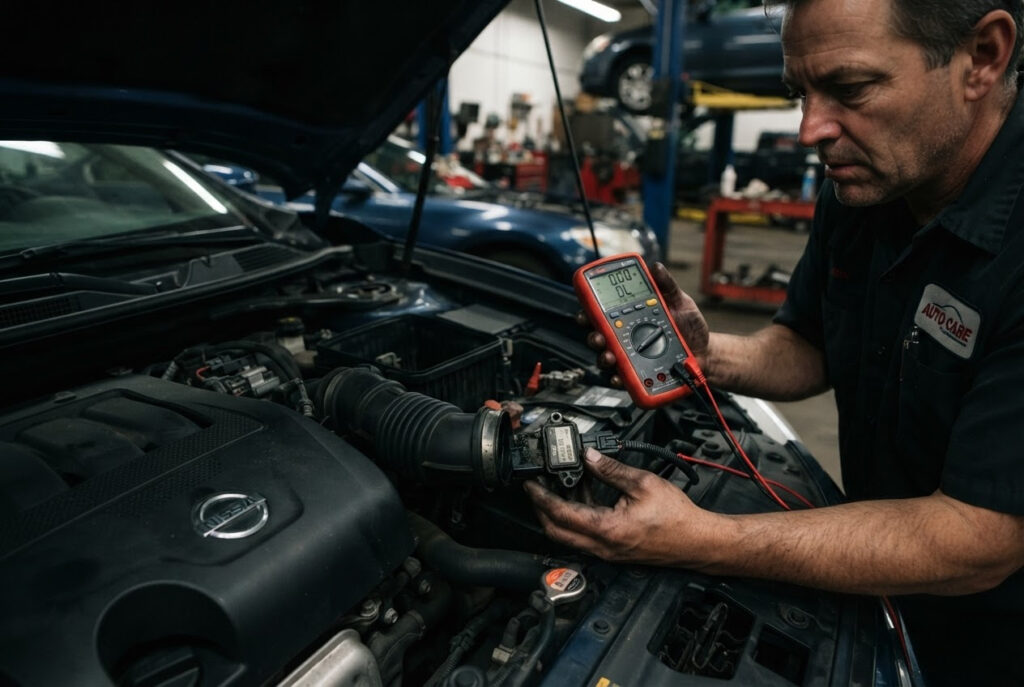
The MAF sensor measures the amount of air entering the engine and sends that information to the ECU. The ECU then calculates how much fuel to inject for the proper air-fuel mixture.
If the sensor sends incorrect airflow readings, the ECU may deliver:
- Too much fuel (a rich mixture)
- Too little fuel (a lean mixture)
Either condition can make the engine difficult to start. If the mixture is far enough outside the ideal range, combustion may not occur at all.
Whether a bad MAF sensor actually causes a no-start depends on the vehicle. Many modern ECUs recognize unrealistic MAF sensor readings and switch to a backup strategy using pre-programmed airflow values. This allows the engine to start and run, although performance is usually reduced.
On other vehicles, especially if the sensor has failed completely or is sending severely inaccurate data, the ECU may not be able to compensate. In those cases, the engine may crank normally but fail to start until the underlying MAF sensor problem is corrected.
For this reason, a bad MAF sensor should be viewed as a possible cause of a no-start—not the first one to suspect.
Symptoms That May Point to a Bad MAF Sensor
A no-start condition caused by a bad MAF sensor is rarely the first symptom you’ll notice. In most cases, the sensor begins to fail gradually, giving you several warning signs before the engine refuses to start.
If your vehicle has been experiencing one or more of the following problems, the MAF sensor is worth inspecting:
Check Engine Light
One of the earliest signs of a failing MAF sensor is an illuminated check engine light. The ECU may detect abnormal airflow readings and store airflow- or fuel mixture-related diagnostic trouble codes.
Hard Starting
Before the engine reaches the point of not starting at all, you may notice that it takes longer than usual to start, especially when the engine is cold.
Rough Idle
A faulty MAF sensor can send incorrect airflow information to the ECU, causing an improper air-fuel mixture. This often results in an unstable or rough idle.
Poor Acceleration
If the ECU isn’t receiving accurate airflow data, it can’t deliver the correct amount of fuel. As a result, your vehicle may hesitate or feel sluggish when accelerating.
Engine Stalling
Some vehicles may stall while idling or shortly after starting if the MAF sensor provides inaccurate readings.
Reduced Fuel Economy
A failing MAF sensor can also cause the engine to consume more fuel than necessary, leading to a noticeable drop in fuel efficiency.
If these symptoms appeared before the no-start condition, there’s a greater chance that the MAF sensor is contributing to the problem.
Other Common Causes of a No-Start Condition
Although a bad MAF sensor can prevent an engine from starting in certain situations, it’s not the most common cause. Several other components fail much more frequently and should be checked first.
Some of the most common causes include:
Weak or Dead Battery
A discharged battery is one of the leading reasons vehicles fail to start. If the engine doesn’t crank or cranks very slowly, the battery should be tested first.
Faulty Starter Motor
If you hear a clicking noise or the engine won’t turn over, the starter motor or starter solenoid may be faulty.
Failed Fuel Pump
The engine can’t start without adequate fuel pressure. A failed fuel pump or fuel pump relay can prevent fuel from reaching the engine.
Faulty Crankshaft Position Sensor
The ECU relies on the crankshaft position sensor to determine engine speed and timing. If this sensor fails, the engine may crank but never start.
Ignition System Problems
Worn spark plugs, failed ignition coils, or ignition control issues can prevent the air-fuel mixture from igniting.
Blown Fuse or Relay
A blown fuse or faulty relay affecting the fuel pump, ECU, or ignition system can also create a no-start condition.
Because these problems are generally more common than MAF sensor failure, diagnosing the entire starting system is always the best approach.
How to Diagnose Whether the MAF Sensor Is the Problem
Instead of replacing the MAF sensor based on symptoms alone, perform a few simple checks to confirm whether it’s actually causing the no-start condition.
Scan for Diagnostic Trouble Codes
Use an OBD-II scanner to check for stored trouble codes. Airflow-related or fuel mixture codes may indicate a MAF sensor problem, although additional testing is still required.
Check Live Data
If your scan tool supports live data, monitor the MAF sensor readings while cranking the engine. Unusually high, low, or unrealistic airflow values may indicate a faulty sensor.
Inspect the Sensor
Remove the MAF sensor and inspect it for dirt, oil contamination, corrosion, or physical damage. A contaminated sensing element can produce inaccurate airflow readings.
Inspect the Wiring
Check the electrical connector and wiring harness for loose connections, corrosion, damaged insulation, or broken wires that could interrupt communication with the ECU.
Check the Air Intake System
Inspect the intake tube and vacuum hoses for cracks or leaks. Unmetered air entering the engine can create symptoms similar to a failed MAF sensor.
By following these diagnostic steps, you can determine whether the MAF sensor is actually responsible or whether another component is preventing the engine from starting.
Can You Start a Car with the MAF Sensor Unplugged?
Sometimes, yes. Many modern vehicles can start and run with the MAF sensor unplugged because the Engine Control Unit (ECU) switches to a backup or “limp” strategy. Instead of using live airflow data, it relies on pre-programmed values to estimate how much fuel the engine needs.
If your engine starts normally after unplugging the MAF sensor, it may indicate that the sensor is sending incorrect airflow readings. However, this isn’t a definitive test. Some vehicles won’t start with the sensor disconnected, while others may continue to run with reduced performance and a check engine light.
It’s also important to remember that unplugging the MAF sensor is only a temporary diagnostic step—not a permanent fix. If the sensor is faulty, it should be cleaned, tested, or replaced as needed.
How to Fix a No-Start Caused by a Bad MAF Sensor
Once you’ve confirmed that the MAF sensor is responsible for the no-start condition, the next step is fixing the underlying issue.
Clean the MAF Sensor
If the sensing element is covered with dirt or oil, cleaning it with a dedicated MAF sensor cleaner may restore accurate airflow readings. Never touch the sensing wire or use brake cleaner, carburetor cleaner, or other harsh solvents.
Repair Damaged Wiring
If the problem is caused by a loose connector, damaged wiring, or corrosion, repairing the electrical connection may restore normal sensor operation without replacing the MAF sensor.
Replace the MAF Sensor
If testing shows that the sensor has failed internally or cleaning doesn’t solve the problem, replacing the MAF sensor is the best solution. Choosing a high-quality OEM or reputable aftermarket sensor helps ensure accurate airflow measurements.
Clear Trouble Codes and Verify the Repair
After completing the repair, clear any stored diagnostic trouble codes with an OBD-II scanner and start the engine. Allow the engine to idle, then take the vehicle for a short test drive to confirm that the no-start condition has been resolved.
How to Prevent MAF Sensor Failure
While no sensor lasts forever, proper maintenance can significantly reduce the risk of premature MAF sensor failure.
Here are a few simple ways to extend its lifespan:
- Replace the engine air filter at the recommended interval.
- Avoid over-oiling reusable air filters.
- Inspect the air intake system for cracks or loose connections.
- Keep moisture out of the air intake whenever possible.
- Clean the MAF sensor only when necessary using a dedicated MAF sensor cleaner.
- Address check engine lights promptly before minor issues become major repairs.
A clean air intake system helps the MAF sensor provide accurate airflow readings and reduces the likelihood of future starting problems.
Frequently Asked Questions
Can a dirty MAF sensor cause a car not to start?
Yes, although it’s uncommon. If heavy contamination prevents the MAF sensor from measuring airflow accurately, the ECU may inject an incorrect amount of fuel, making the engine difficult or impossible to start.
Can unplugging the MAF sensor help diagnose a no-start?
Sometimes. On many vehicles, disconnecting the MAF sensor forces the ECU to use default airflow values. If the engine starts with the sensor unplugged, the MAF sensor may be faulty. However, this should only be used as part of a complete diagnosis.
Will replacing the MAF sensor fix a no-start?
Only if the MAF sensor is the actual cause of the problem. A no-start condition can also result from issues such as a weak battery, faulty fuel pump, bad crankshaft position sensor, or ignition system failure.
Can a bad MAF sensor drain the battery?
No. A bad MAF sensor doesn’t normally drain the battery. Battery drain is usually caused by electrical problems, a failing battery, or a parasitic electrical load.
What sensor most commonly causes a no-start?
A faulty crankshaft position sensor is one of the most common sensor-related causes of a crank-no-start condition because the ECU relies on it for ignition timing and fuel injection.
Conclusion
A bad MAF sensor can cause a no-start condition, but it isn’t the most common reason your vehicle won’t start. In many cases, the engine will still run because the ECU can switch to default airflow values. However, if the sensor sends severely inaccurate data or the vehicle can’t compensate for the failure, the engine may crank but refuse to start.
Before replacing the MAF sensor, inspect it for contamination, check the wiring and air intake system, and scan the vehicle for diagnostic trouble codes. A proper diagnosis helps you avoid replacing good parts and ensures you fix the real cause of the no-start condition.
If the MAF sensor is confirmed to be faulty, cleaning or replacing it promptly can restore reliable starting, improve engine performance, and prevent additional drivability issues.