Ceramic window tint is generally better for blocking solar heat and improving cabin comfort, while dyed window tint is a more affordable choice for reducing glare, darkening windows, and increasing privacy. Both can provide strong UV protection, but ceramic films typically offer better infrared heat rejection without requiring extremely dark glass.
The main difference is the technology inside the film. Dyed tint uses colored material to absorb portions of incoming sunlight and reduce visible light. Ceramic tint contains microscopic ceramic particles designed to control solar energy, particularly infrared radiation.
This difference matters when driving in hot weather. A vehicle with dark dyed windows may still absorb considerable heat, while a properly selected ceramic film can reduce solar heat entering through the glass more effectively at a similar visible light transmission level.
However, ceramic tint costs more, and not every driver needs its additional thermal performance. Film quality, installation, warranty coverage, and legal tint limits also influence the decision.
In this article, I compare ceramic and dyed window tint in terms of heat rejection, UV protection, glare, privacy, durability, visibility, installation cost, and long-term value. I also explain how to read tint performance ratings and choose the right film for your vehicle.
Ceramic vs Dyed Window Tint: Key Differences
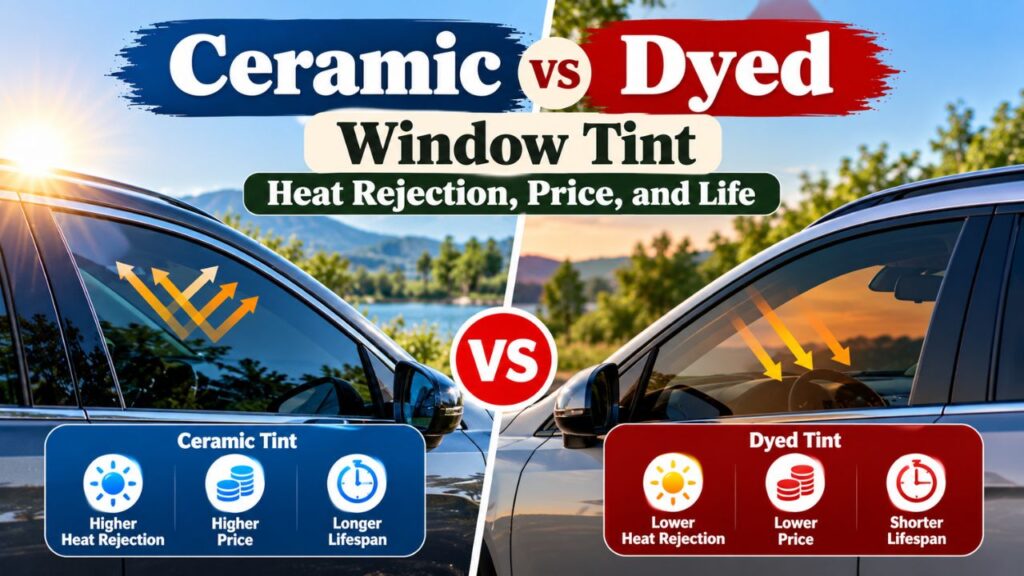
Ceramic and dyed window films can look almost identical from outside a vehicle, especially when they have similar darkness levels.
However, their construction and solar performance are different.
| Feature | Ceramic window tint | Dyed window tint |
| Film technology | Uses heat-controlling ceramic particles | Uses dyes to reduce incoming visible light |
| Heat rejection | Generally higher | Usually lower in basic films |
| Infrared rejection | Typically strong in quality ceramic films | Usually limited in basic dyed films |
| UV protection | Often blocks 99% or more | Quality dyed films can also block 99% or more |
| Glare reduction | Depends mainly on tint darkness | Depends mainly on tint darkness |
| Privacy | Depends on VLT and lighting conditions | Depends on VLT and lighting conditions |
| Color stability | Generally good in quality products | Varies considerably with dye quality |
| Electronic interference | Nonmetallic designs generally avoid interference | Nonmetallic designs generally avoid interference |
| Night visibility | Depends on darkness and optical quality | Depends on darkness and optical quality |
| Initial cost | Higher | Lower |
| Best for | Heat control and everyday comfort | Affordable appearance and privacy |
These are general differences between conventional dyed films and modern ceramic films. Some products combine dyes, ceramics, carbon, or other technologies, so their performance may overlap.
What Is Ceramic Window Tint?
Ceramic window tint is an automotive film containing microscopic ceramic particles that help control solar energy passing through vehicle glass.
These particles can absorb and reject portions of incoming infrared radiation, reducing the amount of solar heat transmitted into the cabin.
Ceramic films are typically nonmetallic and are available in different visible light transmission levels.
Their main characteristics include:
- Strong infrared heat rejection in quality products
- Effective UV protection
- Multiple darkness options
- Low signal-interference risk
- Good color stability in well-manufactured films
- Improved thermal comfort compared with many basic dyed products
Ceramic tint does not have to be extremely dark to provide meaningful heat rejection.
A relatively light ceramic film may outperform a darker basic dyed film in total solar heat control, depending on their actual specifications.
What Is Dyed Window Tint?
Dyed window tint uses dyes incorporated into or applied within the film construction to reduce the amount of visible sunlight passing through automotive glass.
Its primary functions are darkening windows, reducing glare, and providing a desired appearance.
Dyed films also absorb some solar energy and can contribute to cabin comfort.
However, basic dyed products generally lack the dedicated infrared-controlling technology found in ceramic films.
Typical advantages include:
- Lower initial installation cost
- Reduced visible glare
- Increased privacy at darker shades
- A charcoal or black appearance
- Multiple tint darkness options
- No metallic signal interference in conventional nonmetallic designs
Not all dyed films are low quality.
Premium dyed products can use improved color-stable dyes, protective coatings, and UV-blocking components.
The distinction is between the actual film technologies and specifications, not simply whether a product is labeled budget or premium.
Ceramic vs Dyed Window Tint for Heat Rejection
Heat rejection is usually the strongest reason to choose ceramic tint over conventional dyed tint.
Both films reduce sunlight entering the vehicle, but ceramic films are specifically engineered to manage more of the solar energy responsible for cabin heating.
How Ceramic Tint Reduces Heat
Sunlight contains ultraviolet, visible, and infrared radiation.
All three can contribute to solar energy entering a vehicle, although their relative effects differ.
Ceramic window films use specialized particles to control infrared radiation while allowing a selected amount of visible light to pass through.
According to 3M’s automotive window film technical information, its Ceramic IR Series uses nano-ceramic technology and offers up to 66% total solar energy rejection under specified test conditions.
The same manufacturer distinguishes between infrared rejection and total solar energy rejection because they measure different aspects of film performance.
The practical advantage is that a quality ceramic film can reduce the radiant heat drivers and passengers feel through side windows.
However, ceramic tint does not stop all heat transfer or prevent a parked vehicle from becoming dangerously hot.
How Dyed Tint Handles Solar Heat
Dyed films primarily darken the glass by absorbing selected portions of incoming light.
This can reduce visible glare and some solar heat.
However, darker glass does not automatically mean stronger overall heat rejection.
A dark dyed film can absorb considerable energy without providing the same infrared-control performance as a quality ceramic film.
Some absorbed heat can subsequently transfer toward the vehicle interior.
The amount depends on the film’s construction, glass type, and environmental conditions.
Which Tint Keeps a Car Cooler?
Ceramic tint generally provides better heat control when compared with a basic dyed film at a similar visible light transmission level.
This is particularly useful for vehicles regularly exposed to strong sunlight.
However, the performance difference depends on the actual products.
A high-quality dyed or hybrid film may outperform a low-performing ceramic product in some measurements.
Compare published total solar energy rejection values rather than assuming every ceramic film is superior.
Key Takeaway: If reducing heat entering the cabin is your primary goal, ceramic tint is usually the better choice. For appearance and basic shading, dyed tint may provide sufficient performance.
Understanding VLT, TSER, and Infrared Rejection
Window tint performance specifications can be confusing because different percentages describe different properties.
Three measurements are especially useful when comparing ceramic and dyed films.
Visible Light Transmission (VLT)
Visible Light Transmission (VLT) measures how much visible light passes through the tinted glass.
A lower VLT percentage means a darker appearance.
For example:
| VLT | General appearance |
| 70% | Very light tint |
| 50% | Light to moderate tint |
| 35% | Noticeably dark tint |
| 20% | Dark tint |
| 5% | Very dark tint |
VLT does not directly measure heat rejection.
Two films with approximately 35% VLT can have significantly different solar heat rejection properties.
A ceramic film may reject more infrared energy than a dyed film even when both transmit a similar amount of visible light.
Total Solar Energy Rejection (TSER)
Total Solar Energy Rejection (TSER) describes the percentage of total solar energy rejected by a particular film-and-glass combination.
It considers solar energy across a broader spectrum than an infrared-only measurement.
A higher TSER generally indicates that less solar energy passes through the tested glazing system.
For example, consider two hypothetical films tested under identical conditions:
- Film A: 45% TSER
- Film B: 60% TSER
Film B rejects a larger portion of the measured total solar energy.
These are illustrative values, not performance claims for specific commercial films.
When comparing actual products, verify that the test methods and glass conditions are comparable.
Infrared Rejection (IRR and IRER)
Infrared performance is particularly relevant to heat-related comfort.
However, infrared rejection numbers require careful interpretation.
IRR may describe rejection measured over a limited infrared wavelength range, while IRER describes rejection over a broader range and accounts for additional energy behavior.
The exact test method and wavelength range matter.
For example, a film advertised with very high infrared rejection over a narrow wavelength range does not necessarily reject the same percentage of all incoming solar heat.
For meaningful shopping comparisons, ask for:
- VLT
- TSER
- IRR or IRER with the measurement method
- UV rejection
- Tested glass conditions
A high infrared percentage can be impressive, but it should not replace the overall solar-energy performance rating.
Ceramic vs Dyed Tint for UV Protection
Both ceramic and quality dyed window films can provide substantial ultraviolet protection.
This is an area where ceramic tint does not automatically have a large advantage.
UV Blocking With Ceramic Tint
Many premium ceramic films are designed to reject approximately 99% or more of ultraviolet radiation within their specified test range.
This helps reduce UV exposure through treated windows and can limit UV-related fading of interior materials.
However, UV protection depends on the specific film, not just its ceramic classification.
Can Dyed Tint Block UV Rays?
Yes. Quality dyed films can also provide high levels of UV rejection.
According to LLumar’s automotive tint benefits guidance, its window films can block up to 99% of harmful UV radiation. The manufacturer also explains that ceramic films generally provide greater cooling performance than conventional dyed films.
The important distinction is that UV rejection and heat rejection are not the same measurement.
A dyed film may block most UV radiation while rejecting much less total solar heat than a ceramic film.
Does Darker Tint Provide Better UV Protection?
Not necessarily.
A film’s UV-blocking components and construction determine its UV rejection performance.
A light-colored film with strong UV protection may block more UV radiation than a darker film with poor UV-blocking properties.
Check the manufacturer’s UV rejection rating instead of judging protection by how dark the windows appear.
Ceramic vs Dyed Window Tint for Glare and Privacy
Both film types can reduce visible glare and make it harder for people to see inside a vehicle.
However, these benefits depend more on tint darkness than on whether the film is ceramic or dyed.
Which Tint Reduces Sun Glare Better?
At a comparable VLT, ceramic and dyed films may provide similar reductions in visible light.
For example, two properly installed films transmitting approximately 35% of visible light can create similar shading effects.
The precise result can vary because of differences in optical properties and film construction.
A darker film generally blocks more visible light, but it also reduces visibility through the glass.
Strong glare reduction should not come at the expense of safe driving visibility.
Does Ceramic Tint Offer More Privacy?
Ceramic tint does not inherently provide more privacy than dyed tint.
At similar VLT levels and under similar lighting, privacy can be comparable.
The amount of light inside and outside the vehicle also matters.
During daylight, a dark film may make the interior difficult to see from outside.
At night, interior lighting can make occupants more visible through the same film.
No ordinary automotive tint guarantees complete privacy in all lighting conditions.
Which Tint Looks Better?
Both types are available in neutral charcoal and dark shades.
High-quality ceramic films often provide a clean, consistent appearance.
Modern color-stable dyed films can look equally attractive.
Appearance depends on the film’s shade, reflectivity, color tone, and installation quality.
For most drivers, the difference between two films with similar VLT may not be obvious from outside the vehicle.
Which Tint Has Better Visibility at Night?
Neither ceramic nor dyed tint automatically provides better nighttime visibility at the same darkness.
The most important factors are VLT, optical clarity, and installation quality.
Why Tint Darkness Matters
Dark window film reduces the visible light entering the vehicle.
This can make it more difficult to see pedestrians, cyclists, curbs, and other objects in poorly lit environments.
The problem becomes more noticeable through side windows and rear glass when reversing or turning.
A very dark ceramic film can reduce nighttime visibility just as a similarly dark dyed film can.
Better heat rejection does not eliminate the visibility limitations of low VLT.
Does Ceramic Tint Have Better Optical Clarity?
High-quality ceramic films are often designed to maintain good optical clarity.
However, premium dyed films can also provide clear visibility.
Distortion, haze, adhesive defects, and poor installation can affect either type.
Choose a reputable film with suitable optical properties and have it installed correctly.
For drivers who frequently travel at night, selecting an appropriate legal VLT may matter more than choosing between ceramic and dyed technology.
Ceramic vs Dyed Tint for Durability and Fading
Long-term appearance is another important difference.
Low-quality dyed films may discolor or fade as they age, while premium ceramic films generally offer good color stability.
However, actual durability depends on film construction, environmental exposure, and installation quality.
Why Some Dyed Tint Turns Purple
Certain dyed films can gradually change color as their dye components degrade after prolonged exposure to sunlight and heat.
The original charcoal appearance may fade or develop a purplish tone.
This problem is more common with inexpensive or poorly manufactured dyed products.
However, modern premium dyed films can use improved color-stable technology that reduces discoloration.
It is inaccurate to assume that every dyed film will eventually turn purple.
Does Ceramic Tint Fade?
Ceramic films generally provide good color stability, but they are not immune to aging or manufacturing defects.
Some ceramic films also contain dyes or other components that contribute to their appearance.
A ceramic label alone does not guarantee that the film will retain its original color indefinitely.
The specific product formulation, warranty, and manufacturer reputation matter.
Which Tint Is Less Likely to Bubble or Peel?
Bubbling and peeling are not determined solely by whether a film contains ceramic particles or dyes.
Common contributing factors include:
- Improper glass preparation
- Contamination during installation
- Adhesive deterioration
- Poor-quality film construction
- Excessive heat exposure
- Incorrect installation techniques
- Damage during cleaning or window operation
A premium dyed film installed correctly may perform better over time than a poorly installed ceramic film.
Choose a qualified installer and review the warranty terms before paying for either option.
Ceramic vs Dyed Window Tint Cost Comparison
Dyed window tint is usually cheaper than ceramic tint, making it appealing to drivers who primarily want privacy, glare reduction, and a darker appearance.
Ceramic film generally costs more because of its specialized materials and heat-control technology.
However, pricing varies considerably between products and installation shops.
Why Dyed Tint Costs Less
Basic dyed films use comparatively straightforward film constructions.
They are widely available and commonly offered as entry-level automotive tint packages.
The lower material cost makes them suitable for budget-conscious installations.
A quality dyed film can still offer an attractive appearance and useful UV protection.
Why Ceramic Tint Costs More
Ceramic films use specialized particles and manufacturing processes intended to deliver improved solar performance.
Premium products may also include advanced optical layers, protective coatings, and higher-performance adhesives.
The additional cost generally reflects the technology and product positioning.
However, a higher price does not automatically mean a better installation or a better-performing film.
What Affects the Total Installation Price?
The final price depends on several factors:
- Vehicle size and body style
- Number of windows
- Glass curvature and accessibility
- Film brand and product series
- Ceramic or dyed construction
- Existing tint removal
- Rear-window defroster considerations
- Installer experience
- Warranty coverage
- Local labor rates
Tinting a two-door coupe generally involves different labor and film requirements than tinting a large SUV.
Old film removal can also add labor, particularly if the adhesive has deteriorated.
Is Ceramic Tint Worth the Extra Money?
Ceramic tint can justify its higher price when heat rejection is an important priority.
Drivers in hot, sunny climates may appreciate the improved comfort, especially during long commutes.
It can also be worthwhile when the vehicle will be kept for several years and the chosen product has strong durability and warranty coverage.
Dyed tint may be the better value when the main goals are a darker appearance, basic glare reduction, and affordable installation.
Key Takeaway: Pay extra for ceramic tint when its verified thermal performance solves a problem you actually experience. Don’t pay a premium solely because the product carries a ceramic label.
Does Ceramic or Dyed Tint Interfere With Electronics?
Conventional ceramic and dyed films generally do not cause the radio-frequency interference associated with some metallized window films.
Ceramic films typically use nonmetallic ceramic particles.
Conventional dyed films use dyes rather than reflective metallic layers.
This makes both types suitable for vehicles using electronic communication systems, including:
- GPS navigation
- Mobile phones
- Satellite radio
- Wireless communication devices
- Certain vehicle antenna systems
However, not every film marketed as ceramic or dyed has a simple single-technology construction.
Some products combine multiple materials.
Check the manufacturer’s product specifications if electronic compatibility is a concern.
Is Ceramic or Dyed Window Tint Legal?
Both ceramic and dyed tint can be legal, but legality depends on the film’s installed light transmission, reflectivity, placement, and applicable regulations.
A ceramic film is not automatically legal simply because it is a premium product.
Likewise, dyed tint is not automatically illegal because it is dark.
Window Tint Laws Vary by State
In the United States, automotive tint requirements vary by jurisdiction.
Rules may differ for:
- Front side windows
- Rear side windows
- Rear windshields
- Front windshields
- Reflective or mirrored films
- Certain tint colors
- Passenger cars, SUVs, and other vehicle classes
Some states also have medical exemptions or special conditions.
Check current requirements with the relevant state motor vehicle agency before installation.
Factory Glass and Film VLT Are Different
A common mistake is assuming that a film labeled 35% VLT will create a finished window with exactly 35% light transmission.
Automotive glass already reduces some incoming light.
When a film is installed, the final transmission depends on both the glass and the film.
For a simplified example:
- Existing glass VLT: 70%
- Applied film VLT: 50%
- Approximate combined VLT: 35%
The calculation is:
0.70 × 0.50 = 0.35
This is an illustrative approximation. Actual installed VLT should be verified with suitable measuring equipment because product ratings and test conditions can differ.
A professional installer should evaluate the glass before recommending a film that must meet a legal limit.
Are Light Ceramic Tints Better for Legal Heat Reduction?
Often, yes.
One advantage of high-performance ceramic film is the ability to achieve meaningful heat rejection at relatively light VLT levels.
This can be useful where dark front-window tint is restricted.
However, the film must still satisfy applicable laws after installation over the original glass.
Do not assume a light-looking ceramic film is automatically compliant.
How to Choose Between Ceramic and Dyed Window Tint
The best choice depends on which benefits matter most during everyday driving.
A film that performs well on a technical specification sheet may not provide meaningful additional value if the driver primarily wants a particular appearance.
Choose Ceramic Tint for Hot Weather
Ceramic tint is generally the stronger choice when the vehicle is frequently driven in intense sunlight.
It is particularly useful for:
- Long summer commutes
- Vehicles with large side windows
- Drivers who want heat reduction without very dark glass
- Passengers sensitive to radiant heat
- Owners who prioritize premium solar performance
Choose a film with documented TSER and infrared rejection values.
Avoid relying on an installer demonstration alone, especially if the compared films have different darkness levels.
Choose Dyed Tint for a Lower Budget
Dyed tint is practical when the goal is to improve the vehicle’s appearance without spending significantly more for advanced heat-control technology.
It can provide:
- A darker exterior appearance
- Reduced visible glare
- Increased daytime privacy
- Strong UV protection in quality products
- Lower initial cost
For drivers who rarely encounter severe heat or primarily want cosmetic benefits, a reputable dyed film can be sufficient.
Choose Based on How Long You Plan to Keep the Vehicle
Consider the expected ownership period.
If you plan to keep the car for several years, paying more for a quality ceramic product may provide ongoing comfort benefits.
If the vehicle is being sold soon or receives limited use, the additional expense may be harder to justify.
However, warranty coverage and color stability should still be considered when choosing a dyed product.
Consider a Mixed Tint Installation
Some drivers choose different film products for different windows.
For example, a vehicle may use a high-performance ceramic film on frequently exposed front side windows and a less expensive film elsewhere.
This can reduce the total expense while addressing the most noticeable heat exposure.
However, mixed films may have slightly different color tones, reflectivity, and optical characteristics.
Ask the installer to compare samples before proceeding.
Also verify that every window meets the applicable legal requirements.
How to Compare Ceramic and Dyed Tint Before Installation
A reliable comparison should use actual manufacturer specifications rather than advertising claims alone.
Compare Films at Similar VLT Levels
If possible, compare two films with similar visible light transmission.
For example, comparing a 35% VLT ceramic film against a 5% VLT dyed film does not provide a fair assessment of the underlying technology.
The much darker film will naturally block more visible light.
Matched VLT values make it easier to evaluate the difference in heat performance.
Ask for the Product Data Sheet
Request the exact film brand and series.
A useful technical data sheet should identify:
- Product construction
- Available VLT options
- Total solar energy rejection
- Infrared rejection rating and measurement method
- UV rejection
- Visible light reflectance
- Warranty terms
Compare films using consistent test conditions whenever possible.
Check the Actual Warranty
A lifetime warranty may have limitations.
Review what it covers, including:
- Color fading
- Discoloration
- Bubbling
- Peeling
- Adhesive failure
- Defects in film materials
- Installation workmanship
A manufacturer’s material warranty and an installer’s labor warranty may be separate.
Confirm whether coverage transfers to a new vehicle owner and whether proof of purchase is required.
Choose a Qualified Installer
Installation quality strongly affects the finished appearance and long-term performance.
Look for a shop that identifies the exact product being installed and provides clear warranty documentation.
Ask how the glass is prepared and what aftercare instructions apply.
After installation, follow the film manufacturer’s recommended curing period before lowering windows or cleaning the film.
Avoid abrasive cleaners and tools that may damage the film surface.
Common Misconceptions About Ceramic and Dyed Tint
Several assumptions can lead drivers to choose the wrong film.
Darker Tint Always Blocks More Heat
False. Darkness primarily describes visible light transmission.
A lighter ceramic film can reject more total solar heat than a darker basic dyed film.
Compare TSER instead of judging heat rejection by appearance.
Dyed Tint Does Not Block UV Radiation
False. Quality dyed films can provide high UV rejection.
The larger performance difference is usually related to infrared and total solar energy rejection.
Ceramic Tint Keeps a Parked Car Cool
Not completely.
Ceramic tint can reduce incoming solar heat, but it cannot eliminate heat buildup inside a parked vehicle.
Interior surfaces, direct sunlight, ventilation, outdoor temperature, and exposure time all affect cabin temperature.
Never rely on tinted windows to make a parked vehicle safe for children or pets.
Ceramic Tint Never Fades or Bubbles
False. Film quality and installation determine long-term performance.
A premium ceramic film may offer excellent durability, but manufacturing defects, adhesive problems, or installation damage can still occur.
Expensive Ceramic Tint Is Always Better Than Dyed Tint
Not necessarily.
A reputable dyed product can outperform a low-quality ceramic film in areas such as color stability, optical appearance, or installation reliability.
Compare specific products rather than choosing solely by film category.
Conclusion
The ceramic vs dyed window tint comparison comes down to heat rejection, price, and the performance you expect from your vehicle’s windows.
Ceramic tint is generally the better option for drivers who want stronger solar heat reduction, improved comfort, and good thermal performance without excessively dark glass. Its main disadvantage is a higher installation cost.
Dyed tint remains a practical choice for affordable privacy, glare reduction, and appearance. Premium dyed films can also provide strong UV protection and good color stability.
For vehicles driven regularly in hot, sunny conditions, I recommend considering a quality ceramic film with verified TSER performance. For drivers mainly interested in appearance and cost, a reputable dyed film is often sufficient.
Regardless of the technology, choose a legal VLT, compare actual product specifications, and prioritize professional installation.
FAQs About Ceramic vs Dyed Window Tint
Is Ceramic Tint Noticeably Better Than Dyed Tint?
Ceramic tint can provide a noticeable improvement in radiant heat comfort, particularly during strong sunlight exposure.
However, if the primary goal is privacy or appearance, ceramic and dyed films with similar VLT may look and function much alike.
Is Ceramic Tint Worth It on an Older Car?
It can be worth the cost if the vehicle is driven regularly in hot conditions and you expect to keep it for a while.
The vehicle’s age does not prevent ceramic film from providing heat-rejection benefits. However, the installation price should be considered relative to the vehicle’s value and intended use.
Does Ceramic Tint Look Darker Than Dyed Tint?
Not necessarily. Darkness depends primarily on visible light transmission.
A 35% VLT ceramic film and a similarly rated dyed film may appear approximately equally dark, although their color tone and reflectivity can differ.
Can Dyed Window Tint Last as Long as Ceramic Tint?
Some premium dyed films can retain their appearance for many years when properly manufactured, installed, and maintained.
However, inexpensive dyed films may be more prone to fading or discoloration. Compare manufacturer warranties and product quality rather than assuming every dyed film has a short lifespan.
Does Ceramic Tint Block More UV Than Dyed Tint?
Not always. Both high-quality ceramic and dyed films can block approximately 99% or more of ultraviolet radiation, depending on their specifications.
Ceramic tint’s main advantage is generally stronger infrared and overall solar heat rejection.
Does Ceramic Tint Interfere With GPS or Cell Signals?
Conventional nonmetallic ceramic films generally do not interfere with GPS, mobile phones, or radio-frequency communications.
Nonmetallic dyed films also typically avoid these problems. Check the product’s construction if it includes metallic or hybrid components.
Is 35% Ceramic Tint Better Than 5% Dyed Tint?
It depends on the desired result.
A 35% ceramic film may provide better infrared heat rejection and greater visibility, while a 5% dyed film provides much darker windows and greater daytime privacy.
The correct choice must also comply with applicable window tint laws.
Can You Put Ceramic Tint Over Existing Dyed Tint?
Applying ceramic film over existing dyed tint is generally not recommended without manufacturer approval.
Layering films can reduce visible light transmission, affect appearance, complicate adhesion, and create legal compliance problems.
Removing old film and installing the selected replacement product directly on properly prepared glass is usually the better approach.