For most drivers, a reputable independent tint shop offers more control over film quality, shade, and price than a typical dealership tint package. Dealer-installed tint can still be a good choice when the exact product, installation quality, and warranty are comparable.
A dealership may offer tint as part of a new-car purchase, sometimes with the work completed before delivery. That convenience is appealing, but the package price does not necessarily reveal the film brand, performance level, or who installed it. Independent installers usually let customers compare specific products and ask technical questions directly.
Another source of confusion is factory privacy glass. Dark rear windows made at the factory are not the same as film added by a dealership, and neither tells you how much solar heat the glass rejects.
In this article, I compare dealer window tint and aftermarket installation by price, film quality, heat rejection, installer workmanship, and warranty terms. You’ll also learn how to identify factory tint, compare written quotes, check legal light-transmission limits, and decide whether a dealer add-on is worth paying for.
Dealer Window Tint vs Aftermarket: Main Differences
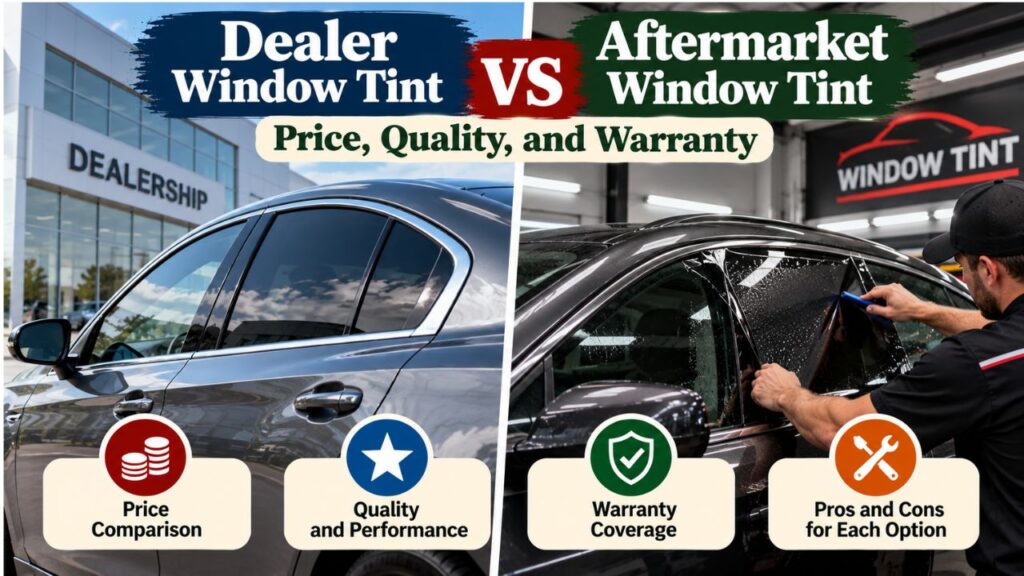
The main difference is where and how you purchase the tinting service, not necessarily the window film itself.
Dealership tint is typically sold through the vehicle dealer as an accessory or protection package. Aftermarket tint is usually purchased directly from an independent window tint installation business.
Both can use the same film manufacturers, materials, and installation methods.
| Feature | Dealer Window Tint | Aftermarket Tint |
| Purchase location | Vehicle dealership | Independent tint shop |
| Installation | Dealer staff or contracted installer | Tint shop technicians |
| Film selection | May be limited to dealer packages | Often multiple brands and film series |
| Pricing | Set by the dealership | Set by the tint shop |
| Convenience | May be completed before vehicle delivery | Requires a separate appointment |
| Film quality | Depends on the selected product | Depends on the selected product |
| Heat rejection | Depends on actual film specifications | Depends on actual film specifications |
| Warranty | Dealer, installer, or film manufacturer | Installer or film manufacturer |
| Customization | Depends on the dealership | Often more flexible |
| Best advantage | Convenience during vehicle purchase | Product choice and direct installer access |
Neither option guarantees better results.
A dealership using a skilled installer and premium ceramic film can provide an excellent installation. An independent shop using inexpensive film and poor installation practices can produce disappointing results.
The film specifications, installer skill, and written warranty are more important than the location where you purchase the service.
What Is Dealer-Installed Window Tint?
Dealer-installed window tint is automotive window film added through a vehicle dealership rather than installed during the vehicle’s original glass manufacturing process.
Some dealerships install window film in their own facilities.
Others contract with independent tint shops or mobile installation technicians.
The dealership typically sells the service and controls the customer-facing price.
How Dealership Window Tint Packages Work
When purchasing a new or used vehicle, the dealership may offer a tint package as an optional accessory.
Depending on the dealer, the package may include:
- Front side-window tinting.
- Rear passenger-window tinting.
- Rear windshield tinting.
- A choice of film darkness.
- Ceramic or conventional window film.
- A dealer-provided installation warranty.
Some packages cover only the two front windows, particularly on SUVs and trucks that already have dark rear privacy glass.
Others cover most of the vehicle’s side and rear glass.
Always confirm which windows are included before comparing prices.
Does the Dealership Install the Tint Itself?
Sometimes, but not always.
A dealership may employ an installer, use a mobile tinting service, or send vehicles to a local window film specialist.
This arrangement is not necessarily a disadvantage.
An experienced independent installer performing dealership work may produce the same quality as when working directly with retail customers.
However, the dealership salesperson may not know every technical detail about the film.
Ask for the name of the installation company and the exact film product.
Is Dealer Window Tint an Original Manufacturer Option?
Usually, dealer-installed tint is considered an added accessory rather than original factory equipment.
According to Cars.com’s explanation of dealer-installed options, dealer-installed accessories are generally priced by individual dealerships and are not automatically covered under the automaker’s factory warranty.
Factory-installed or certain automaker-approved accessories may have different warranty arrangements.
This distinction matters when purchasing a vehicle with tint already installed.
Request written documentation identifying who supplied the film and who is responsible for warranty claims.
What Is Aftermarket Window Tint?
Aftermarket window tint is film installed on vehicle glass after its original manufacture.
Although the term is commonly associated with independent tint shops, dealership-installed film is also technically an aftermarket modification in many situations.
The practical comparison is therefore between purchasing tint through the dealership and purchasing it directly from a specialized installer.
How Independent Tint Shops Work
A specialized tint shop usually provides window film installation as one of its main services.
Customers can often choose from several film types, brands, and performance levels.
Common options include:
- Dyed window tint.
- Carbon window tint.
- Ceramic window tint.
- Nano ceramic window tint.
- High-performance infrared-rejecting film.
The available selection depends on the shop.
Some businesses specialize in particular film brands, while others offer several manufacturers.
Benefits of Buying Tint Directly From an Installer
Purchasing directly from a tint shop can provide greater control over the installation.
You may be able to:
- Compare exact film specifications.
- Select individual window shades.
- Examine film samples.
- Discuss installation methods.
- Review previous installation work.
- Receive a detailed price breakdown.
- Ask the installer about warranty coverage.
Direct communication is especially useful when selecting tint for a vehicle with unusual glass shapes, existing privacy glass, or specific visibility requirements.
However, independent tint shops vary in quality.
Choose a business based on its experience, product information, and workmanship rather than assuming every aftermarket installation is superior.
Dealer Window Tint vs Aftermarket: Which Costs Less?
Independent tint shops can offer better value because customers purchase the service directly and can compare several competing quotes.
Dealership tint packages may include an additional retail markup.
However, the price difference varies, and some dealerships offer competitive installation packages.
Why Dealership Tint Can Cost More
A dealership may purchase installation services from an outside provider and resell them as part of a vehicle package.
The final price can reflect administrative costs, convenience, and the dealership’s profit margin.
Dealership-installed accessories may also appear on a supplemental window sticker or vehicle purchase agreement.
Cars.com’s consumer guidance notes that dealer-installed options can be substantially marked up compared with purchasing comparable services elsewhere.
That doesn’t mean every dealership tint package is overpriced.
The price should be evaluated against the exact film product and installation coverage.
Example of Dealer vs. Aftermarket Tint Pricing
Consider two hypothetical quotes for the same vehicle.
| Item | Dealer package | Independent tint shop |
| Film type | Ceramic | Ceramic |
| Windows covered | Side and rear windows | Side and rear windows |
| Installation price | $600 | $400 |
| Price difference | $200 more | $200 less |
| Warranty | Must be verified | Must be verified |
These are illustrative prices, not verified quotes from specific businesses.
If both quotes use the same film series, cover identical windows, and provide equivalent warranty protection, the independent installation would save $200.
However, the lower-priced package may not offer better value if it uses an inferior film or excludes important services.
Compare the complete package before deciding.
Does Financing Dealer Tint Increase Its Cost?
It can.
When a dealer adds the tint package to the vehicle purchase amount, the cost may become part of the financed balance.
If the loan charges interest, financing the tint can increase the total amount paid for the service.
For example, a $600 tint package included in a vehicle loan may ultimately cost more than $600 after financing charges.
The additional cost depends on the loan’s interest rate, repayment term, and payment schedule.
Paying an independent installer separately may avoid financing the tint through the vehicle loan.
However, financing arrangements vary, so compare the total cost rather than only the monthly payment.
Can You Negotiate Dealer Tint Pricing?
Often, yes.
Dealership-installed accessories may be negotiable, especially when they are offered as optional additions during a vehicle purchase.
Before agreeing to the package:
- Ask for the exact film brand and series.
- Request the price as a separate line item.
- Confirm which windows are included.
- Get a comparable quote from an independent installer.
- Ask the dealership whether it can match the price.
- Review the final purchase agreement.
If the tint is already installed, removal may not be practical without additional labor.
In that situation, negotiate the vehicle’s total out-the-door price rather than assuming the dealership can remove the charge.
Dealer vs. Aftermarket Tint: Which Offers Better Film Quality?
Neither dealer tint nor aftermarket tint has an automatic advantage in material quality.
The film manufacturer, product series, and installation workmanship determine the result.
A dealership could offer premium ceramic film, while an independent shop could offer basic dyed tint.
The opposite is equally possible.
Dealer Tint May Have Limited Film Options
Some dealerships offer only one or two tint packages.
The packages may be described using general terms such as:
- Standard tint.
- Premium tint.
- Ceramic tint.
- Heat rejection package.
- UV protection package.
These descriptions don’t identify the exact film.
For example, two products labeled ceramic may have significantly different heat-rejection ratings.
Request the manufacturer and complete product name before purchasing.
If the dealer cannot identify the film, it becomes difficult to compare performance or confirm warranty eligibility.
Independent Shops May Offer More Choices
A dedicated tint shop may carry several film series with different performance levels.
This can make it easier to select a product based on budget and driving needs.
For example, one ceramic film may prioritize affordable heat reduction, while another offers higher infrared rejection at a higher price.
However, more options don’t necessarily mean better quality.
A reputable installer should explain the differences using published performance specifications.
Ceramic Tint vs. Dyed Tint
One of the most meaningful comparisons is the type of film.
Dyed window tint primarily reduces visible light transmission and glare through coloring materials.
Ceramic window tint uses ceramic-based solar-control technology to manage infrared energy while maintaining selected levels of visible light transmission.
High-quality ceramic films can provide substantial heat rejection without requiring extremely dark shades.
However, ceramic films also vary widely in performance.
If the dealership offers dyed film and the independent shop offers ceramic, compare the products based on heat rejection, price, and warranty rather than treating both as equivalent tint packages.
Which Tint Provides Better Heat and UV Protection?
Heat and UV protection depend on the selected film’s performance, not whether it was sold by a dealership or independent shop.
Both installation channels can provide high-quality solar-control films.
Compare Total Solar Energy Rejection
Total Solar Energy Rejection (TSER) measures the percentage of total solar energy rejected by the tested glass-and-film combination.
It is one of the most useful specifications when evaluating heat-control performance.
A film with higher TSER generally rejects more incoming solar energy under comparable testing conditions.
However, TSER does not directly translate into an identical percentage reduction in vehicle cabin temperature.
The result depends on the vehicle’s glass, sunlight exposure, ventilation, and other conditions.
Compare Infrared Rejection
Infrared radiation contributes to the heat felt through automotive glass.
Some manufacturers advertise high infrared-rejection percentages.
However, different test methods may measure different portions of the infrared spectrum.
According to 3M’s official automotive window film support information, its infrared rejection measurement (IRR) covers the 900–1,000 nanometer range, while its infrared energy rejection measurement (IRER) covers a broader range from 780–2,500 nanometers.
These measurements should not be confused with TSER.
When comparing dealer and aftermarket tint, ask for the exact testing values for each film.
Check UV Rejection Separately
Many quality automotive films provide substantial ultraviolet protection.
For example, 3M identifies several automotive film series that meet the Skin Cancer Foundation’s criteria for blocking 99% or more of UVA and UVB radiation.
However, the exact level of protection depends on the specific film.
Don’t assume that every dealership package provides the same UV protection.
Also, high UV rejection doesn’t automatically mean high infrared heat rejection.
The two measurements describe different properties.
Compare Films at the Same VLT
Visible Light Transmission (VLT) is the percentage of visible light passing through the tested material or glass-and-film combination.
For example, 35% VLT allows substantially less visible light through than 70% VLT.
If you compare a dark dealer tint with a much lighter aftermarket film, their solar performance may differ partly because of their visible light transmission.
For a fair comparison, choose films with similar VLT ratings.
Then compare TSER, infrared rejection, UV protection, and optical clarity.
Is Dealer Tint the Same as Factory-Tinted Glass?
No. Dealer-installed film and factory-tinted glass are usually different products.
This distinction is especially important for SUVs, pickup trucks, and minivans.
What Is Factory Privacy Glass?
Factory privacy glass typically contains coloring material incorporated into the glass during manufacturing.
It often appears on rear passenger windows and the rear windshield.
Unlike conventional aftermarket tint, it is not necessarily a removable film applied to the interior surface.
Factory privacy glass can reduce visible light transmission and improve privacy.
However, its solar heat rejection depends on the actual glass construction.
Dark appearance alone doesn’t establish infrared or total solar energy rejection.
How to Tell Whether a Vehicle Has Film or Privacy Glass
Inspect the glass carefully.
Factory-colored glass typically has a consistent appearance without a separate film edge.
Applied window film may have a visible edge near the top of a roll-down window.
However, professional film installations can be difficult to identify visually.
Other clues include:
- Tint listed on a dealer accessory invoice.
- Installation paperwork identifying the film brand.
- A separate window film warranty.
- Factory glass specifications.
- An identifiable film edge.
Do not scrape or peel at the window simply to determine whether film is present.
If uncertain, ask a qualified tint installer to inspect it.
Can You Add Aftermarket Film Over Factory Privacy Glass?
Yes, compatible window film can often be installed over factory privacy glass.
This may improve selected heat-rejection properties or further darken the appearance.
However, applying film to already-dark glass reduces the final amount of visible light that passes through.
The combined VLT matters for legal compliance and nighttime visibility.
Have the existing glass measured before choosing additional tint.
Dealer vs. Aftermarket Tint: Installation Quality
Installation quality depends on the technician’s skill, preparation, and working environment.
Neither dealerships nor independent shops guarantee flawless results.
What Makes a Good Window Tint Installation?
Professional installation requires careful glass preparation and accurate film positioning.
A quality finished installation should have:
- Clean, consistent film edges.
- Minimal visible contamination.
- No permanent creases.
- Proper adhesive bonding.
- No unnecessary gaps or overlapping film.
- Appropriate clearance around window seals.
- No damage to defroster elements or nearby equipment.
Some temporary moisture haze or small water pockets may be normal during the film’s curing period.
Follow the manufacturer’s instructions before judging the final appearance.
Does an Independent Tint Shop Do Better Work?
A specialized shop may offer the advantage of technicians who perform window tint installations regularly.
They may also have dedicated preparation areas and equipment for cutting film accurately.
However, an experienced dealership contractor can provide comparable workmanship.
The important question is who performs the installation and whether their work meets professional standards.
Ask to see completed vehicles and check how the shop handles installation defects.
Can Dealer Tint Damage Vehicle Electronics?
Improper installation can potentially damage electronic components regardless of who performs the work.
Modern vehicles may have equipment near window glass, including:
- Rear-window defroster elements.
- Cameras and sensors.
- Antennas.
- Interior electrical connections.
- Window switches and door electronics.
Installers should protect sensitive components from water and follow vehicle-specific installation restrictions.
For vehicles with unusual windshield sensors or camera systems, confirm that film placement will not interfere with their operation.
Dealer Window Tint vs Aftermarket: Warranty Differences
Warranty coverage is one of the most important factors when choosing between a dealership package and an independent installer.
The word “lifetime” alone doesn’t explain what is covered.
Does Dealer Tint Have a Factory Warranty?
Not automatically.
Dealership-installed window film is commonly a separate accessory rather than part of the original vehicle manufacturing process.
The tint warranty may come from the dealership, the installation contractor, or the film manufacturer.
Some automaker-approved accessory programs have their own warranty arrangements.
Ask for written confirmation instead of assuming the vehicle’s standard bumper-to-bumper warranty covers the tint.
Does Aftermarket Tint Have a Manufacturer Warranty?
Many reputable film manufacturers provide warranties when their products are installed through authorized installers.
For example, 3M states that qualifying automotive window film installed by an authorized installer is covered by its applicable vehicle-owner warranty.
Its stated coverage includes certain defects involving adhesion, bubbling, delamination, and film performance, subject to the terms of the warranty.
Coverage can be limited to the original owner and may not transfer when the vehicle is sold.
Other manufacturers have different terms.
Who Handles Warranty Repairs?
This depends on the product and seller.
For dealership tint, the dealer may require you to return to its service department or contact the contracted installer.
For aftermarket tint, the installing shop may inspect the film directly.
Some manufacturer warranties allow an authorized network installer to handle claims when the original installer is unavailable.
Before purchasing, ask:
- Who provides the written warranty?
- Are both film and labor included?
- What happens if bubbling or peeling develops?
- Does coverage transfer to another owner?
- Can another authorized installer handle a claim?
- Is a purchase receipt or warranty registration required?
Keep the installation receipt and warranty documentation.
These records can become important years after the film was installed.
Is Dealer or Aftermarket Window Tint More Durable?
Neither installation channel automatically provides a longer-lasting film.
Durability depends on the materials, adhesive, protective coating, environmental exposure, and workmanship.
What Causes Window Tint to Fail?
Common problems include:
- Adhesive deterioration.
- Bubbling.
- Peeling edges.
- Delamination.
- Excessive discoloration.
- Scratches from damaged window seals.
- Poor initial installation.
Low-quality materials may deteriorate sooner than well-manufactured products.
However, even premium tint can develop problems when incorrectly installed or maintained.
Does Ceramic Tint Last Longer?
Quality ceramic films are often designed for good color stability and long-term performance.
However, ceramic technology alone does not guarantee a particular lifespan.
A reputable dyed or carbon film with strong materials and proper installation may remain functional longer than a poorly made ceramic product.
Compare actual manufacturer warranties and product construction rather than relying only on marketing labels.
How Should New Tint Be Maintained?
Follow the film manufacturer’s curing and cleaning instructions.
New film may require time for installation moisture to dissipate.
Avoid rolling down freshly tinted windows until the installer says it is safe.
Use suitable cleaning products and soft cloths.
For example, 3M’s automotive film support guidance specifies waiting 30 days before cleaning its films and avoiding abrasive materials.
Other products may have different requirements, so follow the instructions for the exact film installed.
Is Dealer Window Tint Legal in Every State?
No. A dealership’s involvement does not automatically make a tint installation legal.
Window tint regulations vary by state and may differ according to vehicle classification and window location.
The installer must account for the applicable federal requirements and state laws.
Front and Rear Window Rules May Differ
Tint laws can regulate:
- Front side-window VLT.
- Rear side-window VLT.
- Rear windshield tint.
- Windshield tint placement.
- Reflective film.
- Medical exemptions.
- Inspection and certification requirements.
Some states permit darker film on rear windows than on front windows.
Vehicle categories may also be treated differently.
A dealer package available in one state may not satisfy the rules governing a vehicle operated or registered elsewhere.
Factory Glass Affects Final VLT
The amount of light passing through the finished window depends on both the original glass and the added film.
For example, if the original glass transmits 80% of visible light and the added film transmits 70%, the approximate combined VLT is:
0.80 × 0.70 = 0.56
The final visible light transmission is approximately 56%.
This simplified calculation illustrates why a film labeled 70% VLT doesn’t necessarily produce a completed window measuring 70%.
Actual results should be verified with a suitable tint meter.
Does a Dealer Warranty Cover Illegal Tint?
Don’t assume so.
Manufacturer warranties may cover film defects without accepting responsibility for the legality of the installed shade.
If the vehicle fails an inspection because of tint darkness, the film may need to be removed or replaced.
Before installation, request the final legal VLT for each window.
If you live in one state but purchase a vehicle in another, verify the rules applicable to the vehicle’s intended registration and use.
Which Is Better for New Cars: Dealer Tint or Aftermarket?
For many new-car buyers, an independent tint shop offers better control over the final product.
However, dealership tint may be worthwhile when convenience is important and the package is competitively priced.
Choose Dealer Tint When Convenience Matters
Dealer tint may make sense when:
- The installation is completed before vehicle delivery.
- The dealer identifies the exact film product.
- The price is comparable to independent quotes.
- The installer has a strong reputation.
- Warranty coverage is clearly documented.
- The finished tint meets applicable legal requirements.
For someone purchasing a new vehicle, avoiding a separate installation appointment can be valuable.
The convenience is worth paying for when the additional cost is reasonable.
Choose Aftermarket Tint for Greater Customization
An independent tint shop may be preferable when:
- You want a specific ceramic film series.
- You want to compare multiple heat-rejection ratings.
- You need precise shade matching.
- You prefer direct communication with the installer.
- You want to compare several prices.
- You need existing tint removed.
- You have a vehicle requiring specialized installation work.
This approach gives you more opportunity to compare film performance before purchasing.
What if the Dealer Already Installed Window Tint?
If the vehicle already has dealer-applied tint, inspect it before agreeing to additional work or payment.
Ask the dealership for the film manufacturer, series, VLT, installation date, and warranty.
If the tint is in good condition, legal, and meets your needs, there may be no reason to replace it.
If the dealership cannot identify the product or the film’s performance is unsuitable, obtain an independent assessment.
Avoid adding a second layer of film without confirming compatibility, visibility, and legal limits.
How to Compare Dealer and Aftermarket Tint Quotes
The most dependable approach is to compare written quotes for equivalent installations.
A lower price alone doesn’t reveal the better choice.
Step 1: Ask for the Exact Film Product
Request the manufacturer, product series, and proposed shade.
Don’t accept “premium ceramic” as the only description.
A specific product name allows you to examine published specifications.
Step 2: Compare Identical Window Coverage
Confirm whether each quote includes:
- Front side windows.
- Rear side windows.
- Rear windshield.
- Small quarter windows.
- Windshield film, where permitted.
- Removal of existing tint, if necessary.
Two quotes cannot be fairly compared when they cover different numbers of windows.
Step 3: Review Performance Measurements
Ask for the TSER, IRER or infrared-rejection figures, UV rejection, and VLT.
Check that measurements refer to comparable testing conditions.
Focus on the properties that matter most for your vehicle.
Step 4: Confirm Installer Qualifications
Find out who will physically install the film.
Ask about previous experience with your vehicle model and whether installation will be completed in an appropriate environment.
If the dealership outsources the work, request the contractor’s details.
Step 5: Compare Warranty Terms
Check who provides the warranty and which defects are covered.
A written manufacturer-backed warranty may provide more predictable protection than an informal verbal promise.
However, a strong independent installer warranty can also be useful.
Step 6: Compare the Total Price
Include applicable taxes, removal charges, additional windows, and any financing costs.
Ask both businesses for their complete final prices.
If the dealer’s package costs more, determine whether the difference reflects an actual product or service advantage.
Key Takeaway: Compare the film, coverage, installation, warranty, and total price as one package. The seller’s business type alone does not establish value.
Common Mistakes When Choosing Dealer or Aftermarket Tint
Several purchasing mistakes can lead to higher costs or disappointing results.
Paying for a Package Without Knowing the Film Brand
A generic tint package may sound appealing, but it doesn’t tell you what performance to expect.
Always identify the film manufacturer and series.
Assuming Dealer Tint Is Factory Tint
Film applied by a dealership is not the same as factory-colored privacy glass.
The two products have different constructions and may provide different solar-control properties.
Comparing Tint Darkness Instead of Heat Rejection
A darker window doesn’t necessarily reject more infrared heat than a lighter premium ceramic film.
Compare TSER and infrared performance rather than VLT alone.
Choosing the Cheapest Installation Without Checking Quality
An unusually low price may exclude certain windows or use a lower-tier film.
Check the complete quote, product details, and workmanship before buying.
Assuming a Lifetime Warranty Covers Everything
Lifetime warranties have limitations.
They may exclude physical damage, improper cleaning, unauthorized installation, or ownership transfers.
Read the written conditions.
Ignoring Legal Tint Restrictions
A film may be available for purchase without being legal for every window on your vehicle.
Confirm the completed glass-and-film VLT before installation.
Financing Tint Without Checking Total Cost
Adding tint to a vehicle loan can increase its total cost when interest applies.
Compare the full financed expense with paying an independent installer separately.
Conclusion
In the dealer window tint vs aftermarket comparison, neither installation channel is automatically better, but independent tint shops often provide more film choices, direct communication, and competitive pricing.
Dealer tint offers convenience and may be a good value when the dealership uses a reputable installer, identifies the exact film, and provides competitive warranty coverage.
For most drivers, I recommend obtaining an independent tint quote before accepting a dealership add-on.
Compare the same film series and window coverage, then review heat rejection, installation quality, legal VLT, warranty terms, and final price.
If the dealer package matches those requirements at a reasonable cost, choosing it can save time.
If the independent shop provides comparable or better film at a lower total price, aftermarket installation is usually the stronger value.
FAQs About Dealer Window Tint vs Aftermarket
Is Dealer Window Tint Better Than Aftermarket Tint?
Not necessarily. Dealer tint and aftermarket tint can use the same products and installation methods. The better result depends on the film quality, technician’s skill, warranty, and price. A reputable independent tint shop may offer more customization.
Why Is Dealership Window Tint Sometimes More Expensive?
Dealership tint may include retail markup, administrative costs, and the convenience of having the vehicle tinted before delivery. Some dealerships also contract with outside installers. However, prices vary, and certain dealer packages can be competitive.
Do Dealerships Use Ceramic Window Tint?
Some dealerships offer ceramic window tint, while others provide dyed, carbon, or different film packages. Ask for the exact manufacturer and product series before purchasing. The word ceramic alone doesn’t establish a specific heat-rejection rating.
Does Aftermarket Window Tint Void a Car Warranty?
Professionally installed aftermarket tint does not automatically void the entire vehicle warranty. However, damage directly caused by an installation may affect coverage for the damaged component. Film warranty coverage is usually separate from the automaker’s vehicle warranty.
Can You Replace Dealer-Installed Tint With Aftermarket Ceramic Tint?
Yes. A qualified installer can generally remove existing window film and install a new compatible product. Special care is necessary around rear defroster lines and other sensitive components. Removal costs may increase the total price.
Is Factory Privacy Glass Better Than Aftermarket Tint?
Not automatically. Factory privacy glass mainly provides a darker appearance and reduced visible light transmission, although its full solar performance depends on the glass construction. High-performance aftermarket films may provide additional infrared heat rejection and UV protection.
Should I Accept a Dealer Tint Package on a New Car?
Accept the package when the dealership provides a suitable, identifiable film, professional installation, legal darkness, clear warranty coverage, and competitive pricing. Otherwise, compare quotes from reputable independent tint shops before agreeing to the additional charge.