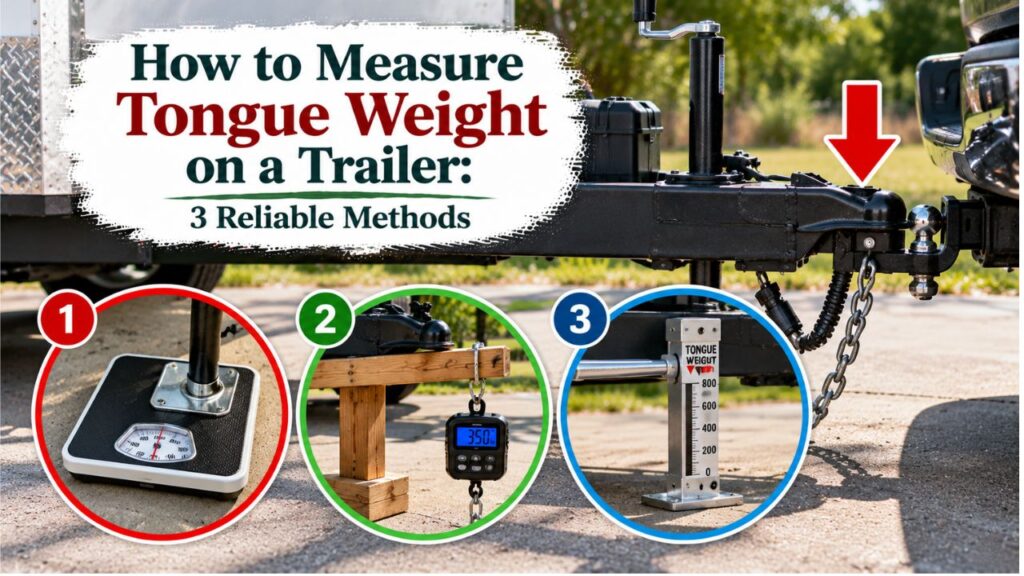
To measure tongue weight on a trailer, place a properly rated tongue weight scale beneath the trailer coupler, lower the loaded trailer onto the scale at its normal towing height, and read the displayed weight. You can also use a bathroom scale for lighter trailers or a commercial vehicle scale for heavier towing setups.
Tongue weight is the downward force the trailer applies to the tow vehicle’s hitch ball. For most conventional ball-hitch trailers, the recommended tongue weight is approximately 10–15% of the trailer’s total loaded weight, unless the manufacturer specifies otherwise.
Getting this measurement right matters for towing stability. Too little tongue weight can contribute to dangerous trailer sway, while excessive tongue weight can overload the tow vehicle’s rear axle, suspension, or hitch.
The measurement must reflect actual towing conditions, including cargo, equipment, and other items loaded into the trailer. An empty-trailer measurement may not represent the load you’ll tow.
In this article, I explain three practical tongue weight measurement methods, the correct scale setup, how to calculate tongue weight percentage, ways to adjust an unbalanced load, and the towing capacity checks to complete before driving.
What Is Trailer Tongue Weight and Why Does It Matter?
Trailer tongue weight (TW) is the vertical downward force applied to the tow vehicle’s hitch ball by a conventional trailer’s coupler.
It is not the total weight of the trailer.
For example, a trailer weighing 5,000 pounds when fully loaded might apply 600 pounds of downward force to the hitch.
The remaining trailer weight is carried primarily by the trailer’s wheels and axles.
Tongue weight changes when cargo is moved forward or backward relative to the trailer axles.
Moving cargo toward the front generally increases tongue weight. Moving it toward the rear generally decreases tongue weight.
What Happens When Tongue Weight Is Too Low?
Insufficient tongue weight can make a trailer unstable.
A trailer with too much weight concentrated behind its axles may begin moving from side to side, particularly at highway speeds or when affected by wind and passing vehicles.
This movement is commonly called trailer sway.
Severe sway can become difficult to control and may lead to a loss of control.
A trailer that looks level while parked can still have insufficient tongue weight.
The proper way to evaluate the load is to measure it rather than estimate it from appearance.
What Happens When Tongue Weight Is Too High?
Excessive tongue weight places additional load on the tow vehicle.
Potential consequences include:
- Rear suspension sag
- Reduced front-axle loading
- Poor steering response
- Increased braking and handling concerns
- Overloaded rear tires or axle
- Exceeding the hitch receiver’s tongue weight rating
- Exceeding the tow vehicle’s payload or gross vehicle weight rating
The correct tongue weight must satisfy both the recommended trailer balance and the weight limits of the towing equipment.
How to Measure Tongue Weight on a Trailer Before You Tow
The three most practical methods are a dedicated tongue weight scale, a bathroom scale, and a commercial vehicle scale.
The best method depends on the expected tongue weight and the equipment available.
| Measurement Method | Best Application | Main Advantage |
| Dedicated tongue weight scale | Utility trailers, boat trailers, campers, and travel trailers within the scale’s rating | Direct measurement |
| Bathroom scale | Lightweight trailers or carefully rated lever setups | Can use common household equipment |
| Commercial vehicle scale | Heavy trailers and complete towing weight checks | Allows comparison with actual vehicle and trailer weights |
Before using any method, prepare the trailer properly.
Step 1: Load the Trailer as It Will Be Towed
The trailer should contain its normal towing load before measuring.
Depending on the trailer, this may include:
- Tools and equipment
- Camping supplies
- Batteries
- Propane cylinders
- Water in tanks
- Motorcycles or other transported vehicles
- Boat equipment
- Spare tires
- Other secured cargo
Tank levels and the location of heavy accessories can affect the result.
For a travel trailer, measure with water and cargo loads representative of the intended trip.
Do not rely on the manufacturer’s unloaded tongue weight if the trailer will carry additional equipment.
Step 2: Park on Firm, Level Ground
Choose a firm, flat surface that can support the trailer and measuring equipment.
Apply the tow vehicle’s parking brake when appropriate.
Chock the trailer wheels securely before disconnecting or transferring weight to a scale.
Avoid soft dirt, steep slopes, and uneven surfaces that could allow the trailer to move.
Safety Note: Never place your body beneath an unsupported trailer tongue. Use equipment rated for the load, keep hands clear of pinch points, and do not rely on an unstable stack of blocks to support the coupler.
Step 3: Establish the Normal Coupler Height
The trailer should be close to its intended towing attitude during measurement.
Measure the height of the hitch ball on the tow vehicle in its normal loaded condition, then support the trailer coupler at the corresponding height.
A trailer that is substantially nose-high or nose-low may produce a different tongue weight reading.
This is particularly relevant for some tandem-axle trailers, where changes in attitude can affect how the load is shared between the axles.
Step 4: Check the Scale Capacity
Estimate the expected tongue weight using the loaded trailer weight and the manufacturer’s recommended percentage.
For example, a 4,000-pound conventional trailer using a 10–15% target range could have a tongue weight between 400 and 600 pounds.
Choose a scale with a rated capacity greater than the anticipated load.
Never exceed a scale’s maximum capacity to obtain a reading.
Method 1: Measure Trailer Tongue Weight With a Tongue Weight Scale
A dedicated tongue weight scale is generally the simplest method for measuring a conventional trailer at home.
These scales are designed to measure the downward force applied by the trailer tongue.
Some are freestanding mechanical or hydraulic scales, while others are integrated into compatible hitch components.
How to Use a Dedicated Tongue Weight Scale
- Park the loaded trailer on a firm, level surface and securely chock its wheels.
- Use the trailer jack to support the tongue and disconnect it from the tow vehicle according to the trailer’s instructions.
- Position the tongue weight scale on a stable, level base directly beneath the coupler.
- Use an approved adapter or support if required by the scale manufacturer.
- Adjust the setup so the trailer will be supported at its normal towing height.
- Slowly lower the coupler onto the scale.
- Continue lowering until the scale carries the tongue load and the trailer jack is no longer supporting it.
- Allow the reading to stabilize and record the weight.
- Raise the trailer with its jack before removing the scale.
Make sure the scale receives the load vertically and remains stable throughout the procedure.
The CURT guide to measuring trailer tongue weight describes using a dedicated scale beneath the trailer jack or coupler, along with alternative methods involving household and vehicle scales.
Should You Measure at the Coupler or Trailer Jack?
For the most representative result, measure the vertical load at the coupler’s normal hitch-ball location.
Some tongue weight scales are designed to operate beneath a trailer jack.
However, a jack positioned behind the coupler may produce a slightly different reading because the support point is not in the same location.
The difference depends on the distance between the jack and the coupler relative to the axle position.
For example, a measurement taken several inches behind the coupler may not exactly equal the downward force at the hitch ball.
Follow the scale manufacturer’s instructions and use the actual coupler position when accurate hitch loading is the priority.
Can You Use a Hitch With a Built-In Tongue Weight Scale?
Yes.
Some ball mounts and hitch systems include an integrated gauge that measures vertical tongue load.
These systems can be convenient because they allow the trailer load to be checked during hitching.
However, the reading depends on the device’s design, calibration, installation, and operating requirements.
A built-in scale must still be rated for the expected tongue weight.
If a weight-distribution hitch is involved, follow the measurement instructions for that particular hitch system.
Method 2: Measure Trailer Tongue Weight With a Bathroom Scale
A bathroom scale can be used to measure tongue weight on a lightweight trailer when the expected load falls within the scale’s rated capacity.
For heavier tongue weights, a properly constructed lever arrangement can reduce the force applied to the scale.
However, a household scale is not designed as general-purpose trailer lifting equipment.
If the setup cannot safely support the load, use a dedicated tongue weight scale or commercial weighing service instead.
Measuring a Lightweight Trailer Directly
For a small trailer with an expected tongue weight below the scale’s capacity, the procedure is relatively simple.
- Park the loaded trailer on level ground and chock its wheels.
- Position a suitable bathroom scale beneath the coupler.
- Use a stable, properly rated support to bring the scale’s contact point to normal hitch-ball height.
- Protect the scale surface with a suitable rigid plate if the manufacturer permits it.
- Lower the coupler gradually onto the scale.
- Ensure the jack no longer supports the tongue load.
- Read and record the weight.
For example, a properly rated scale displaying 180 pounds indicates approximately 180 pounds of tongue weight when the load is applied directly at the coupler.
Do not attempt this method if the tongue weight may exceed the scale’s capacity.
How to Measure Heavier Tongue Weight With a 3:1 Lever
A lever system can allow a household scale to measure a fraction of the total tongue weight.
The common 3:1 arrangement uses a strong beam supported at two locations.
The trailer tongue applies its weight between those supports.
Materials needed
- Bathroom scale with adequate capacity
- Strong, appropriately rated wooden or metal beam
- Two suitable cylindrical support pieces
- Stable support block
- Properly rated vertical tongue support
- Measuring tape
- Wheel chocks
The beam, supports, and contact surfaces must safely withstand the applied loads.
Ordinary lumber or improvised blocks should not be assumed strong enough for a heavy trailer.
Setting Up the 3:1 Lever
For the standard arrangement:
- Place the support block on firm, level ground.
- Position the bathroom scale 3 feet from the support block’s contact point.
- Place a suitable support on the block and another on the scale.
- Rest the beam securely across the two support points.
- Position the trailer tongue load point 1 foot from the support block and 2 feet from the scale.
- Make sure the beam is approximately level at the intended measuring height.
- Account for the weight of the beam and supports according to the weighing procedure.
- Lower the trailer tongue slowly onto the designated load point.
- Confirm the setup remains stable before reading the scale.
With this arrangement, the bathroom scale carries approximately one-third of the applied tongue weight.
Calculate Tongue Weight With the 3:1 Method
Use this formula:
Tongue Weight = Bathroom Scale Reading × 3
For example:
Bathroom scale reading = 200 pounds
Tongue weight = 200 × 3
Actual tongue weight = 600 pounds
Another example:
Bathroom scale reading = 250 pounds
Tongue weight = 250 × 3 = 750 pounds
These calculations assume the specified support distances are accurate, the setup is level, and the beam’s own weight has been properly accounted for.
Changing the support distances changes the multiplier.
A lever arrangement is not automatically safe because the bathroom scale displays a manageable number. The beam and other supports still carry substantial forces.
If you cannot verify the strength and stability of every component, do not use this method for a heavy trailer.
Method 3: Measure Trailer Tongue Weight at a Commercial Scale
A commercial vehicle scale is useful when the trailer is too heavy for a household scale or when you also need to check the tow vehicle’s axle weights.
Truck stops, public weighing facilities, and some commercial scales offer vehicle weighing services.
The scale operator can explain the facility’s weighing procedure and whether the platform arrangement supports the intended measurements.
Step 1: Weigh the Loaded Tow Vehicle Without the Trailer
Load the tow vehicle with the passengers, cargo, and equipment that will be present during towing.
Drive onto the scale without the trailer attached.
Record the vehicle’s total weight.
For example:
Tow vehicle alone = 6,200 pounds
Keep the same occupants, cargo, and equipment in the vehicle for the second measurement.
Step 2: Weigh the Tow Vehicle With the Trailer Attached
Connect the loaded trailer to the tow vehicle.
Position the tow vehicle’s wheels on the scale while keeping the trailer’s wheels off the weighing platform.
This arrangement measures the load supported by the tow vehicle, including the weight transferred through the trailer hitch.
For example:
Tow vehicle with trailer attached = 6,850 pounds
For a conventional weight-carrying hitch, this difference provides the tongue load when the conditions are properly controlled.
If a weight-distribution hitch is installed, disengage the spring bars according to the manufacturer’s instructions before this particular comparison. Otherwise, the system can transfer part of the load between the tow vehicle and trailer axles and alter the result.
Step 3: Subtract the Two Measurements
Use the following formula:
Tongue Weight = Tow Vehicle Weight With Trailer Attached − Tow Vehicle Weight Alone
Using the example:
6,850 − 6,200 = 650 pounds
Measured tongue weight = 650 pounds
The two weighings must be made with consistent vehicle loading.
If passengers, tools, fuel, or hitch components differ between measurements, the calculated difference can include those changes.
Step 4: Confirm the Loaded Trailer Weight
To calculate the tongue weight percentage, you also need the trailer’s actual loaded weight.
One option is to weigh the complete vehicle-and-trailer combination with all axles on the scale.
Then subtract the weight of the tow vehicle alone.
For example:
- Combined vehicle and trailer weight: 11,200 pounds
- Tow vehicle alone: 6,200 pounds
Loaded trailer weight:
11,200 − 6,200 = 5,000 pounds
This gives you the trailer’s loaded gross weight rather than its unloaded factory specification.
Make sure the measurements use consistent loading conditions.
Important: A multi-platform axle scale can also help check front and rear axle loads. Follow the scale operator’s instructions, especially when measuring vehicles equipped with weight-distribution hitches.
What Should Trailer Tongue Weight Be?
For many conventional trailers connected with a standard ball hitch, the commonly recommended tongue weight is 10–15% of the loaded trailer weight.
However, this is a general range, not a universal requirement for every trailer design.
According to Ford’s official towing guidance, conventional trailer tongue weight should generally be about 10–15% of the total loaded trailer weight, while the tow vehicle and hitch’s maximum permitted tongue weight must not be exceeded.
Always follow the specific trailer and vehicle manufacturer’s limits when they differ.
Trailer Tongue Weight Chart
| Loaded Trailer Weight | 10% Tongue Weight | 15% Tongue Weight |
| 1,000 lb | 100 lb | 150 lb |
| 2,000 lb | 200 lb | 300 lb |
| 3,000 lb | 300 lb | 450 lb |
| 4,000 lb | 400 lb | 600 lb |
| 5,000 lb | 500 lb | 750 lb |
| 6,000 lb | 600 lb | 900 lb |
| 8,000 lb | 800 lb | 1,200 lb |
| 10,000 lb | 1,000 lb | 1,500 lb |
These figures are calculated reference ranges for conventional trailers.
They are not vehicle-specific towing approvals.
For example, a 6,000-pound trailer may fall within the general balance range at 750 pounds of tongue weight, but that load is not acceptable if the hitch or tow vehicle is rated for only 600 pounds.
How to Calculate Tongue Weight Percentage
Use this formula:
Tongue Weight Percentage = (Measured Tongue Weight ÷ Loaded Trailer Weight) × 100
Suppose:
- Loaded trailer weight = 5,000 pounds
- Measured tongue weight = 600 pounds
The calculation is:
(600 ÷ 5,000) × 100 = 12%
The trailer has a 12% tongue weight.
That falls within the commonly recommended 10–15% range for conventional ball-hitch trailers, provided the applicable equipment limits are also satisfied.
Is 10% Tongue Weight Enough?
Ten percent is commonly the lower end of the recommended range for many conventional trailers.
However, trailer design and manufacturer requirements matter.
Some boat trailers, specialty trailers, and other configurations may have different specified tongue weight ranges.
Do not reduce tongue weight simply to reach an arbitrary percentage if the manufacturer calls for a higher minimum.
Also, a correct percentage does not guarantee safe towing when the trailer or tow vehicle is overloaded.
Do Fifth-Wheel and Gooseneck Trailers Use the Same Percentage?
No.
Fifth-wheel and gooseneck trailers transfer their vertical load near or over the tow vehicle’s rear axle rather than through a conventional rear-mounted ball hitch.
This load is commonly called pin weight for fifth-wheel trailers.
Their typical loading percentages are higher than those of conventional bumper-pull trailers.
These trailers also require different weighing procedures and towing capacity checks.
The 10–15% conventional trailer guideline should not automatically be applied to a fifth-wheel or gooseneck setup.
How to Adjust Trailer Tongue Weight After Measuring
If the measured tongue weight falls outside the trailer manufacturer’s recommended range, the next step is to review the cargo placement.
You generally do not need to add or remove cargo immediately.
Redistributing the existing load may correct the balance, provided all applicable weight ratings remain satisfied.
How to Increase Tongue Weight
If tongue weight is too low, move suitable cargo forward toward the trailer tongue.
For example, moving a secured toolbox from behind the axle to a position ahead of the axle generally increases the downward load at the coupler.
Follow these steps:
- Identify movable cargo positioned behind the trailer axle or axle group.
- Move an appropriate amount toward the front.
- Keep heavy items low and properly secured.
- Maintain reasonable left-to-right balance.
- Measure the tongue weight again.
Do not place so much cargo forward that the hitch, trailer frame, or tow vehicle becomes overloaded.
How to Reduce Tongue Weight
If tongue weight is excessive, move suitable cargo rearward.
Make small changes rather than relocating all heavy items behind the axle.
After repositioning the cargo, check the new tongue weight.
The objective is to reach the specified range while maintaining stable loading and staying within every weight rating.
Does the 60/40 Loading Rule Always Work?
Some towing instructions recommend placing approximately 60% of cargo weight toward the front half of the trailer and 40% toward the rear.
This is a general starting approach, not a substitute for measuring tongue weight.
The actual result depends on axle location, trailer design, and where the load’s center of mass falls.
For example, a heavy item positioned far ahead of the axle affects tongue weight differently from the same item placed only a few inches ahead.
Measure the final load instead of assuming a 60/40 arrangement automatically produces the correct percentage.
Secure the Cargo After Adjusting
Once the weight distribution is correct, secure the load with appropriate tie-down equipment.
Cargo that shifts during driving can change tongue weight and trailer stability.
Check that:
- Heavy items cannot slide forward or backward.
- Loads are balanced reasonably from side to side.
- Tie-downs are rated for the cargo.
- Doors, ramps, and storage compartments are secured.
- The trailer does not exceed its axle or gross weight limits.
For travel trailers, also account for changes in water tank levels and items stored in front or rear compartments.
Does Trailer Tongue Weight Count Toward Vehicle Payload?
Yes. Tongue weight contributes to the load carried by the tow vehicle and must be included when checking the vehicle’s weight and payload limits.
This is a common point of confusion.
A truck may have enough advertised towing capacity to pull a trailer but insufficient remaining payload for its tongue weight, passengers, and equipment.
Tongue Weight vs. Towing Capacity
Towing capacity refers to the maximum trailer weight the vehicle is rated to tow under specified conditions.
Tongue weight is the vertical load applied to the hitch.
These two values are related but are not interchangeable.
For example:
- Vehicle maximum trailer rating: 7,000 pounds
- Loaded trailer weight: 5,000 pounds
- Actual tongue weight: 650 pounds
The trailer may be below the advertised towing capacity, but the 650-pound tongue load must still fit within the vehicle’s remaining load capacity.
Tongue Weight vs. Payload
Payload is the weight the vehicle can carry in addition to its applicable curb or base weight.
Passengers, cargo, equipment, hitch hardware, and the trailer’s tongue weight all affect the available capacity.
Suppose a vehicle has an available payload allowance of 1,400 pounds before loading.
Its planned loads include:
| Load | Weight |
| Driver and passengers | 350 lb |
| Cargo in the vehicle | 200 lb |
| Hitch equipment | 80 lb |
| Trailer tongue weight | 650 lb |
| Total added load | 1,280 lb |
In this simplified example:
1,400 − 1,280 = 120 pounds
Only 120 pounds remains within that stated payload allowance.
Actual allowable loading must be checked using the vehicle’s specific ratings and current weight, not a generic example.
Check All Relevant Weight Ratings
Before towing, confirm:
- GVWR: Maximum allowed total weight of the tow vehicle.
- GAWR: Maximum permitted weight on each vehicle axle.
- GCWR: Maximum permitted combined weight of tow vehicle and trailer.
- Trailer GVWR: Maximum allowed loaded weight of the trailer.
- Hitch tongue weight rating: Maximum vertical load permitted at the receiver or hitch.
- Vehicle towing rating: Maximum trailer weight permitted for the specific vehicle configuration.
The trailer’s axle and tire ratings must also be respected.
The lowest applicable limit controls the towing setup.
A weight-distribution hitch does not increase the tow vehicle’s published GVWR or axle ratings.
How to Measure Tongue Weight With a Weight-Distribution Hitch
A weight-distribution hitch uses spring bars or other mechanisms to redistribute some of the load among the tow vehicle and trailer axles.
This can improve the balance of axle loading when the system is properly selected and adjusted.
However, it also affects certain weighing procedures.
Measure the Trailer’s Undistributed Tongue Weight
When checking the trailer’s actual static tongue load, measure without the weight-distribution spring bars applying force.
Use a dedicated tongue weight scale at the coupler, or follow an approved commercial weighing procedure.
If the trailer is still attached to the tow vehicle, disengage the weight-distribution system only according to the manufacturer’s instructions.
Spring bars may be under substantial tension.
Never attempt to remove them without the appropriate unloading procedure and tools.
Check Axle Loads After Engaging Weight Distribution
After obtaining the actual tongue weight and setting up the hitch, weigh the loaded combination again if necessary.
A multi-platform vehicle scale can show how the weight-distribution system changes front and rear axle loading.
The adjusted setup must remain within the tow vehicle’s axle ratings and the hitch manufacturer’s specifications.
Do not treat a reduced rear-axle reading as proof that the trailer’s original tongue weight has disappeared.
Common Trailer Tongue Weight Measurement Mistakes
Even a good scale can produce misleading results when the trailer is not measured under appropriate conditions.
Measuring an Empty Trailer
The unloaded tongue weight may change significantly after cargo is added.
Batteries, tools, camping equipment, and water can all affect the measurement.
Measure the loaded configuration that will actually be towed.
Measuring at the Wrong Coupler Height
A trailer that is considerably higher or lower at the front than during towing may give a different result.
Support the coupler at its normal towing height whenever practical.
Forgetting to Chock the Trailer Wheels
A trailer can move when the coupler is disconnected or its weight is transferred to a scale.
Secure the wheels before making the measurement.
Never depend on a trailer jack alone to prevent horizontal movement.
Exceeding the Bathroom Scale Capacity
A standard bathroom scale is not designed to support unlimited loads.
Never exceed its rated capacity.
With a lever setup, confirm that both the scale and the structural supports are suitable for their respective loads.
Measuring With Weight Distribution Applied
Spring bars can change the forces measured at the tow vehicle’s axles.
For a conventional two-weighing comparison intended to determine undistributed tongue weight, follow the correct procedure with the spring bars disengaged.
Using the Trailer GVWR Instead of Its Actual Weight
The trailer’s GVWR is its maximum permitted loaded weight, not necessarily what it currently weighs.
For example, a trailer with a 7,000-pound GVWR may actually weigh 5,200 pounds when loaded.
The tongue weight percentage should be calculated using the actual loaded trailer weight.
Assuming the Correct Percentage Means Everything Is Safe
A trailer can have 12% tongue weight and still exceed the receiver rating, tow vehicle payload, or rear axle limit.
The percentage is only one part of the complete towing safety check.
How Often Should You Check Trailer Tongue Weight?
You do not necessarily need to weigh an unchanged trailer before every trip, but the reading should be checked whenever the loading conditions change enough to affect balance.
Useful times to measure include:
- Before towing a newly purchased trailer
- After loading a utility trailer with unfamiliar cargo
- When transporting a motorcycle, ATV, or other heavy equipment
- After changing the location of a trailer battery or spare tire
- After adding accessories near the tongue or rear bumper
- When travel trailer storage compartments are substantially rearranged
- When water tank levels materially affect the load
- After modifying the axle, suspension, or trailer structure
For a trailer carrying the same secured equipment in the same positions, a previously verified measurement can provide a useful reference.
However, never assume the tongue weight remains unchanged after significant loading changes.
If towing feels unstable, stop safely and inspect the loading and equipment rather than continuing to drive.
Conclusion
Knowing how to measure tongue weight on a trailer is essential for checking trailer balance and staying within towing equipment limits.
A dedicated tongue weight scale is usually the easiest option for direct measurement. A bathroom scale can work for lightweight trailers, while a commercial scale is particularly useful for heavier trailers and complete vehicle weight checks.
For most conventional ball-hitch trailers, tongue weight should generally fall within 10–15% of the actual loaded trailer weight, unless the manufacturer specifies a different range.
Measure with the trailer loaded, parked securely, and supported at its normal towing height. If the reading is unsuitable, adjust cargo placement and measure again.
Most importantly, verify the tow vehicle’s payload, axle ratings, receiver capacity, and other applicable limits. A properly balanced trailer is only safe to tow when the entire combination stays within its rated capacities.
FAQs About How to Measure Tongue Weight on a Trailer
Can I measure trailer tongue weight with a regular bathroom scale?
Yes, if the expected tongue weight is within the bathroom scale’s rated capacity and the coupler can be supported safely. For heavier loads, an appropriately engineered lever setup can reduce the force applied to the scale. A dedicated tongue weight scale is generally preferable.
How do you measure tongue weight without a special scale?
You can use a suitably rated bathroom scale for a lightweight trailer or visit a commercial vehicle scale. At a vehicle scale, compare the tow vehicle’s weight alone with its weight while supporting the trailer’s tongue, keeping the loading conditions consistent.
Is 200 pounds of tongue weight enough for a trailer?
It depends on the trailer’s actual loaded weight and manufacturer requirements. For a conventional 2,000-pound trailer, 200 pounds represents 10% tongue weight. For a 4,000-pound trailer, the same load represents only 5%, which is below the general recommended range for many conventional trailers.
Can I measure tongue weight using the trailer jack?
Yes, some dedicated tongue weight scales are designed to support the trailer through its jack. However, a jack positioned behind the coupler may produce a slightly different result than a direct coupler measurement. Follow the scale manufacturer’s instructions.
Does tongue weight change when you add cargo?
Yes. Cargo placed ahead of the trailer axle generally increases tongue weight, while cargo placed behind it generally reduces tongue weight. The amount of change depends on cargo weight and distance from the axle. Remeasure after significant loading changes.
Is tongue weight the same as hitch weight?
For conventional ball-hitch trailers, the terms generally refer to the same downward load applied at the hitch connection. However, fifth-wheel trailers use the term pin weight, and weight-distribution systems can change how loads are transferred between the axles.
Does a weight-distribution hitch reduce actual tongue weight?
A weight-distribution hitch redistributes forces among the tow vehicle and trailer axles. It does not remove the trailer’s underlying static tongue load or increase the vehicle’s published weight limits. Measure undistributed tongue weight when evaluating trailer balance, then check axle loading with the hitch correctly adjusted.