Yes, an 800 amp jump starter can be enough for many cars, crossovers, motorcycles, and some light trucks—but the “800A” number alone does not tell you exactly what it can start. The safest way to size one is to check its manufacturer-rated gas and diesel engine capacity, voltage, and sustained starting output, not just the peak-amp label.
That distinction matters because two jump starters both labeled 800 peak amps can have very different real-world capabilities. Schumacher currently lists one 800A model for engines up to 8.0L gasoline and 6.0L diesel, while another 800A Schumacher model is rated up to 6.0L gasoline and 3.0L diesel.
800 Amps Can Be Plenty—or Marginal—Depending on the Unit
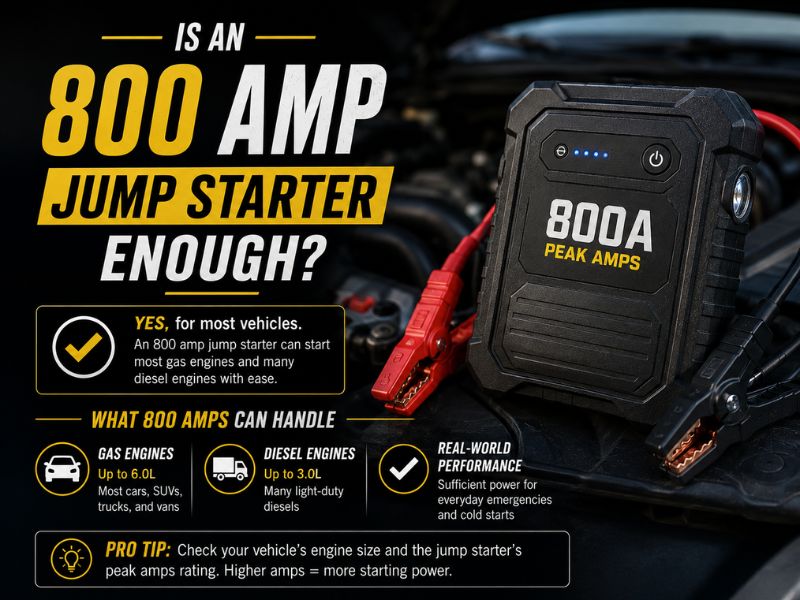
An 800A jump starter sounds straightforward: it can supposedly provide 800 amps.
The problem is what those 800 amps represent.
Most consumer products prominently advertise peak amps, which describe a brief maximum-current capability rather than a standardized measure of sustained cranking output. Clore Automotive warns that there is no industry-agreed definition of peak amps, making peak numbers difficult to compare directly across brands.
Clore instead emphasizes Cranking Amps for its lead-acid jump starters and Start Assist Amps for lithium models because those measurements specify current delivery over a defined period.
That means the answer to “is 800 amp jump starter enough?” should never be based on 800 alone.
You need to know what the manufacturer says the actual unit can start.
What Size Engine Can an 800 Amp Jump Starter Start?
There is no universal engine-size limit for every 800A jump pack.
Schumacher’s current specifications demonstrate the difference clearly.
Its FR01549 800 Peak Amp Jump Starter is rated by Schumacher for gasoline engines up to 8.0 liters and diesel engines up to 6.0 liters. It uses an internal sealed lead-acid AGM battery and heavy 6-gauge cables.
By comparison, Schumacher’s SJ1342, which is also advertised at 800 peak amps, is rated for engines up to 6.0L gasoline and 3.0L diesel.
Schumacher also has an 800A lithium model, the SL1396, that lists 800 peak amps and 400 cranking amps and is marketed for 8-cylinder cars.
Same headline amp number. Different battery technology, different supporting specifications, and different intended vehicles.
So, for your actual purchase or existing jump starter, trust the engine-displacement rating printed by that manufacturer rather than assuming every 800A product has identical capability.
Is 800 Amps Enough for a 4-Cylinder Car?
In most cases, a properly rated 800A jump starter should provide substantial starting capability for a typical 12V four-cylinder passenger vehicle.
As a useful comparison, NOCO rates its smaller 500A GB20 for gasoline engines up to 4.0 liters.
That does not prove every 800A jump starter will outperform every 500A unit, because peak ratings are not standardized. It does show that relatively compact jump starters can be designed for ordinary four-cylinder gasoline engines when the manufacturer specifically rates them for that application.
For a 1.5L, 2.0L, 2.4L, or similar gasoline four-cylinder car, an 800A unit carrying an appropriate manufacturer engine rating is generally a sensible class of jump starter.
What About a V6?
This is where an 800A unit can still make a lot of sense.
Schumacher specifically describes its SJ1342 800 Peak Amp model as suitable for V6 engines and rates that particular unit up to 6.0L gasoline.
For common gasoline V6 applications, therefore, a reputable 800A jump starter can be sufficient when its manufacturer explicitly supports the engine size.
There is still value in having some power reserve.
A 3.5L V6 on a mild day with a moderately discharged battery presents a much easier starting situation than the same engine at very low temperature with a deeply discharged battery.
Buying exactly at the edge of a product’s stated capability leaves less margin for those difficult conditions.
Is an 800 Amp Jump Starter Enough for a V8?
Potentially, yes—but this is the point where the specific model becomes especially important.
Schumacher’s FR01549 is rated up to an 8.0L gasoline engine, while the company’s 800A lithium SL1396 is marketed for 8-cylinder cars.
That means it would be incorrect to say an 800A rating is automatically too small for every V8.
It would be equally incorrect to assume any inexpensive jump starter displaying “800A” can start a large V8.
Look for a manufacturer rating covering your actual engine displacement, not merely cylinder count.
A modern 5.0L V8 and a very large-displacement gasoline truck engine may create different starting demands even though both have eight cylinders.
Diesel Changes the Answer
Diesel engines deserve a more conservative approach.
Notice how manufacturers generally give the same jump starter a smaller diesel-engine rating than gasoline rating.
Schumacher rates the SJ1342 at up to 6.0L gas but only 3.0L diesel. Its FR01549 is rated at 8.0L gas and 6.0L diesel.
NOCO shows the same pattern at another power level: its 1000A GB40 is rated for engines up to 6.0L gasoline and 3.0L diesel.
The practical takeaway is straightforward.
If you drive a gasoline sedan or crossover, 800A may offer plenty of usable starting capacity.
If you drive a large diesel pickup, an 800A consumer jump pack may be marginal unless its manufacturer specifically rates it for your diesel displacement.
For diesel applications, do not extrapolate from the gasoline rating.
Peak Amps Are the Biggest Source of Confusion
This is the part of jump-starter shopping that causes the most misleading comparisons.
Suppose one product says:
800 Peak Amps
and another says:
1000 Peak Amps
It is tempting to conclude that the second unit is exactly 25% more capable.
That conclusion is not justified from peak amps alone.
Clore Automotive says peak amps have no industry-agreed definition and describes the value as a very brief maximum rather than the current actually sustained through a normal starting event.
Clore’s own products illustrate why additional ratings matter. Its JNC4000 is advertised at 1100 peak amps but also specifies 325 cranking amps, while its much larger ES6000 lists 3000 peak amps and 800 cranking amps.
So when evaluating an 800A product, prioritize these specifications:
Manufacturer engine-size rating, gasoline/diesel rating, correct system voltage, Cranking Amps or Start Assist Amps when provided, cable and clamp quality, and the manufacturer’s operating limits.
Those details tell you more than the largest number printed on the front of the case.
800 Peak Amps vs. 800 Cranking Amps
These are very different ratings.
An 800 peak amp consumer jump starter may have much lower sustained cranking capability.
By contrast, a unit providing 800 actual cranking amps is in a much more powerful class.
For example, Clore’s commercial ES6000 delivers 800 cranking amps but is advertised at 3000 peak amps.
This illustrates why you should never casually equate:
800 peak amps = 800 cranking amps.
They describe different tests and different capabilities.
Schumacher’s SL1396 provides another useful example: the unit is advertised at 800 peak amps but 400 cranking amps.
If you’re comparing two products, make sure you’re comparing the same type of amp rating.
Cold Weather Can Make 800A Feel Smaller
Winter starting is generally more demanding, so having more reserve capability can be useful.
Battery and jump-starter performance also depend on product design and temperature limits. For example, NOCO specifies an operating range of -4°F to 122°F (-20°C to 50°C) for its GB40 and GB20 lithium jump starters.
The manufacturer’s temperature specification matters because a jump starter should be used within its approved operating range.
If you routinely deal with severe winter weather, selecting a pack comfortably above the minimum engine-size requirement is more reassuring than choosing a unit that is already at its advertised limit.
This is particularly relevant for larger engines and diesel vehicles.
Battery Condition Matters Too
A jump starter is designed to assist a weak or discharged starting battery. The difficulty of that task changes depending on how deeply the vehicle battery is discharged and whether the battery is merely low or physically damaged.
Some smart lithium jump starters may not automatically activate when connected to an extremely low-voltage battery.
For example, NOCO’s GB40 has a manual override mode intended for batteries too low for normal automatic detection, but NOCO warns that this mode disables safety protections and should only be used according to its instructions.
That is another reason a jump-start failure does not automatically mean “800 amps isn’t enough.”
The pack may be undercharged, outside its temperature range, improperly connected, or interacting with a battery condition that requires a model-specific procedure.
A damaged or frozen battery should not be jump-started; NOCO explicitly warns against attempting to jump a damaged or frozen battery.
Should You Buy More Than 800 Amps?
For a small gasoline car, buying an enormous jump pack solely to maximize the advertised peak number may be unnecessary.
For larger trucks, diesels, cold climates, or situations where you want greater starting reserve, moving above the 800A class can make sense.
For perspective, NOCO’s current Boost X line scales engine ratings with its products: the 1250A GBX45 is rated up to 6.5L gas and 4.0L diesel, while higher-output models extend to larger engines.
The important lesson is not that 1250A is automatically better than 800A.
It is that manufacturers publish engine ratings for a reason.
If an 800A model is officially rated above your engine size with reasonable margin, it may be all you need.
If your engine is at or beyond its rating—especially a diesel—choose a stronger model rather than hoping the peak number will be enough.
An 800A Jump Starter Cannot Fix Every No-Start
Even an appropriately sized booster only helps when the starting problem involves insufficient battery power.
It cannot repair a failed starter motor, broken starting circuit, fuel-delivery fault, ignition problem, compression problem, or other mechanical no-start condition.
If the engine already cranks strongly at normal speed but does not start, adding a larger jump starter usually does not address the real problem.
Similarly, if an 800A unit that is correctly charged and properly rated for the vehicle makes no difference to a no-crank condition, diagnose the starting system rather than immediately buying a 3000A booster.
More advertised current cannot repair a failed component.
Frequently Asked Questions
Is 800 Amps Enough to Jump-Start a Car?
Yes, an appropriately designed 800A jump starter can be sufficient for many passenger cars. The exact capability depends on the specific product’s engine rating rather than the peak-amp number alone. Schumacher currently offers 800A units rated for gasoline engines ranging up to 6.0L or 8.0L depending on the model.
Is 800 Amps Enough for a 4-Cylinder?
Generally, an 800A unit rated for your engine should be more than reasonable for many gasoline four-cylinder vehicles. For comparison, NOCO rates its 500A GB20 for gasoline engines up to 4.0L.
Is 800 Amps Enough for a V6?
It can be. Schumacher specifically markets one 800 Peak Amp model for V6 applications and rates it up to a 6.0L gasoline engine.
Can an 800 Amp Jump Starter Start a V8?
Some can. Schumacher lists an 800A lead-acid model for gasoline engines up to 8.0L and an 800A lithium model for 8-cylinder cars. Check the rating of your specific product.
Is 800 Amps Enough for a Diesel?
Possibly for a smaller diesel, but check the manufacturer’s diesel displacement limit carefully. Schumacher’s two 800A examples have diesel ratings of 3.0L and 6.0L respectively, proving that 800A alone does not establish diesel capability.
Is 800 Peak Amps the Same as 800 Cranking Amps?
No. Peak amps and cranking amps are different ratings. Clore’s ES6000, for example, is rated at 3000 peak amps but 800 cranking amps, while Schumacher lists an 800 peak amp lithium unit with 400 cranking amps.
Is 1000A Better Than 800A?
Not necessarily based on the headline figures alone. Clore warns that peak amps are not standardized across manufacturers, so engine ratings and meaningful sustained-output specifications are better comparison tools.
Should I Get 800A or 1500A?
An 800A model can be appropriate when it comfortably covers your engine’s manufacturer-rated size. A higher-output unit may provide more reserve for larger engines, diesel applications, severe cold, or repeated starting needs.
Can an 800A Jump Starter Damage a Small Car?
A jump starter should be selected for the vehicle’s system voltage and used according to its instructions. A correctly designed 12V jump starter does not force its advertised peak current continuously into the starter; however, voltage compatibility and correct connection remain essential.
Why Won’t My 800A Jump Starter Start My Car?
Possible reasons include insufficient charge in the jump pack, poor clamp contact, an engine larger than the unit’s rating, extreme temperature, an extremely discharged or damaged vehicle battery, or a no-start problem unrelated to battery power. Check the manufacturer’s troubleshooting procedure before assuming you simply need more amps.
Is an 800 Amp Jump Starter Enough Overall?
An 800 amp jump starter is enough for many everyday passenger vehicles when the specific unit is manufacturer-rated for the vehicle’s engine size. Current 800A Schumacher products demonstrate that this class can cover anything from V6-oriented applications up to certain units rated for 8.0L gasoline and 6.0L diesel engines.
But 800 peak amps is not a universal performance standard.
Clore Automotive specifically warns that peak amps have no agreed industry definition, which means two jump starters carrying the same 800A number may perform very differently.
For a typical four-cylinder or moderate gasoline V6, a reputable 800A jump starter with the appropriate engine rating can be a practical choice. For a large V8, diesel truck, severe winter environment, or vehicle near the unit’s maximum rating, selecting a product with more verified starting reserve may be wiser.
The best buying rule is simple: match voltage first, then the manufacturer’s gas/diesel engine-size rating, and use peak amps only as a secondary comparison—not the deciding specification.