Yes, some portable jump starters can start a car with a completely dead or near-0V battery, but not every jump pack can do it automatically. Smart jump starters may refuse to activate when battery voltage is extremely low, while models with a properly designed manual override or forced-start mode can sometimes supply starting power even to a battery reading around 0.0V.
There is also an important distinction between a battery that is simply deeply discharged and one that is physically failed. A jump starter may temporarily overcome a lack of charge, but it cannot repair an internally damaged, frozen, shorted, or otherwise unsafe battery.
What Does “Completely Dead Battery” Actually Mean?
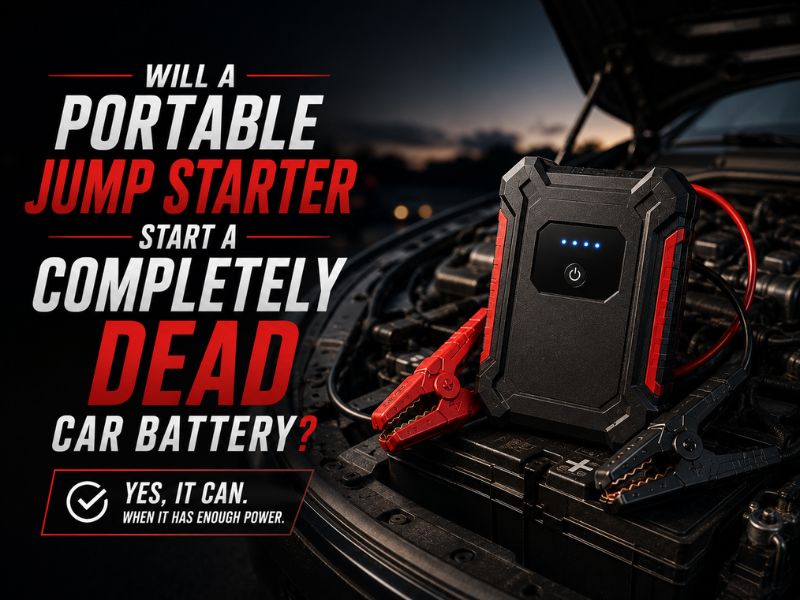
Drivers use the phrase “completely dead” for several different battery conditions.
One battery may still have several volts remaining but not enough energy to crank the starter. Another might measure below the detection threshold of a smart jump starter. A severely discharged battery can even measure close to 0 volts.
Those situations are not necessarily the same as a physically failed battery.
Clore Automotive explains that modern smart service equipment normally needs to detect some minimum battery voltage—often roughly 1–5V depending on the equipment—before it can confirm that the clamps are connected with correct polarity. A nearly 0V battery can therefore cause smart equipment to refuse to turn on even when the clamps are connected correctly.
That is why a jump starter sometimes appears to “do nothing” with an extremely discharged battery.
The pack may have plenty of stored energy. Its safety electronics simply cannot verify the connection.
Why Some Jump Starters Will Not Detect a Dead Battery
Modern lithium jump starters commonly include reverse-polarity protection, short-circuit protection, and battery-detection circuitry.
Those protections are useful because the jump starter normally checks the connected battery before sending high current through the clamps.
But the system faces a problem when vehicle-battery voltage becomes extremely low.
NOCO states that most completely dead batteries cannot be jump-started using the standard mode on its Boost products because the device may not detect the battery normally. Its Manual Override feature exists specifically to force the jump-start function on for an extremely weak battery.
Several NOCO Boost models identify batteries below about 2V as situations where manual override may be required.
So if your jump pack does not activate, it does not automatically mean:
“The battery is too dead for any portable jump starter.”
It may mean the smart pack cannot verify the battery using its normal safety mode.
Can a Jump Starter Really Start a 0-Volt Battery?
Some models are specifically designed to do so.
Clore’s JNC305 is advertised as capable of starting a totally dead battery measuring 0.0V through its override function. After confirming that the connection and polarity are correct, the operator can engage override to force the unit’s output on.
Clore provides the same 0.0V capability on models such as the JNC325 and JNC345.
That proves a portable jump starter can, in some circumstances, crank a vehicle whose battery is essentially electrically invisible to normal smart detection.
But it does not mean every jump starter has that ability.
If your model does not have an approved low-voltage or override function, do not improvise a bypass.
Manual Override Requires More Caution
A normal smart jump-start mode can verify conditions before energizing the clamps.
Override changes that.
NOCO warns that Manual Override forces the jump-start function on for a battery that is too weak to be detected normally. Because the operator is bypassing automatic detection, correct polarity must be positively confirmed before the mode is activated.
This is especially important with a battery reading near zero because the jump starter cannot necessarily use battery voltage to determine whether red and black are connected correctly.
The practical procedure should therefore be:
Confirm the vehicle uses a voltage and battery chemistry supported by the jump starter.
Identify the correct positive and negative or designated ground jump points.
Verify the red clamp is actually on positive.
Verify the black clamp is on the manufacturer-approved negative or ground point.
Only then use an override feature if the manufacturer’s manual specifically permits it.
Do not use manual override simply because a normal jump attempt failed.
A Completely Discharged Battery Is Not Necessarily a Bad Battery
A healthy battery can occasionally become deeply discharged.
For example, electrical accessories can drain a vehicle battery while the engine is off. In that situation, the battery may have very little charge remaining without necessarily having suffered immediate internal failure.
A portable jump starter provides temporary auxiliary starting power. Clore describes a jump starter as essentially acting like an additional battery connected to the vehicle’s starting system.
That extra power can crank the starter even when the vehicle battery cannot.
However, a successful jump does not tell you whether the discharged battery is still healthy.
A battery that has been deeply discharged may need proper charging and testing afterward rather than being considered repaired simply because the engine started.
A Jump Starter Does Not Recharge the Dead Battery
This distinction is easy to miss.
The purpose of the jump pack is to provide a large amount of power for a short starting event.
It is not normally replacing a dedicated battery charger.
Clore explicitly describes a jump starter as auxiliary power for the starting battery rather than a device intended to fully recharge a dead battery.
So after a successful jump, do not assume the vehicle battery is suddenly full.
If the battery became deeply discharged, determine why and recharge it according to the battery and vehicle manufacturer’s procedure.
If it repeatedly goes dead, battery and charging-system testing is appropriate.
When a Portable Jump Starter May Still Fail
Even a model capable of handling very low battery voltage can fail to start the vehicle.
The Jump Pack Is Too Small for the Engine
Jump starters have maximum engine ratings.
A compact booster designed for small gasoline engines may not provide enough starting capability for a large-displacement truck or diesel engine.
Select the unit by engine-size rating and fuel type, not merely by whether it has an override mode.
The Jump Starter Is Not Fully Charged
An undercharged jump starter may turn on while lacking enough reserve for a demanding crank.
A completely dead vehicle battery places more of the starting burden on the jump pack because the vehicle’s own battery contributes little useful energy.
Starting with a well-charged booster therefore matters even more in this situation.
Clamp Contact Is Poor
High-current starting requires a low-resistance electrical connection.
Corrosion, loose terminals, painted metal, or clamps that barely touch the battery post can prevent the jump starter from delivering useful current.
Before assuming the battery is “too dead,” verify that the connection points are clean and secure.
The Starter or Vehicle Has Another Fault
A jump starter only addresses inadequate battery power.
If the starter motor has failed, the engine is mechanically locked, or the vehicle has another no-crank fault, adding another battery will not necessarily make it start.
Similarly, if the engine cranks strongly but never runs, the problem may involve fuel, ignition, compression, or engine management rather than the battery.
When You Should Not Try to Jump the Battery
“Completely dead” should never be interpreted as permission to boost every battery.
NOCO explicitly warns not to jump-start a damaged or frozen battery.
If the battery case is swollen, cracked, leaking, frozen, or otherwise visibly abnormal, stop.
A battery can be discharged because it simply lost charge, or it can have serious internal problems. A jump starter cannot distinguish every failure mechanism just from terminal voltage.
Do not force-start a visibly unsafe battery using manual override.
That feature exists for an electrically low battery—not to bypass physical battery damage.
What if the Battery Reads 0 Volts?
A near-0V reading deserves caution.
Clore’s technical guidance confirms that some modern jump starters can service batteries at 0.0V using an override function, but the user must first verify that the connection is correct because the automatic system cannot rely on battery voltage for normal detection.
If your jump starter has no approved override function, stop rather than experimenting with jumper wires or other ways to defeat its electronics.
You should also remember that an actual 0V reading can indicate more than simple discharge.
If a battery repeatedly returns to zero, will not accept or retain charge, or behaves abnormally after a jump, proper battery testing is the better next step.
Does a Larger Jump Starter Make a Difference?
Sometimes, but not in the way people often think.
A more capable jump starter can provide additional starting reserve for larger engines or difficult conditions.
But going from 1000A to 3000A does not solve:
A frozen battery, internally failed battery, broken starter, poor cable connection, or crank-no-start problem.
A model with a genuine 0V override capability can actually be more useful for a deeply discharged battery than another high-amp model whose safety system will not activate below its minimum detection voltage.
This is why features and manufacturer specifications matter in addition to peak amperage.
What Happens After the Engine Starts?
Disconnect the jump starter according to its manual and avoid leaving it attached unnecessarily.
Then address the vehicle battery itself.
If the battery died because an interior light was left on, it may simply need proper recharging.
If there was no obvious reason for the discharge, check for:
Battery deterioration, charging-system problems, loose battery connections, or an abnormal parasitic electrical draw.
A jump starter gets you moving again. It does not diagnose why the battery became discharged.
Repeatedly carrying out emergency jumps without investigating the cause can eventually leave you stranded when either the battery or another starting-system component fails completely.
Completely Dead vs. Completely Failed
This distinction is the key to the entire question.
A completely discharged battery has very little stored energy.
A failed battery has an internal condition that prevents it from functioning properly.
Some discharged batteries can be jump-started even at extremely low voltage. Clore specifically builds lithium jump starters capable of engaging batteries measuring 0.0V through an override mode.
A physically damaged or frozen battery should not be jump-started.
And a battery that has failed internally may not remain usable even if a powerful jump pack temporarily gets the engine started.
“Dead” therefore describes a symptom. It does not tell you the battery’s actual health.
Frequently Asked Questions
Can a Portable Jump Starter Start a 0-Volt Battery?
Some can. Clore’s JNC305, JNC325, and JNC345 are specifically designed with override functions capable of jump-starting batteries reading 0.0V.
Why Won’t My Jump Starter Detect a Completely Dead Battery?
Smart jump starters normally need some battery voltage to verify polarity and connection. Clore says this threshold is commonly around 1–5V depending on the equipment, while several NOCO Boost models use manual override for batteries below approximately 2V.
What Is Manual Override on a Jump Starter?
Manual override forces the jump starter output on when the connected battery is too deeply discharged for automatic detection. It should only be used after polarity and compatibility have been positively verified.
Is Manual Override Safe?
It can be used safely when the manufacturer provides the feature and its instructions are followed exactly. Because normal detection protections may be bypassed, incorrect polarity becomes especially dangerous.
Can You Jump-Start a Battery Below 2 Volts?
Certain jump starters can. NOCO provides manual-override procedures for several Boost models specifically for dead batteries below about 2V.
Will a Jump Starter Recharge a Completely Dead Battery?
Not normally. A portable jump starter supplies auxiliary power for the starting event; it is not a substitute for properly recharging the vehicle battery afterward.
Can You Jump a Frozen Battery?
No. NOCO specifically warns against attempting to jump-start a frozen battery.
Can a Completely Dead Battery Be Permanently Damaged?
A deeply discharged battery may no longer be healthy even if the car can be jump-started. Whether it remains usable should be determined through proper charging and battery testing rather than from a successful jump alone.
Why Does the Car Crank With a Jump Starter but Still Not Start?
If the engine is cranking strongly, the jump starter is supplying starting power. A continued crank-no-start condition can point to a problem outside the battery, such as fuel, ignition, engine-management, or mechanical faults.
Do I Need a Bigger Jump Starter for a Completely Dead Battery?
Possibly if your current unit is undersized for the engine, but higher peak amps are not always the solution. A jump starter specifically rated for the engine and equipped with an approved low-voltage override function can be more important than simply buying the highest amp number.
Will a Portable Jump Starter Start a Completely Dead Battery?
A portable jump starter can start a completely dead battery when the battery is deeply discharged rather than physically failed and the jump starter is designed to operate at that low voltage. Some modern units need manual override below their normal detection threshold, while Clore models such as the JNC305 and JNC325 are specifically designed to engage batteries measuring as low as 0.0V.
Do not confuse a completely discharged battery with a damaged one. A jump pack can temporarily supply the power a discharged battery cannot provide, but it cannot make a frozen, physically damaged, or internally failed battery healthy. NOCO specifically warns against boosting damaged or frozen batteries.
If your smart jump starter refuses to activate on a very low battery, check its manual for an approved low-voltage or manual-override mode. Never invent your own bypass, and never use override until voltage compatibility and clamp polarity have been positively confirmed.
The practical rule is: a completely discharged battery can often be jump-started; a completely failed battery usually needs replacement or repair, not more jump-starting power.