The main difference between 1-ply and 2-ply window tint is the number of polyester film layers. A 1-ply tint uses one polyester sheet, while a 2-ply tint bonds two sheets into a single manufactured film. Two-ply products often have a thicker, more substantial construction, but that alone does not guarantee better heat rejection, UV protection, or a longer lifespan.
When choosing tint for a car, it is easy to confuse ply with thickness, darkness, and film technology. A two-ply dyed tint can cost more than a single-ply option while rejecting less solar heat than a high-performance film with a different construction.
The quality of the polyester, adhesive, scratch-resistant coating, and heat-control materials matters just as much as the number of plies. Film construction also affects handling during installation, particularly on curved rear windows.
In this article, I compare 1-ply and 2-ply window tint construction, thickness, durability, heat rejection, installation, and cost. I also explain how to read manufacturer specifications, avoid misleading performance claims, and choose a suitable film for your vehicle.
1 Ply vs 2 Ply Window Tint: Main Differences
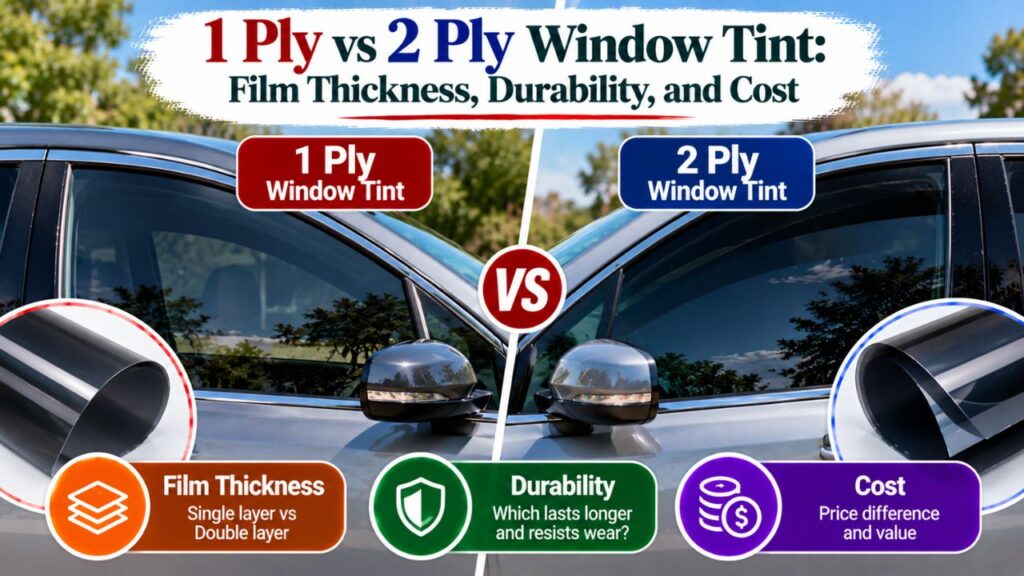
One-ply and two-ply automotive window films have different internal constructions.
A single-ply film contains one primary polyester sheet, while a double-ply film contains two polyester sheets joined together during manufacturing.
The polyester layers provide the film’s physical structure. Additional coatings, adhesives, and solar-control materials determine many of its other properties.
| Feature | 1-Ply Window Tint | 2-Ply Window Tint |
| Polyester construction | One sheet | Two bonded sheets |
| Typical thickness | Often around 1 mil | Commonly around 1.5–2 mil or more |
| Physical strength | Depends on material and thickness | May provide greater tear resistance |
| Scratch resistance | Depends on protective coating | Depends on protective coating |
| Heat rejection | Depends on film technology | Depends on film technology |
| UV protection | Can provide high UV rejection | Can provide high UV rejection |
| Optical clarity | Depends on manufacturing quality | Depends on manufacturing quality |
| Installation | Often flexible and lightweight | May offer more handling stability |
| Removal | May tear more easily if thin or degraded | May be easier to remove intact if well constructed |
| Cost | Often more economical | Frequently costs more in comparable product ranges |
| Best application | Budget-focused automotive tinting | Drivers prioritizing robust construction |
Key Takeaway: Two-ply tint has an additional polyester layer, but it is not automatically darker, cooler, more scratch-resistant, or longer-lasting. Actual performance depends on the complete film design.
What Is 1-Ply Window Tint?
One-ply window tint is an automotive film constructed using a single sheet of polyester, commonly known as polyethylene terephthalate (PET).
The polyester provides the main structural base.
Other materials may be added to create the desired appearance and performance.
A typical single-ply film may include:
- A scratch-resistant surface coating
- One polyester sheet
- Dyes, pigments, or solar-control materials
- An adhesive layer for attachment to the glass
- A removable protective release liner
The release liner protects the mounting adhesive before installation. It is removed during application and is not counted as a permanent polyester ply.
Advantages of 1-Ply Window Tint
Single-ply films are frequently used in economical automotive tint product lines.
Their potential advantages include:
- Lower material costs in many product ranges
- A relatively thin construction
- Good flexibility
- Compatibility with common automotive window shapes
- A wide selection of darkness levels
- Less material thickness where that is desirable
A well-manufactured single-ply film can provide satisfactory glare reduction, privacy, and UV protection.
The exact performance depends on the product rather than its ply count.
Limitations of 1-Ply Window Tint
Thin single-ply films may be more vulnerable to tearing during handling or removal than thicker, properly laminated films.
They can also be challenging to handle during installation if the material folds or creases easily.
However, these are possible construction-related differences, not universal defects.
Some high-quality single-ply films have effective scratch-resistant coatings and durable adhesives.
A low-quality two-ply film is not necessarily better than a well-made single-ply product.
What Is 2-Ply Window Tint?
Two-ply window tint contains two separate polyester sheets bonded together into one film.
The manufacturer typically uses a laminating adhesive between the sheets.
The resulting construction may provide greater thickness, mechanical strength, or additional space for specialized coatings.
According to the European Window Film Association’s explanation of window film manufacturing, polyester sheets can be joined through lamination, while separate manufacturing processes apply adhesives, scratch-resistant coatings, and solar-control materials.
The number of polyester sheets is only one part of the complete construction.
Advantages of 2-Ply Window Tint
Two-ply film construction can provide several practical advantages, depending on the materials used.
These may include:
- Greater resistance to tearing
- More substantial handling characteristics
- Better dimensional stability during some installation procedures
- Additional flexibility in film design and manufacturing
- Improved removal characteristics in some products
- Compatibility with advanced dyed, carbon, metallic, or ceramic technologies
The additional polyester layer can contribute to physical strength.
However, the amount of improvement depends on the thickness, bonding quality, and mechanical properties of both sheets.
Limitations of 2-Ply Window Tint
Two-ply tint is not automatically superior in every category.
Potential disadvantages include:
- Higher prices in comparable product ranges
- Increased stiffness in some constructions
- More challenging heat shaping on certain curved windows
- Possible laminate separation if bonding quality is poor
- No guaranteed improvement in thermal performance
A second polyester layer alone does not establish that a film provides better heat rejection or UV protection.
Those characteristics must be evaluated separately.
Is 2-Ply Window Tint Twice as Thick as 1-Ply?
No. Two-ply window tint is not necessarily twice as thick as single-ply tint.
Ply refers to the number of polyester sheets, while mil refers to physical thickness.
One mil equals one-thousandth of an inch, or approximately 25.4 microns.
A two-ply film may use two relatively thin polyester sheets, while a single-ply product may use one thicker sheet.
The thickness of adhesives and additional coatings can also influence the finished measurement.
Common Window Tint Thickness Measurements
Automotive window film is manufactured in multiple thicknesses.
Examples include:
- 1.0 mil: Approximately 0.001 inch
- 1.5 mil: Approximately 0.0015 inch
- 2.0 mil: Approximately 0.002 inch
These measurements describe thickness, not the number of plies.
For example, a 2-ply film may be 1.5 mil thick rather than 2 mil.
Likewise, two products with identical finished thicknesses may use different polyester constructions.
Real Manufacturer Example: 1-Ply vs. 2-Ply Thickness
The VION automotive window film product lineup provides useful examples of different constructions.
| Product Series | Construction | Listed Thickness | UV Absorption |
| VION Eco Tint | 1 ply | 23 microns | 95% |
| VION Classic Tint | 1 ply | 25 microns | 99% |
| VION Advanced Tint | 2 ply | 60 microns | 99% |
| VION Premium Tint | 2 ply for the listed standard construction | 55–65 microns | 99% |
These are manufacturer-published specifications for particular product lines, not universal values for all single-ply and double-ply films.
The comparison shows that a two-ply construction can be substantially thicker than a single-ply option.
It also shows that both one-ply and two-ply products can provide the same stated UV absorption.
Film thickness and layer count should always be checked separately.
Which Is More Durable: 1-Ply or 2-Ply Window Tint?
A well-constructed two-ply film may offer greater mechanical durability than a comparable thin single-ply film.
However, durability is not determined by the number of polyester layers alone.
The material quality, surface coating, adhesive, manufacturing process, and environmental conditions all influence how a tint performs over time.
Resistance to Tearing
Tear resistance is one area where thicker, properly laminated films may have an advantage.
Two bonded polyester sheets can provide greater resistance to physical damage than a thin single sheet.
This can be useful during handling and removal.
However, a poorly bonded film may develop separation between layers.
A properly manufactured film must maintain adequate adhesion between its internal components.
For meaningful comparisons, use actual mechanical performance specifications rather than ply count alone.
Scratch Resistance
Two-ply tint is not automatically more scratch-resistant than one-ply tint.
Scratches usually affect the exposed surface of the film.
A dedicated hard coat is an important factor in protecting that surface from routine abrasion.
Both single-ply and double-ply films may have scratch-resistant coatings.
For example, a quality one-ply film with a durable hard coat may withstand normal window cleaning better than a poorly manufactured two-ply product with weak surface protection.
Check whether the manufacturer specifies a scratch-resistant coating.
Resistance to Bubbling and Peeling
Bubbling and peeling often result from adhesive deterioration, contamination, installation problems, or prolonged exposure to challenging conditions.
The number of polyester plies does not directly prevent these problems.
A high-quality mounting adhesive is necessary for both constructions.
If the adhesive fails, the film may separate from the glass regardless of its thickness.
Two-ply products also contain an internal bond between the polyester layers, which must remain stable.
Color Stability and Fading
The way a film maintains its color depends heavily on the dyes, pigments, coatings, and manufacturing process.
A two-ply dyed film may experience discoloration if its coloring system is unstable.
Likewise, a single-ply film using a durable color system may retain its appearance for a long time.
Carbon and ceramic films can offer different color-stability characteristics from conventional dyed films.
However, film technology and product quality matter more than simply having two polyester layers.
Does 2-Ply Window Tint Block More Heat Than 1-Ply?
Not necessarily. Two-ply construction does not automatically provide stronger solar heat rejection than one-ply construction.
Heat-rejection performance depends on the film’s solar-control technology.
Automotive films can use different materials to manage solar energy, including:
- Dyes and pigments
- Carbon-based materials
- Ceramic particles
- Metallic coatings
- Multilayer optical technologies
These materials affect how sunlight is transmitted, reflected, and absorbed.
The additional polyester sheet in a two-ply product does not, by itself, guarantee a major thermal advantage.
Total Solar Energy Rejected (TSER)
TSER measures the percentage of total solar energy rejected by the tested film-and-glass combination.
It is one of the most useful specifications when comparing window tint for heat control.
For example, suppose two hypothetical films have the following measurements under equivalent testing conditions.
| Specification | Film A | Film B |
| Polyester construction | 1 ply | 2 ply |
| Visible light transmission | 35% | 35% |
| Total solar energy rejected | 45% | 40% |
In this example, the single-ply film has the higher TSER rating despite having fewer polyester layers.
These figures illustrate how to interpret specifications; they are not test results for particular products.
The film with higher TSER provides greater measured total solar energy rejection under the stated conditions.
Infrared Rejection (IRR)
Infrared radiation is part of the solar spectrum and contributes to solar heating.
Some window films are engineered specifically to reduce infrared transmission.
However, an infrared rejection percentage may apply to only a particular wavelength range.
A film advertising 95% infrared rejection does not necessarily reject 95% of total solar energy.
Check the wavelength range and compare TSER when overall heat control is your priority.
Is 2-Ply Ceramic Tint Better Than 1-Ply Dyed Tint?
A premium two-ply ceramic film may provide substantially better heat rejection than a basic one-ply dyed film.
However, that difference primarily reflects their solar-control technology, not simply the extra polyester layer.
Ceramic films use specialized particles to manage solar energy.
Conventional dyed films mainly control visible light through their coloring materials.
For a fair comparison, evaluate the film’s complete specifications, including VLT, TSER, and infrared rejection.
1-Ply vs. 2-Ply Window Tint for UV Protection
Both single-ply and double-ply automotive tint can provide strong ultraviolet protection.
UV rejection depends on the UV-absorbing or UV-blocking components within the film.
These may be incorporated into the polyester, adhesive, or other functional layers.
A film does not necessarily need two polyester sheets to achieve high UV rejection.
For example, VION’s published specifications identify 99% UV absorption for its one-ply Classic Tint and two-ply Advanced Tint.
The two constructions provide the same stated UV performance despite their different thicknesses.
Does Adding Another Ply Double UV Protection?
No.
UV rejection percentages cannot be determined by multiplying the number of polyester layers.
A one-ply film with a suitable UV-blocking system may perform similarly to a two-ply film.
Likewise, a poorly designed double-ply product may offer lower UV protection than a premium single-ply alternative.
Check the manufacturer’s measured UV rejection rating.
Does Thicker Tint Protect Car Interiors Better?
Thickness alone does not establish better protection against dashboard fading or upholstery deterioration.
Ultraviolet radiation, visible light, heat, and material properties all contribute to interior aging.
A film with strong UV protection and suitable overall solar heat rejection can help reduce these exposures.
However, additional polyester thickness without an effective protective system may provide limited improvement.
Which Window Tint Offers Better Clarity and Visibility?
Optical clarity depends on polyester quality, coatings, adhesive consistency, and manufacturing precision.
Both one-ply and two-ply films can provide clear visibility when properly manufactured and installed.
Does 2-Ply Tint Look Darker?
No. Ply count does not directly determine tint darkness.
Darkness is measured using Visible Light Transmission (VLT).
A film with 35% VLT allows approximately 35% of visible light through under the specified test conditions.
A 1-ply film and a 2-ply film with matching VLT values can have similar visible darkness.
Their color tone, reflectivity, and clarity may still differ.
Does Double-Ply Tint Create More Haze?
A two-ply film has additional internal interfaces, but that does not automatically produce visible haze.
Well-manufactured laminates are designed to maintain optical clarity.
Poor bonding, unsuitable adhesives, or manufacturing defects can introduce distortion.
Similarly, a low-quality single-ply film may also have haze or visual imperfections.
Inspect actual product samples rather than assuming one construction is optically superior.
Which Is Better for Night Driving?
For nighttime visibility, prioritize appropriate VLT and good optical clarity rather than ply count.
Dark window films reduce the amount of visible light entering the vehicle.
This can make it more difficult to see pedestrians, road markings, and other objects at night.
A lighter high-performance film may be preferable for drivers who regularly travel in low-light conditions.
The installed glass-and-film combination must also comply with applicable state tint regulations.
1-Ply vs. 2-Ply Window Tint Installation Differences
Film thickness and construction can affect how automotive tint behaves during installation.
Installers must cut, position, shape, and apply film without introducing creases, contamination, or air pockets.
However, no single installation method works identically for every product.
Is 1-Ply Window Tint Easier to Install?
Thin single-ply film is often flexible and lightweight.
This can make it easier to conform to certain window shapes.
However, very thin film may also be more difficult to handle without folding or creasing.
Its behavior depends on the polyester material and manufacturing process.
A basic single-ply film is not necessarily the easiest choice for an inexperienced installer.
Is 2-Ply Window Tint Easier to Handle?
Some two-ply films have greater body and dimensional stability.
This may make them easier to position during application.
The additional stiffness can also help reduce unwanted folding in certain situations.
However, thicker film may require different heat-shrinking techniques to conform to strongly curved glass.
A film that handles well on a flat side window may behave differently on a curved rear windshield.
Heat Shrinking on Curved Windows
Heat shrinking is commonly used to shape automotive window film before installation on curved glass.
The amount of heat and manipulation required depends on:
- Film thickness
- Polyester construction
- Manufacturing orientation
- Film shrink characteristics
- Window curvature
- Installer technique
Excessive heating can permanently damage either type of film.
Follow the manufacturer’s installation instructions instead of assuming every two-ply film needs a particular heat setting.
Which Tint Is Better for DIY Installation?
For DIY work, choose a film with clear application instructions and manageable installation characteristics.
The number of plies can influence handling, but installation quality also depends on surface preparation, cutting accuracy, and contamination control.
For complex rear windows, professional installation may be worthwhile regardless of the film construction.
Key Takeaway: Film thickness affects handling, but neither single-ply nor double-ply tint guarantees easier installation.
Is 2-Ply Window Tint Easier to Remove?
Two-ply window tint may be easier to remove intact when its construction provides greater tear resistance.
A thicker laminate can sometimes tolerate pulling forces better than a thin single-ply product.
However, removal difficulty depends heavily on adhesive condition and film aging.
Removing Old 1-Ply Tint
An older or deteriorated thin film may tear into small pieces during removal.
This can make the process slower.
Adhesive residue may also remain on the glass.
However, a high-quality single-ply film can still remove cleanly when the adhesive remains stable.
Removing Old 2-Ply Tint
A properly bonded two-ply film may remain intact more readily during removal.
This can help reduce tearing.
However, a deteriorated laminate may separate between its polyester layers.
In that situation, removal may become more complicated rather than easier.
Rear windows require particular caution because aggressive scraping or pulling can damage defroster lines or other integrated components.
Use removal procedures appropriate for the vehicle and film.
1-Ply vs. 2-Ply Window Tint Cost: Which Is Cheaper?
Single-ply window tint is often more affordable than comparable two-ply products within the same manufacturer’s range.
Two-ply construction requires additional polyester material and a lamination process.
However, ply count is only one factor affecting price.
A premium single-ply film with specialized technology can cost more than a basic double-ply dyed film.
Factors That Affect Tint Pricing
Installation costs depend on:
- Film manufacturer and product series
- Polyester construction and thickness
- Dyed, carbon, metallic, or ceramic technology
- Number of vehicle windows
- Window size and curvature
- Installer labor charges
- Existing tint removal
- Warranty coverage
A quote labeled only as 2-ply tint does not provide enough information to establish its value.
Ask the installer to identify the exact film brand and product line.
Is 2-Ply Tint Worth the Extra Cost?
Two-ply tint can be worth the additional cost if it offers better construction quality, suitable handling characteristics, and dependable durability.
However, don’t pay more simply because the film contains an additional polyester sheet.
If two products have similar measured solar performance, compare their warranties, scratch-resistant coatings, optical clarity, and installation quality.
For drivers focused mainly on reducing cabin heat, upgrading to a better solar-control technology may provide more value than upgrading ply count alone.
Is 2-Ply Window Tint the Same as Ceramic Tint?
No. Two-ply describes the film’s polyester construction, while ceramic describes a type of solar-control technology.
A ceramic film may use one or more polyester sheets, depending on the product.
Likewise, a two-ply film may be dyed, carbon-based, metallized, or ceramic.
The terms describe different characteristics.
| Window Tint Term | What It Describes |
| 1 ply | One polyester sheet |
| 2 ply | Two bonded polyester sheets |
| 1.5 mil | Film thickness |
| Dyed tint | Color-control technology |
| Carbon tint | Carbon-based film technology |
| Ceramic tint | Ceramic-based solar-control technology |
| Infrared tint | Infrared heat-rejection characteristics |
| 35% VLT | Visible light transmission |
A two-ply ceramic film and a two-ply dyed film may have similar thicknesses but very different heat-rejection performance.
This is why comparing products only by the number of plies can be misleading.
Does 2-Ply Window Tint Make Glass Safer?
A two-ply automotive tint may offer greater physical strength than a thin single-ply film, but that does not make it a certified safety or security window film.
Safety and security films are designed and evaluated for particular glass-retention or impact-resistance applications.
These products often have substantially different construction requirements from ordinary automotive solar-control tint.
A standard two-ply tint should not be assumed to provide burglary resistance, impact protection, or guaranteed retention of shattered glass.
If safety glazing performance is an important consideration, look for products with documented testing for the intended application.
Important: Ordinary automotive tint is not a replacement for properly rated vehicle safety glass.
How to Choose Between 1-Ply and 2-Ply Window Tint
The better choice depends on your budget, expected durability, installation requirements, and performance priorities.
Use the following steps to evaluate specific films.
Step 1: Check the Film’s Construction
Ask whether the product uses one or two polyester sheets.
Also request its total thickness in mils.
Do not assume that a thicker film necessarily has more plies.
A manufacturer specification sheet is more reliable than an informal description.
Step 2: Compare Heat Rejection Ratings
If reducing cabin heat is your priority, check the film’s TSER rating.
For a more meaningful comparison, choose films with similar VLT values and equivalent measurement conditions.
Infrared rejection can provide additional information, but check the wavelengths covered by the measurement.
Step 3: Check Scratch Resistance and Adhesive Quality
Look for a scratch-resistant hard coat and manufacturer documentation describing the film’s construction.
Ask about the product’s warranty against bubbling, peeling, and other manufacturing defects.
These factors may matter more for long-term appearance than ply count alone.
Step 4: Compare Visibility and Legal Darkness
Select a suitable VLT for the vehicle’s windows.
Check your state’s current tint regulations, including restrictions on front side windows and windshields.
Remember that the final light transmission depends on both the existing glass and the installed film.
A film’s labeled VLT does not automatically equal the finished window’s measured VLT.
Step 5: Review Installation and Warranty Coverage
Choose an installer familiar with the particular film.
Check whether the warranty covers materials, workmanship, or both.
Also confirm whether the warranty is transferable and which conditions may void it.
Do not assume that two-ply products automatically include better warranty coverage.
Step 6: Compare the Total Installed Price
Request itemized quotes identifying the film manufacturer, series, and windows included.
If the two-ply option costs more, determine what additional benefit the product actually provides.
A higher price may be justified by better materials, improved solar performance, or stronger warranty terms.
However, extra polyester alone does not establish superior value.
Which Is Better for Different Automotive Needs?
A single-ply or two-ply film can be appropriate depending on the intended application.
The following recommendations focus on practical buying priorities.
Best for Budget Window Tinting
A reputable one-ply film can be a reasonable option when cost is the primary concern.
Choose a product with appropriate UV protection, satisfactory optical clarity, and reliable adhesive quality.
Avoid extremely inexpensive films with unclear specifications or no meaningful manufacturer support.
Best for Long-Term Durability
A quality two-ply film may be attractive when physical robustness and resistance to tearing are priorities.
However, select it based on its actual construction quality and warranty.
A proven single-ply product can still outperform a poorly manufactured double-ply alternative.
Best for Hot Climates
For drivers in hot, sunny regions, prioritize high measured total solar energy rejection.
Premium ceramic or other advanced solar-control technologies may provide stronger heat management than basic dyed products.
The film’s ply count should be a secondary consideration.
Best for Appearance and Privacy
Choose the tint’s visible light transmission, color tone, and reflectivity according to your preferences and legal requirements.
A one-ply and two-ply film can produce similar privacy levels when their visible light transmission values are comparable.
Best for Professional Installation
Professional installers can work with both constructions.
The most suitable film depends on its handling characteristics, the vehicle’s glass geometry, and the installer’s experience.
A high-quality product installed correctly is generally preferable to an expensive film installed poorly.
Common Mistakes When Comparing 1-Ply and 2-Ply Tint
Several misconceptions can lead to an unnecessary purchase or unrealistic performance expectations.
Assuming 2-Ply Means Twice the Heat Rejection
Two polyester sheets do not automatically reject twice as much solar energy as one.
Heat rejection depends on the film’s solar-control system and measured performance.
Confusing Ply Count With Film Thickness
Two-ply films can be manufactured at different thicknesses.
Always compare ply and mil measurements separately.
Assuming Single-Ply Film Cannot Have a Scratch-Resistant Coating
Single-ply films may include protective hard coats.
Scratch resistance depends on the surface treatment, not simply the number of polyester sheets.
Believing Two-Ply Tint Is Always Ceramic
Two-ply tint can use several film technologies.
An extra polyester layer does not automatically mean ceramic particles are present.
Confusing Factory Lamination With Stacking Two Tint Films
A factory-made two-ply film contains bonded polyester layers engineered as one product.
Installing two separate sheets of finished tint on the same window is different.
Stacking separate films can reduce visible light transmission, complicate installation, and create adhesive or warranty issues.
Do not stack window tint unless the manufacturer specifically supports the application.
Ignoring the Warranty and Manufacturer
An inexpensive double-ply film may have poor adhesive quality or limited warranty protection.
An established manufacturer’s product specifications provide more useful information than a generic 2-ply label.
Conclusion
The 1 ply vs 2 ply window tint comparison comes down to film construction, physical durability, and overall product quality.
Single-ply tint contains one polyester sheet, while double-ply tint contains two bonded polyester sheets. Two-ply products may offer greater tear resistance and more substantial handling characteristics, but the additional layer does not automatically improve heat rejection, UV protection, or optical clarity.
For budget-focused installations, a quality single-ply film can provide suitable performance. For drivers seeking a more robust construction, a well-manufactured two-ply film may justify the added cost.
I recommend comparing exact product specifications rather than choosing tint solely by ply count.
Prioritize TSER for heat control, VLT for visibility, scratch-resistant coatings for everyday durability, and reliable warranty coverage for long-term value.
FAQs About 1 ply vs 2 ply window tint
Is 2-Ply Window Tint Better Than 1-Ply?
Two-ply window tint may provide greater mechanical strength and tear resistance than a comparable thin single-ply film.
However, it is not automatically better at rejecting heat, blocking UV radiation, or resisting scratches.
The better product depends on its materials, coatings, adhesive, and measured performance.
Does 2-Ply Tint Last Longer Than 1-Ply Tint?
Not necessarily. Film lifespan depends on manufacturing quality, adhesive stability, environmental exposure, installation, and maintenance.
A properly manufactured two-ply film may offer useful mechanical durability, but a high-quality single-ply film can also remain serviceable for many years.
Compare manufacturer warranties rather than assuming a fixed lifespan.
Is 2-Ply Window Tint Darker Than 1-Ply?
No. Darkness is determined by visible light transmission, not the number of polyester layers.
A one-ply film with 20% VLT can be darker than a two-ply film with 35% VLT.
Always choose the tint shade using VLT and applicable legal requirements.
Can 1-Ply Window Tint Block 99% of UV Rays?
Yes. A properly manufactured single-ply film can provide 99% UV blocking or absorption, depending on its tested specifications.
UV protection comes from appropriate film materials and UV-control components rather than the number of plies alone.
Check the exact manufacturer’s rating.
Is 2-Ply Window Tint Harder to Install?
Not always. Some two-ply films have greater handling stability, while others may be more challenging to heat-shrink on strongly curved windows.
Installation difficulty depends on film thickness, shrink characteristics, glass shape, and installer experience.
Neither construction guarantees easier application.
Is 2-Ply Tint the Same as Double-Layer Tint?
The term double-layer tint can refer to two-ply construction, but it may also be used informally to describe two separate tint films installed on the same window.
Factory-manufactured two-ply film contains two bonded polyester sheets within one product.
It is not the same as stacking two finished tint films.
Is 2-Ply Ceramic Tint Worth It?
Two-ply ceramic tint may be worth purchasing when it offers strong verified heat rejection, suitable durability, and good optical clarity.
However, ceramic technology and ply count describe different aspects of the film.
Compare the film’s TSER, VLT, UV protection, construction quality, and warranty before deciding whether the price is justified.