The main difference between 5% and 10% window tint is the amount of visible light they allow through. A 5% tint transmits approximately 5% of visible light, while a 10% tint transmits approximately 10%, making 5% noticeably darker. Both shades provide substantial daytime privacy, but 10% allows twice as much visible light through the film as 5%.
Although the difference may appear small from outside a vehicle, it becomes more important in low-light conditions. Dark side and rear windows can make it harder to see pedestrians, obstacles, and surrounding traffic at night.
Heat rejection is another consideration. A darker tint doesn’t automatically block more solar heat. The film’s construction, including whether it uses dyed, carbon, or ceramic technology, can be more important than its darkness.
Legality also varies across the United States. Some states permit very dark rear windows on certain vehicles, while others impose stricter limits.
In this article, I compare 5% and 10% tint for darkness, privacy, nighttime visibility, glare, heat rejection, appearance, and legal restrictions. I also explain how factory glass changes the final tint percentage and which shade makes more sense for different driving situations.
5 vs 10 Window Tint: Main Differences
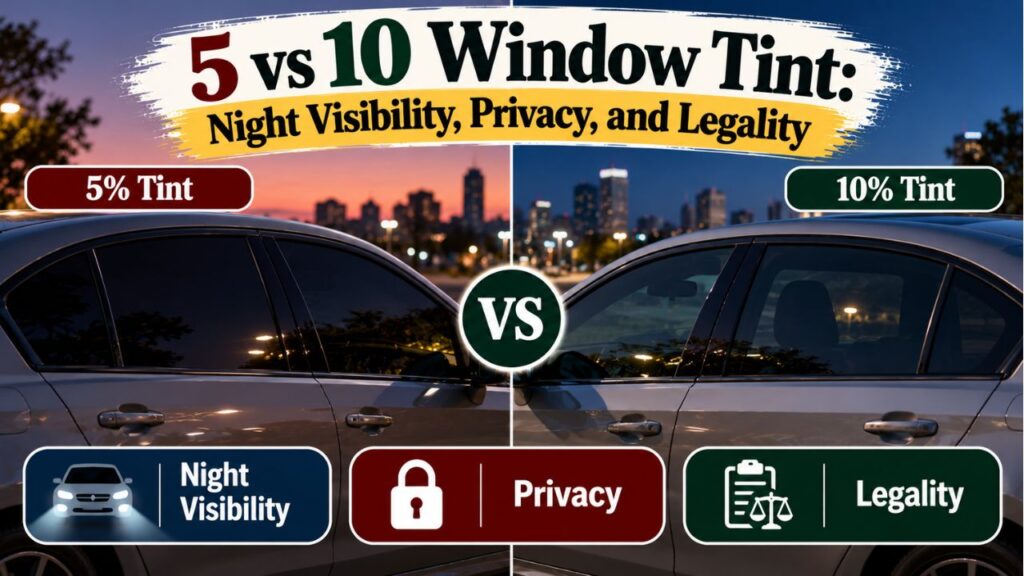
Both 5% and 10% window tint fall into the very dark end of the automotive tint range.
The difference is measured using Visible Light Transmission (VLT), which represents the percentage of visible light passing through the film.
A lower VLT means a darker tint.
| Feature | 5% window tint | 10% window tint |
| Visible light transmission | 5% | 10% |
| Visible light blocked | Approximately 95% | Approximately 90% |
| Appearance | Extremely dark | Very dark |
| Daytime privacy | Very high | Very high |
| Nighttime visibility | Severely reduced | Reduced, but better than 5% |
| Interior visibility from outside | Usually very limited in daylight | Limited in daylight |
| Glare reduction | Greater visible light reduction | Slightly less visible light reduction |
| Heat rejection | Depends on film technology | Depends on film technology |
| UV protection | Depends on film specifications | Depends on film specifications |
| Legal restrictions | Highly restrictive | Highly restrictive |
| Best consideration | Maximum darkness where permitted | Slightly more visibility with strong privacy |
These values describe nominal film transmission. The actual VLT of the finished window depends on the original glass and film combination.
What Does 5% Window Tint Mean?
5% window tint allows approximately 5% of visible light to pass through the film and blocks the remaining 95%.
This shade is commonly called limo tint because it creates an extremely dark appearance.
From outside, a vehicle with 5% tint may look nearly black through the treated windows, especially during bright daylight when the cabin is relatively dark.
However, 5% tint doesn’t create absolute privacy.
Under certain lighting conditions, people may still see silhouettes, illuminated objects, or details inside the vehicle.
The major disadvantage is limited outward visibility in low-light conditions.
What Does 10% Window Tint Mean?
10% window tint transmits approximately 10% of visible light, blocking the remaining 90%.
It is lighter than 5% tint but still considerably darker than common 20%, 35%, or 50% films.
During daylight, 10% tint can provide substantial privacy while allowing more light into the cabin than 5%.
The difference becomes particularly relevant when looking through the side windows at night.
However, 10% tint is still extremely dark for regular nighttime driving.
It shouldn’t be considered a safe or legal alternative to 5% without evaluating the vehicle, window location, and applicable tint restrictions.
How Much Darker Is 5% Than 10%?
A 5% film transmits half as much visible light as a 10% film.
The numerical difference is 5 percentage points of VLT, but the relative difference in transmitted visible light is 50%.
For example, under identical lighting conditions:
- A 10% film transmits 10 units out of every 100 units of incoming visible light.
- A 5% film transmits 5 units out of every 100 units.
- Both substantially reduce incoming light compared with untreated glass.
This doesn’t mean every driver will perceive an exact 50% difference in brightness. Human vision adapts to lighting conditions, and visual perception isn’t perfectly linear.
Still, the reduction is substantial when little ambient light is available.
5% vs 10% Window Tint for Privacy
Privacy is one of the main reasons drivers choose extremely dark tint.
Both shades limit how easily people can see inside a vehicle during daylight.
However, their effectiveness changes depending on lighting conditions.
Daytime Privacy With 5% Tint
A 5% film provides very strong daytime privacy.
When the outside environment is bright and the vehicle interior is relatively dark, the glass may appear almost opaque from outside.
This can make occupants and interior objects difficult to identify.
However, privacy depends on the viewing angle, exterior reflections, and interior lighting.
An observer standing close to the window may sometimes see more than someone standing farther away.
Likewise, light entering through an untinted windshield can illuminate the interior and reveal objects behind the dark glass.
Daytime Privacy With 10% Tint
A 10% film also provides substantial privacy.
The cabin may be slightly easier to see into than with 5%, particularly when sunlight reaches the interior.
However, the practical difference isn’t always dramatic during ordinary daytime viewing.
A vehicle with 10% tint can still have a very dark exterior appearance.
For many drivers, the additional darkness of 5% may provide only a modest improvement in daytime privacy compared with the greater reduction in outward visibility.
Does 5% Tint Provide Complete Privacy at Night?
No. Extremely dark tint doesn’t guarantee complete privacy at night.
If the vehicle interior is brightly illuminated while the surroundings are dark, people outside may still see through the windows.
For example, an overhead cabin light or bright phone screen may reveal an occupant’s face or other interior details.
This applies to both 5% and 10% films.
Window tint reduces visible light transmission in both directions. It doesn’t function as permanent one-way glass.
Key Takeaway: 5% provides greater darkness, but neither 5% nor 10% guarantees privacy under every lighting condition.
5 vs 10 Window Tint for Night Driving Visibility
Nighttime visibility is the most important practical difference between these two shades.
Both reduce the amount of light entering through the tinted window, but 5% creates a more severe restriction.
Can You See Through 5% Tint at Night?
Visibility through 5% tint at night can be extremely limited.
Bright headlights, illuminated signs, and nearby streetlights may remain visible, but darker objects can be difficult to recognize.
Potential problems include identifying:
- Pedestrians near intersections.
- Cyclists without bright lights.
- Curbs and parking barriers.
- Animals beside the road.
- Vehicles approaching from poorly illuminated areas.
- Objects near the vehicle while reversing.
The difficulty becomes greater on roads with limited street lighting.
A driver may struggle to judge distance or identify objects through a 5% side window, especially while turning or checking a blind spot.
For windows needed for driving visibility, 5% tint presents a significant concern.
Is 10% Tint Easier to See Through at Night?
Yes. Under otherwise comparable conditions, 10% tint transmits more visible light than 5%.
That generally provides a visibility advantage.
However, twice the visible light transmission doesn’t automatically mean adequate visibility.
A 10% tint still blocks approximately 90% of visible light passing through the film.
Dark clothing, poorly lit intersections, and objects without reflective surfaces may remain difficult to identify.
The difference between these shades shouldn’t be confused with the difference between a dark tint and a relatively clear window.
For regular nighttime driving, neither 5% nor 10% is a good choice for windows that must provide dependable outward visibility.
Driving on Rural Roads and Dark Highways
Low-light roads create additional challenges.
Streetlights may be absent, and obstacles may not be illuminated until the vehicle is close.
While headlights illuminate the road ahead, they don’t provide the same level of illumination through side windows.
During turns, lane changes, and parking maneuvers, drivers must observe areas that headlights may not fully illuminate.
A very dark side window can make this more difficult.
For drivers who frequently travel on rural roads or at night, choosing a substantially lighter and legally compliant tint is generally more practical.
Can Backup Cameras Make Dark Tint Safer?
Backup cameras can assist with reversing, but they don’t eliminate the visibility problems created by extremely dark film.
A camera may show objects behind the vehicle, yet it doesn’t replace direct observation of the surroundings.
Camera visibility also depends on lighting, lens cleanliness, image quality, and system limitations.
Drivers still need to check mirrors, surrounding traffic, pedestrians, and nearby obstacles.
Don’t rely on a backup camera to compensate for unsuitable window darkness.
5 vs 10 Window Tint for Heat Rejection
Many drivers assume that 5% tint must provide more heat protection than 10% because it blocks more visible light.
That isn’t always correct.
Window tint darkness and total solar heat rejection are different performance measurements.
A 10% ceramic film may reject more solar heat than a 5% basic dyed film.
Does 5% Tint Block More Heat Than 10%?
When comparing two shades within the same film series, the darker shade may reject more total solar energy.
However, the amount of improvement depends on the film construction.
A 5% dyed film primarily controls visible light and may offer relatively limited infrared performance.
A 10% ceramic film can use specialized materials to reject infrared energy while maintaining its particular VLT.
As explained in 3M’s guide to automotive tint darkness and legal limits, some advanced lighter films can reject more heat than darker conventional films.
The manufacturer also emphasizes the difference between film VLT and the final VLT of the installed glass-and-film combination.
What Is Total Solar Energy Rejection?
Total Solar Energy Rejection (TSER) describes the percentage of incoming solar energy rejected by a tested glass-and-film system.
For example, a window film with a published TSER of 55% rejects 55% of total solar energy under the specified testing conditions.
This metric is more useful for comparing overall solar heat control than VLT alone.
When evaluating 5% and 10% products, compare TSER values measured under similar conditions.
Avoid comparing one manufacturer’s film-only claim with another manufacturer’s installed-glass performance.
Does Infrared Rejection Matter More Than Darkness?
Infrared performance is an important part of solar heat control.
However, infrared rejection claims can use different measurement ranges.
Some products report rejection over a narrow infrared wavelength band, while others provide broader infrared energy measurements.
A film advertised with 95% infrared rejection doesn’t necessarily reject 95% of total solar energy.
Compare the manufacturer’s TSER and other relevant heat-control specifications instead of relying on a single promotional percentage.
Which Tint Is Better for Hot Climates?
In states with intense summer sunlight, heat-control technology can matter more than the difference between 5% and 10% darkness.
A high-performance ceramic film at a lighter, legally compliant VLT may provide a better balance of heat rejection and visibility.
For daily driving, that can be more useful than selecting the darkest available film.
Neither shade makes a parked vehicle safe for children or pets. Interior temperatures can still become dangerously high.
Does 5% Tint Block More UV Rays Than 10%?
Not necessarily.
Ultraviolet rejection depends on the film’s materials and UV-protective components.
Many quality automotive films provide high UV rejection at a wide range of visible tint percentages.
A lighter ceramic film may block a similar amount of UV radiation as a very dark dyed film.
This matters because UV protection and visible light transmission measure different parts of the light spectrum.
UV Protection vs. Visible Light Reduction
A 5% tint blocks approximately 95% of visible light.
That number doesn’t describe how much ultraviolet radiation the film blocks.
Similarly, a 10% tint blocks approximately 90% of visible light, but that doesn’t mean it blocks only 90% of UV radiation.
Check the manufacturer’s separate UV rejection specification.
For protecting interior upholstery, dashboards, and other materials from UV exposure, film quality is more important than simply choosing the darkest tint.
Is 5% or 10% Window Tint Legal?
Both shades face substantial legal restrictions in the United States.
Tint laws differ by state, vehicle category, window location, and applicable exemptions.
A shade permitted on a rear window may be prohibited on a front side window.
Do not assume that 5% or 10% tint is legal simply because a local installer offers it.
Legal Limits for Front Side Windows
Front side windows are important for driver visibility.
Many states require considerably more visible light transmission than either 5% or 10%.
Applying extremely dark film to driver and front-passenger windows can violate state requirements.
Windshield tint rules are generally even more restrictive, often limiting where tint can be applied and how much visible light must pass through.
Check the official rules for your state and vehicle before purchasing film.
Legal Limits for Rear Windows
Rear-window restrictions can vary by vehicle type.
For example, under Florida Statutes Section 316.2954, the general minimum visible light transmission for regulated rear-window tint is 15%.
Qualifying multipurpose passenger vehicles have a different rear-window minimum of 6%, subject to the law’s other conditions and exceptions.
That difference affects whether either shade might be permitted.
For example:
- A 5% film generally produces a finished window below the 6% minimum applicable to qualifying multipurpose passenger vehicles.
- A 10% film might meet that particular rear-window threshold if the final installed glass-and-film combination transmits at least 6% and all other requirements are satisfied.
- Neither shade ordinarily meets Florida’s 15% rear-window minimum for passenger cars subject to that requirement.
These examples concern Florida law, not a nationwide rule.
Medical exemptions, vehicle classifications, and other legal provisions may change the applicable requirements.
Why Installed VLT Matters More Than Film VLT
A film labeled 10% doesn’t necessarily produce a finished window with 10% light transmission.
The original glass already absorbs or reflects some incoming light.
Adding film reduces the combined transmission.
For example, consider original glass with 70% VLT.
| Film applied | Approximate combined VLT |
| 5% film | 3.5% |
| 10% film | 7% |
| 20% film | 14% |
| 35% film | 24.5% |
These are simplified estimates calculated by multiplying the glass and film transmission fractions.
Actual measured values can differ because of product specifications, wavelength behavior, and measurement conditions.
A professional tint installer can use a suitable meter to check the finished window.
Always compare the final measured value with the applicable legal limit.
5% vs 10% Tint Appearance on Different Vehicles
Both shades create a dark exterior appearance, but the effect varies with the vehicle’s glass, interior, and lighting.
Appearance on Sedans
A sedan with 5% tint on the rear windows may have an extremely dark appearance.
At 10%, the glass can still look nearly black under certain daylight conditions.
However, light entering through the windshield may make the interior more visible than expected.
For sedans, legal limits can be particularly important because some states distinguish passenger cars from multipurpose vehicles.
Appearance on SUVs and Trucks
SUVs and some trucks have factory privacy glass on the rear windows.
Adding aftermarket film can make those windows considerably darker.
For example, a rear window with factory privacy glass transmitting 20% of visible light would have an approximate combined transmission of 2% after adding a 10% film.
That is much darker than the 10% label alone suggests.
Factory privacy glass also may not provide the same solar heat rejection as a specialized window film.
Always measure the existing glass before adding another dark layer.
Does 5% Tint Look Blacker Than 10%?
Usually, yes.
A 5% film generally creates a darker appearance than a comparable 10% film.
However, the visible difference depends on viewing conditions.
During bright daylight, both may look extremely dark from outside.
At night, reflections, streetlights, and interior illumination can change how the windows appear.
Film color also matters. A charcoal ceramic film may look different from a dyed film with a blue or brown undertone.
Does 5% Window Tint Cost More Than 10%?
When comparing two shades within the same product series, installation costs are often similar.
The shade itself usually doesn’t require a significantly different installation process.
Pricing depends more on:
- Film brand and product line.
- Dyed, carbon, or ceramic construction.
- Number and size of windows.
- Vehicle glass curvature.
- Existing film removal.
- Installer labor.
- Warranty coverage.
A premium 10% ceramic film may cost more than a basic 5% dyed film.
Likewise, a 5% ceramic film may cost more than a conventional 10% dyed product.
Is Premium Ceramic Tint Worth Choosing?
Ceramic film may provide stronger heat-control performance than basic dyed tint, depending on the product.
It can also offer good color stability and low reflectivity.
However, ceramic technology doesn’t eliminate the visibility restrictions of a very dark shade.
A 5% ceramic film still transmits approximately 5% of visible light.
If nighttime visibility is the concern, paying for a premium ceramic film at the same darkness won’t solve the underlying problem.
Choose an appropriate VLT first, then compare film technologies.
Which Is Better: 5% or 10% Window Tint?
The better choice depends on the intended window location, driving conditions, and legal requirements.
However, 10% is generally preferable to 5% when comparing these two shades solely for outward visibility, because it allows more visible light through.
That doesn’t make 10% appropriate for every road-going vehicle.
Choose 5% Tint Only When Maximum Darkness Is Appropriate
A 5% film may appeal to drivers who want an extremely dark appearance.
It may also be considered for certain rear-window applications where it is explicitly permitted.
However, it creates substantial low-light visibility limitations.
Avoid treating 5% tint as a suitable choice for windows necessary for safe driving.
Its legal status must also be verified before installation.
Consider 10% Tint for Slightly Better Visibility
A 10% film offers more visible light transmission than 5% while retaining a very dark appearance.
It can provide strong daytime privacy.
However, the difference doesn’t eliminate night-driving concerns.
A 10% shade may still be too dark for safe operation or may violate local regulations.
It should be considered only where permitted and where adequate outward visibility can be maintained.
Choose a Lighter Tint for Regular Driving
For many vehicles used daily, a lighter film is the more practical solution.
Depending on applicable law, higher-VLT options such as 35%, 50%, or 70% may offer better outward visibility.
High-performance ceramic films can also provide meaningful solar heat control without requiring extremely dark glass.
The legal and safest choice depends on the vehicle, window location, and jurisdiction.
Best Choice by Driving Priority
| Driving priority | More suitable approach |
| Maximum darkness where legally permitted | 5% |
| Slightly better visibility between the two shades | 10% |
| Regular nighttime driving | A substantially lighter legal tint |
| Strong daytime privacy | Either, where permitted |
| Heat rejection | Compare TSER and film technology |
| UV protection | Compare verified UV rejection |
| Front side windows | Follow legal VLT requirements rather than choosing either dark shade |
| Dark rear-window appearance | Verify vehicle-specific legality and installed VLT |
These recommendations don’t override safety requirements or vehicle-specific restrictions.
Common Mistakes When Choosing 5% or 10% Tint
Assuming 10% Tint Is Safe at Night
Although 10% allows twice as much visible light through as 5%, it still blocks approximately 90%.
That can significantly reduce visibility through the window in dark conditions.
Choosing 5% Tint Only for Heat Protection
A darker shade doesn’t automatically provide better solar heat rejection.
A lighter, high-performance film may offer stronger heat control while preserving more visible light.
Compare actual product specifications.
Ignoring Factory Privacy Glass
Applying 5% or 10% film over already tinted glass can produce a much lower final VLT.
Measure the existing glass before installation.
Installing Dark Tint on the Windshield
Extremely dark windshield tint can seriously obstruct forward visibility and typically conflicts with legal light-transmission requirements.
Don’t apply 5% or 10% film across the windshield of a road-going vehicle.
Assuming Dark Tint Guarantees Privacy
Cabin lights, sunlight entering through other windows, and viewing angles can reveal the interior.
Never leave valuable belongings visible simply because the vehicle has very dark windows.
Ignoring Film Quality
Poor-quality film may develop discoloration, bubbles, peeling, or optical distortion.
Those defects can further interfere with visibility.
Choose a reputable product and qualified installer rather than focusing only on the advertised darkness.
How to Test 5% and 10% Tint Before Installation
If you’re comparing these shades, review both the physical appearance and the actual film specifications before paying for installation.
Compare Real Film Samples
Ask the installer to show the intended shades on glass.
Compare them under normal daylight conditions.
Observe the difference from both inside and outside the vehicle.
Pay particular attention to how much detail remains visible through the film.
A small sample won’t perfectly reproduce nighttime driving conditions, but it can help reveal differences in color and reflectivity.
Measure the Existing Window Glass
Use a suitable VLT meter to determine the current light transmission.
Then ask the installer to calculate the expected combined VLT and verify the result after installation.
Don’t rely solely on the shade printed on the film packaging.
Verify the Film’s Technical Specifications
Ask for the exact manufacturer and product series.
Review the published VLT, TSER, UV rejection, and other relevant specifications.
Compare films from the same product line when evaluating shade differences.
If heat rejection is the priority, don’t select a film based entirely on how dark it looks.
Conclusion
The 5 vs 10 window tint comparison comes down primarily to darkness, privacy, outward visibility, and legal restrictions.
A 5% tint allows approximately half as much visible light through as a 10% tint. This makes it darker and potentially more private during daylight, but also creates a more severe limitation when looking through the window at night.
A 10% tint provides a small practical advantage in visibility while maintaining a very dark appearance. However, it remains unsuitable for many driving windows and may violate state tint laws.
Neither shade is guaranteed to reject more solar heat than the other because heat-control performance depends on the film’s technology and specifications.
For regular driving, I recommend prioritizing safe outward visibility and legal compliance over maximum darkness. A lighter, high-performance ceramic film may offer a better combination of comfort, heat rejection, and usability.
If choosing specifically between 5% and 10%, 10% is the more reasonable option for visibility, but only where the finished window meets the applicable regulations and remains suitable for driving conditions.
FAQs About 5 vs 10 Window Tint
Is 5% Tint Twice as Dark as 10%?
A 5% film transmits half as much visible light as a 10% film.
However, that doesn’t mean it will look exactly twice as dark to the human eye. Perceived darkness depends on lighting, reflections, and the original window glass.
Is 10% Tint Considered Limo Tint?
The term limo tint is most commonly associated with 5% VLT.
However, 10% is also an extremely dark shade and may produce a similar exterior appearance under certain lighting conditions.
Can You See Out of 10% Tint at Night?
You may be able to see bright lights and illuminated objects, but visibility through 10% tint can be significantly restricted in dark environments.
Pedestrians, curbs, and other poorly illuminated objects may be harder to recognize. A lighter legal shade is generally preferable for windows used for driving visibility.
Does 5% Ceramic Tint Block More Heat Than 10% Ceramic Tint?
Not necessarily.
If both films belong to the same product series, their published solar energy rejection values will show the actual difference.
The darker film may reject more heat, but this must be verified using the manufacturer’s specifications rather than VLT alone.
Is 10% Tint Legal on Rear Windows?
It depends on the state, vehicle classification, and final installed VLT.
Some jurisdictions permit very dark rear-window tint on certain vehicles, while others require higher light transmission. Check the applicable rules before installing 10% film.
Can You Put 5% Tint Over 10% Tint?
Layering a 5% film over a 10% film would produce an approximate combined transmission of 0.5% through the films alone, before accounting for the glass.
That is extremely dark and can create serious visibility and legal problems. Film stacking can also cause installation or warranty issues, so it isn’t recommended without manufacturer approval.
Is 20% Tint Better Than 5% or 10% for Daily Driving?
A 20% film transmits more visible light than either 5% or 10%, making it generally easier to see through under comparable conditions.
However, 20% may still be too dark for certain windows and may not comply with local laws. A higher-VLT film may be more suitable, especially for frequent nighttime driving.