For most gasoline V8 vehicles, a quality jump starter in roughly the 1,000–2,000 peak-amp class can be enough, provided the manufacturer specifically rates it for your engine displacement. Large diesel V8s usually justify substantially more reserve—often 2,500–3,000 amps or a unit explicitly rated for the engine—because “V8” alone does not determine starting demand.
The most important specification is not the largest amp number printed on the case. Check the jump starter’s 12V compatibility, gasoline/diesel engine-size rating, and meaningful starting-current specification because peak amps are not standardized across manufacturers. Clore Automotive specifically warns that “peak amps” have no industry-agreed definition.
A Practical Jump Starter Size Guide for V8 Engines
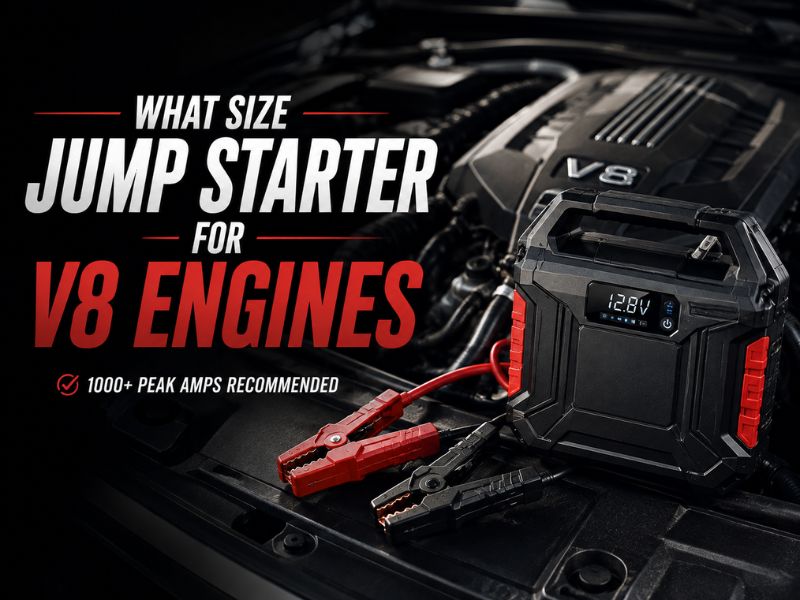
If you are choosing a jump starter without yet comparing individual products, this is a useful starting framework:
| V8 Application | Practical Starting Range |
| Smaller gasoline V8, roughly 4.0–5.5L | 1,000–1,500A class |
| Typical gasoline V8, roughly 5.0–6.5L | 1,500–2,000A class |
| Large gasoline V8, roughly 6.5–8.0L | 2,000A or manufacturer-rated equivalent |
| Smaller V8 diesel | 2,000A+ with correct diesel rating |
| Large V8 diesel around 6–7L | 2,500–3,000A class or specifically rated unit |
| Severe cold / deeply discharged battery | Choose additional reserve |
These are shopping ranges, not universal electrical requirements. Individual jump starters can outperform or underperform what their headline amp rating suggests.
For example, Schumacher currently sells a 1,000 peak-amp lithium jump starter rated for engines up to 8.0L gasoline and 6.0L diesel. Meanwhile, NOCO’s 1,000A GB40 is rated only up to 6.0L gasoline and 3.0L diesel.
That difference is exactly why sizing by engine rating is better than simply saying, “A V8 needs 1,500 amps.”
Is 1,000 Amps Enough for a V8?
It can be.
A reputable 1,000A jump starter may handle many gasoline V8 engines when the manufacturer explicitly rates it for them.
NOCO’s GB40, for example, is rated for gasoline engines up to 6.0 liters. That can cover numerous gasoline V8 applications with displacement at or below its stated limit.
Schumacher demonstrates how dramatically products can differ even at the same advertised output. Its FR01543 is also labeled 1,000 peak amps, yet Schumacher rates it for engines up to 8.0L gas and 6.0L diesel.
So the useful question is not:
“Is 1,000 amps enough for a V8?”
It is:
“Is this specific 1,000A jump starter rated for my V8’s displacement and fuel type?”
If yes, it can be enough.
If your engine is at the product’s maximum rating and you regularly experience severe winter weather, moving up a size can provide more comfortable reserve.
When 1,500 Amps Makes More Sense
For many gasoline V8 owners, 1,500A is a useful middle ground.
NOCO rates its 1,500A GB50 for engines up to 7.0L gasoline and 4.5L diesel.
That makes this general power class suitable for a broad range of gasoline V8 vehicles when the specific pack carries a comparable engine rating.
It also offers more margin than buying a jump starter whose maximum rating is almost identical to your engine displacement.
For example, if you have a 6.2L gasoline V8, a device rated only to 6.0L would technically fall short of its published application range, even if it might work in favorable conditions.
A unit rated to 7.0L or more is the more defensible choice.
Is a 2,000 Amp Jump Starter Better for a V8?
For large gasoline V8s, trucks, SUVs, and drivers who want more reserve, 2,000A is a strong class to consider.
NOCO’s GB70 is a 2,000A jump starter rated for gasoline engines up to 8.0L and diesel engines up to 6.0L.
Its newer 2,000A AX65 carries the same 8.0L gasoline and 6.0L diesel engine ratings.
Clore’s JNC325 provides another useful comparison. It is rated at 450 Start Assist Amps and can start gasoline engines up to 8.0L and diesel engines up to 6.0L.
That example reinforces an important point: a meaningful sustained-output rating can tell you more than comparing peak numbers from unrelated manufacturers.
For a large gasoline V8, a reputable 2,000A-class lithium pack with an 8.0L gas rating provides a reasonable combination of portability and reserve.
Diesel V8s Need More Careful Sizing
Do not use the gasoline rating for a diesel V8.
Manufacturers almost always give their jump starters a smaller diesel displacement rating than gasoline rating.
The NOCO GB50, for example, handles up to 7.0L gasoline but only 4.5L diesel. Its 2,000A GB70 increases those limits to 8.0L gas and 6.0L diesel.
For larger diesel V8s, you may need to move into the 2,500–3,000A range.
NOCO’s 2,500A GBX75 is rated for engines up to 8.5L gasoline and 6.5L diesel.
Its 3,000A GB150 extends the diesel rating to 7.0L, along with gasoline engines up to 9.0L.
This shows why diesel displacement should drive the decision.
If your diesel engine is 6.7 liters, for example, a unit explicitly rated only to 6.5L diesel falls slightly outside the manufacturer’s stated application range. A model rated for 7.0L diesel provides the clearer fit.
Why Peak Amps Can Mislead You
Peak amps are one of the least reliable ways to compare jump starters across brands.
Clore Automotive states that peak amps have no industry-agreed definition, so a peak rating from one manufacturer may not be directly comparable with another manufacturer’s figure.
Clore uses other specifications to describe sustained starting capability.
For lithium jump starters, it uses Start Assist Amps, defined as current delivered for five seconds at 32°F.
For example, its JNC325 uses a 450 Start Assist Amp specification while being rated for up to 8.0L gas and 6.0L diesel engines.
So don’t automatically assume:
2,000 peak amps = twice as powerful as 1,000 peak amps.
It may be more capable, but you need comparable test methods to quantify the difference.
For practical buying, the manufacturer’s engine-size rating is usually easier to apply.
Gasoline V8 vs. Diesel V8
Cylinder count does not tell the whole story.
A gasoline V8 and diesel V8 may both have eight cylinders, but manufacturers consistently rate the same jump starter for a smaller diesel displacement.
NOCO’s 2,000A GB70 illustrates this clearly: 8.0L maximum for gasoline versus 6.0L for diesel.
Schumacher follows the same pattern with several products, including its 1,000A FR01543, rated for 8.0L gas but 6.0L diesel.
Therefore, never shop solely for “a V8 jump starter.”
Know:
Fuel type + displacement + system voltage.
Those three pieces of information narrow the correct size much more effectively.
Cold Weather Is a Good Reason to Size Up
A jump starter that comfortably covers your V8 is preferable to one sitting exactly at its maximum engine rating when temperatures are very low.
Cold-weather starting can be demanding, particularly when the vehicle’s own battery is already weak.
Clore specifically discusses cold-weather starting capability in its lithium jump-starter guidance and rates certain products for V8 starting at temperatures below zero Fahrenheit.
You do not necessarily need to buy the biggest jump starter available just because you live somewhere cold.
But if you are choosing between a pack whose engine rating barely covers your V8 and one that offers comfortable headroom, the larger appropriately rated unit is generally the better emergency tool.
Battery Condition Changes How Difficult the Jump Is
There is a difference between a battery that is simply somewhat discharged and one that is extremely depleted.
Some smart lithium jump starters require an override function when battery voltage is too low for their automatic safety circuitry to recognize the battery normally.
Clore’s JNC325, for example, includes an override feature designed to enable jump starting of batteries measuring down to 0.0V, provided the operator has verified correct connections before enabling it.
This is important because a failed jump-start attempt does not always mean your V8 needs more amps.
The jump pack could be insufficiently charged, the clamps might have poor contact, or the battery voltage could be below the unit’s normal activation threshold.
Follow the exact instructions for your jump starter before deciding it is undersized.
Bigger Is Not Always Necessary
There is little reason to carry an extremely large professional jump starter for a modest gasoline V8 when a compact unit is explicitly rated for the engine.
A 5.0L gasoline V8, for example, falls comfortably inside the published engine range of several consumer lithium units.
The advantages of choosing only the capacity you reasonably need include lower weight, smaller physical size, and often lower cost.
On the other hand, a little reserve can be useful.
For a gasoline V8, moving from a marginal 1,000A unit to a well-rated 1,500–2,000A product can provide flexibility for larger vehicles and tougher starts without entering heavy commercial-jump-starter territory.
For a large diesel V8, more reserve is much more important.
Make Sure the Voltage Is Correct
Before worrying about amp ratings, verify the vehicle’s battery-system voltage.
The jump starter must be compatible with the electrical system it is being used on.
Many consumer automotive boosters discussed here, including the NOCO GB40, GB50, GB70, GBX75, and GB150, are 12V jump starters.
Do not assume that an extremely high amp rating makes a device appropriate for a different-voltage starting system.
Voltage compatibility comes first.
What I Would Choose for a Gasoline V8
For a typical gasoline V8 passenger vehicle or light truck, I would start by looking at reputable 1,500–2,000A-class lithium jump starters whose published engine rating comfortably exceeds the actual engine displacement.
That range is not a technical minimum.
As the Schumacher 1,000A example shows, some lower-rated products are officially specified for very large gasoline engines.
The reason to consider 1,500–2,000A is margin and selection: current models in that range commonly carry gasoline engine ratings around 7–8 liters. NOCO’s 1,500A GB50 reaches 7.0L, while its 2,000A GB70 reaches 8.0L.
For most gasoline V8 owners, that gives a straightforward way to choose without overbuying dramatically.
What I Would Choose for a Diesel V8
For a large diesel V8, I would prioritize an explicit diesel engine rating above the engine’s actual displacement.
If the engine is around 6 liters, quality 2,000A products may be sufficient; NOCO rates its GB70 at 6.0L diesel.
At roughly 6.5 liters, NOCO’s 2,500A GBX75 reaches 6.5L diesel.
For a diesel closer to 7 liters, its 3,000A GB150 is rated up to 7.0L.
Again, these are examples showing how manufacturers scale their products—not a claim that every 3,000A product has the same ability.
Frequently Asked Questions
How Many Amps Do I Need to Jump-Start a V8?
There is no universal amp requirement. For shopping purposes, 1,000–2,000A products can cover many gasoline V8s, while large diesel V8s frequently require a higher-rated unit. Use the manufacturer’s engine displacement rating as the deciding specification.
Is 1,000 Amps Enough for a V8?
It can be. NOCO rates its 1,000A GB40 up to 6.0L gasoline, while Schumacher has a 1,000A model rated up to 8.0L gasoline.
Is 1,500 Amps Enough for a V8?
For many gasoline V8s, yes. NOCO’s 1,500A GB50 is rated up to 7.0L gasoline.
Is 2,000 Amps Enough for a V8?
A reputable 2,000A unit can cover many large gasoline V8s. NOCO rates its GB70 up to 8.0L gasoline and 6.0L diesel.
What Size Jump Starter Do I Need for a 5.0L V8?
Choose a 12V jump starter whose manufacturer specifically rates it for at least a 5.0L gasoline engine, preferably with some additional margin. Many reputable 1,000–1,500A-class units meet that requirement.
What Size Jump Starter for a 6.2L V8?
For a 6.2L gasoline V8, choose a unit rated above 6.2L gas. A product rated for 7.0L or 8.0L gasoline provides a clear fit; current NOCO examples include the 1,500A GB50 at 7.0L and 2,000A GB70 at 8.0L.
What Size Jump Starter for a Large Diesel V8?
Large diesel V8s often warrant 2,500–3,000A-class equipment, but use the diesel displacement rating. NOCO rates its 2,500A GBX75 to 6.5L diesel and 3,000A GB150 to 7.0L diesel.
Are Peak Amps or Cranking Amps More Important?
Peak amps are difficult to compare because Clore says there is no industry-agreed definition. Cranking Amps or Start Assist Amps, when properly defined, provide a more meaningful sustained-output reference.
Can a Jump Starter Be Too Powerful for a V8?
The important requirement is using a jump starter designed for the vehicle’s correct system voltage and following its connection procedure. A larger current capability does not mean the starter continuously forces its full advertised peak current into the vehicle.
Should I Buy a Larger Jump Starter for Winter?
Some additional reserve can be sensible when you regularly start a large V8 in severe cold. Choose a product whose manufacturer supports the engine size and operating-temperature conditions rather than relying only on a larger peak-amp number.
What Size Jump Starter for V8 Engines Is Best?
For a typical gasoline V8, a reputable 1,500–2,000A-class jump starter with an engine rating comfortably above your engine displacement is a strong general choice. For a large diesel V8, look more toward 2,500–3,000A-class units or, more importantly, a model specifically rated for your diesel’s displacement.
Do not make the decision from cylinder count alone.
A 5.0L gasoline V8 and a large diesel V8 have very different starting requirements, and even two products with identical peak-amp labels can have substantially different published capabilities. Schumacher has a 1,000A model rated to 8.0L gas/6.0L diesel, while NOCO’s 1,000A GB40 is rated to 6.0L gas/3.0L diesel.
Clore’s warning about peak amps explains why: the term does not have an agreed industry definition.
The most reliable sizing formula is therefore simple: confirm voltage, identify your V8’s displacement and fuel type, choose a jump starter whose published engine rating exceeds those requirements, and allow extra margin for severe cold or difficult starting conditions.