Yes, a 1000 amp jump starter can be enough for many passenger cars, crossovers, SUVs, and some trucks, but the 1000A label alone does not determine what it can start. Current 1000A models illustrate the difference: NOCO rates its GB40 for engines up to 6.0L gasoline and 3.0L diesel, while Schumacher offers 1000A models rated as high as 8.0L gasoline and 6.0L diesel.
That variation is why you should size a jump starter by its manufacturer-rated engine capacity, fuel type, voltage, and meaningful starting-output specification, not simply choose the biggest peak-amp number you see.
What Can a 1000 Amp Jump Starter Actually Start?
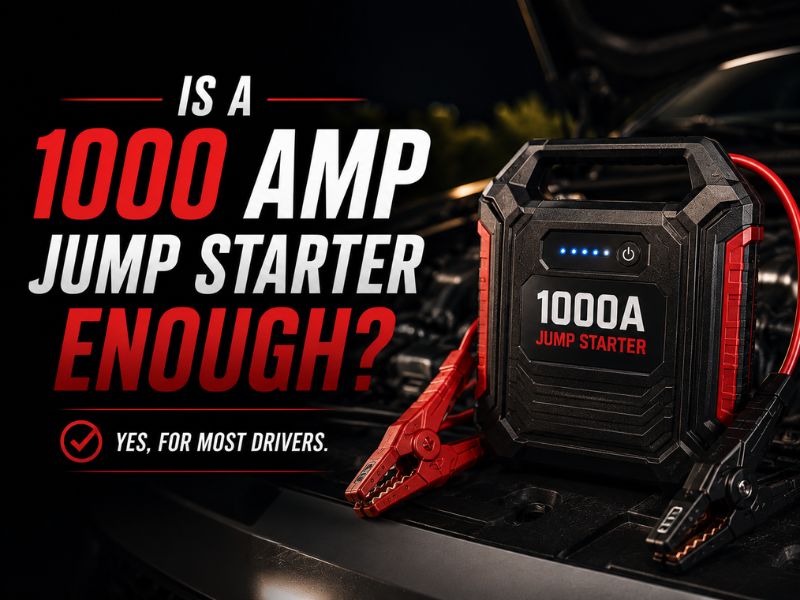
For many everyday vehicles, a quality 1000A jump starter provides useful starting capability.
A typical 12V gasoline four-cylinder or V6 often falls comfortably within the engine ratings of reputable 1000A products. Many gasoline V8s can also fall within the rating of particular 1000A models, although larger V8s require more attention to the exact product specification.
Current manufacturer examples make the range clear:
| 1000A Jump Starter Example | Gas Engine Rating | Diesel Engine Rating |
| NOCO GB40 | Up to 6.0L | Up to 3.0L |
| Schumacher FR01543 | Up to 8.0L | Up to 6.0L |
| Schumacher FR01578 | Up to 8.0L | Up to 6.0L |
These are manufacturer ratings for those exact models, not universal ratings for every 1000A jump starter.
The major takeaway is simple: two products marked 1000A can be rated for dramatically different engines.
Why 1000 Peak Amps Does Not Tell the Whole Story
Peak amps are useful as a rough product label, but they are poor for comparing unrelated jump starters.
Clore Automotive specifically says peak amps do not have an industry-agreed definition. The company describes the number as a loosely defined representation of maximum potential current rather than a standardized measure of sustained starting performance.
This creates a comparison problem.
A jump starter labeled 1000 peak amps from Brand A is not necessarily equivalent in real starting performance to a 1000 peak amp product from Brand B.
Clore illustrates the difference with its JNC305. That unit is marketed as 1000A, but Clore also provides a more specific 300 Start Assist Amp rating.
Start Assist Amps describe performance over a defined starting interval, making the figure more useful than an undefined peak number when comparing products using the same test method.
For normal buyers, however, the simplest comparison remains the manufacturer’s stated gasoline and diesel displacement rating.
Is 1000 Amps Enough for a 4-Cylinder?
Yes, a reputable 1000A jump starter rated for your engine is generally a strong class for common gasoline four-cylinder passenger vehicles.
NOCO’s 1000A GB40 is rated for gasoline engines up to 6.0 liters, which is well beyond the displacement of many four-cylinder passenger-car engines.
That does not mean every generic product displaying 1000A will perform identically.
Clamp quality, internal battery design, cable resistance, state of charge, temperature protection, and the manufacturer’s electronics can all influence whether a jump starter performs as expected.
For a typical small or midsize gasoline car, however, there is usually little reason to move to an enormous 3000A or 4000A pack solely because you think a 1000A rating is automatically too small.
Is 1000 Amps Enough for a V6?
For many gasoline V6 vehicles, yes.
A 3.0L, 3.5L, 3.6L, or similar gasoline V6 can fall within the published rating of products such as the NOCO GB40, which supports gasoline engines up to 6.0L.
Schumacher’s 1000A FR01543 carries an even higher stated gas-engine limit of 8.0L.
That makes a well-designed 1000A unit a practical category for many V6 cars, SUVs, and light trucks.
If you regularly face very cold weather or your engine is near the product’s maximum rating, choosing some additional power reserve may still be worthwhile.
Is 1000 Amps Enough for a V8?
Sometimes.
This is where looking only at the number 1000 can become misleading.
NOCO limits its GB40 to 6.0L gasoline, which means a 5.0L or 5.7L gasoline V8 could fit within its stated displacement range, while a 6.2L or larger V8 would exceed it.
Schumacher’s FR01543, on the other hand, is also rated at 1000 peak amps but supports gasoline engines up to 8.0L, according to Schumacher.
So the correct statement is not:
“1000 amps is enough for every V8.”
Nor is it:
“1000 amps cannot start a V8.”
The correct answer is:
Check whether that specific 1000A jump starter is rated for the displacement of your V8.
For a large V8 in a truck or SUV, especially in winter, moving into a 1500–2000A class with a comfortable manufacturer-rated margin can be a more conservative choice.
Diesel Engines Change the Answer
Diesel sizing should always be treated separately from gasoline.
Manufacturers typically give the same jump starter a lower diesel displacement rating.
For example, NOCO rates the GB40 at:
6.0L gasoline
3.0L diesel
for the same 1000A product.
This is why a 1000A unit that is easily adequate for a midsize gasoline SUV may be a poor choice for a large diesel pickup.
Schumacher again demonstrates that product design matters: its FR01543 1000A lithium unit carries a stated rating of up to 6.0L diesel.
Therefore, never assume all 1000A units have a 3.0L or 6.0L diesel limit.
Read the specification for the exact product.
Is 1000 Amps Enough for a Diesel Truck?
For a small diesel, it can be.
For a large pickup diesel, 1000A may be too close to the edge or outside the rating of many products.
A 6.7L diesel engine, for example, exceeds the published diesel limit of both the NOCO GB40 at 3.0L and Schumacher FR01543 at 6.0L.
For engines in that range, moving to a higher-output model specifically approved for large diesel displacement is more appropriate.
For comparison, NOCO’s 2000A GB70 is rated for up to 8.0L gasoline and 6.0L diesel—still below a 6.7L diesel.
This illustrates why diesel owners should never purchase based on peak amps without looking at the engine rating.
Cold Weather Makes Power Reserve More Valuable
A jump starter that works comfortably under mild conditions can face a more demanding situation during severe winter weather.
Jump-starter manufacturers specifically design certain models around cold-weather performance. Schumacher, for example, markets some of its lithium products with pre-heating technology intended to improve cold-temperature starting.
Clore also notes that cold-weather performance is an important measure of a lithium jump starter’s usefulness because low temperatures are frequently associated with vehicle battery starting problems.
For that reason, if your vehicle is near the maximum displacement rating of a 1000A unit and you regularly encounter severe cold, selecting the next size up can provide useful margin.
A 4.0L gasoline engine on a mild day is a very different assignment from a large truck engine after sitting overnight in extreme winter temperatures.
A Deeply Discharged Battery Can Also Change the Situation
The condition of the vehicle battery matters.
Some smart lithium jump starters will not automatically activate when the battery voltage is extremely low.
NOCO’s GB40, for example, provides a manual override mode for batteries below its normal detection threshold, including batteries below 2 volts. NOCO warns that this procedure should be used according to the product instructions because normal automatic safety behavior changes during override operation.
This means a failed jump-start does not necessarily prove that 1000 amps is insufficient.
Possible reasons include:
- Poor clamp contact
- An undercharged jump pack
- Extremely low vehicle-battery voltage
- Temperature protection
- Incorrect operating procedure
- A damaged battery
- A starter or vehicle problem unrelated to battery power
Check those issues before deciding that you simply need a larger amp rating.
Don’t Jump-Start a Frozen Battery
More power is not the answer to a physically unsafe battery.
NOCO’s GB40 instructions specifically warn against jump-starting a frozen battery.
If a battery is frozen, damaged, leaking, swollen, or otherwise visibly unsafe, follow the battery and vehicle manufacturer’s service procedure rather than connecting a larger booster.
A 2000A or 3000A jump starter does not make an unsafe battery safe.
Is 1000A Better Than 800A?
Not automatically.
One unusual but useful comparison comes from Schumacher.
Schumacher currently lists an 800 peak amp FR01549 with a rating of up to 8.0L gasoline and 6.0L diesel.
The company also sells 1000A products with similar engine-size ratings.
That tells you why simply saying “1000A is better because 1000 is larger than 800” can be misleading.
If two products use different internal batteries, cable designs, electronics, and rating methodologies, their peak labels do not provide a clean apples-to-apples comparison.
Clore’s warning that peak amps are not standardized reinforces that point.
Should You Buy 1500A Instead?
A higher-rated pack makes sense when it provides a genuinely higher engine-size rating or sustained starting capability, not merely because the box shows a larger number.
You may prefer more than 1000A if you have:
A large-displacement gasoline V8, a diesel truck, frequent subfreezing starts, multiple vehicles with different engine sizes, or an engine near the 1000A pack’s published maximum.
For a typical smaller gasoline vehicle, the extra capacity may not provide much practical benefit if a quality 1000A unit already comfortably meets the manufacturer’s engine rating.
Buying the right size is better than buying the largest advertised number.
Check Voltage Before Amperage
For most passenger vehicles discussed here, the jump starter will be designed for a 12V starting system.
The NOCO GB40, for example, is explicitly a 12V jump starter.
Voltage compatibility comes before amp capacity.
Do not assume that a large 1000A or 3000A current rating makes a device appropriate for a different-voltage electrical system.
If your equipment uses a 24V starting system, you need equipment specifically designed for that system.
Keep the Jump Starter Fully Charged
Even a correctly sized 1000A pack will disappoint you if its internal battery is nearly empty.
Jump starters need maintenance charging according to their manufacturer’s instructions, especially when they spend months in a trunk without being used.
Clore recommends keeping jump starters adequately charged and notes that extreme temperature exposure can increase the need for more frequent charging.
The label may say 1000A, but that rating assumes the device itself is in usable condition.
A half-dead jump pack is not the same tool as a fully charged one.
Frequently Asked Questions
Is 1000 Amps Enough to Jump-Start a Car?
Yes, for many cars. NOCO rates its 1000A GB40 for gasoline engines up to 6.0L and diesel engines up to 3.0L. Other 1000A products have different limits.
Is 1000 Amps Enough for a 4-Cylinder?
Generally, a reputable 1000A jump starter whose manufacturer approves the engine size should provide plenty of capacity for many gasoline four-cylinder passenger vehicles.
Is 1000 Amps Enough for a V6?
Often, yes. Products such as the 1000A NOCO GB40 carry gasoline engine ratings up to 6.0L, covering many common V6 displacements.
Can a 1000 Amp Jump Starter Start a V8?
Some can. NOCO’s 1000A GB40 supports gasoline engines up to 6.0L, while Schumacher sells 1000A products rated to 8.0L gasoline. Check the exact unit rather than the amp number alone.
Is 1000 Amps Enough for a Diesel?
It depends on displacement and product design. Current 1000A examples range from 3.0L to 6.0L diesel ratings, depending on the manufacturer and model.
Is 1000 Peak Amps the Same as 1000 Cranking Amps?
No. Clore says peak amps are loosely defined and not standardized, while ratings such as Start Assist Amps describe output using a more specific test.
Is a 1000A Jump Starter Better Than an 800A Unit?
Not necessarily. Schumacher has both 800A and 1000A products carrying engine ratings as high as 8.0L gasoline and 6.0L diesel, showing why the peak number alone is insufficient.
Should I Get 1000A or 2000A?
Choose the 1000A model if its published engine rating comfortably covers your vehicle. Consider 2000A or another higher class when you have a larger engine, diesel application, difficult winter conditions, or want greater verified engine-size capability.
Why Won’t My 1000A Jump Starter Start My Car?
Possible causes include inadequate charge in the booster, poor clamp contact, an engine beyond its rating, extreme battery discharge, temperature protection, or a vehicle fault unrelated to the battery. Some smart jump starters also require a special override procedure for extremely low-voltage batteries.
Can a 1000 Amp Jump Starter Damage a Small Car?
Use a jump starter only with a vehicle of the correct system voltage and according to the manufacturer’s instructions. A model designed and approved for passenger vehicles can cover engines smaller than its maximum rating; the key requirements are voltage compatibility and correct connection procedure.
Is a 1000 Amp Jump Starter Enough Overall?
A 1000 amp jump starter is enough for many gasoline cars, crossovers, SUVs, and some V8 applications when the specific unit is rated for the vehicle’s engine displacement. It can also work on smaller diesels, but diesel limits vary much more and should be checked carefully.
The 1000A number itself should not make the buying decision.
NOCO’s 1000A GB40 is rated for 6.0L gas and 3.0L diesel, while Schumacher has 1000A models rated for 8.0L gas and 6.0L diesel. That large difference demonstrates why two products carrying the same peak-amp number can have very different published capabilities.
Clore Automotive explains part of the reason: peak amps are not an industry-standardized comparison metric.
For a typical gasoline four-cylinder or V6, a quality 1000A unit with the proper engine rating is often a very practical size. For a larger V8, diesel pickup, or vehicle used in severe cold, choose a model with more verified starting margin rather than assuming 1000A will always be sufficient.
The best rule is straightforward: match the system voltage first, check the manufacturer’s gasoline or diesel displacement rating second, and treat the 1000A peak number as supporting information—not the final answer.