A dead battery and a lack of AC power can happen at the same time during camping, roadside emergencies, storms, or work away from an outlet. The best jump starter with inverter combines vehicle starting power with a built-in 120V AC outlet, letting one unit handle both automotive recovery and smaller household-style electrical loads.
The key is understanding inverter capacity. A 200W or 400W inverter can run or charge many low-power electronics, but it is not a replacement for a large portable power station or generator. High-draw heaters, microwaves, coffee makers, large power tools, and similar appliances usually exceed what these compact inverter-equipped jump boxes are designed to supply.
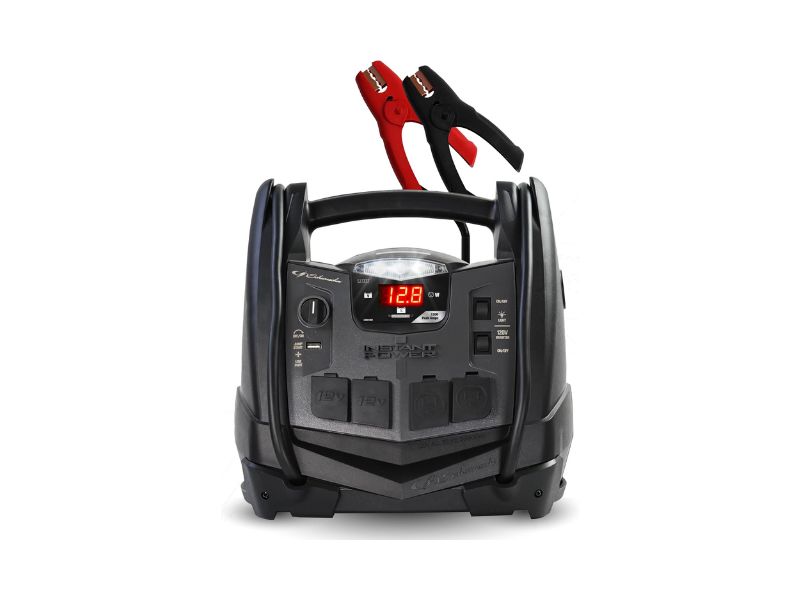
My primary recommendation is the Schumacher SJ1332 1200A Portable Power Station. I would choose it for most drivers who specifically want a jump starter, AC inverter, compressor, and USB charging in one unit. It combines 1200 peak amps, a 200W continuous / 400W peak inverter, two AC outlets, a 150 PSI compressor, USB power, and an internal AGM battery.
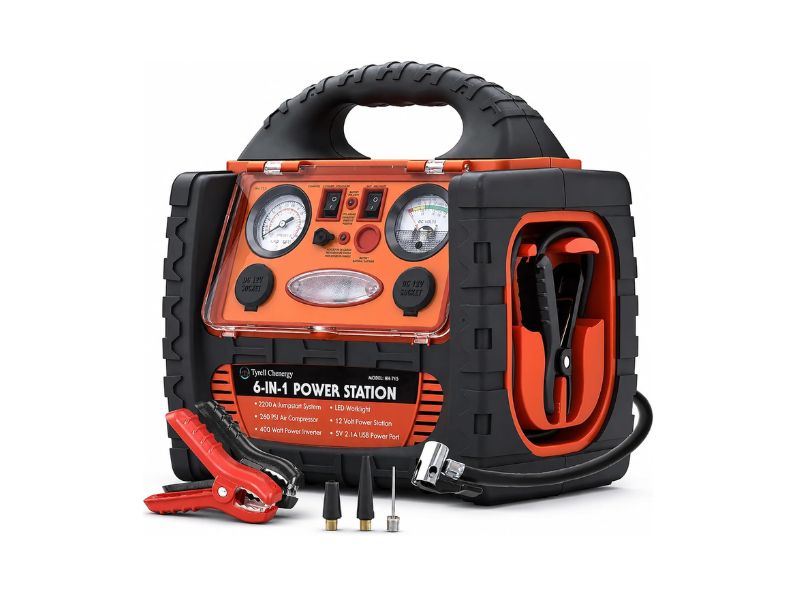
I would choose the Tyrell Chenergy 2200A Jump Starter with 400W Inverter when stronger advertised jump-start output and a higher-capacity inverter are the priorities. Its Amazon listing combines a 2200A jump starter, 400W power inverter, AC/DC connections, USB charging, and a high-pressure tire inflator.
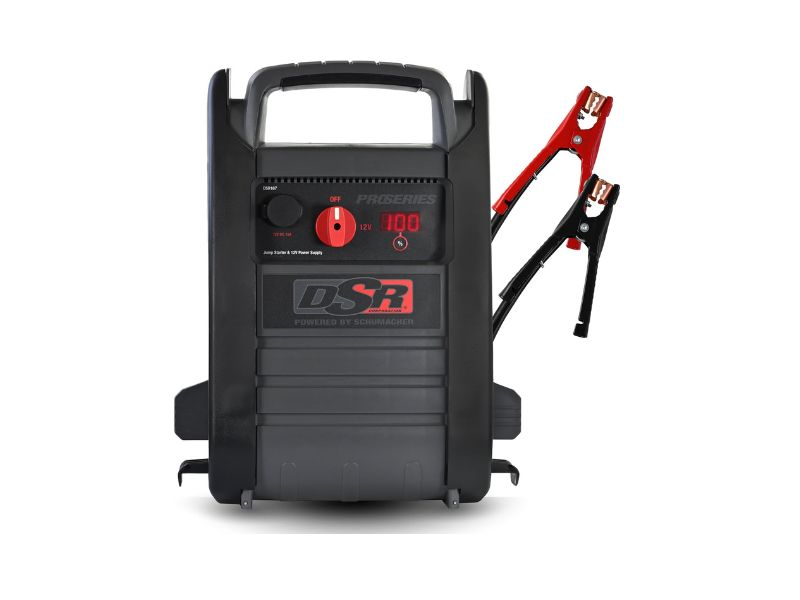
The Schumacher DSR167 2250A ProSeries Jump Starter is the professional-style alternative. I would choose it for a garage, work truck, farm, marina, or serious roadside kit because it provides 2250 peak amps, 525 cranking amps, 350 cold cranking amps, dual AC outlets, and a 400W inverter in a heavy-duty package.
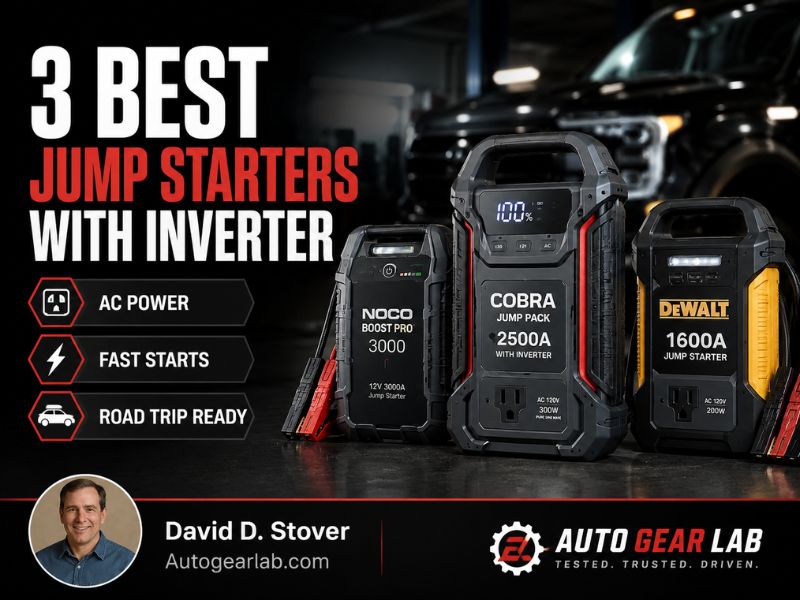
3 Jump Starters with Inverters Reviewed
| Image | Product Name | Check Price |
|---|---|---|
Best Choice | Check Price | |
Second Best | Tyrell Chenergy 2200A Jump Starter with 400W Power Inverter | Check Price |
Third Choice | Schumacher DSR167 2250A ProSeries Jump Starter with Inverter | Check Price |
These products are substantially different from pocket-size lithium jump starters. An inverter, larger internal battery, AC outlets, and—in some models—a compressor add useful capability, but also increase weight and storage requirements.
1. Schumacher SJ1332 1200A Portable Power Station
Key Features
- 1200 peak amps
- Suitable for up to 8.0L gas / 6.0L diesel per current listing
- 200W continuous / 400W peak inverter
- Two 120V AC outlets
- 150 PSI automatic digital air compressor
- Two 12V DC accessory outlets
- 2A USB-A port
- Sealed AGM battery
- Built-in LED area light
The SJ1332 is my primary recommendation because it integrates the functions that make an inverter-equipped jump starter genuinely useful rather than simply adding an AC socket to a battery box.
Schumacher specifies a 1200 peak-amp engine starter and a 400 peak-watt converter, feeding two 120V AC outlets. The current Amazon listing further describes the inverter as 200 continuous watts and 400 peak watts.
That continuous rating is the important number.
A 400W peak figure only describes brief surge capability. When powering an appliance for more than a moment, the 200W continuous limit is what should guide the decision.
Within that limit, the AC outlets can be useful for items such as:
- Small electronics chargers
- Camera-battery chargers
- Some laptops
- Low-power lighting
- Certain small fans
- Other modest AC loads
The unit should not be treated like a generator.
A household appliance labeled 600W, 1000W, or 1500W is beyond the continuous inverter rating even if its plug physically fits into the AC outlet.
The SJ1332 also contains a 150 PSI automatic digital compressor. That dramatically improves roadside usefulness because dead batteries and low tires are two common reasons drivers can become stranded.
The compressor includes digital pressure monitoring, while the unit also has inflator/deflator functionality for larger recreational inflatables. Schumacher positions it for camping, tailgating, and emergency power as well as vehicle service.
Two 12V DC accessory outlets add another type of portable power. These are useful for compatible automotive accessories that do not require conversion to household AC.
The 2A USB port handles phones, tablets, and other portable electronics without using the inverter. That is preferable whenever possible because converting the internal battery’s DC energy to AC and then back to DC through a wall charger wastes more energy.
The internal battery is a sealed AGM design.
Compared with modern lithium boosters, this means more weight and bulk. The tradeoff is a traditional power-station format designed to deliver jump-starting, inverter power, and compressor operation from one substantial battery.
The jump-start side is rated at 1200 peak amps. The current Amazon product information lists suitability for engines up to 8.0L gasoline and 6.0L diesel.
For many cars, SUVs, and pickups, that provides useful coverage.
A reverse hook-up alarm warns when the clamps are connected improperly. This is less sophisticated than some lithium smart-clamp systems, but it adds an important warning before a start attempt.
What I Like
- True 120V AC inverter built in
- Two AC outlets
- 200W continuous output is useful for small electronics
- Integrated compressor
- 12V DC and USB power
- Good all-in-one roadside capability
What I Do Not Like
- Much bulkier than a lithium jump starter
- 200W continuous inverter cannot handle large appliances
- AGM battery requires more storage space and maintenance attention
The SJ1332 is the most balanced choice for someone who genuinely wants jump starting, AC power, tire inflation, and USB charging in one box. Its inverter is modest, but the feature combination is highly practical for roadside and camping use.
2. Tyrell Chenergy 2200A Jump Starter with 400W Power Inverter
Key Features
- 2200A advertised peak output
- Designed for 12V vehicles
- 400W power inverter
- AC and DC power connections
- 2.1A USB port
- Integrated tire inflator
- Portable power-station functionality
- Battery clamps included
The Tyrell Chenergy unit is the more aggressive option when inverter output and advertised starting current matter.
Its current Amazon listing specifies a 2200A jump starter and 400W power inverter with AC/DC power connections and a 2.1A USB port.
That makes it attractive for buyers who want more AC capability than the SJ1332’s 200W continuous inverter.
A 400W-class inverter can support a broader range of small electronics and accessories, provided their actual operating and startup loads remain within the manufacturer’s limit.
For example, it may be better suited to:
- Laptop chargers
- Small TVs
- Low-power fans
- Camera equipment
- Battery chargers
- Certain small tools
- Camping electronics
Still, 400W is not high household power.
Anything containing a large heating element or substantial motor should be checked carefully. Startup surge can be significantly higher than the appliance’s normal running wattage.
The Tyrell also incorporates a tire inflator, giving it the same general multi-function appeal as the Schumacher SJ1332.
This matters because combining several emergency tools into one package reduces the amount of separate equipment stored in the vehicle.
The 2200A number sounds significantly stronger than the SJ1332’s 1200A specification, but cross-brand peak-amp numbers should not be treated as perfectly standardized measurements.
I would therefore look at real vehicle compatibility, internal battery design, cable construction, and the user’s intended engine rather than assuming the larger number makes it automatically more capable.
The unit is designed around 12V vehicle starting, making it appropriate for ordinary cars, SUVs, trucks, motorcycles, boats, RVs, tractors, and similar equipment according to the listing.
The USB port provides a more efficient way to charge compatible small electronics than using the AC inverter plus a wall adapter.
The biggest tradeoff is brand depth and documentation. Schumacher publishes more detailed technical information for its long-established power-station products, whereas the Tyrell listing relies more heavily on marketplace specifications.
For that reason, I would pay particular attention to the supplied manual’s inverter limits, duty-cycle guidance, battery recharge instructions, and any restrictions on simultaneous operation.
What I Like
- 400W inverter capability
- Strong advertised jump-start output
- AC, DC, and USB power options
- Built-in tire inflation
- Useful camping and emergency versatility
What I Do Not Like
- Peak amps are difficult to compare directly across brands
- Less detailed technical documentation than Schumacher
- Bulkier than a lithium-only jump starter
The Tyrell Chenergy is the stronger choice when 400W AC output matters more than selecting the most established professional brand. I would consider it for camping, road trips, and multi-purpose emergency power.
3. Schumacher DSR167 2250A ProSeries Jump Starter with Inverter
Key Features
- 2250 peak amps
- 525 cranking amps
- 350 cold cranking amps
- 400W power inverter
- Dual 110/120V AC outlets
- 2.1A USB output
- 12V DC outlet
- 60-inch 4-gauge cables
- Reverse-connection warning
- External automatic charger
The DSR167 is the product I would choose when jump-starting performance matters more than portability.
Schumacher’s ProSeries specification lists 2250 peak amps, 525 cranking amps, and 350 cold cranking amps. Those sustained-current figures provide more useful context than a peak number alone when comparing a professional-style jump box.
The unit also includes a 400W inverter with dual AC outlets, allowing it to operate modest electrical equipment when utility power is unavailable. Schumacher specifically positions it for small appliances and emergency, camping, and tailgating applications.
The 60-inch 4-gauge cables distinguish the DSR167 from compact consumer jump packs.
Longer cables are valuable when dealing with:
- Large truck engine bays
- Recessed batteries
- Remote jump terminals
- Marine batteries
- Farm equipment
- Work vehicles
The heavy conductors also help control voltage drop under substantial current.
A 2.1A USB port provides direct small-device charging, while the 12V DC outlet can power compatible automotive accessories without involving the inverter.
This is important for energy efficiency.
Every time battery energy is converted from DC to AC, some energy is lost as heat. If an accessory can run directly from 12V DC or USB, using those outputs often preserves more of the internal battery.
The DSR167 also has an automatic external charger for maintaining its internal battery.
That makes sense for a workshop environment where the jump box can return to a charging location after use.
The major drawback is weight.
Schumacher lists the comparable ProSeries 2250A inverter platform at about 31 pounds, so this is not something I would buy for casual storage in a small sedan unless I specifically needed the professional capability.
It makes far more sense in a service truck, garage, farm shop, marina, or RV.
What I Like
- Published cranking and cold-cranking ratings
- 400W inverter
- Dual AC outlets
- Long 60-inch heavy-duty cables
- USB and 12V DC power
- Better suited to repeated professional-style starting
What I Do Not Like
- Heavy and bulky
- Less convenient for normal passenger-car storage
- Overkill for occasional small-car emergencies
The DSR167 is the strongest professional-style option in this group. I would choose it when heavy cables, sustained cranking capability, and 400W inverter power matter more than weight.
Jump Starter with Inverter Comparison
| Product | Peak Starting Output | Inverter | AC Outlets | Compressor | USB | Best Use |
| Schumacher SJ1332 | 1200A | 200W continuous / 400W peak | 2 | 150 PSI | 2A USB-A | Best all-around roadside power station |
| Tyrell Chenergy | 2200A advertised | 400W | Yes | Integrated inflator | 2.1A | Higher inverter output and multi-use power |
| Schumacher DSR167 | 2250A / 525 CA / 350 CCA | 400W | 2 | No | 2.1A | Garage, truck, farm, and professional use |
The SJ1332 is the most balanced product because it provides AC power, a compressor, USB output, 12V outlets, and useful starting capability in one package.
The Tyrell Chenergy places more emphasis on the 400W inverter and 2200A advertised jump-start rating.
The DSR167 gives up the integrated compressor but adds professional-style cables and published cranking performance.
How to Choose the Best Jump Starter with Inverter
Check Continuous Inverter Watts First
This is the most important inverter specification.
Continuous watts describe the electrical load the inverter can sustain during normal operation.
Peak or surge watts describe a higher output available only briefly.
The SJ1332, for example, is rated at 200W continuous and 400W peak.
If an appliance requires 300W continuously, a 200W inverter is not appropriate even though the packaging says 400W peak.
Add Up the Wattage of Connected Devices
If two AC outlets are present, the inverter’s maximum rating is generally shared between them.
Connecting a 100W device to one outlet and a 150W device to another produces approximately a 250W combined load.
That exceeds a 200W continuous inverter.
Do not assume each outlet gets the full inverter rating independently.
Watch for Motor Startup Surge
Motorized equipment may temporarily draw far more power during startup than it consumes while running.
Examples include:
- Small refrigerators
- Pumps
- Fans
- Compressors
- Certain power tools
A 300W motor might briefly require much more than 300W when starting.
This is why both continuous and surge ratings matter.
Avoid High-Wattage Heating Appliances
Heating elements consume large amounts of power.
A small inverter jump starter generally should not be expected to run:
- Space heaters
- Hair dryers
- Electric kettles
- Toasters
- Hot plates
- Large coffee makers
- Microwaves
These devices commonly exceed the output of 200W–400W portable inverters.
Use USB Instead of AC When Possible
If you are charging a phone, use the USB port.
Running the internal battery through an inverter to produce 120V AC and then converting that AC back to low-voltage DC through a phone charger wastes energy.
Direct USB charging is simpler and generally more efficient.
Use 12V DC for Compatible Accessories
The same logic applies to 12V accessories.
If a tire inflator, cooler, or other device can run directly from a 12V DC outlet, there is little reason to convert the battery’s DC power to AC first.
The DSR167 and SJ1332 both provide useful DC power options.
Jump Starter Battery Type Matters
Many inverter-equipped power stations use sealed AGM lead-acid batteries rather than the lithium cells found in compact jump packs.
AGM has several advantages for this product category:
- Strong high-current capability
- Familiar charging architecture
- Stable workshop use
- Proven jump-box design
The disadvantages are substantial:
- More weight
- Greater physical size
- More energy lost to self-discharge over time
- Battery eventually requires replacement or unit retirement
The SJ1332 uses a sealed AGM battery.
This explains why it is considerably larger than a pocket-style lithium jump starter.
How Much Inverter Power Do You Need?
For phone and tablet charging, you probably do not need the inverter at all. Use USB.
For laptop chargers, small TVs, LED lighting, cameras, and low-power electronics, 200W can be enough if the device label confirms the requirement.
For moderate small appliances, a 400W inverter offers more flexibility.
For anything regularly demanding 500W, 1000W, or more, a jump starter with a small inverter is the wrong category. A dedicated portable power station is more appropriate.
Pure Sine Wave vs Modified Sine Wave
Inverter waveform can matter for sensitive electronics.
A pure sine wave inverter produces AC power more similar to household utility power.
A modified sine wave inverter uses a stepped waveform and can work with many ordinary chargers and basic appliances, but certain sensitive electronics, audio equipment, motors, and medical devices may behave poorly.
If you intend to power sensitive equipment, check the exact inverter waveform specification rather than assuming all 120V outlets provide identical power quality.
When a manufacturer does not clearly state pure sine wave output, I would not assume it.
Think About Battery Runtime
A jump starter’s inverter does not create energy.
Its runtime depends on the internal battery capacity, inverter efficiency, and connected load.
A high-wattage appliance drains the unit dramatically faster than a phone charger.
This also means using the inverter can reduce the energy available for jump-starting.
If the vehicle battery is already weak, I would preserve sufficient battery capacity for the vehicle before running unnecessary AC devices.
Look at Cable Length and Gauge
Starting power has to travel through the jumper cables.
Long cables provide better reach, but longer conductors also increase resistance unless they are sufficiently thick.
The DSR167 addresses this with 60-inch 4-gauge cables, making it much better suited to large engine bays and professional use than many compact packs.
For normal passenger cars, shorter cables are usually easier to manage.
Consider a Built-In Compressor
A compressor adds considerable roadside value.
The SJ1332 combines its jump starter and inverter with a 150 PSI automatic digital compressor.
That allows one emergency unit to address both a discharged battery and a low tire.
Keep in mind that compressor operation draws from the same internal battery as the jump starter and inverter.
If both the tire and vehicle battery need attention, conserve enough energy for the more urgent task.
Do Not Compare Peak Amps Across Brands Blindly
Peak-current numbers are useful, but they are not necessarily measured using an identical industry method across every manufacturer.
The DSR167 is informative because Schumacher publishes:
- 2250 peak amps
- 525 cranking amps
- 350 cold cranking amps
Those additional figures help show sustained starting capability.
I would place more confidence in a complete specification set than in a single enormous headline number.
Recharge After Every Significant Use
Using the inverter, compressor, USB ports, or jump-start function all drain the internal battery.
Recharge the power station after:
- Jump-starting
- Running AC appliances
- Inflating several tires
- Extended USB charging
- Long periods in storage
A multi-function unit is only useful if its internal battery is ready when needed.
How to Use the Inverter Safely
1. Check the Appliance Wattage
Read the device label or power adapter.
Confirm that the required continuous watts stay below the inverter’s rating.
2. Turn the Inverter Off Before Connecting
Begin with the AC inverter switched off unless the product manual specifies otherwise.
3. Plug In the Appliance
Make sure the AC connector fits securely.
4. Turn the Inverter On
Watch for overload warnings or abnormal operation.
5. Stop if the Unit Becomes Excessively Hot
Inverters generate heat during conversion.
Never block ventilation openings.
6. Avoid Moisture
Do not expose open AC outlets to rain or standing water.
7. Turn the Inverter Off When Finished
Leaving it active can continue drawing battery power even after the connected appliance is removed.
How to Jump-Start a Vehicle Safely
1. Check System Voltage
These recommendations are intended primarily for compatible 12V vehicles.
2. Inspect the Vehicle Battery
Do not attempt to jump-start a battery that is:
- Frozen
- Cracked
- Swollen
- Leaking
- Smoking
- Unusually hot
3. Turn Off the Inverter and Accessories
Do not run AC devices while preparing a vehicle jump unless the manufacturer explicitly allows simultaneous operation.
4. Connect the Positive Clamp
Attach red to the approved positive battery or jump terminal.
5. Connect the Negative Clamp
Attach black to the manufacturer-specified negative or chassis-ground point.
6. Check the Polarity Warning
Correct any reverse-connection alarm before continuing.
7. Activate the Jump-Start Function
Follow the unit-specific procedure.
8. Crank Briefly
Do not hold the starter continuously.
Follow the product’s maximum crank time and cooldown guidance.
9. Disconnect After Starting
Remove clamps in the sequence specified by the vehicle and jump-starter manuals.
10. Recharge the Power Station
Do not return it to storage partially discharged.
Common Jump Starter with Inverter Mistakes
Confusing Peak Watts With Continuous Watts
A 400W peak inverter may only support 200W continuously.
Trying to Run a Microwave or Heater
Most jump-starter inverters are far too small for high-wattage heating appliances.
Running Devices Until the Battery Is Empty
Preserve enough reserve for vehicle starting.
Using AC for a USB Device
Direct USB charging normally wastes less stored energy.
Ignoring Startup Surge
Motors can require much more power during startup than while running.
Buying by Peak Amps Alone
Cable design, battery type, engine compatibility, and sustained cranking capability also matter.
Forgetting the Weight
Inverter-equipped AGM jump boxes are often significantly heavier than lithium boosters.
Leaving the Unit Uncharged
A 30-pound jump box with an empty internal battery is still useless during an emergency.
Frequently Asked Questions
What is the best jump starter with inverter?
The Schumacher SJ1332 is the best balanced choice for most multi-purpose users.
It combines 1200A starting power, two AC outlets, a 200W continuous/400W peak inverter, a 150 PSI compressor, 12V power, and USB charging in one emergency unit.
What does an inverter do on a jump starter?
It converts the jump starter’s DC battery power into household-style AC power.
This allows compatible 110V or 120V devices to plug into an AC outlet when grid power is unavailable.
Can a jump starter inverter run a laptop?
Yes, many laptop chargers fall within a 200W or 400W inverter’s limits.
Check the charger’s maximum input wattage first. USB charging may be more efficient if the laptop and jump starter support an adequate direct USB-C output.
Can a 200W inverter run a TV?
Some small TVs can run below 200W, but you must check the actual label.
Television power consumption varies widely by screen size and technology. Stay under the inverter’s continuous limit.
Can a 400W inverter run a refrigerator?
Usually not reliably without checking both running watts and startup surge.
Refrigerator compressors can draw substantially more power during startup than their steady-state rating, potentially exceeding a small inverter’s surge capability.
Can a jump starter inverter run a coffee maker?
Most standard coffee makers draw too much power for 200W–400W inverters.
Many heating appliances require several hundred to more than 1000 watts. Check the appliance rating before connecting it.
Can a jump starter with inverter run a microwave?
Generally no; typical microwaves exceed the output of compact jump-starter inverters.
A larger dedicated portable power station or generator is usually needed.
Is 200W enough for an inverter?
It is enough for small electronics, chargers, lighting, and certain low-power devices.
It is not enough for most heating appliances or large motor-driven equipment.
Is 400W inverter power better than 200W?
It provides more appliance flexibility, but it also drains the internal battery faster under heavier loads.
Buy according to the equipment you actually need to run.
What is the difference between peak and continuous inverter watts?
Continuous watts describe sustained output; peak watts describe short temporary surge capability.
Continuous wattage should be your main specification when deciding whether an appliance is compatible.
Can I use both AC outlets at once?
Yes when the combined load remains within the inverter’s total continuous rating.
Two 120W devices would require about 240W combined, which would exceed a 200W continuous inverter.
Can I charge my phone from the inverter?
You can, but the built-in USB port is normally more efficient.
Using the inverter converts DC to AC and then the phone adapter converts AC back to DC, wasting additional energy.
Can the inverter damage electronics?
Sensitive equipment can be affected by poor waveform quality or unstable power.
Check whether the inverter supplies pure sine wave or modified sine wave power before connecting sensitive electronics.
Is a jump starter with inverter better than a portable power station?
It is better when vehicle jump-starting is the priority; power stations are better for larger AC loads.
A dedicated portable power station usually provides much higher energy capacity and inverter output, but may not include high-current vehicle jump clamps.
Can I jump-start while the inverter is running?
I would turn the inverter and unnecessary loads off before jump-starting.
This preserves battery capacity and avoids competing demands unless the manufacturer’s manual explicitly permits simultaneous use.
Does a compressor reduce jump-starting power?
Yes, both functions draw energy from the same internal battery.
Inflating tires before starting can reduce the reserve available for a difficult vehicle jump.
Is 1200A enough for a car?
Yes, a properly rated 1200A jump starter can cover many gasoline cars and SUVs.
The SJ1332’s current listing states compatibility up to 8.0L gasoline and 6.0L diesel applications.
Is 2250A enough for a truck?
It can provide substantial capability for compatible 12V trucks and work vehicles.
The DSR167 also publishes 525 cranking amps and 350 cold cranking amps, giving more context than peak amps alone.
How often should I recharge an inverter jump starter?
Recharge it after significant use and check its charge regularly during storage.
Inverter use, compression, USB charging, and jump-starting all reduce the same internal battery reserve.
Conclusion
The best jump starter with inverter should provide enough vehicle-starting capability while offering an AC output that actually matches the equipment you intend to power. Continuous inverter wattage, battery design, AC outlets, USB and DC connections, cable quality, and overall portability matter just as much as the jump starter’s headline peak amps.
The Schumacher SJ1332 remains my primary recommendation for most drivers. Its 200W continuous / 400W peak inverter, dual AC outlets, 1200A starting capability, 150 PSI compressor, USB connection, and 12V accessory outputs make it the strongest all-around emergency package.
The Tyrell Chenergy 2200A is more appealing when a 400W inverter and higher advertised jump-start output are priorities. It combines AC/DC power, USB charging, and tire inflation in a versatile multi-purpose design.
The Schumacher DSR167 is the professional alternative. Its 2250 peak amps, 525 cranking amps, 350 cold cranking amps, 60-inch 4-gauge cables, and 400W inverter make it better suited to garages, farms, service trucks, and demanding repeated use.
For most roadside and camping applications, I would choose the Schumacher SJ1332. It does not have the largest amp or inverter numbers, but its combination of starting power, AC electricity, tire inflation, USB charging, and straightforward all-in-one operation provides the most useful overall balance.