A V8 engine can demand considerably more starting power than a small four-cylinder, especially when the battery is deeply discharged or temperatures drop. The best jump starter for V8 engines should provide enough gasoline-engine displacement headroom while remaining easy to connect, portable enough to keep in the vehicle, and dependable during an actual roadside emergency.
Cylinder count alone is not enough to size a booster. A 5.0L or 5.7L V8 has different requirements from a 6.2L or 6.4L V8, so I would compare the jump starter’s published gasoline-engine displacement limit before focusing on the peak-amp number. NOCO rates the three models here from 6.0L to 8.0L gasoline engines.
My primary recommendation is the NOCO Boost GB40 1000A Lithium Jump Starter for V8 engines at or below its 6.0L gasoline limit. I would choose it for many 5.0L, 5.3L, and 5.7L applications because its compact 24Wh lithium pack, reverse-polarity protection, spark-resistant connection, IP65 enclosure with closed ports, and 1000A output provide a strong balance of portability and starting capability.
I would choose the NOCO Boost GB70 2000A Lithium Jump Starter for larger V8 pickups and SUVs, especially 6.2L and 6.4L applications or drivers who want substantially more winter reserve. NOCO rates it for gasoline engines up to 8.0L, with a 56Wh battery, 400-lumen light, IP65 enclosure, and 12V accessory output.
The NOCO Boost GB50 1500A Lithium Jump Starter sits between them. Its 7.0L gasoline rating makes it a practical step up for larger V8s while keeping the pack smaller and lighter than the GB70.
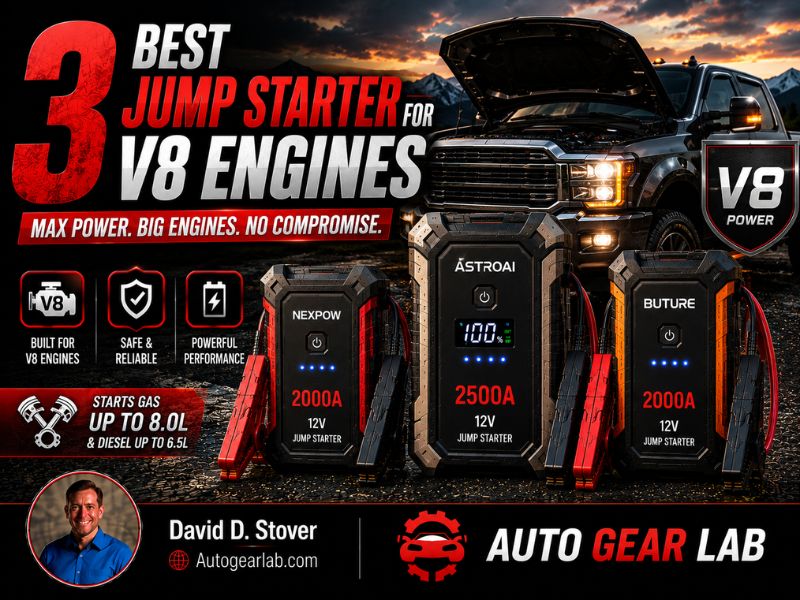
3 Jump Starters for V8 Engines Reviewed
| Image | Product Name | Check Price |
|---|---|---|
Best Choice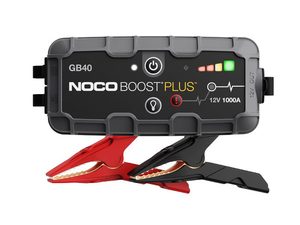 | NOCO Boost GB40 1000A Lithium Jump Starter | Check Price |
Second Best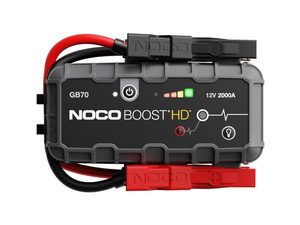 | NOCO Boost GB70 2000A Lithium Jump Starter | Check Price |
Third Choice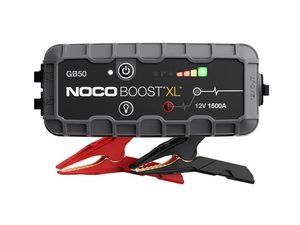 | NOCO Boost GB50 1500A Lithium Jump Starter | Check Price |
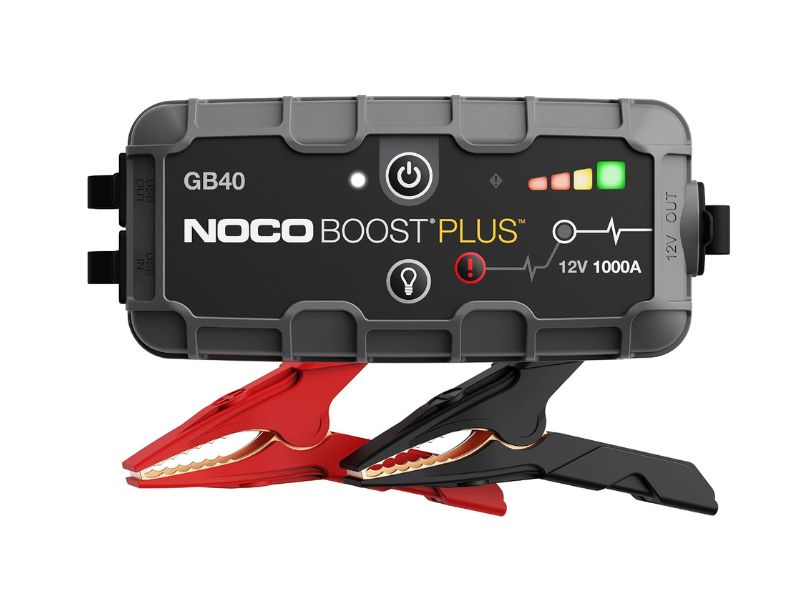
1. NOCO Boost GB40 1000A Lithium Jump Starter
Key Features
- 1000A peak output
- 12V lithium-ion jump starter
- Gasoline engines up to 6.0L
- Diesel engines up to 3.0L
- 24Wh internal battery
- Reverse-polarity protection
- Spark-resistant normal connection
- IP65 with ports closed
- 100-lumen LED flashlight
- USB device charging
- Approx. 2.4 lb with accessories
The GB40 is my primary recommendation for V8 owners whose engines stay inside its published 6.0L gasoline limit.
NOCO rates the unit at 1000A and explicitly supports gasoline engines up to 6.0 liters. That means it has manufacturer-rated displacement coverage for many common V8 configurations below that ceiling.
This distinction matters.
A buyer searching for a V8 jump starter might assume that every eight-cylinder engine requires a 2000A or 3000A booster. That is not necessarily true.
A 5.0L gasoline V8 and a 6.4L gasoline V8 are both V8s, but only the smaller engine falls inside the GB40’s 6.0L published ceiling.
For engines within that range, the GB40’s strongest advantage is portability.
NOCO specifies a 24Wh lithium-ion battery and a total weight of approximately 2.4 pounds with clamps and accessories.
That makes it substantially easier to keep beneath a truck seat, in an SUV cargo organizer, or inside a roadside emergency bag than a traditional lead-acid jump box.
Its normal connection system also provides spark-resistant technology and reverse-polarity protection.
Reverse-polarity protection helps when the clamps are accidentally connected backward.
Spark-resistant operation reduces the chance of connection sparks during normal protected use.
Those systems are valuable when a jump starter may sit unused for months and then be handled by someone who does not routinely work around vehicle batteries.
Still, always identify the correct positive terminal and approved negative or chassis-ground point before connecting.
The GB40 also carries an IP65 enclosure rating with the ports closed. NOCO specifies an operating range of approximately -4°F to 122°F.
IP65 adds useful protection against dust and water jets, though the unit should not be submerged.
For winter use, the published operating range does not mean cold has no effect. Vehicle batteries and lithium jump packs both provide less effective performance in severe cold, while cold engine oil can increase cranking resistance.
That is one reason I would move to a higher-capacity booster if a V8 operates near the GB40’s maximum engine limit in a severe winter climate.
The GB40 also includes a 100-lumen flashlight and USB power capability.
The flashlight is useful around large V8 engine compartments at night, while USB charging can keep a phone powered during a breakdown.
Preserve the jump starter’s energy for starting first when the vehicle battery is already dead.
One limitation deserves special emphasis: do not choose the GB40 for a gasoline V8 larger than 6.0L simply because it is the first product in this ranking.
A 6.2L or 6.4L engine sits outside NOCO’s published GB40 gasoline limit.
For those applications, the GB50 or GB70 is the better fit.
What I Like
- Excellent choice for V8s up to 6.0L
- Compact 2.4-pound package
- Reverse-polarity protection
- Spark-resistant connection
- IP65 enclosure with closed ports
- Easy to keep permanently in a vehicle
What I Do Not Like
- Not rated for gasoline engines above 6.0L
- Less energy reserve than GB50 or GB70
- Basic 5V USB system
- Smaller winter margin for large V8s
For a V8 that falls comfortably below 6.0L, the GB40 is the model I would keep in the vehicle. Its compact size makes it especially practical for everyday emergency storage without carrying unnecessary capacity.
2. NOCO Boost GB70 2000A Lithium Jump Starter
Key Features
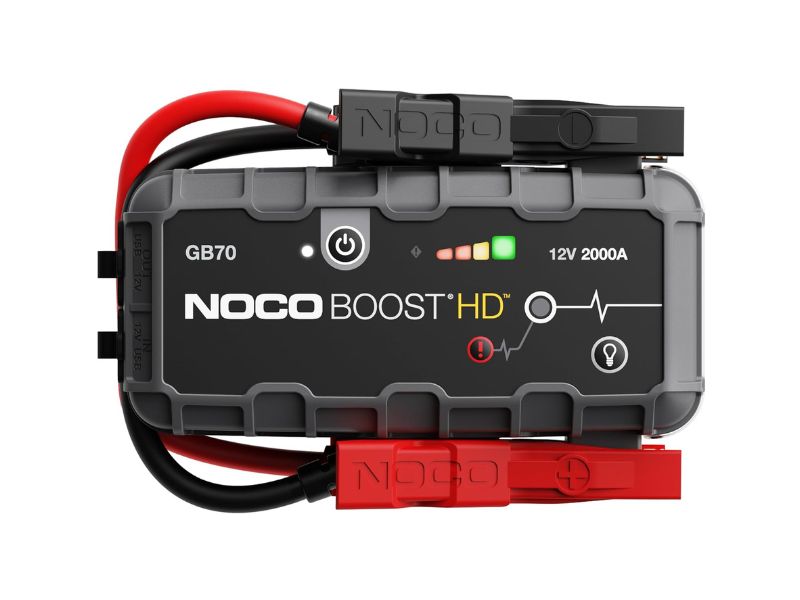
- 2000A peak output
- Gasoline engines up to 8.0L
- Diesel engines up to 6.0L
- 56Wh lithium-ion battery
- Reverse-polarity protection
- Spark-resistant normal operation
- IP65 with ports closed
- 400-lumen LED flashlight
- 12V/15A accessory output
- Approx. 5 lb with accessories
The GB70 is the model I would choose when V8 compatibility matters more than minimizing size.
NOCO rates it for gasoline engines up to 8.0L, giving it enough published displacement headroom for 6.2L, 6.4L, and other large gasoline V8 applications that exceed the GB40’s limit.
It also delivers 2000A peak output and uses a 56Wh internal lithium battery.
That larger energy reserve can be useful when dealing with:
- Large V8 pickups
- Full-size SUVs
- Cold weather
- Extended vehicle storage
- Heavily discharged batteries
- Multiple vehicles
- Repeated starting attempts
Watt-hours and peak amps describe different characteristics.
The 2000A figure describes short-duration high-current capability.
The 56Wh figure gives useful context about the amount of energy stored inside the booster.
For a V8 truck that spends time parked outdoors in winter, I would value both.
The GB70 retains spark-resistant connection and reverse-polarity protection for normal operation.
NOCO also gives it an IP65 housing rating with the ports closed and an operating range from approximately -4°F to 122°F.
The integrated 400-lumen flashlight is considerably brighter than the GB40’s 100-lumen light.
That is genuinely useful around a pickup engine bay.
Large V8 vehicles often have broad, deep engine compartments, and a stronger light can make terminal identification and clamp placement much easier after dark.
Another advantage is its 12V/15A accessory output.
Compatible automotive equipment can draw power directly from the GB70, which can be useful for certain inflators and roadside accessories.
The tradeoff is size.
NOCO lists the complete GB70 setup at approximately five pounds, roughly twice the total weight of the GB40.
For a compact sedan, that extra bulk may be unnecessary.
For a V8 pickup or SUV, I think it is much easier to justify.
The GB70 also provides manual override for batteries below the normal detection threshold, but NOCO warns that the mode disables safety protection and forces Boost on.
That warning is important.
Normal protected mode should always be attempted first.
Manual override should be reserved for a severely discharged battery after voltage compatibility, battery condition, and clamp polarity have been carefully confirmed.
What I Like
- Excellent 8.0L gasoline rating
- Strong fit for 6.2L and 6.4L V8s
- 56Wh stored-energy reserve
- 400-lumen work light
- Reverse-polarity and spark protection
- Useful 12V accessory output
What I Do Not Like
- Larger than many V8 cars require
- Heavier than GB40 or GB50
- Manual override disables normal safety protection
The GB70 is the model I would choose for a large-displacement V8 truck or SUV. Its 8.0L gasoline rating gives considerably more useful headroom than a smaller passenger-car booster.
3. NOCO Boost GB50 1500A Lithium Jump Starter
Key Features
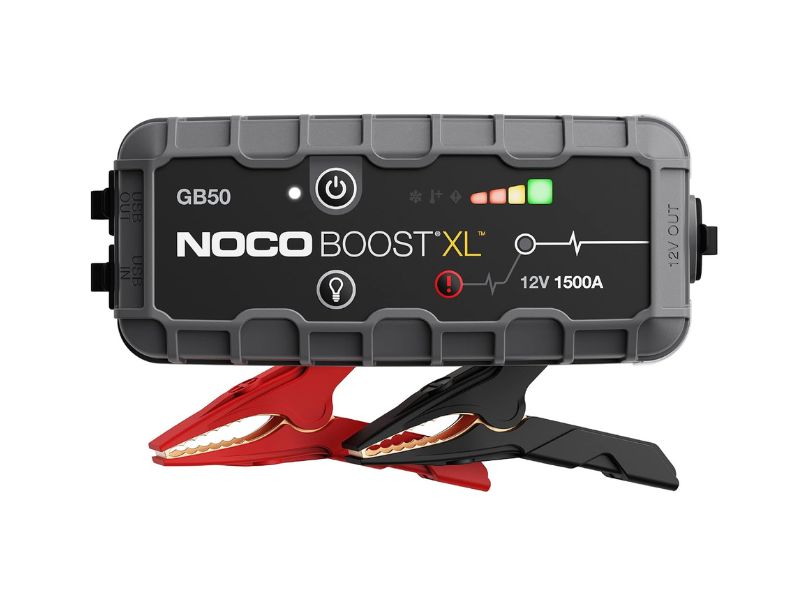
- 1500A peak output
- Gasoline engines up to 7.0L
- Diesel engines up to 4.5L
- 12V lithium-ion construction
- Reverse-polarity protection
- Spark-resistant operation
- IP65 enclosure
- 200-lumen flashlight
- USB portable power
- Approx. 2.7 lb
The GB50 provides an excellent middle ground for V8 owners.
NOCO rates it at 1500A for gasoline engines up to 7.0L and diesel engines up to 4.5L.
The 7.0L gasoline ceiling is particularly useful because it covers larger V8 displacements such as 6.2L and 6.4L while avoiding some of the size increase of the GB70.
At approximately 2.7 pounds, it remains much closer to the compact GB40 than the five-pound GB70.
That makes it attractive for V8 sports cars, SUVs, and pickups where you want additional starting margin without carrying the largest pack.
The GB50 also includes reverse-polarity protection and spark-resistant normal operation.
Its enclosure is rated IP65, helping protect it from dust and incidental water exposure during roadside use.
The integrated flashlight produces 200 lumens, sitting halfway between the GB40 and GB70 in practical nighttime illumination.
USB charging adds emergency portable-power capability.
The larger 1500A starting specification also gives the GB50 more margin than the GB40 when dealing with a heavily discharged battery.
However, I would not interpret that as meaning it is exactly 50% better at starting.
Peak-current figures describe a short maximum and do not capture every part of real starting performance.
Vehicle starting also depends on:
- Battery temperature
- Engine displacement
- Oil viscosity
- Battery condition
- Clamp contact
- Cable resistance
- Starter-motor condition
- Cranking duration
For most V8 owners, the more important advantage is the 7.0L published engine limit.
That clearly establishes compatibility for V8 engines that exceed the GB40’s 6.0L ceiling but do not require the GB70’s 8.0L headroom.
What I Like
- Strong 7.0L gasoline compatibility
- Good fit for 6.2L and 6.4L V8s
- Compact 2.7-pound construction
- Reverse-polarity protection
- IP65 enclosure
- Useful balance between GB40 and GB70
What I Do Not Like
- Less reserve than the GB70
- Smaller flashlight than GB70
- Diesel rating is only 4.5L
The GB50 is the V8 jump starter I would choose when compact size and large-engine compatibility need to coexist. It is particularly attractive for owners of V8s above 6.0L who do not want the larger GB70.
V8 Jump Starter Comparison
| Product | Peak Output | Gas Engine Limit | Diesel Limit | Weight | Main Strength | Best Fit |
| NOCO GB40 | 1000A | 6.0L | 3.0L | ~2.4 lb | Compact everyday protection | V8s up to 6.0L |
| NOCO GB70 | 2000A | 8.0L | 6.0L | ~5 lb | Maximum V8 reserve | Large V8 trucks/SUVs |
| NOCO GB50 | 1500A | 7.0L | 4.5L | ~2.7 lb | Size-to-power balance | 6.2L/6.4L V8s |
NOCO’s published specifications place the GB40 at 6.0L gasoline, the GB50 at 7.0L, and the GB70 at 8.0L. That displacement progression makes it relatively straightforward to match one to a specific V8 engine.
How to Choose the Best Jump Starter for V8 Engines
Start With Engine Displacement
“V8” tells you that the engine has eight cylinders.
It does not tell you its displacement.
A V8 could be:
- 4.6L
- 5.0L
- 5.3L
- 5.7L
- 6.0L
- 6.2L
- 6.4L
- 7.0L
- Or another displacement
That difference is crucial when selecting a jump starter.
The GB40 supports gasoline engines up to 6.0L, GB50 up to 7.0L, and GB70 up to 8.0L.
Best Jump Starter for a 5.0L V8
A 5.0L gasoline V8 falls comfortably within the GB40’s 6.0L gasoline rating.
For normal climates and a vehicle in good mechanical condition, I would favor the GB40 because it provides adequate displacement headroom while remaining compact.
For severe winter use, frequent towing trips, or multi-vehicle households, moving to the GB50 or GB70 gives additional reserve.
Best Jump Starter for a 5.3L V8
A 5.3L gasoline V8 also sits within the GB40’s published 6.0L limit.
The GB40 therefore makes sense for normal emergency use.
I would move to the GB70 when the vehicle is a full-size pickup that spends substantial time outdoors in severe winter weather or when the same booster must cover larger engines.
Best Jump Starter for a 5.7L V8
A 5.7L gasoline V8 remains under the GB40’s 6.0L ceiling, but with less displacement margin.
For moderate climates, the GB40 is within the manufacturer’s published range.
For colder environments or owners who want more reserve, the GB50 is an attractive upgrade.
Best Jump Starter for a 6.2L V8
A 6.2L gasoline engine exceeds the GB40’s 6.0L published limit.
I would therefore choose the GB50 or GB70 rather than operating outside the smaller pack’s rated engine range.
The GB50 supports up to 7.0L gasoline, while the GB70 extends to 8.0L.
For a full-size 6.2L pickup, I would lean toward the GB70 when storage space is not a concern.
Best Jump Starter for a 6.4L V8
A 6.4L V8 similarly falls outside the GB40’s rating.
The GB50’s 7.0L limit provides published compatibility, while the GB70 offers still more displacement and energy reserve.
For year-round V8 truck use, especially in winter, the GB70 is the stronger choice.
How Many Amps Does a V8 Jump Starter Need?
There is no single universal amp requirement for every V8.
A reputable 1000A-class starter can be suitable for a V8 when the manufacturer’s engine-displacement rating covers it.
The GB40 is a clear example: NOCO rates the 1000A unit for gasoline engines up to 6.0L.
Larger 1500A and 2000A models provide additional displacement coverage and stored-energy reserve.
1000A vs 1500A vs 2000A for V8
For V8 applications, I would think of these classes this way:
1000A: suitable for many smaller and midsize gasoline V8s when manufacturer-rated.
1500A: better middle ground for V8s above 6.0L and drivers wanting more reserve.
2000A: stronger option for large V8 pickups, SUVs, severe winter use, and multi-vehicle households.
The engine limit remains more useful than selecting by amps alone.
Cold Weather Changes Starting Demand
Cold weather makes a V8 more difficult to start.
The vehicle battery provides less effective output while cold oil creates greater resistance inside the engine.
A large V8 also has more rotating mass than a small engine.
That combination means additional starting reserve can be worthwhile in winter.
If your engine is close to the maximum published rating of the jump starter, I would step up one size for severe cold.
Battery Condition Matters
A jump starter works alongside the vehicle’s installed electrical system.
A slightly discharged but otherwise healthy battery presents a different challenge from a battery with:
- Internal failure
- Heavy sulfation
- Loose terminals
- Damaged cables
- Severe corrosion
- Shorted cells
A jump starter can overcome discharge.
It cannot repair physical battery failure.
Peak Amps Are Not the Whole Story
Peak amps describe brief maximum output.
They do not tell you:
- Stored energy
- Cable resistance
- Clamp quality
- Cold-temperature behavior
- Engine displacement support
- Protection circuitry
That is why the 1000A GB40 can be appropriately rated for some V8 engines even though much larger numbers appear on competing jump starters.
Watt-Hours Matter Too
NOCO publishes 24Wh for the GB40 and 56Wh for the GB70.
Wh describes stored battery energy.
More stored energy can provide additional reserve for difficult or repeated start attempts.
It also increases available runtime for lights and accessory power.
Peak amps and watt-hours should therefore be considered together.
Reverse-Polarity Protection Is Important
All three models provide protected connection systems designed to help prevent normal operation when the clamps are reversed.
This is especially useful around large V8 engine bays where battery access may be obstructed by covers, intake hardware, fuse boxes, or remote jump terminals.
Still verify terminal polarity manually.
Understand Manual Override
NOCO’s Boost series supports manual override when the connected battery voltage is too low for automatic detection.
However, NOCO explicitly warns that manual override disables safety protection and forces Boost on.
Use normal protected mode first.
Before override, confirm:
- The vehicle is a compatible 12V system.
- The red clamp is on positive.
- The black clamp is on the approved negative or ground.
- The battery is not physically damaged.
Never Jump a Damaged Battery
Do not attempt to jump a battery that is visibly:
- Frozen
- Cracked
- Swollen
- Leaking
- Smoking
- Exceptionally hot
NOCO’s safety documentation specifically warns against jump-starting damaged or frozen batteries.
Check the Vehicle’s Jump Points
Not every V8 vehicle expects you to clamp directly onto the battery.
Some provide:
- Remote positive terminals
- Dedicated chassis grounds
- Covered battery posts
- Rear-mounted batteries with under-hood jump points
Follow the vehicle owner’s manual rather than assuming direct battery access is correct.
How to Jump-Start a V8 Engine Safely
1. Confirm 12V Compatibility
These three jump starters are intended for compatible 12V automotive starting systems.
2. Check the Engine Size
Make sure the V8 falls within the manufacturer’s gasoline-engine limit.
3. Inspect the Battery
Do not continue if it is physically damaged or frozen.
4. Turn Off Accessories
Switch off headlights, HVAC, heated seats, audio equipment, chargers, and other unnecessary loads.
5. Locate the Approved Positive Point
Follow the vehicle manual.
6. Connect the Red Clamp
Attach it firmly to the designated positive terminal.
7. Connect the Black Clamp
Attach it to the approved negative terminal or chassis-ground point.
8. Verify the Connection
Correct any polarity or error warning before proceeding.
9. Use Normal Protected Mode First
Do not immediately use manual override.
10. Attempt a Short Start
Follow the vehicle and jump-starter cranking-time limits.
11. Allow Cooling Between Attempts
Repeated long cranks can heat the booster, clamps, cables, vehicle battery, and starter motor.
12. Stop After Repeated Failure
A no-start problem may involve more than a discharged battery.
13. Disconnect According to Instructions
Follow both the jump-starter and vehicle manuals.
14. Recharge the Booster
Restore its internal battery before returning it to emergency storage.
Common V8 Jump Starter Buying Mistakes
Buying by Cylinder Count Alone
A 5.0L V8 and 6.4L V8 require different displacement coverage.
Buying Only by Peak Amps
Manufacturer engine limits provide better compatibility guidance.
Using a GB40 on a V8 Above 6.0L
Move to a model whose published engine limit actually covers the engine.
Ignoring Winter Reserve
Cold weather increases starting difficulty.
Buying Too Much for a Small V8
A 3000A or 5000A booster can be unnecessary when a compact manufacturer-rated unit already covers the engine.
Using Manual Override First
Protected normal operation should be the default.
Leaving the Pack Discharged
Check the jump starter periodically and recharge after use.
Repeatedly Jumping a Failing Battery
Repeated no-start events call for battery and charging-system diagnosis.
Frequently Asked Questions
What is the best jump starter for V8 engines?
The NOCO GB40 is my first choice for V8 engines up to its 6.0L gasoline limit.
For larger 6.2L or 6.4L V8s, I would move to the GB50 or GB70 because their published gasoline ratings extend to 7.0L and 8.0L.
Is 1000 amps enough for a V8?
Yes, when the V8 falls within the jump starter manufacturer’s published engine limit.
NOCO rates the 1000A GB40 for gasoline engines up to 6.0L.
Can the NOCO GB40 jump a V8?
Yes, provided the gasoline V8 is 6.0L or smaller.
For a larger V8, select a model with a higher published engine limit.
Is the GB40 enough for a 5.0L V8?
Yes, a 5.0L gasoline engine falls within its published 6.0L limit.
The GB40 therefore provides appropriate manufacturer-rated displacement headroom for that application.
Is the GB40 enough for a 5.3L V8?
Yes, 5.3L remains inside the GB40’s 6.0L gasoline rating.
Extra reserve from a GB50 or GB70 can still be useful for severe winter conditions.
Can the GB40 start a 5.7L V8?
Yes, 5.7L remains within its published 6.0L gasoline limit.
Because the displacement is closer to the maximum, I would consider the GB50 when additional winter reserve is important.
Is the GB40 good for a 6.2L V8?
No, a 6.2L engine exceeds the GB40’s published 6.0L gasoline ceiling.
Choose the 7.0L-rated GB50 or 8.0L-rated GB70 instead.
What jump starter should I use for a 6.4L V8?
The GB50 or GB70 provides appropriate published gasoline-engine coverage.
GB50 supports up to 7.0L gas, while GB70 supports up to 8.0L.
Is 1500A enough for a V8?
Yes for many V8 engines when they fall within the manufacturer’s displacement specification.
NOCO rates its 1500A GB50 for gasoline engines up to 7.0L.
Is 2000A enough for a V8 truck?
Yes, the GB70 provides substantial published capability for large gasoline V8 trucks.
Its engine rating extends to 8.0L gasoline.
Which jump starter is best for a V8 pickup?
The GB70 is my preferred option when the pickup has a large V8 or sees severe winter use.
Its 2000A output, 8.0L gasoline rating, and 56Wh battery provide useful starting reserve.
Which jump starter is best for a V8 SUV?
The GB40 works well for V8 SUVs up to 6.0L; larger engines favor GB50 or GB70.
Match the actual engine displacement rather than selecting by vehicle body style.
Does a larger V8 need more jump-starting power?
Generally, larger displacement can increase starting demand, but battery and starter design also matter.
Cold temperature, oil viscosity, battery condition, and starter efficiency can all change the amount of assistance required.
Is more peak amperage always better?
No, engine compatibility, battery capacity, clamps, and protection features matter too.
Peak-current figures should be used as one specification rather than the complete buying decision.
Can a jump starter damage a V8 engine?
Correctly used 12V equipment should not harm a compatible vehicle simply because its peak rating is high.
Correct voltage and polarity are more important than buying the smallest possible amp rating.
Can a jump starter start a completely dead V8 battery?
Sometimes, provided the battery is discharged rather than physically failed or damaged.
Very low voltage may require an approved manual-override procedure, but normal protected operation should be attempted first.
What does manual override do?
It forces jump-start output when battery voltage is too low for automatic detection.
NOCO warns that this mode disables normal safety protection, so polarity must be confirmed carefully.
How often should I charge my V8 jump starter?
Recharge it after use and check its charge every few months.
I would also inspect it before winter, towing trips, long-distance travel, or extended vehicle storage.
Why will my V8 still not start with a jump starter?
A discharged battery may not be the only cause of the no-start condition.
Poor battery connections, failed battery cells, a bad starter, wiring faults, fuel or ignition problems, or mechanical issues can prevent starting even with a charged booster.
Conclusion
The best jump starter for V8 engines depends primarily on the actual engine displacement rather than cylinder count alone. Peak amps matter, but gasoline-engine limits, stored energy, cold-weather reserve, connection safeguards, portability, and battery condition provide much better buying guidance.
The NOCO GB40 remains my primary recommendation for V8 engines at or below its 6.0L gasoline rating. Its 1000A output, compact 24Wh lithium design, reverse-polarity protection, spark-resistant connection, and IP65 enclosure make it particularly practical for many 5.0L, 5.3L, and 5.7L V8 applications.
The NOCO GB70 is the stronger choice for larger V8 pickups and SUVs. Its 2000A output, 8.0L gasoline rating, 56Wh battery, 400-lumen flashlight, and 12V accessory output provide considerably more reserve for 6.2L and 6.4L engines, winter conditions, and difficult starts.
The NOCO GB50 fills the middle ground with 1500A output and 7.0L gasoline compatibility while remaining only about 2.7 pounds.
For a V8 up to 6.0L, I would choose the NOCO GB40. For a 6.2L or 6.4L V8, I would step up to the GB50 or GB70, with the GB70 providing the most useful reserve for large trucks and severe winter use.