A dead starting battery at the dock is inconvenient; away from shore, it can become a much bigger problem. The best boat battery jump starter should provide enough power for your marine engine while remaining portable, easy to connect, and appropriate for the boat’s actual 12V starting system.
For marine use, I would prioritize more than peak amps. Engine displacement, battery voltage, reserve capacity, clamp access, water resistance, corrosion prevention, and low-voltage safety are especially important around boats.
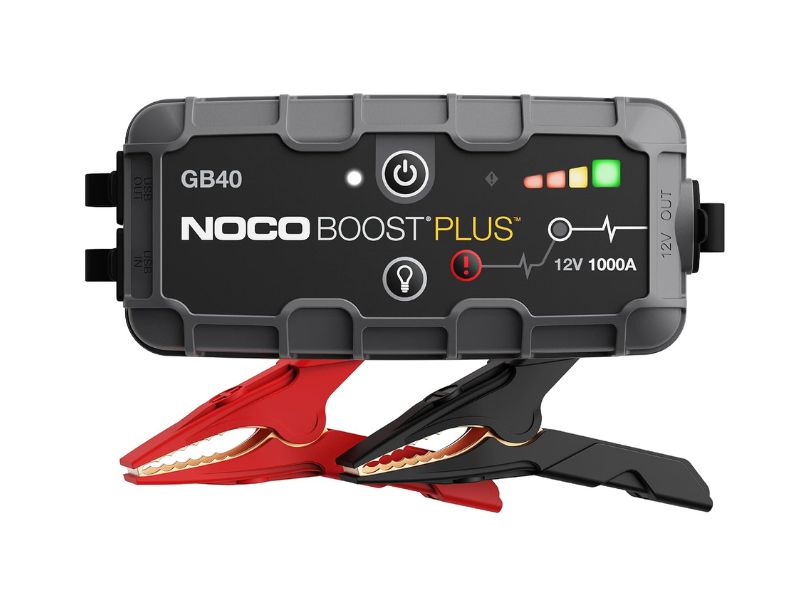
My primary recommendation is the NOCO Boost GB40 1000A Lithium Jump Starter. I would choose it for smaller gasoline-powered boats, personal watercraft, and typical trailer-boat emergency kits because it combines 1000A output, up to 6.0L gasoline-engine coverage, IP65 protection with the ports closed, reverse-polarity protection, spark-resistant operation, USB power, and compact storage. Amazon explicitly lists boats among its supported applications.
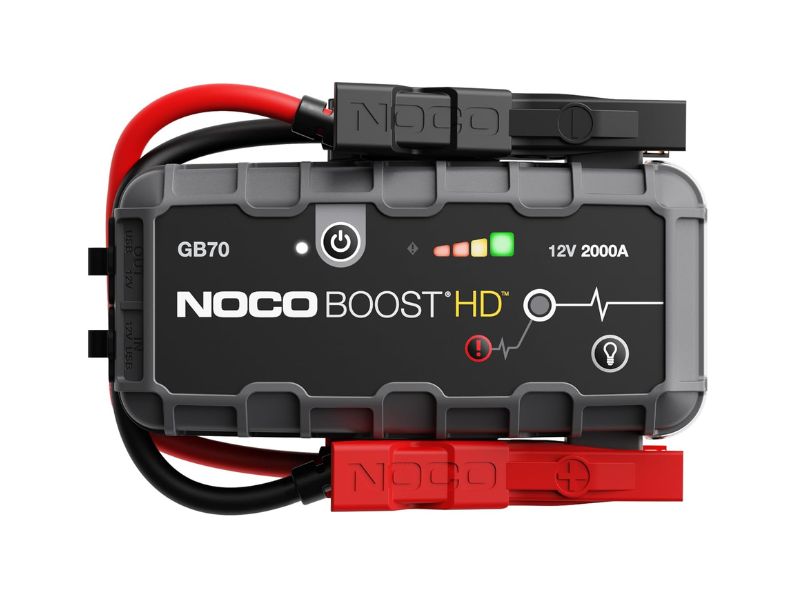
I would choose the NOCO Boost GB70 2000A Lithium Jump Starter for larger outboards, sterndrives, V8-powered boats, or boat owners who simply want more reserve. It increases published engine compatibility to 8.0L gasoline and 6.0L diesel while retaining NOCO’s protected connection system and boat-specific application support.
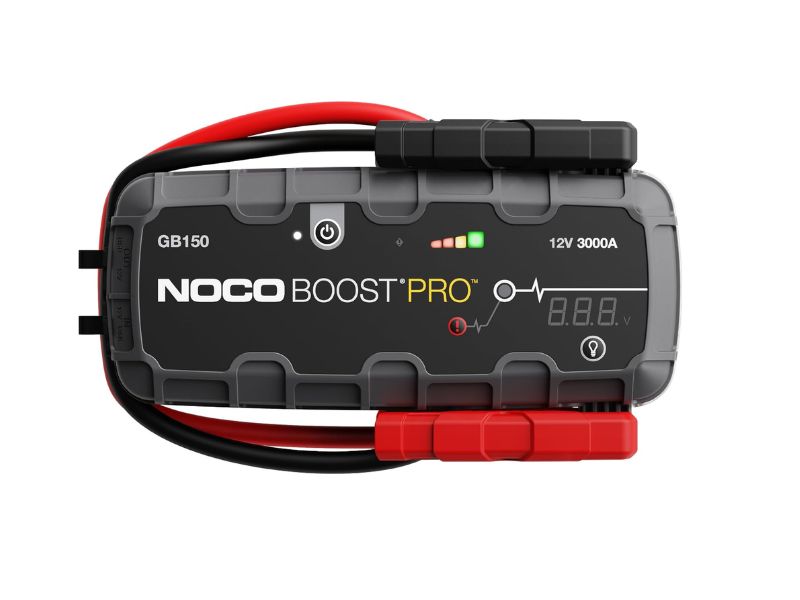
The NOCO Boost GB150 3000A Lithium Jump Starter is the model I would choose for large marine engines, diesel-powered boats, multiple-boat households, and heavier emergency use. NOCO rates it for 9.0L gasoline and 7.0L diesel engines, supplies an 88Wh battery, adds a built-in voltmeter and 12V accessory output, and explicitly specifies marine compatibility.
3 Boat Battery Jump Starters Reviewed
| Image | Product Name | Check Price |
|---|---|---|
Best Choice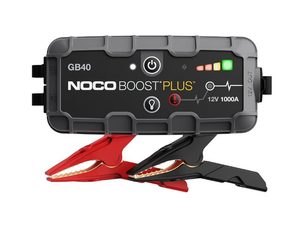 | NOCO Boost GB40 1000A Lithium Jump Starter | Check Price |
Second Best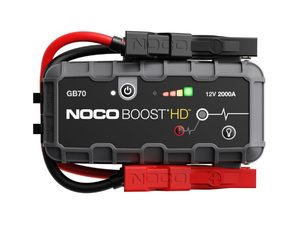 | NOCO Boost GB70 2000A Lithium Jump Starter | Check Price |
Third Choice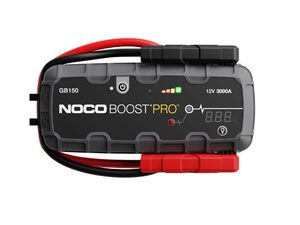 | NOCO Boost GB150 3000A Lithium Jump Starter | Check Price |
1. NOCO Boost GB40 1000A Lithium Jump Starter
Key Features
- 1000A peak lithium output
- For compatible 12V starting batteries
- Up to 6.0L gasoline
- Up to 3.0L diesel
- Reverse-polarity protection
- Spark-resistant connection
- IP65 protection with ports closed
- USB portable power
- Built-in LED flashlight
- Compact marine-friendly storage size
The GB40 is my primary recommendation because it provides enough starting capability for many recreational boats without forcing you to store a large, heavy jump box onboard.
Its current Amazon listing specifies 1000A peak output with engine support up to 6.0L gasoline and 3.0L diesel. Boats are specifically included in the manufacturer’s listed vehicle applications.
For many recreational boat owners, that engine range is already generous.
It can make sense for compatible:
- Small and midsize outboards
- Personal watercraft
- Runabouts
- Fishing boats
- Pontoon boats
- Smaller sterndrive applications
The exact engine manufacturer and displacement should always be checked rather than assuming compatibility simply because the vehicle is a boat.
The GB40’s compact lithium design is especially useful aboard smaller boats where dry storage space can be limited.
A large traditional jump box may take up valuable compartment space and can be awkward to move around a cockpit. The GB40 is much easier to store inside a protected emergency bag or dry compartment.
Its safety electronics are another major advantage.
The normal connection system offers reverse-polarity protection and spark-resistant operation.
That is valuable in a marine environment because battery compartments can be cramped, visibility can be poor, and terminals may sit near multiple cables.
Still, spark-resistant should not be interpreted as permission to make connections around fuel vapors.
Always follow the boat and engine manufacturer’s battery-jump instructions. Gasoline vapors are a serious marine hazard, particularly in enclosed compartments.
The IP65 rating with the ports closed also makes the GB40 better suited to marine storage than an unprotected electronic pack. It provides defined resistance to dust and water jets, but it is not a submersible marine battery pack.
I would still keep it in a dry compartment or waterproof protective case.
Saltwater is particularly aggressive.
Even when the housing tolerates incidental water exposure, salt residue on clamps, terminals, ports, or cables can accelerate corrosion.
The GB40 also works as a small USB power bank.
That can be useful if the boat’s starting battery is too low to operate a phone-charging outlet. Preserving phone power for weather information, navigation backup, or contacting assistance can have more value on the water than it does in an ordinary parking-lot breakdown.
The built-in flashlight is another practical boating feature.
It can help when accessing battery compartments after dark or identifying terminals inside poorly lit storage areas.
The main limitation is reserve.
A 1000A compact booster is excellent for many recreational boats, but I would move to the GB70 or GB150 for large engines, diesel applications, repeated starts, or boats where getting stranded carries greater consequences.
What I Like
- Excellent size for onboard storage
- Appropriate for many recreational gasoline boats
- Reverse-polarity protection
- Spark-resistant normal connection
- IP65 protection with closed ports
- USB emergency power
- Easy to carry between boat and vehicle
What I Do Not Like
- Less starting reserve than GB70 or GB150
- Only 3.0L published diesel support
- Should still be protected carefully from saltwater
For most owners of smaller and midsize gasoline boats, the GB40 is the most sensible option. It offers plenty of emergency utility without consuming excessive onboard storage space.
2. NOCO Boost GB70 2000A Lithium Jump Starter
Key Features
- 2000A peak output
- Compatible 12V starting systems
- Up to 8.0L gasoline
- Up to 6.0L diesel
- Reverse-polarity protection
- Spark-resistant connection
- IP-rated portable housing
- USB power-bank function
- 12V accessory output
- 400-lumen emergency light
The GB70 is the model I would choose for larger recreational boats or anyone who wants considerably more reserve than the GB40.
NOCO rates it at 2000A, with support for gasoline engines up to 8.0L and diesel engines up to 6.0L. Its Amazon listing explicitly includes boats among its intended applications.
That gives the GB70 much broader marine usefulness.
It is a stronger match for larger:
- Outboards
- Sterndrives
- V8-powered boats
- Cabin cruisers
- Fishing boats
- Diesel marine applications within its published limit
More power does not automatically make the GB70 the better purchase for every boater.
The important benefit is reserve.
Starting conditions on a boat can be difficult when the battery has been depleted by electronics, pumps, lighting, stereos, refrigeration, or simply extended storage.
A higher-output pack provides additional margin when the starting battery contributes little of its own current.
That can also matter at the end of a boating season when batteries have been sitting for longer periods.
The GB70 maintains the same basic safety approach as the smaller model, including reverse-polarity protection and spark-resistant normal operation.
Those protections are useful, but the marine environment deserves additional caution.
Never treat the booster as intrinsically safe around fuel vapor simply because the clamps are designed to reduce sparks.
Ventilate gasoline-engine compartments according to the boat manufacturer’s procedure and never energize equipment in an environment where fuel vapor is suspected.
The larger pack also provides more useful emergency lighting.
Its integrated light can illuminate battery compartments, bilges, docks, engine areas, or an emergency work space after dark.
The 12V accessory capability is another reason the GB70 can be useful aboard a boat.
Compatible 12V equipment can potentially be powered independently from the boat battery, subject to NOCO’s output limits and the equipment’s requirements.
That should be treated as backup capability rather than a replacement for a properly maintained house-battery bank.
The GB70 is larger than the GB40, but still much more manageable than a conventional lead-acid jump box.
For a boat with sufficient dry storage, I think the additional reserve is worth the increase in size.
What I Like
- Excellent 8.0L gasoline coverage
- Useful 6.0L diesel capability
- More starting reserve than GB40
- Reverse-polarity and spark-resistant protection
- Strong emergency-light output
- Useful 12V accessory power
- Good fit for larger recreational boats
What I Do Not Like
- Larger than necessary for small outboards
- Requires more storage space than GB40
- Still needs protection from saltwater and immersion
The GB70 is my preferred step-up option for boaters running larger gasoline engines or who simply want more confidence when the starting battery is severely discharged.
3. NOCO Boost GB150 3000A Lithium Jump Starter
Key Features
- 3000A peak output
- Up to 9.0L gasoline
- Up to 7.0L diesel
- 88Wh lithium-ion battery
- Built-in voltmeter
- Reverse-polarity protection
- Spark-resistant connection
- IP65 with ports closed
- 500-lumen LED light
- 12V/15A accessory output
- Fast-charge capability
The GB150 is the heavy-duty portable option of these three.
NOCO rates it at 3000A for gasoline engines up to 9.0L and diesel engines up to 7.0L, explicitly listing boats among its intended applications.
That engine range makes it relevant for considerably larger marine starting systems.
The 88Wh internal battery is one of its most useful specifications.
Peak amps tell you about brief high-current output.
Watt-hours tell you how much energy is stored inside the pack.
That additional reserve becomes useful when the jump starter might need to handle:
- Multiple starting attempts
- Large-displacement engines
- Cold-weather boating
- Diesel starts
- Emergency phone charging
- 12V accessory use
- Multiple boats or vehicles
The GB150 also includes an onboard voltmeter.
That is particularly useful on a boat because it gives you quick visibility into the voltage of the connected starting battery.
It does not replace a full marine battery or charging-system diagnostic test, but it can help distinguish a deeply discharged battery from one that still shows a relatively normal resting voltage.
NOCO also provides a 12V/15A accessory output, allowing compatible 12V equipment to operate from the jump starter.
That can add useful emergency flexibility aboard a boat.
The GB150 also carries an IP65 housing rating with its ports closed and a 500-lumen LED light.
The brighter light is particularly useful around large engine compartments and battery banks.
Another important feature is manual override.
NOCO states that the GB150 can use manual override when a connected battery is below the normal detection threshold. The company also warns that manual override disables safety protection and manually forces Boost on.
That warning deserves emphasis.
Normal protected mode should always be attempted first.
Before manual override, confirm:
- The boat uses the correct 12V system
- Polarity is correct
- Battery terminals are identified correctly
- The battery is not frozen
- The battery is not swollen or cracked
- There is no fuel-vapor hazard
The GB150’s larger size is the obvious tradeoff.
It weighs substantially more than the GB40 and occupies more storage space.
For a small runabout, that may be unnecessary.
For a larger offshore-capable boat, diesel application, RV/boat combination, or owner who wants one booster for several large vehicles, the extra reserve becomes easier to justify.
What I Like
- Excellent 9.0L gas / 7.0L diesel compatibility
- Large 88Wh energy reserve
- Built-in voltmeter
- 12V/15A accessory output
- IP65 protection with ports closed
- 500-lumen light
- Strong choice for large marine engines
What I Do Not Like
- Much larger than the GB40
- More power than small recreational boats need
- Manual override disables normal safety protection
The GB150 is the model I would choose for large boats, diesels, and situations where extra reserve matters more than minimizing size. It is also a logical choice if the same booster needs to serve a boat, pickup, RV, and other large 12V equipment.
Boat Battery Jump Starter Comparison
| Product | Peak Output | Gas Engine Limit | Diesel Limit | Stored Energy | Main Strength | Best Fit |
| NOCO GB40 | 1000A | 6.0L | 3.0L | 24Wh class | Compact marine emergency power | Small and midsize boats |
| NOCO GB70 | 2000A | 8.0L | 6.0L | 56Wh class | Larger-engine reserve | V8 boats and larger recreational craft |
| NOCO GB150 | 3000A | 9.0L | 7.0L | 88Wh | Maximum reserve and diagnostics | Large boats and diesel applications |
For most normal recreational boats, the GB40 is the easiest unit to keep onboard. The GB70 adds substantially more engine headroom, while the GB150 provides the strongest combination of stored energy, large-engine support, lighting, and diagnostic features.
How to Choose the Best Boat Battery Jump Starter
Confirm the Boat’s Starting-System Voltage
Do this before considering amp ratings.
A large number of recreational boats use 12V starting systems, but marine electrical systems can become more complicated than automotive systems.
A boat may have:
- One 12V starting battery
- Separate start and house batteries
- Dual battery banks
- 24V trolling-motor systems
- 36V trolling-motor systems
- Series or parallel battery configurations
Do not assume every battery onboard belongs to the same electrical system.
The three jump starters reviewed here are intended for compatible 12V starting batteries.
Do Not Connect a 12V Jump Starter to a 24V or 36V Bank
This is one of the most important marine-specific rules.
Many fishing boats use 24V or 36V battery banks for trolling motors.
Those batteries may be physically close to the engine-starting battery.
A 12V portable jump starter should not be connected across an entire 24V or 36V series bank.
Identify the engine starting battery and its actual voltage before making connections.
Starting Battery vs Deep-Cycle House Battery
Boats often use different batteries for different jobs.
A starting battery is designed to provide a short burst of high current to crank an engine.
A deep-cycle or house battery is designed to provide energy over a longer period for electronics, lights, pumps, refrigeration, trolling motors, or other accessories.
A portable jump starter is primarily intended to help the engine’s starting system.
It should not be considered a replacement for a properly charged deep-cycle house bank.
Check Engine Displacement
Peak amperage is useful, but manufacturer engine limits are easier to apply.
The three products here cover:
- GB40: up to 6.0L gasoline / 3.0L diesel
- GB70: up to 8.0L gasoline / 6.0L diesel
- GB150: up to 9.0L gasoline / 7.0L diesel
For a small outboard, the GB150 is probably unnecessary.
For a large V8 marine engine or diesel, additional reserve makes more sense.
Outboard vs Sterndrive vs Inboard
The type of propulsion system also affects the buying decision.
Outboard Engines
Many small and midsize outboards can be covered by compact jump starters, provided their electrical system and displacement fall inside the manufacturer’s limits.
The GB40 is particularly attractive here because of its small storage footprint.
Sterndrives
Larger gasoline sterndrives can place greater demands on the starting battery.
A GB70 provides useful additional reserve.
Inboard and Diesel Engines
Larger-displacement marine diesels can require significantly more starting power.
The GB150’s 7.0L published diesel rating and 88Wh energy reserve make it the strongest option of these three.
Marine Batteries Can Be Hard to Reach
Battery access on a boat can be considerably worse than under a car hood.
Starting batteries may be:
- Beneath seats
- Inside stern compartments
- Behind panels
- Inside battery boxes
- Near house batteries
- Surrounded by cables and switches
Before an emergency, open the battery compartment and confirm that your jump-starter clamps can reach the intended terminals safely.
Do not discover a cable-reach problem while drifting away from the dock.
Battery Selector Switches Matter
Many boats have OFF / 1 / 2 / BOTH battery switches or automatic charging relays.
Do not guess which switch position should be used during a jump.
The correct configuration depends on how the boat is wired.
Follow the boat manufacturer’s electrical diagram and battery-switch instructions.
Improper switching can connect batteries in ways you did not intend.
Water Resistance Is Useful but Not Waterproofing
Marine use makes environmental protection especially important.
The GB40/GB70 family and GB150 are designed with rugged housings, while the GB150 carries a documented IP65 rating with its ports closed.
IP65 means resistance to dust and water jets under defined test conditions.
It does not mean:
- Submersible
- Safe to drop overboard
- Saltwater-proof
- Suitable for permanent outdoor exposure
Store the pack dry.
Saltwater Corrosion Requires Extra Care
Salt accelerates corrosion on metal surfaces.
After marine use, inspect:
- Clamps
- Cable ends
- Connector pins
- Charging ports
- Carrying case
- Battery terminals
If the equipment has been exposed to salt spray, follow the manufacturer’s cleaning instructions before returning it to storage.
Never plug a charger into a wet or contaminated port.
Avoid Fuel-Vapor Hazards
Gasoline-powered boats deserve additional caution because fuel vapors can accumulate in enclosed compartments.
Do not create an electrical connection or attempt a jump when you smell gasoline or suspect fuel leakage.
Follow the boat manufacturer’s ventilation and blower procedures before starting an inboard gasoline engine.
Even a jump starter marketed as spark-resistant should never be treated as permission to ignore marine fuel-vapor safety.
Reserve Matters More Away From Shore
A slightly undersized jump starter may be acceptable for a driveway emergency where another vehicle and charger are nearby.
A boat can be very different.
If the engine fails miles from the ramp or marina, more starting reserve may be worth carrying.
That is one reason I would move from GB40 to GB70 for larger boats even when both technically exceed the engine’s displacement.
Watt-Hours Help Compare Reserve
The GB150 publishes an 88Wh internal battery.
Watt-hours are useful because they indicate the amount of stored energy available for repeated starts and accessory use.
Peak amps and watt-hours answer different questions:
Peak amps: How much short-duration starting current can the unit provide?
Watt-hours: How much total energy can it store?
For boating, both can matter.
USB Power Can Be More Valuable on a Boat
A power-bank function is not just a convenience.
If the boat’s battery system is down, keeping a phone charged can provide access to:
- Emergency calls
- Weather information
- Digital charts
- Marina contact information
- Navigation backup
- Tow-service apps
The GB40, GB70, and GB150 can provide portable-device power.
Still, preserve enough battery reserve to restart the engine first.
Do Not Use the Jump Starter as a Battery Charger
A jump starter and a battery charger serve different purposes.
A jump starter delivers a brief burst of current so the engine can crank.
A marine battery charger restores battery state of charge over a much longer period.
If your boat sits at a dock or in storage, a suitable marine charger or maintainer is the correct long-term solution.
Repeatedly jump-starting the boat is a sign that the starting battery or charging system deserves inspection.
Why Boat Batteries Go Dead
Common causes include:
- Battery age
- Long storage
- Bilge-pump draw
- Stereo use
- Fish finders
- Lighting
- Refrigeration
- Accessories left energized
- Poor battery-switch management
- Charging-system faults
- Corroded connections
A jump starter solves the immediate no-crank problem.
It does not correct the reason the battery became discharged.
How to Jump-Start a Boat Safely
1. Secure the Boat
Make sure the boat is safely docked, anchored, or otherwise controlled before working around the battery.
2. Confirm Battery Voltage
Identify the 12V engine-starting battery.
Do not accidentally connect across a trolling-motor bank.
3. Check for Fuel Odor
Do not proceed if gasoline or fuel vapor is suspected.
4. Ventilate as Required
Follow the boat manufacturer’s blower and ventilation procedure.
5. Turn Off Unnecessary Loads
Switch off electronics, lighting, stereos, pumps that are not required, and other major accessories.
6. Inspect the Battery
Do not jump a battery that is:
- Cracked
- Swollen
- Leaking
- Smoking
- Exceptionally hot
- Frozen
7. Connect Positive
Attach the red clamp to the approved positive terminal.
8. Connect Negative
Attach the black clamp to the approved negative or ground connection specified by the boat or engine manufacturer.
9. Verify the Connection
Correct any reverse-polarity warning before proceeding.
10. Use Normal Protected Mode
Allow the jump starter’s safety system to operate normally.
11. Use Manual Override Only if Required
If battery voltage is too low for detection, follow the booster’s exact manual-override procedure.
12. Crank Briefly
Follow the engine and jump-starter maximum cranking intervals.
13. Allow Cooling Between Attempts
Repeated starting creates heat in the starter motor, battery cables, clamps, and booster.
14. Disconnect According to Instructions
Follow the engine and jump-starter manuals.
15. Recharge the Booster
Do not return it to marine emergency storage partially discharged.
How to Store a Jump Starter on a Boat
Keep the pack somewhere:
- Dry
- Accessible
- Away from direct salt spray
- Away from excessive engine heat
- Protected from physical impact
- Separate from loose metal tools
A dry bag or protective case can be useful, provided it is suitable for the jump starter and does not trap damaging moisture.
Do not bury the jump starter beneath equipment that would be difficult to move during an emergency.
Common Boat Jump Starter Buying Mistakes
Buying Only by Peak Amps
Match engine displacement and starting-system voltage first.
Assuming Every Boat Is 12V
Trolling-motor and house banks may use different voltages.
Jumping the Wrong Battery Bank
Identify the engine-starting battery before connecting.
Ignoring Saltwater Exposure
Keep clamps and ports clean and dry.
Treating IP65 as Submersible
Water-resistant electronics are not necessarily waterproof.
Ignoring Fuel Vapors
Marine gasoline safety deserves more caution than an ordinary roadside jump.
Buying Too Little Reserve
A larger boat may justify more margin even when a smaller booster technically meets the displacement rating.
Using the Jump Starter as a Permanent Charger
A proper marine charger should maintain the battery during storage.
Frequently Asked Questions
What is the best boat battery jump starter?
The NOCO GB40 is my primary recommendation for most recreational gasoline boats.
It combines 1000A output, 6.0L gasoline compatibility, reverse-polarity protection, spark-resistant operation, compact storage, and boat-specific manufacturer support.
Is a 1000A jump starter enough for a boat?
Yes for many smaller and midsize gasoline marine engines within the manufacturer’s rating.
The GB40 supports gasoline engines up to 6.0L, giving it substantial headroom for many recreational applications.
Is 2000A better for a boat?
It provides additional reserve that can be useful for larger engines and difficult starts.
The GB70 supports up to 8.0L gasoline and 6.0L diesel engines.
Which jump starter is best for a large boat?
The GB150 provides the strongest large-engine capability of these three.
NOCO rates it at 3000A for engines up to 9.0L gasoline and 7.0L diesel.
Can I jump-start an outboard motor?
Yes when the outboard uses a compatible starting system and follows the manufacturer’s jump procedure.
Check the outboard’s required voltage and starting-battery instructions before connecting a portable booster.
Can I jump-start an inboard boat engine?
Yes when the booster matches the engine and electrical system, but fuel-vapor precautions are critical.
Ventilate according to the boat manufacturer’s instructions and never proceed when fuel leakage or gasoline vapor is suspected.
Can I use a car jump starter on a boat?
Yes if the manufacturer supports marine use and the boat has a compatible electrical system.
NOCO explicitly lists boats among the applications for the models reviewed here.
Can I jump a marine deep-cycle battery?
A portable booster is primarily intended to help start the engine, not recharge a deep-cycle battery.
Use an appropriate marine charger to restore a discharged deep-cycle or house battery.
Can a jump starter recharge my boat battery?
No, jump-starting provides brief cranking assistance rather than a full battery recharge.
A suitable marine battery charger or charging system is needed to restore state of charge.
Is a waterproof jump starter necessary for a boat?
Water resistance is valuable, but the pack should still be stored dry and protected from saltwater.
The GB150 carries an IP65 rating with its ports closed.
Is IP65 safe to submerge?
No, IP65 does not mean the jump starter is designed for submersion.
Keep the unit out of standing water and store it in a protected compartment.
Can saltwater damage a jump starter?
Yes, saltwater and salt residue can rapidly corrode metal terminals, clamps, and connectors.
Protect the unit from spray and inspect it after marine use.
Can I use a 12V jump starter on a 24V trolling-motor system?
Not across the entire 24V bank.
Identify the separate engine-starting system and follow its specific voltage and jump procedure.
What if my boat has three batteries?
Battery count does not tell you system voltage or which battery starts the engine.
The batteries may serve starting, house, and trolling-motor systems separately. Check the wiring diagram.
Should I use the BOTH battery-switch setting before jumping?
Do not change a marine battery switch unless the boat manufacturer’s procedure tells you to.
Battery-switch configurations vary, and an incorrect setting can connect battery banks unintentionally.
Which jump starter is best for a diesel boat?
The GB150 offers the broadest diesel compatibility of these three at up to 7.0L.
Its 88Wh battery also provides additional stored-energy reserve for demanding starts.
Is the GB40 good for fishing boats?
Yes for many fishing boats with compatible 12V gasoline starting systems.
Its compact size is particularly useful where storage space is limited.
Is the GB70 good for a V8 boat?
Yes, its published 8.0L gasoline limit provides substantial headroom for many V8 marine engines.
Verify the exact displacement and electrical system first.
Can I leave a lithium jump starter on my boat?
Yes within the manufacturer’s storage limits, provided it remains dry and protected from excessive heat.
Periodically inspect its charge level and physical condition.
How often should I charge my boat jump starter?
Recharge it after use and check its state of charge every few months.
I would also inspect it before launching after winter storage, before long trips, and before offshore or remote boating.
Conclusion
The best boat battery jump starter should match the boat’s actual starting system rather than simply having the largest amp rating. For marine use, I would pay particular attention to 12V compatibility, engine displacement, stored reserve, clamp safety, water resistance, corrosion exposure, battery-bank configuration, and onboard storage.
The NOCO GB40 remains my primary recommendation for most recreational gasoline boats. Its 1000A output, 6.0L gasoline rating, compact lithium construction, reverse-polarity protection, spark-resistant operation, and rugged housing make it easy to keep aboard without taking up excessive space.
The NOCO GB70 is the better choice for larger outboards, V8-powered boats, and owners who want more starting reserve. Its 2000A output and 8.0L gas/6.0L diesel compatibility expand the range considerably.
For large marine engines and diesel applications, I would move to the NOCO GB150. Its 3000A output, 9.0L gasoline/7.0L diesel limits, 88Wh battery, voltmeter, 12V accessory output, and IP65 housing with closed ports provide the strongest emergency capability of the three.
For a typical recreational boat, I would keep the NOCO GB40 charged and stored in a dry, accessible compartment. For a larger boat where additional reserve matters, I would step up to the GB70 or GB150.