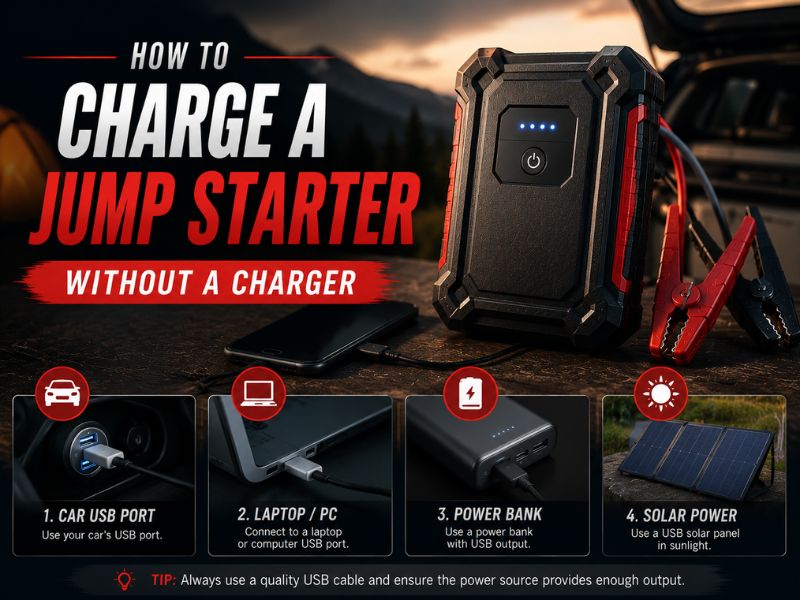
You can often charge a jump starter without its original charger by using a compatible USB/USB-C power source, an approved 12V vehicle charging cable, or a manufacturer-approved replacement adapter. The correct option depends on the jump starter’s input port, required voltage, charging protocol, and battery type, so do not improvise by connecting random power supplies or feeding power through the booster clamps.
Modern lithium models can be particularly flexible. NOCO, for example, says several Boost and Boost X jump starters can recharge from powered USB sources such as wall adapters, car chargers, and laptops, while Schumacher offers models that can recharge by both USB and 12V vehicle power.
First, Figure Out What “Without a Charger” Means
There are two common situations.
You may have lost the wall adapter but still have the jump starter’s USB charging cable.
Or you may have lost the entire original charging setup, including its cable or proprietary adapter.
Those situations require different solutions.
If your jump starter accepts a standard USB or USB-C input, replacing the wall charger can be relatively simple. If it uses a proprietary barrel connector, pin jack, or dedicated AC charger, you should obtain a compatible replacement rather than guessing at voltage and polarity.
Clore Automotive, for example, sells model-specific and universal replacement chargers for many of its jump starters, including dedicated chargers for specific Jump-N-Carry and Booster PAC models.
Option 1: Charge It From a USB Wall Adapter
For many modern lithium jump starters, this is the easiest alternative.
If the unit has a USB charging input, you may not need the original wall adapter at all. You can often connect the appropriate cable to another powered USB source.
NOCO states that several of its Boost models can recharge from a powered USB port such as an AC adapter, car charger, or laptop.
Its current Boost X GBX45 also accepts charging through its USB-C IN/OUT port and supports USB Power Delivery for faster charging when a compatible higher-wattage source is used.
The important detail is that the replacement USB source must be compatible with the jump starter.
A low-power USB adapter may still work on some models but charge much more slowly.
For example, NOCO lists dramatically different GBX45 recharge times depending on whether the source supplies only a few watts or supports higher-power USB-C charging.
So if your original wall brick is gone but the unit charges through USB, check the manual for:
Connector type, supported input wattage, and required charging protocol.
Option 2: Use a USB-C Laptop or Phone Charger
This can work especially well with newer USB-C jump starters.
NOCO’s Boost X series uses a USB-C IN/OUT port and supports USB Power Delivery 3.0. The GBX45, for example, can accept up to 60W with a compatible USB-C PD charger.
NOCO also sells its own 65W USB-C adapter, but the company’s documentation states that Boost X can recharge from other appropriate powered USB sources as well.
This means a compatible USB-C laptop charger may be useful even if you lost the jump starter’s original wall adapter.
However, do not assume every USB-C-looking port supports every USB-C charger.
USB-C defines the connector shape, while Power Delivery support and input limits determine how much power the device can actually accept.
If the charger is incompatible, a smart jump starter may refuse charging. NOCO’s support information for Boost X includes an incompatible-charger warning condition.
Option 3: Recharge It From Your Car’s 12V Outlet
Many jump starters can be recharged from a vehicle’s 12V accessory socket, often called the cigarette-lighter socket.
This is particularly useful when you are traveling and do not have access to an AC outlet.
NOCO offers a dedicated 12V USB-C car charger for Boost X products and states that it can recharge those jump starters from a vehicle’s 12V power source.
Older NOCO models such as the GB70 and GB150 also support 12V fast charging through dedicated 12V input connections when used with the appropriate cable.
Schumacher likewise offers several RUGGED lithium jump starters that recharge using either a 12V DC car charger or USB. For example, its 1000A SL1610 is listed at about two hours using its 12V car charger versus roughly four to five hours over USB.
The critical requirement is using the approved 12V input method for the model.
Do not connect the vehicle’s 12V electrical system to an arbitrary port simply because the voltage sounds similar.
Can You Charge a Jump Starter From a Running Car?
Some models are specifically designed for this.
For example, NOCO states that its Boost X Auto Charger can fast-charge compatible units from a vehicle and notes that the vehicle must be on/running for the Auto Charger to provide its fast-charge function.
Other products support charging from a powered 12V accessory socket even if the exact operating requirement differs.
That does not mean you can universally connect a jump starter directly to the vehicle battery using the jump clamps and let the alternator charge it.
Use only a charging input and cable that the manufacturer specifically provides or approves.
Do Not Try to Recharge It Through the Booster Clamps
The clamps are normally designed as a high-current output for starting a vehicle, not as a general-purpose charging input.
Trying to feed charging current backward through them can bypass the device’s intended charge-control circuitry.
Manufacturers build dedicated charging ports and accessories for a reason.
Clore, for example, sells separate 12V charging cords and replacement chargers for compatible jump starters rather than instructing users to recharge their products through the starting clamps.
Likewise, Clore warns against mixing unapproved cable assemblies and jump starters because the supplied assemblies can contain important safety features.
Unless your exact jump starter explicitly documents clamp-based recharging, do not improvise this method.
Don’t Connect a Random DC Power Adapter
An adapter that physically fits the charging port is not automatically electrically compatible.
DC chargers can differ in:
Output voltage, current capability, polarity, connector dimensions, and charging behavior.
Using a higher voltage than the jump starter expects can damage its charging electronics or internal battery.
Using the wrong connector polarity can be even more problematic on equipment without protective circuitry.
This is especially relevant to older AGM jump boxes that often use barrel plugs or pin-jack chargers rather than standardized USB.
Clore sells different replacement chargers for different jump starter families, illustrating that these chargers are not automatically interchangeable simply because they look similar.
When a jump starter uses a proprietary input, matching the exact model number is safer than attempting to find a generic power supply by plug size alone.
A Replacement Charger Is Often the Best Answer
If your jump starter does not support ordinary USB charging, replacing the missing charger is usually the cleanest solution.
Clore sells a universal replacement charger for compatible 12V jump starters as well as numerous model-specific charger assemblies.
A manufacturer-approved replacement gives you the correct connector and charging characteristics without requiring electrical guesswork.
Before ordering one, find the jump starter’s model number on its case or identification label.
Do not order from the brand name alone.
A company may make dozens of jump starters using different internal battery technologies and charging arrangements.
Can a Power Bank Charge a Jump Starter?
Sometimes—if the jump starter supports USB charging and the power bank provides a compatible output.
Modern USB-C systems can even allow power to move in either direction depending on how the devices negotiate the connection.
NOCO specifically notes that Boost X can interact with dual-role-power USB-C devices, such as certain phones, laptops, or power banks. When recharging the Boost X from such a device, NOCO instructs users to make the connection with the Boost X switched off so power flows in the correct direction.
This is a model-specific capability.
Do not assume an older Micro-USB or proprietary jump starter can be recharged from every power bank.
Can You Use a Phone Charger?
Often, yes, for jump starters designed to recharge over USB.
A standard phone wall adapter connected to the correct USB cable can work on many models, although charging may be considerably slower than with the original fast charger.
NOCO’s current documentation lists ordinary powered USB sources as valid charging options for multiple Boost products.
For Boost X, a basic USB source can recharge the unit, but a compatible higher-output USB-C PD charger is required to achieve its fastest recharge rates.
So a phone charger may be a perfectly acceptable emergency substitute—even if it is not the fastest option.
What About an AGM Jump Box?
Traditional lead-acid jump boxes require more caution.
Unlike many lithium packs, they may depend on a dedicated charger matched to the internal sealed lead-acid battery.
Clore’s ES400 manual warns against using damaged charging equipment and says that attachments not recommended or sold by the manufacturer may create a risk of damage or injury.
If you have an older AGM jump box with a missing proprietary charger, replacing the charger with the correct OEM or approved equivalent is usually preferable to improvising with USB converters or arbitrary power supplies.
How Do You Know the Alternative Charger Is Working?
Use the jump starter’s normal charge indicator.
NOCO Boost X units, for example, indicate charging progress through their battery-level LEDs, with the 100% indicator becoming solid when fully charged.
If the unit displays an error, becomes unusually hot, repeatedly stops charging, or reports an incompatible charger, disconnect the source and verify the specifications.
A charging setup should not require forcing connectors, bypassing warning lights, or modifying the jump starter.
If you need to splice wires or defeat protections, you are no longer using a normal replacement charging method.
How Long Will It Take Without the Original Charger?
It depends primarily on the input power available.
A low-power USB source can take much longer than a fast USB-C PD or dedicated 12V charger.
NOCO lists GBX55 recharge examples ranging from about 28 hours at 2.5W to roughly 1.2 hours at 60W, showing how dramatically charging power changes the result.
Schumacher shows the same principle on the SL1610: approximately two hours through its 12V DC car charger versus four to five hours by USB.
Faster is not automatically better if the jump starter is not designed for the higher input.
Use only the power levels the manufacturer supports.
Don’t Charge and Jump-Start at the Same Time
If you are trying to charge the unit because you need an immediate jump, avoid assuming you can leave the charging cable connected while cranking the vehicle.
NOCO states that it does not recommend charging and discharging its Boost products at the same time.
Charge the booster first, disconnect the charging source, and then perform the jump-start according to its instructions.
If there is not enough time or charge capacity to do that, use another properly charged booster or an appropriate alternative starting method.
Frequently Asked Questions
How Can I Charge a Jump Starter if I Lost the Charger?
First check its charging input. If it accepts USB or USB-C, you may be able to use a compatible wall adapter, car USB charger, laptop, or power bank. If it uses a proprietary connector, obtain an approved replacement charger.
Can I Charge a Jump Starter With a Phone Charger?
Yes, many USB-rechargeable jump starters can charge from a compatible phone adapter. Charging may be slower than with the original higher-power charger.
Can I Charge a Jump Starter With a Laptop Charger?
If the jump starter supports the laptop charger’s USB-C Power Delivery profile, yes. NOCO Boost X models support USB-C PD charging and can recharge from compatible powered USB sources.
Can I Charge a Jump Starter From My Car?
Some models support charging from a 12V vehicle accessory socket through an approved cable or car charger. NOCO and Schumacher both offer jump starters with this capability.
Can I Charge a Jump Starter Through the Clamps?
Do not assume so. The clamps are generally jump-start outputs. Use the dedicated charging port and manufacturer-approved charging equipment unless the manual explicitly states otherwise.
Can I Use Any 12V Adapter?
No. A 12V label alone does not guarantee correct polarity, current, connector type, or charging behavior. Proprietary-input jump starters should use the charger specified for that model.
Can a Power Bank Recharge a Jump Starter?
Potentially, if the unit supports compatible USB charging. NOCO says Boost X can receive power from compatible dual-role USB-C devices such as some power banks.
Is USB Charging Slower Than a Car Charger?
It can be. Schumacher’s SL1610 is listed at approximately two hours using its 12V car charger versus four to five hours over USB. The difference varies by model.
What Should I Do if My Jump Starter Has a Round Charging Port?
Find the model number and obtain the correct OEM or approved replacement charger. Do not select a generic adapter solely because its plug fits.
Can I Jump-Start While Charging the Jump Starter?
Usually, you should avoid it. NOCO recommends against simultaneous charging and discharging on its Boost products. Charge first, disconnect the charging source, and then use the jump starter.
How to Charge a Jump Starter Without a Charger Safely
The safest way to charge a jump starter without its original charger is to use another charging source that the manufacturer explicitly supports. For modern lithium packs, that may include a standard USB adapter, USB-C Power Delivery charger, laptop USB port, power bank, or approved 12V vehicle charger.
For jump starters with proprietary charging inputs, buy a compatible replacement charger rather than experimenting with random DC adapters. Clore’s wide range of model-specific replacement chargers illustrates why the correct input hardware matters.
Avoid trying to recharge the jump starter through its booster clamps unless the manufacturer specifically documents that capability. Likewise, do not increase charging voltage simply to make the process faster.
Find the model number, identify the input port and charging specification, then choose the safest supported alternative. In many cases, losing the original charger is only a minor inconvenience—but matching the replacement power source correctly is what keeps it from becoming a damaged jump starter.