Yes, trailer tongue weight reduces the available payload of the tow vehicle because the hitch transfers part of the trailer’s weight onto the vehicle. A 650-pound tongue load uses approximately 650 pounds of payload in a conventional hitch setup, leaving less capacity for passengers, tools, luggage, and other gear.
Payload and towing capacity are different ratings. A truck can be rated to pull a relatively heavy trailer yet run out of payload once the trailer is coupled and passengers or cargo are added. This is especially important for SUVs, pickup trucks, and travel trailers with substantial tongue loads.
The entire trailer’s weight does not rest on the tow vehicle. Its axles support most of the load, while the coupler transfers tongue weight to the hitch. A weight-distribution hitch can change how the load is shared between axles, but it does not create additional manufacturer-rated payload capacity.
In this article, I explain how tongue weight counts against vehicle payload, calculate the remaining capacity, identify the correct towing ratings, and measure actual loads. You’ll also learn how weight-distribution hitches and fifth-wheel pin weights affect the calculation and what to check before towing.
Does Trailer Tongue Weight Affect Payload on Every Tow Vehicle?
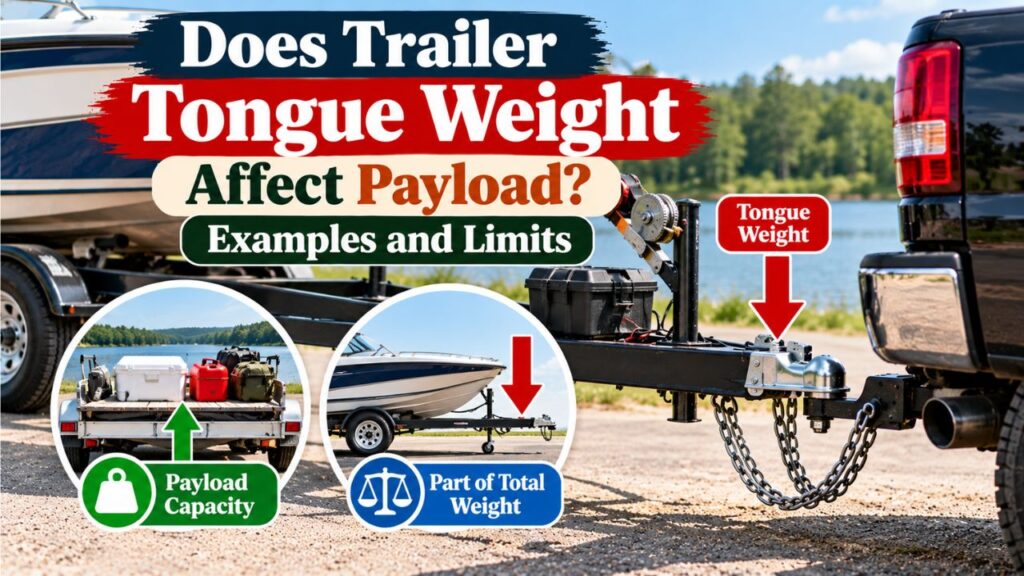
Yes. Trailer tongue weight affects the available payload of any vehicle that supports a conventional trailer through its hitch.
This includes pickup trucks, SUVs, vans, and other properly equipped tow vehicles.
When the trailer is connected, part of its weight transfers through the coupler and hitch into the tow vehicle.
That downward load becomes part of the weight the vehicle must carry.
How Tongue Weight Uses Vehicle Payload
Payload capacity is the maximum additional weight a vehicle is designed to carry beyond its specified curb weight.
It includes occupants, cargo, and equipment that add weight to the vehicle.
When towing, the trailer’s tongue weight must also be accounted for.
For example, suppose a pickup truck has a payload capacity of 1,500 pounds.
If the trailer places 600 pounds on the hitch, only 900 pounds remain for other payload items before accounting for passengers, cargo, and added towing equipment.
The calculation is:
1,500 − 600 = 900 pounds
If two passengers and their luggage weigh 500 pounds combined, the remaining capacity decreases further.
900 − 500 = 400 pounds
This is why a tow vehicle can reach its payload limit before reaching its advertised towing capacity.
According to Ram’s official towing and payload guidance, tongue weight must be included when determining how much payload remains available for the vehicle.
Does the Entire Trailer Weight Count Against Payload?
No. Only the portion of the trailer’s weight supported by the tow vehicle contributes to its carried load.
Most of a conventional trailer’s weight rests on the trailer axles.
For example, consider a trailer weighing 5,000 pounds when fully loaded.
If its tongue weight is 650 pounds:
- Total loaded trailer weight: 5,000 pounds.
- Weight supported through the hitch: 650 pounds.
- Weight supported by the trailer axles: Approximately 4,350 pounds.
The tow vehicle does not carry all 5,000 pounds as payload.
However, it must still be rated to tow the entire loaded trailer.
Key Takeaway: Tongue weight reduces available vehicle payload, while the full trailer weight must be considered when checking towing capacity.
How to Calculate Payload After Adding Trailer Tongue Weight
The easiest way to calculate remaining payload is to subtract the trailer’s actual tongue weight and the other loads carried by the tow vehicle from its rated payload capacity.
Use this formula:
Remaining Payload = Rated Payload Capacity − Passengers − Vehicle Cargo − Added Equipment − Trailer Tongue Weight
All measurements should be in pounds.
Step 1: Find Your Vehicle’s Payload Rating
Check the driver’s doorjamb for the vehicle’s Tire and Loading Information label.
Many US vehicles display a statement identifying the maximum combined weight of occupants and cargo.
This number provides a useful starting point for calculating available payload.
Use the label on your specific vehicle rather than an advertised maximum for the model.
Payload varies with equipment, trim level, cab configuration, drivetrain, and other factors.
Step 2: Add the Weight of Passengers
Include everyone who will travel inside the vehicle.
For example:
- Driver: 190 pounds.
- Front passenger: 160 pounds.
- Rear passenger: 110 pounds.
Total passenger weight:
190 + 160 + 110 = 460 pounds
Use actual or reasonably measured weights when planning a load near the vehicle’s limit.
Step 3: Include Cargo and Towing Equipment
Account for items such as:
- Toolboxes and tools.
- Luggage and camping equipment.
- Cargo stored in the truck bed.
- Portable generators.
- Aftermarket accessories.
- Added hitch equipment.
- Other items not already included in the vehicle’s rated curb weight.
A hitch receiver installed at the factory may already be accounted for in the vehicle’s configuration.
However, a heavy aftermarket weight-distribution hitch or other equipment added later must be included if its weight isn’t already reflected in the vehicle’s payload rating.
Avoid counting the same equipment twice.
Step 4: Determine the Trailer’s Tongue Weight
Use a suitable tongue weight scale or commercial vehicle scale to obtain an actual measurement.
For many conventional bumper-pull trailers, the commonly recommended tongue weight range is approximately 10–15% of the loaded trailer weight.
However, this percentage is a loading guideline, not a measurement.
For example:
5,000 × 0.13 = 650 pounds
A 5,000-pound trailer with a 13% tongue weight places approximately 650 pounds on the hitch.
Step 5: Subtract Everything From Payload Capacity
Consider this example of a truck towing a travel trailer.
| Payload item | Weight |
| Vehicle payload capacity | 1,600 lbs |
| Driver and passengers | 400 lbs |
| Cargo inside the vehicle | 150 lbs |
| Added hitch equipment | 75 lbs |
| Trailer tongue weight | 650 lbs |
| Total payload used | 1,275 lbs |
| Remaining payload | 325 lbs |
The calculation is:
1,600 − 400 − 150 − 75 − 650 = 325 pounds
In this situation, the truck has approximately 325 pounds of payload capacity remaining.
That doesn’t automatically mean another 325 pounds can safely be placed anywhere in the truck.
The rear axle, tires, hitch, and other applicable ratings must also be checked.
How Much Trailer Tongue Weight Counts Against Payload?
For a conventional hitch without an engaged weight-distribution system, the actual downward tongue load contributes approximately the same amount to the tow vehicle’s total weight.
However, the amount of tongue weight depends on the loaded trailer and cargo placement.
Tongue Weight Percentage for Conventional Trailers
For many conventional trailers, a tongue weight of approximately 10–15% of total loaded weight is commonly recommended.
The formula is:
Tongue Weight = Loaded Trailer Weight × Tongue Weight Percentage
For example, a 6,000-pound trailer might have:
At 10%:
6,000 × 0.10 = 600 pounds
At 15%:
6,000 × 0.15 = 900 pounds
Its general target range would be 600–900 pounds.
The Ford towing and trailering guide describes the 10–15% range for conventional trailers and emphasizes measuring the loaded trailer and following vehicle and hitch limits.
Tongue Weight and Payload Examples
| Loaded trailer weight | Tongue weight at 10% | Tongue weight at 15% |
| 2,000 lbs | 200 lbs | 300 lbs |
| 3,000 lbs | 300 lbs | 450 lbs |
| 4,000 lbs | 400 lbs | 600 lbs |
| 5,000 lbs | 500 lbs | 750 lbs |
| 6,000 lbs | 600 lbs | 900 lbs |
| 7,000 lbs | 700 lbs | 1,050 lbs |
| 8,000 lbs | 800 lbs | 1,200 lbs |
| 10,000 lbs | 1,000 lbs | 1,500 lbs |
These are calculated examples, not guaranteed tongue weights.
Your actual trailer may have a different load distribution.
A tongue weight scale provides the information needed for an accurate payload calculation.
Can Tongue Weight Use All Available Payload?
Yes.
A trailer can consume most or even all the payload capacity of a tow vehicle.
Consider an SUV with a rated payload capacity of 1,000 pounds.
Suppose it carries:
- Passengers: 350 pounds.
- Luggage: 150 pounds.
- Added hitch equipment: 50 pounds.
- Trailer tongue weight: 500 pounds.
Total payload used:
350 + 150 + 50 + 500 = 1,050 pounds
The SUV is 50 pounds over its rated payload capacity.
This can happen even if the trailer weighs less than the SUV’s advertised maximum towing capacity.
Payload Capacity vs. Towing Capacity: Why Both Matter
Payload capacity and towing capacity describe different limits.
A vehicle may have enough power and structural capability to pull a trailer but insufficient capacity to support its tongue weight along with passengers and cargo.
Payload Capacity Is What the Vehicle Can Carry
Payload refers to the additional load supported by the vehicle.
Its available amount is reduced by passengers, cargo, accessories, and trailer hitch load.
For example, a truck with 1,400 pounds of payload cannot safely carry 1,500 pounds of added load simply because it has a high towing rating.
Towing Capacity Is What the Vehicle Can Pull
Towing capacity refers to the maximum trailer weight the manufacturer permits under specified conditions.
It depends on factors such as:
- Engine and transmission configuration.
- Vehicle structure.
- Cooling systems.
- Drivetrain and axle ratio.
- Towing equipment.
- Combined vehicle weight.
- Manufacturer specifications.
A truck advertised as capable of towing 10,000 pounds may not be able to tow that amount when heavily loaded with passengers and cargo.
Example: A Truck That Reaches Payload Capacity First
Suppose a truck has:
| Vehicle specification | Value |
| Maximum trailer towing rating | 9,000 lbs |
| Vehicle payload capacity | 1,300 lbs |
| Actual loaded trailer weight | 7,000 lbs |
| Measured trailer tongue weight | 910 lbs |
| Passengers | 350 lbs |
| Additional cargo | 150 lbs |
The total load counted against payload is:
910 + 350 + 150 = 1,410 pounds
The truck exceeds its 1,300-pound payload rating by 110 pounds, even before accounting for any additional hitch equipment not already included in its rated weight.
The trailer weighs less than the 9,000-pound maximum towing rating, but the combination still exceeds a vehicle limit.
Key Takeaway: A high towing capacity does not guarantee sufficient payload capacity for a particular trailer and passenger load.
Does Trailer Tongue Weight Affect GVWR and Axle Ratings?
Yes. Tongue weight affects the tow vehicle’s actual loaded weight and the forces carried by its axles.
This means payload is not the only specification that matters.
Gross Vehicle Weight Rating (GVWR)
GVWR is the maximum permissible loaded weight assigned to the vehicle by its manufacturer.
It includes the vehicle itself and the loads it carries.
When a conventional trailer is attached, its tongue load contributes to the weight supported by the tow vehicle.
For example:
- Vehicle weight before towing: 5,500 pounds.
- Trailer tongue weight: 700 pounds.
- Vehicle weight with tongue load: Approximately 6,200 pounds.
If the vehicle’s GVWR is 6,500 pounds, approximately 300 pounds remain before reaching that rating.
This simplified example assumes the vehicle is loaded the same way and no weight-distribution system is engaged.
For accurate results, weigh the actual towing combination.
Gross Axle Weight Rating (GAWR)
GAWR is the maximum permitted weight supported by a particular axle.
The front and rear axles have separate ratings.
A conventional trailer connected behind the rear axle can increase rear axle loading by more than the numerical tongue weight.
This occurs because the hitch applies its load behind the axle, creating a leverage effect that can unload the front axle.
For example, a 600-pound tongue load may increase the rear axle’s measured load by more than 600 pounds while reducing weight on the front axle.
The exact distribution depends on the tow vehicle’s wheelbase, hitch position, suspension, and towing equipment.
This is why rear axle capacity needs to be checked separately from total payload.
Gross Combined Weight Rating (GCWR)
GCWR represents the manufacturer’s maximum permitted combined weight of the tow vehicle and loaded trailer.
The combination must remain within this rating.
Remember that tongue weight is part of the trailer’s total weight.
When calculating combined weight, don’t add tongue weight a second time after including the full loaded trailer weight.
The correct relationship is:
Combined Weight = Loaded Tow Vehicle Weight Before Hitching + Total Loaded Trailer Weight
This assumes the same passengers, cargo, and equipment are included in the vehicle weight.
When using scale readings taken with the trailer connected, add the weight supported by the tow vehicle’s axles to the weight supported by the trailer’s axles.
That provides the actual combined weight without double-counting the tongue load.
How to Measure Actual Payload When Towing a Trailer
Calculations are useful for planning, but actual measurements provide a more dependable picture of the vehicle’s loaded condition.
A commercial scale can help confirm total weight and axle loads.
Step 1: Load the Truck and Trailer for Travel
Prepare the tow vehicle and trailer as they will be used.
Include:
- Passengers and personal belongings.
- Camping equipment or work tools.
- Equipment stored in the truck bed.
- Trailer cargo.
- Normal travel quantities of water, fuel, and other supplies.
- All required towing equipment.
Secure cargo before driving to the scale.
Moving equipment between trips can change both tongue weight and vehicle axle loads.
Step 2: Measure Tongue Weight
Use a properly rated tongue weight scale or an appropriate commercial weighing procedure.
For a conventional trailer, a scale positioned at the coupler can measure the downward load when the trailer is supported at its normal towing height.
Follow the scale manufacturer’s instructions and secure the trailer wheels before disconnecting the hitch.
Do not estimate actual tongue weight solely from the trailer’s published dry weight.
Step 3: Weigh the Connected Vehicle and Trailer
Use a multi-platform commercial vehicle scale when available.
Record:
- Tow vehicle front axle weight.
- Tow vehicle rear axle weight.
- Trailer axle or axle-group weight.
With the trailer connected, these measurements show how the load is actually distributed.
Compare the tow vehicle’s front and rear axle readings with their respective GAWR limits.
Add the tow vehicle axle readings to determine the actual weight supported by the vehicle.
Also verify the combined weight against GCWR.
Step 4: Check the Results Against the Ratings
The towing combination must satisfy all applicable limitations:
- Tow vehicle GVWR.
- Front and rear GAWR.
- Available payload capacity.
- Maximum permitted trailer weight.
- Hitch receiver and hitch component ratings.
- Tire load limits.
- Trailer GVWR and axle ratings.
- GCWR.
If any limit is exceeded, the combination is not acceptable simply because the remaining ratings are within their limits.
Does a Weight-Distribution Hitch Reduce Payload Usage?
No. A weight-distribution hitch does not increase the tow vehicle’s manufacturer-rated payload capacity or eliminate the trailer’s tongue load.
It changes how forces are distributed among the tow vehicle and trailer axles.
How a Weight-Distribution Hitch Works
A conventional trailer applies downward pressure to the hitch ball behind the tow vehicle’s rear axle.
This can increase rear axle loading and reduce front axle loading.
A properly adjusted weight-distribution hitch uses spring bars or another approved mechanism to redistribute some load toward the tow vehicle’s front axle and the trailer axles.
This can help restore the front axle loading and improve handling when used according to the manufacturer’s instructions.
However, the hitch does not make the trailer lighter.
Why Weight Distribution Does Not Create More Rated Payload
Suppose a truck has 1,500 pounds of rated payload.
Installing a weight-distribution hitch does not change that rating to 1,800 or 2,000 pounds.
The vehicle still has the same manufacturer-assigned GVWR and applicable load limits.
A weight-distribution system may change the actual axle loads shown on a scale, but it must not be treated as permission to exceed payload or other vehicle ratings.
Certain vehicles and hitch receivers have separate ratings for weight-carrying and weight-distributing configurations.
Those ratings must be checked individually.
Does a Weight-Distribution Hitch Change Scale Readings?
Yes.
With a weight-distribution system engaged, some load can be transferred from the tow vehicle’s axles toward the trailer axles.
As a result, the increase in total weight supported by the truck’s axles may not equal the original unredistributed tongue weight.
This does not mean the trailer’s actual tongue weight has disappeared.
For accurate assessment, follow the vehicle and hitch manufacturers’ specified weighing procedures.
Never release or adjust tensioned weight-distribution components without following the manufacturer’s safety instructions.
Does Fifth-Wheel or Gooseneck Pin Weight Affect Payload?
Yes. Fifth-wheel and gooseneck trailers also transfer part of their weight to the tow vehicle.
However, these trailers normally apply their vertical load through a hitch mounted in the truck bed, rather than a conventional hitch ball behind the bumper.
This load is commonly called pin weight or kingpin weight for fifth-wheel trailers.
How Much Payload Does Fifth-Wheel Pin Weight Use?
The same general payload principle applies.
Pin weight must be included when evaluating the truck’s capacity to carry passengers, cargo, hitch equipment, and the trailer’s vertical load.
Fifth-wheel and gooseneck trailers often place a larger percentage of their total weight on the tow vehicle.
A commonly used planning range is approximately 15–25% of loaded trailer weight, although the actual requirement depends on the trailer and manufacturer.
For example, a fifth-wheel trailer weighing 12,000 pounds with 20% pin weight transfers:
12,000 × 0.20 = 2,400 pounds
That is a substantial load before passengers, cargo, and the fifth-wheel hitch itself are considered.
Example of Pin Weight and Truck Payload
Suppose a pickup truck has:
- Available rated payload: 3,200 pounds.
- Fifth-wheel pin weight: 2,400 pounds.
- Fifth-wheel hitch equipment: 180 pounds.
- Passengers: 400 pounds.
- Cargo: 150 pounds.
The total payload requirement is:
2,400 + 180 + 400 + 150 = 3,130 pounds
Remaining capacity:
3,200 − 3,130 = 70 pounds
This example illustrates why a truck can have an impressive fifth-wheel towing rating yet very little payload remaining after the trailer is connected.
Verify the actual pin load and axle weights before towing.
What to Do if Tongue Weight Exceeds Available Payload
If tongue weight and the other vehicle loads exceed the available payload, the towing setup needs to change before traveling.
Reducing the total load or choosing appropriately rated equipment is safer than trying to make the overloaded vehicle appear level.
Remove Unnecessary Cargo From the Tow Vehicle
Start by removing items that are not needed for the trip.
Examples include unused tools, spare equipment, unnecessary storage containers, and other heavy accessories.
Recalculate the payload after making changes.
Remember that moving cargo into the trailer can increase the trailer’s total weight and may also change its tongue weight.
Measure again after redistributing equipment.
Rebalance Trailer Cargo Carefully
Moving cargo rearward generally reduces conventional trailer tongue weight.
However, excessive rearward loading can produce insufficient tongue weight and increase the risk of trailer sway.
For most conventional trailers, maintain the manufacturer-recommended tongue weight percentage.
If the trailer requires 10–15% tongue weight for proper loading, don’t deliberately reduce it to 5% simply to fit the tow vehicle’s payload limit.
Secure all cargo so it cannot shift during travel.
Reduce the Trailer’s Total Loaded Weight
Removing cargo from the trailer reduces its overall weight.
Depending on where that cargo was positioned, it can also reduce tongue weight.
For example, removing a 200-pound item positioned ahead of the trailer axles may reduce the tongue load.
However, the exact change depends on the item’s distance from the axles and hitch.
Measure the tongue weight after making adjustments.
Use a Tow Vehicle With Adequate Payload Capacity
Sometimes the trailer’s properly balanced tongue weight is simply too high for the intended vehicle.
In that situation, a vehicle with greater payload, rear axle capacity, and suitable hitch ratings may be necessary.
Compare the exact configurations rather than assuming that a larger model always has more available payload.
Higher trim levels and added equipment can reduce payload capacity.
The correct tow vehicle must satisfy both trailer towing requirements and the load it carries.
Common Mistakes When Calculating Tongue Weight and Payload
Several common misunderstandings can lead to overloaded towing combinations.
Using Maximum Advertised Towing Capacity Alone
A vehicle advertised with a 10,000-pound towing capacity is not automatically suitable for every 10,000-pound trailer.
Passengers, cargo, hitch equipment, tongue weight, and manufacturer limits all matter.
Check the specific vehicle’s payload and towing information.
Forgetting the Weight of Hitch Equipment
A weight-distribution hitch or fifth-wheel hitch can add substantial weight to the vehicle.
If that equipment is not already included in the vehicle’s rated configuration, it must be counted.
Ignoring hitch equipment may leave less payload available than expected.
Using Dry Tongue Weight From a Trailer Brochure
Published dry tongue weight may not represent the load after adding propane, batteries, water, supplies, or camping gear.
The actual tongue weight can change depending on where those items are located.
Use a measurement taken with the trailer loaded for travel.
Ignoring Rear Axle Weight
Even when the vehicle remains below its GVWR, the rear axle may exceed its GAWR.
A conventional hitch mounted behind the rear axle creates a leverage effect that can increase rear axle loading.
Check the individual axle weights instead of relying only on total vehicle weight.
Assuming Airbags Increase Payload
Air suspension helpers and aftermarket air springs may reduce visible rear suspension sag.
However, they do not automatically increase the vehicle’s manufacturer-assigned GVWR, GAWR, or payload rating.
A level-looking truck can still be overloaded.
Adding Trailer Tongue Weight Twice
Tongue weight is part of the trailer’s total loaded weight.
It contributes to the tow vehicle’s carried load when connected, but it should not be added again when calculating the total combined weight from the full trailer weight and the tow vehicle’s unhitched weight.
Use consistent measurements to avoid double-counting.
Conclusion
Does trailer tongue weight affect payload? Yes. The downward load transferred through the hitch reduces the amount of weight the tow vehicle can carry in passengers, cargo, and additional equipment.
For conventional trailers, tongue weight is commonly targeted at approximately 10–15% of the loaded trailer weight, subject to manufacturer specifications.
A trailer with 700 pounds of tongue weight can use about 700 pounds of vehicle payload before accounting for other loads.
To determine whether a towing combination is suitable, calculate the remaining payload, measure the actual tongue weight, and verify the vehicle’s GVWR, axle ratings, hitch limits, and combined weight rating.
If the load exceeds a permitted limit, reduce weight or use appropriately rated towing equipment rather than attempting to compensate through suspension adjustments.
The most reliable towing setup is one that stays within every applicable weight rating while maintaining the trailer’s correct loading balance.
FAQs About Does Trailer Tongue Weight Affect Payload
Does 500 Pounds of Tongue Weight Use 500 Pounds of Payload?
Yes. A conventional trailer applying 500 pounds of downward load to the hitch uses approximately 500 pounds of the tow vehicle’s payload capacity in a normal weight-carrying hitch arrangement. Passengers, cargo, and added equipment must also fit within the remaining capacity.
Does Tongue Weight Count Against Towing Capacity?
Tongue weight is part of the trailer’s total loaded weight, which must remain within the vehicle’s towing rating. It also contributes to vehicle payload, so the available payload can restrict how heavy a trailer the vehicle can safely tow.
Does a Weight-Distribution Hitch Increase Payload Capacity?
No. A weight-distribution hitch can redistribute axle loads, but it does not raise the manufacturer’s assigned payload rating or GVWR. All applicable vehicle, hitch, and axle limits still apply.
Is Tongue Weight Included in Trailer GVWR?
Yes. Trailer GVWR applies to the trailer’s total loaded weight, including the portion supported by its axles and the portion transferred through the hitch. Tongue weight should not be added on top of trailer GVWR when calculating the trailer’s total weight.
Can a Truck Exceed Payload Without Exceeding Towing Capacity?
Yes. A truck can remain within its rated trailer towing capacity while exceeding its payload or rear axle rating because of passengers, cargo, and tongue weight. Both ratings must be checked independently.
Does Moving Trailer Cargo Change Available Truck Payload?
Yes. Moving cargo forward or rearward can change tongue weight, which changes how much load the tow vehicle supports. However, changes must keep the trailer properly balanced and within the manufacturer’s recommended tongue weight range.
Does Tongue Weight Affect the Truck’s Rear Axle More Than Its Front Axle?
Often, yes. A conventional trailer hitch located behind the rear axle can increase rear axle loading while reducing front axle loading. A properly adjusted weight-distribution hitch can redistribute those loads, but actual axle weights should be verified using a suitable scale.