Yes, trailer overall length generally includes the tongue, but trailer body length, deck length, and cargo length usually exclude it. The correct measurement depends on the trailer type and whether you’re checking manufacturer specifications, storage space, campsite requirements, or legal length limits.
For example, a utility trailer advertised as 12 feet long may have a 12-foot cargo deck, with several additional feet extending forward to the hitch coupler. Its actual overall length will therefore be longer than the advertised deck measurement.
Travel trailers introduce another distinction. A model name or floor plan length may refer to the living area rather than the full exterior dimensions. However, an official overall-length measurement normally includes the hitch connection at the front.
Understanding these differences helps prevent buying a trailer that doesn’t fit in a garage, reserving an undersized parking space, or misunderstanding a manufacturer’s specifications.
In this article, I explain when trailer length includes the tongue, how different trailer types are measured, how to calculate overall length, and which measurements matter for storage, towing, and legal requirements. You’ll also learn how to identify misleading trailer size listings before purchasing.
Does Trailer Length Include the Tongue in Overall Measurements?
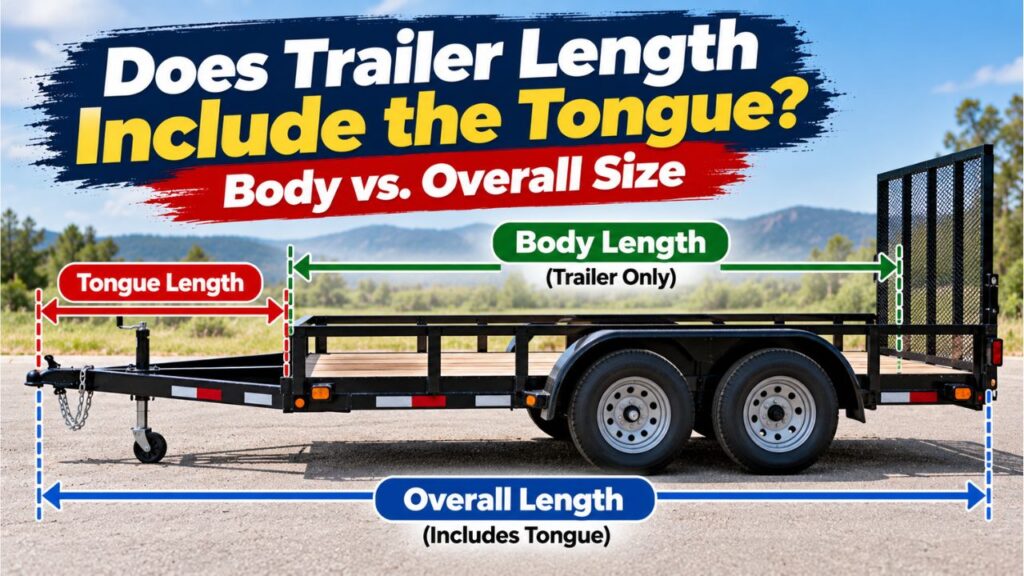
Overall trailer length typically includes the tongue and coupler because they are part of the complete trailer assembly. However, measurements labeled body length, deck length, or box length generally exclude the tongue.
This distinction is especially important when comparing utility trailers, cargo trailers, boat trailers, and recreational vehicles.
Trailer Length Measurements Explained
| Measurement Type | Includes Tongue? | What It Measures |
| Overall trailer length | Generally yes | Front of coupler to rear of trailer |
| Trailer body length | No | Exterior length of trailer body |
| Cargo deck length | No | Usable or specified cargo platform length |
| Enclosed trailer box length | No | Length of enclosed cargo body |
| Interior length | No | Usable space inside an enclosed trailer |
| Travel trailer overall length | Yes, under RVIA measurement rules | Front of coupler to rear extremity |
| Trailer model number | Not necessarily | Manufacturer’s model designation |
A trailer’s stated length is therefore not always the same as the space it occupies.
For buying, parking, or storage, the overall physical dimensions are usually more useful than a model name or cargo deck measurement.
What Counts as the Trailer Tongue?
The trailer tongue is the forward structural section connecting the main trailer frame to the hitch coupler.
Common tongue configurations include:
- A-frame tongue: Two structural members extend forward and meet near the coupler.
- Straight tongue: A single structural member extends forward from the trailer frame.
- Extended tongue: A longer front section, sometimes used on boat trailers and specialized equipment.
- Folding tongue: A hinged tongue that can fold back for storage when designed for that purpose.
The tongue’s length varies between trailer models.
A longer tongue may provide additional clearance between the trailer and towing vehicle, but it also increases the trailer’s overall length.
Key Takeaway: When someone says a trailer is 16 feet long, verify whether that measurement describes the cargo area or the entire trailer, including the tongue.
How Is Trailer Length Measured With the Tongue?
For a conventional bumper-pull trailer, overall length is normally measured horizontally from the front of the hitch coupler to the rear of the trailer.
The exact rear endpoint depends on the trailer’s construction and the purpose of the measurement.
Step 1: Park the Trailer on a Level Surface
Position the trailer on firm, level ground.
Keep the trailer straight and secure it against movement.
Chock the wheels before working around a disconnected trailer, and support the tongue with the appropriate trailer jack.
If the trailer has a folding or extendable tongue, place it in the configuration you want to measure.
Step 2: Locate the Frontmost Point of the Coupler
Find the front edge of the trailer’s hitch coupler.
For most conventional trailers, this is the forward end of the trailer assembly.
Do not begin measuring at the front wall of an enclosed trailer if you want its overall length.
The section between the body and coupler must be included.
Step 3: Find the Rear Measurement Point
Identify the trailer’s rearmost structural point.
Depending on the design, this might be:
- The rear bumper
- The rear edge of the trailer frame
- The back of an enclosed cargo body
- The rear of a fixed loading structure
For practical storage measurements, include anything that physically extends beyond the rear, such as a spare tire carrier or permanently mounted accessory.
Official manufacturer and legal measurement rules may exclude certain accessories, so the appropriate endpoint depends on the purpose.
Step 4: Measure the Full Length
Extend a measuring tape horizontally, parallel to the trailer’s centerline.
Measure from the coupler’s front to the chosen rear endpoint.
Avoid measuring diagonally along the sides of an A-frame tongue, since this does not produce the trailer’s actual front-to-back length.
A long measuring tape or laser measuring tool can make the process easier.
For storage planning, record the maximum physical length, including any accessories that occupy additional space.
Step 5: Record the Body Length Separately
After measuring overall length, measure the trailer body or deck independently.
Keeping both measurements prevents confusion when comparing advertised dimensions.
For example:
- Cargo deck length: 12 feet
- Tongue projection beyond deck: 4 feet
- Overall length: 16 feet
These are illustrative measurements, not universal dimensions for 12-foot trailers.
The actual tongue projection depends on the trailer’s design.
Does a 12-Foot or 16-Foot Trailer Include the Tongue?
A trailer advertised as 12 feet or 16 feet long does not necessarily include its tongue in that measurement.
For many utility and cargo trailers, the advertised length refers to the cargo deck or enclosed box.
The actual overall length may be several feet longer.
Example: Overall Length of a 12-Foot Trailer
Suppose a utility trailer has:
- Deck length: 12 feet
- Tongue extension beyond the deck: 4 feet
- No additional rear projection
The overall length is:
12 + 4 = 16 feet
Although the trailer is advertised as a 12-foot model, it occupies approximately 16 feet from the coupler to the rear of the deck.
If a ramp assembly extends beyond the deck in its travel position, that may increase the physical length further.
Example: Overall Length of a 16-Foot Trailer
Consider another trailer with:
- Cargo body length: 16 feet
- Front tongue projection: 4.5 feet
- Rear bumper projection: 0.5 feet
Its overall length would be:
16 + 4.5 + 0.5 = 21 feet
A 16-foot cargo trailer can therefore require considerably more than 16 feet of parking space.
These examples demonstrate the calculation. They should not be used as actual dimensions for a particular manufacturer or model.
Trailer Body Length vs. Overall Length
| Advertised Body Length | Example Front Projection | Example Rear Projection | Example Overall Length |
| 8 feet | 3 feet | 0 feet | 11 feet |
| 10 feet | 3.5 feet | 0 feet | 13.5 feet |
| 12 feet | 4 feet | 0 feet | 16 feet |
| 14 feet | 4 feet | 0.5 feet | 18.5 feet |
| 16 feet | 4.5 feet | 0.5 feet | 21 feet |
| 20 feet | 5 feet | 0.5 feet | 25.5 feet |
These are hypothetical examples to illustrate the difference between body length and overall length. Actual dimensions must be obtained from the specific trailer.
Important: Do not assume that every trailer of a given advertised length has the same tongue dimensions.
Does Travel Trailer Length Include the Tongue?
Yes, an official travel trailer overall-length measurement includes the hitch coupler under the RV Industry Association’s measurement requirements.
However, a travel trailer’s model number or advertised floor plan length may describe something different.
How RV Manufacturers Measure Overall Length
The RV Industry Association’s official vehicle length labeling guidance establishes a standardized overall-length measurement for member manufacturers.
For travel trailers, the measurement starts at the leading front edge of the hitch coupler and ends at the rearmost bumper or body extremity when no bumper is installed.
The RV Industry Association introduced its overall-length labeling requirement for newly manufactured units produced by member companies beginning January 1, 2021.
The policy also excludes certain accessories from the official overall-length figure, including items such as exterior ladders and spare tire carriers.
This means the official RV length label may differ slightly from the maximum physical space required for storage.
Why Travel Trailer Model Numbers Can Be Misleading
Travel trailer model numbers do not always represent overall length.
For example, a trailer identified with a number such as 24 or 26 might use that number as part of a floor plan designation.
It doesn’t necessarily mean the trailer measures exactly 24 or 26 feet from the coupler to the rear bumper.
Some models have living areas or exterior bodies substantially shorter than their full towing length.
Before buying, check the manufacturer’s actual overall-length specification instead of relying on the model designation.
How to Find the Overall Length on a Travel Trailer
For a travel trailer manufactured under the RV Industry Association’s length-labeling requirements, look for the overall-length label near the occupant or cargo-carrying capacity information.
You can also consult:
- The manufacturer’s official specification sheet
- The trailer owner’s manual
- The dealer’s verified dimensions
- A physical measurement of the trailer
The physical measurement is especially valuable when accessories have been added after manufacturing.
Does the Tongue Count Toward Utility, Cargo, and Boat Trailer Length?
Different trailer categories use different measurements in their sales listings.
Understanding the terminology helps prevent confusion.
Utility Trailers
Utility trailers commonly use their cargo deck dimensions in model descriptions.
A 6 × 12-foot utility trailer usually identifies a deck approximately 6 feet wide and 12 feet long.
The forward tongue is not part of the usable cargo platform.
To determine how much storage space the trailer needs, measure from the coupler to the rearmost point.
Enclosed Cargo Trailers
Enclosed trailer dimensions commonly refer to the cargo box.
For example, a 7 × 16 enclosed trailer generally describes an enclosed body approximately 7 feet wide and 16 feet long.
The tongue extends beyond the front of the cargo body.
Some enclosed trailers also have V-shaped front sections that affect their exterior dimensions.
Check whether the manufacturer includes the V-nose in the stated box length or provides a separate interior measurement.
Boat Trailers
Boat trailers may have adjustable, extendable, or folding tongues, depending on their design.
Their overall physical length also depends on the location of the boat, outboard motor, transom, and other equipment.
When measuring a boat trailer for garage storage, account for the entire stored assembly.
A boat motor tilted outward or a rear-mounted accessory may extend beyond the trailer’s frame.
If the tongue folds, measure the trailer in both its towing and storage positions.
Equipment and Flatbed Trailers
Flatbed and equipment trailers often use deck length as their primary advertised measurement.
The tongue or gooseneck structure is separate from the usable cargo platform.
For equipment selection, deck length determines how much cargo space is available.
For parking, towing clearance, and overall dimensions, the hitch structure must also be considered.
Does Fifth-Wheel and Gooseneck Trailer Length Include the Hitch?
Fifth-wheel and gooseneck trailers use different coupling systems from conventional bumper-pull trailers.
Instead of a long A-frame tongue ending at a coupler behind the towing vehicle, they connect through a hitch positioned in the truck bed.
Fifth-Wheel Trailer Overall Length
For fifth-wheel RVs, the RV Industry Association defines overall length from whichever extends farther forward—the leading edge of the pin box or the frontmost body profile—to the rearmost body or bumper extremity.
Therefore, the pin box can affect the official overall-length measurement.
A fifth-wheel model number or living-area length should not be assumed to represent this full dimension.
Gooseneck Trailer Length
Gooseneck equipment trailers commonly advertise the length of their usable deck.
That may include the main deck and, depending on the trailer description, an additional upper deck section.
The gooseneck coupling structure is not necessarily part of the advertised deck measurement.
For physical storage, measure the complete trailer from its forwardmost projection to its rear.
When checking legal length limits, use the applicable rules for that trailer configuration.
Does Trailer Length Include the Tongue for Legal Requirements?
The answer depends on the regulation, jurisdiction, and measurement being used.
A manufacturer’s overall-length specification does not automatically determine how a state measures trailer length for every legal purpose.
Trailer Length Rules May Exclude Coupling Devices
For example, the Texas Department of Public Safety’s official trailer length measurement guidance instructs that trailers be measured from the front of the box or basic permanent load-bearing surface to the rearmost part of the vehicle.
For this specific regulatory measurement, coupling devices are excluded.
This differs from the RV Industry Association’s overall-length labeling method for travel trailers, which includes the front of the hitch coupler.
Both methods are valid within their respective purposes.
That is why the word “length” must be interpreted in context rather than treated as a universal measurement.
Trailer Registration and Title Length
Trailer registration information may use the manufacturer’s recorded dimensions or measurements defined by the relevant state.
Not every state records or uses trailer length in the same way.
If you need the measurement for registration or titling, verify the requirements of the state motor vehicle agency.
Don’t assume that the cargo deck length, model number, or RV overall-length label will automatically satisfy every registration requirement.
Maximum Legal Trailer Length
State regulations may establish limits for individual trailers, trailer combinations, or particular vehicle categories.
These limits can depend on whether the trailer is a conventional utility trailer, semitrailer, recreational vehicle, or specialized equipment trailer.
Some rules measure the trailer separately, while others consider the full towing combination.
Check the applicable state and route requirements before transporting an unusually long trailer.
Which Trailer Length Matters for Parking, Storage, and Camping?
The correct measurement depends on the available space and how the trailer will be positioned.
For practical clearance, the physical dimensions often matter more than the number printed in a model name.
Measuring Trailer Length for Garage Storage
For garage storage, measure the entire trailer in its actual parked configuration.
Include physical projections such as:
- The hitch coupler
- The tongue jack, if it projects forward
- Rear spare tire carriers
- Extended bumper accessories
- Outboard motors on boat trailers
- Other permanently mounted equipment
Allow additional clearance so you can close the garage door and access the trailer safely.
If the trailer has a folding tongue, measure it in the properly folded storage position.
Do not assume that every swing-away tongue can be folded while the trailer is loaded or supported in any particular way. Follow the manufacturer’s instructions.
Measuring Trailer Length for a Campsite
Campgrounds may request the trailer’s length when assigning a campsite.
Some use the manufacturer’s overall-length specification, while others have their own requirements for reporting attached accessories or the total towing combination.
For practical campsite planning, know:
- The travel trailer’s full physical length
- Whether a rear rack or accessory extends beyond the bumper
- The tow vehicle’s length
- The total length of the vehicle and trailer when connected
If the campsite’s measurement requirements are unclear, verify them before reserving a site with limited space.
Measuring Total Tow Vehicle and Trailer Length
The total towing combination is measured from the frontmost point of the towing vehicle to the rearmost point of the connected trailer when they are aligned.
This is different from the trailer’s individual overall length.
You cannot always calculate the total combination accurately by simply adding the tow vehicle’s length to the trailer’s overall length.
Some trailer tongue length overlaps the towing vehicle’s rear projection when the coupler is connected to the hitch.
For accurate parking or length-limit measurements, measure the connected combination directly.
How to Check Trailer Length Before Buying
Checking a few specific dimensions before purchase can prevent problems with storage, equipment loading, and towing.
Ask for the Actual Overall Length
If a listing identifies a trailer as 7 × 14 feet, ask whether 14 feet refers to the interior box, deck, or total outside length.
Request the overall measurement from the coupler to the rear of the trailer.
For fifth-wheel and gooseneck trailers, ask which points the manufacturer uses for its published length.
Confirm the Usable Cargo Length
Overall length does not tell you how much equipment fits on the deck.
If you’re transporting a car, tractor, mower, or other large item, measure the actual usable loading area.
Pay attention to wheel wells, front walls, ramps, and other obstructions.
Check the Trailer’s Full Storage Dimensions
Measure the available parking or garage space before purchasing.
Compare it with the trailer’s:
- Maximum physical length
- Overall width, including fenders
- Overall height, including fixed equipment
- Clearance needed for access and maneuvering
A trailer may fit within the available length but still be too wide for a garage door or too tall for the opening.
Verify Modifications and Accessories
Aftermarket accessories can change a trailer’s actual footprint.
Examples include extended hitch components, rear cargo racks, spare tire mounts, and modified boat trailer tongues.
Manufacturer specifications for the original model may not account for these changes.
Measure the actual trailer rather than relying exclusively on factory dimensions.
Conclusion
So, does trailer length include the tongue? Yes, when referring to the trailer’s conventional overall physical length. However, advertised deck length, enclosed box length, and some regulatory measurements may exclude it.
A 12-foot cargo trailer may require substantially more than 12 feet of storage space because of its tongue and other projections.
For travel trailers, the RV Industry Association’s overall-length measurement includes the hitch coupler, while certain state-specific legal measurements can follow different rules.
The most reliable approach is to distinguish overall length from usable cargo length and measure the trailer directly when space is limited.
Before purchasing, parking, or registering a trailer, confirm which measurement is required. This prevents confusion and helps ensure the trailer fits its intended purpose.
FAQs About Does Trailer Length Include the Tongue
Is a 16-Foot Trailer Actually 16 Feet Long?
Not necessarily. A 16-foot utility or enclosed cargo trailer may have a 16-foot deck or box, with additional length from the tongue and rear projections. Check the manufacturer’s overall-length specification for the actual outside dimensions.
How Much Length Does a Trailer Tongue Add?
The additional length depends on the trailer’s design. Some tongues extend only a relatively short distance beyond the body, while others project several feet forward. Measure from the front of the cargo body or deck to the leading edge of the coupler for the actual projection.
Does a Travel Trailer’s Advertised Length Include the Hitch?
It depends on what the advertised number represents. An official RV overall-length measurement includes the hitch coupler under RV Industry Association rules, but a model number or floor plan designation may not represent the trailer’s full outside length.
Does a Folding Trailer Tongue Count Toward Length?
For towing, the tongue is part of the trailer’s full physical length. For storage, a properly folded tongue can reduce the space needed. Legal measurement requirements and manufacturer specifications may use different definitions, so verify the applicable measurement.
Does Trailer Length Include the Rear Bumper?
Overall trailer length generally includes the rear bumper or rearmost body structure. However, some official RV measurements exclude specific accessories attached beyond the bumper. For garage storage, measure every part that physically occupies space.
Is Trailer Length Measured From the Hitch Ball or the Coupler?
For a conventional trailer’s physical overall length, measure from the forwardmost point of the trailer coupler to the rear endpoint. The hitch ball is attached to the towing vehicle, so it is not the usual starting point for measuring an unhitched trailer.
Does Trailer Length Include the Tongue for a Storage Unit?
For practical storage planning, yes. Measure the full parked trailer, including its tongue, coupler, and any accessories that project beyond the frame. If the trailer has a folding tongue, use its actual stored dimensions and allow enough clearance for safe access.