Yes, the overall length of a travel trailer includes the tongue and hitch coupler. However, a trailer’s advertised model length or body length may not include the tongue. The difference depends on which measurement the manufacturer or seller is using.
Overall length generally runs from the front of the trailer’s hitch coupler to its rear bumper or rearmost body surface. This measurement represents the trailer’s complete manufactured length, including the A-frame extending beyond the front wall.
The confusion comes from manufacturers using several measurements. A camper advertised as a 25-foot model isn’t necessarily 25 feet long from hitch to bumper. Its model number might describe the floor plan, approximate body length, or another manufacturer-specific designation.
This difference matters when choosing a campsite, checking garage clearance, planning driveway storage, or comparing RV sizes. Using the wrong measurement could leave insufficient parking space.
In this article, I explain which travel trailer measurements include the tongue, how manufacturers calculate overall length, and how to measure your trailer accurately. You’ll also learn which dimensions matter for campsites, storage, towing, and rear-mounted accessories.
Does Travel Trailer Length Include the Tongue in Overall Measurements?
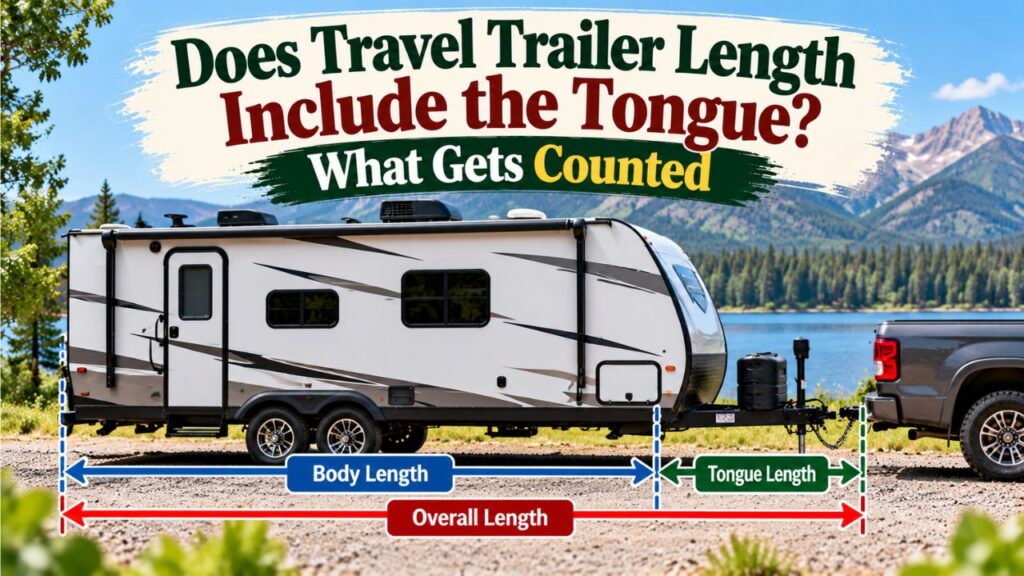
Yes. Overall travel trailer length includes the tongue because the measurement extends forward to the hitch coupler.
The RV Industry Association’s official vehicle-length labeling requirements define a travel trailer’s overall length as the distance from the leading front edge of its hitch coupler to the rearmost point of its bumper or body, depending on whether a bumper is installed.
This measurement includes the A-frame tongue located between the trailer’s front wall and the hitch connection.
The RV Industry Association introduced its overall-length labeling requirement for member manufacturers effective January 1, 2021.
However, the term overall length should not be confused with a manufacturer’s floor-plan name or a dealer’s abbreviated description.
What Parts Are Included in Overall Travel Trailer Length?
The manufactured overall length generally accounts for:
- The trailer’s front hitch coupler.
- The A-frame tongue extending ahead of the body.
- The entire enclosed trailer body.
- The rear bumper, when installed.
- The rear body or rear cap when there is no bumper.
Certain accessories may be excluded from the manufacturer’s overall-length label, even though they occupy physical space.
Examples include exterior ladders, spare tires, spare-tire carriers, and some rear-mounted equipment.
Key Takeaway: The tongue is included in a trailer’s official overall length, but some attached accessories may extend beyond that published measurement.
Travel Trailer Overall Length vs. Body Length vs. Model Length
The main reason travel trailer dimensions cause confusion is that several length measurements describe different parts of the RV.
Knowing these distinctions helps you compare trailers accurately.
Travel Trailer Length Measurement Comparison
| Measurement | Includes the tongue? | What it describes |
| Overall length | Yes | Complete manufactured trailer from hitch to rear |
| Exterior body or box length | No | Enclosed camper body, excluding the tongue |
| Interior length | No | Length of the usable interior space |
| Floor-plan or model length | Not necessarily | Manufacturer-specific designation |
| Trailer and tow vehicle combined length | Yes | Complete connected towing combination |
| Trip-ready physical length | Yes | Trailer including any accessories extending beyond its manufactured length |
These terms are useful for different purposes.
Overall length is the most relevant starting point for parking and campsite restrictions, while interior length helps describe usable living space.
What Is Travel Trailer Body Length?
Body length, sometimes called box length, is the distance from the front of the enclosed camper body to its rear body surface.
It excludes the A-frame and hitch coupler.
Depending on the manufacturer’s terminology, it may also exclude the rear bumper.
For example, a trailer might have:
- A 20-foot enclosed body.
- A 3-foot distance from the front body wall to the foremost hitch point.
- A rear bumper extending 6 inches beyond the body.
In this hypothetical example, the body length is 20 feet, but the overall length is 23 feet 6 inches.
These are illustrative dimensions, not specifications for a particular RV model.
Does the Travel Trailer Model Number Include the Tongue?
Not necessarily.
A manufacturer’s model number may refer to an approximate floor-plan length, the main body, or an internal product designation.
For example, a trailer with a model name containing the number 24 might have an overall length greater than 24 feet.
That number alone does not establish the camper’s exterior dimensions.
Some manufacturers use model names that correspond closely to actual trailer length. Others do not.
Never use the model number as a substitute for the published overall-length specification.
How Do Travel Trailer Manufacturers Measure Length?
Travel trailer manufacturers commonly provide exterior length measurements in their specifications, but the exact measuring convention should always be confirmed.
How Airstream Measures Travel Trailer Length
According to Airstream’s official exterior-length measurement guidance, its travel trailer exterior lengths are measured from the center of the hitch to the end of the rear bumper.
For Airstream models without a bumper, the measurement extends to the rearmost exterior point of the trailer.
Airstream also advises buyers to check the specifications for the individual floor plan because the model name may not provide the exact measurement.
This shows why the wording in the specification sheet matters.
The RV Industry Association’s overall-length labeling method uses the leading edge of the coupler, while Airstream describes its published exterior-length measurement from the hitch center.
That difference may be small, but it matters when comparing precise dimensions.
Where to Find Your Trailer’s Official Length
You can usually check the following locations:
- Manufacturer specifications: Look for overall length, exterior length, or hitch-to-rear measurements.
- Owner’s manual: Check the dimensions or vehicle identification section.
- RV length label: On applicable RVs, look near the cargo-carrying capacity label.
- Manufacturer customer support: Request confirmation using the exact model and model year.
- Physical measurement: Measure the trailer yourself when space is limited.
Some manufacturers place the overall-length label near the Cargo Carrying Capacity (CCC) label.
The specific location may vary by manufacturer and trailer design.
If you are buying a used trailer, confirm whether its bumper, coupler, or other structural components have been modified.
How Much Length Does the Tongue Add to a Travel Trailer?
The tongue adds the distance between the enclosed trailer body and the foremost point of the hitch coupler.
That distance varies with the trailer’s design.
Many conventional travel trailers have an A-frame extending several feet ahead of the body, but there is no single tongue length that applies to every model.
Example of Trailer Body Length With and Without Tongue
Consider a hypothetical camper with these measurements:
| Component | Length |
| Enclosed trailer body | 20 feet |
| Front A-frame and coupler extension | 3 feet |
| Rear bumper extension | 6 inches |
| Total overall length | 23 feet 6 inches |
In this example, measuring only the enclosed body would underestimate the overall trailer length by 3 feet 6 inches.
That difference can affect whether the camper fits inside a garage, driveway, or reserved campsite.
Why Trailer Tongue Lengths Vary
Manufacturers design trailer tongues according to factors such as:
- Trailer frame construction.
- Coupler location.
- Clearance between the trailer and tow vehicle.
- Placement of propane cylinders.
- Battery and equipment mounting.
- Intended trailer configuration.
A longer tongue doesn’t automatically mean the entire camper offers more interior space.
Likewise, two travel trailers with identical body lengths can have different overall lengths because their tongues and rear bumpers are constructed differently.
Important: Don’t add a fixed number of feet to every trailer’s advertised length. Check the actual dimensions instead.
How to Measure Travel Trailer Length Including the Tongue
If the specification sheet is unclear or you need an accurate measurement for parking, you can measure the trailer directly.
For the overall manufactured length, measure from the foremost point of the hitch coupler to the rearmost bumper or body surface.
Use a suitable tape measure and work on firm, level ground.
Step 1: Park the Trailer on Level Ground
Position the trailer on a stable, relatively level surface.
Secure it against movement before measuring.
For a disconnected trailer:
- Chock the wheels.
- Support the tongue properly.
- Make sure the tongue jack is stable.
- Keep children and other people away from areas where the trailer could move.
You don’t need to crawl beneath the trailer to measure its length.
Step 2: Locate the Front of the Hitch Coupler
Find the farthest forward point of the trailer’s coupler.
This is the connection that fits over the tow vehicle’s hitch ball.
Don’t start measuring from the front wall of the camper if your goal is overall length.
The A-frame tongue must be included.
For comparison with a specific manufacturer’s published measurement, follow that manufacturer’s stated starting point.
Step 3: Identify the Rear Measuring Point
Move to the rear of the trailer.
If the manufacturer-installed bumper extends beyond the body, that is generally the rear measuring point for overall manufactured length.
If the trailer has no bumper, use the rearmost exterior body surface.
Do not automatically include ladders, spare tires, or accessory carriers when trying to match the manufacturer’s labeled length.
You can measure those separately to establish how much physical parking space the trailer occupies.
Step 4: Measure Along the Trailer’s Length
With a helper, use a tape measure to determine the straight horizontal distance between the front and rear measuring points.
Keep the measurement parallel to the trailer’s longitudinal direction.
Avoid following the curve of the front cap, roof, or sidewalls.
For a large trailer, a measuring wheel or another suitable measuring tool may be more convenient, provided the measurement stays properly aligned.
Record the result in feet and inches.
Step 5: Measure Any Additional Rear Accessories
If your camper has a spare tire carrier, bike rack, cargo platform, or other rear-mounted accessory, measure to the farthest point when the equipment is in its travel position.
For example:
- Manufactured overall length: 25 feet 6 inches.
- Rear accessory extends an additional 18 inches.
- Actual length including that accessory: 27 feet.
This additional measurement is especially useful for storage and parking clearance.
If a campground, storage provider, or other facility applies a length restriction, confirm how it treats protruding accessories.
Step 6: Record the Trailer and Towing Combination Separately
Keep two measurements:
Trailer overall length: From the trailer’s hitch coupler to its rear extremity.
Complete towing combination length: From the front of the tow vehicle to the rearmost point of the connected trailer and equipment.
Do not simply add the full lengths of the tow vehicle and trailer.
The connected hitch arrangement creates an overlap between the vehicle’s rear end and the front of the trailer, so the actual combination length must be measured or calculated from the connection geometry.
Does Travel Trailer Length Include the Tongue for Campgrounds?
For campsite planning, the safest approach is to use the trailer’s actual overall length, including the tongue, unless the campground explicitly defines its limits differently.
Campgrounds may publish restrictions based on site length, RV size, road access, turning clearance, or other site-specific conditions.
These descriptions are not always interchangeable.
What If a Campground Has a 25-Foot Trailer Limit?
Suppose you own a travel trailer with:
- A 22-foot enclosed body.
- A 25-foot 6-inch manufactured overall length.
If the campground restricts trailers to 25 feet overall, the trailer would exceed that limit.
You shouldn’t assume the shorter body length qualifies.
However, if the campground uses a different measurement convention, the result may depend on its specific rules.
Confirm the maximum permitted trailer length before booking.
Does the Tow Vehicle Count Toward Campsite Length?
That depends on the campground’s layout and reservation rules.
Some sites have enough room for both the camper and tow vehicle.
Others provide a separate parking area or require the tow vehicle to be parked elsewhere.
The site’s stated parking-pad length does not necessarily tell you how much space is available for the complete connected combination.
Before reserving a tight site, confirm:
- The maximum permitted RV length.
- Whether the tow vehicle must fit on the same pad.
- Whether separate vehicle parking is available.
- Whether rear-mounted accessories affect the length limit.
- Whether the access road and turning area accommodate the trailer.
Key Takeaway: Use the full trailer length when planning a campsite, and verify the campground’s measurement rules rather than relying on the trailer’s model number.
Does Travel Trailer Length Include the Tongue for Storage?
Yes, you should include the tongue when calculating the space required to store a travel trailer.
The hitch coupler and A-frame occupy real space even though they are outside the enclosed living area.
Measuring a Travel Trailer for a Garage
If you’re storing a camper inside a garage, measure its full physical length from the front coupler to the rearmost attached item.
Also check:
- Garage door clearance.
- Trailer exterior height.
- Roof-mounted equipment.
- Trailer width.
- Door and walkway clearance.
- Space required to operate the tongue jack.
- Whether the hitch coupler or rear accessories can contact the walls.
For example, a garage with 26 feet of interior depth may not accommodate a trailer measuring 25 feet 10 inches comfortably.
Although the trailer is technically shorter than the garage, very little clearance remains.
The exact space needed depends on the storage arrangement and how the trailer will be moved.
Measuring for Driveway Storage
When checking driveway space, use the full trailer length.
Include rear accessories that extend beyond the bumper.
Also consider whether any part of the parked trailer would obstruct a sidewalk, public road, or required access area.
Local property rules and parking restrictions may affect where a trailer can be stored.
A trailer that physically fits on the driveway isn’t automatically permitted to remain there.
Measuring for an RV Storage Facility
Storage facilities may rent spaces based on nominal length categories.
For example, a facility could offer spaces advertised for trailers up to 25 or 30 feet long.
A trailer measuring slightly more than a listed category may require a longer space.
Ask whether the facility measures the camper alone, includes rear-mounted equipment, or requires room for hitch access.
Does the Tongue Count Toward Travel Trailer Towing Length?
The tongue contributes to the overall physical length of the towing combination.
However, trailer length and towing weight capacity are separate measurements.
A tow vehicle’s maximum trailer weight rating does not establish a universal maximum trailer length.
Travel Trailer Length and Towing Stability
Trailer dimensions can influence how a combination handles on the road.
Relevant factors include:
- Trailer wheelbase and axle placement.
- Hitch configuration.
- Tongue weight.
- Overall trailer mass.
- Side surface area.
- Tow vehicle dimensions and stability.
- Cargo distribution.
A longer travel trailer may be more sensitive to certain handling conditions, but length alone doesn’t determine whether the towing combination is safe.
Follow the tow vehicle, trailer, and hitch manufacturers’ requirements.
Don’t rely on an unsupported formula claiming that a particular vehicle can safely tow any trailer below a fixed length.
Overall Length and Turning Clearance
A travel trailer’s tongue and hitch arrangement affect the space between the camper and tow vehicle.
The combination also needs enough room to turn without interference between the trailer body and the tow vehicle.
When planning a route or storage location, consider both the overall combination length and its turning requirements.
Tight driveways, campground roads, fuel stations, and narrow entrances can create difficulties even when the trailer technically fits within a stated length.
Common Travel Trailer Length Measurement Mistakes
Most measurement problems come from confusing a floor-plan designation with the full exterior dimensions.
A few checks can prevent unnecessary surprises.
Assuming a 25-Foot Model Is Exactly 25 Feet Long
Model names are not reliable measuring tools.
Some correspond closely to exterior length, while others reflect interior layouts or approximate body measurements.
Always check the exact model-year specifications.
Measuring Only the Living Area
The interior sleeping, cooking, and seating spaces do not include the tongue.
Interior length can help compare layouts, but it doesn’t tell you whether the camper fits a parking space.
Use the overall exterior measurement for that decision.
Forgetting the Rear Bumper
A rear bumper can extend beyond the enclosed body.
If you’re measuring from the camper’s front wall to its rear wall, you’re missing both the tongue and potentially the bumper.
Measure to the correct rear endpoint.
Ignoring Bikes and Cargo Carriers
A trailer may fit inside a storage space based on its published overall length but exceed that space after rear equipment is installed.
Measure the physical setup you actually intend to park or tow.
Confusing Trailer Length With Combined Vehicle Length
A 25-foot travel trailer doesn’t mean the entire connected towing setup is 25 feet long.
The tow vehicle adds substantial length.
Measure the connected combination separately when planning maneuvering space, ferry reservations, or other situations requiring the complete vehicle length.
Conclusion
So, does travel trailer length include the tongue? Yes, when the measurement is the trailer’s overall length. That measurement includes the A-frame and hitch coupler, along with the enclosed body and applicable rear bumper.
However, a trailer’s body length, interior length, or model number may not include the tongue.
The most dependable way to confirm the actual size is to check the manufacturer’s overall-length specification or measure from the hitch coupler to the trailer’s rearmost manufactured point.
For parking, storage, and campsite planning, also measure accessories that extend beyond the published length.
Use the overall length for physical clearance, not just the number in the trailer’s model name. This avoids confusion when comparing RVs and helps prevent problems with spaces that are too short for your camper.
FAQs About Does Travel Trailer Length Include the Tongue
Does a 25-Foot Travel Trailer Actually Measure 25 Feet?
Not necessarily. A trailer described as a 25-foot model may have a different overall exterior length.
The number could represent an approximate floor-plan size, body length, or model designation.
Check the manufacturer’s specifications to confirm the hitch-to-rear measurement.
Does Travel Trailer Exterior Length Always Include the Hitch?
The official overall-length measurement includes the hitch coupler.
However, a manufacturer’s use of the term exterior length should be checked against its published measuring method.
For example, Airstream measures exterior length from the center of the hitch to the rear bumper or rearmost exterior point.
How Long Is the Tongue on a Typical Travel Trailer?
Many travel trailer tongues extend several feet beyond the enclosed body, but the exact distance varies by model.
There is no universal tongue length that can be added to every camper’s body length.
Measure from the front body wall to the foremost coupler point for your specific trailer.
Does a Rear Spare Tire Count Toward Travel Trailer Length?
Not necessarily for the manufacturer’s published overall-length label. The RV Industry Association permits certain accessories, including spare tires and carriers, to be excluded.
However, the spare tire still occupies physical space.
Include its projection when measuring for garages, storage spaces, or other tight clearances.
Is Travel Trailer Length Measured With Slide-Outs Open?
The trailer’s overall length is generally measured in its manufactured travel configuration, not with slide-outs extended for camping.
Slide-outs primarily affect the space needed beside the trailer, although their design may affect other dimensions.
For campsites, measure the full width with slides extended separately from the trailer’s overall travel length.
Does the Tow Vehicle Count as Part of the Travel Trailer Length?
No. The trailer’s published overall length generally measures the camper itself, including its tongue, but not the tow vehicle.
The connected tow vehicle and camper have a separate combined overall length.
That combined measurement matters when checking certain parking arrangements, road restrictions, and maneuvering spaces.