A trailer tongue should generally be about 4 to 6 feet long for many small and medium utility trailers, measured from the front of the trailer frame to the center of the hitch ball connection. A length of approximately 4 to 5 feet is a practical starting point for many utility trailers, but the correct dimension depends on trailer width, tow vehicle clearance, axle placement, and structural design.
A tongue that’s too short can cause the trailer to turn sharply while backing and increase the risk of the trailer’s front corners hitting the tow vehicle. An excessively long tongue adds leverage to the trailer frame, may require reinforcement, and can affect weight distribution.
The ideal length also varies by trailer type. A small cargo trailer, boat trailer, and travel trailer may need different tongue designs because of their cargo, accessories, and turning requirements.
In this article, I explain how long a trailer tongue should be for different trailers, how to measure it correctly, and how tongue length affects turning, backing, and towing stability. I also cover practical clearance checks, structural considerations, and when extending an existing tongue makes sense.
How Long Should a Trailer Tongue Be for Different Trailer Types?
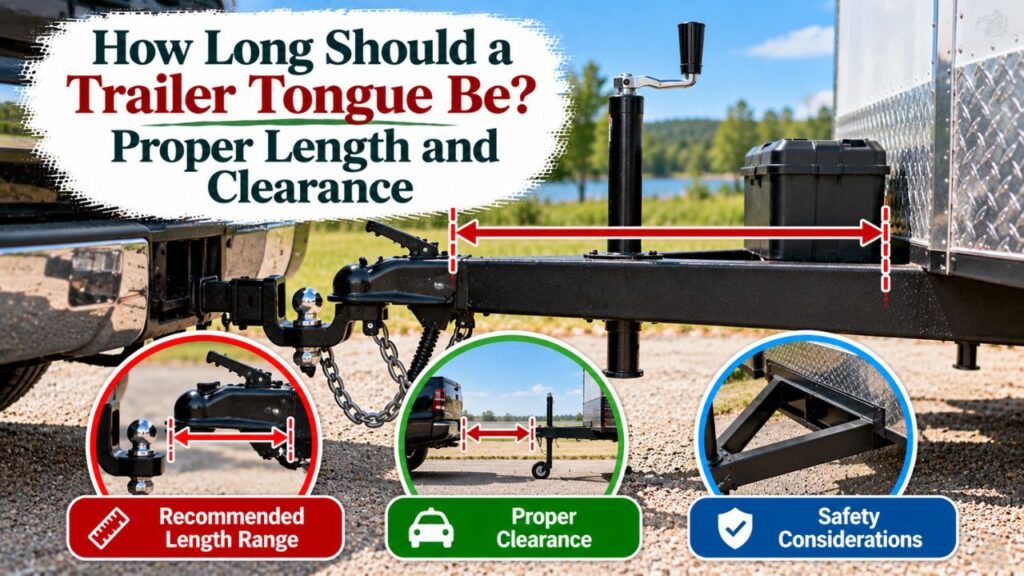
There isn’t one universal tongue length that fits every trailer. However, common design ranges provide useful starting points.
For many conventional utility trailers, a tongue extending approximately 48–60 inches from the front frame to the coupler is a practical arrangement.
The following table provides general design guidance rather than manufacturer-approved specifications.
| Trailer Type | General Tongue Length Considerations |
| Small utility trailer | Around 3–4 feet may work with verified clearance |
| Standard utility trailer | Approximately 4–5 feet is a common starting range |
| Larger utility or cargo trailer | Approximately 4–6 feet, depending on body width |
| Boat trailer | Often longer or adjustable for boat and vehicle clearance |
| Travel trailer | Depends on A-frame geometry, body shape, and accessories |
| Specialty equipment trailer | Determined by engineered frame and load requirements |
The TrailerSauce technical guide to trailer tongue design identifies approximately 4–6 feet as a common tongue-length range and recommends roughly 4 feet to 4 feet 8 inches for many general-purpose trailers.
These dimensions are design guidelines, not universal legal minimums or maximums.
Tongue Length for Small Utility Trailers
Small utility trailers often use relatively short tongues because their cargo decks are narrow and their towing loads are modest.
A compact trailer may have a tongue around 3–4 feet long.
However, a 3-foot tongue isn’t automatically adequate.
The tow vehicle’s rear bumper, trailer width, hitch location, and turning angle all affect whether sufficient clearance exists.
A trailer that works behind a compact car may not provide the same clearance behind a pickup with a wide rear bumper.
For many small utility trailers, a tongue closer to 4 feet offers more flexibility than a very short design.
Tongue Length for 5×8 and 6×10 Utility Trailers
Utility trailers with 5-by-8-foot or 6-by-10-foot cargo decks often benefit from a tongue in the approximate 4–5-foot range.
This length can provide reasonable separation between the trailer and tow vehicle while maintaining practical maneuverability.
A wider trailer or a vehicle with rear-mounted accessories may require additional clearance.
The actual frame design must also support the tongue’s length and the loaded trailer weight.
Don’t select the tongue dimension based only on the cargo deck length.
Tongue Length for Boat Trailers
Boat trailers have additional design requirements.
The tongue must provide clearance for the boat’s bow, winch stand, and other equipment.
It must also allow the tow vehicle to remain appropriately positioned during launching and retrieval.
Some boat trailers use extended or adjustable tongues for these purposes.
A fixed 4-foot tongue may be adequate for one boat trailer but unsuitable for another.
For an existing boat trailer, follow the trailer manufacturer’s design and loading specifications.
Tongue Length for Travel Trailers
Travel trailers commonly use A-frame tongues with the coupler positioned ahead of the trailer body.
The front area may contain:
- Propane cylinders.
- Battery boxes.
- A tongue jack.
- Weight-distribution hitch components.
- Storage accessories.
These components require space and must remain clear of the tow vehicle during turns.
A travel trailer’s tongue length is normally established by the manufacturer as part of the chassis design.
It shouldn’t be shortened or extended simply to match a general utility trailer measurement.
How to Measure Trailer Tongue Length Correctly
Trailer tongue length is normally measured horizontally from the front of the trailer’s main frame to the center of the coupler’s ball socket.
This is different from measuring the entire trailer or the distance from the hitch to the axle.
Step 1: Locate the Front Trailer Crossmember
Find the front crossmember of the main trailer frame.
On a typical flatbed utility trailer, this is near the front edge of the cargo deck.
An A-frame tongue usually extends forward from this area toward the coupler.
For enclosed trailers, the front body may extend beyond the main frame crossmember. Measure body clearance separately.
Step 2: Identify the Coupler Center
Locate the center of the trailer coupler’s ball socket.
This is the point that sits over the hitch ball when connected.
Don’t measure only to the front tip of the coupler housing.
The center of the ball connection is the relevant reference point.
Step 3: Measure the Horizontal Distance
Use a measuring tape to determine the distance from the front crossmember to the coupler center.
For example:
- Front crossmember to coupler center: 48 inches.
- Trailer tongue length: 48 inches.
- Equivalent length: 4 feet.
This provides the nominal tongue length for comparing trailer designs.
Step 4: Measure the Forwardmost Trailer Components
Measure the actual clearance from the coupler to any part of the trailer that extends forward.
This may include a V-shaped cargo nose, toolbox, winch, or spare tire.
The front frame measurement alone doesn’t guarantee adequate turning clearance.
Important: Trailer tongue length isn’t the same as tongue weight. Tongue length is a horizontal measurement, while tongue weight is the downward force applied to the hitch.
Why Trailer Tongue Length Matters for Turning Clearance
One of the most important reasons to choose an appropriate tongue length is preventing contact between the trailer and tow vehicle.
During a turn, the trailer rotates around the hitch connection.
The trailer’s front corners may move toward the tow vehicle’s rear bumper or body.
How a Short Tongue Affects Sharp Turns
With a short tongue, the front of the trailer sits closer to the tow vehicle.
As the angle between them increases, the risk of contact may increase.
Possible interference points include:
- Rear bumper corners.
- Tailgates.
- Rear-mounted spare tires.
- Trailer toolboxes.
- Front corners of enclosed cargo trailers.
- Jacks and other mounted accessories.
A short tongue may be suitable for a narrow trailer, but the same length may not work for a wider trailer.
The actual vehicle and trailer geometry must be checked.
How a Longer Tongue Improves Clearance
A longer tongue generally moves the trailer body farther from the towing vehicle’s rear.
This can provide more room during sharp turns and backing maneuvers.
It may also create space for equipment installed on the tongue.
However, additional length introduces structural considerations and can change the trailer’s loading characteristics.
The goal is sufficient clearance without adding unnecessary length.
How Much Turning Clearance Is Enough?
There is no single clearance measurement that applies to every trailer and tow vehicle.
The required space depends on the shape and dimensions of both vehicles, hitch location, suspension movement, and terrain.
A practical inspection involves:
- Connecting the trailer on firm, level ground.
- Checking the distance between the trailer and tow vehicle.
- Slowly turning through the intended steering range in a clear area.
- Having a spotter observe possible contact points from a safe position.
- Stopping well before any component approaches contact.
- Checking whether driveways, slopes, or uneven terrain could reduce clearance further.
A clearance check on level pavement doesn’t necessarily represent the most demanding conditions encountered on the road.
If adequate clearance cannot be verified, the towing configuration should be corrected before use.
Is a Longer Trailer Tongue Better for Backing Up?
A somewhat longer tongue can make a conventional trailer less sensitive to small steering changes while reversing.
This is one reason very short trailers sometimes feel difficult to back up.
Backing Up With a Short Trailer Tongue
A short tongue often places the trailer closer to the towing vehicle’s rear axle.
The trailer can respond quickly to changes in the tow vehicle’s direction.
When backing, small steering adjustments may cause the trailer angle to change rapidly.
This can increase the risk of jackknifing if the driver doesn’t react soon enough.
Short trailers require careful steering and slow movement.
Backing Up With a Longer Trailer Tongue
A longer tongue often makes the trailer’s angular response more gradual.
This can give the driver additional time to recognize and correct the trailer’s direction.
It may also make more of the trailer visible in the mirrors.
However, backing behavior depends on the complete geometry, particularly the distance between the hitch and trailer axle.
A longer tongue isn’t a substitute for proper loading or backing practice.
Does Tongue Length Affect Turning Radius?
Yes. Tongue length influences how the trailer follows the tow vehicle through turns.
A longer connection can change the trailer’s path and the space required for maneuvering.
A shorter connection may help a trailer follow more closely in certain tight-turn situations, but it can reduce clearance between the trailer body and tow vehicle.
The better choice depends on the intended application.
For ordinary utility towing, adequate body clearance and predictable handling are more useful goals than making the tongue as short as possible.
How Trailer Tongue Length Affects Towing Stability
Tongue length affects trailer geometry, but stability also depends heavily on loading, axle position, suspension, and towing speed.
A longer tongue doesn’t automatically make an improperly loaded trailer safe.
Tongue Length and Trailer Sway
Trailer sway occurs when the trailer oscillates from side to side.
Several conditions can contribute, including:
- Insufficient tongue weight.
- Poor cargo distribution.
- Excessive speed.
- Tire or suspension problems.
- Wind and road disturbances.
- Incompatible towing equipment.
Tongue length can influence the trailer’s dynamic behavior, but it is only one part of the system.
Changing the tongue length without considering the axle position and center of gravity may produce unexpected results.
Tongue Weight Is Different From Tongue Length
For many conventional ball-hitch trailers, a common tongue weight target is approximately 10%–15% of the actual loaded trailer weight, unless the manufacturer specifies another range.
For example, a loaded trailer weighing 2,000 pounds might require:
- 10% tongue weight: 200 pounds.
- 15% tongue weight: 300 pounds.
The appropriate load must also remain within the towing vehicle’s and hitch’s ratings.
Tongue length alone doesn’t establish the correct tongue weight.
Changing the coupler position or tongue structure may affect weight distribution and should be followed by proper weight measurements.
Axle Position and Tongue Length
The location of the trailer axle influences the load carried by the hitch.
Moving an axle or changing the trailer’s center of gravity can substantially change tongue weight.
The distance between the coupler and axle also affects trailer behavior.
For this reason, tongue length and axle placement should be considered together during trailer design.
Don’t move an axle or alter the frame simply to achieve a preferred tongue length without evaluating the entire trailer structure and loading.
How Short Is Too Short for a Trailer Tongue?
A trailer tongue is too short when it doesn’t provide the clearance, structural support, or handling characteristics required for the towing combination.
Although some compact trailers use tongues around 3 feet long, this doesn’t mean 36 inches is adequate for every trailer.
Problems With an Extremely Short Tongue
Potential problems include:
- Trailer corners contacting the tow vehicle.
- Increased sensitivity when backing.
- Limited space for a tongue jack.
- Interference from toolboxes or spare tires.
- Reduced clearance for rear doors or tailgates.
- Difficulties connecting certain towing equipment.
A short tongue isn’t necessarily unsafe when correctly engineered for a specialized trailer.
However, it should be evaluated according to the trailer’s actual design rather than assumed acceptable because another trailer uses a similar dimension.
Is a 3-Foot Trailer Tongue Long Enough?
A 3-foot tongue may work for a narrow, compact trailer with a compatible towing vehicle.
But it can be too short for a wider utility trailer or a vehicle with a projecting rear bumper.
For a typical general-purpose utility trailer, approximately 4 feet is often a more practical starting point.
Always verify turning clearance before selecting the final dimension.
Can a Trailer Tongue Be Too Long?
Yes. An excessively long tongue can create structural and practical disadvantages.
The extra length increases the distance over which forces act on the tongue and its connections.
If the structure isn’t designed for those forces, excessive flexing or fatigue may result.
Increased Structural Stress
A longer unsupported tongue generally creates a greater bending lever arm.
The structure must resist vertical, sideways, and twisting forces during towing.
Simply welding a long piece of steel onto a short existing tongue doesn’t guarantee adequate strength.
The proper design depends on:
- Trailer gross vehicle weight rating.
- Expected tongue load.
- Steel section dimensions.
- Material properties.
- Frame connections.
- Bracing configuration.
- Dynamic towing loads.
A-frame and properly reinforced tongue structures may distribute forces more effectively than an inadequately supported single beam.
Additional Overall Trailer Length
A longer tongue increases the trailer’s total length.
This may affect:
- Parking space.
- Storage requirements.
- Driveway access.
- Maneuvering in confined areas.
- Garage or storage-building clearance.
It can also increase the amount of space needed to turn or position the combination.
Does a 6-Foot Trailer Tongue Need Reinforcement?
It may.
A tongue longer than approximately 5 feet often deserves particular attention to stiffness and support, but the actual reinforcement requirement depends on the engineered design.
A heavy-duty A-frame structure and a lightweight straight tongue won’t have identical capacities.
There is no reliable rule that a certain tongue length is automatically safe without checking its construction.
For a new trailer design or major modification, use suitable engineering calculations or qualified trailer fabrication guidance.
Straight Tongue vs. A-Frame Tongue: Does Length Matter?
The tongue’s structural design affects how long it can be while safely supporting the required loads.
Straight Trailer Tongue
A straight tongue generally consists of a central structural member extending forward from the trailer frame.
This arrangement is common on some smaller utility and boat trailers.
A properly designed straight tongue can perform well.
However, its central connection and unsupported length must be strong enough to resist towing forces.
Increasing the length may require additional structural support.
A-Frame Trailer Tongue
An A-frame tongue uses two structural members extending from the trailer’s frame toward the coupler.
This triangular arrangement can help transfer loads into the trailer’s main chassis.
A-frame designs are common on utility, cargo, and travel trailers.
Their advantages may include:
- Better distribution of some structural loads.
- Lateral stiffness.
- Space for a tongue jack and accessories.
- Compatibility with suitable A-frame couplers.
The actual capacity still depends on materials, welds, connections, and overall design.
An A-frame tongue is not automatically safe simply because it has two structural members.
How to Determine the Right Tongue Length Before Building a Trailer
If you’re planning a custom utility trailer, choose the tongue length based on actual dimensions and operating conditions.
The following process helps establish design requirements before fabrication.
Step 1: Measure the Trailer Width
Record the trailer’s overall width, including any front components that extend beyond the main deck.
A wider front body may require more distance from the hitch to avoid contacting the tow vehicle.
For a square-front trailer, the front corners are particularly important.
Step 2: Measure the Tow Vehicle
Identify the towing vehicle’s:
- Rear body width.
- Bumper shape and projection.
- Hitch ball position.
- Rear-mounted accessories.
- Tailgate or rear door clearance.
A hitch located far behind the bumper may provide different clearance than one positioned closer to the body.
The final dimensions should reflect the actual towing vehicle rather than a generic width estimate.
Step 3: Establish a Preliminary Tongue Length
For many general-purpose utility trailers, consider approximately 4–5 feet as an initial design range.
This is not the final approved measurement.
The preliminary dimension must be evaluated against turning geometry, load requirements, and structural strength.
A wider trailer or one carrying equipment on its tongue may require more clearance.
Step 4: Evaluate Turning Geometry
Check how the front corners of the trailer move around the hitch during turns.
Consider the maximum practical articulation angle, not just normal road corners.
The tow vehicle’s rear body, trailer width, and distance from the ball to the trailer front all influence clearance.
A scale drawing or computer-aided layout can help identify likely interference.
However, the design should still be checked against the actual vehicle and trailer combination.
Step 5: Check Structural Requirements
Calculate the expected towing and tongue loads.
Evaluate the tongue structure, bracing, frame connections, and fatigue resistance.
The tongue must safely support the trailer under normal driving forces, not merely hold the trailer stationary.
This step is especially important for heavy trailers or modifications involving cutting and welding.
Step 6: Verify the Finished Trailer
After construction by a qualified fabricator, inspect the trailer’s connections and equipment.
Check the actual clearances with the intended tow vehicle.
Measure the loaded tongue weight and verify that the trailer and towing vehicle remain within their ratings.
Any required inspections or registration requirements should also be satisfied before road use.
Can You Extend an Existing Trailer Tongue?
Yes, some trailer tongues can be extended, but the modification must be compatible with the original frame and rated capacity.
There is an important difference between extending the trailer’s structural tongue and installing an extender on the tow vehicle’s hitch.
Extending the Trailer’s Structural Tongue
A structural tongue extension changes the trailer itself.
This may involve replacing or redesigning parts of the tongue and its supports.
Such modifications can affect:
- Frame strength.
- Fatigue resistance.
- Tongue weight.
- Axle loading.
- Coupler location.
- Overall trailer length.
- Safety chain and wiring arrangements.
A professional trailer fabricator or qualified engineer should evaluate the design.
Don’t assume a welded extension is safe based only on the thickness or appearance of the added steel.
Using an Extendable Boat Trailer Tongue
Some boat trailers are manufactured with telescoping tongues.
These allow the coupler to move farther forward for launching or retrieving a boat.
The extended position may have different load limits or operating restrictions.
Follow the manufacturer-approved extension procedure and locking requirements.
Never assume a boat trailer’s launch extension is rated for normal highway towing while fully extended.
Adding a Receiver Hitch Extender
A receiver hitch extender is installed on the towing vehicle rather than the trailer frame.
It moves the hitch connection farther behind the vehicle.
This may help with clearance, but it also increases leverage on the receiver.
According to CURT’s official hitch extender guide, hitch extenders can reduce the effective tongue weight capacity of a receiver. CURT also emphasizes following the lowest-rated component in the towing system.
Some receiver extensions are not rated for towing at all.
Check the extender’s specific gross trailer weight and tongue weight ratings, along with the vehicle and receiver limits, before using one.
Common Trailer Tongue Length Mistakes to Avoid
Choosing Length Based Only on Trailer Deck Size
A 5×8 trailer and another 5×8 trailer may require different tongue lengths.
Differences in front-body shape, axle placement, tow vehicle design, and accessories can change the requirements.
Use the entire towing combination when selecting dimensions.
Ignoring Rear Bumper Clearance
A tongue that appears long enough while the trailer is straight may allow contact during a sharp turn.
Check the front corners and any components protruding toward the tow vehicle.
Extending the Tongue Without Checking Strength
Longer tongues introduce additional structural demands.
Increasing length without suitable bracing, section strength, or connection design may create dangerous flexing or failure.
Assuming Tongue Length Fixes Sway
Trailer sway can result from loading and other mechanical conditions.
Lengthening the tongue isn’t a guaranteed solution.
Confirm the loaded tongue weight, axle loading, tire condition, and proper equipment setup first.
Confusing Tongue Length With Overall Trailer Length
The tongue contributes to the trailer’s overall length but isn’t the same measurement.
A trailer advertised as 12 feet long may refer to the cargo box or deck length rather than the distance from the coupler to the rear.
Check the manufacturer’s dimensional definitions.
Using a Hitch Extender Without Checking Ratings
A receiver extender may provide additional clearance but reduce the permitted load.
Verify that the specific extender is approved for towing and that all applicable capacities remain within their limits.
When Should You Keep the Original Trailer Tongue Length?
For an existing factory-built trailer, keeping the original tongue length is generally the safest starting point.
The original frame was designed around particular dimensions, structural connections, and load ratings.
Replacing the tongue solely because another trailer uses a longer one may introduce new problems.
Consider modifications only when there is a clear, verified need, such as inadequate clearance or a manufacturer-approved change.
If the trailer has poor towing behavior, investigate the loaded tongue weight, tire condition, axle alignment, suspension, and hitch setup before assuming tongue length is the cause.
For custom trailers, the dimensions should be established through proper design rather than copying an arbitrary measurement.
Conclusion
How long should a trailer tongue be? For many small and medium utility trailers, approximately 4–6 feet is a common design range, with 4–5 feet providing a practical starting point for many standard applications.
However, the ideal length depends on trailer width, tow vehicle dimensions, axle placement, structural strength, and the clearance needed during turning and backing.
A very short tongue can make reversing more sensitive and increase the risk of contact between the trailer and tow vehicle. An excessively long tongue can introduce additional structural stress and may require reinforcement.
For an existing manufactured trailer, follow the original design unless a qualified assessment supports modification. For a custom trailer, establish the needed clearance first, then confirm that the tongue structure and weight distribution meet the intended towing requirements.
FAQs About How Long Should a Trailer Tongue Be
Is a 4-Foot Trailer Tongue Long Enough?
A 4-foot tongue is a practical starting length for many small and medium utility trailers.
However, the actual towing clearance depends on trailer width, vehicle dimensions, and hitch position.
Check the full turning range before assuming the length is adequate.
Is a 6-Foot Trailer Tongue Too Long?
Not necessarily. A 6-foot tongue may be suitable for certain larger or specialized trailers.
However, additional length can increase structural demands and may change the trailer’s handling and loading characteristics.
The structure must be designed and rated appropriately.
Does a Longer Trailer Tongue Reduce Sway?
Not automatically. Tongue length can influence trailer handling, but proper tongue weight, cargo distribution, axle position, and towing speed also affect sway stability.
A longer tongue won’t correct a trailer that is improperly loaded or mechanically unsuitable for towing.
How Long Should a Boat Trailer Tongue Be?
A boat trailer tongue should provide enough clearance for the bow, winch stand, towing vehicle, and launching conditions.
The required length varies with boat size and trailer design.
Use the manufacturer’s specifications, especially when the trailer has an extendable tongue.
How Is Trailer Tongue Length Measured?
Measure horizontally from the front crossmember of the main trailer frame to the center of the coupler’s hitch ball connection.
Also check the forwardmost trailer components because they may reduce turning clearance even when the nominal tongue length appears sufficient.
Can I Make My Trailer Tongue Longer?
Yes, a trailer tongue may be lengthened when the design is properly evaluated and modified.
However, extending it can affect structural strength, tongue weight, and overall trailer geometry.
Have a qualified trailer fabricator or engineer assess the modification rather than simply adding steel to the original tongue.
Does Trailer Tongue Length Include the Hitch Coupler?
The standard design measurement is taken to the center of the hitch ball connection within the coupler.
It doesn’t normally extend to the coupler’s frontmost physical tip.
When comparing trailer specifications, verify the exact measuring points used by the manufacturer.