To strengthen a trailer tongue, first inspect its condition and connection to the frame, then use a reinforcement design appropriate to the trailer—often gussets, properly engineered braces, or a stronger replacement tongue. A damaged, cracked, or badly rusted tongue should not be repaired by simply welding plates over the problem. It needs assessment and potentially replacement before towing.
The tongue carries vertical hitch load, braking forces, and repeated twisting from turns and bumps. Weak connections at the front crossmember, long unsupported sections, and poorly designed modifications can concentrate stress. Adding steel in the wrong place may create a new failure point instead of preventing one.
The right method also depends on whether the trailer has a single straight tongue or an A-frame, what the frame is made of, and how much weight the combination is approved to carry. Reinforcement does not automatically raise the trailer’s gross vehicle weight rating (GVWR).
In this article, I cover how to inspect a trailer tongue, identify weak areas, compare gussets and bracing options, and prepare for a safe structural repair. You’ll also learn when replacement is safer than reinforcement, why weld design matters, and how to check the tongue and hitch before towing.
Why Trailer Tongues Need Reinforcement
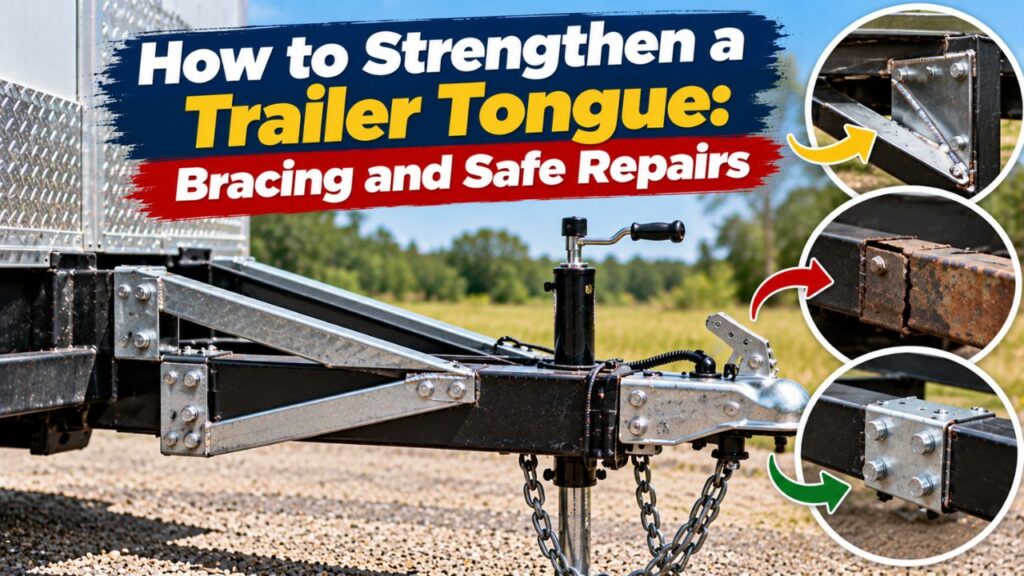
The trailer tongue connects the main trailer frame to the tow vehicle’s hitch. It transfers forces between the trailer and the towing vehicle during acceleration, braking, turning, and travel over uneven roads.
Although the tongue looks relatively simple, it experiences several types of loading simultaneously.
Vertical Bending From Tongue Weight
Tongue weight creates a downward load at the coupler.
For many conventional bumper-pull trailers, the commonly recommended tongue weight is approximately 10–15% of the actual loaded trailer weight, subject to manufacturer requirements.
For example, a 5,000-pound trailer may have a target tongue weight of approximately 500–750 pounds.
However, the tongue must also withstand changing forces from bumps, dips, and other road conditions.
A tongue capable of holding a trailer’s static weight may still experience fatigue if its structure or connections are inadequate.
Side-to-Side Forces During Turning
The tongue also transfers lateral forces when the tow vehicle turns or changes direction.
These forces can twist or bend the drawbar and place stress on the joints connecting it to the trailer frame.
An A-frame tongue distributes some of these forces through its two angled members.
A single straight tongue depends heavily on the strength of its main beam and its connection to the chassis.
Stress From Long Tongue Extensions
A longer tongue can provide additional clearance during turning or reversing.
However, increasing the unsupported length also increases the bending leverage created by a given vertical force.
This is why extending a trailer tongue requires more than welding an extra piece of tubing onto its end.
The existing steel section, connection geometry, and supporting structure must be evaluated together.
How to Strengthen a Trailer Tongue Without Guesswork
A reliable reinforcement project starts with understanding the existing structure.
Before cutting, drilling, or welding, determine whether the tongue is fundamentally sound and what problem the modification is intended to solve.
Step 1: Inspect the Trailer Tongue for Structural Damage
Park the trailer on firm, level ground.
Unload it when appropriate, chock the wheels, and support the trailer according to the manufacturer’s instructions.
Inspect the entire tongue assembly, including:
- The hitch coupler and mounting points.
- The straight tongue beam or A-frame members.
- Welds connecting the tongue to the trailer frame.
- The front crossmember.
- Gussets and existing braces.
- Tongue jack mounting areas.
- Safety chain attachment points.
- Bolted connections and their surrounding steel.
Look for visible cracks, bending, twisted metal, severe corrosion, missing fasteners, or separating welds.
Pay particular attention to the area where the tongue enters or joins the trailer’s main frame.
The National Association of Trailer Manufacturers’ trailer inspection guidance identifies the tongue-to-frame connection as an important area to inspect for cracked welds and structural stress.
Safety Note: Do not tow a trailer with a suspected structural crack, visibly bent tongue, or failing tongue-to-frame connection until a qualified repair professional has assessed and corrected the problem.
Step 2: Identify Where Reinforcement May Be Needed
Different tongue designs have different potential weak points.
For a straight tongue, inspect the area where the single beam connects to the front crossmember and surrounding chassis.
For an A-frame tongue, inspect both angled members and their connections to the trailer frame.
Check whether the existing structure has adequate bracing to resist bending and twisting.
Also inspect the coupler connection, especially if the trailer has been modified or fitted with a different hitch.
The objective is to identify how forces travel from the coupler into the main frame.
Reinforcing only the visible weak area may transfer additional stress into another component.
Step 3: Check the Trailer’s Design and Weight Ratings
Locate the trailer’s identification plate or manufacturer’s specifications.
Record the following information:
- Trailer make and model.
- Vehicle identification number (VIN).
- Gross vehicle weight rating.
- Gross axle weight rating.
- Original tongue configuration.
- Hitch coupler rating.
- Existing frame dimensions.
- Frame material and known specifications.
If the trailer was manufactured commercially, contact the manufacturer or an authorized dealer before modifying its tongue.
Some trailer frames have specific restrictions concerning welding, drilling, or structural changes.
A reinforcement design suitable for one trailer may not be appropriate for another.
Step 4: Select an Appropriate Reinforcement Method
The possible methods depend on the tongue’s condition and design.
| Tongue condition or design | Potential solution |
| Sound A-frame with an identified weak connection | Engineered gussets or improved connection bracing |
| Sound straight tongue needing additional lateral support | Designed side braces or A-frame-style reinforcement |
| Long tongue with insufficient vertical stiffness | Engineered longitudinal or truss-style bracing |
| Insufficient support at front crossmember | Reinforcement integrated with the main frame |
| Cracked or bent tongue | Structural assessment and often replacement |
| Severe corrosion or metal loss | Replacement of affected structural members |
| Damaged coupler or mounting components | Approved coupler or component replacement |
These options are not interchangeable.
The material sizes, reinforcement locations, and fastening methods must be appropriate for the actual trailer loads.
How to Strengthen an A-Frame Trailer Tongue
An A-frame tongue uses two angled structural members that extend from the trailer’s main frame toward the coupler.
This design can distribute towing forces across a wider portion of the chassis.
However, weak connections, damaged welds, or insufficiently supported members can still cause problems.
Reinforce the Tongue-to-Frame Connection With Gussets
A gusset is a reinforcing plate or shaped structural component used to strengthen a joint.
Gussets can help distribute forces between connected frame members.
On an A-frame trailer, they may be used near the junctions where the angled tongue members connect to the main chassis.
A properly designed gusset can reduce stress concentration at a connection.
However, the gusset’s:
- Shape.
- Thickness.
- Material grade.
- Position.
- Attachment area.
- Weld configuration.
must match the existing structure and expected loads.
Simply welding a triangular steel plate over every visible joint is not a reliable reinforcement method.
Poorly positioned gussets can create abrupt stiffness changes and increase fatigue stresses near their ends.
Improve Support at the Front Crossmember
The front crossmember connects the trailer’s main frame rails.
Depending on the chassis design, it may also form part of the tongue attachment.
If the crossmember is too weak or its connection has deteriorated, reinforcing the tongue alone may not correct the underlying problem.
A qualified fabricator may recommend strengthening the crossmember, modifying its attachment, or replacing damaged material.
Any additional bracing should direct forces into structural members capable of carrying them.
Avoid attaching reinforcement only to thin sheet-metal body panels or nonstructural brackets.
Use Reinforcement Plates Only With an Approved Design
Reinforcement plates, sometimes called fishplates, can distribute loads along a structural member.
However, their effectiveness depends on how they connect to the existing steel.
Incorrect plate length, abrupt ends, unsuitable welds, or poor material compatibility can introduce new fatigue points.
The repair design should specify where the plates begin and end and how forces transfer between the original member and the added material.
Do not assume that a thicker plate automatically produces a stronger tongue.
How to Strengthen a Straight Trailer Tongue
A straight trailer tongue, also called a pole tongue or single-beam tongue, extends forward from the trailer frame.
This design is common on smaller utility trailers, boat trailers, and certain specialty trailers.
Straight tongues can perform reliably when correctly designed, but their structural behavior differs from an A-frame.
Add Properly Designed Side Braces
Side braces can connect the main tongue beam to structural members on either side of the trailer frame.
This creates a wider load path and can improve resistance to certain lateral forces.
The resulting structure may resemble part of an A-frame.
The braces must connect to suitable frame locations rather than simply terminating against thin or unsupported steel.
Their angles, lengths, and attachment details affect how forces are distributed.
A professional should also confirm that the braces do not interfere with turning clearance, trailer jacks, wiring, or other components.
Reinforce the Tongue Near Its Frame Connection
The point where a straight tongue joins the main chassis is particularly important.
This connection transfers braking, vertical, and side-loading forces into the trailer.
If the connection is inadequate, a properly designed reinforcement may include:
- Structural gussets.
- Extended attachment members.
- Additional crossmember support.
- Reinforcement plates.
- A redesigned tongue-to-frame connection.
The appropriate method depends on the frame’s geometry and material.
Avoid installing short plates that terminate at an already stressed joint without evaluating their effect on fatigue.
Strengthen a Long Straight Tongue With Bracing
A long straight tongue may need additional vertical stiffness.
Some trailer designs use longitudinal stiffeners or truss-like braces to reduce bending.
These structures work by creating a stronger load path rather than relying solely on the original beam.
However, adding bracing changes how forces move through the tongue and main frame.
The connection points and clearances must be designed carefully.
For a lightweight utility trailer, appropriately sized structural bracing may be sufficient.
For larger trailers or substantial tongue extensions, replacing the tongue with a properly designed assembly may be more appropriate.
Should You Weld or Bolt Trailer Tongue Reinforcement?
Both welding and bolting can form structural connections, but neither is automatically suitable for every trailer.
The correct method depends on the original design, material, and approved repair instructions.
Welding Trailer Tongue Reinforcement
Welding can create a permanent structural connection between compatible metal components.
However, trailer tongues experience repeated loading, making weld quality and placement especially important.
Poor welding can introduce defects or create stress concentrations in the surrounding metal.
Structural welding also changes the properties of the nearby material through heating and cooling.
The correct procedure depends on:
- Steel or aluminum alloy.
- Material thickness.
- Joint design.
- Welding process.
- Filler material.
- Required weld size and location.
- Existing fatigue or corrosion damage.
A 2023 manufacturer trailer-tongue replacement service bulletin published in NHTSA’s recall records provides an example of a model-specific structural repair. It requires a qualified welder, specifies the replacement tongue assembly and weld locations, and calls for reinspection.
Those instructions apply to the affected trailer design, not to every trailer tongue.
This illustrates why structural tongue welding should follow an appropriate manufacturer-approved or engineered procedure rather than a universal weld pattern.
Can You Bolt Reinforcement Plates Onto a Trailer Tongue?
Bolted reinforcement can work when the connection has been specifically designed for it.
However, drilling holes into a tongue beam removes material and can create stress concentrations.
An incorrectly designed bolted connection may weaken the original member rather than strengthen it.
Important considerations include:
- Fastener strength and grade.
- Hole placement and spacing.
- Edge distances.
- Load transfer between members.
- Tube-wall deformation.
- Corrosion protection.
- Access for inspection and maintenance.
Use approved bolted reinforcement kits where available.
Do not substitute ordinary hardware-store bolts for structural fasteners without checking the required specifications.
Can You Reinforce a Trailer Tongue Without Welding?
Sometimes.
Certain trailers use manufactured bolt-on components or reinforcement systems.
However, not every frame can safely accept bolt-on modifications.
Avoid drilling arbitrary holes or attaching homemade plates without an appropriate design.
If no suitable approved kit exists, a professional structural repair or complete tongue replacement may be necessary.
How to Choose Steel for Trailer Tongue Reinforcement
Steel selection affects how well the reinforced structure handles bending, fatigue, and corrosion.
The material should be compatible with the existing trailer frame and the intended connection method.
Square and Rectangular Steel Tubing
Square and rectangular hollow structural sections are common in trailer construction.
Their closed shapes can provide useful resistance to bending and twisting.
However, tubing strength depends on more than its outside dimensions.
Important properties include:
- Wall thickness.
- Section dimensions.
- Steel grade.
- Material condition.
- Unsupported length.
- Connection design.
Two tubes with identical outside dimensions can have substantially different capacities when their wall thicknesses or steel grades differ.
Avoid choosing reinforcement solely because the tubing appears thick or heavy.
Steel Plate and Angle Sections
Steel plate and structural angle are commonly considered for gussets and braces.
A plate may be appropriate for distributing forces around a joint.
An angle section may provide a different type of stiffness or connection geometry.
However, neither material should be selected solely by appearance.
A qualified fabricator should use the existing frame specifications and the required reinforcement design to determine suitable dimensions.
Galvanized Steel and Aluminum Tongues
Galvanized steel requires additional care because welding can damage the protective zinc coating and produce hazardous fumes.
Structural welding on galvanized components should be performed using appropriate safety controls and procedures.
Aluminum trailer tongues require different material and welding considerations than ordinary carbon-steel frames.
Aluminum’s alloy, temper, and heat-affected properties influence repair suitability.
Do not assume that a steel reinforcement method can be copied directly onto an aluminum tongue.
For aluminum trailers, follow the manufacturer’s repair procedure or obtain guidance from a qualified professional familiar with the specific alloy and structural design.
When Should You Replace a Trailer Tongue Instead of Reinforcing It?
Reinforcement is not always an acceptable repair.
If the original structure has already lost substantial strength, adding material around it may leave the primary problem unresolved.
Replace a Tongue With Severe Structural Rust
Surface rust does not automatically mean a trailer tongue is unsafe.
However, deep pitting, holes, flaking layers, or significant metal loss can reduce structural capacity.
Pay special attention to corrosion around:
- Welded joints.
- Coupler attachments.
- Open tubing ends.
- Drainage openings.
- Areas where water collects.
- Overlapping reinforcement plates.
A rusted tube may have internal corrosion that is not obvious from the outside.
Painting over corrosion does not restore the lost metal.
When substantial section loss is present, replacement is generally more dependable than adding reinforcement over deteriorated material.
Replace a Bent or Twisted Tongue
A tongue that has been permanently bent may have experienced loading beyond its intended structural capacity.
Straightening it does not necessarily restore its original strength.
A visibly twisted tongue can also affect coupler alignment and trailer tracking.
Have the frame inspected to determine whether the deformation extends beyond the tongue.
A replacement assembly may be necessary.
Do Not Cover Existing Cracks With Reinforcement Plates
A crack in the tongue or its structural welds is a serious warning sign.
Welding a plate over a crack without correcting the underlying damage can conceal the defect while allowing fatigue to continue.
A qualified repair professional should determine whether the damaged member can be repaired under an approved procedure or must be replaced.
If the manufacturer specifies replacement, follow that requirement.
Key Takeaway: Reinforcement is most appropriate for a sound structure that needs a properly designed improvement. Cracked, bent, or severely corroded tongues require professional assessment and may need replacement rather than additional plating.
How to Prepare a Trailer for Professional Tongue Reinforcement
A trailer owner can complete several useful preparation steps without altering its structural members.
This helps the repair shop identify the problem and select the correct approach.
Step 1: Unload and Secure the Trailer
Park on firm, level ground.
Remove unnecessary cargo and securely chock the wheels.
Support the trailer using equipment rated for its weight and positioned according to its manufacturer’s instructions.
Never work beneath an unsupported trailer.
If structural failure is suspected, arrange safe transport to the repair facility instead of towing it on public roads.
Step 2: Record the Existing Tongue Dimensions
Measure and document:
- Tongue length.
- Tongue beam width and height.
- Accessible wall thickness, when reliably known.
- Distance between the coupler and main frame.
- Location of existing braces.
- Position of the tongue jack.
- Safety chain attachments.
- Coupler mounting arrangement.
Take photographs of the entire tongue and the frame connections.
Include clear pictures of cracks, corrosion, or deformation.
These measurements help the repair professional understand the existing geometry.
Do not use the measurements alone to select structural reinforcement sizes.
Step 3: Obtain Manufacturer Information
Find the trailer’s VIN, make, model, and original weight rating.
Contact the manufacturer or dealer to ask whether an approved reinforcement kit, repair bulletin, or replacement tongue is available.
For custom-built trailers, a qualified trailer designer or engineer may need to evaluate the structure.
Step 4: Have the Reinforcement Designed and Installed
A qualified trailer fabricator should evaluate the frame and determine the appropriate repair.
The procedure may include:
- Confirming the existing structure is suitable for reinforcement.
- Identifying how loads transfer through the tongue.
- Selecting compatible structural materials.
- Establishing the correct gusset or brace geometry.
- Specifying the necessary welds or approved fasteners.
- Protecting adjacent wiring, brake components, and other equipment during fabrication.
- Inspecting the completed connections.
- Restoring corrosion protection to affected surfaces.
This is a professional repair workflow, not a universal set of fabrication dimensions.
The actual procedure must be based on the trailer’s construction and applicable manufacturer instructions.
Step 5: Inspect the Completed Reinforcement
Before the trailer returns to service, confirm that the repair has been inspected.
Check that:
- Structural connections meet the approved design.
- The coupler remains properly aligned.
- The tongue jack operates without interference.
- Safety chains remain correctly attached.
- Brake and lighting wiring is protected.
- Breakaway equipment remains functional.
- The repair has appropriate corrosion protection.
- Tires, suspension, and axle alignment have not been affected.
Where required or appropriate, professional weld inspection may include suitable nondestructive testing.
Do not assume that a weld is structurally sound simply because its visible surface appears smooth.
Does Strengthening a Trailer Tongue Increase Towing Capacity?
No. Adding reinforcement to a trailer tongue does not automatically increase the trailer’s GVWR, axle ratings, or legal towing capacity.
A trailer’s overall capacity depends on several components working together.
These include the frame, tongue, axles, suspension, wheels, tires, coupler, and braking system.
A stronger tongue does not increase the capacity of the remaining components.
Tongue Reinforcement vs. Trailer GVWR
GVWR is the maximum permissible loaded weight assigned to the trailer.
If a trailer is rated for 3,500 pounds, installing thicker gussets does not automatically change its rating to 5,000 pounds.
A change in rated capacity requires appropriate engineering, component evaluation, and any applicable manufacturer or regulatory procedures.
Do not modify or replace a weight-rating label based solely on a reinforcement project.
Check Tongue Weight After Modifications
Additional steel can change the trailer’s empty weight and weight distribution.
Reinforcement near the front may increase tongue weight.
For many conventional trailers, the usual target is approximately 10–15% of actual loaded trailer weight, unless the manufacturer specifies otherwise.
Use this formula:
Tongue Weight Percentage = (Measured Tongue Weight ÷ Loaded Trailer Weight) × 100
For example:
- Loaded trailer weight: 4,000 pounds.
- Measured tongue weight: 480 pounds.
480 ÷ 4,000 × 100 = 12%
This falls within the common conventional-trailer guideline.
However, the hitch, tow vehicle, and trailer must still remain within their applicable ratings.
Check Coupler and Hitch Ratings
The trailer coupler must be rated for the intended load.
The tow vehicle’s receiver, hitch ball, and related components must also be compatible.
A reinforced tongue cannot compensate for an underrated coupler or hitch.
If modifications involve replacing the coupler, use a compatible component and the manufacturer’s specified installation method.
Common Trailer Tongue Reinforcement Mistakes to Avoid
Poorly designed changes may create problems that are not immediately visible.
Welding Plates Over Cracked Steel
Covering a crack can hide damage rather than correct it.
The existing crack may continue to spread under repeated loading.
Have the damaged section assessed and repaired or replaced under an appropriate procedure.
Using Excessively Thick Steel Without Evaluating the Frame
Thicker steel does not always mean a better repair.
An overly rigid reinforcement may transfer loads into a weaker adjacent section.
The reinforcement should work with the existing structure rather than create an abrupt, highly stressed transition.
Welding Across Highly Stressed Sections Without a Design
Weld placement affects how the tongue responds to repeated bending.
An unsuitable weld termination or connection across a stressed section can create a fatigue initiation point.
Some designs require particular weld locations and patterns.
Follow the manufacturer-approved or engineered details rather than assuming that welding every available edge is always better.
Drilling Large Holes for Additional Bolts
Holes remove material from the tongue beam.
Poorly positioned holes can weaken the structure or create stress concentrations.
Only drill structural members where an approved design permits it.
Extending the Tongue Without Additional Engineering
A longer tongue changes leverage and may increase bending stresses.
Adding tubing without evaluating the supporting structure can introduce dangerous weak points.
Treat a tongue extension as a structural redesign, not a simple accessory installation.
Ignoring Existing Frame Damage
Strengthening the tongue won’t correct an overloaded, cracked, or distorted main trailer frame.
Inspect the front crossmember, frame rails, suspension attachments, and other related structural areas before approving the modification.
Forgetting Corrosion Protection
Grinding and welding can expose bare metal.
After inspection and completion of structural work, apply an appropriate coating system compatible with the frame material.
Pay attention to exposed steel, cut edges, and areas where moisture may collect.
How to Maintain a Reinforced Trailer Tongue
After a properly completed repair, regular inspection helps detect developing problems.
Inspect the Tongue Before Towing
Before each trip, visually check the tongue and connecting hardware.
Look for:
- New cracks or separation near welds.
- Loose or missing fasteners.
- Bent structural members.
- Unusual rust stains near connections.
- Damaged coupler components.
- Loose safety chain attachments.
- Changes in tongue alignment.
Any new structural damage should be evaluated before the trailer is used again.
Check After Heavy Loading or Road Impacts
A severe pothole strike, collision, or unusual loading event may place unexpected stress on the tongue.
Inspect the affected areas afterward.
If the trailer has experienced a significant impact, obtain a professional structural inspection even when obvious damage is limited.
Keep the Tongue Clean and Protected
Remove road salt, mud, and other debris that may hold moisture against metal surfaces.
Inspect coated areas for damage.
Repair minor protective-coating defects before corrosion develops.
For enclosed tubing, check existing drain openings and avoid modifications that trap water inside the members.
Monitor Tongue Weight and Cargo Distribution
Correct loading helps reduce unnecessary stress.
Place cargo according to the trailer manufacturer’s instructions and secure it to prevent shifting.
Recheck tongue weight when making significant changes to the load arrangement.
Never use reinforcement as a reason to exceed the trailer’s rated capacity.
Conclusion
Understanding how to strengthen a trailer tongue begins with inspecting the existing structure and identifying the forces that cause weakness or fatigue.
For a sound trailer, properly designed gussets, additional bracing, or improved tongue-to-frame connections may help strengthen the assembly. Straight tongues and A-frame tongues require different reinforcement approaches.
If the tongue is cracked, bent, or severely corroded, replacement may be safer than adding more steel.
Structural welding and reinforcement should follow an appropriate manufacturer-approved or engineered procedure, especially when the trailer will operate on public roads.
Most importantly, reinforcing the tongue does not automatically increase the trailer’s weight rating.
A dependable repair combines sound structural design, appropriate materials, qualified fabrication, and continued inspection.
FAQs About How to Strengthen a Trailer Tongue
Can You Strengthen a Trailer Tongue by Welding Steel Plates to It?
Yes, properly designed steel reinforcement plates may strengthen certain trailer tongue structures. However, the plate material, geometry, and weld locations must be appropriate for the existing frame. Welding random plates onto a damaged tongue can make it less reliable.
Are Gussets Enough to Strengthen an A-Frame Trailer Tongue?
Sometimes, but not always. Gussets can improve the strength of certain tongue-to-frame connections when properly designed. They cannot correct severe corrosion, an undersized main frame, or a cracked structural member without an appropriate repair.
Can You Strengthen a Trailer Tongue Without Welding?
Yes, some trailer designs accept manufacturer-approved bolt-on reinforcement systems. However, drilling or bolting additional steel onto an existing tongue without proper design can weaken it. Use compatible approved components or obtain professional guidance.
Is an A-Frame Tongue Stronger Than a Straight Tongue?
An A-frame generally provides a wider load path and can offer greater lateral stiffness for certain trailer designs. However, actual strength depends on steel dimensions, material grade, connections, and overall construction. A properly engineered straight tongue can also be suitable.
Can You Repair a Cracked Trailer Tongue Instead of Replacing It?
Sometimes, a cracked tongue may be repairable under a manufacturer-approved or engineered procedure. However, severe cracking, deformation, or substantial metal loss may require replacement. Do not tow until the structure has been properly assessed and repaired.
Does Adding Reinforcement Increase a Trailer’s GVWR?
No. Reinforcing the tongue does not automatically raise the manufacturer’s gross vehicle weight rating. Axles, suspension, brakes, tires, wheels, and other structural components also determine the trailer’s permitted capacity.
Can You Strengthen a Trailer Tongue That Has Been Extended?
An extended tongue may be reinforced when the complete structure is evaluated and the additional support is properly designed. Because lengthening the tongue changes bending loads and connection stresses, the modification should be reviewed by a qualified trailer fabricator or engineer before towing.