The safest way to make a folding trailer tongue is to install a manufacturer-rated swing-away hinge kit on a compatible steel trailer tongue. The hinge lets the coupler section pivot to one side for storage and lock straight again for towing. A homemade door-style hinge or an untested welded joint is not a suitable substitute for a load-rated trailer component.
The conversion can make a boat or utility trailer easier to fit into a garage, but it also changes a load-bearing part of the trailer. The existing tube dimensions, steel wall thickness, loaded trailer weight, tongue weight, and distance from the coupler to the hinge must all match the kit’s requirements. Wiring, safety chains, and hydraulic brake lines also need safe routes around the pivot.
Not every tongue can be converted. A-frame designs, damaged tubing, aluminum frames, and certain brake actuators may require a manufacturer-approved solution or professional redesign.
In this article, I explain how to choose a folding hinge, measure the pivot location, prepare and install a bolt-on kit, handle chains and brake lines, and check the completed tongue before towing.
How Does a Folding Trailer Tongue Work?
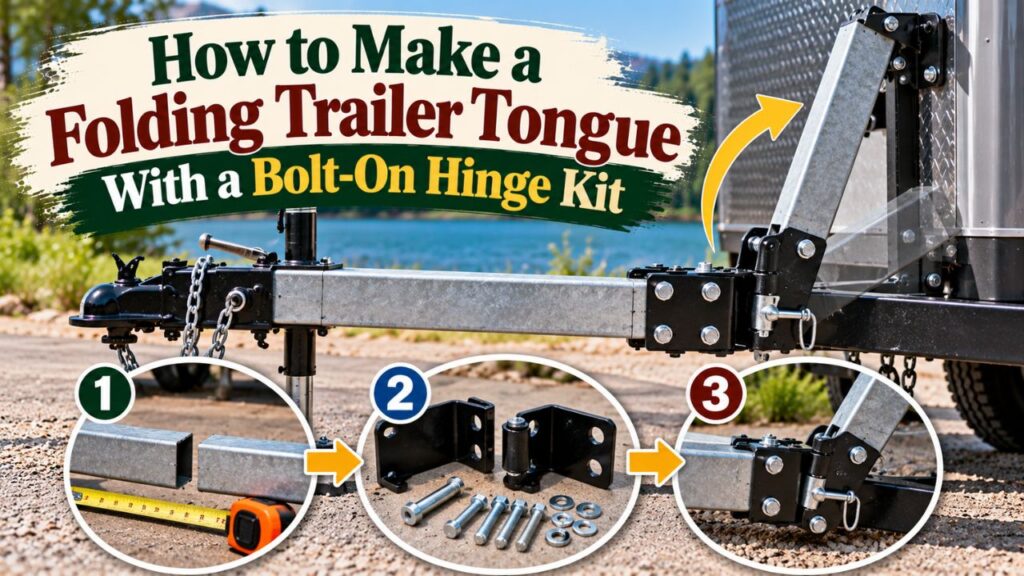
A folding trailer tongue, also called a swing-away trailer tongue, uses a reinforced hinge assembly between the trailer’s fixed frame and its front coupler section.
The hinge lets the forward portion swing sideways when the trailer is parked.
When preparing to tow, the tongue swings back into alignment and is secured by the manufacturer’s pivot and locking hardware.
A typical folding tongue assembly contains:
- Fixed hinge section: Attaches to the trailer’s main tongue structure.
- Swinging hinge section: Attaches to the removable or movable front tongue section.
- Pivot bolt or pin: Allows the forward section to rotate.
- Locking pin: Prevents the tongue from folding during towing.
- Retaining clip or cotter: Keeps the locking pin from coming out.
- Rated mounting hardware: Secures the hinge to the trailer tongue.
The hinge transfers towing and vertical tongue loads across the connection.
For this reason, the hinge must be designed and rated for trailer use.
A general-purpose gate hinge or ordinary steel bracket cannot be assumed to provide the necessary structural strength.
Bolt-On vs. Weld-On Folding Tongue Hinges
There are two common types of folding tongue conversion kits.
| Feature | Bolt-On Hinge Kit | Weld-On Hinge Kit |
| Attachment | Manufacturer-specified bolts | Engineered welded connections |
| Welding required | No | Yes |
| Installation tools | Drill, cutting tools, torque wrench | Cutting tools and professional welding equipment |
| Main requirement | Compatible tongue and accurate bolt installation | Compatible tongue and qualified welding |
| Suitable application | Approved straight steel tongues | Approved fabricated or professionally modified tongues |
| Inspection focus | Fasteners, alignment, hinge, and locking pin | Weld integrity, alignment, hinge, and locking pin |
Neither method is automatically stronger.
The actual capacity depends on the specific hinge, trailer construction, installation, and manufacturer’s rating.
For many compatible utility and boat trailers, a bolt-on kit is the more straightforward conversion option because it avoids field welding.
Check Whether Your Trailer Tongue Can Be Converted
Before purchasing a folding hinge, confirm that the existing tongue is suitable.
This is especially important because installing a pivot changes how forces travel through the trailer’s front structure.
Straight Steel Trailer Tongues
Many folding hinge kits are designed for straight rectangular or square steel tubing.
Common compatible tube sizes for certain commercial kits include:
- 2 × 3 inches
- 3 × 3 inches
- 3 × 4 inches
- 3 × 5 inches
These sizes are examples, not a guarantee of compatibility.
Measure the outside width, height, and wall thickness of your existing tongue.
Some Fulton bolt-on kits specify a steel wall thickness of approximately 0.120–0.188 inch.
The tube must also be structurally sound.
Severe rust, cracks, previous questionable repairs, or deformation may make the conversion unsuitable.
A-Frame Trailer Tongues
An A-frame tongue consists of two angled structural members extending forward from the trailer frame.
These members distribute towing forces differently from a single straight tube.
Do not cut an A-frame tongue and install a standard rectangular-tube hinge unless the trailer manufacturer or a qualified trailer engineer approves that exact conversion.
A custom engineered system may be necessary.
This is particularly relevant to travel trailers and larger utility trailers using A-frame construction.
Aluminum Trailer Tongues
A hinge kit intended for steel tubing should not be installed on an aluminum tongue.
Aluminum has different structural and fastening characteristics.
Even if the external dimensions match, that does not establish compatibility.
Use only a conversion system specifically approved for the trailer’s frame material and design.
Trailers With Surge Brakes
Boat trailers sometimes use hydraulic surge brake actuators mounted near the coupler.
A folding tongue may require a flexible hydraulic brake connection that accommodates the hinge’s movement.
A rigid brake line cannot simply be bent repeatedly whenever the tongue folds.
Confirm that the hinge, brake actuator, and proposed hydraulic connection are compatible before proceeding.
A qualified trailer brake technician should handle hydraulic modifications and verify proper brake operation.
Choose the Correct Folding Trailer Tongue Hinge Kit
A suitable hinge kit must match more than the tongue’s outside dimensions.
Check the manufacturer’s requirements for:
- Tongue tube width and height
- Steel wall thickness
- Gross trailer weight rating
- Maximum vertical tongue load
- Maximum permitted pivot length
- Coupler or brake actuator compatibility
- Required mounting hardware
- Permitted installation method
The maximum trailer weight rating of a hinge kit can decrease as the folding section becomes longer.
This happens because a longer forward section increases the leverage acting on the hinge.
How Pivot Length Affects Folding Tongue Capacity
The Fulton Heavy Duty Fold-Away installation instructions provide specific capacity limits based on the tongue’s dimensions and pivot length.
For example, the manufacturer’s published chart for its applicable 3 × 3-inch steel-tube hinge system includes:
| Maximum Pivot Length | Maximum Gross Trailer Weight Rating | Maximum Tongue Load |
| 24 inches | 5,000 lbs | 500 lbs |
| 30 inches | 4,200 lbs | 420 lbs |
| 36 inches | 3,500 lbs | 350 lbs |
| 48 inches | 2,600 lbs | 260 lbs |
These figures apply to the specified Fulton hinge configuration and installation instructions. They are not universal folding tongue ratings.
Verify the chart for your exact product model and revision before installation.
For example, a 3 × 3-inch Fulton hinge configuration that permits 5,000 pounds at a 24-inch pivot length does not necessarily permit the same trailer weight at a 48-inch pivot length.
The actual loaded trailer weight and tongue weight must each remain within their applicable limits.
Measure the Existing Tongue Before Ordering
Measure the trailer’s tongue tubing with a tape measure or appropriate measuring tools.
Record:
- Outside tube width
- Outside tube height
- Wall thickness
- Distance from the coupler to the proposed hinge
- Available clearance around the hinge
- Actual loaded trailer weight and tongue weight
Use the manufacturer’s official rating chart rather than selecting a hinge based only on its advertised maximum capacity.
Also check whether nearby components interfere with installation.
These may include a tongue jack, winch stand, spare tire carrier, battery box, or brake actuator.
Tools and Materials Needed for a Folding Trailer Tongue
A bolt-on conversion typically requires metalworking tools and an appropriate hinge kit.
The exact requirements depend on the manufacturer’s installation instructions.
Materials
- Compatible, load-rated folding trailer tongue hinge kit
- Manufacturer-supplied mounting bolts, nuts, and washers
- Pivot bolt and locking pin supplied with the kit
- Approved retaining clips or cotter pins
- Suitable safety chains and rated attachment hardware
- Protective coating for exposed steel where appropriate
- Wiring protection and suitable grommets
- Approved flexible brake components if required
Avoid substituting ordinary hardware-store bolts for the kit’s specified structural fasteners.
The original hardware may have specific strength, shoulder dimensions, or locking features necessary for safe operation.
Tools
- Tape measure
- Carpenter’s square
- Marker or metal scribe
- Suitable metal-cutting saw
- Power drill
- Drill bits specified in the kit instructions
- Center punch
- Clamps
- Socket and wrench set
- Calibrated torque wrench
- File or deburring tool
- Wheel chocks
- Rated jack stands
- Safety glasses and protective gloves
If you do not have the tools or experience needed to cut and drill structural steel accurately, have a qualified trailer repair shop perform the conversion.
How to Make a Folding Trailer Tongue With a Bolt-On Hinge Kit
The following steps describe the general installation process for a manufacturer-approved bolt-on folding hinge.
These steps do not replace the instructions for your exact hinge model. Structural cutting, drilling, and fastening must follow the manufacturer’s specifications.
Step 1: Measure the Desired Folding Section
Decide how much trailer length you want to reduce during storage.
Measure from the coupler’s hitch-ball pocket center toward the trailer frame, using the pivot measurement method specified by the hinge manufacturer.
Identify a potential location that:
- Provides the desired storage clearance
- Remains within the hinge’s rated pivot length
- Has straight, compatible steel tubing
- Does not interfere with structural attachments
- Leaves sufficient space for the hinge assembly
- Allows the tongue to swing without striking nearby components
For example, suppose the front of a boat trailer extends too far into a garage.
A swing-away section may let the coupler move alongside the trailer when stored.
However, the usable folding length must be determined by the hinge’s rating and the trailer’s layout, not simply by how much space you want to save.
Step 2: Check the Hinge Location and Clearances
Before marking the cut, inspect the selected location carefully.
Check for:
- Welded frame joints
- Tongue jack brackets
- Safety-chain attachments
- Winch stands
- Brake lines
- Electrical wiring
- Other structural members
Some manufacturer instructions specify minimum clearances between the cut location and nearby obstructions.
Do not relocate load-bearing components without confirming that the new arrangement is approved.
Fulton also prohibits mounting certain accessories, including jacks and winch stands, on the movable portion of its Fold-Away system.
Plan the fixed section accordingly.
Step 3: Securely Support the Trailer
Park the trailer on a firm, level surface.
Disconnect it from the tow vehicle when the installation procedure requires it.
Chock the trailer wheels securely.
Support the fixed tongue with appropriately rated jack stands positioned according to the installation instructions.
Don’t rely on the tongue jack alone while cutting the structural tube.
Removing the forward section can change the way the tongue is supported.
Safety Note: Never work beneath an unsupported trailer tongue. Make sure the fixed and detachable portions cannot fall or move unexpectedly during cutting.
Step 4: Remove Wiring and Brake Lines From the Cutting Area
Many trailer tongues contain electrical wiring.
Some also contain hydraulic brake lines.
Inspect the tongue before making any cuts or drilling holes.
Remove or reroute wiring and brake lines from the affected area according to the manufacturer’s instructions.
Do not assume wires are protected simply because they are inside the steel tube.
Cutting through a wire can damage the trailer’s lighting system.
Cutting a hydraulic brake line can disable the brakes and create a fluid leak.
If hydraulic components must be disconnected, have the system restored and tested using the appropriate brake service procedures.
Step 5: Mark and Cut the Trailer Tongue
Once the manufacturer-approved cut location has been verified, mark the tongue using a square.
The cut must be positioned and aligned as specified for the selected hinge.
Use appropriate metal-cutting equipment and follow the tool manufacturer’s safety instructions.
After cutting:
- Remove sharp burrs.
- Inspect both tube ends.
- Check that the tubing has not been crushed or distorted.
- Confirm that the hinge components fit as specified.
- Protect exposed steel surfaces according to the installation requirements.
Do not compensate for an incorrect cut with improvised spacers, oversized holes, or additional unapproved welds.
If the fit or alignment is incorrect, stop and obtain guidance from the hinge manufacturer or a qualified trailer fabricator.
Step 6: Attach the Hinge Components
A typical bolt-on hinge kit uses separate hinge castings or mounting assemblies for the fixed and swinging tongue sections.
Position each component on its corresponding tube end.
Use the manufacturer’s alignment method to confirm that the hinge is straight and seated correctly.
For kits that require drilled mounting holes, use the provided component as the drilling reference and follow the specified drilling sequence.
Secure the hinge with the supplied structural hardware.
Tighten fasteners to the exact torque values listed in the instructions for your kit.
Don’t guess torque values or assume that specifications from a different hinge model are interchangeable.
Incorrect fastener installation can reduce the assembly’s load capacity or allow movement at the connection.
Step 7: Install the Pivot Bolt and Locking Pin
After both hinge sections are securely attached, assemble the pivot according to the kit instructions.
The pivot connection allows the forward tongue section to swing.
The locking mechanism holds the tongue in its straight towing position.
Depending on the system, the assembly may include:
- A permanent pivot bolt
- A locking or pull pin
- A locking nut
- A retaining clip or hairpin cotter
Use the manufacturer’s specified lubrication, assembly, and tightening procedures.
Check that the hinge rotates smoothly when unlocked.
Then return the tongue to its towing position and insert the locking pin fully.
The retaining device must also be installed correctly.
Never tow with a missing, damaged, or partially inserted locking pin.
Step 8: Reinstall Safety Chains Correctly
Safety-chain placement is especially important on a folding tongue.
For the Fulton system described earlier, the manufacturer specifies attaching the safety chains to the fixed trailer tongue behind the hinge assembly, rather than to the folding section or coupler.
This maintains the intended safety-chain connection to the trailer frame if the forward coupling assembly separates.
Use appropriately rated chains and manufacturer-approved attachment hardware.
Make sure the chains:
- Reach the tow vehicle’s intended attachment points
- Have enough length for normal turning
- Do not drag on the road
- Cannot become trapped in the hinge
- Are routed according to the trailer and hitch manufacturer’s instructions
On conventional trailers, safety chains are commonly crossed beneath the tongue to help support the coupling area if separation occurs.
Do not attach safety chains to the hinge bolts or other components unless the manufacturer expressly approves that arrangement.
Step 9: Reroute Electrical Wiring and Brake Lines
The folding section must move without pulling, crushing, or cutting the connections passing through it.
Reroute electrical wiring using the approved path.
Provide enough controlled slack for the full folding motion while preventing wires from contacting sharp edges or moving parts.
Use suitable protective sleeves or grommets where wiring passes through metal.
If the trailer has hydraulic surge brakes, the brake system may require an appropriately rated flexible hose and approved fittings.
The hose must accommodate the hinge movement without kinking or being pinched.
Brake modifications should be completed and tested by a qualified technician.
If the trailer has electric brakes, inspect the electric brake wiring and breakaway system as well.
The breakaway cable must connect independently to the towing vehicle as required by the brake system’s instructions.
Step 10: Test the Folding Mechanism
Before towing, test the system while the trailer is parked and properly supported.
With the tongue unlocked, swing it slowly through its intended range of motion.
Check that:
- The hinge moves without binding.
- The coupler clears the trailer frame and nearby equipment.
- Wiring does not become tight or pinched.
- Brake hoses remain free from sharp bends.
- The swinging section does not strike the tongue jack or other accessories.
- The tongue returns to its correct towing alignment.
- The locking pin and retaining clip fit securely.
Do not force a hinge that binds or fails to align.
Correct the problem before loading or towing the trailer.
How Much Length Can a Folding Trailer Tongue Save?
A folding tongue reduces the amount of space occupied by the trailer’s forward section when that section swings sideways.
The actual reduction depends on the pivot location, hinge geometry, coupler projection, and available sideways clearance.
Example: Folding a Boat Trailer Tongue
Suppose a boat trailer has a forward tongue section that extends approximately 30 inches from its proposed hinge location toward the coupler.
Folding that section could remove much of the forward projection from the trailer’s storage footprint.
However, the remaining hinge components may still project forward, and the folded tongue occupies space beside the trailer.
You should not assume that a 30-inch folding section automatically reduces the trailer’s stored length by exactly 30 inches.
Measure the actual folded arrangement.
How to Calculate Storage Clearance
Use this procedure before purchasing a hinge kit:
- Measure the trailer’s current overall length.
- Identify the desired hinge location.
- Confirm that the proposed pivot length is permitted.
- Estimate the forward projection remaining after folding.
- Check how far the folding section will extend sideways.
- Compare the folded dimensions with your garage or storage space.
Allow enough clearance to operate the hinge without striking walls, doors, or nearby objects.
For boat trailers, include the boat’s bow, winch, outboard motor, and other components that may determine the maximum storage dimensions.
Can You Make a Folding Trailer Tongue by Welding a Hinge?
A professionally engineered weld-on folding hinge can be used on compatible trailers.
However, welding a general-purpose hinge onto a cut trailer tongue is not an acceptable substitute for an engineered assembly.
Trailer tongues experience vertical loading, tension, compression, bending, and twisting during towing.
The hinge and its attachments must withstand those operating conditions.
Requirements for a Weld-On Folding Tongue
Weld-on systems require:
- A manufacturer-approved hinge
- Compatible structural steel tubing
- Correct hinge alignment
- Appropriate welding procedures
- Proper weld preparation and penetration
- Qualified welding personnel
- Verification of the completed assembly
The Dexter E-Z Swing installation instructions, published through the National Highway Traffic Safety Administration’s document database, specify particular tubing dimensions, welding requirements, and pivot limitations for Dexter’s 6-inch swing tongue system.
The instructions also warn that weld undercutting can weaken components and cause premature failure.
Those specifications apply to that particular Dexter design. They should not be transferred to unrelated hinges.
Is a Homemade Steel Hinge Strong Enough?
A hinge made from steel plates, bolts, and tubing may look substantial without having a verified towing capacity.
Its strength depends on material grade, geometry, weld quality, fasteners, fatigue resistance, and how forces pass through the connection.
Without an engineered design and appropriate validation, there is no reliable basis for claiming that a homemade hinge can safely support a particular trailer.
For a road-going trailer, use a rated commercial system or a professionally engineered custom assembly.
How to Use a Folding Trailer Tongue Safely
Once the conversion is complete, operating the tongue correctly is just as important as installing it.
Folding the Tongue for Storage
Follow the manufacturer’s operating procedure.
A typical folding process involves:
- Park on level ground and secure the wheels.
- Disconnect the coupler and other connections as instructed.
- Support the trailer with the designated jack or stand.
- Remove the approved locking pin and retaining clip.
- Swing the front tongue section slowly to its storage position.
- Check that wiring and brake lines remain free from tension.
- Secure the folded section if the manufacturer requires it.
Keep hands clear of the hinge and pinch points.
Don’t allow the swinging tongue to move suddenly or strike nearby equipment.
Returning the Tongue to Towing Position
Before reconnecting the trailer:
- Inspect the hinge and pivot hardware.
- Swing the tongue into its straight position.
- Align the locking openings.
- Insert the proper locking pin fully.
- Install its retaining clip or cotter.
- Confirm the tongue is mechanically locked.
- Connect the coupler, safety chains, wiring, and breakaway cable as applicable.
- Test the trailer lights and brakes.
The tongue must be securely locked before the trailer is moved on the road.
Inspect the Hinge Before Every Trip
Look for:
- Missing or loose locking hardware
- Cracks in the hinge or tongue
- Rust damage around structural connections
- Loose mounting fasteners
- Elongated or damaged pin holes
- Excessive movement at the pivot
- Pinched wires or hydraulic hoses
Follow the hinge manufacturer’s inspection and maintenance schedule.
If any structural component appears damaged, stop towing until the problem has been evaluated and corrected.
Does a Folding Tongue Change Trailer Weight Capacity?
Installing a folding hinge can introduce a new weight limitation.
The trailer’s original gross vehicle weight rating does not automatically become the hinge’s permitted capacity.
The completed setup must remain within the lowest applicable rating of its structural and towing components.
These may include:
- Trailer frame
- Folding hinge assembly
- Tongue tube
- Hitch coupler
- Safety-chain attachments
- Tow vehicle and receiver hitch
- Trailer axles and tires
Why Pivot Length Changes Capacity
The forward section acts as a lever between the coupler and hinge.
Increasing its length increases the bending effect from a given vertical tongue load.
This is why manufacturers may permit different maximum gross trailer weights and tongue loads at different hinge positions.
A kit advertised with a 5,000-pound maximum rating may have a lower permitted load when installed with a longer folding section.
Use the exact rating table for the installation.
What Happens if Tongue Weight Exceeds the Hinge Rating?
Excessive tongue load can overstress the hinge and supporting tongue structure.
It may also overload the coupler or tow vehicle.
For example, a hinge configuration rated for a maximum vertical tongue load of 420 pounds is not suitable for an actual 500-pound tongue load, even if the trailer’s total loaded weight is below another published capacity.
Don’t attempt to solve an overloaded hinge simply by shifting cargo rearward until the trailer becomes unstable.
The entire towing combination must meet its required load distribution and weight limits.
Common Mistakes When Building a Folding Trailer Tongue
Several mistakes can compromise the conversion even when a commercially manufactured hinge is used.
Choosing a Hinge Based Only on Trailer Weight
A hinge’s maximum advertised trailer capacity is not enough to confirm suitability.
Check the actual pivot length, vertical tongue load, tubing dimensions, and any other conditions in the rating chart.
Cutting Before Confirming Compatibility
A structural cut cannot always be reversed without an approved repair.
Verify the hinge model, tongue measurements, installation location, and required clearances before modifying the frame.
Installing Ordinary Bolts Instead of Rated Hardware
Hinge assemblies may use special shoulder bolts, locking nuts, or other manufacturer-specific components.
Substituting unapproved hardware can change how forces are carried through the connection.
Use only the specified fasteners and torque values.
Attaching Safety Chains to the Folding Section
If the manufacturer requires safety chains to attach behind the hinge, placing them on the movable section can defeat the intended separation protection.
Follow the approved chain attachment arrangement.
Forgetting Brake Lines and Wiring
A hinge may fold correctly while placing damaging tension on an internal wire or hydraulic hose.
Test all required connections through the full range of movement before towing.
Leaving the Tongue Unlocked
A folding tongue must be secured in its towing position with the specified locking hardware.
Do not substitute temporary bolts, ordinary clips, or improvised pins.
Ignoring Corrosion After Cutting
Cutting and drilling expose unprotected steel.
Use suitable corrosion protection compatible with the hinge manufacturer’s instructions.
Keep coatings from interfering with hinge operation, fit, or required fastener seating.
When Should You Have a Trailer Shop Install the Folding Tongue?
Professional installation is appropriate whenever the trailer’s construction, rating, or braking system makes the modification uncertain.
Consider a qualified trailer fabrication or repair shop when:
- The trailer has an A-frame tongue.
- The frame uses aluminum or unusual tubing.
- The existing steel is heavily rusted or damaged.
- The trailer has a complex surge brake system.
- The required pivot length exceeds the kit’s limits.
- Structural accessories must be relocated.
- A weld-on system is necessary.
- The completed assembly needs engineering review.
A professional can assess the structural loads, select a compatible system, and verify that the installation does not compromise the towing assembly.
Also check whether the modification affects the trailer manufacturer’s warranty, state inspection requirements, or other applicable rules.
Requirements vary by jurisdiction and trailer type.
Conclusion
Understanding how to make a folding trailer tongue starts with choosing a manufacturer-rated hinge that is compatible with the trailer’s existing structure.
For a suitable straight steel tongue, a bolt-on swing-away hinge kit provides a practical way to reduce the trailer’s storage length without fabricating an untested hinge.
However, the conversion must account for pivot length, loaded trailer weight, vertical tongue load, mounting hardware, safety chains, electrical wiring, and braking components.
The most important step is verifying compatibility before cutting the tongue.
For steel tongues that meet the manufacturer’s requirements, a properly installed commercial hinge is generally preferable to a homemade pivot assembly. For A-frame trailers, unusual structures, or complex brake systems, professional assessment is the safer option.
Never tow until the tongue is fully locked, the connections have been tested, and every applicable towing and component rating has been verified.
FAQs About How to Make a Folding Trailer Tongue
Can You Add a Folding Tongue to Any Trailer?
No. Folding hinge kits have specific compatibility requirements involving tongue material, dimensions, wall thickness, pivot length, and weight ratings. Straight steel tongues are common candidates, while A-frame and aluminum designs may require specialized solutions.
Can I Make a Folding Trailer Tongue Without Welding?
Yes. A compatible bolt-on folding hinge kit allows installation without welding. However, the conversion still requires accurate structural cutting, drilling, fastening, and verification according to the manufacturer’s instructions.
How Long Can a Folding Trailer Tongue Be?
The maximum folding section length depends on the hinge model, trailer weight, and tongue load. Some Fulton configurations permit pivot lengths up to 48 inches at reduced capacities, but other products have different limits. Always use the rating chart for the specific hinge.
Can You Put a Folding Tongue on a Boat Trailer With Surge Brakes?
Sometimes. The hinge must be compatible with the trailer and brake actuator, and the hydraulic system may need a suitable flexible brake hose. A qualified trailer brake technician should make and verify any hydraulic modifications.
Does a Folding Trailer Tongue Weaken the Trailer?
An incorrectly designed or installed hinge can weaken the tongue and create a serious towing hazard. A properly selected, rated hinge installed according to its manufacturer’s requirements is intended to carry specified loads. However, the converted trailer remains subject to the hinge’s limits.
Can I Install a Folding Hinge on an A-Frame Trailer Tongue?
Not with a standard straight-tube kit unless the manufacturer expressly approves that configuration. A-frame tongues distribute loads through angled structural members, so a folding conversion may require a specifically engineered design.
Do Safety Chains Need to Be Moved When Installing a Folding Tongue?
They often do. For Fulton Fold-Away installations, the chains must attach to the fixed trailer tongue behind the hinge assembly. Use the chain attachment location and hardware specified for your hinge and trailer, and verify that the chains remain properly connected during towing.