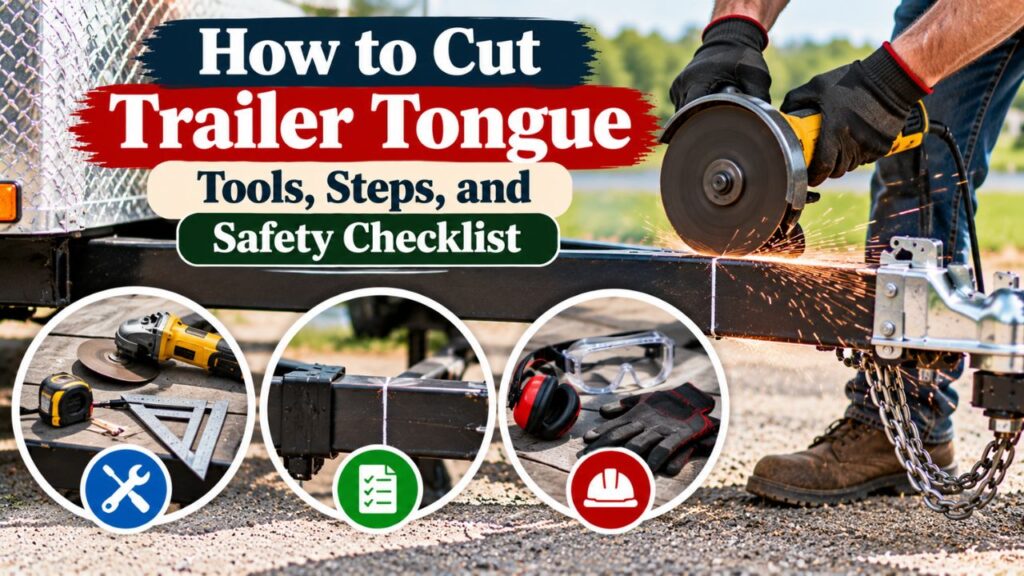
To cut a trailer tongue, first confirm that the modification is approved for the trailer, support the frame securely, remove wiring and brake lines from the cutting area, mark a square cut, and use a metal-cutting saw or an angle grinder fitted with an appropriate cutoff wheel. The cut must be made accurately, and the tongue must be restored to a properly rated structural configuration before towing.
Trailer tongues are load-bearing components that connect the trailer frame to the tow vehicle. Shortening one or installing a folding hinge can affect tongue weight, turning clearance, frame strength, and hitch compatibility.
The process also depends on the tongue design. A straight rectangular steel tongue may accommodate a manufacturer-approved folding hinge, while an A-frame tongue or a trailer equipped with surge brakes can require a different solution.
Cutting the steel is only one part of the job. Proper measurement, structural connections, corrosion protection, and final inspections are equally important.
In this article, I cover the tools needed to cut trailer tongue steel, how to measure and mark the cutting location, safe cutting procedures, fold-away hinge installation considerations, tongue-shortening risks, and the inspections required before towing a modified trailer.
Can You Cut a Trailer Tongue Safely?
Yes, a steel trailer tongue can be cut when the modification is structurally appropriate and follows an approved installation or repair procedure. However, cutting an existing tongue without an approved plan can weaken the connection between the trailer and tow vehicle.
The trailer tongue transfers several forces during towing.
These include:
- Vertical tongue weight
- Forward pulling forces
- Braking and reversing forces
- Side-to-side loads during turns
- Dynamic loads from bumps and uneven roads
The tongue must withstand these forces without excessive bending, cracking, or connection failure.
Cutting through a structural member interrupts its original load path. The remaining sections must be connected using a system capable of carrying the required loads.
When Cutting a Trailer Tongue May Be Appropriate
Cutting may be part of a properly designed modification involving:
- Installing a compatible fold-away tongue hinge
- Replacing a damaged tongue section
- Installing a manufacturer-approved replacement tongue
- Modifying a trailer according to an engineered fabrication plan
- Replacing a coupler assembly when the specified repair requires cutting
These situations require different procedures.
A fold-away hinge kit, for example, may include precisely matched hardware and cutting instructions. Permanently shortening a tongue usually requires a broader evaluation of trailer geometry and structural strength.
When You Should Not Cut the Tongue
Do not begin cutting when the trailer’s design, material, or required modification cannot be verified.
Particular caution is necessary with:
- A-frame trailer tongues
- Aluminum trailer frames
- Tongues containing internal wiring or hydraulic lines
- Heavily rusted or cracked structural members
- Trailers with unknown load ratings
- Gooseneck and fifth-wheel structures
- Trailers with complex brake actuators or welded reinforcements
A qualified trailer fabricator or engineer should evaluate changes that affect the trailer’s primary structure.
Important: A trailer tongue should never be shortened simply because there appears to be extra steel ahead of the frame.
Types of Trailer Tongues and How They Affect Cutting
Before choosing a cutting method, identify the tongue’s construction.
Different designs carry loads differently.
| Tongue Design | Construction | Cutting Consideration |
| Straight rectangular tube | Single square or rectangular steel member | May support compatible manufactured hinge systems |
| A-frame tongue | Two angled structural members meeting near the coupler | Requires evaluation of both structural members |
| C-channel tongue | Open steel channel | Requires a connection designed for the channel section |
| Aluminum tongue | Aluminum structural tubing or sections | Requires material-specific engineering and repair methods |
| Folding tongue | Manufactured hinge or pivot assembly | Follow the manufacturer’s exact installation requirements |
| Integrated boat trailer tongue | Structural member supporting winch, jack, or surge actuator | Must account for accessories and brake equipment |
Straight Steel Trailer Tongues
A straight tongue commonly uses square or rectangular steel tubing.
This design is found on some utility trailers, boat trailers, and smaller equipment trailers.
A compatible bolt-on folding hinge may be installed on certain straight steel tongues.
However, compatibility depends on the tube’s outside dimensions, wall thickness, material, and loaded trailer weight.
A rectangular appearance alone does not establish that the tongue is suitable for cutting.
A-Frame Trailer Tongues
An A-frame tongue uses two angled members extending from the main trailer frame toward the coupler.
This design distributes towing forces through multiple structural members.
Cutting one or both members changes the load path.
A generic straight-tongue folding hinge should not be installed on an A-frame simply because its dimensions appear close.
A-frame modifications require a design specifically approved for that construction.
Boat Trailer Tongues
Boat trailers often have straight tongues, but additional equipment can complicate modification.
The tongue may carry:
- Winch stands
- Bow stops
- Trailer jacks
- Spare tire carriers
- Surge brake actuators
- Hydraulic brake lines
- Lighting harnesses
A cut that appears clear from the outside may interfere with an internal cable or the placement of a critical accessory.
Some boat trailers are manufactured with removable or folding tongue sections. These designs should be handled according to their original specifications.
Tools Needed to Cut Trailer Tongue Steel
A suitable metal-cutting tool can make a clean, straight cut through steel tubing.
However, the tool must match the material thickness and the available working space.
Metal-Cutting Tool Comparison
| Tool | Best Application | Main Consideration |
| Metal-cutting band saw | Accurate cuts through accessible steel tubing | Requires stable positioning |
| Reciprocating saw with metal blade | Cutting an installed tongue in restricted space | Blade movement can affect accuracy |
| Angle grinder with cutoff wheel | Steel tubing where full cutting access is available | Sparks, wheel breakage, and kickback hazards |
| Metal-cutting chop saw | Straight cuts on a removed, securely clamped section | Usually unsuitable for cutting a tongue still attached to a trailer |
| Plasma cutter | Professional metal fabrication | Heat, fumes, and edge-finish considerations |
| Oxy-fuel cutting equipment | Specialized fabrication | Heat-affected metal and fire hazards |
For a typical approved folding-hinge installation, a properly equipped metal-cutting saw is often a practical choice.
An angle grinder can also cut steel, but it requires careful wheel selection and control.
Essential Measuring and Support Equipment
Prepare:
- Tape measure
- Carpenter’s square or combination square
- Metal scribe or suitable marker
- Rated jack stands or structural supports
- Wheel chocks
- Suitable clamps
- Deburring tool or metal file
- Tools needed to remove and reinstall electrical components
- Rust-preventive coating suitable for exposed steel
Additional tools may be required for the approved hinge or replacement component.
For example, a bolt-on hinge installation may need a drill, accurately sized bits, and a calibrated torque wrench.
Personal Protective Equipment
Steel cutting can produce flying fragments, sharp metal edges, sparks, and significant noise.
Use suitable protective equipment, including:
- Safety glasses with side protection
- Appropriate face protection
- Hearing protection
- Close-fitting protective gloves suitable for the work
- Sturdy footwear
- Nonflammable clothing appropriate for metal cutting
- Respiratory protection when the material, coating, and exposure conditions require it
The OSHA standard for guarding portable powered tools addresses protective guards and wheel inspection for covered portable abrasive-wheel equipment.
For an angle grinder, the cutting wheel must be compatible with the machine, appropriately rated for its rotational speed, and used with the required guard in place.
Never substitute an ordinary wood-cutting blade into an angle grinder.
How to Measure a Trailer Tongue Before Cutting
Accurate measurement is essential because a cut in the wrong location can make the intended hinge or replacement component impossible to install safely.
The correct measuring point depends on the modification.
Measure From the Coupler Ball Pocket
For an approved fold-away tongue installation, the manufacturer may specify measuring from the center of the coupler’s ball pocket.
This measurement determines the distance between the hitch connection and the proposed hinge location.
It is often called the pivot length or swing length.
Do not assume this measurement starts from the coupler’s front edge or the end of the steel tube.
Those positions are not necessarily the same as the center of the hitch ball.
Check the Manufacturer’s Maximum Pivot Length
The maximum permitted folding length depends on the specific hinge, tongue dimensions, and rated trailer weight.
For example, the Fulton Heavy Duty Fold-Away Coupler/Bracket Kit installation instructions include a chart relating trailer weight capacity to hinge position.
For the specified 3-by-3-inch steel tongue configuration, the chart lists:
| Maximum Pivot Length | Maximum Gross Trailer Weight |
| 24 inches | 5,000 lb |
| 30 inches | 4,200 lb |
| 36 inches | 3,500 lb |
| 42 inches | 3,000 lb |
| 48 inches | 2,600 lb |
These values apply to that particular manufacturer’s hinge configuration, not all folding tongues.
The chart demonstrates why hinge location matters.
Moving a folding hinge farther from the coupler can reduce the allowable trailer weight for the hinge assembly.
Do not select a hinge location based only on how much storage space you want to save.
Check Clearance Around Accessories
Before marking the cut, check the location of nearby components.
For its specified kit, Fulton instructs installers to keep the cut location at least 5 inches from obstructions such as a jack bracket or winch stand.
Other hinge systems may require different clearances.
Inspect the proposed location for:
- Welded support brackets
- Coupler mounting hardware
- Safety chain attachments
- Trailer jack mounts
- Winch stand brackets
- Brake components
- Structural reinforcement plates
Mark the location only after confirming that every required component will fit.
Mark a Square Cutting Line
Use a carpenter’s square to establish a line perpendicular to the tongue’s length.
Mark all accessible sides of the steel tube.
The line should form one continuous cutting plane rather than separate, misaligned marks.
A square cut is particularly important when the two sections must fit precisely into a manufactured hinge assembly.
Measure again before cutting.
Once material has been removed, a mistaken cut location may require replacement tubing or an engineered repair.
How to Cut Trailer Tongue Steel Step by Step
The following procedure describes the cutting stage of an approved modification to a compatible straight steel tongue, such as installation of a manufacturer-specified bolt-on folding hinge.
It is not an engineering procedure for permanently shortening an A-frame or redesigning an unverified trailer.
Step 1: Confirm the Approved Modification
Before picking up a cutting tool, identify the exact component or repair method to be installed.
For a folding hinge, check:
- Required tongue dimensions
- Steel wall thickness
- Maximum gross trailer weight
- Maximum tongue weight
- Permitted pivot length
- Required mounting clearances
- Compatibility with the existing coupler
- Brake actuator and wiring requirements
The approved system must accommodate the trailer’s actual loaded weight and tongue load.
Do not assume a hinge’s advertised maximum weight rating applies at every possible pivot location.
Step 2: Park and Secure the Trailer
Move the trailer onto firm, level ground.
Unload it if required by the component manufacturer’s installation instructions.
Chock the trailer wheels securely.
Disconnect the trailer from the tow vehicle when the approved procedure requires it.
Support the tongue with properly rated jack stands or another suitable support arrangement.
Place support behind the intended cut, and independently secure the forward section so it cannot fall, twist, or move unexpectedly when the steel separates.
Do not rely solely on the trailer jack.
Never position yourself beneath an unsupported tongue.
Step 3: Remove Wiring and Brake Lines From the Cutting Area
Inspect the tongue for electrical cables, brake lines, and other components.
Trailer wiring may pass through the inside of rectangular steel tubing.
Cutting directly through the tube without checking can destroy the lighting harness or breakaway system wiring.
Before cutting:
- Disconnect the trailer electrical connector from the tow vehicle.
- Identify the route of the lighting and brake wiring.
- Remove or safely reroute cables away from the cutting area.
- Identify hydraulic or other brake lines.
- Have brake components disconnected or rerouted using the appropriate service procedure.
- Confirm that no hidden lines remain in the section being cut.
If the trailer uses hydraulic surge brakes, the modification must accommodate the actuator and hydraulic connections.
Opening a hydraulic brake system requires correct reassembly, bleeding, and functional testing.
Step 4: Mark and Verify the Cutting Position
Measure the cut position according to the approved installation drawing.
For a folding hinge, use the specified measurement from the coupler ball pocket.
Check the distance to nearby accessories and supports.
Use a square to draw a cutting line around the tongue.
Confirm that the line is perpendicular to the length of the tubing.
Then verify:
- The approved pivot length
- Required mounting clearance
- The location of existing welds
- Support positions
- Wire and brake line clearance
- The amount of material that must remain for the new connection
Do not cut until the approved measurements and component fit have been confirmed.
Step 5: Prepare the Metal-Cutting Tool
Choose a cutting tool suitable for the steel’s thickness.
For a reciprocating saw, install a blade rated for cutting the relevant steel material.
For an angle grinder, use a compatible metal cutoff wheel rather than a general grinding disc.
Inspect the tool and consumable for damage.
Make sure:
- The guard is installed correctly.
- The cutting wheel is rated for the tool speed.
- The workpiece is properly supported.
- Sparks will not contact flammable materials.
- Wiring, brake hoses, and fuel-related components are clear.
- The cutting tool has enough space to operate without binding.
Keep other people away from the cutting area.
Step 6: Cut Along the Marked Line
Start the tool according to its operating instructions.
Maintain a stable stance and controlled grip.
Follow the marked line while allowing the blade or cutoff wheel to work without excessive force.
For rectangular tubing, the cutting operation must pass through the appropriate walls of the tube while keeping the workpiece supported.
Do not force or twist an abrasive cutoff wheel sideways.
Avoid allowing the weight of the forward tongue section to close the cut and pinch the blade.
If the material begins moving or the tool binds, stop and reassess the support arrangement.
Keep hands away from the cutting path.
Allow the blade or wheel to stop completely before setting the tool down.
Step 7: Remove Burrs and Inspect the Cut
Freshly cut steel often has sharp edges and metal burrs.
Use a suitable file or deburring tool to remove them.
Inspect the cut for:
- Severe unevenness
- Cracks extending beyond the cut
- Distorted tubing
- Excessively damaged coating
- Misaligned walls
- Other structural damage
The cut surfaces must meet the fit requirements of the approved replacement or hinge assembly.
Do not attempt to correct major misalignment by forcing the structural connection together.
Step 8: Protect Exposed Steel
Cutting coated steel exposes bare metal.
If the manufacturer permits or requires it, apply an appropriate corrosion-protective treatment to exposed surfaces.
Keep coatings off surfaces that must remain clean for welding or precise component fit.
Follow the component manufacturer’s finishing instructions.
A cosmetic coating does not compensate for structural damage or an unsuitable connection.
Step 9: Install the Approved Hinge or Replacement Component
After cutting, install the approved structural component according to its specific instructions.
For a bolt-on folding hinge, this may involve drilling precise mounting holes, inserting the hinge castings, and tightening supplied fasteners to the manufacturer’s specified torque.
For a weld-on system, the welding must follow the approved procedure and be performed by a qualified person.
Fulton’s heavy-duty fold-away instructions specifically require a certified AWS welder for its weld-on models.
The same instructions require safety chain attachments to remain on the fixed trailer tongue behind the hinge castings.
These are product-specific instructions. They should not be applied blindly to a different hinge system.
Step 10: Reconnect Wiring, Brakes, and Safety Equipment
After the structural installation is complete, restore the trailer’s systems.
Check that:
- Electrical wiring is correctly routed.
- Wires cannot rub against sharp steel edges.
- Lighting connectors have enough movement for turns.
- The breakaway system remains functional.
- Brake lines are properly supported and tested.
- Safety chains attach to the approved fixed structure.
- Chain length allows turning without dragging.
- Coupler hardware is correctly installed.
- The folding hinge locks securely in its towing position.
Do not tow the trailer until the complete system has been inspected and confirmed safe.
How to Shorten a Trailer Tongue Permanently
Permanently shortening a trailer tongue is different from installing a folding hinge.
A folding hinge usually allows the front section to move during storage while returning the coupler to its original towing position.
Shortening moves the coupler closer to the trailer body.
That changes the trailer’s geometry.
Can You Cut a Trailer Tongue Shorter?
Yes, but only when the remaining tongue and new coupler attachment are suitable for the trailer’s loads.
A permanent shortening job may require:
- Removing the existing coupler
- Cutting back the tongue structure
- Establishing a new coupler mounting location
- Repositioning trailer accessories
- Engineering a suitable structural connection
- Modifying safety chain attachments
- Rerouting wiring and brake equipment
- Rechecking tongue weight and turning clearance
These modifications should be evaluated by the trailer manufacturer or a qualified trailer fabricator.
Cutting off a section and attaching the coupler to the remaining steel does not automatically preserve the original trailer rating.
How Much Can You Shorten a Trailer Tongue?
There is no universal safe shortening distance.
The allowable amount depends on:
- Trailer frame construction
- Steel section dimensions and condition
- Coupler mounting design
- Axle position
- Actual trailer weight
- Tongue weight
- Clearance between the trailer and tow vehicle
- Manufacturer requirements
A modification that is acceptable on one light utility trailer may be unsuitable on another trailer with similar outside dimensions.
Do not assume that removing 6, 12, or 18 inches is safe without checking the complete design.
Does Shortening a Trailer Tongue Change Tongue Weight?
It can.
Tongue weight depends on the trailer’s total weight, center of gravity, axle position, and hitch connection location.
If the coupler is moved closer to the axle while the trailer’s weight distribution otherwise remains unchanged, the vertical load at the hitch can increase.
Removing the tongue section also removes some material weight, so the final change depends on the actual configuration.
The correct approach is to measure tongue weight again after the approved modification.
For many conventional ball-hitch trailers, a common recommended tongue weight range is approximately 10–15% of the actual loaded trailer weight, subject to manufacturer requirements.
How Does a Shorter Tongue Affect Turning?
A shorter tongue reduces the distance between the tow vehicle and trailer body.
This may reduce the turning clearance available during tight maneuvers.
Potential problems include:
- Trailer corners contacting the tow vehicle
- Insufficient clearance for the tailgate
- Interference with a rear-mounted spare tire
- Trailer jack contacting the tow vehicle
- Reduced clearance during backing
- Greater risk of body contact during sharp turns
The allowable turning angle depends on the trailer dimensions and towing setup.
Do not modify the tongue without verifying the intended clearance envelope.
Cutting a Trailer Tongue for a Fold-Away Hinge vs. Shortening
These two modifications may look similar during fabrication, but their operating results are different.
| Feature | Fold-Away Hinge | Permanent Tongue Shortening |
| Main purpose | Reduce storage length | Reduce permanent tongue length |
| Tongue is cut | Yes, for systems requiring a cut | Usually |
| Coupler towing position | Typically remains near original position | Moves toward trailer body |
| Requires a structural connection | Yes | Yes |
| Changes towing geometry | Usually minimal when correctly designed | Yes |
| Affects turning clearance | Usually preserves original geometry | Can reduce clearance |
| Compatibility requirements | Specific hinge, tubing, and loading limits | Trailer-specific engineering |
| Appropriate DIY scope | Certain manufacturer-approved kits | Usually professional design and fabrication |
When a Folding Tongue Is the Better Choice
If the main objective is to fit a trailer inside a garage, a manufactured folding tongue may be preferable to shortening it permanently.
The hinge allows the coupler section to fold away when the trailer is parked.
When secured in its towing position, the intended hitch location is restored.
However, the hinge must be approved for the trailer’s tubing and loaded weight.
When Permanent Shortening May Make Sense
Permanent shortening may be considered when a trailer manufacturer or qualified fabricator determines that the original tongue length is unsuitable for the intended application.
It may also be part of a larger engineered rebuild.
The result must provide adequate structural strength, hitch clearance, and safe towing behavior.
For an ordinary trailer used on public roads, permanent tongue shortening should not be treated as a simple cosmetic modification.
Can You Cut a Trailer Tongue Without Welding?
Yes, certain approved modifications can be completed without welding.
A compatible bolt-on folding hinge is one example.
However, bolt-on does not mean that an arbitrary cut tongue can be safely joined using ordinary hardware.
The connection must be designed and rated for towing loads.
Bolt-On Folding Tongue Kits
Manufactured bolt-on kits use purpose-designed hinge components and specified fasteners.
They are generally available only for particular tongue dimensions and materials.
For example, Fulton’s heavy-duty fold-away instructions identify certain rectangular steel tongue sizes, including:
- 2 × 3 inches
- 3 × 3 inches
- 3 × 4 inches
- 3 × 5 inches
The listed kit family also specifies steel wall thickness between 0.120 and 0.188 inches.
These dimensions are not interchangeable with every bolt-on hinge available on the market.
The trailer’s loaded weight, tongue load, and pivot length must also fall within the selected kit’s specifications.
Can You Bolt a New Coupler Onto a Cut Tongue?
Possibly, if the coupler is designed for bolt-on installation and the trailer structure supports that attachment method.
However, the coupler must have the correct dimensions, rating, mounting arrangement, and required fasteners.
Do not drill random holes or use ordinary bolts without an approved installation specification.
Drilling through structural tubing can weaken the member when the holes are incorrectly positioned or sized.
When Welding Is Necessary
Some trailer repairs and tongue modifications require welded structural connections.
Welding quality depends on the parent metal, joint preparation, filler material, weld design, and fabrication procedure.
A visually smooth weld is not proof that the joint is strong enough for towing.
For structural tongue modifications, use a qualified trailer welding professional working from an appropriate design.
Do not assume that welding a cut-off piece back in place restores the trailer’s original strength.
What to Check Before Towing a Trailer With a Cut Tongue
A modified trailer should undergo a complete inspection before returning to public-road service.
The inspection must cover structural connections, hitch operation, electrical systems, brakes, and actual loaded weights.
Structural Inspection
Check the modified area for:
- Cracks
- Distortion
- Improperly seated hinge components
- Loose or missing fasteners
- Incomplete or defective welds
- Damaged steel around mounting holes
- Excessive movement at structural connections
A qualified professional should evaluate the completed repair or modification and determine whether the original ratings remain valid.
Hitch and Safety Chain Inspection
Confirm that the coupler matches the hitch ball and locks correctly.
Inspect the safety chain attachment points.
For a folding tongue, safety chains must follow the hinge manufacturer’s specified routing and attachment method.
The chain system must not depend on an unsupported or improperly connected folding section.
Check that the chains have enough length for normal turns without dragging.
Brake and Electrical Checks
Verify the operation of:
- Running lights
- Brake lights
- Turn signals
- Electric trailer brakes, if equipped
- Hydraulic trailer brakes, if equipped
- Breakaway equipment
- Wiring connections
Route cables away from sharp edges, moving hinge parts, and excessive heat.
A folding tongue must allow the wiring and compatible brake components to move without being stretched or pinched.
Tongue Weight and Loading Checks
After an approved permanent shortening modification, measure the trailer’s actual loaded tongue weight.
Also verify:
- Trailer GVWR
- Trailer axle ratings
- Coupler rating
- Hitch receiver rating
- Tow vehicle towing capacity
- Tow vehicle payload and rear axle limits
For a folding-hinge installation, the hinge’s rating may also depend on the pivot length.
Do not assume the trailer retains all original ratings unless the completed system has been verified.
Turning and Storage Clearance
Before normal towing, check that the completed tongue provides adequate clearance between the trailer and tow vehicle.
Also inspect the trailer jack, spare tire, and other accessories.
For a folding design, confirm the tongue locks securely in its towing position and that no hardware interferes with its intended operation.
Trailer Tongue Cutting Mistakes to Avoid
Several mistakes can make a tongue modification unsafe or require expensive repairs.
Cutting Before Confirming the Final Design
The largest mistake is removing structural material before selecting an approved replacement or hinge system.
The available mounting space may be insufficient after the cut.
Complete the design and compatibility checks first.
Measuring From the Wrong Reference Point
The front of the coupler is not always the correct measuring point.
If the instructions specify the center of the ball pocket, use that location.
An incorrect measurement can affect hinge installation and the assembly’s permitted rating.
Failing to Support the Front Section
The severed tongue section can fall or twist when the cut is completed.
Support both sides independently as required by the approved procedure.
Never rely on the cutting tool or an unsupported piece of steel to hold the load.
Cutting Through Hidden Wiring
Trailer wiring commonly runs inside structural tubing.
Remove or reroute the wiring before cutting.
The same precaution applies to brake lines.
Using the Wrong Cutting Wheel
A grinding disc is not automatically suitable for cutting.
Use a proper cutoff wheel with the required machine guard.
Never exceed the wheel’s rated operating speed.
Shortening the Tongue Without Checking Clearance
A shorter tongue can bring the trailer body closer to the tow vehicle.
This may create contact during sharp turns or backing.
Check the geometry before approving the modification.
Attaching Safety Chains to an Unapproved Location
Safety chains must remain effective if the coupler or primary hitch connection fails.
A folding system may require attachment behind the hinge.
Follow the exact component instructions rather than reusing a convenient mounting location.
Failing to Protect Cut Steel
Exposed steel can corrode when moisture reaches the unprotected surface.
Use a compatible corrosion-protection method after the structural connection is completed.
Towing Before Structural Approval
A clean cut and properly assembled hardware do not establish that the trailer is safe.
The completed connection must be suitable for the loads and inspected before road use.
Conclusion
Understanding how to cut trailer tongue steel requires more than choosing a saw and making a straight cut.
The first step is determining whether the proposed modification is structurally appropriate. Straight steel tongues may accommodate approved folding-hinge systems, while A-frame designs and permanent shortening projects often require professional engineering and fabrication.
For an approved cutting procedure, secure the trailer, support both sides of the proposed cut, remove wiring and brake lines, measure accurately, and use a suitable guarded metal-cutting tool.
After cutting, the correct structural component must be installed, and all electrical, braking, hitch, and safety chain systems must be restored.
If the goal is easier trailer storage, a compatible fold-away tongue is often more practical than permanently shortening the trailer.
For structural repairs or permanent length changes, use an approved design and qualified fabrication rather than cutting first and trying to solve the remaining problems afterward.
FAQs About How to Cut Trailer Tongue
Can I cut a trailer tongue with an angle grinder?
Yes. An angle grinder fitted with a suitable metal cutoff wheel can cut steel trailer tubing. Use the required guard, appropriate protective equipment, and secure work supports. The trailer must have an approved structural modification plan before cutting.
Can I use a reciprocating saw to cut a trailer tongue?
Yes. A reciprocating saw with a suitable metal-cutting blade can cut some steel trailer tongues. It may be convenient where access is limited, but keeping the cut square can be more difficult. Proper support and accurate marking remain necessary.
Will cutting a trailer tongue weaken it?
Cutting interrupts the original structural member. The strength of the completed trailer depends on the approved replacement connection, material, and installation. An unsupported cut or improperly repaired joint can weaken the tongue and create a serious towing hazard.
Can I shorten my trailer tongue by 12 inches?
Possibly, but there is no universal safe 12-inch shortening allowance. The modification can affect structural strength, tongue weight, turning clearance, and coupler placement. Obtain approval for the specific trailer design before removing material.
Do I need to remove trailer wiring before cutting the tongue?
Yes. Wiring and brake lines should be identified and removed or rerouted away from the cutting area. Cutting through hidden cables can damage the trailer’s lighting, braking, or breakaway systems.
Is a folding trailer tongue better than cutting it shorter?
A compatible folding tongue is often preferable when the goal is reducing storage length. It can preserve the original coupler position during towing, while permanent shortening changes trailer geometry and may require extensive structural modifications.
Can I weld a trailer tongue back together after cutting it?
A properly engineered structural repair may use welding, but simply joining the cut ends does not guarantee the original strength. The repair must account for material properties, joint design, reinforcement, weld quality, and trailer loads. A qualified trailer fabrication professional should handle this work.