Ceramic window tint typically costs 400–800 for professional installation, compared with approximately 250–300 for regular dyed window tint. The higher price generally reflects ceramic film’s improved solar heat rejection, color stability, and premium construction. However, actual prices depend on the vehicle, film brand, installation shop, and windows being tinted.
Regular window tint is usually made with dyed film that darkens the glass and provides privacy. Ceramic tint uses advanced particles within the film to reduce solar heat transmission without necessarily requiring a darker appearance.
This difference matters most for drivers in hot climates or vehicles regularly parked outdoors. A less expensive film can provide useful glare reduction and privacy, but it may not deliver the same heat-control performance.
The extra cost of ceramic tint isn’t always justified, especially if you’re working with a limited budget or don’t need maximum heat rejection.
In this article, I compare ceramic window tint cost vs regular tint, including installation prices, heat rejection, UV protection, durability, and maintenance. You’ll also learn why installation quotes vary, how ceramic compares with carbon film, and when paying more makes financial sense.
Ceramic Window Tint Cost vs Regular: Installed Price Comparison
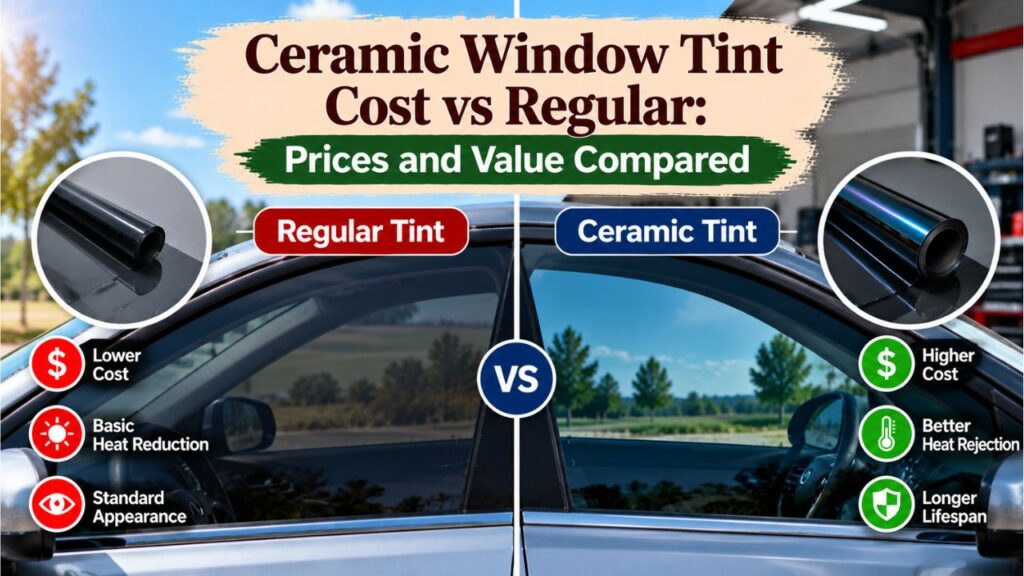
Ceramic tint usually costs more than conventional dyed film because of its construction, heat-rejection technology, and market positioning.
According to AAA’s car window tinting cost guide, professional installation prices vary by film type, vehicle size, and installation requirements.
The following figures provide useful U.S. budgeting estimates.
| Window Tint Type | Estimated Installed Cost | Main Characteristic |
| Regular dyed tint | 250–300 | Affordable privacy and glare reduction |
| Carbon tint | 350–500 | Better color stability and heat control |
| Ceramic tint | 400–800 | Strong infrared heat rejection |
| Premium specialty tint | 500–1,200 | Advanced solar-control technology |
These are broad installation estimates, not guaranteed prices for a standardized vehicle or window package. Confirm exactly which windows are included when comparing quotes.
How Much Does Regular Window Tint Cost?
Regular dyed window tint commonly costs around 250–300 for professional installation, based on AAA’s published estimates.
Some local installers may offer lower prices for basic films, smaller vehicles, or limited-window packages.
Dyed film is usually the least expensive option because its main purpose is to darken the glass and reduce visible light transmission.
It can provide:
- A darker appearance
- Additional daytime privacy
- Reduced sunlight glare
- Some ultraviolet protection, depending on the product
- A lower initial installation cost
However, standard dyed tint generally provides less infrared heat rejection than a quality ceramic film.
Lower-grade dyed films may also fade, discolor, or turn purple as they age.
For drivers mainly interested in appearance and privacy, regular tint can still be an economical choice.
How Much Does Ceramic Window Tint Cost?
Ceramic window tint generally costs around 400–800 for professional installation, according to AAA’s estimates.
Entry-level ceramic products may fall toward the lower end of that range, while premium film lines and more demanding installations can cost more.
A ceramic tint quote often reflects:
- Film brand and product series
- Infrared and total solar heat rejection performance
- Vehicle size and glass area
- Installation complexity
- Warranty coverage
- Local labor rates
Not every product labeled ceramic provides the same performance.
A basic ceramic film and a premium infrared-rejecting ceramic film may have noticeably different specifications.
Compare actual film performance rather than assuming the most expensive product is always the best.
How Much More Does Ceramic Tint Cost Than Regular Tint?
The price difference depends on the two quotes being compared.
For example, consider these hypothetical installation prices:
| Installation | Example Price |
| Regular dyed tint | $275 |
| Ceramic tint | $600 |
| Additional ceramic cost | $325 |
In this example, ceramic tint costs $325 more than regular film.
That’s a substantial premium for the same vehicle.
However, the additional cost may be reasonable if the ceramic film delivers noticeably better heat rejection and remains in good condition for a longer period.
If privacy is your main objective, the cheaper film may offer better value.
Ceramic vs Regular Window Tint Cost by Vehicle Type
The vehicle’s size and window design influence how much tinting costs.
Larger vehicles often require more film and installation time.
However, a small vehicle with complex curved glass may cost more to tint than a larger vehicle with simpler windows.
Ceramic vs Regular Tint Cost for Sedans
Sedans are commonly used as the reference point for window tint installation estimates.
A typical four-door sedan may require tinting:
- Two front side windows
- Two rear side windows
- Rear windshield
- Additional quarter windows, depending on the design
A shop may include all these windows in its standard package or charge separately for certain pieces of glass.
For a sedan, the difference between regular and ceramic film is often easier to evaluate because the total glass area is relatively manageable.
Ask for both prices using exactly the same window coverage.
Ceramic vs Regular Tint Cost for SUVs
SUVs often have more glass than sedans, especially models with three rows of seating.
Larger rear windows and extra quarter windows can increase the material and labor requirements.
Some SUVs already have factory privacy glass on their rear windows.
That darker glass doesn’t necessarily provide the same solar heat rejection as an aftermarket ceramic film.
Adding ceramic film may improve heat control, but the combined darkness must remain legal.
If you’re tinting an SUV, confirm whether the quote includes every side window and the rear windshield.
Ceramic vs Regular Tint Cost for Pickup Trucks
Pickup truck tinting prices depend on cab design and glass configuration.
A regular-cab truck has fewer side windows than a crew-cab model.
Sliding rear windows and complex glass arrangements can also increase installation labor.
For trucks used in hot weather, ceramic tint may provide a practical comfort improvement.
However, the decision should be based on actual film specifications and the price difference rather than vehicle type alone.
How Much Does Ceramic Tint Cost for Two Front Windows?
Tinting only the two front side windows generally costs less than purchasing a complete vehicle package.
The final price depends on the window dimensions and selected film.
Many drivers choose this option to match the appearance of factory-tinted rear windows.
Ceramic film can also be useful on front side windows because of its infrared heat-rejection performance.
Before installation, verify the legal visible light transmission level for your state.
Factory rear privacy glass may be substantially darker than the legal limit for front side windows.
What Is the Difference Between Ceramic and Regular Window Tint?
The main difference is the technology used to control sunlight and heat.
Regular dyed film primarily reduces the amount of visible light entering the vehicle.
Ceramic film is designed to reduce infrared energy and other solar radiation while maintaining a selected level of visible light transmission.
Regular Dyed Window Tint
Dyed window tint uses coloring agents within the film construction.
Its primary functions are appearance, privacy, and glare reduction.
The dye absorbs some incoming light, creating a darker window.
However, darkness doesn’t automatically mean strong heat rejection.
A dark dyed film may transmit more solar heat than a lighter ceramic film engineered for infrared control.
Some premium dyed films also offer meaningful UV protection and improved color stability, so performance should be evaluated by product rather than category alone.
Ceramic Window Tint
Ceramic tint incorporates ceramic-based technology designed to control solar energy.
Many modern ceramic films are nonmetallic, allowing them to reject infrared energy without using a reflective metallic layer.
That can improve thermal comfort without introducing the signal-interference concerns sometimes associated with metalized film.
Ceramic products are available in different shades.
A lighter ceramic tint can provide useful heat rejection while allowing more visible light through the glass.
Ceramic vs Regular Tint Performance Comparison
| Feature | Regular Dyed Tint | Ceramic Tint |
| Initial cost | Lower | Higher |
| Heat rejection | Usually limited to moderate | Generally stronger |
| Infrared control | Varies; often limited | Designed for better IR rejection |
| UV protection | Product-dependent | Often very high |
| Privacy | Depends on darkness | Depends on darkness |
| Glare reduction | Yes | Yes |
| Color stability | Depends on film quality | Often better |
| Electronic interference | Generally no | Generally no for nonmetallic films |
| Long-term value | Good for basic needs | Better for demanding heat-control needs |
The categories describe general differences. Individual products can overlap in performance, especially when comparing a premium conventional film with an inexpensive ceramic product.
Does Ceramic Window Tint Block More Heat Than Regular Tint?
Yes. Quality ceramic window tint generally rejects more solar heat than basic dyed tint at a comparable darkness level.
This is one of the main reasons ceramic film costs more.
How Ceramic Tint Reduces Solar Heat
Sunlight contains visible light, ultraviolet radiation, and infrared energy.
A film that primarily darkens visible light doesn’t necessarily reject large amounts of infrared energy.
Ceramic films use specialized materials to reduce solar energy transmission.
For example, 3M’s official Ceramic IR Series specifications report up to 66% total solar energy rejection and up to 95% infrared rejection under the manufacturer’s stated measurement conditions.
These are product-specific maximum figures, not guaranteed results for every ceramic film or shade.
3M also identifies its Ceramic IR film as nonmetallic, helping avoid interference with electronic signals.
What Is Total Solar Energy Rejection?
Total Solar Energy Rejection (TSER) measures the percentage of total solar energy prevented from passing through a filmed glass system.
It accounts for more than just visible sunlight or a narrow portion of infrared radiation.
A higher TSER value generally indicates stronger overall solar heat control under comparable test conditions.
For example, a film with 60% TSER rejects more total solar energy than one with 35% TSER when the measurements are made using comparable methods and glass.
However, TSER doesn’t directly predict an exact cabin temperature.
Vehicle insulation, windshield area, sunlight intensity, ventilation, and air-conditioning performance also affect interior temperature.
Is Infrared Rejection the Same as Total Heat Rejection?
No.
Infrared rejection and total solar energy rejection measure different aspects of film performance.
Manufacturers may report infrared rejection over selected wavelength ranges.
For that reason, an advertised infrared rejection figure of 95% doesn’t mean the film blocks 95% of all solar heat.
When comparing films, look for:
- TSER: Total solar energy rejection
- IRER: Infrared energy rejection over the stated wavelength range
- VLT: Visible light transmission
- UV rejection: Percentage of ultraviolet radiation blocked
Use specifications measured under comparable conditions.
A large infrared rejection number can be misleading if the testing method isn’t explained.
Does Ceramic Tint Keep a Parked Car Cooler?
Ceramic tint can reduce solar heat entering through treated windows.
However, it won’t prevent a parked car from becoming dangerously hot.
Sunlight still enters through other glass surfaces, including an untreated windshield, and heat can accumulate inside a closed vehicle.
Ceramic tint may reduce heat buildup, but it cannot guarantee a specific interior temperature reduction.
Never rely on window tint to make a parked vehicle safe for children, pets, or anyone unable to leave independently.
Ceramic vs Regular Window Tint: UV Protection and Glare
Heat rejection and UV protection are related benefits, but they are not identical.
A film can provide strong ultraviolet protection without offering the same infrared heat control as ceramic tint.
Does Regular Window Tint Block UV Rays?
Some regular dyed films provide substantial UV protection.
The exact percentage depends on the film’s construction and manufacturer.
Therefore, it’s incorrect to assume all regular tint provides almost no UV protection.
However, inexpensive dyed film may lack the durability or high solar-control performance of premium alternatives.
Check the UV rejection specification for the particular film being quoted.
Does Ceramic Tint Provide Better UV Protection?
Many ceramic films block a very high percentage of ultraviolet radiation.
For example, the 3M Ceramic IR Series referenced earlier lists up to 99.9% UV rejection.
That can help reduce UV exposure through treated windows and limit some UV-related interior fading.
However, ceramic technology isn’t the only way to achieve high UV rejection.
Premium dyed, carbon, and other films may also provide strong ultraviolet protection.
If UV blocking is your only priority, compare the actual specifications before paying more for ceramic.
Does Ceramic Tint Reduce Glare Better?
Glare reduction depends heavily on visible light transmission.
A darker film generally allows less visible light through the window.
Ceramic and dyed films with similar VLT ratings may produce comparable reductions in visible light.
The major difference is that ceramic film can offer stronger solar heat rejection without requiring an extremely dark shade.
This can be useful when local tint laws limit how dark the front windows may be.
Does Ceramic Tint Last Longer Than Regular Tint?
Premium ceramic film often offers better color stability and resistance to fading than inexpensive dyed film.
However, lifespan depends on more than the film category.
Adhesive quality, installation technique, window usage, sun exposure, and maintenance all influence durability.
How Long Does Regular Window Tint Last?
Basic dyed films may fade or discolor as they age.
Some develop a purple appearance because their coloring agents deteriorate.
However, high-quality dyed films can remain in good condition for years.
A professionally installed product with a dependable warranty may provide better value than a poorly installed film marketed as premium.
Don’t assume every dyed tint requires replacement after a fixed number of years.
How Long Does Ceramic Window Tint Last?
Quality ceramic tint is often designed for long-term use.
Premium products may carry limited lifetime warranties against specified defects.
However, a lifetime warranty doesn’t mean the film is guaranteed to remain unchanged forever.
Coverage depends on the manufacturer, installer, and warranty terms.
Before purchasing, ask whether the warranty includes:
- Bubbling
- Peeling
- Cracking
- Excessive color change
- Adhesive failure
- Replacement labor
- Transferability to another vehicle owner
Keep your installation receipt and warranty registration.
Is Ceramic Tint Less Likely to Turn Purple?
Quality ceramic films are generally less prone to the dye-related color changes associated with some inexpensive dyed films.
However, ceramic products can still experience defects or deterioration.
Poor installation, defective adhesive, and physical damage can affect any film.
A reputable installer and properly documented warranty matter as much as the marketing category.
Is Ceramic Window Tint Worth the Extra Cost?
Ceramic tint is usually worth considering when heat rejection and long-term comfort are more important than minimizing the initial price. Regular dyed tint can be the better value when privacy and appearance are the primary goals.
The decision depends on your driving habits and how much benefit you expect from the upgrade.
Ceramic Tint Makes Sense for Hot Climates
If you regularly drive in intense sunshine, ceramic film’s stronger heat rejection may provide a noticeable comfort benefit.
This is particularly relevant for vehicles with large side windows.
Ceramic film can reduce the sensation of direct solar heat through treated glass.
However, it doesn’t replace a properly functioning air-conditioning system.
Regular Tint Makes Sense for Budget Vehicles
If you’re tinting an older vehicle or mainly want a darker appearance, regular dyed tint may be sufficient.
Paying hundreds of dollars extra for ceramic may not be justified if strong heat rejection isn’t important to you.
A quality basic film installed correctly is generally preferable to a low-quality ceramic product installed poorly.
Ceramic Tint Can Be Worthwhile for Long-Term Ownership
Drivers who intend to keep a vehicle for several years may benefit from investing in a durable film.
Consider the earlier example:
- Regular tint installation: $275
- Ceramic tint installation: $600
- Additional ceramic cost: $325
Spread across five years of ownership, the extra ceramic cost equals approximately $65 per year.
That doesn’t prove ceramic tint will save $65 annually or pay for itself through reduced air-conditioning use.
It simply shows the additional upfront cost over a longer ownership period.
For someone who values heat control every day, the extra expense may be reasonable.
For someone who rarely drives in direct sunshine, the benefit may be less meaningful.
Ceramic Tint May Not Be Necessary for a Leased Vehicle
If you plan to return a vehicle soon, consider how much time you’ll have to benefit from the upgrade.
Also check whether the leasing agreement permits aftermarket window film and whether removal is required.
A temporary vehicle may not justify premium tinting expenses, particularly when a basic film meets your needs.
Ceramic vs Carbon vs Regular Window Tint: Which Offers Better Value?
Carbon tint is worth considering if ceramic exceeds your budget.
It generally sits between dyed and ceramic film in terms of pricing and performance.
Regular Dyed Tint for the Lowest Initial Cost
Regular dyed tint is appropriate when the main priorities are:
- Lower purchase cost
- Privacy
- A darker window appearance
- Basic glare reduction
Choose a product with documented UV performance and a suitable warranty.
Carbon Tint for a Middle-Ground Option
Carbon film often offers improved color stability and heat control compared with basic dyed film.
It may be a practical option when you want better performance without paying for premium ceramic technology.
However, individual products vary, and carbon tint is not guaranteed to outperform every dyed or hybrid film.
Review the manufacturer’s specifications.
Ceramic Tint for Greater Heat Rejection
Ceramic film generally makes the most sense when solar heat control is the leading priority.
A high-quality ceramic product can reject substantial infrared energy while maintaining an appropriate VLT.
If a reputable installer offers carbon and ceramic packages at similar prices, compare their actual TSER and warranty terms.
The ceramic label alone shouldn’t determine the purchase.
What Affects Ceramic Window Tint Installation Cost?
Several factors explain why two tint shops may quote very different prices for the same vehicle.
Window Film Brand and Product Line
Well-known manufacturers often offer several grades of film.
For example, a brand may sell an entry-level solar-control film, a standard ceramic film, and a premium infrared-rejecting series.
Each product can have different performance specifications and warranty coverage.
Ask for the exact manufacturer and product name rather than accepting a quote that simply says “ceramic tint.”
Number of Windows Being Tinted
The total price depends on which windows are included.
A quote may cover:
- Front side windows only
- All side windows
- Side and rear windows
- Side and rear windows plus a windshield strip
- Additional windshield coverage where legal
Compare the same window package at each shop.
A lower quote may cover fewer windows.
Vehicle Window Shape and Size
Large, curved rear windows can require more installation labor.
Vehicles with complex seals, small quarter windows, or difficult access may also cost more.
Removing interior trim can add labor when necessary for proper installation.
Removing Existing Window Tint
If the vehicle already has tint, the old film may need to be removed.
AAA estimates that professional tint removal can add approximately 100–400 or more, depending on the vehicle and job.
Removal can be more complicated when old adhesive is stubborn or the rear windshield contains delicate defroster lines.
Ask whether removal is included in the installation quote.
Installer Experience and Warranty
Professional installation affects the finished appearance and durability.
A skilled installer should prepare the glass, fit the film accurately, and minimize contamination.
The cheapest installation may not provide the best value if defects require replacement.
Compare warranty coverage and installer reputation, not just the price.
Does Window Tint Darkness Affect Ceramic Tint Cost?
Tint darkness is described using Visible Light Transmission (VLT).
VLT measures the percentage of visible light passing through a glass-and-film system.
A lower number means less visible light is transmitted.
| VLT Rating | General Appearance |
| 70% | Very light tint |
| 50% | Light tint |
| 35% | Medium tint |
| 20% | Dark tint |
| 5% | Very dark tint |
These descriptions are approximate. Actual appearance depends on the original glass and lighting conditions.
Does Darker Ceramic Tint Cost More?
Not necessarily.
Many installers charge the same price for different VLT shades within the same film series.
The price may change when selecting a different product line, but darkness alone doesn’t automatically determine the cost.
Ask whether the shop charges differently for your preferred shade.
Can Light Ceramic Tint Block More Heat Than Dark Regular Tint?
Yes.
A light ceramic film with strong solar-control properties can reject more heat than a darker basic dyed film.
That is one of ceramic tint’s main advantages.
Compare TSER values rather than assuming the darkest film provides the greatest heat protection.
Is Ceramic Tint Legal in Every State?
Ceramic window tint is not automatically legal simply because of its material.
U.S. state laws regulate factors such as visible light transmission, reflectivity, and permitted window coverage.
Requirements may differ for:
- Front side windows
- Rear side windows
- Rear windshield
- Windshield
- Passenger cars and certain other vehicle types
The existing factory glass also affects the final VLT reading.
For example, applying a film rated at 70% VLT to glass that already transmits approximately 75% of visible light could produce a combined theoretical transmission near 52.5%, before accounting for other optical effects.
Therefore, a film labeled 70% VLT doesn’t guarantee a finished window will meet a state’s 70% minimum.
Ask the installer to verify compliance using the applicable state requirements and a suitable light-transmission meter.
Does Ceramic Tint Interfere With GPS, Radio, or Cell Signals?
Most nonmetallic ceramic window films are designed to avoid the electronic signal-interference concerns associated with certain metalized films.
This can matter for vehicles using:
- GPS navigation
- Cellular connections
- Satellite radio
- Electronic toll systems
- Other wireless equipment
However, interference depends on the actual film construction and vehicle electronics.
Not every non-ceramic film contains metal.
Regular dyed and carbon films are commonly nonmetallic as well.
If signal compatibility is important, ask whether the exact product contains any metalized layers.
How to Compare Ceramic and Regular Tint Quotes Before Buying
A useful quote comparison includes more than the total installation price.
Ask each installer for the same set of details.
1. Confirm the Exact Film Brand
Request the manufacturer’s name and product series.
A vague description such as “premium ceramic” isn’t enough to evaluate film performance.
2. Compare Heat-Rejection Specifications
Look for TSER and relevant infrared rejection measurements.
Be cautious about percentages presented without explaining how they were measured.
3. Check Which Windows Are Included
Make sure every quote includes the same windows.
Confirm whether rear quarter windows, windshield strips, and any additional glass are included.
4. Verify the Legal Tint Shade
Choose a VLT appropriate for the vehicle and the state where it will be operated.
Don’t assume that a shop’s recommended shade is automatically legal.
5. Review the Warranty
Ask for written warranty terms.
Check whether labor is included and whether coverage requires installation by an authorized dealer.
6. Confirm Additional Charges
Ask whether the quote includes:
- Old tint removal
- Window cleaning and preparation
- Installation labor
- Sales tax
- Warranty registration
- Any special glass-handling fees
A complete estimate makes it easier to compare value.
Common Mistakes When Choosing Ceramic or Regular Window Tint
Several purchasing mistakes can lead to unnecessary spending.
Paying More Without Checking Film Performance
Not every ceramic film delivers the same level of solar heat rejection.
A premium carbon film may outperform a poorly specified low-cost ceramic product in certain measurements.
Use the manufacturer’s data to compare actual performance.
Confusing Darkness With Heat Rejection
A darker appearance doesn’t always mean better heat control.
Regular dyed film may provide excellent privacy while allowing more infrared energy into the cabin than a lighter ceramic film.
Choose film based on the performance you need.
Choosing an Illegal Tint Shade
Dark tint can reduce visibility at night and may violate state requirements.
An illegal installation can lead to fines, inspection failures, or the cost of removing the film.
Confirm legal limits before installation.
Ignoring the Existing Glass
Factory privacy glass, laminated glass, and existing tint can affect the final result.
Adding film changes the combined light transmission.
Have the existing glass measured when necessary.
Assuming Ceramic Tint Will Eliminate Air-Conditioning Costs
Ceramic tint can reduce solar heat entering through treated glass, but it doesn’t eliminate the vehicle’s cooling needs.
Fuel or electricity savings depend on actual driving and climate conditions.
Don’t justify the purchase using unsupported promises of a guaranteed financial payback.
Choosing the Cheapest Installer
Poor installation can cause bubbles, trapped debris, peeling edges, or premature failure.
A lower price isn’t a good deal if the job needs to be repeated.
Choose a reputable shop that identifies its film products and provides written warranty information.
Conclusion
The ceramic window tint cost vs regular comparison shows a clear difference in both upfront price and solar heat-control performance.
Regular dyed tint is generally more affordable, with AAA’s published estimates around 250–300, while ceramic film typically costs approximately 400–800 for professional installation.
Ceramic tint’s main advantage is stronger heat rejection without necessarily requiring an extremely dark shade. Quality ceramic films may also provide better color stability and long-term durability.
For drivers in hot climates or those who keep their vehicles for several years, ceramic tint can justify the additional expense.
For drivers mainly interested in privacy, glare reduction, and a darker appearance, regular dyed tint may be sufficient.
If ceramic exceeds your budget, carbon tint offers another option worth comparing.
The best choice is a legally compliant film with verified performance, a suitable warranty, and professional installation—not simply the most expensive tint available.
FAQs About ceramic window tint cost vs regular
Is Ceramic Tint Worth $300 More Than Regular Tint?
It can be worth an additional $300 if heat rejection, comfort, and long-term film performance are important to you.
If you mainly want privacy and a darker appearance, regular tint may provide better value. Compare the exact film specifications and warranty before paying the difference.
Why Is Ceramic Window Tint More Expensive?
Ceramic tint uses specialized materials and film construction designed to reduce solar heat transmission.
Premium product positioning, manufacturer warranties, and installation costs can also contribute to its higher price.
However, a higher price doesn’t automatically guarantee superior performance.
Does Ceramic Tint Look Different From Regular Tint?
Ceramic and regular dyed tint can look similar when they have comparable darkness and color.
Ceramic’s main advantage is heat-rejection performance rather than a dramatically different exterior appearance.
The finished look depends on the film shade, color, and original glass.
Can Regular Window Tint Block 99% of UV Rays?
Yes. Some high-quality non-ceramic films can block approximately 99% of UV radiation.
UV rejection and infrared heat rejection are different measurements.
Check the specific product’s UV rating instead of assuming ceramic technology is required for strong UV protection.
Is Ceramic Tint Better for Night Driving?
Ceramic film can provide useful heat rejection at a lighter shade, which may help drivers who want to preserve more visible light.
However, ceramic tint isn’t automatically safer at night.
Dark ceramic film still reduces visible light, and excessive darkness can make driving more difficult in low-light conditions.
How Much Does It Cost to Replace Regular Tint With Ceramic?
The total cost includes removing the old film and installing the ceramic replacement.
AAA estimates ceramic installation at approximately 400–800 and professional tint removal at roughly 100–400 or more.
The combined expense depends on the vehicle, existing film condition, and shop pricing. Some installers may offer package pricing for removal and replacement.
Does Ceramic Tint Last Longer Than Carbon Tint?
Both high-quality ceramic and carbon films can provide good long-term durability.
Ceramic products often have premium construction and warranties, but the actual lifespan depends on the manufacturer, installation quality, and maintenance.
Compare written warranties and product specifications rather than assuming every ceramic film lasts longer.
Can You Get Ceramic Tint Without Making the Windows Dark?
Yes. Ceramic window films are available in relatively light shades.
Some offer substantial solar heat rejection while allowing a large percentage of visible light through the glass.
However, the finished window must still comply with applicable state tint laws, including the combined VLT of the film and factory glass.