Ceramic window tint is generally better than regular dyed tint for reducing solar heat inside a vehicle, while regular tint is usually more affordable for privacy, glare reduction, and appearance. Both can block ultraviolet (UV) radiation, but ceramic films use advanced infrared-rejecting materials that typically provide better heat control without requiring extremely dark windows.
For drivers in hot climates, this difference can affect comfort during summer commutes and long drives. A dark conventional tint may reduce glare and make the cabin appear shaded without providing the same heat rejection as a high-performance ceramic film.
However, ceramic tint isn’t automatically the best choice for every vehicle. Product quality, tint darkness, installation, warranty coverage, and state window tint regulations all affect the decision.
Some premium non-ceramic films also deliver substantial heat protection, so comparing actual specifications is more useful than relying on marketing labels.
In this article, I compare ceramic and regular window tint in terms of heat rejection, UV protection, visibility, durability, and installation costs. You’ll also learn how to read tint performance ratings, choose a legal shade, and decide whether paying extra for ceramic film makes sense for your driving conditions.
Ceramic vs Regular Window Tint: Main Differences
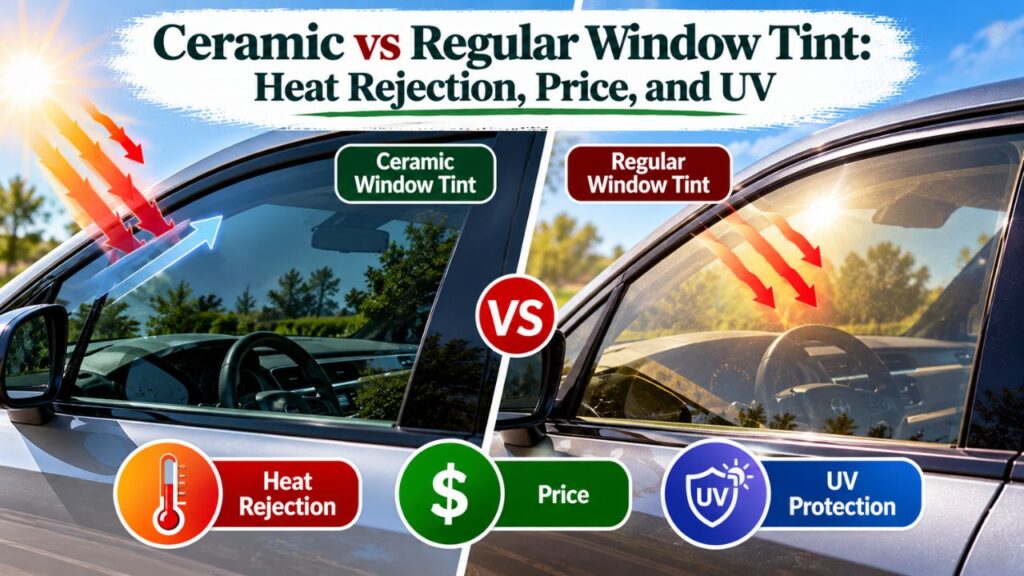
The biggest difference is how the films control sunlight.
Traditional dyed tint primarily uses coloring agents to reduce visible light. Ceramic tint uses infrared-absorbing nanoparticles to reduce solar heat while maintaining a selected level of visible light transmission.
However, the term regular window tint can describe several products, including dyed, metalized, and hybrid films. For this comparison, regular tint primarily refers to conventional dyed automotive window film.
Ceramic vs Regular Window Tint Comparison Chart
| Feature | Ceramic Window Tint | Regular Dyed Tint |
| Primary technology | Infrared-rejecting ceramic nanoparticles | Colored or dyed film layers |
| Heat rejection | Generally higher | Generally lower |
| UV protection | Often 99% or more | Can also reach 99% or more |
| Glare reduction | Depends mainly on shade | Depends mainly on shade |
| Available darkness | Light to dark | Light to dark |
| Night visibility | Depends on installed VLT | Depends on installed VLT |
| Signal interference | Generally none in nonmetallic films | Generally none in nonmetallic dyed films |
| Color stability | Often excellent in premium products | Varies; quality dyed films can be color-stable |
| Durability | Typically strong with quality construction | Depends on film and adhesive quality |
| Installation cost | Generally higher | Generally lower |
| Best application | Heat reduction and long-term comfort | Affordable privacy and appearance |
These are general comparisons, not guaranteed performance differences.
A premium dyed film may outperform a poorly manufactured ceramic product in certain categories. Always compare the actual film specifications.
What Is Regular Window Tint?
Regular automotive window tint commonly refers to dyed polyester film installed on the interior surface of vehicle glass.
The dye absorbs some visible light and produces a darker window appearance.
Depending on its construction, a conventional dyed film can provide:
- Reduced sunlight glare.
- Increased daytime privacy.
- UV protection.
- A darker appearance.
- Some solar heat reduction.
Basic dyed tint is generally less expensive because it doesn’t rely on the same advanced infrared-control materials used in premium ceramic products.
However, regular tint isn’t one standardized product.
Modern dyed films may use improved pigments, adhesives, and manufacturing processes that offer better color retention and durability than older low-quality films.
What Is Ceramic Window Tint?
Ceramic window tint is an automotive window film containing microscopic ceramic-based particles designed to control solar radiation, particularly infrared energy.
These nanoparticles absorb selected infrared wavelengths while allowing manufacturers to produce films with different levels of visible light transmission.
Ceramic films are commonly marketed as nano-ceramic window tint.
Their main advantages include:
- Strong infrared heat rejection.
- Good visibility at appropriate tint levels.
- UV protection.
- Low visible reflectivity in many products.
- Compatibility with vehicle electronics when the film is nonmetallic.
- Improved long-term comfort in sunny conditions.
Ceramic film isn’t necessarily free of dyes. Some ceramic products combine infrared-rejecting nanoparticles with color-stable dyes to produce their desired appearance.
The actual film construction depends on the manufacturer.
Ceramic vs Regular Window Tint for Heat Rejection
Heat rejection is generally the strongest reason to choose ceramic tint instead of basic dyed film.
Both products can reduce solar heat entering a vehicle, but they do so with different levels of effectiveness.
How Regular Window Tint Reduces Heat
Conventional dyed tint absorbs part of the sunlight that reaches the glass.
Darker film blocks more visible light, which can reduce glare and some solar heating.
However, visible darkness does not directly indicate how effectively a film controls infrared radiation.
A dark dyed tint may allow more solar heat into the cabin than a lighter high-performance film.
This explains why some vehicles with dark windows still become uncomfortable during summer driving.
How Ceramic Tint Blocks Infrared Heat
Ceramic films contain infrared-control particles that reduce the amount of selected infrared energy passing through the filmed glass.
These materials allow manufacturers to provide substantial heat rejection without relying entirely on a dark visible appearance.
The International Window Film Association’s Automotive Education Guide explains that nano-ceramic films can deliver higher infrared-absorption performance than conventional colored films because their nanoparticles are more effective at absorbing targeted infrared radiation.
This distinction is particularly useful for drivers who want improved heat rejection while maintaining relatively light windows.
However, ceramic tint does not block all heat. Visible sunlight also carries energy, and the film itself can absorb heat and transfer some of it inward.
How Much More Heat Does Ceramic Tint Reject?
The difference depends on the exact film series, shade, glass type, and testing method.
As one manufacturer example, 3M’s November 2025 automotive film comparison guide reports the following maximum performance figures:
| 3M Film Series | Maximum Total Solar Energy Rejected | Maximum Infrared Energy Rejected |
| Ceramic IR Series | 63% | 63% |
| XP Series | 55% | 49% |
These figures are from a particular manufacturer’s comparison of film ranges using specified glass and test conditions.
They are not universal ceramic-versus-dyed performance ratings, and the maximum values may occur at different tint shades.
The practical lesson is that higher-performance films can reject more solar energy, but you should compare the specifications of individual products at similar visible light transmission levels.
Does Ceramic Tint Keep a Car Cooler?
Ceramic tint can reduce solar heat entering through the windows, which may improve comfort while driving.
This can be particularly noticeable when direct sunlight reaches the driver’s arms, legs, or other exposed areas.
However, the actual cabin temperature depends on:
- Outdoor temperature.
- Sunlight intensity.
- Windshield and window area.
- Vehicle interior color.
- Air-conditioning performance.
- Parking conditions.
- Film specifications.
A vehicle parked in direct sunlight can still become dangerously hot even with premium ceramic tint.
Important: Window tint should never be relied upon to make a parked vehicle safe for children, pets, or anyone unable to leave it independently.
Which Window Tint Blocks More UV Rays?
Both ceramic and high-quality regular window tint can block substantial amounts of ultraviolet radiation.
Ceramic tint does not automatically provide better UV protection simply because it costs more.
UV Protection in Ceramic Tint
Many premium ceramic films advertise UV rejection of 99% or higher over their specified testing range.
This can help reduce UV exposure through treated glass and contribute to protecting vehicle interiors.
However, UV protection depends on the product’s construction and verified specifications.
Also, blocking UV radiation does not eliminate every cause of interior fading or deterioration.
Visible light, temperature, moisture, and material quality can still influence aging.
UV Protection in Regular Dyed Tint
A properly formulated dyed film can also provide excellent UV rejection.
The 3M comparison cited earlier lists up to 99.9% UV protection for both its Ceramic IR and more affordable XP series.
This illustrates why UV-blocking percentages alone may not justify paying more for ceramic film.
If UV protection is your main priority, compare the verified UV ratings of the actual products.
Don’t assume every inexpensive tint offers the same protection, but don’t assume only ceramic films can provide high UV rejection.
Does Ceramic Tint Protect Leather and Dashboards Better?
Ceramic tint may offer additional interior protection when its overall solar heat rejection is higher than that of the alternative film.
Reduced UV exposure and solar heat can help limit some conditions associated with fading and material deterioration.
However, the degree of protection depends on the product and the vehicle’s exposure.
For example, a dashboard receiving direct sunlight through an untinted windshield may still experience considerable heating even when the side windows have premium ceramic film.
For interior preservation, evaluate the coverage and performance of the entire window system rather than focusing on one film feature.
Ceramic vs Regular Tint: Darkness and Visibility
A common misunderstanding is that ceramic tint must be darker to work better.
In reality, heat rejection and visible darkness are different performance characteristics.
What Does VLT Mean in Window Tint?
Visible Light Transmission (VLT) is the percentage of visible light that passes through the filmed glass or through the film itself, depending on the measurement being reported.
A higher VLT generally means a lighter appearance.
A lower VLT means less visible light passes through.
| VLT Rating | General Appearance |
| 70% | Very light tint |
| 50% | Light tint |
| 35% | Moderate tint |
| 20% | Dark tint |
| 5% | Very dark tint, often called limousine tint |
These percentages describe light transmission, not heat rejection.
A 70% VLT ceramic film may offer better infrared control than a significantly darker basic dyed film.
However, the exact comparison depends on the products involved.
Can Ceramic Tint Be Light and Still Reject Heat?
Yes. This is one of the main advantages of high-performance ceramic film.
Its infrared-control materials can provide meaningful heat rejection even at relatively high VLT levels.
This makes lighter ceramic shades appealing to drivers who want thermal comfort without dramatically changing the vehicle’s appearance.
However, a light ceramic film still reduces some visible light and is not automatically legal for every window.
Always check the installed glass-and-film combination against applicable regulations.
Which Tint Is Better for Driving at Night?
Neither ceramic nor regular tint is automatically better for nighttime visibility.
The most important factor is the amount of visible light transmitted through the completed window.
Two films with similar installed VLT can provide similar overall light transmission, although haze, reflectivity, and optical quality may differ.
A very dark ceramic film can reduce nighttime visibility more than a lighter conventional dyed film.
This is particularly important when:
- Driving on poorly lit roads.
- Checking side mirrors.
- Reversing at night.
- Looking for pedestrians or cyclists.
- Traveling during heavy rain.
Choose a legal VLT that maintains suitable outward visibility under the driving conditions you regularly encounter.
Does Ceramic Tint Have Better Optical Clarity?
High-quality ceramic tint can provide excellent optical clarity, but clarity depends on more than film technology.
Important factors include:
- Manufacturing quality.
- Optical distortion.
- Film haze.
- Adhesive quality.
- Installation cleanliness.
- Window curvature.
- Product condition.
A poorly installed ceramic film may show contamination, distortion, or bubbles.
Likewise, a professionally installed conventional tint from a reputable manufacturer can provide clear visibility.
The film’s actual optical quality and installation workmanship matter more than the word ceramic alone.
Is Ceramic Tint More Durable Than Regular Window Tint?
Premium ceramic films often offer strong color stability and long-term performance.
However, durability is influenced by the entire film construction, not only the infrared-control particles.
Fading and Purple Discoloration
Older or inexpensive dyed films may experience color changes after prolonged exposure to sunlight.
Some deteriorating films develop a purplish appearance as coloring agents break down.
High-quality modern dyed films may use more stable dyes that resist these changes.
Ceramic films are also available with stable color systems, and their infrared-control function is not dependent solely on conventional dark dyes.
However, not all ceramic films have identical fade resistance.
Compare manufacturer warranties and documented color-stability claims rather than assuming a film type guarantees a particular lifespan.
Bubbling and Peeling
Bubbling and peeling are commonly associated with adhesive problems, installation defects, deterioration, or contamination.
Ceramic film can also bubble or peel if the adhesive fails or the installation is poor.
Typical issues include:
- Inadequate glass preparation.
- Contamination beneath the film.
- Incorrect installation procedures.
- Damaged edges.
- Adhesive deterioration.
- Physical wear around movable windows.
A more expensive film does not compensate for poor installation.
Professional workmanship and suitable product quality are important for both ceramic and regular tint.
Which Tint Lasts Longer?
A premium ceramic film may provide better long-term value than an entry-level dyed product, particularly where heat rejection and color stability matter.
However, no universal lifespan applies to all products.
Actual service life varies with:
- Film quality.
- Adhesive formulation.
- Installation workmanship.
- Sun exposure.
- Climate.
- Cleaning practices.
- Window use.
Check whether the manufacturer’s warranty covers fading, bubbling, peeling, discoloration, and other specific defects.
A limited lifetime warranty may include exclusions and installation requirements.
Do Ceramic and Regular Tint Interfere With Electronics?
Nonmetallic ceramic and dyed films generally do not create the signal-interference concerns associated with some metal-containing window films.
Ceramic Tint and Vehicle Electronics
Most conventional nano-ceramic automotive films are designed without metallic layers.
That allows them to reduce infrared heat without relying on conductive metal coatings.
This is beneficial for vehicles using:
- GPS navigation.
- Cellular connectivity.
- Satellite radio.
- Wireless communication systems.
- Other radio-frequency equipment.
However, ceramic is a broad product category. Verify the particular film’s construction instead of assuming every product has identical properties.
Regular Dyed Tint and Signal Reception
Basic nonmetallic dyed tint is also generally compatible with vehicle electronics.
Therefore, ceramic tint does not have a unique advantage over ordinary dyed film in this category.
Some metalized or hybrid films contain conductive layers that may affect certain radio-frequency signals.
The actual effect depends on the film, device, antenna arrangement, and window coverage.
If electronic compatibility is important, ask whether the product contains metallic layers.
Ceramic vs Regular Window Tint: Cost and Value
Ceramic window tint generally costs more than conventional dyed tint because its materials and manufacturing process are more specialized.
However, the total installed price depends on the specific film and vehicle.
Why Ceramic Tint Costs More
Ceramic films use specialized infrared-control technology.
Premium product lines may also include advanced coatings, higher-performance adhesives, and additional warranty coverage.
The final installation cost can vary with:
- Film brand and series.
- Vehicle size.
- Number of windows.
- Window shape and curvature.
- Local labor rates.
- Existing tint removal.
- Windshield or sunroof coverage.
- Installer experience.
A sedan with straightforward side windows may cost less to tint than a large SUV with additional glass.
Complex rear windows and removal of deteriorated film can increase labor.
Is Regular Tint the Cheaper Option?
Usually, yes.
Basic dyed tint is often the lowest-cost professionally installed automotive film category.
It may be suitable when the main goals are:
- A darker appearance.
- Daytime privacy.
- Glare reduction.
- Basic UV protection.
- Lower upfront expense.
However, the lowest-priced installation isn’t always the best value.
Poor installation or inexpensive film with limited warranty coverage can result in additional costs if replacement becomes necessary.
Is Ceramic Tint Worth the Extra Money?
Ceramic tint can be worth the additional cost when strong heat rejection is a priority.
Drivers in hot, sunny climates may appreciate the improved comfort more than drivers in mild climates.
Ceramic is also attractive when you want a relatively light tint with meaningful solar heat control.
The value depends on how much you benefit from these features.
If appearance and privacy are your main goals, a quality regular dyed film may provide everything you need.
Practical recommendation: Compare at least two actual film models at similar installed VLT levels. Consider their total solar energy rejection, warranty, and installed price before making a decision.
How to Compare Window Tint Performance Ratings
Tint marketing often highlights the largest available percentage, but not every percentage measures the same thing.
Understanding the major specifications helps you compare ceramic and regular films correctly.
TSER: Total Solar Energy Rejection
TSER measures the percentage of total solar energy rejected by the filmed glass.
It accounts for solar energy across the relevant spectrum rather than focusing only on one narrow infrared band.
A higher TSER generally indicates better overall solar heat control under comparable conditions.
For evaluating thermal performance, TSER is one of the most useful specifications to examine.
Compare products tested using similar glass and methods.
IRR: Infrared Rejection
IRR describes the percentage of infrared energy rejected within a specified wavelength range.
Some manufacturers report performance over a relatively narrow section of the infrared spectrum.
For example, a film might advertise very high infrared rejection over a limited wavelength band.
That number does not mean the film blocks the same percentage of total solar heat.
Always check the wavelength range and testing conditions associated with an IRR rating.
IRER: Infrared Energy Rejection
IRER measures infrared energy rejection over a broader specified infrared range and accounts for heat absorbed by the film that can be transferred inward.
It can provide useful information when comparing infrared-control performance.
However, it is not interchangeable with TSER because the two metrics cover different energy ranges.
Use IRER alongside TSER rather than treating them as identical measurements.
VLT: Visible Light Transmission
VLT tells you how much visible light passes through the glass-and-film combination.
It helps evaluate darkness, visibility, and legal compliance.
VLT does not establish the film’s infrared rejection.
For example, a film labeled 50% VLT applied to factory glass transmitting 70% of visible light might produce an approximate combined VLT of:
0.50 × 0.70 = 0.35
That is approximately 35% combined VLT.
Actual installed VLT should be confirmed with an appropriate meter because film specifications, glass properties, and measurement conditions can affect the result.
UV Rejection
UV rejection describes how much ultraviolet radiation is prevented from passing through the tested system.
Check the product’s reported UV performance and testing range.
Both ceramic and dyed films can offer high UV rejection.
Do not confuse UV rejection with total solar heat rejection, since they measure different properties.
Are Ceramic and Regular Window Tint Legal?
Both ceramic and conventional window tint can be legal, but legality depends on the vehicle, window location, tint darkness, reflectivity, and applicable state regulations.
There is no single aftermarket window tint rule that applies uniformly to every vehicle across the United States.
State Window Tint Laws and VLT Limits
Many states set different minimum VLT requirements for:
- Windshields.
- Front side windows.
- Rear side windows.
- Rear windshields.
Requirements may also vary by vehicle classification and permitted exemptions.
Some states regulate reflectivity, tint color, certification markings, and other characteristics.
The same film may be permitted on a rear passenger window but prohibited on a front side window.
Ceramic Tint Is Not Automatically Street-Legal
A film being labeled ceramic does not make it exempt from tint restrictions.
For example, an excessively dark ceramic film may violate the same VLT restrictions as a conventional dyed film of similar darkness.
Even a nearly clear heat-rejecting film may affect an already tinted factory windshield or front window enough to create a legal issue.
Check the current regulations issued by the applicable state transportation or motor vehicle authority before installation.
Why the Finished Window Must Be Measured
Factory automotive glass may already reduce visible light transmission.
Adding film generally lowers the combined VLT.
A film marketed as a particular percentage does not guarantee the completed window will have that exact VLT.
Ask the installer to measure the existing glass and verify the expected final transmission.
For legal compliance, the final installed window matters more than the film’s advertised shade.
Which Window Tint Should You Choose for Your Car?
The best choice depends on your priorities, typical driving conditions, and budget.
Neither film category is automatically the right answer for every driver.
Choose Ceramic Tint for Hot Climates
Ceramic tint is generally the stronger option when your main goal is reducing solar heat entering the cabin.
It can be especially useful for:
- Daily commuting in strong sunlight.
- Vehicles with large side windows.
- Drivers seeking better heat control without very dark tint.
- Long highway trips in hot climates.
- Owners planning to keep the vehicle for several years.
Premium non-ceramic films can also provide good heat control, so compare their specifications before making a final choice.
Choose Regular Tint for Affordable Privacy
Conventional dyed tint is a reasonable option when appearance and privacy matter more than maximum heat rejection.
It may suit:
- Budget-conscious drivers.
- Vehicles used mainly in mild climates.
- Owners seeking a darker appearance.
- Drivers focused on glare reduction.
- Short-term vehicle ownership.
A quality dyed film installed by a reputable shop can provide satisfactory results without the higher cost of ceramic.
Choose Based on the Actual Film, Not Just the Label
A better buying approach is to compare specific products using the same evaluation criteria.
| Your Main Priority | Better Starting Choice |
| Strong heat rejection | High-performance ceramic |
| Lowest installation cost | Quality regular dyed film |
| Maximum daytime privacy | Appropriate legal dark VLT |
| Lighter appearance with heat control | Light ceramic film |
| UV protection | Compare verified ratings from both |
| Low electronic interference | Nonmetallic film of either type |
| Long-term value | Compare durability, warranty, and price |
| Safe nighttime visibility | Appropriate legal VLT and optical quality |
The ideal product balances its technical performance with what you actually need from the windows.
What to Check Before Paying for Ceramic Window Tint
Because ceramic tint usually costs more, verify the product and installation details before accepting a quote.
Ask for the Exact Film Brand and Series
Some installers advertise their products simply as ceramic tint without identifying the manufacturer.
Request the full product name and specifications.
A genuine product data sheet should identify relevant performance measurements.
Avoid choosing solely based on phrases such as premium ceramic or maximum heat blocking.
Compare Similar VLT Levels
Do not compare the heat rejection of a very dark ceramic film with that of a much lighter dyed film and assume the difference comes entirely from the film technology.
Ask for comparable shades whenever possible.
This produces a more meaningful comparison of solar-control performance.
Review Warranty Coverage
Check whether the warranty covers:
- Excessive discoloration.
- Bubbling.
- Adhesive failure.
- Peeling.
- Manufacturing defects.
- Installation-related issues.
Also determine whether replacement labor is covered and whether warranty service requires an authorized installer.
Keep the installation invoice and warranty documentation.
Inspect the Installer’s Workmanship
Professional installation should minimize dust contamination, trapped debris, creases, and visible defects.
Curved rear windows may require more demanding film forming and handling.
Ask about the film’s expected curing period and appropriate cleaning methods.
Temporary moisture haze can occur during curing, but persistent bubbles, peeling edges, and significant optical defects should be assessed by the installer.
Avoid Common Tint Selection Mistakes
The most frequent mistakes include choosing film based only on darkness or advertised infrared rejection.
Other problems include:
- Ignoring existing factory glass tint.
- Purchasing film without verified specifications.
- Overlooking front-window and windshield regulations.
- Assuming every ceramic film has the same performance.
- Paying more without comparing installed prices.
- Choosing an excessively dark shade for nighttime driving.
- Ignoring warranty exclusions.
A well-chosen regular film can be a better purchase than an expensive ceramic installation that doesn’t match your needs.
Conclusion
In the ceramic vs regular window tint comparison, ceramic is generally the better choice for drivers who prioritize solar heat rejection and comfort, while regular dyed tint remains a practical option for affordable privacy, appearance, and glare reduction.
Ceramic films use specialized infrared-control materials that can provide stronger heat rejection without requiring excessively dark windows.
However, both film types can offer substantial UV protection, and neither is automatically superior in every category.
For drivers regularly exposed to strong sunlight, paying more for a reputable ceramic film may be worthwhile. For those mainly interested in appearance or privacy, quality dyed tint can deliver satisfactory performance at a lower cost.
The best decision is to compare actual TSER, IRER, VLT, warranty terms, and installation prices while ensuring the finished windows comply with applicable laws.
FAQs About ceramic vs regular window tint
Is Ceramic Tint Always Better Than Regular Tint?
No. Ceramic tint is generally better for infrared heat rejection, but it isn’t automatically superior in every respect.
Quality dyed films can provide excellent UV protection, appearance, and glare reduction at a lower price.
The right option depends on the specific products and your priorities.
Can You Install Ceramic Tint Over Existing Regular Tint?
Some films can physically be layered, but installing ceramic tint over existing regular tint is generally not recommended without manufacturer approval.
Layering can change VLT, affect optical quality, and create warranty or adhesive problems.
Removing the existing film and preparing the glass properly is usually the better approach when upgrading.
Will Ceramic Tint Keep My Car Cool When Parked in the Sun?
Ceramic tint can reduce solar heat entering through treated windows, but it cannot prevent the interior of a parked vehicle from becoming dangerously hot.
Cabin temperature still depends on sunlight, outdoor temperature, vehicle design, and ventilation.
Never leave children or pets inside a parked vehicle based on the presence of heat-rejecting film.
Can You Put Clear Ceramic Tint on a Windshield?
High-VLT ceramic products are available, but windshield installation depends on local law, vehicle glazing requirements, and product suitability.
Even a nearly clear film can reduce the windshield’s existing light transmission.
Check applicable windshield tint regulations and have the complete glass-and-film combination evaluated before installation.
Can a Tint Meter Tell Whether Window Film Is Ceramic?
A standard VLT meter measures visible light transmission, not film composition.
It generally cannot establish whether a film uses ceramic nanoparticles, conventional dyes, or another construction.
To verify the product type, check the manufacturer’s documentation and the installer’s product identification records.
Does Ceramic Tint Stop GPS or Cell Phone Signals?
Most nonmetallic ceramic films are designed to avoid interfering with cellular, GPS, and satellite radio reception.
However, electronic compatibility should be confirmed for the specific product.
Conventional nonmetallic dyed tint also generally avoids these interference concerns.
Is It Worth Replacing Regular Tint With Ceramic?
Replacing regular tint with ceramic may be worthwhile if your existing film provides insufficient heat rejection and you regularly drive in hot, sunny conditions.
However, if your current tint is in good condition and already meets your needs, replacement may offer limited value relative to its cost.
Compare the expected improvement in total solar energy rejection before paying for removal and reinstallation.