Tinted car windows provide greater privacy, reduce sunlight glare, and can block more solar heat and ultraviolet (UV) radiation than normal car windows. However, normal windows generally offer better nighttime visibility, require less maintenance, and avoid aftermarket tint-related legal restrictions. The better choice depends on your driving habits, climate, budget, and preferred level of privacy.
Normal car windows already provide some UV protection and solar heat control, depending on the glass construction. Adding aftermarket tint can improve these properties, but performance varies considerably between dyed, carbon, ceramic, and other window films.
The darkness of the film also matters. Very dark tint can make it harder to see pedestrians, road edges, and other vehicles at night. A lighter, high-performance film may provide substantial heat rejection without significantly reducing visible light.
Installation quality and local regulations are equally important when deciding whether tinting is worthwhile.
In this article, I compare tinted car window vs normal glass for heat rejection, UV protection, privacy, glare, driving visibility, cost, and durability. You’ll also learn how factory-tinted glass differs from aftermarket film, which tint technologies offer better performance, and when keeping your windows untinted makes more sense.
tinted car window vs normal: Main Differences
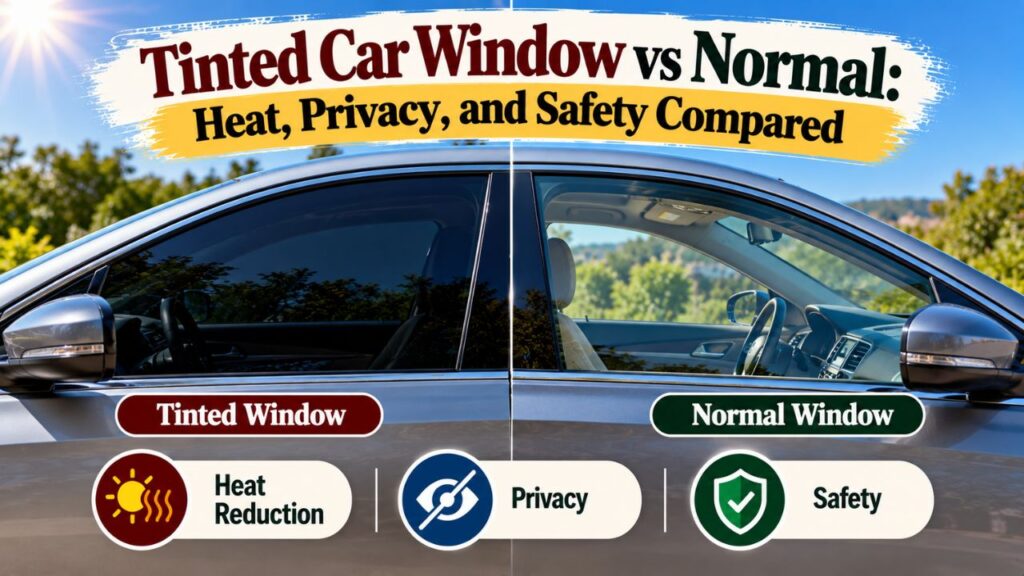
The primary difference between tinted and normal car windows is how they transmit, absorb, and reflect light and solar energy.
A normal car window has no added aftermarket tint film, although the original glass may already contain color, coatings, or other treatments.
A tinted window typically contains an additional film designed to modify visible light transmission, solar heat rejection, UV protection, or privacy.
Tinted vs. Normal Car Window Comparison Chart
| Feature | Tinted car window | Normal car window |
| Visible light | Reduced according to tint shade | Generally higher transmission |
| Daytime privacy | Usually better with darker film | Interior more visible |
| Solar heat rejection | Can be substantially improved | Depends on factory glass |
| UV protection | High with suitable UV-blocking film | Varies by glass construction |
| Sunlight glare | Usually reduced | More visible light enters |
| Nighttime visibility | Can be reduced, especially with dark tint | Generally better |
| Appearance | Darker or customized | Original factory appearance |
| Installation cost | Additional expense | No aftermarket film expense |
| Maintenance | Film needs appropriate care | Standard glass cleaning |
| Legal restrictions | VLT and reflectivity limits apply | Factory glazing normally meets applicable standards |
| Long-term durability | Film may age or need replacement | No aftermarket film to deteriorate |
Neither option is universally better.
If you spend considerable time driving in hot, sunny weather, high-quality tint can improve comfort. If nighttime visibility and minimal maintenance are more important, normal glass has advantages.
Key Takeaway: Window tint changes more than appearance, but its actual benefits depend on film quality and specifications rather than darkness alone.
What Makes a Tinted Car Window Different From Normal Glass?
Normal and tinted car windows may look similar from inside a vehicle when the tint is light, but their construction differs.
How Normal Car Windows Work
Most modern passenger vehicles use safety glazing designed for automotive applications.
Windshields commonly use laminated glass, while many side and rear windows use tempered glass. Some vehicles also use laminated side glass.
Laminated glass contains layers bonded together with an interlayer. Tempered glass is heat-treated to change how it breaks under impact.
Both types may incorporate factory tinting or coatings.
Even clear-looking automotive glass does not necessarily transmit all visible light or ultraviolet radiation.
For example, windshields often provide substantial UV protection because of their laminated construction. The protection provided by untreated side windows can vary.
Normal car glass therefore shouldn’t be described as offering no UV or heat protection.
How Tinted Car Windows Work
Aftermarket window tint usually consists of a thin film applied to the interior surface of automotive glass.
Depending on the technology, the film may contain dyes, carbon-based materials, ceramic particles, metallic layers, or specialized optical coatings.
These components change how solar radiation interacts with the window.
Some films primarily darken visible light, while others are designed to reject more solar energy without creating a particularly dark appearance.
Window tint is generally available in multiple shades and performance levels.
What Is Visible Light Transmission?
Visible Light Transmission (VLT) measures the percentage of visible light passing through glass or window film.
The higher the VLT, the lighter the window appears.
| VLT | General appearance |
| 70% | Very light |
| 50% | Light to moderate tint |
| 35% | Medium-dark |
| 20% | Dark |
| 15% | Very dark |
| 5% | Extremely dark |
These are general appearance descriptions. Actual color, reflectivity, and perceived darkness vary by product.
The percentage printed on a film package may refer to the film itself rather than the final glass-and-film combination.
That distinction matters for legal compliance.
Tinted vs. Normal Car Windows for Heat Rejection
A high-quality tinted window can reject more solar heat than ordinary untreated automotive glass. However, a darker tint is not automatically more effective.
Solar radiation contains ultraviolet, visible, and infrared energy. Different film technologies manage these components differently.
How Normal Windows Handle Solar Heat
Normal automotive glass already reflects or absorbs some incoming solar energy.
However, a substantial amount of sunlight may still enter the vehicle.
Interior materials such as dashboards, seats, and trim absorb that energy and warm up.
The heated surfaces then transfer energy to the cabin air and surrounding interior.
The amount of solar heat entering depends on the original glass, vehicle orientation, sunlight intensity, and environmental conditions.
Some modern vehicles have factory solar-control glazing that performs better than ordinary clear glass.
How Window Tint Reduces Solar Heat
High-performance tint can reduce the amount of solar energy entering through the windows.
This may help:
- Reduce direct radiant heat reaching occupants.
- Limit solar heating of interior surfaces.
- Improve comfort near sun-exposed windows.
- Reduce some air-conditioning demand under certain driving conditions.
The performance varies by film.
A basic dark dyed film may reduce visible glare without providing the same heat rejection as a high-performance ceramic or multilayer optical film.
Real Performance Comparison: Tinted vs. Untinted Glass
According to 3M’s October 2025 Crystalline automotive window film technical bulletin, the following laboratory measurements were recorded using representative automotive glass.
| Performance | Untinted Auto 75 glass | With Crystalline BLK 70 | With Crystalline BLK 35 |
| Visible light transmitted | 73% | 64% | 33% |
| Total solar energy rejected | 43% | 54% | 65% |
| UV radiation blocked | 79% | 99% | 99% |
These are manufacturer-reported illustrative measurements for specified glass and film combinations, not universal results for every vehicle.
The comparison demonstrates two important differences.
First, adding suitable film can improve heat rejection beyond the original glass performance.
Second, a relatively light window film can reject meaningful solar energy without making the glass extremely dark.
Does Tint Keep a Parked Car Cool?
Window tint may reduce solar heat entering a parked vehicle, but it does not prevent a closed car from becoming dangerously hot.
Sunlight still enters through other windows, and interior materials continue absorbing energy.
Vehicle color, glass area, parking orientation, weather, and ventilation also affect cabin temperature.
Even vehicles with high-performance tint can become dangerously hot in the sun.
Safety Note: Never leave children or pets unattended inside a parked vehicle. Window tint does not make a closed vehicle safe during hot weather.
Tinted vs. Normal Car Windows for UV Protection
Window tint can provide additional UV protection, particularly when the film is specifically designed to block ultraviolet radiation.
However, original automotive glass already provides some UV protection.
The amount varies according to whether the glass is laminated, tempered, coated, or otherwise treated.
UV Protection From Normal Car Glass
Automotive glass blocks much of the shorter-wavelength UVB radiation.
UVA protection is more variable.
Laminated windshields often block substantial UVA because of their interlayer construction.
Some tempered side windows may allow more UVA through, although manufacturers increasingly offer glass with additional UV-control properties.
Consequently, it is inaccurate to assume every normal car window has identical UV transmission.
UV Protection From Aftermarket Tint
Many high-quality automotive films are designed to block a substantial percentage of UV radiation.
In the 3M technical comparison referenced earlier, the selected Crystalline films blocked 99% of UV radiation under the stated test conditions.
This performance can be beneficial for reducing UV exposure through treated windows.
It may also help protect interior materials from some UV-related discoloration and deterioration.
However, sunlight, heat, material composition, and age can all contribute to interior fading.
UV-blocking film does not eliminate every cause of upholstery or dashboard deterioration.
Do You Need Dark Tint for UV Protection?
No.
A very light or nearly clear UV-blocking window film may provide substantial UV protection.
The degree of UV rejection depends on the film’s construction, not simply how dark it looks.
This is particularly useful for drivers who want additional UV protection without significantly reducing nighttime visibility.
Compare the manufacturer’s tested UV rejection specifications rather than assuming 5% tint always provides more protection than 70% tint.
Tinted vs. Normal Car Windows for Privacy
Tinted windows generally offer more privacy than normal clear-looking windows, particularly during daylight.
However, the privacy difference depends on the film’s visible light transmission and the lighting conditions inside and outside the vehicle.
Daytime Privacy With Tinted Windows
Darker films make it harder for people outside the vehicle to see occupants and interior details.
For example, a 20% tint typically creates substantially more daytime privacy than relatively clear factory glass.
A 5% film provides an even darker appearance.
However, neither shade makes the interior completely invisible in all conditions.
Direct sunlight entering through the windshield may illuminate the cabin enough for people to see inside.
Privacy With Normal Windows
Normal windows usually make it easier for people outside to see passengers, seats, and belongings.
This can be convenient when passengers need to communicate visually with people outside the vehicle.
However, it provides less concealment for the interior.
Factory privacy glass can reduce this difference, especially on rear passenger windows.
Does Window Tint Provide Privacy at Night?
Privacy changes when the vehicle interior becomes brighter than the outside environment.
For example, if someone turns on the interior dome light at night, occupants may become visible even through dark tint.
This happens because the lighting contrast changes.
Tinted windows do not function as permanent one-way privacy glass.
Key Takeaway: Darker tint improves daytime privacy, but it cannot guarantee that passengers or valuables remain hidden under every lighting condition.
Tinted vs. Normal Windows for Nighttime Driving Visibility
Normal car windows generally provide better nighttime visibility than heavily tinted windows because they allow more visible light to reach the driver’s eyes.
This difference becomes particularly important when driving on poorly illuminated roads.
Nighttime Visibility With Normal Glass
Without dark aftermarket film, drivers generally have a clearer view through side and rear windows.
This can make it easier to identify:
- Pedestrians near intersections.
- Cyclists beside the vehicle.
- Road edges and curbs.
- Vehicles approaching from the side.
- Objects while reversing.
- Obstacles in unlit parking areas.
Visibility also depends on glass cleanliness, weather, headlights, and the driver’s eyesight.
Normal glass does not eliminate glare or other visibility problems, but it avoids the additional light reduction created by dark tint.
Nighttime Visibility With Dark Window Tint
Dark tint reduces the brightness of the outside scene.
For example, 20% and 15% films allow far less visible light through than relatively clear automotive glass.
The effect can become particularly noticeable during:
- Rural nighttime driving.
- Heavy rain after sunset.
- Reversing into dark driveways.
- Turning across poorly illuminated intersections.
- Checking traffic through side windows.
The darker the film, the greater the potential loss of visible detail.
A film may have excellent optical clarity but still reduce the available light because of its VLT.
Is Light Window Tint Better for Night Driving?
Generally, yes.
A lighter shade such as 70% or another legally compliant high-VLT film preserves more visible light than dark tint.
This makes it a more practical option when maintaining visibility is a priority.
However, the final light transmission also depends on the original glass.
For drivers who frequently travel at night, a suitable clear or light solar-control film can be preferable to dark privacy tint.
Does Window Tint Reduce Glare Better Than Normal Glass?
Tinted windows can reduce glare by limiting the amount of visible light entering the vehicle.
Normal glass generally permits more visible light, although it may already have some solar-control properties.
Sunlight Glare During the Day
During bright daylight, tinted windows may reduce uncomfortable brightness from sunlight entering through side windows.
This can make driving more comfortable when the sun is low or directly beside the vehicle.
However, tint on the side windows does not prevent sunlight entering through the windshield.
Sunglasses and properly adjusted sun visors may still be necessary.
Headlight Glare at Night
Dark film can reduce the apparent brightness of headlights seen through treated glass.
However, it also makes dimmer objects harder to identify.
Reducing nighttime brightness is not automatically the same as improving visibility or driving safety.
A very dark film may create more disadvantages than benefits during low-light driving.
If glare is a major concern, choose a legally compliant film that balances glare reduction with adequate visibility.
Are Tinted Car Windows Legal Compared With Normal Windows?
Normal factory-installed automotive glass is generally designed to meet applicable vehicle glazing standards.
Aftermarket tint must comply with additional rules concerning visible light transmission, reflectivity, color, and placement.
These rules vary across U.S. states.
Window Tint Laws for Front Side Windows
Many states have minimum VLT requirements for the windows beside the driver.
For example, the Texas Department of Public Safety’s window tinting standards require the front side windows to transmit at least 25% of visible light when the film and original glass are measured together.
Under that ordinary requirement, a finished front side window measuring 20% or 15% VLT would be too dark.
Texas also has reflectivity requirements and provisions for qualifying medical exceptions.
Other states may have stricter or different limits.
Check the current requirements for your state, vehicle classification, and window position before installation.
Rear Side Window and Rear Windshield Rules
Rear-window regulations can differ significantly from front side window rules.
Some states allow darker tint on rear passenger windows.
Rear windshield requirements may depend on whether the vehicle has suitable outside mirrors.
For example, Texas provides more flexibility for rear windows under specified mirror conditions.
This does not mean the same rules apply nationwide.
Is Untinted Glass Always Legal?
Factory-installed glass on a vehicle originally certified for U.S. road use is generally intended to satisfy applicable glazing requirements.
However, replacement glass, unusual modifications, damaged glazing, or imported vehicles can create separate compliance questions.
The important distinction is that adding aftermarket film changes the finished window’s light transmission.
Why Film VLT and Final Window VLT Are Different
The film’s nominal VLT is not necessarily the same as the final window’s measured VLT.
For a simplified calculation:
Final VLT = Original glass VLT × Film VLT ÷ 100
For example, suppose your vehicle’s original glass transmits 75% of visible light.
Adding nominal 50% film produces an estimated combined VLT of:
75 × 50 ÷ 100 = 37.5%
Adding nominal 35% film produces:
75 × 35 ÷ 100 = 26.25%
These are approximate mathematical examples. Actual measurements depend on the glass, film, and testing method.
A professional installer can measure the final VLT using a suitable calibrated tint meter.
Important: Always verify legal compliance based on the completed glass-and-film combination rather than relying only on the shade printed on the film package.
Factory Tinted Glass vs. Aftermarket Window Tint
Factory tint and aftermarket tint aren’t identical.
Many vehicles already have tinted or solar-control glass before leaving the factory.
What Is Factory Tinted Glass?
Factory tinted glass has coloring or solar-control properties incorporated during glass manufacturing.
The material may contain pigments, coatings, or other features that affect light transmission.
Factory privacy glass is commonly found on rear passenger and cargo-area windows of SUVs, vans, and certain other vehicles.
Because the tint is part of the glass, there is no aftermarket film layer that can peel or bubble.
How Aftermarket Window Film Differs
Aftermarket film is applied to existing automotive glass.
It can be selected according to desired:
- Visible light transmission.
- Solar heat rejection.
- UV protection.
- Exterior appearance.
- Glare reduction.
Depending on the product, it may offer additional solar-control performance beyond the vehicle’s original glass.
However, aftermarket film introduces a separate layer that requires correct installation and maintenance.
Is Factory Privacy Glass as Good as Ceramic Tint?
Not necessarily.
Factory privacy glass is often intended primarily to reduce visible light transmission and provide a darker rear-window appearance.
High-performance ceramic film may offer greater infrared or total solar energy rejection.
However, some original equipment glass already has advanced solar-control properties.
Compare actual specifications rather than assuming every factory-tinted window performs worse than aftermarket ceramic film.
Types of Window Tint Compared With Normal Car Glass
The benefits of aftermarket tint depend heavily on the film technology.
Not every tinted window offers the same heat rejection, durability, or appearance.
Dyed Window Tint
Dyed film contains materials that absorb visible light.
It is commonly used when a darker appearance and glare reduction are the main goals.
Advantages include relatively affordable pricing and a wide range of shades.
However, performance varies, and some lower-quality dyed films can fade or discolor over time.
Dyed film should not automatically be considered a high-performance heat-control solution.
Carbon Window Tint
Carbon-based window films use carbon-containing components as part of their construction.
Depending on the product, they may provide improved solar performance and color stability compared with certain basic dyed films.
However, carbon labeling alone does not establish a specific heat rejection rating.
Check the manufacturer’s actual specifications.
Ceramic Window Tint
Ceramic films use specialized nonmetallic materials to manage solar energy.
High-quality ceramic products can provide substantial heat rejection without requiring extremely dark visible light transmission.
This makes them attractive to drivers seeking additional comfort while preserving relatively good visibility.
However, ceramic film quality and performance differ by manufacturer.
A film marketed as ceramic should still be evaluated using its tested specifications.
Metallized and Multilayer Films
Some automotive films use metallic layers or specialized multilayer optical structures.
These can offer strong solar-control performance.
Certain metallic films may affect radio-frequency signals depending on their construction and vehicle systems.
Nonmetallic multilayer films may avoid that issue.
Always check product compatibility rather than assuming every metallic or nonmetallic film behaves identically.
Tinted vs. Normal Car Window Cost Comparison
Normal glass requires no additional aftermarket film installation.
Tinted windows involve purchasing film and paying for installation unless the work is completed as a DIY project.
What Affects Car Window Tint Prices?
The final cost depends on several factors:
- Number of windows.
- Vehicle size and body style.
- Glass curvature.
- Film technology.
- Film brand and warranty.
- Professional installation labor.
- Removal of existing film.
- Local market pricing.
A basic dyed film installation generally costs less than a premium ceramic or multilayer film package, although prices vary.
The difference between tinted and normal glass is therefore an additional investment rather than a fixed price.
Is Ceramic Tint Worth the Additional Cost?
Ceramic tint can be worthwhile when meaningful solar heat rejection and long-term product performance are priorities.
However, the purchase decision should be based on verified specifications.
Compare the Total Solar Energy Rejection (TSER), UV blocking, warranty terms, and installed cost.
A premium film with better solar performance may justify its price for someone who regularly drives in a hot climate.
For drivers who prioritize appearance or rarely experience strong sunlight, a lower-cost compliant film or normal glass may be sufficient.
Does Tinting Car Windows Save Money on Air Conditioning?
Reducing solar heat entering the cabin may lower some cooling demand under appropriate conditions.
However, the actual effect depends on the vehicle, film, weather, glazing area, and air-conditioning operation.
There is no universal fuel savings or energy savings figure that applies to every tinted car.
Do not assume tinting will pay for itself through reduced fuel consumption.
Comfort, UV protection, glare management, and privacy are generally more direct reasons for installation.
Durability and Maintenance: Tinted vs. Normal Windows
Normal car windows have fewer surface layers requiring special care.
Aftermarket tint introduces a film and adhesive layer that may deteriorate or become damaged.
How Long Does Automotive Window Tint Last?
High-quality automotive tint can remain serviceable for many years when properly installed and maintained.
However, its actual lifespan depends on:
- Film construction.
- Installation quality.
- Sunlight exposure.
- Climate.
- Cleaning methods.
- Window operation.
- Adhesive performance.
A professionally installed premium film may have a substantial warranty, but warranty terms differ by product.
Avoid treating a lifetime warranty as proof that the film cannot fail.
Common Window Tint Problems
Problems that may occur include:
- Bubbling.
- Peeling edges.
- Adhesive deterioration.
- Color changes.
- Scratches.
- Haze.
- Installation contamination.
Poor installation can make even an otherwise good film look unattractive.
Normal glass avoids film-related bubbling and peeling, although glass can still become scratched or damaged.
How to Clean Tinted Car Windows
Aftermarket tint usually requires careful cleaning to avoid scratching or damaging the film.
Use a suitable soft microfiber cloth and a cleaning product approved by the film manufacturer.
Avoid abrasive pads and harsh chemicals.
Follow the installer’s instructions concerning when to clean the newly tinted windows or operate power windows after installation.
Do not scrape the interior film with sharp tools.
For normal glass, conventional automotive glass-cleaning products are usually suitable, provided they are compatible with the vehicle’s coatings and surrounding materials.
Can Window Tint Protect Car Windows From Breaking?
Ordinary automotive tint should not be treated as a substitute for safety glazing.
Some films may help hold broken glass fragments together, but performance depends on the film’s construction, adhesive, installation, and testing.
A standard privacy tint is not automatically a security film.
Tint Film vs. Safety and Security Film
These products serve different purposes.
Standard automotive tint primarily changes light transmission, appearance, or solar performance.
Specialized safety and security films may use thicker materials and stronger adhesive systems designed to help retain broken glass under specified conditions.
However, even security film does not make vehicle windows unbreakable.
If impact retention or security is important, choose a product tested for that purpose rather than relying on ordinary dark tint.
Which Is Better for Different Driving Conditions?
The better choice depends on how and where the vehicle is used.
Daily Commuting in Hot Weather
A suitable high-performance window tint may be preferable when strong sunlight and cabin heat are common concerns.
Choose a film with verified solar heat rejection and a legal VLT.
A lighter ceramic film can be a useful option when you want heat protection without making the windows extremely dark.
Frequent Night Driving
Normal glass or a lighter, legally compliant film is generally more suitable.
Dark tint can make pedestrians, road markings, and other objects harder to identify through treated windows.
Prioritize visibility over a very dark appearance.
Family Cars and SUVs
For family vehicles, a moderate tint may provide a balance of privacy, glare reduction, and comfort.
Check whether the vehicle already has factory privacy glass.
Additional dark film may be unnecessary on some rear passenger windows.
Vehicles Used Primarily During Daylight
Drivers who travel mostly in daylight may appreciate the privacy and glare reduction offered by tint.
However, even occasional nighttime driving should be considered.
Choose a compliant shade that does not create unnecessary visibility problems.
Budget-Focused Vehicle Ownership
Normal glass is the simplest option because it requires no aftermarket installation.
If additional UV or heat protection is desirable, compare the cost of a suitable light film with the benefits it provides.
Avoid paying for premium film features that do not match your actual driving needs.
Should You Tint Your Car Windows or Keep Them Normal?
Before deciding, compare the priorities that matter most to your vehicle and driving routine.
| Your priority | More practical option |
| Maximum visible light | Normal glass |
| Additional solar heat rejection | High-performance tint |
| Greater daytime privacy | Darker legal tint |
| Easy nighttime visibility | Normal glass or light tint |
| Additional UV protection | Suitable UV-blocking film |
| Lowest initial cost | Normal glass |
| Minimal film-related maintenance | Normal glass |
| Reduced sunlight glare | Suitable tint |
| Original factory appearance | Normal glass or nearly clear film |
| Balanced comfort and visibility | Light high-performance tint |
For many drivers, the decision doesn’t need to be between completely normal glass and very dark tint.
A light solar-control film can provide some of the benefits of tint while preserving much of the vehicle’s original appearance.
However, even clear-looking film must meet the applicable windshield and side-window rules.
Conclusion
In the tinted car window vs normal comparison, tinted windows generally offer better daytime privacy, reduced glare, and the potential for improved solar heat and UV rejection.
Normal car windows provide higher visible light transmission, simpler maintenance, and fewer aftermarket film-related compliance concerns.
The biggest tradeoff is visibility. Dark tint reduces the light available for viewing the surroundings, particularly at night, while high-performance lighter films can provide useful solar protection without requiring a dramatic reduction in VLT.
For drivers who regularly experience strong sunlight, I recommend comparing legally compliant ceramic or other high-performance films based on their actual specifications rather than choosing the darkest available shade.
If nighttime driving, cost, and minimal maintenance are your main priorities, normal glass or a very light compliant film may be the better option.
The best choice balances heat rejection, UV protection, visibility, legal requirements, and cost instead of focusing on appearance alone.
FAQs About tinted car window vs normal
Are Tinted Car Windows Better Than Normal Windows?
Tinted windows can be better for privacy, glare reduction, UV protection, and solar heat rejection.
However, normal glass generally offers better nighttime visibility and avoids film-related maintenance.
The better choice depends on the film technology, legal requirements, and how the vehicle is used.
Do Normal Car Windows Block UV Rays?
Yes. Normal automotive glass blocks some ultraviolet radiation.
Laminated windshields generally provide substantial UV protection, while side-window performance varies according to glass construction and coatings.
A suitable UV-blocking aftermarket film can provide additional protection where needed.
Does Window Tint Make a Car Cooler Than Normal Glass?
A suitable solar-control film can reduce the amount of solar heat entering through treated windows.
However, the benefit depends on the film’s tested performance and the vehicle’s existing glass.
Darkness alone does not determine how effectively a film rejects heat.
Is It Harder to Drive at Night With Tinted Windows?
It can be, particularly with darker films.
Tint reduces visible light transmission, which can make dimly illuminated objects harder to identify.
Normal glass or a lighter legally compliant film generally provides better low-light visibility.
Can You Remove Car Window Tint and Return to Normal Glass?
Yes. Most aftermarket window film can be removed professionally.
However, removal may involve heating, peeling, and cleaning residual adhesive.
Care is particularly important around rear-window defroster lines and delicate coatings.
Proper removal generally restores the original glass appearance, provided the glass and its components have not been damaged.
Is Factory Tinted Glass Better Than Aftermarket Tint?
Factory tint avoids the additional film layer that can peel or bubble.
However, aftermarket high-performance film may provide greater solar heat rejection or UV protection than certain factory privacy glass.
The actual comparison depends on the original glass and aftermarket film specifications.
Does Window Tint Prevent People From Seeing Inside a Car?
Dark tint generally reduces visibility into a vehicle during daylight, but it doesn’t guarantee complete privacy.
People may still see inside when sunlight enters through other windows or when the interior is brightly illuminated.
No ordinary automotive tint should be considered a guarantee that belongings remain hidden.
Is Clear Ceramic Tint Worth Installing on Normal Car Windows?
A high-performance nearly clear ceramic or other solar-control film can be useful when you want additional heat or UV rejection without substantially darkening the glass.
However, performance varies by product.
Compare the tested VLT, TSER, UV rejection, cost, and applicable legal requirements before installation.