Tinting car windows professionally typically costs 250–500 for a standard sedan, while premium ceramic tint can cost 400–800 or more. Larger SUVs, luxury vehicles, and installations that include the windshield or sunroof can cost $1,000 or more, depending on the film and the amount of glass.
The biggest factor affecting the price is the type of window film. Basic dyed tint is generally the least expensive, carbon film offers a middle-priced option, and ceramic tint costs more because of its advanced solar heat rejection properties.
Vehicle size, window shape, local labor rates, and the number of windows also influence the final bill. Removing old tint or choosing a premium film can add to the total.
A lower price doesn’t always mean better value, especially if the film fades, bubbles, or requires replacement sooner than expected. Understanding what you’re paying for makes comparing installation quotes much easier.
In this article, I break down car window tinting costs by film type, vehicle size, and individual window. I also explain additional installation charges, DIY versus professional costs, the value of ceramic tint, and how to choose a reliable installer without overspending.
How Much Does It Cost to Tint Car Windows Professionally?
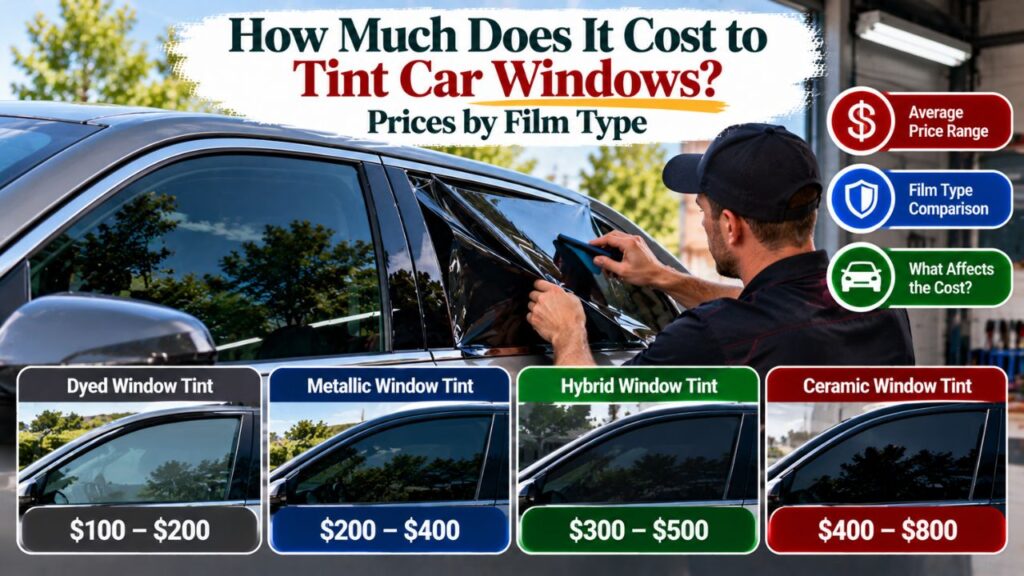
Professional window tinting prices vary considerably, but most drivers can establish a reasonable budget by comparing the main film categories.
For a typical installation, expect basic dyed film to cost less than carbon or ceramic film.
The following figures are broad U.S. pricing estimates, not guaranteed local quotes.
| Window Tint Type | Estimated Professional Cost | Main Advantage |
| Dyed film | 250–300 | Affordable privacy and appearance |
| Carbon film | 350–500 | Color stability and improved solar control |
| Ceramic film | 400–800 | Advanced heat rejection |
| Premium specialty film | 500–1,200 | High-performance solar control |
These ranges are based on the material estimates in AAA’s car window tinting cost guide. They are general installation budgets rather than prices for an identical vehicle and window package.
The final cost depends on the amount of glass being covered.
What Does a Full Car Window Tint Include?
A typical full-car tint package includes the side windows and rear windshield.
For a four-door sedan, that may mean four main side windows plus the rear glass. Some vehicles also have smaller fixed quarter windows that require film.
The front windshield is usually priced separately.
A panoramic sunroof or glass roof may also be excluded from standard packages.
Before comparing quotes, confirm exactly which windows the shop includes.
A $350 package covering only the side windows isn’t directly comparable to a $450 package covering all side windows and the rear glass.
Is Labor Included in Window Tint Prices?
Professional installation quotes generally combine the film and installation labor.
However, some shops may charge separately for unusual glass shapes, removing old film, or additional preparation.
Ask whether the quoted amount includes:
- The selected window film.
- Professional installation.
- All requested windows.
- Necessary glass preparation.
- Applicable shop fees.
- Warranty registration.
- Sales tax, where applicable.
Getting the total price in writing helps avoid unexpected charges.
Car Window Tinting Cost by Vehicle Size
Larger vehicles often cost more to tint because they have additional windows or larger glass surfaces.
However, the number of windows isn’t the only consideration. A coupe with a large, curved rear windshield may require more installation work than a sedan with relatively flat glass.
Estimated Tinting Prices by Vehicle Type
| Vehicle Type | General Tinting Budget |
| Sedan or coupe | 150–400 |
| SUV or crossover | 200–500 |
| Crew-cab pickup truck | 150–400 |
| Van or minivan | 250–600 |
These broad basic-to-midrange planning ranges are consistent with AutoZone’s car window tinting cost guide. Premium ceramic film, complex glass, or additional windows can push prices above these amounts.
Cost to Tint a Sedan
A sedan is often less expensive to tint than a large SUV.
Compact vehicles such as a Honda Civic or Toyota Corolla may require less film than larger sedans.
However, installation difficulty varies.
A strongly curved rear windshield, small fixed glass sections, or complicated interior trim can increase labor.
For a standard sedan, a budget of approximately 250–500 is a reasonable starting point before comparing higher-priced specialty products.
Cost to Tint an SUV
SUV tinting prices depend heavily on the number and size of the windows.
A compact crossover may cost less than a three-row SUV with multiple rear quarter windows.
Some SUVs already have factory privacy glass on the rear windows.
In that situation, you may only need the two front side windows tinted, depending on your goals and local regulations.
A complete premium ceramic installation can cost substantially more than a basic SUV package.
Cost to Tint a Pickup Truck
Pickup truck tinting costs vary with cab design.
A regular-cab truck generally has fewer windows than a crew-cab pickup.
Rear sliding glass, small fixed panels, and curved windows may add complexity.
For trucks with factory rear privacy glass, tinting only the front doors may be a practical option.
Always check the final glass-and-film darkness against state law.
Cost to Tint a Van or Minivan
Vans and minivans often have larger windows and more total glass area.
This increases the amount of film and may require additional installation time.
A basic package can remain relatively affordable, but premium ceramic tint across numerous windows may cost considerably more.
Ask the installer to identify every window included in the price.
How Much Does Window Tint Cost Per Window?
You don’t necessarily need to tint every window at once.
Many shops offer individual-window and partial-vehicle installations.
For a single side window, a rough professional installation budget is 50–150, depending on the size, film, and installer.
The actual price may be higher for complex glass or premium film.
Cost to Tint Two Front Windows
Tinting the two front side windows is a common request among SUV and pickup owners.
Using the general per-window estimate, budgeting approximately 100–300 for two windows is a starting point.
However, shops may offer a different two-window package price.
This is often more economical than purchasing an entire vehicle package when the rear windows already have the appearance you want.
Before installation, make sure the film’s completed visible light transmission meets the applicable front-window requirements.
Cost to Tint a Rear Windshield
Rear windshield tinting may cost more than applying film to a small side window.
The rear glass can be large and strongly curved, requiring careful shaping of the film.
Installers must also work around rear defroster lines and other glass features.
The cost depends on the film type, vehicle design, and whether the shop can install the film in one piece.
A rear windshield may already be included in a full-car package, so confirm before paying separately.
Cost to Tint a Front Windshield
A full windshield installation is generally priced separately.
It requires a large piece of film and careful fitting around features such as mirrors, cameras, and sensors.
Some installers offer very light, high-performance films designed to reduce solar heat without substantially darkening the glass.
However, windshield tinting is subject to restrictive laws.
Don’t assume a film is legal for the entire windshield simply because it is labeled clear or ceramic.
The completed window must comply with the applicable regulations.
Cost to Add a Windshield Tint Strip
A windshield sun strip, sometimes called an eyebrow or visor strip, covers only an allowed portion near the upper windshield edge.
AAA lists a typical professional cost of approximately 60–100 for windshield brow tinting.
The price depends on the film, vehicle, and strip dimensions.
Check the allowable position and depth before installation.
Car Window Tint Cost by Film Type
The film category is often the largest factor behind differences between quotes.
Two installers may offer substantially different prices for the same car because one is quoting basic dyed film while the other is quoting premium ceramic.
Dyed Window Tint Cost
<text weight=”medium”>Typical professional budget: 250–300</text>
Dyed tint is generally the most affordable traditional film category.
It reduces visible sunlight and gives the windows a darker appearance.
Its main advantages are lower upfront cost and a range of available shades.
However, basic dyed films may offer less solar heat rejection than higher-performance products.
They can also fade or discolor over time, depending on film quality and environmental exposure.
Dyed film can make sense when your main goals are appearance and privacy rather than maximum heat rejection.
Carbon Window Tint Cost
<text weight=”medium”>Typical professional budget: 350–500</text>
Carbon tint offers a middle-priced alternative between basic dyed and premium ceramic films.
Carbon-containing film constructions can provide improved solar control and better color stability than some inexpensive dyed products.
They also don’t rely on metallic layers that may interfere with electronic signals.
However, carbon film performance varies by manufacturer.
Not every carbon product rejects the same amount of heat.
For drivers who want a durable, darker appearance without paying for a premium ceramic package, carbon tint is worth comparing.
Ceramic Window Tint Cost
<text weight=”medium”>Typical professional budget: 400–800</text>
Ceramic film is commonly selected for its solar heat management and optical performance.
High-quality ceramic films can reject substantial infrared energy while remaining relatively light in appearance.
This makes ceramic tint attractive for drivers who want to reduce solar heat without making the windows excessively dark.
Ceramic films also generally avoid the signal-interference concerns associated with some metallic films.
However, the ceramic label alone doesn’t guarantee a particular level of performance.
Compare the manufacturer’s tested specifications.
Premium Ceramic and Specialty Window Film Cost
<text weight=”medium”>Typical professional budget: 500–1,200</text>
Premium specialty films may use advanced multilayer constructions or enhanced infrared-rejection technology.
These products are often selected for:
- High solar heat rejection.
- Strong UV protection.
- Optical clarity.
- Color stability.
- Long-term manufacturer warranties.
- Heat control at lighter tint levels.
A high price doesn’t automatically mean one film is better than another.
Ask for the exact product line and its performance data.
Ceramic vs. Regular Window Tint: Is the Extra Cost Worth It?
Ceramic tint generally costs more than basic dyed film, but it may offer better value when heat rejection is your main concern.
The difference comes from film construction, not simply how dark it looks.
Heat Rejection
A darker film doesn’t automatically block more total solar heat than a lighter film.
For example, a high-performance ceramic film with relatively high visible light transmission may reject more solar energy than a darker basic dyed film.
To compare performance, check Total Solar Energy Rejection (TSER).
TSER measures the percentage of total incident solar energy rejected by the filmed glass under specified conditions.
Infrared rejection is also useful, but different manufacturers may report it across different wavelength ranges.
Compare similar test measurements rather than relying only on advertising percentages.
UV Protection
Many automotive films are designed to reject substantial ultraviolet radiation.
However, UV protection isn’t determined entirely by tint darkness.
A lighter film may provide strong UV rejection without creating the appearance of dark glass.
Check the film manufacturer’s published UV specifications.
Long-Term Durability
Film quality and installation conditions affect how long tint remains usable.
Basic products may fade or show defects sooner than high-quality multilayer films.
Premium ceramic products can have long service lives when properly installed and maintained.
However, a lifetime warranty isn’t the same as a guarantee that the film will never develop problems.
Read the warranty terms to see what defects and labor charges are covered.
Which Film Offers Better Value?
For a driver who mainly wants privacy, a good dyed or carbon film may provide sufficient value.
For someone who frequently drives in hot, sunny conditions and plans to keep the car for years, higher-performance ceramic tint may be worth the additional expense.
The final decision should come from verified performance and the complete installation quote.
Additional Costs That Increase Car Window Tinting Prices
The advertised tint package may not cover every service required for your car.
Old film removal, special glass, and additional windows can increase the total.
Removing Old Window Tint
Old film often needs to be removed before a new installation.
Professional removal may cost approximately 100–400 or more, depending on the vehicle and the condition of the existing film, according to AAA’s published cost guidance.
A badly deteriorated film may leave adhesive residue that requires additional cleaning.
Rear glass can be particularly difficult because careless removal may damage defroster elements.
Don’t assume old-film removal is included in a replacement tint quote.
Removing Tint From Rear Defroster Glass
Removing old tint from a heated rear window requires special care.
Aggressive scraping or unsuitable tools may damage the defroster lines.
If the film has been installed for many years and the adhesive is difficult to release, removal may require additional time.
Ask the shop how it protects the defroster and whether it will inspect existing damage before starting.
Tinting Sunroofs and Panoramic Glass
Sunroofs and panoramic roofs are often priced separately.
Large glass roofs require more material and may be difficult to access.
Before applying aftermarket film, check the vehicle and glass manufacturer’s recommendations.
Some glass assemblies have specific restrictions related to additional films, thermal stress, or warranty coverage.
Luxury and Specialty Vehicles
Luxury cars, sports cars, and vehicles with complicated window shapes may require additional labor.
Some have tight seals, unusual glass curvature, or components that make installation more demanding.
A premium vehicle doesn’t automatically need the most expensive film, but the installer should understand its window design.
Taxes and Shop Fees
Confirm whether the quoted price includes applicable sales tax and other charges.
If several shops offer similar film prices but different final totals, compare the itemized amounts.
A written estimate helps distinguish the film cost from removal, labor, and additional services.
DIY Window Tint Cost vs. Professional Installation
DIY window tinting can reduce the initial expense, but the result depends heavily on preparation and installation skill.
How Much Does DIY Window Tint Cost?
Basic DIY materials can start around 30–50, although complete project costs depend on the film and equipment required.
You may need:
- Window tint film or a pre-cut kit.
- Application solution.
- A suitable squeegee.
- A sharp cutting tool.
- Clean microfiber cloths.
- Safe glass-cleaning supplies.
- Appropriate heat-shaping equipment when required.
Pre-cut kits may reduce some measuring and cutting work, but they don’t eliminate the need for careful application.
Premium materials and specialized tools can raise the cost.
Common DIY Installation Problems
Window tint must be applied to thoroughly cleaned glass.
Small particles of dust, lint, or debris can become trapped beneath the film.
Other common problems include:
- Air or water bubbles.
- Creases.
- Poorly trimmed edges.
- Film contamination.
- Uneven application.
- Damaged film during heat shaping.
Curved rear windows can be especially challenging for beginners.
A failed installation may require replacement film, adding to the original project cost.
Is Professional Tinting Worth the Labor Cost?
For most drivers who want a full-vehicle installation, professional tinting is usually the more dependable option.
An experienced installer can prepare the glass, shape the film correctly, and work around difficult window edges.
Professional work may also qualify for manufacturer-backed warranty coverage.
DIY installation can make sense for someone comfortable with detailed hands-on work, but paying a professional is often worthwhile for complex glass or expensive film.
Does Window Tint Percentage Affect the Installation Cost?
Tint darkness is measured using Visible Light Transmission (VLT).
A 20% tint allows less visible light through than a 35% tint.
However, the darkness percentage alone usually isn’t the main reason one tint package costs more than another.
20% vs. 35% Tint Cost
If both shades belong to the same film series, their installation prices may be similar.
The film construction and amount of glass are generally more important pricing factors.
A 20% ceramic film may cost more than a 35% dyed film because of the different technologies, not because 20% is darker.
Does Darker Tint Provide More Heat Rejection?
Not necessarily.
A premium lighter ceramic film may reject more total solar energy than a darker, lower-performance film.
Compare TSER and other manufacturer specifications.
Don’t pay extra for a darker shade solely because you expect it to keep the car cooler.
Is Darker Tint Legal Everywhere?
No. State laws regulate the amount of visible light that must pass through different vehicle windows.
The rules may differ for front side windows, rear side windows, and rear glass.
The existing factory glass also affects the final tint percentage.
For example, installing nominal 35% film over glass that already reduces visible light can produce a finished window with a VLT lower than 35%.
Have the original glass measured and select a film that keeps the completed window within the applicable legal limit.
How Long Does Professional Car Window Tint Last?
The lifespan of window tint depends on film quality, installation, climate, and maintenance.
A lower-priced film may not provide the same long-term color stability or durability as a premium product.
High-quality ceramic films may remain serviceable for 10–15 years under favorable conditions, while some basic films may need replacement considerably sooner.
These aren’t guaranteed lifespans.
Signs Window Tint Needs Replacement
Watch for:
- Persistent bubbles after the initial curing period.
- Film peeling along the edges.
- Purple or uneven discoloration.
- Cracking or separating film layers.
- Significant haze or optical distortion.
- Damage that interferes with visibility.
A small amount of temporary moisture haze immediately after installation may be normal.
Follow the installer’s curing guidance before assuming the work is defective.
How to Maintain Newly Tinted Windows
After installation, avoid rolling down the windows until the installer confirms that the film has cured sufficiently.
A common recommendation is to leave the windows closed for approximately 3–5 days, although actual curing conditions vary.
Use a soft microfiber cloth and a cleaner approved for the film.
Avoid abrasive tools and cleaning products that could damage the adhesive or surface coating.
Why Warranty Coverage Matters
A warranty may cover defects such as bubbling, peeling, cracking, or color changes.
However, coverage varies.
Check whether the warranty includes:
- Material defects.
- Installation workmanship.
- Labor for replacement.
- Transferability to another owner.
- Required registration.
- Exclusions for physical damage.
A slightly more expensive package with reliable warranty support may offer better long-term value than an installation with no meaningful protection.
How to Get an Accurate Quote for Car Window Tinting
A good quote should identify the exact service being offered.
The goal is to compare identical film categories, windows, and warranty conditions.
Step 1: Identify the Windows You Want Tinted
Decide whether you need:
- Two front side windows.
- All side windows.
- Side windows and rear windshield.
- A legal windshield sun strip.
- A full windshield film where permitted.
- A sunroof or panoramic roof.
Avoid requesting a vague full-car quote without confirming the coverage.
Step 2: Choose the Film Category
Determine whether dyed, carbon, or ceramic film best suits your needs.
If heat rejection is important, request the product’s tested specifications.
If privacy is the main concern, compare legally permitted VLT options.
Step 3: Request Several Itemized Quotes
Contact multiple reputable tint installers.
Give each shop the same information about your vehicle and desired coverage.
Ask for an itemized quote showing film, labor, old-film removal, and other charges.
This makes the comparison more meaningful.
Step 4: Verify the Film Brand and Product Line
Don’t rely only on broad labels such as premium ceramic or nano-ceramic.
Ask for the manufacturer’s name and exact product series.
Compare the technical data and warranty terms.
Two products described as ceramic may have very different heat-rejection performance.
Step 5: Check the Installer’s Work
Inspect completed installations when possible.
Look for clean edges, good optical clarity, and consistent workmanship.
Online reviews may provide additional context, but check for patterns rather than relying on a single rating.
A reputable shop should also explain curing requirements and how warranty problems are handled.
How to Save Money on Car Window Tinting
Saving money doesn’t necessarily mean buying the cheapest film available.
The better approach is avoiding services you don’t need while selecting a reliable product.
Tint Only the Windows That Need It
If your SUV or truck already has dark factory rear glass, you may only need tint on the front side windows.
However, confirm the existing glass’s solar performance before assuming that factory privacy glass provides the heat rejection you want.
Partial installation may reduce costs.
Choose Carbon Instead of Premium Ceramic
If your budget is limited and maximum heat rejection isn’t essential, quality carbon film may offer a reasonable balance.
It can provide a dark appearance and useful solar control without the full cost of premium ceramic.
Compare actual product performance before deciding.
Avoid Unnecessary Windshield Add-Ons
A separate windshield film or sun strip increases the total price.
Only include these services if they meet your goals, comply with applicable law, and are compatible with the vehicle.
Compare Total Prices, Not Advertised Specials
A low advertised price may exclude rear glass, removal, premium film upgrades, or other services.
Request the final installed cost.
Pay attention to whether a quote includes taxes and the same warranty coverage as competing offers.
Avoid Cheap Film That May Need Early Replacement
Very inexpensive film may save money initially but become costly if it fades or peels and requires removal.
Consider the film’s expected durability, installer reputation, and warranty.
A dependable midrange product may be better value than the cheapest available package.
Is Tinting Car Windows Worth the Cost?
Window tinting can be worthwhile when it meets a specific need.
The value depends on what you expect from the installation.
For Heat Reduction
A film with verified solar heat-rejection performance can make the cabin more comfortable during sunny conditions.
Ceramic and other advanced films are worth comparing when heat management is the priority.
However, results vary with outside temperature, glass area, exposure, and the film’s performance.
Tint won’t eliminate all heat buildup in a parked vehicle.
For Privacy and Appearance
Basic dyed or carbon tint may be sufficient if your main goal is a darker appearance.
There’s little reason to pay a premium solely for advanced heat rejection if you don’t need that performance.
Choose a legal shade that maintains adequate outward visibility.
For Long-Term Vehicle Ownership
If you expect to keep your car for several years, durability and warranty coverage become more important.
A higher initial price may be reasonable when the film provides documented performance and reliable long-term support.
For a Tight Budget
A professional carbon or basic dyed package may be a practical starting point.
However, don’t compromise legal compliance or visibility to obtain a lower price.
Choose the most suitable film within your budget rather than the darkest or most heavily advertised option.
Conclusion
So, how much does it cost to tint car windows? A standard sedan commonly costs approximately 250–500 for professional tinting, while ceramic installations often fall around 400–800. Premium specialty films, larger vehicles, and additional glass can raise the total to $1,000 or more.
The most important cost factors are film type, vehicle size, window coverage, and installation complexity. Old-film removal and windshield services can add separate charges.
For budget-conscious drivers, a reputable dyed or carbon tint package may be sufficient. For better solar heat control, a ceramic film with verified performance specifications may justify the higher cost.
I recommend getting itemized quotes from multiple professional installers and comparing the exact film, window coverage, warranty, and final price. This helps you avoid unnecessary expenses while choosing tint that suits your vehicle and driving conditions.
FAQs About How Much Does It Cost to Tint Car Windows
How Much Does It Cost to Tint All Car Windows?
Professional full-car tinting commonly costs several hundred dollars.
A standard sedan may cost approximately 250–500, while premium ceramic film can reach $800 or more.
Confirm whether the quoted package includes the rear windshield, front windshield, and sunroof.
How Much Does It Cost to Tint Two Car Windows?
Two side windows may cost approximately 100–300 as a general budgeting estimate.
The price depends on film type, window size, and installer.
Many shops offer specific two-window packages, so request the actual installed price.
How Much Does Ceramic Window Tint Cost?
Ceramic window tint commonly costs around 400–800 for professional installation, although premium products and larger vehicles may cost more.
The exact price depends on the film brand, product series, and number of windows.
Compare tested solar heat rejection and warranty coverage before paying for an upgrade.
Is It Cheaper to Tint Car Windows Yourself?
Yes. Basic DIY tint materials can cost much less than professional installation.
However, tools, preparation, wasted film, and potential reinstallation can increase the total expense.
Professional installation is often preferable for curved glass and premium films.
How Much Does It Cost to Remove Old Window Tint?
Professional old-film removal may cost approximately 100–400 or more for a vehicle, depending on the amount of film and its condition.
Removing deteriorated film from rear defroster glass may require additional care.
Ask whether removal is included in the new installation quote.
Does 20% Tint Cost More Than 35% Tint?
Not usually when both shades come from the same film product line.
The price is generally influenced more by the film’s technology, vehicle size, and installation requirements.
Choose a shade that meets local law and provides adequate visibility.
How Much Does It Cost to Tint a Car Windshield?
A full windshield is generally priced separately from a standard side-and-rear tint package.
The amount depends on windshield size, film type, and installation complexity.
Only choose a product and installation method permitted by the applicable windshield tint regulations.
Is $500 a Reasonable Price for Window Tinting?
Yes. A $500 quote can be reasonable for a professional installation, particularly when it includes quality carbon or ceramic film and appropriate warranty coverage.
However, whether it is good value depends on the vehicle, exact film product, number of windows, and local labor prices.
Compare the same service across multiple installers before deciding.