Tinting the two front windows of a pickup truck typically costs 100–250, while professional full-cab window tinting generally ranges from 200–700 or more, depending on the film and truck configuration. Basic films cost less, while premium ceramic films, larger cabs, and additional windshield work increase the total price.
A regular-cab pickup usually has fewer windows to tint than an extended-cab or crew-cab truck. However, window count is only one factor. Film technology, rear sliding windows, existing tint removal, and local labor rates can significantly change the estimate.
Many pickup trucks already have factory privacy glass behind the front doors. In those cases, some owners choose to tint only the two front side windows instead of paying for a complete installation.
Understanding what each service includes helps prevent unexpected charges and makes it easier to compare estimates from different installers.
In this article, I break down truck window tinting costs by cab size, window location, and film type. I also explain ceramic tint pricing, additional installation fees, legal restrictions, and how to choose an appropriate tint package without overspending.
How Much Does It Cost to Tint Truck Windows by Cab and Coverage?
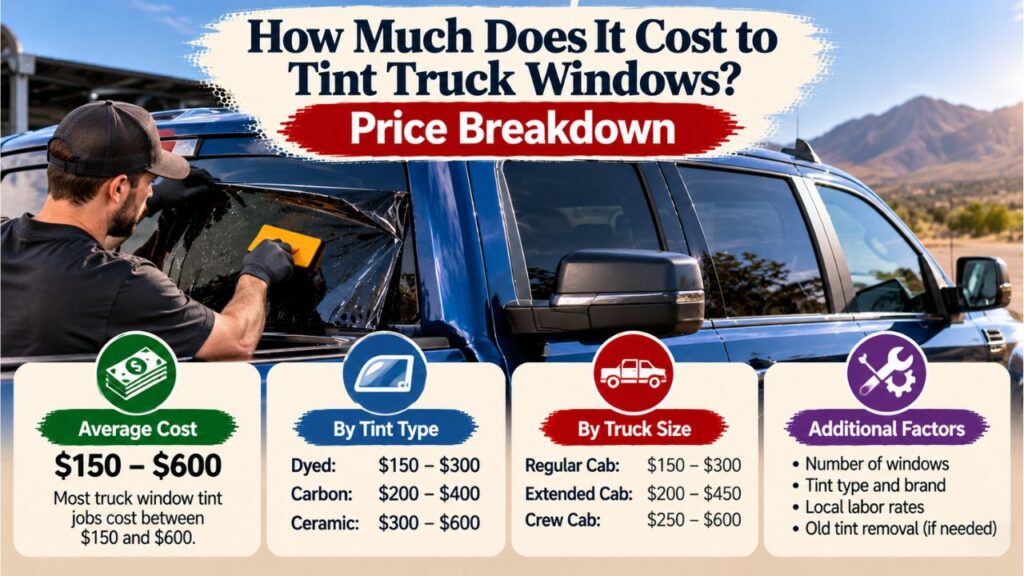
The total cost depends on how many windows receive film and which products the installer uses.
For most pickup trucks, professional tinting falls into three main categories: front-window tinting, full-cab tinting, and premium ceramic installation.
The following figures are approximate U.S. budgeting ranges rather than fixed national averages.
| Tinting Service | Estimated Cost |
| Two front side windows | 100–250 |
| Regular-cab truck, full cab | 200–500 |
| Extended-cab truck, full cab | 225–650 |
| Crew-cab truck, full cab | 250–750+ |
| Full-cab basic or carbon tint | 200–450 |
| Full-cab ceramic tint | 300–750+ |
| Full windshield, separately | 150–500+ |
| Windshield sun strip | 40–100 |
A full-cab package generally includes the side windows and rear glass but excludes the windshield unless the installer states otherwise.
These ranges reflect different film grades and installation markets, so the categories overlap.
For a concrete pricing example, Tint Guy’s published automotive window tint price list in Murfreesboro, Tennessee, lists 100–250 for two front windows, 200–500 for a standard-cab truck, and 225–525 for extended- and crew-cab trucks across its available film tiers.
Those are individual shop prices, not a nationwide average. Other installers may charge more or less.
How Much Does It Cost to Tint Two Truck Windows?
Tinting only the two front side windows generally costs 100–250 with professional installation.
This is one of the most common services for modern pickup trucks because many already have dark factory glass behind the front seats.
The final cost depends mainly on the selected film.
For example:
- Basic or carbon film: approximately 100–175
- Standard ceramic film: approximately 150–225
- Premium infrared-rejecting ceramic film: approximately 200–275 or more
These ranges can overlap because shops use different pricing structures.
Tinting only the front windows requires less film and installation labor than treating the entire cab.
However, the installer must still clean the glass, shape the film, apply it correctly, and finish the edges.
How Much Does It Cost to Tint a Regular-Cab Truck?
A regular-cab pickup typically has two main side windows and one rear window assembly.
Professional full-cab tinting commonly costs approximately 200–500, depending on the film grade.
A basic package is generally the least expensive.
Premium ceramic films increase the price because of their materials and solar-control performance.
Rear glass design also matters. A fixed rear window is often easier to tint than a rear window containing several sliding sections.
How Much Does It Cost to Tint an Extended-Cab Truck?
Extended-cab pickups have additional cabin space behind the front seats and may include small rear side windows or secondary doors.
These extra glass sections can increase labor and material requirements.
Expect approximately 225–650 for many professional installations, with premium packages potentially costing more.
The actual cost depends on the model.
For example, an extended-cab Chevrolet Silverado may have different rear-window arrangements from a Ford F-150 SuperCab.
Some glass panels are small but difficult to access, which can increase labor time.
How Much Does It Cost to Tint a Crew-Cab Truck?
A crew-cab pickup usually has four full-size doors and a rear window assembly.
A professional full-cab tint job commonly costs around 250–750 or more, depending on the film.
Basic installations typically occupy the lower end of the range, while premium ceramic packages cost more.
A crew cab does not automatically cost more than an extended cab at every tint shop.
Some installers group both configurations into the same pricing category.
The exact number of glass sections, their dimensions, and their accessibility determine the actual work involved.
Truck Window Tint Cost by Film Type
The film itself is one of the largest factors affecting the total price.
Different tint technologies offer different combinations of appearance, color stability, solar heat rejection, and cost.
Dyed Window Tint: Lowest Initial Cost
Dyed tint is generally among the least expensive options for truck windows.
It primarily reduces visible light and provides a darker appearance.
A full pickup cab with basic dyed film may cost approximately 200–400 at many installers.
Advantages include:
- Lower initial installation cost
- Reduced visible glare
- Increased daytime privacy
- A variety of darkness levels
However, lower-quality dyed films may experience color fading, discoloration, or reduced appearance quality over time.
Dyed film also does not necessarily provide the same infrared heat rejection as higher-performance products.
Best for: Truck owners who mainly want a darker appearance and privacy at a lower price.
Carbon Window Tint: Midrange Price and Performance
Carbon window tint generally costs more than entry-level dyed film.
Many carbon films are designed to provide stable color and improved solar-control characteristics.
Full-cab carbon installations commonly fall around 250–500, although prices vary by brand and market.
Carbon films are often chosen by drivers who want a balance between affordability and performance.
They typically provide:
- A darkened appearance
- Reduced visible glare
- Good color stability in suitable products
- Nonmetallic construction in many formulations
- Heat-rejection performance that varies by film
Not all carbon films perform equally.
Compare manufacturer specifications instead of assuming every product labeled carbon provides the same results.
Best for: Drivers who want a practical middle-priced option without purchasing the most expensive film.
Ceramic Window Tint: Higher Cost With Heat-Control Benefits
Ceramic window tint generally costs more because it uses specialized materials designed to manage solar energy.
A professional full-cab ceramic installation may cost approximately 300–750 or more.
Premium infrared-rejecting ceramic films can cost substantially more than entry-level ceramic products.
Depending on the specific film, ceramic tint may offer:
- High solar heat rejection
- Reduced infrared transmission
- UV protection
- Stable color
- Good optical clarity
- Nonmetallic construction
However, the term ceramic does not guarantee a particular level of performance.
Compare total solar energy rejected (TSER) and other relevant manufacturer measurements.
A lighter ceramic film may reject more solar heat than a darker, basic dyed film.
Best for: Truck owners who spend considerable time driving in sunny conditions and value heat control as well as appearance.
Premium Ceramic vs. Standard Ceramic Tint
Premium ceramic films often cost more because they offer enhanced solar-control characteristics or other product features.
For example, a tint shop may offer a standard ceramic package and a higher-priced infrared-rejecting ceramic series.
The price difference can be meaningful across an entire crew cab.
Before paying for an upgrade, ask for the technical data sheets.
Compare products using measurements obtained under equivalent testing conditions.
A large advertised infrared-rejection percentage does not automatically mean the film provides the same percentage of total solar heat rejection.
How Truck Cab Size Affects Window Tinting Cost
Truck configuration influences how many pieces of film must be installed and how difficult they are to apply.
The number of windows alone does not always predict the price.
Regular Cab vs. Extended Cab
A regular cab usually requires fewer pieces of film.
This can reduce material and installation time.
An extended cab may include additional glass behind the front seats, increasing the amount of cutting and fitting required.
However, some tint shops use fixed vehicle categories instead of charging separately for every window.
Extended Cab vs. Crew Cab
Crew-cab trucks generally have larger rear passenger doors and additional side glass.
More glass can increase the amount of film used.
However, smaller windows can sometimes be more difficult to access than larger, relatively flat panels.
That is why an extended cab and crew cab may receive similar quotes.
Truck Height and Oversized Vehicles
Lifted trucks, heavy-duty pickups, and vehicles with unusually high cabs can require additional installation setup.
For example, a lifted truck may be more difficult to access safely during windshield or upper-glass work.
Specialty vehicles may also have different glass configurations.
An installer may charge extra when the vehicle requires additional equipment, preparation, or labor.
A typical pickup truck should not be confused with a commercial semi-truck, which has different glass dimensions and may be subject to separate tint regulations.
How Much Does It Cost to Tint Individual Truck Windows?
Not every truck owner wants the entire cab tinted.
Individual-window pricing is useful when replacing damaged film, matching existing tint, or treating only a specific section.
Front Side Windows
The two front windows commonly cost around 100–250 together.
Some shops offer lower-cost packages for basic film, while premium ceramic products can be more expensive.
A single side window may be quoted separately, but the cost per window can be higher because the installer still has preparation and labor expenses.
Rear Truck Window
Tinting the rear glass alone may cost approximately 80–250 or more.
The price depends on its dimensions and construction.
A basic fixed rear window is generally more straightforward than a multi-section sliding rear window.
Tinting around defroster elements or other integrated glass features also requires appropriate care.
Sliding Rear Window
A sliding rear window may contain a large fixed section and one or more movable glass panels.
Some designs require separate film pieces or additional installation work.
This can increase the price compared with a single fixed pane.
When requesting an estimate, tell the shop whether the truck has a manual or powered rear slider.
Also confirm whether the quote includes every section of the rear glass.
Front Windshield
Full-windshield tinting generally costs approximately 150–500 or more, depending on the film and installation complexity.
Premium heat-rejecting films often cost more than basic products.
However, windshield tinting is tightly regulated, and the permitted coverage or film type varies by jurisdiction.
Do not assume a full windshield tint is legal simply because a shop offers the service.
Windshield Sun Strip
A windshield sun strip, sometimes called a visor strip or eyebrow tint, is installed near the upper portion of the windshield.
Professional installation commonly costs around 40–100.
The legal depth and location of the strip vary.
An approved upper windshield strip should not extend into areas prohibited by applicable regulations.
Additional Costs That Can Increase a Truck Tint Quote
The advertised package price may not cover every service required for your truck.
Several extras can increase the final invoice.
Removing Old Window Tint
Removing damaged or faded tint requires labor, especially when old adhesive remains attached to the glass.
A small removal job may cost relatively little, while stripping failed film from an entire cab can add 100–300 or more in some markets.
The price depends on the film’s condition, age, and number of windows.
Rear-window removal can require additional care around defroster lines.
Avoid aggressive scraping or improper chemical use that could damage glass components.
Rear Defroster and Antenna Components
Some trucks have rear defroster grids or antenna elements incorporated into the glass.
These features can make film removal and installation more delicate.
The installer should understand the vehicle’s glass construction and use appropriate methods.
If existing defroster lines are already damaged, confirm whether repairs are included in the quote.
Mobile Window Tinting Service
Some installers travel to a customer’s home or workplace.
Mobile installation may include a travel fee or higher service minimum.
The workspace must also be suitable for applying film.
Wind, dust, strong sunlight, and poor environmental conditions can affect installation quality.
Specialty Film Upgrades
Certain shops charge extra for advanced ceramic or multilayer solar-control films.
The upgrade may provide better tested heat rejection, but the actual benefit depends on the selected product.
Ask for the film series and specifications before accepting an additional charge.
Sales Tax and Shop Fees
Some advertised tint prices are base service prices.
Additional taxes, shop supplies, mobile service fees, or removal charges may be calculated separately.
Request a written total before scheduling the installation.
Is It Cheaper to Tint Only the Front Two Truck Windows?
Yes. Tinting the two front windows is normally less expensive than treating the entire cab.
This is especially relevant for trucks equipped with factory privacy glass behind the front doors.
Why Many Pickup Trucks Only Need Front-Window Tint
Many pickup trucks leave the factory with darker glass in the rear passenger area.
The front windows are often lighter because of visibility and regulatory requirements.
Some owners want the front glass to look more consistent with the rear.
However, a visual match should not be achieved by violating the applicable front-side-window tint law.
A professional installer can measure the existing glass and explain which film shades are permitted.
Does Factory Privacy Glass Already Provide Heat Protection?
Factory privacy glass primarily reduces visible light transmission.
Its UV and solar heat performance depends on the glass construction.
Some factory automotive glazing provides meaningful UV protection or solar-control performance, while other products are designed mainly for appearance and privacy.
Therefore, it is not accurate to assume all privacy glass has poor heat rejection.
If your goal is cooler cabin temperatures, review the original glass specifications when available.
Additional film may improve performance, but its actual benefit depends on the glass-film combination.
Should You Tint the Rear Windows Again?
Not necessarily.
If the existing rear glass already provides the desired appearance and performance, installing additional film may offer limited value.
However, some owners choose an appropriate heat-rejecting film for the rear glass.
Remember that applying film over factory-tinted glass reduces the final visible light transmission.
The finished assembly must remain suitable for the vehicle and compliant with applicable regulations.
Does Tint Darkness Change the Installation Price?
Tint darkness is measured using visible light transmission (VLT).
A lower VLT percentage means less visible light passes through the material.
For example:
| Film VLT | Appearance |
| 70% | Very light |
| 50% | Light |
| 35% | Moderate |
| 20% | Dark |
| 5% | Very dark |
Within the same product series, tint shops often charge similar prices for different darkness levels.
For example, a 35% ceramic film may cost the same as a 20% ceramic film from the same manufacturer.
However, pricing varies by shop and film series.
Darkness alone does not determine heat rejection.
Does 5% Tint Cost More Than 20% Tint?
Not automatically.
If both shades belong to the same film series, they may have similar installation prices.
The main differences involve appearance, privacy, and visibility.
Five-percent tint permits very little visible light through the film and may severely restrict nighttime visibility.
It is not legal for many automotive window applications.
How Factory Glass Changes the Final Tint Percentage
Automotive glass may already reduce visible light before aftermarket film is installed.
A simplified estimate of combined transmission is:
Combined VLT = Glass VLT × Film VLT
For example, suppose the original truck glass transmits 80% of visible light.
Installing a nominal 35% film would produce an estimated combined VLT of:
0.80 × 0.35 = 0.28
Estimated final VLT = 28%
Actual results can differ because of the film, glass, and measurement method.
A tint meter is needed to determine the completed window’s transmission accurately.
This matters when the legal minimum is close to the nominal film percentage.
Are Truck Window Tinting Laws Different From Car Tinting Laws?
They can be.
Tint laws vary by state and may distinguish passenger cars from certain pickup trucks, SUVs, vans, and commercial vehicles.
The legal limits may also differ between front side windows, rear windows, and windshields.
The International Window Film Association’s interactive tint-law guide provides state-specific information and distinguishes passenger cars from multipurpose vehicles, including pickup trucks.
The guide is a useful starting point, but current state statutes and regulatory authorities determine the applicable requirements.
Front Truck Window Tint Laws
Front side windows generally face stricter visibility requirements than some rear windows.
A shade permitted on rear passenger glass may not be legal on the driver’s window.
Before paying for tint, check the minimum permitted VLT for the complete glass-film assembly.
Rear Truck Window Tint Laws
Some states allow darker tint on rear windows or provide different rules for certain vehicle classes.
However, this does not mean every pickup can legally use any rear tint shade.
Mirror requirements, reflectivity limits, and other conditions may apply.
Confirm the requirements for your particular truck.
Commercial Truck Tint Regulations
Large commercial trucks may be subject to federal motor carrier safety requirements in addition to applicable state rules.
This can affect the windshield and windows immediately beside the driver.
Do not apply ordinary pickup truck tint assumptions to a commercial tractor or other regulated heavy truck.
Confirm the vehicle classification and legal requirements before installation.
Why Illegal Tint Can Cost More Later
A low-cost tint installation is not a good deal if the film must later be removed to comply with the law.
Potential expenses include:
- Removal labor
- Replacement film
- Reinstallation
- Applicable fines
- Inspection or compliance-related costs
Choosing a legally compliant shade before installation can avoid these additional expenses.
Professional Truck Window Tinting vs. DIY Installation
DIY window tinting can reduce installation expenses, but professional service is generally more predictable.
The main difference is not only the cost of film.
It is the time, preparation, cutting, fitting, and finishing involved.
Cost of DIY Truck Window Tinting
DIY kits and film rolls can cost substantially less than a professional installation.
However, the total depends on film quality, required coverage, and the tools already available.
Possible additional purchases include:
- Application solution
- Squeegees
- Appropriate cutting tools
- Film-handling tools
- Cleaning supplies
- Heat-shrinking equipment where required
Precut kits may simplify fitting but still require careful installation.
An inexperienced installer may waste material through creases, contamination, or incorrect placement.
Advantages of Professional Installation
A professional tint shop generally provides experienced film preparation and installation.
Depending on the shop, services may include:
- Glass cleaning and preparation
- Computer-cut or accurately hand-cut film
- Proper fitting around window edges
- Film shaping for curved glass
- Suitable work around defroster components
- Installation warranty
- Guidance about permitted tint levels
A higher-quality installation can help prevent premature peeling, bubbles, and contamination.
However, professionalism and workmanship vary.
Check the shop’s reputation and warranty terms.
Which Option Is Better for a Truck?
DIY installation may be reasonable for someone with the required skills and suitable equipment.
However, professional installation is usually preferable for a full crew cab, sliding rear glass, or premium ceramic film.
Mistakes involving expensive film can eliminate the expected savings.
For most truck owners, paying for competent installation is a practical choice.
How Long Does It Take to Tint Truck Windows?
Installation time depends on the number of windows, film type, glass complexity, and whether old tint needs removal.
As rough scheduling estimates, two front side windows may take around 30–90 minutes, while a full-cab installation may require several hours.
These are not fixed service times.
A shop may need longer for complex glass, removal work, or additional preparation.
Does Ceramic Tint Take Longer to Install?
Ceramic film does not necessarily require a completely different installation process from other automotive films.
However, specific products can vary in handling and shaping requirements.
The truck’s window design and the installer’s workflow often have a greater effect on the appointment duration.
How Long Before You Can Roll Down the Windows?
Freshly installed automotive film needs time for moisture to evaporate and the adhesive system to stabilize.
The required curing period varies by film, weather, and installation conditions.
Follow the installer’s instructions before operating the windows or cleaning the inside glass.
Do not assume every product requires the same waiting period.
How to Get an Accurate Truck Window Tint Quote
A useful quote should describe exactly what the shop will install and what you will pay.
Comparing only the total price can be misleading when different installers use different films.
Step 1: Provide Your Truck Details
Tell the installer the truck’s year, make, model, and cab configuration.
For example, specify whether the vehicle is a regular cab, extended cab, or crew cab.
Mention any rear sliding window, unusual glass, or existing tint.
These details help the shop estimate labor and material requirements.
Step 2: Specify the Windows to Be Tinted
Explain whether you want:
- Two front side windows
- All side windows
- Rear glass
- Full cab excluding windshield
- Windshield sun strip
- Legally permitted windshield film
Ask the installer to identify every glass panel included in the estimate.
A quote described only as “full truck” may not include all the windows you expect.
Step 3: Compare Film Brands and Specifications
Ask for the manufacturer and exact film series.
Do not accept vague descriptions such as premium tint or maximum heat protection without supporting product information.
Compare VLT, TSER, warranty coverage, and other relevant specifications.
Also confirm whether the film is dyed, carbon, ceramic, or another type.
Step 4: Request an Itemized Total
An itemized quote should identify the film, labor, coverage, and additional charges.
For example:
| Item | Example Price |
| Two front windows, ceramic film | $180 |
| Windshield visor strip | $60 |
| Old tint removal | $75 |
| Total before tax | $315 |
This is an illustrative estimate, not a quote from a particular installer.
The final price must come from the shop performing the work.
Step 5: Review Warranty and Legal Compliance
Ask whether the warranty covers bubbling, peeling, cracking, discoloration, or other film defects.
Review any exclusions and required maintenance procedures.
Also verify that the installed film will meet the applicable window tint rules.
A warranty against film defects does not necessarily cover removal or replacement if the selected tint violates local law.
How to Save Money on Truck Window Tinting
Reducing costs does not always mean selecting the cheapest film.
The better approach is to choose a package that matches your actual needs.
Tint Only the Windows That Need It
If your truck already has satisfactory rear privacy glass, tinting only the front windows may be enough.
This reduces film and labor costs.
However, check whether the selected shade is legal and whether the finished appearance matches your preferences.
Compare the Same Film Across Different Shops
Obtain estimates for the same film brand and series when possible.
One shop’s standard ceramic product may not be equivalent to another shop’s highest-performance ceramic film.
Comparing identical products makes pricing differences easier to evaluate.
Avoid Unnecessary Windshield Add-Ons
Windshield film and sun strips increase the invoice.
If your main goal is side-window privacy, you may not need either service.
Where windshield heat control is desired, verify legal requirements before purchasing.
Consider Midrange Carbon Film
A quality carbon film may be a suitable alternative to premium ceramic when the budget is limited.
It can provide a darkened appearance and useful glare reduction.
However, compare the specific product’s heat rejection performance before deciding.
Choose a Reputable Installer
Poor installation can lead to peeling, contamination, or the need for replacement.
A low initial price may become expensive if the film fails and the shop does not provide suitable warranty support.
Consider workmanship, product quality, and warranty terms along with price.
Is Ceramic Truck Window Tint Worth the Extra Money?
Ceramic tint can be worth the additional cost when heat control and long-term product performance matter more than minimizing initial expense.
However, not every driver needs premium ceramic film.
Ceramic Tint Makes Sense for Frequent Drivers
If you spend considerable time in your truck during sunny weather, a suitable heat-rejecting ceramic film may improve cabin comfort.
This can be particularly useful for work trucks and vehicles frequently parked outdoors.
Choose based on the product’s measured solar-control performance, not marketing descriptions alone.
Basic Tint May Be Enough for Appearance
If your main goal is a darker appearance or additional daytime privacy, a lower-priced film may satisfy your needs.
An expensive ceramic upgrade is not automatically necessary for every truck.
However, consider color stability, manufacturer reputation, and warranty coverage before choosing the cheapest available option.
Which Tint Package Offers the Best Value?
For many truck owners, the most useful options are:
| Main Priority | Practical Choice |
| Lowest initial expense | Basic tint on the two front windows |
| Appearance and moderate budget | Quality carbon film |
| Stronger solar heat control | Ceramic film with verified TSER |
| Maximum daytime privacy | A darker shade where legally permitted |
| Better night visibility | A lighter, legally compliant shade |
| Full-cab appearance | Consistent film coverage across the intended windows |
For a truck used every day, a reputable midrange ceramic package may provide a useful balance of comfort and cost.
For an older truck used occasionally, a quality carbon film may be sufficient.
The appropriate choice depends on your driving conditions, budget, and local legal requirements.
Conclusion
Understanding how much does it cost to tint truck windows starts with identifying the cab size, number of windows, and film technology.
For most pickup trucks, professional installation costs approximately 100–250 for the two front windows. A basic full-cab installation may cost around 200–400, while ceramic packages commonly run 300–750 or more.
Regular-cab trucks are often less expensive to tint than larger configurations, but sliding rear windows, old-film removal, and premium products can increase the final price.
If your truck already has factory privacy glass, tinting only the front side windows may be the most economical choice.
For drivers seeking stronger heat control, I recommend comparing the tested performance of quality ceramic films before paying for a premium package.
Always confirm which windows are included, check the final glass-film VLT against applicable laws, and request a written estimate.
The best value comes from choosing the right film and coverage for your truck, not simply purchasing the darkest or most expensive tint available.
FAQs About How Much Does It Cost to Tint Truck Windows
How Much Does It Cost to Tint Two Front Truck Windows?
Professional tinting for two front pickup truck windows generally costs 100–250. Basic films usually cost less than premium ceramic products. The final price depends on the shop, film series, and installation requirements.
How Much Does It Cost to Tint a Ford F-150?
A Ford F-150 may cost approximately 100–250 for its two front windows or around 200–750 or more for a full-cab installation. Regular-cab, SuperCab, and SuperCrew configurations can have different pricing. Ceramic film and rear sliding glass may increase the quote.
How Much Does It Cost to Tint a Chevy Silverado?
Tinting a Chevrolet Silverado commonly falls within the same general pricing ranges as other pickup trucks. Two front windows may cost 100–250, while full-cab installation can range from approximately $200 to $750 or more, depending on cab configuration and film quality.
How Much Does Ceramic Tint Cost for a Truck?
Full-cab ceramic tint commonly costs around 300–750 or more. Premium infrared-rejecting products can cost extra. A two-front-window ceramic installation often costs less, typically around 150–275, depending on the film and installer.
Does a Four-Door Truck Cost More to Tint?
Often, yes. A four-door crew cab usually has more side glass than a regular-cab truck. However, some installers charge the same price for extended- and crew-cab configurations. Window size, complexity, and the shop’s pricing structure determine the difference.
Is It Cheaper to Tint Truck Windows at a Dealership?
Not necessarily. Dealership pricing may be higher or lower than an independent tint shop, depending on the product and service arrangement. Some dealerships use outside installers. Compare the exact film brand, coverage, warranty, and total price rather than assuming one provider is cheaper.
How Much Does It Cost to Remove and Retint Truck Windows?
The cost depends on how many windows need old-film removal and replacement. Removal can add a modest charge for a single window or several hundred dollars for a full cab with deteriorated film. The new tint installation is generally charged separately unless the shop offers a combined package.