Window film and window tint usually refer to the same aftermarket product on a car: a thin sheet applied to the glass. “Window film” describes the material, while “window tint” usually describes the darkening effect or the installation service. The important distinction is that not every window film is dark; some nearly clear films are designed mainly for heat or UV control.
Confusion often starts when a tint shop advertises ceramic tint, another retailer sells solar-control window film, and a new SUV already has dark rear windows. These may be different technologies, but they aren’t automatically competing products. Factory privacy glass, for example, can be tinted without any applied film.
Choosing by darkness alone can also lead to disappointment. A darker window isn’t guaranteed to reject more solar heat, and adding film over factory glass can make the finished window darker than expected.
In this article, I compare window film and window tint by materials, appearance, heat rejection, privacy, installation, and cost. You’ll also learn how factory tint differs, how to read light-transmission ratings, and what to check before choosing a legal film for your vehicle.
Window Film vs Window Tint: What Is the Actual Difference?
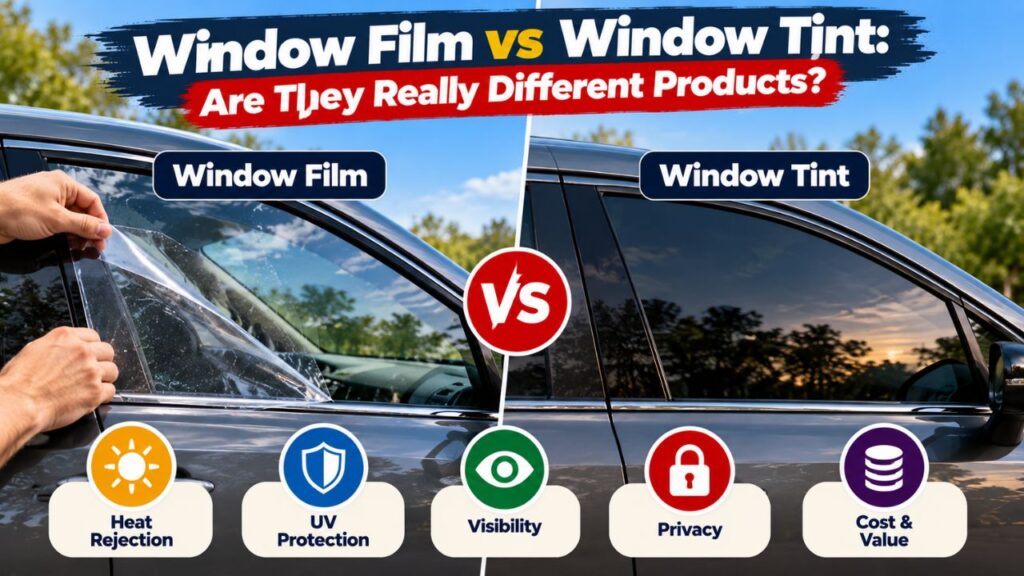
The biggest difference is terminology rather than construction.
Window film is the physical product applied to glass. Window tint is the treatment or appearance created by reducing visible light transmission.
In automotive applications, the terms are commonly used interchangeably because most aftermarket car tinting involves installing window film.
However, tinted glass does not always contain applied film.
Window Film Is the Material
Automotive window film is a thin, flexible material attached to the glass using an adhesive.
Most automotive films are installed on the interior surface of the window.
Depending on their construction, they can:
- Reduce incoming solar heat.
- Block selected ultraviolet wavelengths.
- Decrease visible glare.
- Increase privacy.
- Change the appearance of the glass.
- Provide certain glass-fragment retention properties.
Not every film offers all these benefits to the same degree.
A nearly transparent ceramic film may be designed primarily for solar heat rejection, while a dark dyed film may be selected mainly for appearance and glare reduction.
Window Tint Describes the Darkening Effect
The term window tint is commonly used to describe darker vehicle glass.
For example, a driver might request 35% window tint without specifying the film technology.
The installer would then choose a film with an appropriate visible light transmission rating.
However, tint can also describe coloring incorporated into the glass during manufacturing.
This is why factory privacy glass and aftermarket tint film should not be treated as identical.
Key Differences at a Glance
| Feature | Window Film | Window Tint |
| Basic meaning | Physical material attached to glass | General term for darkened glass or tinting treatment |
| Can be transparent? | Yes | Tint usually implies some darkening, although shops may use the term for clear films |
| Installation | Usually adhesive film application | Often the same film installation process |
| Heat rejection | Depends on film technology | Depends on the actual film or glass |
| UV protection | Depends on film specifications | Depends on the film or tinted glass |
| Privacy | Available in clear and dark options | Usually associated with darker windows |
| Removal | Applied film can generally be removed | Applied tint can be removed; factory-colored glass cannot simply be peeled off |
| Cost | Depends on film and installation | Same factors when referring to applied film |
Key Takeaway: In most automotive tint shops, window film and window tint mean the same product. The meaningful differences are between film types, shades, and factory-colored glass.
What Are Automotive Window Films Made Of?
Window films contain multiple layers or coatings that determine their appearance and performance.
The exact materials vary between manufacturers.
According to the International Window Film Association’s 2026 Automotive Education Guide, automotive films commonly use polyester substrates combined with materials such as dyes, metal-containing coatings, adhesives, and protective surface coatings.
The construction determines how the film interacts with visible light, ultraviolet radiation, and infrared energy.
Dyed Window Film
Dyed film uses coloring materials to reduce visible light transmission.
It is commonly selected for:
- Darker window appearance.
- Glare reduction.
- Increased daytime privacy.
- Lower-cost tinting packages.
However, its solar heat rejection depends on the complete construction.
Basic dyed films may offer less infrared control than advanced ceramic or other high-performance films.
Color stability also varies by product quality.
Metallized Window Film
Metallized film uses thin metal-containing layers to manage incoming solar radiation.
These coatings can improve solar energy rejection.
Some metallized products have a slightly reflective appearance.
Depending on the construction, conductive metallic layers may interfere with certain electronic signals.
If your vehicle relies on GPS, cellular devices, or other wireless systems, check the manufacturer’s compatibility information.
Carbon Window Film
Carbon tint is often marketed as an alternative to basic dyed film.
Its coloring and solar-control materials are designed to provide a dark appearance and certain heat-management benefits.
However, products sold as carbon tint do not follow one universal construction or performance standard.
Compare published specifications rather than assuming every carbon film performs identically.
Ceramic Window Film
Ceramic films use ceramic-based materials to help manage solar energy.
Many premium products are designed to reject substantial infrared energy while maintaining relatively high visible light transmission.
Metal-free ceramic designs generally avoid the electronic signal concerns associated with certain metallized films.
Ceramic products are available in different darkness levels.
Nano Ceramic Window Film
Nano ceramic refers to ceramic technology involving extremely small particles or coatings.
It is closely related to ordinary ceramic film technology.
Many premium ceramic products already use nanoscale materials, even when the manufacturer doesn’t include the word nano in the product name.
Nano ceramic should not automatically be considered better without comparing actual performance measurements.
Window Film vs Factory Window Tint: Are They the Same?
No. Factory-colored automotive glass and aftermarket window film are different constructions.
This distinction matters because vehicles can have dark windows without any added tint film.
What Is Factory Privacy Glass?
Factory privacy glass commonly contains coloring incorporated into the glass during manufacturing.
It is frequently used for rear passenger windows and rear windshields on SUVs, trucks, and minivans.
Some laminated automotive glass uses tinted interlayers or other manufacturing technologies to create a similar appearance.
Because the coloring is part of the glass construction, it cannot simply be peeled away.
Changing the darkness may require replacing the glass.
What Makes Aftermarket Tint Different?
Aftermarket tint normally involves applying film to existing glass.
The installer cleans the surface, cuts the film to fit, and uses an installation solution to position the material before the adhesive bonds.
The film can generally be removed and replaced by a qualified installer.
This makes aftermarket film more flexible when the owner wants a different shade or improved solar-control performance.
How to Identify Factory Tint and Applied Film
Several details can help distinguish the two.
Factory privacy glass:
- Often appears on rear windows.
- Has coloring incorporated into its construction.
- Does not have a separate film edge.
- Cannot be removed by peeling off a layer.
Applied window tint film:
- May have a visible edge near the top of a roll-down window.
- May come with separate installation paperwork.
- Can have its own film warranty.
- Can generally be removed professionally.
A professionally installed film may be difficult to identify by sight alone.
Avoid scratching the glass or lifting a suspected film edge simply to investigate.
Can Window Film Be Installed Over Factory Tint?
Yes, compatible aftermarket window film can often be applied over factory privacy glass.
This may provide additional infrared heat rejection or increase privacy.
However, the final window will transmit less visible light than it did before installation.
Have the existing glass measured before choosing another film layer.
The finished window must comply with applicable tint regulations.
Window Film vs Window Tint for Heat Rejection
When both terms refer to aftermarket film, neither is automatically better at rejecting heat.
Heat rejection depends on the specific film’s materials and tested performance, not whether a seller calls it window film or window tint.
A nearly transparent high-performance film can provide substantial solar heat control.
A very dark, inexpensive film may provide less heat rejection despite making the window look noticeably darker.
How Window Film Controls Solar Heat
Sunlight includes ultraviolet, visible, and infrared radiation.
Window films manage this incoming energy through different combinations of reflection, absorption, and transmission.
Some films primarily darken visible light.
Others use selective coatings to reject more infrared energy while maintaining a lighter appearance.
The resulting performance depends on the entire film-and-glass system.
Total Solar Energy Rejection (TSER)
TSER measures the percentage of total solar energy rejected by the tested glass-and-film combination.
It is a useful specification when comparing how effectively films reduce solar heat entering a vehicle.
For example, a product rated at 50% TSER rejects half of the total solar energy under the specified test conditions.
That doesn’t mean the interior temperature will be reduced by 50%.
Actual cabin temperature depends on the weather, sunlight, ventilation, glass area, and vehicle construction.
Infrared Energy Rejection (IRER)
Infrared Energy Rejection measures how effectively a film manages infrared energy over a specified wavelength range.
It can help explain why certain films feel more comfortable in direct sunlight.
However, infrared measurements are not interchangeable with total solar energy rejection.
A film advertising 95% infrared rejection does not necessarily reject 95% of all incoming solar heat.
Compare both TSER and relevant infrared measurements.
Example of Real Automotive Film Performance
The 3M Color Stable automotive window film specifications describe a nonmetallized film series using ceramic nanoparticle technology.
3M reports that this series can reject up to 64% of total solar energy, depending on the product configuration.
The example demonstrates that a product marketed as automotive window tint is also a technically engineered window film.
The same manufacturer uses separate performance terms for visible light transmission, ultraviolet rejection, infrared rejection, and total solar energy rejection.
For a meaningful comparison, check the exact film model and shade rather than the generic term used in advertising.
Does Window Tint Block More UV Rays Than Window Film?
Not necessarily.
If the window tint consists of applied film, the UV protection comes from that film’s construction.
Quality automotive films often block a very high percentage of selected ultraviolet wavelengths.
However, the actual protection level varies by product.
UV Rejection Is Different From Darkness
A darker tint isn’t guaranteed to block more ultraviolet radiation than a lighter film.
Some nearly clear products incorporate UV-absorbing materials without substantially changing the glass’s visible appearance.
Therefore, a film with high visible light transmission may still provide strong UV protection.
Check the manufacturer’s UV rejection specifications.
What About Factory Privacy Glass?
Factory automotive glass can also reduce ultraviolet transmission.
The amount depends on the glass composition, coatings, and whether the glass is laminated.
It’s inaccurate to assume that factory privacy glass provides no UV protection simply because it lacks aftermarket film.
Similarly, a dark window does not automatically provide a particular level of infrared heat rejection.
For accurate comparison, use the glass manufacturer’s specifications when available.
Window Film vs Window Tint for Privacy and Visibility
Privacy is primarily affected by the amount of visible light passing through the glass.
The technical measurement is called Visible Light Transmission.
What Is Visible Light Transmission?
Visible Light Transmission (VLT) measures the percentage of visible light that passes through a material or glass-and-film combination.
A lower VLT means a darker appearance.
Common automotive tint descriptions include:
| VLT | General appearance | Typical preference |
| 70% | Very light | Minimal visible darkening |
| 50% | Light | Mild tint appearance |
| 35% | Medium | Noticeable tint |
| 20% | Dark | Greater privacy |
| 5% | Very dark | Maximum darkness, with major visibility limitations |
These are appearance descriptions, not recommendations that every shade is suitable or legal.
Is Clear Window Film Better for Visibility?
A high-VLT film allows more visible light through than a dark film.
This can be helpful for drivers who regularly travel after sunset or in low-light conditions.
However, clear film quality still matters.
Poor optical clarity, haze, reflections, or distortion can interfere with visibility regardless of VLT.
For the clearest possible view, choose a quality film with appropriate optical specifications and professional installation.
Does Dark Tint Provide More Privacy?
Generally, darker tint makes it more difficult to see into a vehicle during daylight.
However, privacy also depends on lighting conditions.
When the interior is brightly illuminated at night, occupants and objects may become visible from outside.
Dark tint isn’t equivalent to one-way privacy glass under every lighting condition.
Does Tint Darkness Affect Night Driving?
Yes.
Lower VLT means less visible light reaches the driver’s eyes through the window.
This can make objects harder to see in poorly illuminated surroundings.
Dark film may also complicate checking mirrors, pedestrians, cyclists, and vehicles approaching from the side.
Choose a legal shade that maintains adequate visibility for your driving conditions.
Is Window Film Different From Residential Window Tint?
Window film is also used on residential and commercial buildings.
This creates another source of confusion because architectural and automotive films may have different requirements.
Automotive Window Film
Automotive films are designed for vehicle glass.
They must accommodate the shapes and operating conditions of automotive windows.
Some films also need to withstand repeated movement against window seals.
Automotive installations are subject to vehicle-specific visibility requirements and applicable tint laws.
Residential Window Film
Architectural films are designed for building windows.
Their applications may include:
- Solar heat control.
- Glare reduction.
- UV protection.
- Decorative patterns.
- Frosted privacy finishes.
- Safety and security glazing applications.
Some architectural films are nearly transparent, while others are reflective, opaque, or patterned.
Residential products must be selected for compatibility with the glass and window assembly.
Can You Use Car Window Tint on House Windows?
Not every automotive film is suitable for residential glass.
Building windows may have insulating glass units, low-emissivity coatings, or other configurations that affect heat absorption and thermal stress.
An unsuitable film can increase the risk of glass damage in certain installations.
Likewise, architectural film isn’t automatically suitable for vehicle use.
Select a product approved for the intended glass application rather than assuming every window film is interchangeable.
Window Film vs Window Tint: Installation and Cost
When window tint means aftermarket film, the installation process is essentially the same.
The cost depends on the actual product, vehicle, and installer.
There is no separate universal price category for “window film” versus “window tint.”
How Automotive Window Film Is Installed
A professional tint installation typically involves:
- Inspecting and cleaning the glass.
- Measuring or digitally cutting the film.
- Preparing the film for curved glass where necessary.
- Applying a suitable installation solution.
- Positioning the film on the glass.
- Removing excess solution and trapped air.
- Finishing the edges.
- Allowing the adhesive system to cure.
The exact method depends on the film and vehicle.
Rear windows, curved glass, and vehicles with sensitive electronic equipment may require additional care.
Does Clear Window Film Cost Less Than Dark Tint?
Not necessarily.
Some nearly transparent ceramic films cost more than basic dark dyed films because their construction is more advanced.
The shade alone does not determine the price.
Installation costs are influenced by:
- Film manufacturer and product series.
- Dyed, carbon, ceramic, or specialty construction.
- Vehicle size.
- Number of windows.
- Glass curvature.
- Removal of existing film.
- Installer experience.
- Warranty coverage.
Compare quotes using the exact film model and window coverage.
DIY Window Film vs Professional Tint Installation
Some automotive films are available for DIY installation.
However, achieving a clean result can be difficult without suitable tools and experience.
Common DIY problems include trapped dust, creases, uneven edges, and adhesive contamination.
Professional installation is generally preferable when using expensive film or working with complex automotive glass.
For DIY projects, use vehicle-appropriate film and follow the manufacturer’s installation instructions.
Does Window Film Last Longer Than Window Tint?
No, not when both terms describe the same kind of applied automotive film.
Durability depends on the film’s construction, adhesive quality, installation, cleaning, and environmental exposure.
What Causes Film to Deteriorate?
Common problems include:
- Bubbling.
- Edge peeling.
- Adhesive failure.
- Delamination.
- Color changes.
- Scratches.
- Cloudiness.
Not every bubble indicates a permanent defect.
Some moisture pockets or temporary haze can occur during the initial curing period.
However, persistent bubbling or adhesive separation after curing may require professional inspection.
Is Ceramic Tint More Durable?
Many high-quality ceramic films are designed for long-term color stability and performance.
However, the ceramic label alone doesn’t guarantee a longer lifespan than every other film.
A well-manufactured film installed correctly may perform better than a low-quality ceramic product.
Review the specific warranty.
Can Window Tint Film Be Removed?
Yes. Most aftermarket automotive window films can be removed.
Professional removal may involve controlled heat or steam and careful adhesive cleanup.
However, removing film from rear glass with defroster elements requires particular care.
Improper scraping or pulling can damage the defroster lines.
Factory-colored glass is different because its tint is built into the glass rather than applied as a removable layer.
Are Window Film and Window Tint Subject to the Same Laws?
When window tint refers to applied film on a vehicle, it is subject to applicable automotive tint regulations.
The terminology used by the installer does not create a separate legal exemption.
United States tint requirements vary by state and can also differ according to vehicle type and window position.
Check the Legal VLT for Each Window
State regulations may distinguish between:
- Windshield tint.
- Front side windows.
- Rear side windows.
- Rear windshield.
- Reflective film.
- Medical exemptions.
A shade permitted on the rear windows may not be legal on the front side windows.
Some states also regulate film reflectivity and require particular markings or certifications.
Verify the applicable rules before installation.
Factory Glass and Applied Film Work Together
The legal VLT is often based on the finished glass-and-film combination.
For example, suppose factory glass transmits 80% of visible light.
You apply film that transmits 50% of visible light.
The approximate combined transmission is:
0.80 × 0.50 = 0.40
The resulting VLT is approximately 40%.
This simplified example shows why applying 50% film does not necessarily produce a finished window with 50% VLT.
A qualified installer should measure the existing glass and verify the completed installation using a suitable tint meter.
Is Clear Heat-Rejection Film Automatically Legal?
No.
A nearly clear film still changes the total visible light transmission of the window to some degree.
If the original glass is close to the applicable legal limit, even a lightly tinted film may create a compliance problem.
Don’t assume that a film is exempt from the rules merely because it is marketed as clear, ceramic, or heat-rejecting.
Which Should You Choose: Window Film or Window Tint?
For automotive use, the better question is which type of film provides the performance you need.
The names alone don’t establish quality or suitability.
Choose a Clear Solar-Control Film if You Want Less Darkening
A high-VLT solar-control film may suit drivers who want to preserve a relatively clear appearance.
Look for:
- High visible light transmission.
- Strong verified solar heat rejection.
- Appropriate UV protection.
- Low haze.
- Compatibility with the vehicle’s glass.
- Compliance with applicable laws.
This can be especially useful when privacy isn’t the main objective.
Choose Darker Tint Film if Privacy Is the Priority
A lower-VLT film provides more visible darkening.
However, darker shades can reduce visibility in low-light conditions.
Select a product that meets the legal requirements for the specific window.
If heat rejection also matters, compare TSER rather than selecting the darkest available film.
Choose Ceramic Film if Heat Control Matters Most
Quality ceramic film can provide substantial infrared rejection without relying on very dark shades.
It is often worth considering for vehicles exposed to strong sunlight.
However, compare specific ceramic products rather than assuming every ceramic film performs equally well.
A premium film should justify its price through verified specifications and warranty protection.
Choose Safety or Security Film for Its Intended Protective Purpose
Certain specialized films are designed to help retain glass fragments after breakage.
These products are not equivalent to ordinary privacy tint.
They also do not make automotive glass unbreakable or bulletproof.
Choose a product tested for the intended application and compatible with the vehicle’s glazing requirements.
Mistakes to Avoid When Comparing Window Film and Window Tint
Several misunderstandings can result in choosing an unsuitable product.
Assuming Window Film Is Always Clear
Window film can be transparent, lightly tinted, dark, reflective, or decorative.
The term describes the material, not a specific darkness level.
Assuming Window Tint Is a Different Product
Most aftermarket vehicle tinting involves applying window film.
Comparing the two terms as though they always describe separate products creates unnecessary confusion.
Compare actual film materials and performance ratings instead.
Choosing Tint Based Only on Darkness
A darker film doesn’t automatically offer the best solar heat control.
Evaluate TSER, infrared rejection, UV protection, and VLT together.
Ignoring Factory Privacy Glass
Dark rear windows may already contain factory coloring.
Applying another film changes the final VLT.
Measure the existing glass before choosing a shade.
Confusing Infrared Rejection With Total Heat Rejection
A very high infrared-rejection percentage doesn’t mean the same percentage of all solar energy is rejected.
Use TSER to compare overall solar heat-control performance.
Ignoring Installation and Warranty Quality
A premium film can still perform poorly if installed incorrectly.
Choose an experienced installer, request the full product name, and review the warranty before purchasing.
Conclusion
The main finding in the window film vs window tint comparison is that both terms usually describe the same aftermarket automotive product.
Window film is the physical material attached to glass, while window tint commonly describes its darkening effect or the installation service. Factory privacy glass is different because its coloring is incorporated into the glass itself.
Window films can be nearly transparent or very dark. Their heat rejection, UV protection, privacy, and durability depend on the specific materials and construction.
For drivers who primarily want better heat control, a quality ceramic or other high-performance solar-control film is worth considering. For drivers who prioritize privacy, VLT becomes a more important selection factor.
My recommendation is to compare actual film specifications, choose a legally permitted shade, and use a reputable installer rather than selecting a product based on whether it is advertised as window film or window tint.
FAQs About Window Film vs Window Tint
Is Window Film the Same as Window Tint?
Usually, yes, in automotive applications. Window film is the material installed on the glass, while window tint commonly refers to the darkened appearance or installation service. Some window films are nearly transparent and provide heat or UV control without significant darkening.
Can Window Film Block Heat Without Darkening Windows?
Yes. Certain high-performance ceramic and other solar-control films can reject substantial infrared energy while maintaining high visible light transmission. The exact heat rejection depends on the product, so compare its TSER and infrared performance ratings.
Is Window Film More Expensive Than Window Tint?
Not necessarily. When both terms describe aftermarket film, the cost depends on the specific product and installation. A nearly clear premium ceramic film can cost more than basic dark dyed tint.
Does Window Film Provide Better UV Protection Than Tint?
Not automatically. Applied automotive tint is a type of window film, and UV protection depends on its construction. High-quality clear and dark films can both offer substantial UV rejection.
Can You Remove Window Film but Not Factory Tint?
Yes. Applied automotive film can generally be removed professionally. Factory privacy glass contains its coloring within the glass construction, so its darkness cannot be removed by peeling off a film layer.
Is Ceramic Window Tint Considered Window Film?
Yes. Ceramic tint is a type of automotive window film that uses ceramic-based materials to manage solar energy. It can be available in light or dark shades, depending on the product series.
Can You Put Window Film Over Existing Tint?
It depends on the existing tint. Compatible film can often be installed over factory privacy glass, but applying a second layer over existing aftermarket film is generally less desirable because it can complicate adhesion, visibility, and warranty coverage. Ask a qualified installer to assess the glass and confirm the legal final VLT.