Yes, window tint can block ultraviolet (UV) radiation, and many high-quality automotive window films reject 99% or more of UVA and UVB rays. However, the actual protection depends on the film’s materials, UV-blocking technology, and tested specifications—not simply how dark the windows look.
Car windows already provide some protection against ultraviolet radiation. Most automotive glass blocks a substantial amount of UVB, but UVA can pass through certain windows and reach your skin while driving. Adding suitable UV-protective film can reduce this exposure.
One important detail is that a nearly clear window film may provide excellent UV protection. You don’t necessarily need dark 5%, 20%, or 35% tint to block ultraviolet radiation. Likewise, a dark film isn’t automatically the best choice for solar heat rejection.
In this article, I explain how window tint blocks UVA and UVB rays, how much protection different films provide, and whether ceramic, carbon, dyed, and clear tints perform differently. I also cover factory glass protection, UV rejection percentages, interior fading, legal considerations, and how to choose a film that protects against sunlight without unnecessarily reducing visibility.
Does Window Tint Block UV Rays? How the Protection Works
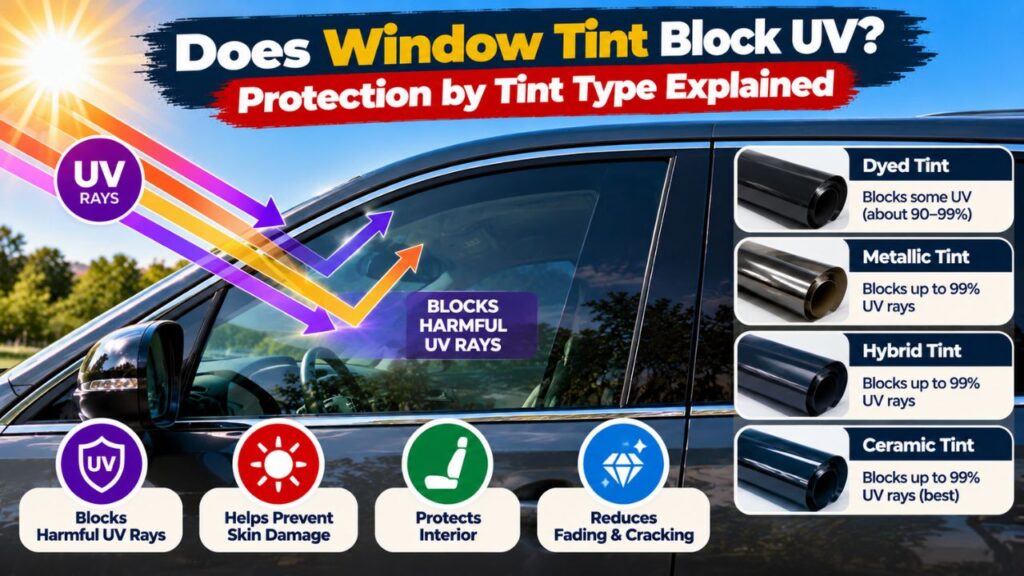
Window tint blocks ultraviolet radiation by absorbing or reflecting specific portions of the sun’s energy.
Most automotive window films use a thin polyester base combined with specialized coatings, UV absorbers, or other light-control materials.
The composition determines how much ultraviolet radiation passes through the finished window.
According to the Skin Cancer Foundation’s guidance on UV window film, properly designed UV-protective films can block more than 99% of UVA and UVB radiation.
The organization also explains that ordinary window glass doesn’t provide equal protection against all ultraviolet wavelengths.
What Are UVA Rays?
UVA radiation makes up most of the ultraviolet radiation reaching the Earth’s surface.
It can pass through many types of ordinary window glass.
UVA exposure contributes to:
- Skin aging.
- Wrinkles and changes in skin texture.
- Pigmentation changes.
- Cellular damage.
- Increased risk of skin cancer.
UVA exposure can occur while driving, even when the window is closed.
Unlike visible sunlight, UVA radiation isn’t something you can directly see.
You also cannot reliably judge UVA exposure by how hot the vehicle feels.
What Are UVB Rays?
UVB radiation is strongly associated with sunburn.
It can also damage skin cells and contribute to skin cancer risk.
Fortunately, most ordinary automotive glass already blocks a large percentage of UVB.
However, the amount blocked depends on the glass material and construction.
High-quality UV-protective window films can provide additional protection against UVB radiation.
What About UVC Rays?
UVC radiation has shorter wavelengths than UVA and UVB.
Nearly all naturally occurring solar UVC is absorbed by Earth’s atmosphere before reaching the ground.
For normal vehicle use, UVA and UVB are the main ultraviolet categories to consider.
UVA vs. UVB Protection
| UV Type | Main Characteristics | Ordinary Car Glass | UV-Protective Window Film |
| UVA | Contributes to skin aging and skin damage | Protection varies considerably | Can block 99% or more with suitable film |
| UVB | Major cause of sunburn and contributes to skin damage | Most is already blocked | Can provide additional protection |
| UVC | Mostly absorbed by the atmosphere | Not a major normal driving exposure | Usually not a practical selection factor |
Key Takeaway: A major benefit of UV-protective automotive film is reducing UVA radiation that may otherwise pass through certain vehicle windows.
How Much UV Does Window Tint Block?
High-quality automotive films commonly advertise UV rejection of 99% or more.
Some premium products advertise values as high as 99.9%.
However, the exact figure depends on the product and the test conditions.
Not every window film provides the same level of protection.
What Does 99% UV Rejection Mean?
A 99% UV rejection rating means that approximately 99% of the ultraviolet radiation covered by the specified test is prevented from passing through the measured film or film-and-glass assembly.
Approximately 1% remains transmitted under those test conditions.
For a simplified example, consider 100 units of incoming UV radiation.
| UV Rejection | UV Blocked | UV Transmitted |
| 80% | 80 units | 20 units |
| 90% | 90 units | 10 units |
| 95% | 95 units | 5 units |
| 99% | 99 units | 1 unit |
| 99.9% | 99.9 units | 0.1 unit |
These are mathematical examples, not measurements of exposure inside a particular vehicle.
They demonstrate how the remaining UV transmission decreases as the rejection percentage increases.
Is 99% UV Protection Good?
Yes. Blocking 99% of UVA and UVB is a strong level of protection for automotive window film.
The Skin Cancer Foundation requires window tint and glass products to demonstrate at least 99% UVA and UVB blocking to qualify for its relevant Seal of Recommendation.
However, a 99% rating doesn’t mean the vehicle provides complete protection against sunlight from every direction.
UV radiation may still enter through untreated windows, open windows, or other areas.
Is 99.9% UV Rejection Better Than 99%?
Mathematically, 99.9% rejection permits one-tenth as much UV transmission as 99% rejection when both are measured using the same method.
However, you shouldn’t automatically assume a meaningful real-world health difference from those two advertised figures alone.
Check whether the ratings use comparable:
- Wavelength ranges.
- Testing methods.
- Glass substrates.
- Product configurations.
- Reporting conditions.
For most drivers, choosing a verified film that blocks at least 99% of UVA and UVB is a sensible priority.
Does the UV Rating Cover Every Ultraviolet Wavelength?
Not necessarily.
Manufacturers may report UV rejection using specific wavelength ranges and testing procedures.
UVA radiation extends to approximately 400 nanometers.
When comparing products, check the technical documentation to understand which UV wavelengths were included.
This is especially useful when comparing films that advertise similar percentages but use different test methods.
Key Takeaway: Look for verified UVA and UVB rejection data rather than relying only on a large percentage printed on the packaging.
Does Darker Window Tint Block More UV?
No. Darker window tint doesn’t automatically block more ultraviolet radiation than lighter tint.
Tint darkness and UV rejection describe different properties.
A film can block substantial UV radiation while still allowing most visible light to pass through.
Why Tint Darkness and UV Rejection Are Different
Window darkness is measured using Visible Light Transmission, or VLT.
VLT describes how much visible light passes through the window.
For example:
- 5% VLT allows 5% of visible light through.
- 20% VLT allows 20%.
- 35% VLT allows 35%.
- 50% VLT allows 50%.
- 70% VLT allows 70%.
A lower VLT means a darker window.
However, UV rejection depends on different film components and optical properties.
Two films with substantially different darkness levels can provide similar ultraviolet protection.
20% vs. 35% Tint for UV Protection
A 20% tint is darker than a 35% tint.
It blocks more visible light and generally provides greater daytime privacy.
However, a high-quality 35% film may block just as much UV radiation as a comparable 20% film.
For example, the following hypothetical products could both provide strong UV protection.
| Film | Visible Light Transmission | UV Rejection |
| Film A | 20% | 99% |
| Film B | 35% | 99% |
These values illustrate how darkness and UV blocking can differ. They aren’t specifications for named products.
If the films have similar UV rejection, choosing the darker one solely for UV protection provides no demonstrated advantage.
Does 5% Tint Block More UV Than 50%?
Not necessarily.
A well-made 50% film with dedicated UV-blocking technology may offer greater UV protection than an inexpensive dark film without comparable testing.
A 5% tint also substantially reduces visible light, which may interfere with nighttime driving and violate applicable tint laws.
For UV protection, choose the film’s performance rather than its darkness.
Does Clear Window Tint Block UV Rays?
Yes. Clear or nearly clear automotive window films can block significant amounts of ultraviolet radiation.
Some are designed to provide 99% or greater UV rejection while maintaining high visible light transmission.
This makes clear UV-protective film particularly useful when you want sunlight protection without a noticeably dark appearance.
How Clear UV Film Works
Clear UV film uses materials that interact with ultraviolet wavelengths while allowing much of the visible spectrum to pass through.
These may include UV absorbers, specialized coatings, and multilayer optical technology.
The film’s transparency doesn’t mean ultraviolet radiation passes through at the same rate as visible light.
Benefits of Clear UV Window Tint
Clear UV film can provide several advantages:
- Reduced ultraviolet exposure through treated glass.
- Better nighttime visibility than dark tint.
- A relatively unchanged window appearance.
- Protection for interior materials.
- Potential solar heat reduction when using a suitable product.
However, clear UV film doesn’t automatically provide strong heat rejection.
Some clear products are primarily designed for UV protection, while others also manage infrared energy.
Check the specifications.
Is Clear UV Tint Legal on Front Windows?
A clear appearance doesn’t automatically establish legal compliance.
Some clear films still reduce the final visible light transmission of the window.
For example, installing a film with 90% VLT over glass with 75% VLT produces an estimated combined transmission of:
75 × 90 ÷ 100 = 67.5%
This simplified calculation demonstrates why a nearly clear film may still produce a finished window below a legal VLT requirement.
Windshield rules can also differ from side-window rules.
Confirm the regulations for the specific window before installation.
Does Ceramic Window Tint Block UV Rays?
Yes. Many quality ceramic automotive window films block 99% or more of ultraviolet radiation.
However, ceramic technology is primarily associated with advanced solar heat management.
Strong UV protection isn’t exclusive to ceramic films.
How Ceramic Tint Works
Ceramic window tint typically contains specialized ceramic-related materials within a polyester film structure.
These components help manage solar radiation, including portions of the infrared spectrum.
Manufacturers may also incorporate UV absorbers or other UV-control technologies.
The finished film can therefore provide UV protection and heat rejection through different properties.
Is Ceramic Tint Better for UV Protection?
Not automatically.
A premium ceramic film may offer:
- High UV rejection.
- Strong infrared control.
- Useful total solar energy rejection.
- Good optical clarity.
- Color stability.
- Nonmetallic construction.
However, a quality carbon or dyed film may provide similar UV rejection.
The main advantage of premium ceramic film is often its ability to manage solar heat while maintaining a selected level of visible light transmission.
Does 70% Ceramic Tint Block UV?
Many high-quality 70% VLT ceramic films are designed to block a substantial percentage of UVA and UVB radiation.
Some provide UV rejection of 99% or more.
However, the exact performance depends on the film.
Always check the manufacturer’s technical data.
A 70% tint can remain relatively light while providing strong UV protection.
Key Takeaway: Ceramic tint can provide excellent UV protection, but you don’t need ceramic technology solely to obtain a high UV rejection rating.
Dyed vs. Carbon vs. Ceramic Tint for UV Protection
Different window film categories can provide different levels of UV blocking.
However, the category alone doesn’t establish the exact percentage.
| Film Type | Can Provide High UV Rejection? | Main Performance Considerations |
| Dyed tint | Yes, depending on formulation | Darkness, glare reduction, price |
| Carbon tint | Yes | Color stability and solar performance |
| Metalized tint | Yes | Solar reflection and possible signal interference |
| Ceramic tint | Yes | Infrared control and optical performance |
| Clear UV film | Yes | UV protection with minimal darkening |
| Multilayer optical film | Yes | Advanced selective solar control |
Dyed Window Tint
Dyed tint uses coloring materials to reduce visible light.
Some products also incorporate UV-blocking ingredients.
A well-made dyed film may provide strong UV rejection even if its heat rejection is relatively modest.
However, inexpensive dyed films vary in quality.
Check the product’s tested UV specifications before assuming it blocks 99%.
Carbon Window Tint
Carbon tint uses carbon-containing materials to influence visible light and solar performance.
Many carbon films are designed to provide high UV rejection.
However, carbon itself doesn’t guarantee a particular percentage.
The finished product’s construction determines the result.
Metalized Window Tint
Metalized film contains extremely thin metallic coatings.
These coatings can reflect parts of incoming solar radiation.
Metalized films may also incorporate UV-protective components.
Some products can interfere with certain radio-frequency signals, depending on the metal layers and vehicle electronics.
For UV protection alone, there is no need to select metalized film over a properly tested nonmetallic alternative.
Ceramic Window Tint
Ceramic tint is often selected for heat management.
Many premium ceramic products also provide excellent UV rejection.
However, the exact performance varies by film series.
Clear and Multilayer Films
Clear and multilayer optical films can provide ultraviolet protection without requiring very dark glass.
Some are designed to selectively manage ultraviolet and infrared wavelengths while allowing substantial visible light transmission.
These products are worth considering when visibility and legal VLT limits are important.
Does Factory Window Tint Block UV Rays?
Factory automotive glass already blocks some ultraviolet radiation.
However, its protection depends on the type of glass and how the window was manufactured.
Windshields, side windows, rear windows, and sunroofs may provide different levels of UV protection.
Windshield UV Protection
Most modern automotive windshields use laminated glass.
Laminated glass contains a plastic interlayer bonded between glass layers.
This construction generally provides strong protection against UVB and substantial protection against UVA.
As a result, the windshield may already block much more ultraviolet radiation than some untreated side windows.
However, exact performance varies by vehicle and glass specification.
Don’t assume every windshield has identical UV rejection.
Front Side Window UV Protection
Front side windows often use tempered glass, although some vehicles use laminated or specially treated glass.
Ordinary tempered glass typically blocks most UVB but may allow significant UVA transmission.
That means drivers can receive UVA exposure through closed side windows.
The American Cancer Society’s UV protection guidance explains that typical vehicle windows block most UVB but less UVA. It also notes that tinted windows may reduce additional UVA exposure, depending on the tint.
For drivers who spend long periods behind the wheel, front side windows are a reasonable place to consider UV-protective film, where permitted.
Rear Side Window UV Protection
Rear windows may use tempered, laminated, tinted, or otherwise treated glass.
Some vehicles include dark factory privacy glass.
However, dark-looking factory glass doesn’t automatically provide the same UVA protection as a properly tested UV-blocking aftermarket film.
Check the vehicle manufacturer’s specifications when available.
Rear Windshield UV Protection
The rear windshield’s ultraviolet performance depends on its glass construction.
Some rear windows may transmit more UVA than laminated front windshields.
A compatible UV-protective film can reduce additional ultraviolet transmission.
Take care when selecting film for rear glass with defroster lines or other embedded components.
Sunroof UV Protection
Sunroofs and panoramic glass roofs vary considerably in construction.
Some use laminated, tinted, coated, or specially formulated glass that provides substantial UV protection.
Others may have different transmission characteristics.
Don’t assume a dark sunroof is automatically equivalent to 99% UVA and UVB rejection.
Consult the vehicle manufacturer before installing additional film because some glass roofs have restrictions related to thermal stress or aftermarket coatings.
Does Window Tint Protect Your Skin From UV Damage?
UV-protective window tint can reduce the amount of ultraviolet radiation reaching your skin through treated glass.
That can be useful for people who spend considerable time driving or sitting near windows.
However, window tint should be considered one component of a broader sun-protection approach.
Reducing UVA Exposure While Driving
UVA radiation can pass through certain vehicle windows.
Repeated exposure may contribute to skin damage over time.
Installing a suitable UV-protective film reduces the radiation transmitted through those windows.
This can be particularly relevant to drivers who regularly spend hours on the road.
Does UV Window Tint Prevent Skin Cancer?
Window tint can reduce UV exposure through treated glass, but it doesn’t guarantee prevention of skin cancer.
Risk depends on cumulative exposure and other individual factors.
UV radiation can still reach the skin through untreated windows, open windows, and sunlight outside the vehicle.
A window film should not be described as providing complete medical protection.
Does Tint Help Prevent Wrinkles and Premature Aging?
UVA exposure contributes to premature skin aging.
Reducing UVA exposure can therefore be part of a strategy to limit sunlight-related skin damage.
However, the condition of the skin is influenced by many factors.
Window film doesn’t reverse existing wrinkles or guarantee that signs of aging will not develop.
Should You Still Use Sunscreen in a Tinted Car?
For extended sun exposure, sunscreen and other protective measures can still be appropriate even when the windows have UV-protective film.
Consider:
- Broad-spectrum sunscreen with SPF 30 or higher.
- UV-protective sunglasses.
- Appropriate sun-protective clothing.
- Keeping windows closed when relying on their UV protection.
- Avoiding unnecessary direct sunlight exposure.
People with specific medical conditions or heightened photosensitivity should follow their clinician’s guidance about protection requirements.
Key Takeaway: UV film can substantially reduce exposure through treated windows, but it doesn’t replace general sun-protection practices.
Does Window Tint Protect Car Interiors From UV Damage?
Yes. UV-protective window film can reduce ultraviolet radiation reaching interior surfaces.
This may help slow some sunlight-related deterioration.
However, ultraviolet radiation isn’t the only factor contributing to interior fading and aging.
Visible light, heat, moisture, and material characteristics can also play important roles.
Protecting Leather Seats
Sunlight exposure can contribute to changes in leather color and condition.
UV protection may help reduce part of that exposure.
However, excessive heat and poor maintenance can still damage leather.
Use suitable upholstery care products according to the vehicle manufacturer’s instructions.
Protecting Dashboards and Plastic Trim
Dashboards and plastic interior components are exposed to considerable sunlight.
Over time, environmental exposure can contribute to discoloration and material deterioration.
UV-blocking film can reduce some of the radiation reaching these surfaces.
However, a high-UV-rejection film doesn’t eliminate heat buildup inside a parked vehicle.
Protecting Fabric Upholstery
Ultraviolet radiation can contribute to changes in textile dyes and fibers.
A suitable film may reduce some fading.
The result depends on the fabric, dye chemistry, visible light exposure, and other environmental factors.
Does 99% UV Tint Stop All Interior Fading?
No.
Even if a film blocks 99% of specified ultraviolet radiation, other portions of sunlight can still contribute to fading.
For stronger overall interior protection, compare UV rejection alongside total solar energy rejection and visible light transmission.
UV Protection vs. Heat Rejection: What’s the Difference?
UV protection and heat rejection are related to sunlight but measure different properties.
A film can provide strong ultraviolet protection without delivering equally strong heat rejection.
UV Rejection
UV rejection measures how much ultraviolet radiation is prevented from passing through the tested film or glass assembly.
Its importance includes reducing UV exposure and limiting certain forms of sunlight-related material damage.
Visible Light Transmission (VLT)
VLT measures the percentage of visible light transmitted through the window.
A lower VLT produces a darker appearance.
It affects outward visibility and privacy.
VLT doesn’t directly tell you how much UVA or UVB the film blocks.
Total Solar Energy Rejection (TSER)
TSER describes how much total incident solar energy the filmed glass rejects under specified test conditions.
It is an important measurement when comparing overall heat-control performance.
A film that performs well for UV rejection may have different TSER values from another film with similar UV blocking.
Infrared Rejection
Infrared rejection describes how a product handles infrared radiation over a specified wavelength range.
Because manufacturers may use different testing methods and ranges, compare the exact technical definitions.
A large advertised infrared rejection percentage doesn’t necessarily establish superior overall solar heat rejection.
Window Tint Performance Measurements Compared
| Specification | What It Measures | Why It Matters |
| UV rejection | Ultraviolet radiation blocked or rejected | UV exposure and material protection |
| VLT | Visible light passing through | Darkness, visibility, and legality |
| TSER | Total solar energy rejected | Overall solar heat control |
| Infrared rejection | Infrared energy controlled over specified wavelengths | Heat-management performance |
| Visible reflectance | Visible light reflected by the window | Reflective appearance |
A film rated for 99% UV rejection isn’t necessarily the best film for reducing cabin temperature.
If heat control is your main goal, compare TSER and other relevant solar-performance specifications.
Can Window Tint Block UV Without Reducing Visibility?
Yes. Some automotive films are designed to block ultraviolet radiation while maintaining relatively high visible light transmission.
However, any installed film must be selected carefully for the vehicle and legal requirements.
High-VLT UV Film
Films with relatively high VLT allow more visible light through than dark tint.
A suitable high-VLT film can be useful for drivers who prefer an almost factory-clear appearance.
The exact UV rejection must still be verified.
UV Protection for Night Driving
Dark tint can reduce visibility at night.
A lighter UV-protective film may provide a more practical balance for windows used to detect pedestrians, traffic, and other road hazards.
However, even a light film may reduce visible light transmission compared with untreated glass.
Select products that maintain appropriate nighttime visibility.
UV Protection and Front Windshield Restrictions
Windshield regulations are often stricter than side-window rules.
Some jurisdictions allow only limited tinting near the top of the windshield.
Others may permit certain nearly clear films under specific conditions.
Do not install a windshield film based solely on its UV rating.
Confirm the applicable regulations and the vehicle manufacturer’s requirements.
How to Choose Window Tint for Maximum UV Protection
Selecting a UV-protective film requires looking beyond appearance and marketing descriptions.
The following steps help compare products more accurately.
Step 1: Look for Verified UVA and UVB Blocking
Choose a film that provides clear documentation of its ultraviolet rejection.
A tested rating of 99% or more for both UVA and UVB is a strong selection criterion.
Look for recognized independent evaluation or appropriate manufacturer testing.
Step 2: Check the Skin Cancer Foundation Seal
The Skin Cancer Foundation’s Seal of Recommendation can help identify products that meet its requirements.
For qualifying window tint products, the organization requires evidence that they block at least 99% of UVA and UVB radiation.
The seal doesn’t mean the product eliminates every sun-related risk.
It indicates that the film has met the organization’s relevant evaluation criteria.
Step 3: Compare UV Rejection With VLT
Don’t select a darker film unless you actually need greater visible light reduction or privacy.
If UV protection is your main priority, a light film with verified UV performance may provide a better balance.
For example, a 70% film with 99% UV rejection may meet your needs better than an excessively dark film.
Always verify the specific product’s published values.
Step 4: Consider Heat Rejection Separately
If you’re also trying to reduce heat inside the car, compare TSER.
A ceramic or advanced multilayer film may provide better overall solar heat management than a basic dyed film.
However, test data should guide the choice.
Step 5: Verify State Window Tint Laws
Automotive window tint regulations vary by state.
Different rules may apply to:
- Front side windows.
- Rear side windows.
- Rear windshields.
- Front windshields.
- Passenger cars versus SUVs or other vehicle categories.
The legal requirement typically concerns the completed glass-and-film assembly.
A film that appears clear can still reduce final VLT.
Consult the relevant state DMV or official vehicle code before installation.
Step 6: Check the Film Manufacturer’s Warranty
A warranty can provide useful protection against defects.
Look for coverage related to:
- Bubbling.
- Peeling.
- Adhesive failure.
- Color changes.
- Film separation.
- Material defects.
Read the conditions carefully.
Not all warranties cover labor or UV-performance changes over time.
Step 7: Choose a Qualified Installer
Proper installation helps maintain the film’s intended performance and optical clarity.
Poor installation may create gaps, contamination, peeling, or distortion.
Ask the installer to identify the exact film brand and product series.
Also confirm that the film is suitable for the specific glass surfaces being treated.
Does Window Tint Still Block UV After Several Years?
Quality window film is designed to provide sustained performance, but actual durability depends on the materials and environmental conditions.
UV-blocking components, adhesives, and protective coatings can age.
Not every film retains identical performance throughout its entire service life.
Does Faded Window Tint Lose UV Protection?
Visible fading doesn’t automatically establish how much UV protection remains.
Some products may undergo color changes while retaining certain functional properties.
Other aging processes may affect the film’s performance.
The appearance alone isn’t a reliable way to measure remaining UV rejection.
If UV protection is especially important, consult the manufacturer or a qualified film specialist.
Signs Window Tint Needs Attention
Inspect aging film for:
- Persistent bubbles.
- Peeling edges.
- Cracking.
- Delamination.
- Severe discoloration.
- Optical haze.
- Physical damage.
These problems can affect coverage, appearance, or visibility.
Film that is peeling away from the glass can leave exposed areas with less protection.
Can Damaged Tint Be Repaired?
Small cosmetic problems don’t always require complete replacement.
However, film that has significantly peeled or separated may need removal and reinstallation.
Improvised patches may not restore consistent optical or UV performance.
Ask a professional installer whether the film can be replaced under warranty.
Common Mistakes When Choosing UV-Blocking Window Tint
Assuming Dark Tint Provides the Best UV Protection
UV rejection isn’t determined by VLT alone.
A nearly clear film may offer the same verified UVA and UVB protection as a much darker film.
Assuming All Ceramic Films Block Exactly 99.9%
Ceramic film performance varies by manufacturer and product.
The ceramic label doesn’t establish the UV rejection percentage.
Check the technical specifications.
Confusing UV Rejection With Heat Rejection
A film that blocks 99% of UV radiation doesn’t necessarily reject 99% of solar heat.
TSER is a better metric for overall solar heat performance.
Relying Only on Factory Privacy Glass
Dark factory privacy glass may not provide the same UVA protection as a dedicated UV-blocking film.
Check the specific glass construction and performance.
Ignoring Untreated Windows
Installing UV film on the two front side windows doesn’t protect against radiation entering through untreated rear glass or an open sunroof.
Consider the complete vehicle.
Assuming Window Tint Replaces Sunscreen
UV-protective film reduces exposure through treated glass.
It doesn’t protect skin from sunlight entering through open windows or during time spent outside the vehicle.
Maintain appropriate sun-protection habits.
Choosing a Film Without Confirming Legal Compliance
Some clear or dark films can reduce the completed window’s VLT below the legal threshold.
Check applicable regulations before installation.
Is UV-Blocking Window Tint Worth It?
For drivers who spend substantial time in the car, UV-protective window tint can provide a practical benefit.
The value is especially relevant when the vehicle’s side glass allows appreciable UVA transmission.
For Daily Commuters
A suitable UV-protective film can reduce exposure through treated windows during daily driving.
A light, legally compliant film may be a good choice when maintaining visibility is important.
For Long-Distance Drivers
Drivers who spend hours on the road may benefit from reducing cumulative sunlight exposure through side windows.
However, tinted glass should be combined with other appropriate sun-protection measures.
For Vehicles With Dark Factory Glass
Factory privacy glass may already provide the desired appearance.
If additional UV protection is needed, a light film with verified UVA and UVB performance may be more appropriate than simply adding another dark layer.
Check the existing glass first.
For Drivers Who Want Better Cabin Comfort
If you’re interested in both UV protection and cooling performance, consider a film with strong UV rejection and useful TSER.
A premium ceramic or multilayer product may offer advantages.
However, the specific test data should justify the additional cost.
For Protecting the Interior
UV-protective film may help limit certain types of interior material deterioration.
However, sunlight-related fading and aging involve more than UV radiation alone.
A combination of appropriate window film and regular interior care is more dependable than relying on tint by itself.
Conclusion
So, does window tint block UV? Yes. High-quality automotive window films can block 99% or more of UVA and UVB radiation, making them useful for reducing ultraviolet exposure through treated car windows.
However, darkness isn’t the determining factor. Dyed, carbon, ceramic, metalized, and clear films can all provide UV protection when properly designed and tested.
Most automotive glass already blocks much of the UVB radiation, but UVA can pass through certain windows. This makes verified UVA protection particularly important when choosing film for side windows.
For drivers primarily interested in UV protection, I recommend choosing a film that documents at least 99% UVA and UVB rejection while maintaining appropriate visibility and legal compliance.
If reducing cabin heat is also important, compare total solar energy rejection rather than relying only on the UV blocking percentage.
FAQs About Does Window Tint Block UV
Does Regular Car Window Tint Block UV Rays?
Many conventional automotive window films reduce ultraviolet radiation.
However, the exact protection varies by product.
Check the manufacturer’s UVA and UVB rejection specifications rather than assuming every film blocks the same amount.
Does 35% Window Tint Block UV?
Yes. A quality 35% film can block 99% or more of UVA and UVB radiation.
The 35% rating refers to visible light transmission, not UV rejection.
Actual UV performance depends on the film’s construction and testing.
Does 20% Window Tint Block More UV Than 35%?
Not necessarily.
A 20% tint blocks more visible light than a 35% tint, but both may provide similar UV rejection.
Choose based on the film’s measured UV performance rather than darkness.
Does Ceramic Tint Block 100% of UV Rays?
Ceramic tint can provide excellent UV protection, but a 100% blocking claim shouldn’t be assumed.
Many premium automotive films advertise UV rejection of 99% or more.
Check the actual specifications for the product.
Does Clear Window Tint Block UV?
Yes. Some clear or nearly clear UV-protective films block 99% or more of UVA and UVB while allowing most visible light through.
This makes them useful for drivers who want UV protection without a dark appearance.
However, clear films must still comply with applicable window regulations.
Do Factory Car Windows Block UV Rays?
Most factory automotive glass blocks a substantial amount of UVB radiation.
Laminated windshields generally provide stronger UVA protection than ordinary tempered side glass.
However, exact protection varies by vehicle, glass construction, and factory treatments.
Does Window Tint Help Prevent Skin Cancer?
UV-protective window tint reduces ultraviolet exposure through treated glass, which is one part of protecting skin from sun damage.
However, it doesn’t guarantee prevention of skin cancer and shouldn’t replace sunscreen or other appropriate sun-protection practices.
Does Window Tint Block UV and Heat?
Many window films reduce both UV transmission and solar heat, but the two properties are measured differently.
UV rejection describes ultraviolet protection, while TSER indicates overall solar energy rejection.
A film can block 99% of UV radiation without rejecting 99% of total solar heat.
Does Window Tint Block UV When the Sun Isn’t Directly Shining?
A UV-protective film can reduce ultraviolet radiation passing through treated glass even when sunlight is indirect or scattered.
However, exposure conditions vary with the weather, surroundings, and direction of sunlight.
UV radiation may still reach occupants through untreated or open windows.
Can You Still Get Sun Damage Through Tinted Car Windows?
Yes, some UV exposure can still occur.
Film may not block every ultraviolet wavelength completely, and sunlight can enter through other windows or openings.
Quality UV-protective film can significantly reduce exposure through treated glass, but complete sun protection requires additional precautions.