A dead 12V battery can leave a car, SUV, pickup, motorcycle, or boat completely stranded. The best 12V battery jump starter should provide enough starting power for the engine while remaining dependable, easy to connect, and practical to keep ready for an emergency.
For most drivers, a compact lithium unit provides the best balance of power and portability. Professional and frequent users may prefer a heavier traditional jump box with longer cables and stronger sustained cranking capability.
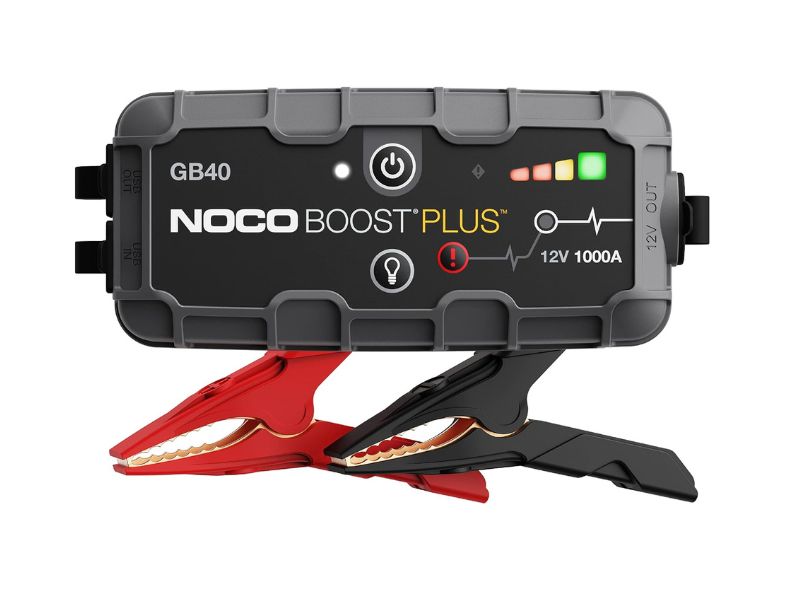
My primary recommendation is the NOCO Boost GB40 1000A 12V Lithium Jump Starter. I would choose it for most passenger cars, crossovers, smaller SUVs, and moderate gasoline vehicles because it supports engines up to 6.0L gasoline and 3.0L diesel, weighs about 2.4 pounds with accessories, and includes reverse-polarity and spark protection. Its current U.S. Amazon listing shows 128,561 customer ratings.
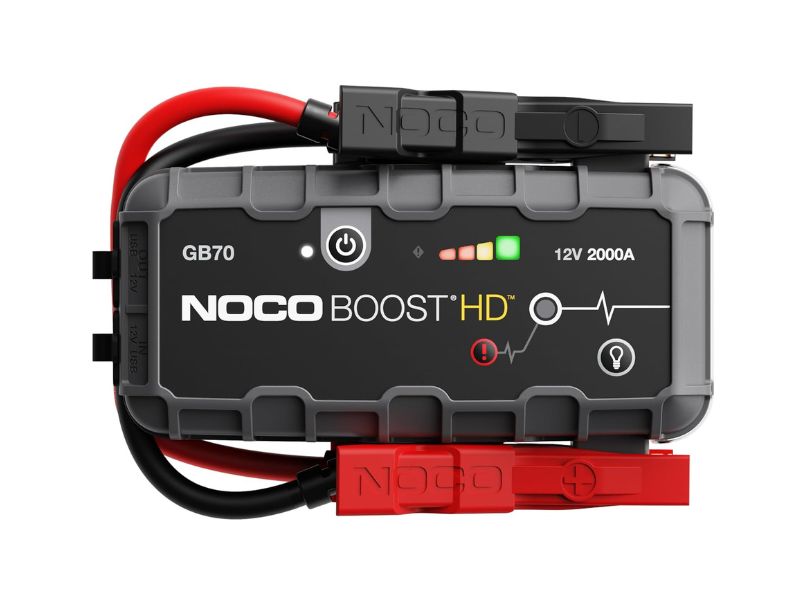
I would choose the NOCO Boost GB70 2000A 12V Lithium Jump Starter for larger SUVs, full-size gasoline pickups, RVs, boats, or moderate diesel engines. It increases engine coverage to 8.0L gasoline and 6.0L diesel, adds a larger energy reserve, and currently has 30,821 Amazon ratings.
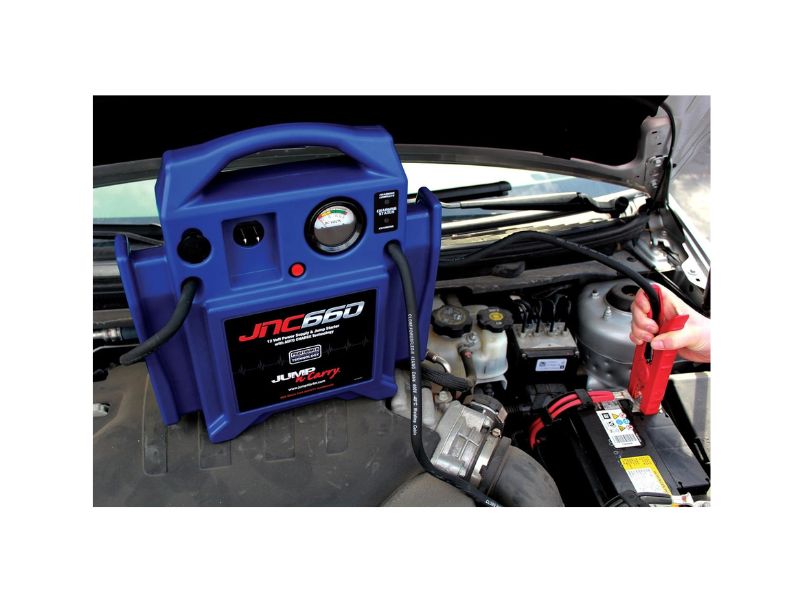
The Clore Automotive Jump-N-Carry JNC660 1700A 12V Jump Starter is the alternative I would choose for garages, farms, fleets, work trucks, and frequent jump-starting. Its 425 cranking amps, 46-inch #2 AWG cables, industrial clamps, automatic charger, and professional-style PROFORMER battery prioritize sustained starting capability over lightweight portability. Its current Amazon listing shows 19,778 ratings.
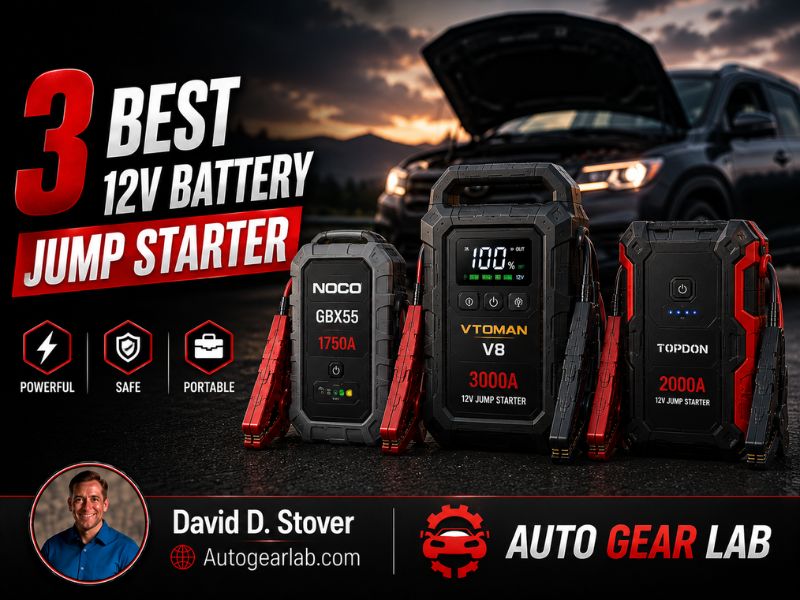
3 Best 12V Battery Jump Starters Reviewed
| Image | Product Name | Check Price |
|---|---|---|
Best Choice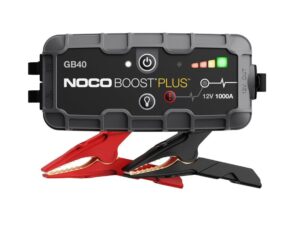 | NOCO Boost GB40 1000A 12V Lithium Jump Starter | Check Price |
Second Best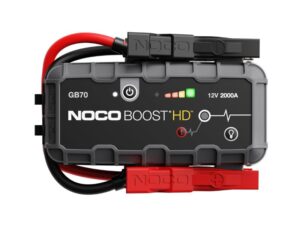 | NOCO Boost GB70 2000A 12V Lithium Jump Starter | Check Price |
Third Choice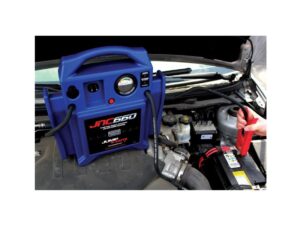 | Clore Automotive Jump-N-Carry JNC660 1700A 12V Jump Starter | Check Price |
All three products are intended for 12V vehicle starting systems, but they serve noticeably different buyers. The two NOCO models use lightweight lithium-ion technology, while the JNC660 uses a traditional professional jump-box design built around sustained high-current service.
1. NOCO Boost GB40 1000A 12V Lithium Jump Starter
Key Features
- 1000A peak output
- 12V lead-acid battery applications
- Gas engines up to 6.0L
- Diesel engines up to 3.0L
- Reverse-polarity protection
- Spark-resistant connection
- IP65 with ports closed
- USB device charging
- 100-lumen flashlight
The GB40 is my primary recommendation because it provides enough starting capability for a large portion of U.S. passenger vehicles without becoming inconvenient to carry.
NOCO rates the GB40 at 1000A for 12V lead-acid starting batteries and supports gasoline engines up to 6.0 liters and diesel engines up to 3.0 liters.
That makes it appropriate for many four-cylinder and six-cylinder cars, crossovers, moderate SUVs, motorcycles, boats, ATVs, and numerous gasoline light trucks.
Its greatest practical advantage is portability.
A traditional professional jump box can weigh well into double digits, while NOCO lists the GB40 as a compact lithium unit intended to fit in a trunk, toolbox, or vehicle emergency kit.
That matters because the jump starter you actually keep in the vehicle is more useful than a much larger unit left in the garage.
The normal connection system provides reverse-polarity protection and spark-resistant operation. These features reduce the risk associated with accidentally reversing the clamps during ordinary use.
They do not replace correct setup. Always locate the vehicle manufacturer’s approved positive terminal and negative or chassis-ground point.
The GB40 also functions as a USB power bank. That allows you to recharge a phone, camera, headphones, or another compatible small electronic device during an emergency. NOCO’s Boost line includes a 2.1A USB output for portable electronics.
The built-in 100-lumen flashlight adds useful illumination when connecting clamps at night and includes multiple light modes.
NOCO also gives the GB40 an IP65 rating with the ports closed, providing defined resistance to dust and water jets.
The biggest limitation is diesel capability.
A 3.0L diesel ceiling excludes the larger engines found in many full-size diesel pickups. Owners of those vehicles should choose a booster specifically rated above their diesel displacement.
The GB40 also carries less stored reserve than the larger GB70, so repeated difficult starts or severe winter use can justify moving up.
What I Like
- Excellent size for everyday vehicle storage
- Enough power for many passenger cars and SUVs
- Reverse-polarity protection
- Spark-resistant normal connection
- IP65 protection with ports closed
- Useful USB and flashlight functions
What I Do Not Like
- Limited to 3.0L diesel engines
- Less reserve than the GB70
- Not designed for repeated professional shop-duty starts
The GB40 is the 12V battery jump starter I would choose for most everyday drivers. It delivers a useful combination of engine coverage, safety electronics, compact storage, and emergency-device charging without forcing you to carry an oversized jump box.
2. NOCO Boost GB70 2000A 12V Lithium Jump Starter
Key Features
- 2000A peak output
- 12V lithium jump starter
- Gas engines up to 8.0L
- Diesel engines up to 6.0L
- Reverse-polarity protection
- Spark-resistant operation
- IP65 enclosure with ports closed
- 400-lumen flashlight
- USB and 12V accessory power
The GB70 is better suited to drivers who want substantially more starting reserve while retaining lithium portability.
NOCO rates it at 2000A, with support for gasoline engines up to 8.0 liters and diesel engines up to 6.0 liters.
That gives it much broader truck and large-SUV coverage than the GB40.
It can be particularly attractive for:
- Full-size gasoline pickups
- Large V8 SUVs
- RVs
- Boats
- Moderate diesel trucks
- Multi-vehicle households
- Cold-weather emergency kits
The GB70 weighs about 5 pounds, according to NOCO, so it remains considerably more portable than traditional professional jump boxes despite its larger output.
The additional stored energy is useful when the installed battery is deeply discharged and contributes very little to the starting process.
NOCO states that the GB70 can deliver multiple jumps per charge under favorable conditions, although real results vary with engine displacement, temperature, battery condition, and cranking duration.
Its normal connection system again provides spark protection and reverse-polarity protection.
The GB70 also offers more portable-power capability than the GB40.
NOCO includes USB device charging and a 12V output that can operate compatible accessories such as tire inflators and other low-voltage equipment.
The integrated flashlight increases to 400 lumens, making it much more useful for illuminating a large engine bay or roadside work area after dark.
Another advantage is faster optional 12V recharging. NOCO’s current GB70 manual lists approximately 2–3 hours for compatible 12V fast charging compared with much longer basic USB recharge times.
The main limitation is that the 6.0L diesel rating still excludes common 6.6L and 6.7L heavy-duty pickup diesels.
For those engines, I would choose a manufacturer-rated pack specifically designed for larger diesel applications instead of assuming the GB70 has enough margin.
What I Like
- Strong 8.0L gasoline coverage
- Useful 6.0L diesel capability
- More starting reserve than the GB40
- Still relatively portable
- 12V accessory output
- Bright 400-lumen work light
What I Do Not Like
- Larger than many car owners need
- 6.0L diesel limit excludes several HD pickups
- More size to store than the GB40
The GB70 is my choice when larger vehicles, winter conditions, or multi-vehicle use justify additional reserve. It offers a strong middle ground between lightweight passenger-car jump packs and heavy professional equipment.
3. Clore Automotive Jump-N-Carry JNC660 1700A 12V Jump Starter
Key Features
- 1700 peak amps
- 425 cranking amps
- 12V operation
- Clore PROFORMER battery
- 46-inch #2 AWG welding cables
- Industrial-grade clamps
- Automatic built-in charging
- Voltmeter
- 12V DC accessory outlet
- Approximately 18 pounds
The JNC660 takes a completely different approach from the compact NOCO lithium boosters.
Instead of prioritizing minimum size, Clore emphasizes sustained cranking performance, heavy cables, long reach, industrial clamps, and repeated-use durability.
Clore specifies 1700 peak amps and 425 cranking amps for the JNC660.
That published cranking figure is valuable because peak amps describe only a brief maximum. Cranking amps provide additional context about sustained starting output, which matters during difficult starts.
The JNC660 uses 46-inch #2 AWG welding cable leads.
Heavy cable gauge is important because starting current has to travel from the jump box to the vehicle with as little electrical resistance as practical.
The longer 46-inch leads also provide more reach around:
- Large engine compartments
- Vans
- Pickups
- Recessed batteries
- Remote jump terminals
- Farm equipment
Industrial-grade clamps provide strong spring pressure and substantial contact surfaces for battery terminals.
That design can be particularly useful when terminals are dirty, recessed, or less accessible than those on an ordinary passenger car.
Clore’s PROFORMER battery technology is specifically designed for jump-starting duty rather than general portable-electronics use.
The tradeoff is weight.
Clore lists the JNC660 at approximately 18 pounds, making it far heavier than the GB40 or GB70.
That makes little sense for someone who wants a tiny emergency pack beneath a seat.
It makes much more sense for a repair garage, fleet vehicle, farm, workshop, roadside-service truck, or driver who values long cables and sustained output over minimum size.
The automatic built-in charger is another advantage for repeated use. The unit can return to its charging location after a jump so it remains ready for the next vehicle.
A voltmeter provides quick onboard battery-status information, while the 12V accessory outlet can run compatible equipment.
What I Like
- Published 425 cranking amps
- Heavy-duty #2 AWG cables
- Excellent 46-inch cable reach
- Industrial clamps
- Automatic onboard charging
- Built around repeated jump-starting duty
What I Do Not Like
- Approximately 18 pounds
- Much bulkier than lithium alternatives
- 12V only
- Less convenient for casual trunk storage
The JNC660 is the strongest choice here for frequent or professional-style 12V jump-starting. I would choose the GB40 for a normal car emergency kit, but the JNC660 is much easier to justify in a garage, farm, fleet, or work truck.
12V Battery Jump Starter Comparison
| Product | Battery Design | Starting Output | Gas Engine Limit | Diesel Limit | Cable Design | Main Strength | Ideal Use |
| NOCO GB40 | Lithium-ion | 1000A | 6.0L | 3.0L | Compact leads | Portability and safety | Most passenger cars |
| NOCO GB70 | Lithium-ion | 2000A | 8.0L | 6.0L | Portable heavy-duty leads | Larger-engine reserve | SUVs, pickups, multi-vehicle use |
| Clore JNC660 | PROFORMER jump-start battery | 1700 peak / 425 cranking | Not specified by displacement | Not specified by displacement | 46-in #2 AWG | Sustained professional output | Garages, fleets, farms |
The GB40 provides the most convenient balance for everyday drivers, while the GB70 offers substantially greater engine coverage.
The JNC660 does not compete primarily on compactness. Its advantage is 425 cranking amps, long #2 AWG cables, industrial clamps, and a charging system designed around repeated use.
How to Choose the Best 12V Battery Jump Starter
Confirm the Vehicle Is Actually 12V
This is the first specification to verify.
Most passenger cars, SUVs, vans, pickups, motorcycles, and many boats use 12V electrical systems.
Some commercial trucks and equipment use 24V.
Do not connect a 12V-only jump starter across a true 24V electrical system.
Two Batteries Do Not Automatically Mean 24V
Diesel pickups often have two 12V batteries.
If those batteries are connected in parallel, the vehicle still operates at approximately 12V while gaining additional capacity and starting-current capability.
Two 12V batteries connected in series can produce approximately 24V.
Always confirm the vehicle’s electrical architecture rather than counting batteries.
Match the Jump Starter to Gasoline Engine Size
Gasoline displacement is one of the easiest compatibility numbers to use.
NOCO rates:
- GB40: up to 6.0L gasoline
- GB70: up to 8.0L gasoline
That means the GB40 already covers a large portion of normal gasoline passenger vehicles.
The GB70 is more appropriate when you own a large V8 SUV or gasoline pickup, or when you want additional winter reserve.
Use the Separate Diesel Rating
Diesel engines impose greater starting demands than similarly sized gasoline engines.
The GB40 is rated only to 3.0L diesel, while the GB70 reaches 6.0L diesel.
Do not apply the gasoline rating to a diesel engine.
If you drive a 6.6L or 6.7L heavy-duty diesel pickup, choose a booster whose manufacturer explicitly supports that displacement.
Peak Amps Are Not the Whole Story
Peak amperage is useful, but it should not be your only buying specification.
Starting performance also depends on:
- Internal battery design
- Vehicle-battery condition
- Temperature
- Clamp contact
- Cable gauge
- Cable length
- Starter condition
- Cranking duration
The JNC660 demonstrates why this matters.
It carries a 1700A peak rating but also publishes 425 cranking amps, giving professional users additional information about sustained performance.
Lithium vs Traditional Jump Boxes
Lithium jump starters such as the GB40 and GB70 offer major advantages for everyday drivers.
They are much easier to carry and store.
Their main advantages include compact dimensions, lower weight, USB power-bank functionality, and electronic connection protection. NOCO’s Boost line is designed specifically around portable 12V lithium jump-starting.
Traditional professional jump boxes such as the JNC660 offer different advantages: heavier cables, stronger clamps, long lead reach, published cranking output, and a workflow suited to repeated shop use.
For a daily-driven passenger car, I prefer lithium.
For a shop, farm, fleet, or service vehicle, a professional jump box can make more sense.
Cable Gauge Matters
Current flowing through thin cables creates more voltage drop than through appropriately heavy conductors.
The JNC660 uses #2 AWG welding cable, a substantial conductor size intended for its professional jump-starting role.
Compact lithium packs use much shorter cables, which helps reduce resistance while keeping the pack easy to store.
Neither approach is automatically better.
It depends on whether portability or reach matters more.
Check Cable Reach Before an Emergency
Open the hood before you actually need the booster.
Find:
- The positive battery terminal
- Any designated remote positive terminal
- The approved chassis ground
- Battery covers
- Fuse-box covers
- Obstructions around the clamps
If the vehicle has unusual jump points, make sure the supplied leads can reach them securely.
Reverse-Polarity Protection Is Worth Having
Connecting the clamps backward can create sparks and potentially damage electrical systems.
NOCO’s GB40 and GB70 provide reverse-polarity protection and spark-resistant normal operation.
This is particularly helpful for drivers who use a jump starter only occasionally.
Still confirm the clamp markings yourself.
Electronic safeguards are an additional layer, not permission to connect carelessly.
Understand Manual Override
Smart lithium jump starters normally need to detect battery voltage before activating their clamps.
A severely discharged battery can fall below that detection threshold.
Some jump starters therefore provide manual override.
Use protected normal mode first.
Override should only be considered after verifying:
- The vehicle uses 12V
- The positive clamp is on positive
- The negative clamp is on the approved ground
- The battery is not physically damaged
Cold Weather Requires Additional Margin
Cold temperatures increase starting difficulty while reducing effective battery performance.
A jump starter selected right at the minimum engine rating can have less reserve in severe winter conditions.
For a normal four-cylinder or six-cylinder gasoline car, the GB40 still provides useful capacity.
For larger engines and regular subfreezing conditions, I would consider the GB70.
Keep the Jump Starter Charged
A jump starter cannot rescue the vehicle when its own battery is nearly empty.
Check its charge periodically and recharge it:
- After every jump
- Before winter
- Before long road trips
- Before extended airport parking
- Before camping or towing
- After substantial USB or accessory use
NOCO publishes recharge times for its Boost models, while the JNC660 includes automatic onboard charging intended to keep the unit ready between uses.
Never Jump a Physically Damaged Battery
Do not attempt to jump-start a battery that is visibly:
- Frozen
- Cracked
- Swollen
- Leaking
- Smoking
- Extremely hot
A jump starter supplies significant electrical current.
Physical battery damage can create serious hazards and should be handled professionally.
How to Use a 12V Battery Jump Starter Safely
1. Read the Vehicle Manual
Locate the designated positive connection and recommended ground.
2. Confirm 12V Compatibility
Do not assume the vehicle voltage.
3. Turn Off Electrical Loads
Switch off unnecessary lights, climate control, audio equipment, heated seats, and accessories.
4. Connect the Positive Clamp
Attach the red clamp securely to the approved positive point.
5. Connect the Negative Clamp
Attach the black clamp to the negative terminal or chassis-ground location identified by the vehicle manufacturer.
6. Check the Connection
If a smart jump starter reports reverse polarity or another fault, correct the problem before continuing.
7. Use Normal Protected Mode
Do not immediately force manual override.
8. Attempt a Brief Start
Crank only for the duration permitted by the vehicle and jump-starter manuals.
9. Allow Cooling Between Attempts
Repeated prolonged cranking generates heat in the starter, cables, clamps, and booster.
10. Stop After Repeated Failure
If properly performed attempts repeatedly fail, battery discharge may not be the only problem.
11. Disconnect Safely
Follow the vehicle and booster instructions.
12. Recharge the Jump Starter
Restore its internal battery before returning it to storage.
Jump Starter vs Battery Charger
A jump starter provides a brief burst of high current so the vehicle can start.
A battery charger gradually restores energy to the vehicle battery over a longer period.
They are not interchangeable.
If the battery is simply discharged and the car is safely parked near AC power, an appropriate smart charger can be the better solution.
If the vehicle will not start in a parking lot, workplace, campsite, or remote location, a portable jump starter provides immediate starting assistance.
Repeated jump-starting should not replace diagnosis of a failing battery or charging system.
Common 12V Jump Starter Buying Mistakes
Buying Only by Peak Amps
Engine compatibility, battery design, cables, clamps, and cold-weather reserve matter too.
Ignoring Diesel Ratings
Use the dedicated diesel-engine limit.
Assuming Two Batteries Means 24V
Verify how the batteries are wired.
Buying Too Much Booster
A huge professional jump box may be unnecessary for a small gasoline sedan.
Buying Too Little Booster
A compact 3.0L-diesel-rated pack is not the right choice for a 6.7L diesel truck.
Ignoring Cable Reach
Remote jump points can make short leads inconvenient.
Leaving the Pack Discharged
Emergency equipment needs a regular charge-check routine.
Assuming a Successful Jump Fixed the Vehicle
Repeated failure can indicate a worn battery, alternator problem, parasitic drain, starter fault, or poor electrical connection.
Frequently Asked Questions
What is the best 12V battery jump starter?
The NOCO GB40 is my primary recommendation for most passenger-car owners.
It combines 1000A output, 6.0L gasoline and 3.0L diesel compatibility, reverse-polarity protection, IP65 construction with closed ports, and compact lithium portability.
Is a 1000A jump starter enough for a car?
Yes, a quality 1000A unit is sufficient for many gasoline passenger vehicles.
NOCO rates the GB40 for gasoline engines up to 6.0L. Engine displacement and fuel type are more useful compatibility checks than peak amps alone.
Is 2000A better than 1000A?
It provides additional starting reserve, but not every vehicle needs the extra capacity.
The GB70 makes more sense for large SUVs, V8 pickups, moderate diesels, severe winter conditions, or multi-vehicle households.
What size jump starter do I need for a V8?
A 1500A–2000A-class quality booster provides useful margin for many gasoline V8 vehicles.
Always verify the manufacturer’s displacement limit. The GB70 supports gasoline engines up to 8.0L.
What jump starter should I use for a diesel?
Choose a model whose published diesel rating exceeds your actual engine displacement.
The GB40 supports up to 3.0L diesel, while the GB70 supports up to 6.0L.
Can I use a 12V jump starter on a truck?
Yes, provided the truck has a compatible 12V system and falls within the starter’s capability.
Many gasoline pickups use 12V electrical systems. Large diesel or commercial trucks require closer attention to displacement and system voltage.
Can I use a 12V jump starter on a 24V truck?
No, do not connect a 12V-only booster across a true 24V system.
Use equipment specifically designed for 24V service and follow the vehicle manufacturer’s procedure.
Do dual batteries mean my diesel truck is 24V?
No, two 12V batteries wired in parallel still create a 12V starting system.
Verify the wiring and manufacturer specifications instead of relying on battery count.
Is lithium better than lead-acid for a jump starter?
Lithium is usually better for portability, while professional battery-based boxes can excel at repeated starts.
The GB40 and GB70 are easier to store, while the JNC660 provides heavy cables, industrial clamps, and 425 published cranking amps.
Why is the JNC660 so much heavier?
Its professional battery, #2 AWG cables, long leads, and industrial clamps add substantial mass.
Clore lists the JNC660 at about 18 pounds with 46-inch #2 AWG cables.
What is the difference between peak amps and cranking amps?
Peak amps describe a brief maximum, while cranking amps provide more context about sustained output.
The JNC660 publishes both 1700 peak amps and 425 cranking amps.
Can a jump starter start a completely dead battery?
Sometimes, but extremely low voltage can prevent automatic smart-battery detection.
Some lithium jump starters offer manual override for this situation. Confirm battery condition and polarity carefully before using any forced-output mode.
Can a jump starter damage the vehicle electronics?
Correctly used compatible equipment should minimize risk, but improper voltage or polarity can cause damage.
Always confirm system voltage and use the vehicle’s designated jump points.
Can I leave a lithium jump starter in my car?
Yes, when temperatures remain within the manufacturer’s approved storage limits.
Extreme summer heat accelerates lithium-battery aging, while severe cold temporarily reduces available output.
How often should I recharge my jump starter?
Recharge it after use and check its state of charge every few months.
Check it more frequently before winter, long trips, camping, towing, or extended vehicle storage.
Why does my jump starter click but the engine does not crank?
Poor clamp contact, a weak booster, damaged cables, or a vehicle fault may be preventing adequate current flow.
Check connections and charge level. A faulty starter or severely damaged vehicle battery can also prevent starting.
Why does my battery keep going dead?
Repeated discharge may indicate battery aging, charging problems, parasitic drain, or poor connections.
A jump starter solves the immediate starting problem but does not repair the underlying electrical fault.
Should I buy a jump starter or jumper cables?
A jump starter works without another vehicle, while jumper cables rely on a donor battery.
For independent roadside preparedness, a portable booster is usually more convenient. Quality jumper cables can still be useful as a backup.
Conclusion
The best 12V battery jump starter should match the largest engine you expect it to start while remaining practical enough to keep charged and available. Engine displacement, gasoline or diesel configuration, cable design, safety features, battery technology, and cold-weather reserve matter more than simply buying the highest advertised peak-amp number.
The NOCO Boost GB40 remains my primary recommendation for most drivers. Its 1000A output, 6.0L gasoline coverage, compact lithium construction, IP65 protection with closed ports, and reverse-polarity safeguards make it especially well suited to passenger cars, crossovers, and everyday emergency storage.
The NOCO GB70 is the better choice for larger SUVs, gasoline pickups, moderate diesels, and drivers who want more starting reserve. Its 2000A rating and 8.0L gas/6.0L diesel coverage significantly expand vehicle compatibility.
The Clore JNC660 serves a different buyer. Its 425 cranking amps, 46-inch #2 AWG cables, industrial clamps, and automatic charging system make it particularly attractive for garages, farms, work trucks, and frequent starting duties.
For an ordinary 12V passenger vehicle, I would keep the NOCO GB40 charged in the car. For larger engines I would move to the GB70, while professional users who prioritize cable reach and sustained output should strongly consider the JNC660.