Usually, no—you cannot jump-start a car if the starter motor itself is truly dead. A jump starter or another vehicle can supply extra battery power, but it cannot repair a failed starter motor, solenoid, or mechanical starter problem. DENSO’s starting-system troubleshooting separates a dead battery from starter faults and recommends starter repair or replacement when the starter or solenoid is defective.
There is an important exception: a car that appears to have a dead starter may actually have a weak battery, corroded connection, excessive cable resistance, or another starting-circuit problem. In that situation, connecting a jump starter may make the engine crank and start, which is why testing before condemning the starter matters.
What a Jump Start Actually Does
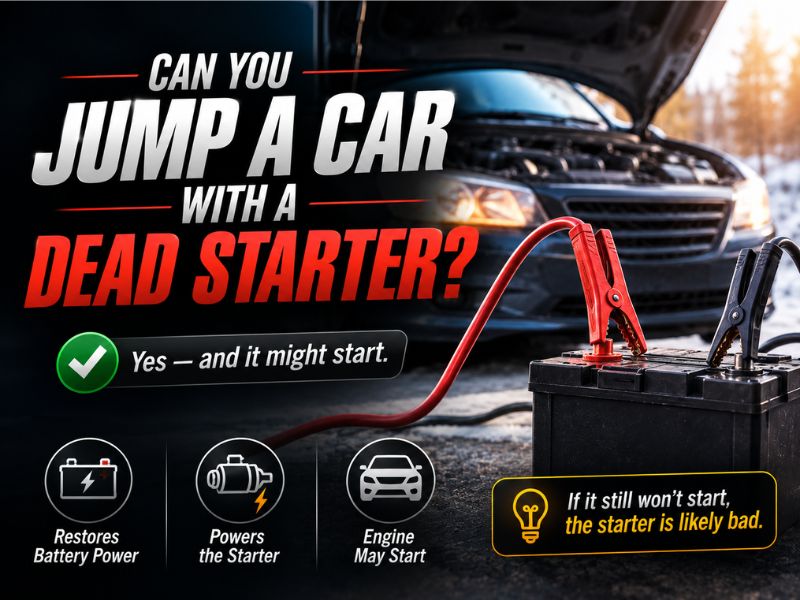
A jump start provides additional electrical power to the vehicle’s starting system.
Clore Automotive describes a portable jump starter as essentially providing auxiliary power to the vehicle’s starting battery, similar to adding a temporary backup battery. Its purpose is to supply the high current needed when the vehicle battery cannot adequately support cranking.
The starting process still depends on several components working together:
Battery → cables and connections → starter solenoid/control circuit → starter motor → engine cranking
If the battery is weak, a booster may provide the missing electrical energy.
If the starter motor has an internal open circuit, failed solenoid, damaged drive, or another genuine mechanical/electrical failure, adding another battery does not correct that failure. DENSO’s troubleshooting guidance specifically lists defective starter solenoid coils and worn solenoid contacts among conditions requiring starter replacement.
Dead Battery vs. Dead Starter: The Critical Difference
Many drivers describe any no-start condition as a “dead starter,” but battery and starter failures can produce overlapping symptoms.
The easiest way to think about the difference is to pay attention to what happens when you turn the key or press the start button.
| Starting Symptom | More Likely Possibilities | Will a Jump Help? |
| Slow engine cranking | Weak battery, resistance in cables, faulty starter | Often, if battery-related |
| Rapid clicking | Low battery voltage or connection problem | Often possible |
| One solid click, no crank | Starter/solenoid, cables, battery | Maybe—diagnosis needed |
| No click and no crank | Control circuit, switch, relay, wiring, battery | Maybe, depending on cause |
| Strong normal crank but engine won’t start | Fuel, ignition, compression, engine management | Usually not |
| Starter spins but engine doesn’t turn | Starter drive/over-running clutch problem | No |
DENSO identifies a dead battery, loose connections, defective starter components, and mechanical engine problems as separate causes of an engine that will not crank. It also states that a starter that spins without cranking the engine can have a defective over-running clutch requiring starter repair or replacement.
Can a Jump Start Work if the Starter Is Weak?
Sometimes.
A starter does not always fail completely in one moment. An aging starter may develop increased internal resistance, worn contacts, or other deterioration that makes it harder to crank the engine.
If the vehicle battery is also somewhat weak, adding a jump starter may temporarily provide enough electrical support for the starter to operate.
That does not prove the starter is healthy.
Delco Remy recommends beginning starting-system diagnosis with the battery and cable circuit. If the battery and cables test correctly but the engine continues to crank slowly, its troubleshooting procedure points toward the starter as the problem.
So if a car repeatedly requires a jump despite having a healthy, charged battery, the starting system deserves proper testing rather than increasingly powerful jump-start attempts.
What if You Hear One Click but the Engine Does Not Crank?
A single click can be an important clue.
Delco Remy classifies this as a click/no-crank condition: the starter solenoid clicks, but the starter does not turn the engine. Its diagnostic procedure still begins with testing the battery and checking voltage drop through the starting circuit because weak power delivery can produce a similar symptom.
This means you should not immediately conclude:
One click = bad starter.
A discharged battery, poor battery terminal, bad ground connection, excessive cable resistance, or starter fault can all require investigation.
Trying a properly connected jump starter can therefore be useful diagnostically.
If the engine suddenly cranks normally, battery condition or electrical supply deserves closer attention.
If a known-good battery or correctly sized jump source makes no meaningful difference and the starter circuit checks out, the starter itself becomes much more suspicious.
What if There Is No Click at All?
No click and no crank does not automatically mean the starter motor is dead.
Delco Remy notes that with a no-click/no-crank symptom, power may not be reaching the solenoid at all, making the starter motor itself less likely to be the immediate cause until the control circuit is checked.
Possible areas include the starting-control circuit, switch, relay, wiring, interlocks, connections, and battery supply.
DENSO similarly lists poor key/start-switch contacts and electrical connection problems among possible causes when an engine will not crank.
A jump starter only helps if insufficient battery power is the underlying issue.
If the starter is never receiving the command to operate, adding battery capacity will not necessarily change anything.
What if the Starter Spins but the Engine Does Not Turn?
A jump start usually will not help.
The starter motor can sometimes be heard spinning rapidly without actually rotating the engine. DENSO identifies a defective over-running clutch as a potential cause when the starter spins but the engine does not crank, with starter repair or replacement required.
This is a mechanical engagement problem rather than a lack-of-battery-power problem.
Supplying another several hundred starting amps cannot make a physically defective starter drive properly engage the flywheel.
That distinction prevents wasted time repeatedly boosting a battery that is not responsible.
Why a Stronger Jump Starter Cannot Fix a Failed Starter
Jump starters are frequently marketed by amperage, which can create the impression that an extremely powerful booster can overcome almost any starting problem.
It cannot.
A high-output jump starter can provide more available cranking current when the vehicle battery is weak or discharged. Clore’s commercial jump starters, for example, are specifically designed to deliver substantial cranking power to vehicle starting systems.
But available current and functioning starter components are two different things.
If the starter’s solenoid contacts are burned away, its internal circuit is open, its drive mechanism has failed, or the starter motor is mechanically damaged, increasing available battery current does not repair those components. DENSO’s diagnostic chart identifies these as starter faults requiring corrective repair rather than battery boosting.
Could the Battery Be Making a Good Starter Look Dead?
Absolutely.
Starters draw very high current, so battery condition and connection quality are critical.
Bosch notes that inadequate battery capability can decrease starter performance, produce starter malfunctions, cause inadequate cold starting, and create substantial voltage drop during high-current demand.
DENSO recommends checking the battery, battery cables, engine grounds, starter connections, and related electrical connections before drawing conclusions about starter condition.
This is why replacing a starter without testing the battery and cables can lead to an unnecessary repair.
A badly corroded battery terminal can create symptoms that resemble starter failure even though the starter itself is functional.
A Jump Start Can Be a Useful Diagnostic Clue
Trying a jump start can tell you something, provided it is done correctly and safely.
If the engine was cranking very slowly and suddenly cranks strongly with a booster attached, the added electrical power clearly changed the starting-system behavior. That shifts attention toward the battery, state of charge, or power-delivery circuit.
If nothing changes at all, you have not automatically proven the starter is bad—but a simple weak-battery explanation becomes less convincing.
Delco Remy’s diagnostic sequence is useful here: first verify the battery, then evaluate voltage drop in the cables and starter circuit, and only then determine whether starter replacement is appropriate.
That is a much more reliable approach than repeatedly trying bigger jump packs.
How to Tell if the Starter Is Actually Bad
Starter diagnosis should be systematic.
DENSO recommends testing the battery and connections as part of starting-system diagnosis and evaluating the starter only after those supporting systems have been considered.
A starter becomes increasingly suspicious when:
The battery is properly charged and passes appropriate testing.
Battery terminals and starter cables are clean and secure.
Voltage drop through the starting circuit is within specification.
The starter receives the proper command.
Yet the engine still does not crank or cranks abnormally slowly.
Delco Remy’s guidance states that if battery and cable checks are within specification and a slow-crank condition remains, starter replacement is indicated.
Don’t Confuse a No-Crank With a Crank-No-Start
This distinction can save a great deal of diagnostic time.
A no-crank condition means the starter is not rotating the engine normally.
A crank-no-start condition means the starter is turning the engine, but the engine never begins running.
If your engine cranks at normal speed when you turn the key, the starter is already doing its primary job.
Jumping the battery is unlikely to fix a strong crank-no-start unless battery voltage is falling enough during cranking to interfere with other electrical systems.
The problem may instead involve fuel delivery, ignition, compression, sensors, or engine management.
Do not replace the starter simply because the car “won’t start.”
What About a Completely Dead Vehicle Battery?
This is where a jump starter is actually designed to help.
Some modern boosters can assist vehicles with extremely discharged batteries. Clore, for example, specifies an override feature on certain models that can engage when connected to a battery reading near 0.0V, provided the operator has confirmed correct connections and follows the manufacturer’s procedure.
That capability applies to a dead vehicle battery, not a dead starter motor.
The difference is fundamental:
A discharged battery lacks stored electrical energy.
A failed starter has a component fault.
A jump starter supplies energy. It does not repair components.
Should You Keep Trying to Crank a Suspected Bad Starter?
Repeated extended attempts are usually not useful once it is clear the starting system is malfunctioning.
Starter motors and their wiring carry substantial current. Bosch notes that improper battery and circuit conditions can contribute to starter overheating and internal damage.
If a properly charged battery or jump source does not produce normal cranking, stop treating the problem as simply “needs more amps.”
Check the battery, terminals, grounds, cables, starter control circuit, and starter according to the vehicle manufacturer’s diagnostic procedure.
Repeatedly boosting a vehicle with a genuine starter fault can waste battery energy without addressing the failure.
Can You Drive the Car Once It Starts?
If a marginal starting system happens to work once, do not assume the problem has disappeared.
A starter is primarily needed to crank the engine. Once the engine is running, the starter disengages, so a vehicle with an intermittent starter fault may continue running normally until you shut it off.
The problem is what happens next.
If the starter fails completely after you park, you may not be able to restart the engine.
Treat an intermittent no-crank or click/no-crank problem as a fault requiring diagnosis rather than relying on repeated jump starts.
Frequently Asked Questions
Can You Jump a Car if the Starter Motor Is Completely Dead?
Usually not. A jump starter supplies additional battery power, but a genuinely failed starter motor or solenoid requires repair or replacement. DENSO lists defective starter components separately from a dead battery in its no-crank troubleshooting procedure.
Will a Jump Starter Help a Weak Starter?
Possibly, especially if the battery is also weak. However, if the battery and cables test correctly and the vehicle still cranks slowly, Delco Remy’s diagnostic guidance points toward the starter itself.
Why Does My Car Click but Not Start Even With Jumper Cables?
A click/no-crank condition can involve battery power, cable resistance, the solenoid, or the starter. Battery and voltage-drop testing are needed before identifying the failed component.
Does No Click Mean the Starter Is Bad?
Not necessarily. Delco Remy says a no-click/no-crank condition can mean power is not reaching the starter solenoid, so the control circuit should be checked.
Can a Bad Battery Look Like a Bad Starter?
Yes. Low battery power can reduce starter performance, and poor cable or ground connections can cause no-crank and slow-crank symptoms.
Why Does My Starter Spin but Not Turn the Engine?
A defective starter over-running clutch can allow the starter to spin without properly cranking the engine. DENSO recommends checking the clutch and replacing the starter when necessary.
Will a 3000-Amp Jump Starter Start a Car With a Bad Starter?
Not if the starter has a genuine internal or mechanical failure. High jump-starter output provides additional electrical current; it does not repair defective starter components.
How Can I Tell Whether the Battery or Starter Is Bad?
Begin by checking battery condition, terminals, grounds, and cable voltage drop. If those are within specification but the engine still cranks slowly or the starter fails its tests, the starter becomes the likely fault.
If the Car Cranks Normally, Is the Starter Bad?
A starter that cranks the engine strongly and normally is performing its main function. A crank-no-start condition generally requires diagnosis beyond simply blaming the starter.
Should I Replace the Starter if Jumping Doesn’t Work?
Not automatically. Verify battery condition, connections, grounds, starter-circuit voltage drop, and control signals first. DENSO and Delco Remy both recommend systematic diagnosis before starter replacement.
Can You Jump a Car With a Dead Starter Overall?
You generally cannot jump a car with a truly dead starter because a jump start only supplies additional electrical power—it does not repair a failed starter motor, solenoid, or starter-drive mechanism. DENSO’s troubleshooting guidance distinguishes battery problems from starter-component failures and recommends starter replacement when defective internal components are identified.
A jump is still worth considering when you do not yet know whether the starter is actually dead. A weak battery, corroded terminal, poor ground, or excessive cable resistance can create symptoms that closely resemble starter failure, and additional battery power may temporarily restore normal cranking.
Pay attention to the symptom. Slow cranking often warrants battery and cable testing first. A single click with no crank requires both power-delivery and starter checks. No click may point toward the control circuit, while a starter that spins without turning the engine can have a mechanical starter-drive fault.
The practical rule is simple: a jump starter can rescue a weak battery, but it cannot rescue a mechanically or electrically failed starter. If a properly charged battery and sound starting circuit still cannot make the starter crank the engine normally, the next step is diagnosis and repair—not a bigger jump pack.