A dead or chronically undercharged car battery can turn a normal morning into a roadside problem, but choosing the right charger is not simply a matter of buying the model with the highest amp rating.
Battery chemistry, capacity, charging speed, temperature compensation, maintenance capability, low-voltage recovery, and safety protections all matter.
For most owners, the ideal charger is one that can safely recharge a low battery and then automatically transition into a maintenance mode without requiring constant supervision.
My primary recommendation is the NOCO GENIUS1 1A Smart Car Battery Charger. It is compact, supports both 6V and 12V systems, works with several lead-acid battery types as well as compatible lithium batteries, and functions as a charger, maintainer, and desulfator.
Its 1A output is deliberately slow, so I consider it especially good for routine maintenance, smaller batteries, seasonal vehicles, and owners who care more about battery preservation than rapid recovery.
For long-term maintenance, the Battery Tender Junior 12V 750mA Charger and Maintainer is another exceptionally established option. Its low charging rate makes it much better suited to maintaining a healthy battery or servicing smaller-capacity batteries than rapidly recharging a large, deeply discharged automotive battery.
If you want more practical output for a typical passenger-car battery, the Battery Tender Plus 12V 1.25A Battery Charger and Maintainer provides additional charging capability while retaining the automatic float-maintenance behavior that makes a smart charger useful for vehicles stored for weeks or months.
The 15 products below are ordered primarily by current buyer-feedback volume, from higher to lower, while remaining relevant to automotive battery charging or maintenance. Because that ranking method places some extremely popular low-amperage maintainers ahead of faster chargers, I explain exactly who each model suits rather than pretending every charger serves the same purpose.
Read More: Best Portable Car Battery Charger
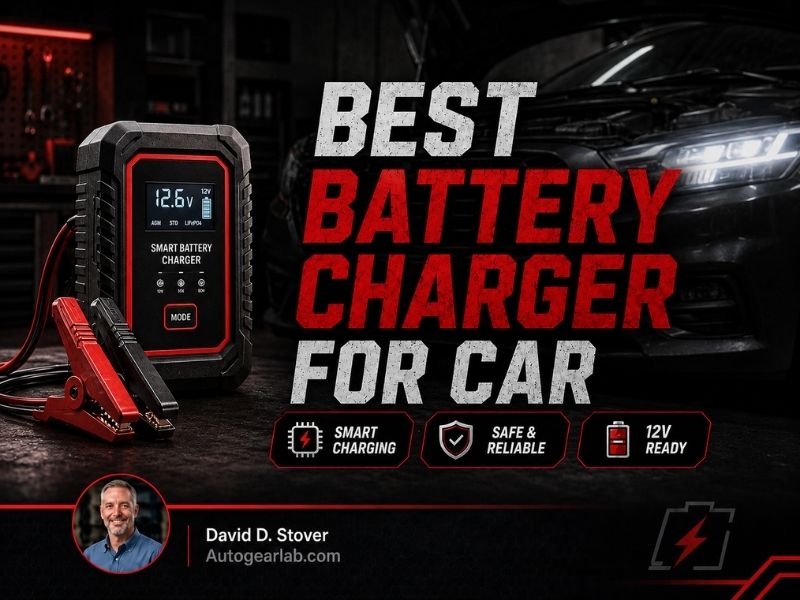
The table reveals an important point: popularity and charging speed are not the same thing. The first few chargers have enormous ownership histories because maintainers are inexpensive, easy to use, and needed by motorcycles, collector cars, seasonal vehicles, lawn equipment, and cars that are driven infrequently. A driver who routinely needs to replenish a partially discharged 60Ah or 80Ah automotive battery should normally choose a 5A or 10A model instead of expecting a 0.75A or 1A charger to work quickly.
15 Best Battery Charger for Car At a Glance
| Image | Product Name | Check Price |
|---|---|---|
Best Choice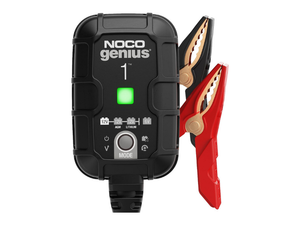 | NOCO GENIUS1 1A Smart Car Battery Charger | Check Price |
Second Best | Battery Tender Junior 12V 750mA Charger and Maintainer | Check Price |
Third Choice | Battery Tender Plus 12V Battery Charger and Maintainer | Check Price |
 | NOCO GENIUS10 10A Smart Battery Charger | Check Price |
 | NOCO GENIUS5 5A Smart Car Battery Charger – | Check Price |
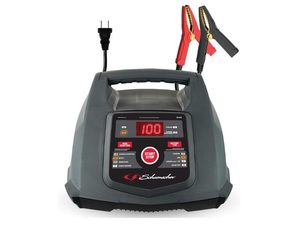 | Schumacher Automatic Charger and Engine Starter | Check Price |
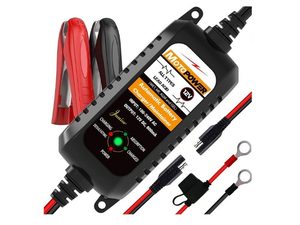 | MOTOPOWER 12V 800mA Battery Charger Maintainer | Check Price |
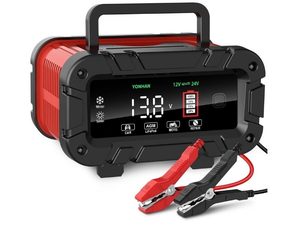 | YONHAN 10A 12V/24V Smart Car Battery Charger | Check Price |
 | NEXPEAK NC201 10-Amp Smart Battery Charger | Check Price |
 | NOCO Direct-Mount Onboard Battery Charger | Check Price |
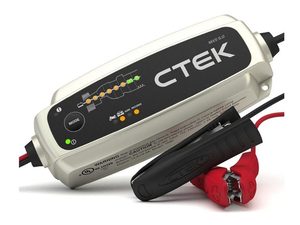 | CTEK MXS 5.0 4.3A Battery Charger and Maintainer | Check Price |
 | TowerTop 2/10/25A 12V Smart Battery Charger | Check Price |
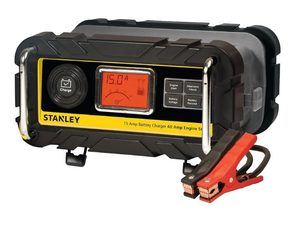 | STANLEY BC15BS 15A Automatic Battery Charger | Check Price |
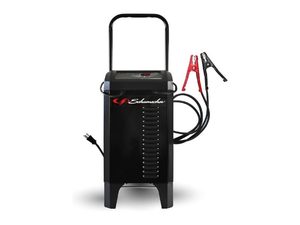 | Schumacher Electric SC1309 Battery Charger and Engine Starter | Check Price |
15 Best Battery Charger for Car Reviewed
1. NOCO GENIUS1 1A Smart Car Battery Charger – Most Popular Compact Pick
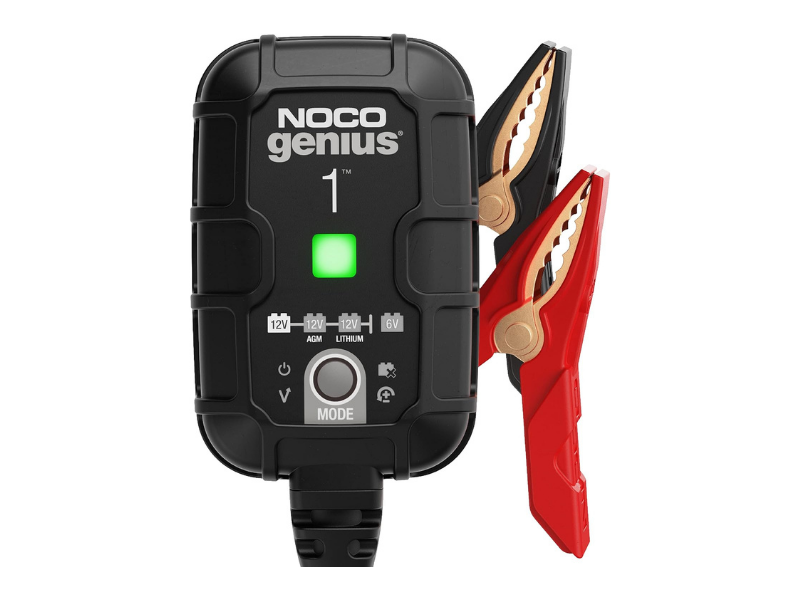
The NOCO GENIUS1 earns the first position because it combines an exceptionally established ownership history with a compact design and broad battery compatibility. It is a 1-amp smart charger, maintainer, and battery desulfator that works with 6V and 12V systems.
Key features: 1A charging output, 6V and 12V support, flooded lead-acid, AGM, EFB, gel, maintenance-free and compatible lithium modes, temperature compensation, maintenance charging, low-voltage recovery, reverse-polarity protection, spark protection, overcharge protection, and automatic charging control.
The most important thing to understand is that GENIUS1 is intentionally slow. Its standard charging capacity is designed around batteries up to roughly 30Ah, although its maintenance function can be used with larger batteries once they are charged. A normal passenger-car battery may be 40Ah, 60Ah, 70Ah, or larger, so restoring a substantially discharged battery with only one amp can take many hours.
That limitation does not make GENIUS1 a poor car charger. It simply changes its role. I see it as an excellent choice for a collector car, weekend vehicle, convertible, second car, generator, motorcycle, lawn tractor, or vehicle that spends substantial time in storage.
Temperature compensation is particularly valuable because charging voltage should not remain identical in every environment. Batteries generally require different charging behavior in a freezing garage than during summer heat. The charger automatically adjusts rather than expecting the owner to calculate the correct voltage.
Another advantage is support for very low battery voltage through a manual force function. Smart chargers normally need to detect battery voltage before beginning a normal charging cycle. When voltage falls below that detection threshold, an override can sometimes allow charging to begin.
Repair functionality may help certain sulfated or stratified lead-acid batteries, but it should never be interpreted as a guarantee that an old battery can be restored. Batteries with internal shorts, physical plate deterioration, severe sulfation, damaged cases, or failed cells require replacement.
What I like: Small footprint, broad chemistry support, automatic maintenance, excellent safety protections, temperature-aware charging, low power consumption, and easy long-term storage.
What I do not like: One amp is slow for a conventional car battery, it is not designed for rapid roadside recovery, and owners of large automotive batteries will often be happier with the GENIUS5 or GENIUS10.
Verdict: An outstanding maintenance-focused charger, particularly when slow, controlled charging is more valuable than speed.
2. Battery Tender Junior 12V 750mA Charger and Maintainer – Best Long-Term Maintainer
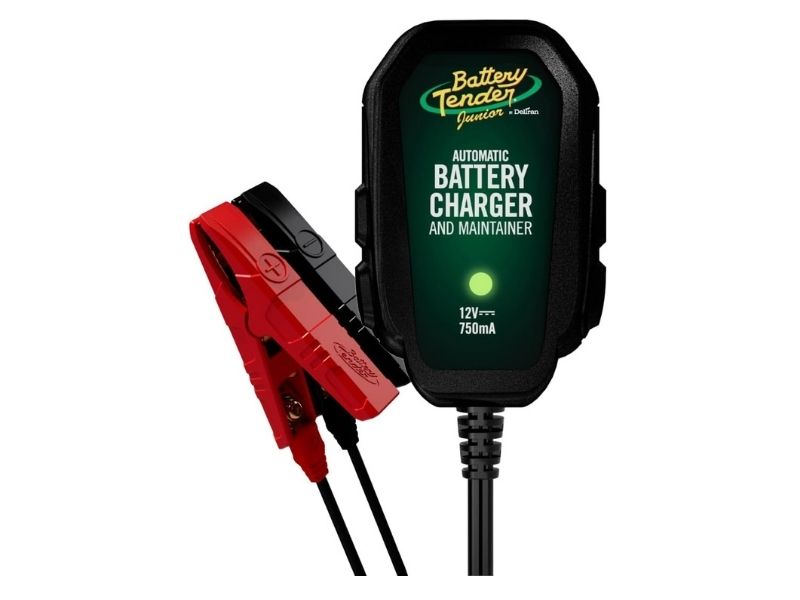
The Battery Tender Junior is one of the simplest products in this guide, and that simplicity is exactly why so many owners use it.
Its 750mA output is substantially lower than a modern 5A or 10A automotive charger. It is therefore best understood as a battery maintainer that can also charge smaller 12V lead-acid batteries, not as the tool I would choose to rapidly revive a deeply discharged full-size car battery.
Key features: 12V output, 750mA charging, automatic charging and float maintenance, compatibility with standard lead-acid, AGM, gel, and sealed batteries, quick-disconnect leads, alligator clips and ring-terminal connection options, and automatic charge management.
The ideal application is a battery that is fundamentally healthy but belongs to a vehicle that does not run often. Modern vehicles continue consuming small amounts of current even when switched off. Security systems, keyless-entry receivers, control modules, data memory, telematics equipment, and aftermarket accessories can gradually lower battery state of charge.
Leaving a battery chronically undercharged encourages sulfation and reduces starting reliability. A smart maintainer compensates for these small losses and keeps the battery close to full charge.
For a frequently parked sports car, classic vehicle, seasonal convertible, or spare car, that can be more useful than owning an enormous charger that only comes out after the battery is already flat.
The Junior is less appropriate when a 60Ah automotive battery has been heavily discharged. At 0.75A, replenishing even 30Ah of missing capacity theoretically requires around 40 hours before efficiency losses and the slower absorption phase are considered.
Another important limitation is chemistry. This particular model is primarily intended for conventional lead-acid battery types. Drivers with LiFePO4 batteries should use a charger explicitly designed for that chemistry.
What I like: Extremely simple operation, excellent for storage, automatic float maintenance, compact design, permanent ring-terminal option, and low charging stress.
What I do not like: Very slow for normal car-battery recovery, 12V only, and not the right choice when lithium compatibility or fast charging is required.
Verdict: One of the strongest options for preventing a stored vehicle from developing a dead battery, but not my preferred solution for fast charging.
3. Battery Tender Plus 12V 1.25A Battery Charger and Maintainer – Best Proven Car Maintainer
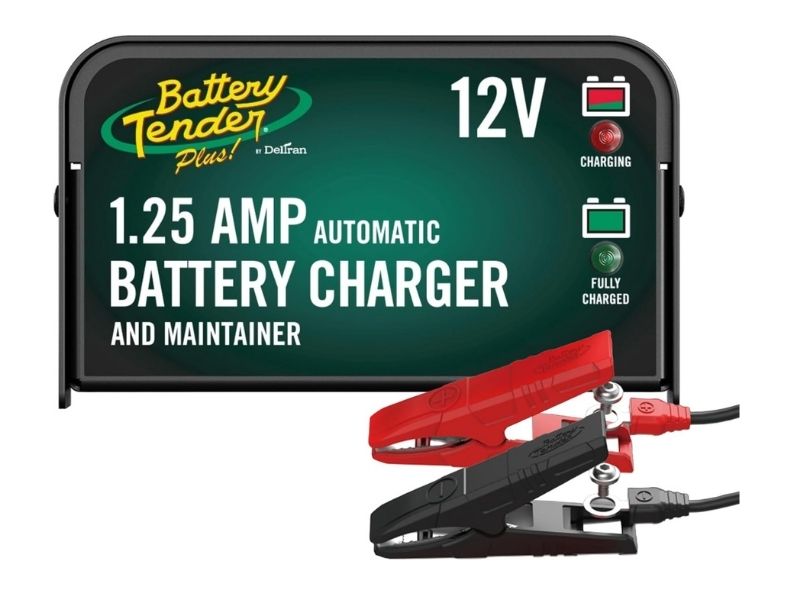
Battery Tender Plus takes the long-term maintenance concept and makes it somewhat more appropriate for automotive batteries.
Its 1.25A output remains gentle, but it offers meaningfully more charging capability than a 750mA maintainer. The manufacturer positions it for automotive batteries up to approximately 80Ah, which covers many passenger cars, compact SUVs, pickups, and light vehicles.
Key features: 12V charging, 1.25A output, automatic multi-step charging, float maintenance, standard lead-acid/AGM/Gel compatibility, quick-disconnect harness, alligator clips, ring terminals, and automatic charge monitoring.
This model makes particular sense when you want to connect a charger and leave it responsible for a vehicle that sits for days or weeks.
During the initial charging stage it replaces missing capacity. As the battery approaches full charge, the charging strategy changes. Once the battery is ready for storage maintenance, the charger monitors voltage instead of continuously forcing current into an already-full battery.
That distinction separates a modern maintainer from the crude trickle chargers many people remember from older garages.
A genuine smart maintainer should not continuously overcharge a healthy battery. It should regulate current and voltage according to battery condition.
At 1.25A, charging speed is still limited. If a 60Ah battery is around 50 percent discharged, approximately 30Ah must be returned. Even before considering charging losses and tapering, that is roughly a full day at this output.
That is acceptable when the vehicle is sitting overnight or through a weekend. It is inconvenient when you need the car again in four hours.
What I like: Proven maintenance-focused design, automotive-friendly capacity range, straightforward connection options, automatic charging behavior, and suitability for long storage periods.
What I do not like: Slow compared with 5A and 10A chargers, limited appeal for drivers who regularly recover discharged batteries, and conventional lead-acid focus.
Verdict: A particularly sensible choice for a second vehicle, collector car, or any automobile that spends long periods parked.
4. NOCO GENIUS10 10A Smart Battery Charger – Best Fast Smart Charger

If I were selecting a charger primarily for restoring discharged automotive batteries rather than maintaining already-charged ones, the GENIUS10 would move near the top of the list.
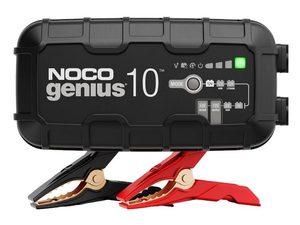
Its 10A output is far more appropriate for full-size automotive batteries. It can charge 6V and 12V batteries and supports lead-acid and compatible lithium chemistries, with a charging capacity extending up to approximately 230Ah.
Key features: 10A charging, 6V/12V operation, flooded, AGM, EFB, gel, maintenance-free and compatible lithium support, temperature compensation, maintenance charging, repair mode, force charging for extremely low batteries, supply mode on supported operation, and comprehensive electronic protections.
Consider a 60Ah battery that is approximately 50 percent discharged. Roughly 30Ah of capacity needs to be restored. A 10A charger can complete most of that bulk charging substantially faster than a 1A maintainer, although the final charging stage slows as the battery approaches full state of charge.
That makes GENIUS10 suitable for a garage where the charger may be used on cars, pickups, SUVs, boats, deep-cycle batteries, lawn equipment, and other vehicles.
Battery chemistry selection matters. AGM batteries have different charging characteristics than conventional flooded batteries, and lithium batteries require their own charging profile. Having dedicated modes reduces the temptation to use one generic voltage strategy across everything.
I also value its temperature compensation. A battery in a freezing garage and a battery sitting in summer heat should not necessarily receive identical charging voltage.
The repair function is useful as an additional tool, not as a reason to keep a structurally failed battery. A charger cannot rebuild missing active material, repair a cracked case, reconnect a failed internal weld, or reverse every form of sulfation.
What I like: Genuine automotive charging speed, broad battery compatibility, high capacity range, smart maintenance, strong safety systems, low-voltage recovery, and useful diagnostic behavior.
What I do not like: Bigger and more expensive than maintenance-only units, unnecessary for tiny powersports batteries unless the correct mode is used, and more charger than occasional maintainers need.
Verdict: My preferred high-output smart option for drivers who actually need to recharge discharged car batteries on a regular basis.
5. NOCO GENIUS5 5A Smart Car Battery Charger – Best Balance for Most Garages
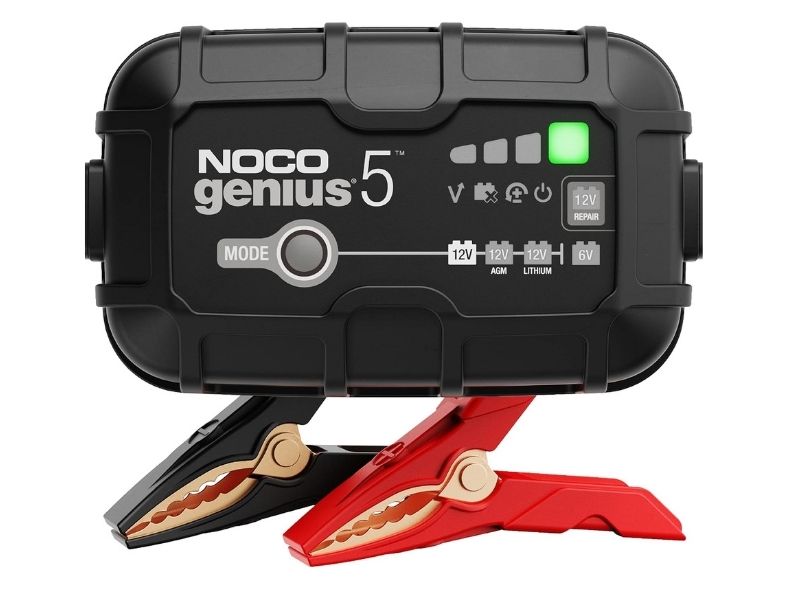
The GENIUS5 may be the sweet spot in this entire category.
Five amps is fast enough to recharge most passenger-car batteries in a reasonable amount of time while remaining compact, easy to store, and suitable for maintenance work.
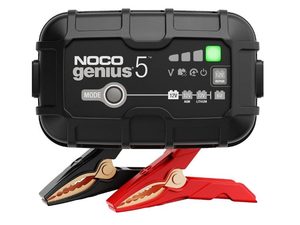
Key features: 5A output, 6V and 12V charging, lead-acid and compatible lithium support, flooded, AGM, EFB, gel and maintenance-free battery modes, temperature compensation, force mode, maintenance charging, repair functionality, reverse-polarity protection, spark protection, overcharge protection, and an IP65-rated housing.
Its stated charging range extends to roughly 120Ah, covering the majority of passenger vehicles and many trucks, recreational vehicles, marine batteries, and deep-cycle applications.
For a 60Ah battery at 50 percent state of charge, approximately 30Ah must be replaced. Dividing that by five amps suggests six hours of ideal bulk charging, but real charging takes longer because conversion is not perfectly efficient and current tapers during later stages. In practice, that still represents a major improvement over waiting a day or more with a 1A charger.
The 5A output is also gentler than an extremely high-current shop charger. That balance makes it an easy product to recommend to someone buying one charger for a home garage.
Its lithium mode is useful for compatible 12V lithium-ion batteries with appropriate battery-management systems. Owners should never assume that every lithium battery can be connected to every lithium-capable charger; battery manufacturer instructions still take priority.
What I like: Excellent charging-speed-to-size ratio, broad compatibility, good safety design, weather-resistant construction, automatic maintenance, and strong versatility.
What I do not like: No full numerical LCD display, 10A models are faster for large batteries, and its multiple modes require owners to identify battery chemistry correctly.
Verdict: If review-count ranking were removed and I had to choose one charger for the average home garage, the GENIUS5 would be one of my strongest all-around choices.
6. Schumacher Electric Fully Automatic Charger and Engine Starter – Best Garage Multi-Function Charger
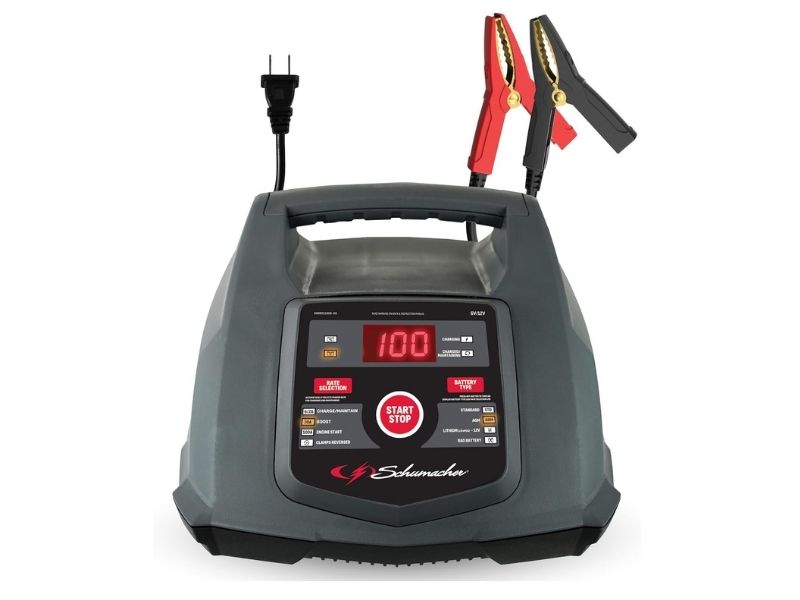
The Schumacher SC1281 is closer to the traditional garage charger many drivers picture when they hear the term battery charger.
Instead of focusing on pocket-size portability, it combines automatic charging, boost capability, engine-start assistance, and battery/alternator diagnostic functions in a larger housing.
Key features: 6V/12V compatibility, automatic charging, standard/AGM/Gel/deep-cycle support, 6A charging function, higher-current boost capability, 100A engine-start assistance, float monitoring, battery testing, alternator testing, digital display, and reverse-hookup protection.
This combination is attractive for a household with several vehicles.
A compact maintainer works well when one battery needs slow charging, but a garage tool becomes more useful when you are troubleshooting whether a no-start condition comes from the battery or charging system.
The engine-start function also differentiates SC1281 from conventional smart maintainers. It can provide a short high-current assist designed to help crank a vehicle after charging conditions are satisfied.
That does not transform it into a portable lithium jump pack because it still requires AC power. Instead, think of it as a bench charger with additional starting capability.
Its physical size and weight are obvious compromises. Drivers who live in apartments or want a charger that fits inside a small drawer will prefer a compact electronic charger.
For a home workshop, however, the larger form factor is less problematic.
What I like: Versatile charging and starting functions, digital display, battery and alternator testing, broad lead-acid compatibility, useful boost mode, and strong garage utility.
What I do not like: Much bulkier than compact chargers, requires wall power for starting assistance, not designed around lithium compatibility, and unnecessary for someone who only maintains one lightly used car.
Verdict: A strong garage-oriented choice for DIY owners who want charging, testing, boosting, and engine-start assistance in one unit.
7. MOTOPOWER 12V 800mA Battery Charger Maintainer – Best Budget Maintainer
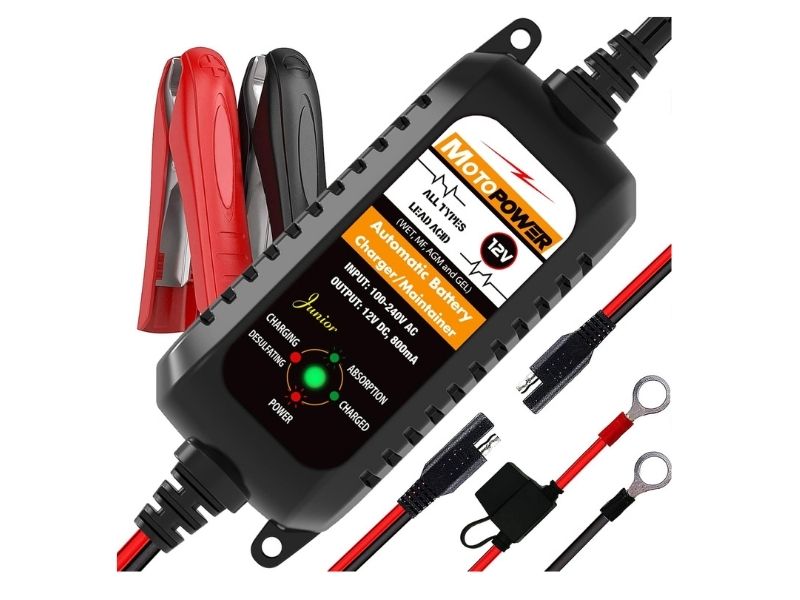
The MOTOPOWER MP00205A is a small 800mA automatic charger and maintainer designed for 12V lead-acid batteries.
Its appeal is straightforward: it provides the core functions many stored vehicles need without the size or output of a larger charger.
Key features: 12V charging, 800mA output, flooded/AGM/Gel battery support, automatic maintenance, automatic desulfation behavior, overcharge protection, reverse-polarity protection, short-circuit protection, spark-resistant connection behavior, ring terminals, and alligator clamps.
Like Battery Tender Junior, this is not a fast automotive recovery charger.
Eight-tenths of an amp is ideal for maintenance and smaller batteries. On a large partially discharged vehicle battery, patience is required.
The desulfation function may help reduce certain early sulfation effects, particularly when a lead-acid battery has spent time below full state of charge. However, consumers should be skeptical of any claim suggesting pulse repair can return every old battery to new condition.
Battery failure is not caused by one mechanism. Grid corrosion, electrolyte loss, shedding of active material, internal shorts, damaged separators, and irreversible sulfation are all possible.
The simplicity of MOTOPOWER is an advantage for owners who do not want multiple modes or a complicated display. Connect it correctly, provide AC power, and allow the charging electronics to manage the process.
What I like: Low cost, compact dimensions, useful maintenance function, automatic operation, included connection options, and suitable output for seasonal batteries.
What I do not like: Too slow for frequent full-size car-battery recovery, 12V-only design, limited advanced diagnostics, and basic indicators compared with LCD-equipped chargers.
Verdict: Excellent for inexpensive preventive maintenance, particularly when charging speed is not important.
8. YONHAN 10A 12V/24V Smart Car Battery Charger – Best Value 10A Charger
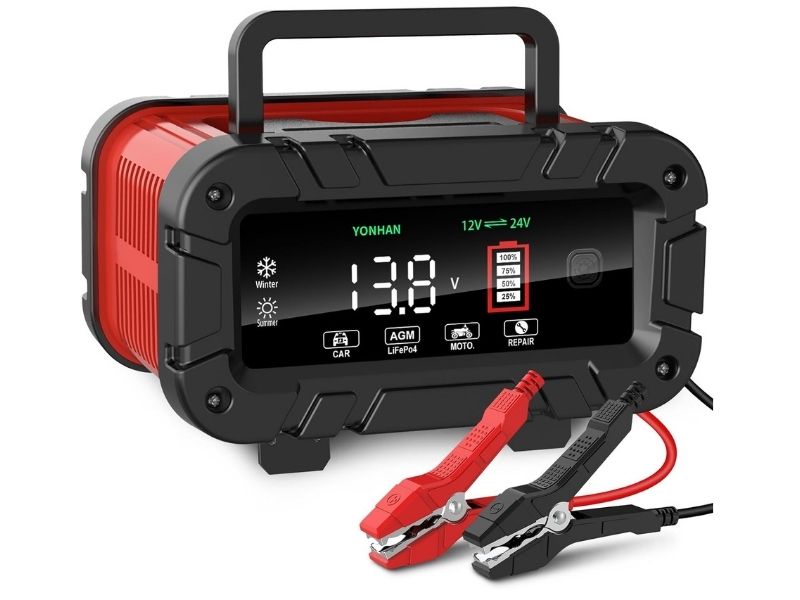
YONHAN approaches the category very differently from the small maintainers above.
This charger provides up to 10A charging for 12V applications while also supporting 24V lead-acid systems, making it useful for cars, trucks, SUVs, marine batteries, equipment, and other applications.
Key features: 12V and 24V operation, up to 10A charging, LCD information display, automatic charging stages, temperature compensation, AGM/Gel/SLA/flooded lead-acid support, maintenance functionality, winter behavior, repair mode, overcharge protection, reverse-polarity protection, overcurrent protection, and short-circuit protection.
The combination of a numerical display and stronger output makes it attractive for DIY owners.
Instead of simply looking at a red or green indicator, you can monitor information such as charging voltage, current, battery percentage estimates, temperature information, or operating mode depending on the stage.
Ten amps also turns this into a genuinely useful recovery charger for typical automotive capacities.
One caution is chemistry compatibility. This model should be treated primarily as a lead-acid charger unless the exact product version explicitly identifies a lithium mode. Product revisions can change, so always identify the battery and match it to the printed charger instructions before connecting.
Its repair function is primarily relevant to lead-acid batteries and should not be used as a universal recovery solution.
What I like: High output for the size, 12V/24V versatility, informative display, temperature-aware operation, maintenance capability, and strong value.
What I do not like: Interface and documentation may feel less polished than premium competitors, clamp size is relatively compact, and users must choose modes carefully.
Verdict: One of the most attractive options when you want 10A charging and a detailed display without moving to a large shop charger.
9. NEXPEAK NC201 10-Amp Smart Battery Charger – Best Digital 12V/24V Pick
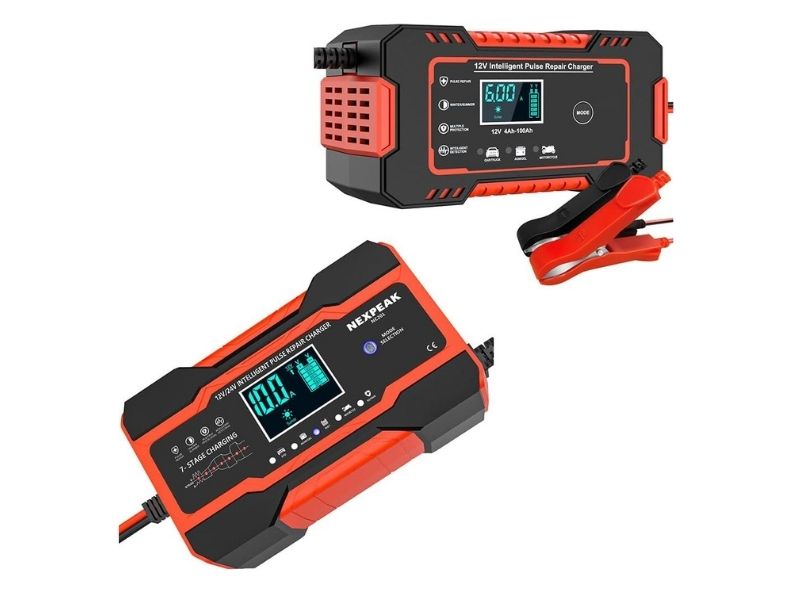
NEXPEAK NC201 competes directly with YONHAN by offering 10A 12V charging and approximately 5A 24V charging in a compact smart-charger format.
Key features: 12V/24V operation, 10A 12V charging, 5A 24V charging, seven-stage automatic process, large LCD, AGM/Gel/SLA/flooded battery compatibility, trickle-maintenance behavior, pulse repair, temperature compensation, cooling system, reverse-polarity protection, overcurrent protection, overcharge protection, and short-circuit protection.
The NC201 makes sense for a driver who wants to see what the charger is doing.
Voltage is especially useful. A battery-percentage estimate is convenient, but resting voltage and a proper battery test can provide more meaningful diagnostic information than a graphical percentage indicator alone.
Temperature compensation is another valuable feature because battery electrochemistry changes with temperature. A charger that can adjust its strategy is more sophisticated than a fixed-voltage device.
Its 24V support increases versatility for commercial equipment and paired-battery systems, although owners must still understand the configuration before connecting.
Repair mode again deserves realistic expectations. It can be useful for some neglected lead-acid batteries, but it cannot restore a battery with physical damage or a failed cell.
What I like: Useful LCD, strong 10A output, 12V and 24V compatibility, intelligent charging stages, temperature compensation, maintenance function, and good safety coverage.
What I do not like: Not intended as a lithium charger, display visibility can vary with lighting, cooling-fan noise may be noticeable, and the included leads are not unusually long.
Verdict: A very capable value charger for drivers who want fast charging plus real-time information rather than simple status lights.
10. NOCO GENIUS2D 2A Direct-Mount Onboard Battery Charger – Best Onboard Car Charger
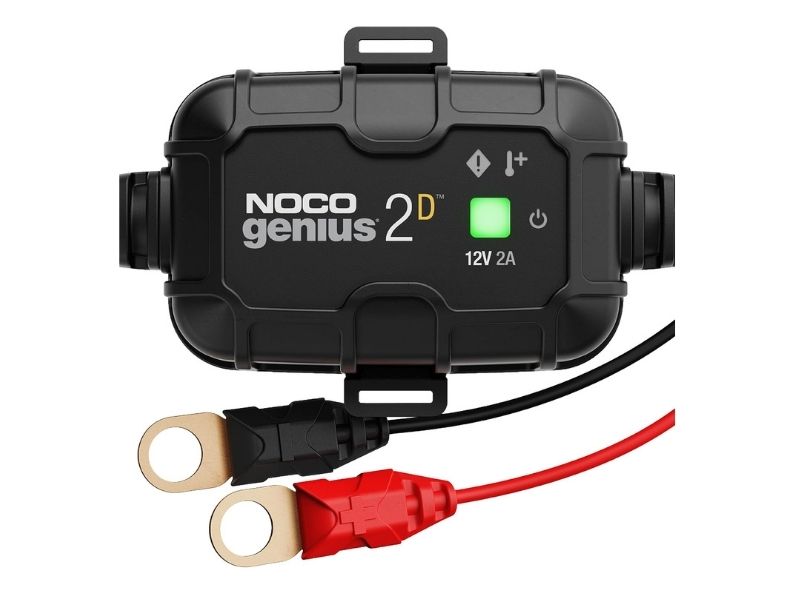
The GENIUS2D is unusual because it is designed to be mounted directly in the vehicle rather than repeatedly carried between batteries.
Its 2A output and integrated ring-terminal configuration make it particularly useful for vehicles that spend long periods parked near an electrical outlet.
Key features: 2A 12V charging, permanent direct-mount design, lead-acid/AGM/Gel/EFB/maintenance-free compatibility, automatic maintenance, temperature compensation, desulfation behavior, spark protection, reverse-polarity protection, and weather-resistant construction.
A permanently installed charger eliminates one of the biggest barriers to regular battery maintenance: setup.
Instead of opening a storage case, finding clamps, attaching them to the correct terminals, and arranging the charger every time the vehicle is parked, the onboard unit remains connected to the battery. When maintenance is needed, the owner simply provides AC power according to the installation instructions.
That is especially useful for collector vehicles, RVs, work trucks, emergency vehicles, seasonal automobiles, and cars with persistent parasitic loads.
Two amps is not particularly fast, but it is a meaningful step above sub-1A maintainers.
The obvious limitation is flexibility. A direct-mounted charger is essentially dedicated to one vehicle. If you have four cars and want one charger that moves between them, GENIUS5 or GENIUS10 is more economical.
What I like: Permanent installation, automatic maintenance, weather resistance, thermal compensation, clean setup, and good safety protections.
What I do not like: 12V lead-acid focus, slow compared with 5A or 10A chargers, and less useful as a shared garage tool.
Verdict: The best choice here for owners who want charging hardware permanently installed on one vehicle.
11. CTEK MXS 5.0 4.3A Battery Charger and Maintainer – Best Premium Lead-Acid Care
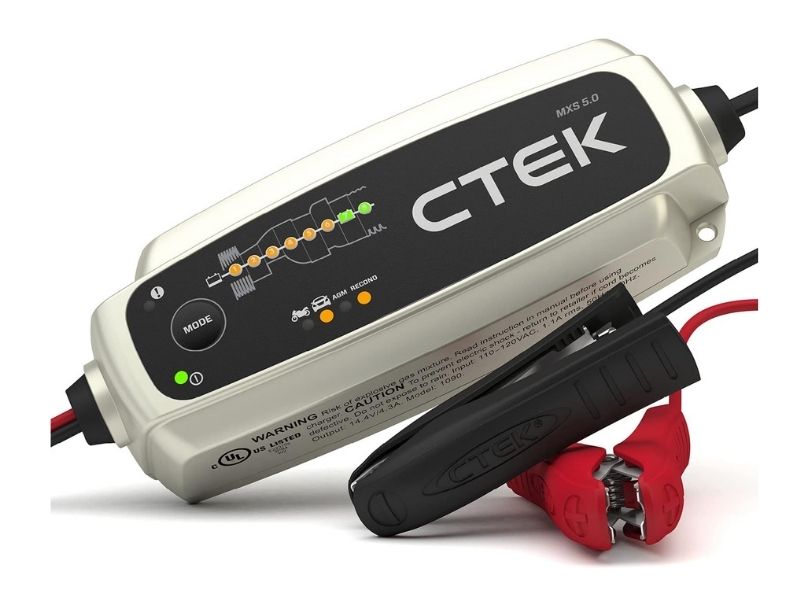
The CTEK MXS 5.0 is designed around careful 12V lead-acid battery management rather than maximum advertised amperage.
Its output is approximately 4.3A, with an eight-step charging program and dedicated support for many traditional automotive battery types.
Key features: 4.3A output, 12V operation, Wet, MF, Ca/Ca, AGM, EFB and Gel compatibility, eight-step automatic charging, temperature compensation, AGM mode, reconditioning mode, maintenance capability, reverse-polarity protection, spark protection, IP65 protection, and support for charging batteries up to roughly 110Ah while maintaining larger batteries.
This output level is well suited to everyday passenger-car batteries.
It charges considerably faster than maintenance-only products without the additional size associated with high-output garage units.
CTEK’s reconditioning mode is designed for certain deeply discharged lead-acid batteries where acid stratification can become an issue. Again, reconditioning is not equivalent to rebuilding the battery. The feature is useful only when the battery’s underlying physical structure remains viable.
EFB compatibility deserves attention because enhanced flooded batteries are common on vehicles equipped with start-stop systems. Owners sometimes assume that every conventional charger is automatically ideal for an EFB or AGM battery, which is not always the case.
What I like: Sophisticated charging process, excellent lead-acid chemistry coverage, AGM/EFB support, useful reconditioning function, weather resistance, temperature sensing, and premium construction.
What I do not like: Lead-acid focused rather than lithium-oriented, more expensive than many similarly powered chargers, and slower than a true 10A charger.
Verdict: A premium choice for owners who care about controlled lead-acid charging and long-term battery condition.
12. BLACK+DECKER BC15BD 15A Automatic Battery Charger – Best 15A Home Charger
The BLACK+DECKER BC15BD provides significantly more charging current than most compact maintainers in this guide.
Its 15A charging capability is well suited to drivers who want to recover a discharged 12V automotive battery relatively quickly at home.
Key features: 15A automatic charging, 12V automotive application, battery maintenance, engine-start assistance on supported operation, battery reconditioning, alternator-check functionality, digital controls, and automatic charge management.
Fifteen amps can dramatically reduce the bulk-charging portion of the process compared with 1A or 2A equipment.
However, charging time does not scale perfectly. A 15A charger does not necessarily charge a battery three times faster than a 5A charger from empty to completely full because charging current tapers as the battery approaches full state of charge.
The initial bulk phase is where the speed advantage is most noticeable.
Diagnostic functions add value for DIY owners. A weak battery and a weak alternator can produce similar symptoms, so alternator-check functionality provides additional context. It is not a substitute for a professional electrical-system diagnosis, but it can help identify obvious charging-system problems.
What I like: Strong 15A output, faster charging, useful digital interface, maintenance mode, reconditioning capability, and alternator-related diagnostics.
What I do not like: Larger than compact chargers, 12V focus, not my choice for lithium batteries, and less convenient for permanent onboard use.
Verdict: A practical home-garage charger for drivers who prioritize charging speed and diagnostic features.
13. TowerTop 2/10/25A 12V Smart Battery Charger – Best High-Amp Home Charger
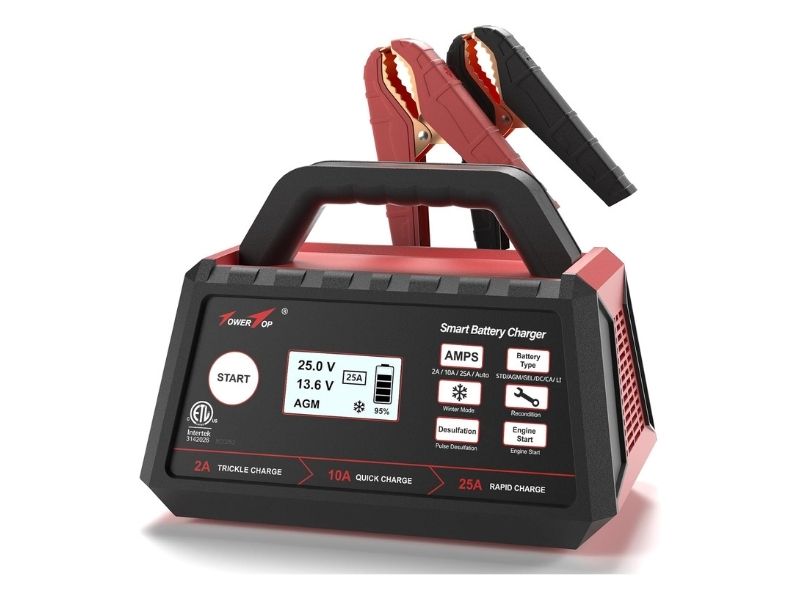
TowerTop offers selectable charging behavior reaching up to 25A, which gives it one of the strongest conventional charging outputs in this roundup.
Key features: 2A, 10A, and 25A charging options, 12V operation, automatic battery-type recognition on supported modes, multi-stage charging, AGM/standard/Gel/deep-cycle support, battery maintenance, winter mode, repair/desulfation functions, and engine-start assistance.
Selectable output is valuable because maximum current is not always desirable.
A small powersports battery does not need the same charge rate as a large automotive deep-cycle battery. Being able to lower current allows the charger to cover a broader range of battery sizes.
At the other end, 25A bulk charging can replenish a large partially discharged battery much faster than a low-output maintainer.
The tradeoff is size, fan noise, and complexity.
High-current chargers produce more heat and require greater attention to ventilation and correct battery selection. Owners should never choose an aggressive charge rate simply because it is available.
What I like: High charging output, multiple rate settings, good home-garage versatility, maintenance function, repair mode, winter operation, and engine-start assistance.
What I do not like: Bigger and louder than passive compact chargers, overkill for routine maintenance, and 12V-only operation limits some commercial applications.
Verdict: A good choice when you regularly charge larger lead-acid batteries and want significantly more speed than a 5A or 10A charger.
14. STANLEY BC15BS 15A Automatic Battery Charger – Best Charger With Engine Start Assist
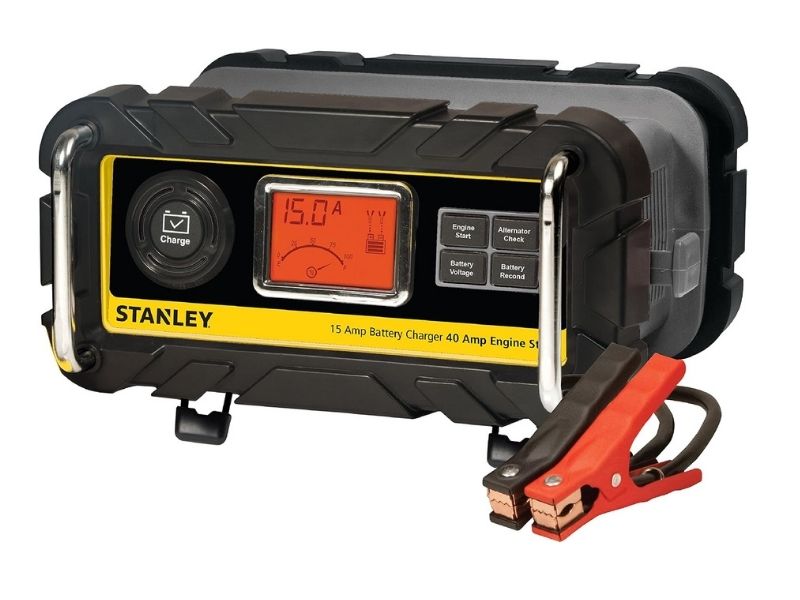
The STANLEY BC15BS combines a 15A automatic charger with maintenance, alternator-check, and approximately 40A engine-start assistance.
It is designed more like a workshop charger than a compact battery tender.
Key features: 15A charging, 12V system compatibility, automatic maintenance, engine-start function, alternator check, digital status information, cable clamps, and protective charging electronics.
The 15A rate is appropriate when you need a substantially discharged car battery ready sooner rather than later.
For a typical automotive battery, it can complete the major bulk-charge phase in a fraction of the time required by a 1A maintainer.
Engine-start assistance is useful when the battery has received some charging but still needs additional current during cranking. Because this is an AC-powered tool, it should not be confused with a self-contained jump starter.
The alternator check provides another useful layer for diagnosing repeat battery problems. If you fully charge a healthy battery but it continues going flat during normal driving, the charging system or a parasitic electrical draw should be investigated.
What I like: Good charging speed, engine-start assistance, alternator check, automatic maintenance, straightforward garage format, and digital monitoring.
What I do not like: Larger footprint, no emphasis on lithium charging, 12V-only focus, and less portable than modern compact chargers.
Verdict: Well suited to a garage where charging speed and occasional starting assistance matter more than minimum size.
15. Schumacher Electric SC1309 Battery Charger and Engine Starter – Best Heavy Garage Charger

The Schumacher SC1309 is the largest and most workshop-oriented product in this group.
It combines 15A charging, higher-current boost capability, and a 200A engine-start mode with a wheeled chassis and long-reach cables.
Key features: automatic 12V charging, 15A charging output, 40A boost function, 200A engine-start capability, standard/AGM/deep-cycle battery compatibility, float-mode monitoring, digital controls, long output cables, heavy-duty clamps, retractable handle, and wheels.
For occasional household maintenance this is unnecessarily large.
For a garage with trucks, SUVs, project vehicles, tractors, or several batteries that occasionally become deeply discharged, the physical size becomes less of a disadvantage.
The wheeled design allows the charger to live beside a workbench and roll to the vehicle when needed.
The 40A boost mode provides significantly more current than standard charging and can help bring a deeply discharged battery toward a usable condition more quickly. Engine-start mode then provides brief high current for cranking assistance.
Those high-current modes demand correct use. They are not appropriate for every battery or every situation, so following the mode timing and connection instructions is essential.
What I like: Heavy-duty construction, powerful charging and boost capabilities, engine-start assistance, long cables, wheels, automatic charging, and good workshop usability.
What I do not like: Large, heavy, unnecessary for simple maintenance, requires significant storage space, and does not provide the battery-chemistry versatility of modern lithium-compatible compact chargers.
Verdict: The strongest choice here for a dedicated home workshop where portability is secondary to power and accessibility.
Quick Comparison of the 15 Best Car Battery Chargers
| Rank | Product | Main Output | Voltage | Battery Types | Maintainer | Repair/Desulfation | Best Use |
| 1 | NOCO GENIUS1 | 1A | 6V/12V | Lead-acid, AGM, EFB, Gel, compatible lithium | Yes | Yes | Maintenance and smaller batteries |
| 2 | Battery Tender Junior | 0.75A | 12V | Lead-acid, AGM, Gel, sealed | Yes | Maintenance focused | Stored vehicles and smaller batteries |
| 3 | Battery Tender Plus | 1.25A | 12V | Lead-acid, AGM, Gel | Yes | Maintenance focused | Cars stored for extended periods |
| 4 | NOCO GENIUS10 | 10A | 6V/12V | Lead-acid, AGM, EFB, Gel, compatible lithium | Yes | Yes | Fast all-around automotive charging |
| 5 | NOCO GENIUS5 | 5A | 6V/12V | Lead-acid, AGM, EFB, Gel, compatible lithium | Yes | Yes | Best balance for most garages |
| 6 | Schumacher SC1281 | 6A charge / boost / start functions | 6V/12V | Standard, AGM, Gel, deep-cycle | Yes | Desulfation capability | Garage and diagnostic use |
| 7 | MOTOPOWER MP00205A | 0.8A | 12V | Flooded, AGM, Gel lead-acid | Yes | Automatic desulfation | Affordable maintenance |
| 8 | YONHAN 10A Smart Charger | Up to 10A | 12V/24V | AGM, Gel, SLA, flooded lead-acid | Yes | Repair mode | Value-focused fast charging |
| 9 | NEXPEAK NC201 | 10A 12V / 5A 24V | 12V/24V | AGM, Gel, SLA, flooded lead-acid | Yes | Pulse repair | Cars, trucks, marine batteries |
| 10 | NOCO GENIUS2D | 2A | 12V | Lead-acid automotive batteries | Yes | Yes | Permanent onboard installation |
| 11 | CTEK MXS 5.0 | 4.3A | 12V | Wet, MF, Ca/Ca, AGM, EFB, Gel | Yes | Reconditioning mode | Premium lead-acid care |
| 12 | BLACK+DECKER BC15BD | 15A | 12V | Common automotive lead-acid types | Yes | Reconditioning features | Faster bench charging |
| 13 | TowerTop 2/10/25A | Up to 25A | 12V | AGM, STD, Gel, deep-cycle | Yes | Repair/desulfation | Fast home-garage charging |
| 14 | STANLEY BC15BS | 15A | 12V | Automotive lead-acid and AGM applications | Yes | Reconditioning capability | Charging plus diagnostics |
| 15 | Schumacher SC1309 | 15A charge with boost/start functions | 12V | Standard, AGM, deep-cycle | Yes | Automatic charging | Heavy garage use |
Which Car Battery Charger Should You Buy?
There is no single amperage that is correct for every driver.
For a vehicle that sits in storage but usually starts normally, a 0.75A to 2A smart maintainer can be ideal. It slowly replaces parasitic losses and prevents a healthy battery from spending months partially discharged.
For a normal passenger car that occasionally needs meaningful recharging, 5A is an excellent all-around rate. This is why I consider NOCO GENIUS5 particularly balanced even though review-volume ordering places it below several extremely popular maintainers.
For quicker recovery of 50Ah to 100Ah automotive batteries, 10A is often the practical sweet spot. GENIUS10, YONHAN, and NEXPEAK NC201 fit this role.
For a garage where batteries frequently arrive heavily discharged, 15A to 25A can save significant time. BLACK+DECKER, STANLEY, TowerTop, and the larger Schumacher units are more appropriate here.
Car Battery Charger vs Battery Maintainer vs Trickle Charger
These terms are often used interchangeably, but they do not always mean the same thing.
Battery Charger
A battery charger is primarily designed to restore energy that has already been removed from a battery.
A modern smart charger usually begins with a bulk-charging stage, transitions into an absorption or optimization stage as voltage rises, and then stops or enters maintenance once the battery reaches full charge.
A 5A, 10A, or 15A charger is generally better when a car battery is meaningfully discharged.
Battery Maintainer
A maintainer’s main job is preserving charge during long periods of inactivity.
It monitors battery voltage and supplies energy only when required. This prevents the continuous overcharging associated with primitive chargers that simply apply current indefinitely.
Maintainers are excellent for collector cars, seasonal vehicles, motorcycles, boats, tractors, recreational vehicles, and second cars.
Traditional Trickle Charger
Historically, a trickle charger supplied a small continuous current without sophisticated monitoring.
Modern products frequently use the phrase “trickle charger” in marketing even when they are actually automatic maintainers.
That distinction matters because a truly unregulated continuous charger can overcharge a battery if left connected indefinitely.
For long-term storage, I prefer a smart automatic maintainer rather than a basic uncontrolled trickle charger.
What Amp Battery Charger Is Best for a Car?
Charging amperage determines how quickly energy can be returned to the battery, but faster is not always better.
1 Amp
A 1A charger is excellent for small batteries and maintenance.
It can charge a car battery, but the process may require one or more days depending on battery capacity and state of discharge.
For example, restoring 30Ah of missing capacity at an ideal one amp would require approximately 30 hours before accounting for charging inefficiency and tapering.
2 Amp
Two amps remains relatively gentle but halves much of the theoretical bulk-charging time compared with 1A.
It works well for permanent onboard maintainers, motorcycles, lawn equipment, and vehicles that usually require only moderate replenishment.
5 Amp
Five amps is one of my favorite rates for home automotive use.
It is fast enough for meaningful recovery while remaining compact and manageable.
A 60Ah battery at roughly 50 percent charge has about 30Ah missing. At 5A, the basic arithmetic suggests around six hours of bulk charging before efficiency losses and final-stage tapering are considered.
10 Amp
Ten amps is excellent for normal passenger cars, SUVs, pickups, and larger batteries.
It can return significant energy overnight or during an afternoon in the garage.
For drivers who occasionally find a battery deeply discharged, I generally prefer 10A over 1A maintenance chargers.
15 to 25 Amp
This range is intended for faster charging and larger batteries.
The charger will typically reduce current as the battery approaches full state of charge, but the initial bulk period can be much faster.
High-current charging creates more heat, so battery condition, chemistry, temperature, and manufacturer limitations matter more.
How Long Does It Take to Charge a Car Battery?
A simple estimate starts with:
Charging time ≈ amp-hours that must be replaced ÷ charger amperage
Then add additional time for efficiency losses and the slower absorption stage.
Suppose a 60Ah battery is approximately 50 percent discharged. Roughly 30Ah need to be replaced.
At 1A, theoretical bulk charging is about 30 hours.
At 2A, it is about 15 hours.
At 5A, it is about 6 hours.
At 10A, it is about 3 hours.
At 15A, it is about 2 hours.
These numbers are not promises. The battery does not accept maximum current at a constant rate all the way to 100 percent. Smart chargers reduce current during later charging stages, so the actual full-charge time will be longer.
Temperature, battery age, chemistry, sulfation, internal resistance, starting state of charge, and charger algorithm also affect the result.
How to Choose a Charger Based on Battery Capacity
Battery capacity is typically expressed in amp-hours, or Ah.
A small powersports battery may be below 20Ah.
Passenger-car batteries commonly occupy a much larger range, often around 40Ah to 80Ah.
Large SUV, truck, marine, or deep-cycle batteries can exceed 100Ah.
The charger’s rated battery-capacity range is more useful than simply looking at its maximum amperage.
A GENIUS1, for example, makes sense for smaller battery charging and large-battery maintenance. A GENIUS5 is far more appropriate when regularly replenishing medium-size automotive batteries, while a GENIUS10 accommodates substantially greater capacity.
Understanding Car Battery Chemistry
Choosing the correct charging mode is one of the most important parts of safe battery maintenance.
Flooded Lead-Acid Battery
Traditional flooded lead-acid batteries contain liquid electrolyte and removable or sealed venting systems depending on design.
They remain common in automotive applications and can generally be charged using a normal 12V lead-acid mode.
Ventilation matters because charging can generate hydrogen and oxygen gases.
Maintenance-Free Lead-Acid Battery
Maintenance-free batteries are still lead-acid batteries, but their construction reduces the need for adding water during normal life.
Use the charging profile recommended by the battery manufacturer.
AGM Battery
Absorbent Glass Mat, or AGM, batteries hold electrolyte within fiberglass separators.
They are popular in vehicles with high electrical loads, premium vehicles, start-stop systems, performance cars, and applications where vibration resistance is important.
AGM charging voltage can differ from conventional flooded charging.
A charger with a dedicated AGM mode is preferable.
EFB Battery
Enhanced Flooded Battery, or EFB, technology is commonly used in less demanding start-stop applications.
It offers greater cycling durability than a traditional flooded starting battery.
Chargers such as the NOCO Genius series and CTEK MXS 5.0 provide charging behavior suited to EFB batteries.
Gel Battery
Gel lead-acid batteries use a silica-thickened electrolyte.
They can be sensitive to excessive charging voltage, making charger compatibility especially important.
Never assume an AGM setting is automatically correct for a Gel battery.
Lithium Iron Phosphate Battery
LiFePO4 batteries require a charging profile designed for lithium chemistry and should contain an appropriate battery-management system.
A conventional lead-acid desulfation or repair mode should not be applied to a lithium battery.
If your vehicle uses lithium, select the lithium mode specified by both the charger and battery manufacturer.
AGM Battery Charger vs Regular Battery Charger
A common question is whether an AGM battery really needs an AGM-compatible charger.
For occasional emergency charging, some general chargers may operate within acceptable voltage ranges, but a charger with a dedicated AGM charging profile is the better long-term choice.
AGM batteries can require a somewhat higher absorption voltage than certain flooded batteries, and charging behavior varies by manufacturer.
Using the appropriate smart mode gives the charger a better chance of reaching full state of charge without excessive voltage or premature termination.
NOCO GENIUS1, GENIUS5, GENIUS10, CTEK MXS 5.0, and several of the larger automotive chargers in this guide provide AGM-specific support.
What Is a Smart Battery Charger?
A smart charger uses electronic control rather than simply applying a fixed voltage or current indefinitely.
It monitors battery response and modifies charging according to its programmed algorithm.
A typical sequence may include battery detection, initialization, soft start, bulk charging, absorption, analysis, optimization, and maintenance.
Not every manufacturer uses the same number or names of stages.
The exact number of stages is less important than whether the charger safely controls voltage, current, temperature, and maintenance behavior for the intended battery chemistry.
Smart charging is particularly useful because battery acceptance changes dramatically as state of charge rises.
When the battery is low, it can often accept higher current.
As it nears full charge, current should taper.
After the battery is full, maintenance should replace only the energy lost through self-discharge and vehicle parasitic loads.
What Does Temperature Compensation Do?
Temperature has a direct effect on lead-acid charging.
Cold batteries generally require different charging voltage than hot batteries.
If charging voltage is too low in cold weather, the battery may never become fully charged.
If voltage is too high during extreme heat, overcharging, electrolyte loss, and accelerated battery degradation become more likely.
A charger with an integrated temperature sensor can adjust its target behavior based on ambient conditions.
This is particularly valuable for garages that experience freezing winters and hot summers.
NOCO Genius models, CTEK MXS 5.0, YONHAN, and NEXPEAK are examples in this guide that emphasize temperature-aware charging.
What Is Battery Desulfation?
Sulfation occurs when lead sulfate crystals develop on battery plates as part of normal discharge.
During normal charging, much of this material is converted back into active battery chemistry.
When a battery remains undercharged for extended periods, sulfate crystals can harden and become increasingly difficult to reverse.
Some smart chargers use controlled pulse or higher-voltage repair strategies intended to reduce recoverable sulfation.
The critical word is recoverable.
A repair mode cannot fix every battery.
If the battery has a shorted cell, excessive grid corrosion, damaged plates, severe active-material shedding, a cracked case, contaminated electrolyte, or irreversible sulfation, replacement is the correct solution.
A charger should never be used to avoid replacing a physically unsafe battery.
Can a Charger Repair a Dead Car Battery?
Sometimes it can recover a battery that appears dead because it has simply become deeply discharged.
That is very different from repairing a failed battery.
A battery discharged to unusually low voltage may still possess healthy internal plates. A charger with low-voltage detection or manual force mode can sometimes begin a controlled charge and restore usable state of charge.
A battery with an internal failure may accept voltage temporarily yet deliver almost no useful cranking current.
A battery test after charging is therefore important.
If the vehicle repeatedly goes dead despite being fully charged, investigate the battery, alternator, parasitic draw, wiring, and charging system rather than repeatedly using repair mode.
Battery Charger vs Jump Starter
These products solve different problems.
Battery Charger
A battery charger requires an external energy source, normally an AC electrical outlet.
It gradually restores energy inside the car battery.
This is the preferred approach when you have several hours and want the battery actually recharged.
Jump Starter
A jump starter stores energy internally and provides a brief burst of high current to crank the engine.
It can get the vehicle running quickly but does not necessarily recharge the battery.
After a jump start, the vehicle’s charging system must replace the missing energy, assuming the alternator and battery are healthy.
For emergency roadside use, a jump starter is better.
For battery recovery and maintenance at home, a charger is better.
Many prepared drivers own both.
Battery Charger vs Engine Starter Function
Several larger chargers advertise an engine-start setting.
This does not mean the charger becomes a cordless jump pack.
Units such as Schumacher SC1281, STANLEY BC15BS, TowerTop, and Schumacher SC1309 use incoming AC power to provide temporarily increased DC current.
The engine-start mode is intended for short cranking attempts and normally has duty-cycle limitations.
Follow the exact timing specified by the manufacturer. Continuous cranking can overheat the charger, cables, starter motor, or battery.
Should You Charge the Battery Inside or Outside the Car?
Many modern smart chargers are designed to charge a battery while it remains installed, provided the vehicle and battery manufacturer’s instructions permit it.
However, polarity, grounding location, vehicle electronics, battery condition, and charger mode must all be correct.
If the battery is damaged, leaking, frozen, severely corroded, or physically swollen, do not attempt routine charging.
Some vehicle manufacturers provide dedicated under-hood charging posts even when the battery is located in the trunk or beneath a seat.
Use the designated connection points when specified.
Safe Car Battery Charging Procedure
Before charging, identify the battery voltage and chemistry. Read the charger’s instructions and the vehicle owner’s manual, especially on vehicles with battery-management systems or remote charging posts.
Inspect the battery for cracks, bulging, leakage, unusual odor, loose terminals, or severe corrosion. Do not charge a physically damaged or frozen battery.
Place the charger where it has adequate ventilation and where cables cannot contact belts, fans, pulleys, exhaust components, or other moving or hot parts.
Connect the clamps according to the charger’s approved procedure. On many vehicles the positive lead connects to the positive battery terminal while the negative connection may go to an approved chassis ground away from the battery. Exact procedures vary, so the equipment and vehicle instructions take priority.
Select the correct voltage and chemistry before starting the charge.
Allow an automatic charger to complete its programmed cycle rather than repeatedly disconnecting it based only on a voltage reading.
After charging, disconnect the equipment according to its instructions.
Why Battery-Charger Safety Matters
Lead-acid batteries contain sulfuric acid and can produce combustible gases.
Electrical connections can create sparks.
Charging damaged batteries can generate heat or pressure.
For these reasons, avoid smoking, flames, welding operations, and spark-producing equipment around a charging battery.
Wear appropriate eye protection when inspecting damaged or corroded batteries.
Do not place metal tools across battery terminals.
Never attempt to charge a frozen battery.
Do not charge a lithium battery with a lead-acid repair mode.
Do not deliberately override safety protections unless the charger’s manual describes the exact procedure and you understand why it is required.
Can You Leave a Smart Charger Connected Overnight?
A correctly selected fully automatic charger or maintainer is generally designed to manage the battery after full charge without continuously overcharging it.
That makes overnight charging normal for many products in this guide.
However, the charger should be in good condition, connected to a compatible battery, placed in a suitable environment, and operated according to its manufacturer instructions.
A damaged battery should never be left charging unattended simply because the charger is marketed as automatic.
Long-term maintenance is slightly different. Products specifically designed as maintainers may remain connected for storage periods and automatically monitor battery voltage.
Can You Leave a Battery Maintainer Connected for Months?
Many automatic maintainers are specifically designed for this type of use.
The charger reaches full charge, transitions into float or maintenance behavior, and periodically provides energy as needed.
This is one reason Battery Tender, NOCO, CTEK, MOTOPOWER, and similar smart products are popular with owners of seasonal vehicles.
The battery should still be inspected periodically.
Corroded connections, damaged cords, failing batteries, flooded batteries with low electrolyte, or unsuitable environmental conditions should never be ignored simply because maintenance is automatic.
Best Charger for a Car That Sits for Months
For long storage, charging speed matters much less than stable maintenance behavior.
The strongest candidates in this guide are NOCO GENIUS1, Battery Tender Junior, Battery Tender Plus, MOTOPOWER MP00205A, NOCO GENIUS2D, and CTEK MXS 5.0.
For a normal full-size automotive battery, I particularly like Battery Tender Plus, GENIUS1 in maintenance duty, GENIUS2D for permanent installation, or CTEK MXS 5.0 when premium lead-acid management is desired.
If the vehicle is connected to a charger every time it enters the garage, permanent ring terminals are more convenient than repeatedly attaching clamps.
Best Charger for a Dead Car Battery
For a genuinely discharged full-size battery, I would skip sub-1A maintainers.
NOCO GENIUS10, GENIUS5, YONHAN 10A, NEXPEAK NC201, BLACK+DECKER BC15BD, TowerTop, STANLEY BC15BS, and the Schumacher garage chargers are far better suited to meaningful recovery.
A 10A charger is an especially practical compromise.
It provides enough output to restore a typical car battery within a useful time frame while remaining portable and easier to manage than a large wheeled charger.
Best Charger for AGM Car Batteries
AGM owners should choose a charger with an explicit AGM mode or compatibility statement.
NOCO GENIUS1, GENIUS5, GENIUS10, CTEK MXS 5.0, Schumacher SC1281, YONHAN, NEXPEAK, TowerTop, and several other models in this guide support AGM charging.
For a normal automotive AGM battery, my preferred balance is GENIUS5 for moderate-speed home charging, GENIUS10 when faster recovery is important, and CTEK MXS 5.0 when premium lead-acid maintenance is the priority.
Best Charger for Start-Stop Car Batteries
Start-stop vehicles commonly use AGM or EFB batteries because conventional flooded batteries are not designed for the same repeated cycling load.
Identify which battery is installed before choosing a mode.
NOCO Genius models specifically support AGM and EFB battery types, while CTEK MXS 5.0 also covers AGM and EFB charging.
Some modern vehicles incorporate battery-management systems that monitor battery current and state of charge. In those cases, the vehicle manufacturer may specify a particular ground point so charging current passes through the monitoring sensor correctly.
Always follow the vehicle manual.
Best Charger for a Truck Battery
Truck requirements vary enormously.
A gasoline half-ton pickup with a conventional 12V starting battery may need nothing more than a good 5A or 10A charger.
A diesel truck may have two 12V batteries, often connected in parallel to provide greater starting current.
Commercial equipment may use a 24V electrical system.
For a single 12V truck battery, GENIUS10 is an excellent compact choice.
For 12V/24V flexibility, YONHAN or NEXPEAK provides broader voltage coverage.
For a workshop handling large batteries, TowerTop or Schumacher SC1309 may be more suitable.
Best Charger for an Older Classic Car
Classic cars often sit longer than modern daily drivers, making maintenance more important than rapid charging.
Battery Tender Plus, NOCO GENIUS1, GENIUS2D, CTEK MXS 5.0, and MOTOPOWER are all attractive.
However, identify whether the classic uses a 6V or 12V electrical system.
Many older vehicles were manufactured with 6V systems. A 12V-only charger must never be connected in 12V mode to a 6V battery.
GENIUS1, GENIUS5, and GENIUS10 support both 6V and 12V charging, making them particularly flexible for mixed collections.
Best Charger for Cold Weather
Cold weather reduces available battery power while simultaneously increasing the current needed to crank a cold engine.
A battery that works acceptably in warm weather may suddenly struggle after the first hard freeze.
Temperature-compensated smart chargers are especially valuable in this situation.
NOCO Genius products, CTEK MXS 5.0, YONHAN, and NEXPEAK all provide temperature-aware charging strategies.
Keeping a battery near full state of charge is also important because a deeply discharged lead-acid battery is more vulnerable to freezing.
Best Charger for Hot Climates
Heat is extremely hard on batteries.
High under-hood temperatures accelerate corrosion and chemical aging. Overcharging in hot conditions can make the problem worse.
A charger with temperature compensation reduces its charging voltage when appropriate instead of behaving exactly as it would in freezing weather.
For hot garages and warm climates, thermal compensation is one of the features I would prioritize ahead of flashy displays or unusually high peak-current claims.
Do Car Battery Chargers Use a Lot of Electricity?
Small maintainers consume very little electricity compared with major household appliances.
During bulk charging, a 10A charger naturally draws more power than a 1A maintainer, but charging occurs for a limited period.
Once an automatic maintainer enters float mode, energy consumption drops because it only needs to compensate for battery self-discharge and parasitic loads.
Actual electricity use depends on charger efficiency, battery capacity, depth of discharge, maintenance duration, and vehicle electrical draw.
How Do You Know When a Car Battery Is Fully Charged?
A smart charger normally indicates full charge automatically.
A healthy 12V lead-acid battery that has rested after charging often measures around the upper 12-volt range at open circuit, but voltage immediately after charging can be artificially elevated by surface charge.
That is why charger status, resting voltage, and a proper battery test provide more useful information together than any single number.
A battery can also show a seemingly normal open-circuit voltage yet fail under starter load.
If cranking remains weak after a full charge, perform a load or conductance test.
Why Does My Car Battery Keep Going Dead?
A charger fixes low state of charge. It does not automatically fix the reason the battery became discharged.
Common causes include an aging battery, alternator problems, parasitic electrical draw, lights left on, long-term vehicle storage, repeated short trips, poor battery connections, damaged cables, extreme temperature, and malfunctioning modules or accessories.
If the battery repeatedly needs charging even though the vehicle is driven normally, diagnose the cause.
Repeatedly restoring the battery without correcting the underlying issue can shorten its life.
Can Short Trips Drain a Car Battery?
Yes.
Starting an engine consumes a meaningful amount of battery energy.
If the vehicle then runs for only a few minutes, the alternator may not have enough time to restore everything consumed during starting, particularly in winter or when headlights, heated seats, rear defrosters, climate blowers, and other electrical accessories are running.
Repeated short-trip driving can therefore leave the battery chronically below full charge.
A periodic smart-charger session can be useful for low-mileage vehicles.
Does Idling Recharge a Dead Battery?
Idling is not an ideal substitute for a dedicated charger.
Modern alternators are designed primarily to support vehicle electrical loads and replenish energy during driving.
Charging performance at idle varies, and a deeply discharged battery may require substantial time.
A controlled external charger can restore the battery without wasting fuel or placing unnecessary charging load on the alternator.
If the battery is deeply discharged, charging it before driving is generally kinder to the electrical system.
Can a Car Alternator Fully Charge a Low Battery?
It can restore substantial charge during extended driving, but repeatedly relying on the alternator to recover deeply discharged batteries is not ideal.
The alternator is not a dedicated battery-reconditioning charger.
A severely discharged battery can demand high current for an extended period, increasing alternator load and heat.
A smart external charger can complete a controlled full charge and is especially useful when the vehicle has been sitting.
How to Check Whether the Battery or Alternator Is the Problem
Start with battery state of charge and condition.
If the battery is low, charge it fully with an appropriate charger.
Allow it to rest and test it.
If the battery passes a proper load or conductance test but repeatedly becomes discharged after driving, test charging-system voltage and investigate parasitic draw.
A failing alternator can prevent proper charging.
A parasitic load can drain a perfectly good battery while the vehicle is parked.
Corroded terminals can also create starting symptoms even when the battery itself is healthy.
What Is Float Charging?
Float charging maintains a fully charged lead-acid battery at a controlled lower voltage.
Instead of continually forcing the high voltage used during active charging, the maintainer supplies only enough energy to counter normal self-discharge and vehicle loads.
This makes float behavior suitable for long-term storage.
A smart maintainer may alternate between monitoring and charging instead of maintaining one fixed float voltage continuously.
The exact strategy depends on the manufacturer.
What Is Pulse Repair Mode?
Pulse repair applies controlled electrical pulses or specialized voltage behavior intended to address certain sulfate crystal formations or acid stratification.
It is most relevant to neglected lead-acid batteries.
It is not magic.
If a battery has reached the end of its chemical or mechanical life, repair mode cannot make it new.
Never run lead-acid repair modes on lithium batteries unless the charger and battery manufacturers explicitly permit that operation.
Why Some Smart Chargers Will Not Detect a Completely Dead Battery
Smart chargers perform safety checks before energizing their output.
If battery voltage is extremely low, the charger may interpret the connection as no battery being present.
Some products therefore include a force or manual-start function.
The feature bypasses part of the normal low-voltage detection and must be used carefully because some automatic safety logic is temporarily reduced.
A zero-volt reading may also indicate an internal battery failure rather than simple discharge.
What Charger Features Actually Matter?
Marketing pages can make battery chargers look much more complicated than they really are.
The features I prioritize are correct chemistry support, appropriate amperage, automatic charge control, temperature compensation, reverse-polarity protection, short-circuit protection, overcharge protection, useful cable length, good clamps or ring terminals, and a clear indication of charge status.
An LCD is convenient but not essential.
A repair mode is useful but not essential.
A 100A or 200A engine-start mode is useful only if you actually need garage-based starting assistance.
A charger that matches your battery correctly is better than a feature-packed model running the wrong charging profile.
Features That Are Nice but Not Essential
A large LCD can make voltage and current monitoring easier.
Alternator testing can provide useful preliminary diagnostic information.
USB ports may add convenience on multipurpose power products.
Permanent mounting brackets make sense for dedicated vehicles.
Multiple output-current settings increase versatility.
Engine-start capability can be helpful in a workshop.
None of these features compensates for choosing the wrong voltage or battery chemistry.
Compatibility comes first.
What to Look for in Charger Clamps and Cables
Cable quality affects both convenience and electrical performance.
Short cables force the charger to sit near the battery and may make certain engine compartments awkward.
Thin conductors create more resistance at high currents.
Clamps should have enough spring pressure to maintain reliable electrical contact.
Copper contact surfaces are desirable.
Ring terminals are especially useful for long-term maintainers because they can remain bolted to the battery and connect through a quick-disconnect plug.
For permanently installed applications, fused ring-terminal leads provide a clean setup.
Is an LCD Better Than LED Status Lights?
Not necessarily.
An LCD can show voltage, current, estimated battery percentage, temperature, error codes, and mode information.
That is useful when troubleshooting.
Simple LEDs can be more durable, easier to read quickly, and perfectly adequate for automatic charging.
NOCO products rely heavily on status LEDs, while YONHAN and NEXPEAK provide more numerical information.
Choose according to how much diagnostic feedback you actually want.
How Much Should You Spend on a Car Battery Charger?
The correct budget depends on how the charger will be used.
An inexpensive maintainer can be entirely appropriate for a healthy vehicle stored indoors.
A more sophisticated 5A or 10A charger makes sense if you own several vehicles or regularly need to restore partially discharged batteries.
Premium chargers justify their cost through better environmental protection, more charging modes, higher output, improved clamps, specialized battery support, longer warranties, diagnostic functions, or professional-style construction.
Buying far more charger than you need is not automatically safer or more economical.
Should Every Car Owner Own a Battery Charger?
Not everyone needs one, but it can be one of the more useful tools in a home garage.
It is particularly worthwhile if your vehicle experiences any of the following conditions: infrequent use, short-trip driving, cold winters, seasonal storage, high parasitic draw, multiple vehicles, collector-car ownership, RV use, motorcycle ownership, or repeated battery discharge.
A charger can also help determine whether a battery simply needs charging before you spend money replacing it.
Battery Charger Maintenance and Storage
Keep the charger dry unless its enclosure rating specifically allows exposure.
Inspect AC and DC cables periodically for cuts, crushed insulation, exposed conductors, loose strain relief, or damaged connectors.
Keep clamp surfaces clean.
Do not wrap cables extremely tightly around a hot charger immediately after use.
Store the unit where tools or vehicle cargo cannot crush it.
If the charger uses a cooling fan, keep air openings clear.
For permanent onboard installations, periodically inspect mounting hardware and wiring near the engine compartment for heat or abrasion damage.
Common Mistakes When Buying a Car Battery Charger
One of the biggest mistakes is selecting the highest amperage without considering battery size.
Another is buying a 0.75A maintainer and expecting it to recover a large dead battery in two hours.
Using a standard lead-acid mode on a lithium battery is another serious error.
Owners also frequently confuse a charger with a jump starter.
A charger restores energy gradually; a jump starter provides immediate cranking power.
Ignoring voltage compatibility is particularly dangerous. A 24V system requires appropriate equipment, while an old 6V vehicle must never be treated as a conventional 12V car.
Finally, repair mode is often overestimated. A charger can sometimes improve a neglected battery, but it cannot eliminate normal battery aging.
My Recommended Charger by Use Case
| Situation | Recommended Type | Strong Choices |
| Car stored for months | 0.75A–2A smart maintainer | GENIUS1, Battery Tender Plus, GENIUS2D |
| Normal home garage | 5A smart charger | NOCO GENIUS5, CTEK MXS 5.0 |
| Frequently discharged car | 10A smart charger | NOCO GENIUS10, YONHAN, NEXPEAK |
| AGM battery | AGM-specific smart charger | GENIUS5, GENIUS10, CTEK MXS 5.0 |
| 6V classic car | 6V/12V selectable charger | GENIUS1, GENIUS5, GENIUS10 |
| 24V equipment | 12V/24V charger | YONHAN, NEXPEAK |
| Fast home charging | 15A–25A charger | BLACK+DECKER, TowerTop, STANLEY |
| Garage diagnostics | Charger with testing functions | Schumacher SC1281 |
| Engine-start assistance | High-current AC charger | SC1281, STANLEY, SC1309 |
| Permanent installation | Direct-mount charger | NOCO GENIUS2D |
Frequently Asked Questions
What is the best battery charger for car use?
A 5A to 10A automatic smart charger is the best all-around choice for most cars.
Low-current maintainers are excellent for storage, but a 5A or 10A charger provides a much more useful charging speed when a normal automotive battery becomes partially discharged. NOCO GENIUS5 offers an excellent balance, while GENIUS10 is better for owners who regularly recharge larger or more deeply discharged batteries. If your main objective is preventing discharge while a vehicle sits, GENIUS1 or Battery Tender Plus may be more appropriate.
Is a 1 amp charger enough for a car battery?
Yes for maintenance and slow charging, but it is not ideal for fast recovery.
A typical automotive battery can have significantly more than 40Ah of capacity. If a 60Ah battery is half discharged, around 30Ah must be replenished. At a theoretical 1A rate, bulk charging alone could require roughly 30 hours. A 1A charger therefore makes more sense for maintaining a healthy battery or charging when time is not important.
Is a 5 amp battery charger good for a car?
Yes. Five amps is one of the best general-purpose charging rates for passenger vehicles.
It provides considerably more speed than a maintainer without becoming excessively large. A 5A smart charger can also taper its output as the battery approaches full charge, allowing it to remain useful for maintenance. For many drivers, this is the best compromise among cost, size, charging time, and battery care.
Is a 10 amp charger too powerful for a car battery?
No, not when the charger is designed for automotive batteries and used correctly.
Modern smart 10A chargers regulate their output according to battery condition. A typical passenger-car battery can accept substantially more than 10A during part of its charging cycle. The important requirements are correct battery chemistry, correct voltage, good battery condition, and compliance with the charger’s specifications.
Is a 15 amp charger safe for a car battery?
Yes for compatible automotive batteries when controlled by a proper automatic charger.
Fifteen amps provides faster bulk charging, but it generates more heat and is unnecessary for very small batteries. Smart chargers reduce current as needed. Always check the battery capacity and charger instructions rather than assuming one charge rate is suitable for every battery.
Can I charge an AGM battery with a normal car battery charger?
Use a charger with explicit AGM compatibility whenever possible.
AGM batteries can have charging-voltage requirements that differ from standard flooded batteries. Dedicated AGM mode helps the battery reach a proper full charge while reducing the risk of inappropriate voltage. Many modern smart automotive chargers include an AGM setting.
Can I charge an EFB battery with an AGM charger?
Not automatically; use a mode approved for the specific EFB battery.
EFB and AGM are different battery technologies even though both are frequently used in start-stop cars. Some smart chargers explicitly support EFB, while others instruct users to select a particular standard mode. Follow the battery and charger manufacturers’ recommendations rather than guessing.
Can I charge a lithium car battery with a normal battery charger?
Only use a charger explicitly compatible with the battery’s lithium chemistry.
LiFePO4 batteries require different charging behavior from lead-acid batteries. Lead-acid repair and desulfation modes may apply voltages or pulses that are inappropriate for lithium batteries. The lithium battery should also have the required battery-management system specified by its manufacturer.
How long should I leave a battery charger on my car?
Leave an automatic charger connected until it indicates the charging cycle is complete.
The time can range from a few hours to more than a day depending on charger amperage, battery capacity, and depth of discharge. A compatible smart maintainer can often remain connected much longer after full charge because it automatically transitions into maintenance behavior.
Can I leave a smart charger connected all winter?
Many automatic maintainers are specifically designed for long-term storage charging.
The charger must be compatible with the battery, installed correctly, and operated in an appropriate environment. Periodically inspect the battery, cables, terminals, and charger rather than assuming any electrical device should be ignored for months.
Will a battery charger start a completely dead car?
A normal charger restores the battery over time rather than instantly starting the engine.
High-current garage chargers may include an engine-start mode, but small smart chargers do not. If you need immediate roadside starting capability, use a suitable jump starter. If you have several hours available, charging the battery properly is better for restoring state of charge.
Can a battery charger fix a bad battery?
It can recover some discharged batteries, but it cannot repair every form of battery failure.
Smart repair modes may improve certain sulfated or stratified lead-acid batteries. They cannot repair cracked cases, shorted cells, excessive grid corrosion, severe active-material loss, or other physical deterioration. A battery that fails a proper test after full charging should normally be replaced.
What does repair mode do on a battery charger?
Repair mode uses a specialized charging strategy intended for certain neglected lead-acid batteries.
Depending on the charger, it may use controlled pulses or elevated voltage to address recoverable sulfation or acid stratification. It should not be used as routine charging unless instructed, and lead-acid repair modes should not be applied to lithium batteries.
Why does my smart charger say the battery is bad?
The charger may have detected abnormal voltage response, inability to hold charge, or an internal fault.
Disconnect the charger safely and verify the result with a proper battery test. A deeply discharged battery can sometimes confuse diagnostic systems, but repeated bad-battery indications after correct charging deserve attention.
Why won’t my battery charger recognize my battery?
The battery voltage may be below the charger’s automatic detection threshold.
Poor clamp contact, corrosion, incorrect polarity, wrong mode, a blown fuse, or battery failure can produce the same symptom. Some chargers include a manual force mode for extremely low-voltage batteries. Use that function only according to the manufacturer’s instructions.
Can a battery be too dead to charge?
Yes. A battery can become chemically or physically damaged beyond practical recovery.
A severely discharged but otherwise healthy battery may recover. A battery with a shorted cell, frozen electrolyte damage, internal corrosion, or extensive sulfation may not. If the case is swollen, cracked, leaking, or unusually hot, do not attempt normal charging.
Should I disconnect the car battery before charging it?
Many modern chargers allow in-vehicle charging, but vehicle instructions should decide the procedure.
Modern vehicles may have dedicated charging posts or battery-monitoring sensors that require a specific connection method. Older vehicles may be simpler. Always check the owner’s manual when uncertain, especially on start-stop, hybrid, luxury, or electronically complex vehicles.
Can I charge my car battery overnight?
Yes, an appropriate automatic smart charger is commonly used for overnight charging.
Choose the correct battery mode and inspect the battery before beginning. A damaged, leaking, frozen, or overheating battery should never be charged unattended. Automatic does not mean unsafe battery conditions can be ignored.
Does a car battery charger stop automatically when full?
A fully automatic smart charger should reduce or stop active charging when the battery reaches its target state.
Many then enter float or maintenance mode. Older manual chargers may not provide the same behavior, which is why they require more supervision. Check the product instructions rather than assuming every charger is automatic.
What is the difference between float and trickle charging?
Float charging regulates voltage for maintenance, while traditional trickle charging continuously supplies a small current.
Modern products often use “trickle charger” as a general term even when their electronics actually perform intelligent maintenance. For long-term storage, automatic float or monitored maintenance is preferable to uncontrolled continuous current.
Does a battery maintainer extend car battery life?
It can help when chronic undercharging or storage is shortening battery life.
Lead-acid batteries deteriorate faster when left partially discharged. A maintainer keeps a stored battery near full state of charge and reduces the conditions that encourage sulfation. It cannot stop normal aging, heat damage, corrosion, or mechanical deterioration.
Can I use a motorcycle battery charger on a car?
A low-current charger can maintain some car batteries but will recharge them very slowly.
A 750mA motorcycle-oriented maintainer may take days to restore a large automotive battery. It is useful when the car is already charged and simply needs maintenance. For actual recovery, 5A or 10A is more practical.
Can I use a car battery charger on a motorcycle?
Only if the charger supports the motorcycle battery’s voltage, chemistry, capacity, and suitable charge rate.
A large 25A charger may be inappropriate for a small powersports battery, while a 1A smart charger can be ideal. Many chargers provide lower-amperage or motorcycle modes specifically for this reason.
Is a higher-amp battery charger always better?
No. Higher amperage mainly improves charging speed when the battery can safely accept it.
Small batteries need lower current, while maintenance applications need very little current. Battery chemistry, capacity, temperature, and charger quality matter more than chasing the largest output number.
What is the best charger for a 12V car battery?
For most owners, a 5A or 10A fully automatic smart charger is the most versatile option.
Five amps gives a strong balance between size and speed. Ten amps is better when the battery is frequently discharged or has higher capacity. A lower-output maintainer is preferable when the vehicle mostly sits in storage.
What battery charger is best for a diesel truck?
Choose a charger based on the truck’s battery-bank configuration, voltage, and total capacity.
Many diesel pickups use two 12V batteries connected in parallel. Commercial vehicles may use 24V systems. A 10A charger may be adequate for maintenance but slow for two large batteries. Verify the electrical system before choosing equipment.
Is it safe to use battery repair mode overnight?
Use repair mode only for the duration and conditions specified by the charger manufacturer.
Repair modes can use charging behavior different from ordinary maintenance, including elevated voltage. They are not the same as float charging. Disconnect sensitive vehicle electronics or remove the battery if the charger or vehicle instructions require it.
Why does my battery get hot while charging?
Some warming is possible, but excessive heat can indicate high current, battery deterioration, or an internal problem.
Stop charging if the battery becomes unusually hot, swells, vents aggressively, leaks, or produces a strong abnormal odor. Do not continue charging a potentially damaged battery simply because the charger has not displayed an error.
Can I use an extension cord with a battery charger?
Only use an extension cord if the charger’s instructions allow it and the cord is appropriately rated.
Undersized or excessively long extension cords can create voltage drop and heat. Outdoor applications require suitable outdoor-rated equipment. Whenever possible, follow the manufacturer’s recommended AC-cord specifications.
What should I do if a fully charged battery still will not start the car?
Test the battery under load and inspect the starting system.
A battery may show normal voltage yet collapse when the starter demands hundreds of amps. Loose terminals, corroded cables, a failed starter, poor ground connection, immobilizer issue, or mechanical engine problem can also cause a no-start condition.
How often should I put my car battery on a charger?
There is no fixed schedule for every vehicle.
A frequently driven car with a healthy charging system may rarely need an external charger. A seasonal or low-mileage vehicle may benefit from continuous maintenance. Vehicles used primarily for short trips can benefit from periodic full charging when battery state of charge remains low.
Is a battery charger worth buying if my car is new?
Yes if the vehicle is driven infrequently, stored seasonally, or used mainly for short trips.
Modern cars can have substantial parasitic electrical loads even when parked. A new battery can still become deeply discharged if the vehicle sits long enough. Preventive maintenance is usually easier on the battery than repeated deep discharges.
Final Verdict
The best battery charger for car use depends on whether you are trying to prevent a dead battery or recover one that is already discharged.
The NOCO GENIUS1 takes my primary position because it has an exceptional ownership history, broad battery-type support, strong electronic safety features, temperature compensation, maintenance capability, and an extremely compact design. It is particularly good for routine battery care and vehicles that spend time in storage. Its important limitation is charging speed: one amp is slow for a large automotive battery.
The Battery Tender Junior is even more maintenance-focused. It is ideal when gentle long-term battery preservation matters more than fast recovery. The Battery Tender Plus offers a more automotive-friendly 1.25A output while retaining the dependable smart-maintenance approach that makes Battery Tender products useful for parked vehicles.
If your definition of “best” means the most useful charger for an average active household vehicle, I would pay special attention to the NOCO GENIUS5. Five amps is a practical balance between charging speed and compact size, and its support for multiple battery chemistries makes it unusually versatile.
For faster recovery, the NOCO GENIUS10, YONHAN 10A, and NEXPEAK NC201 provide much more appropriate output for partially discharged full-size car batteries.
The CTEK MXS 5.0 is particularly compelling for owners who prioritize sophisticated 12V lead-acid, AGM, and EFB battery management. For a larger home garage, the Schumacher SC1281, BLACK+DECKER BC15BD, TowerTop 25A, STANLEY BC15BS, and Schumacher SC1309 provide the charging speed, diagnostics, boost capability, or engine-start assistance that compact maintainers cannot offer.
Ultimately, choose the charger by battery voltage first, chemistry second, battery capacity third, and desired charging speed fourth. Features such as repair mode, LCD screens, alternator tests, and engine-start capability should come after those fundamentals.
For a stored or infrequently driven car, slow smart maintenance is usually the right answer. For a regularly used vehicle with a discharged 50Ah to 100Ah battery, a 5A to 10A smart charger is generally more useful. For workshop use and rapid recovery, a 15A to 25A charger with robust cables and diagnostic functions may be worth the additional size.
A correctly matched charger does more than solve an occasional dead-battery problem. It helps keep a healthy battery at an appropriate state of charge, reduces the damage associated with long periods of undercharging, provides valuable information when starting problems appear, and makes battery maintenance a predictable part of vehicle ownership rather than an emergency response.