A best compact car jump starter should be small enough to keep in your vehicle without sacrificing the power needed to revive a weak 12V battery. For most drivers, the ideal model combines dependable starting output, smart safety protections, good battery clamps, and a body that fits easily under a seat or inside a small emergency kit.
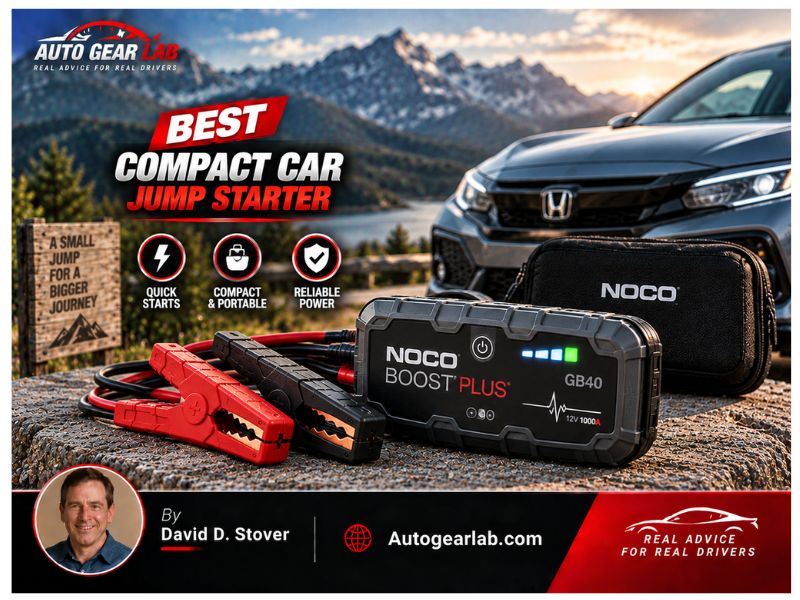
My primary recommendation is the NOCO Boost Plus GB40 1000A Jump Starter. I prefer it for everyday drivers because its compact rugged housing, proven safety system, excellent clamps, and suitability for up to 6.0L gasoline and 3.0L diesel engines provide a strong balance of portability and reliability.
The GOOLOO GP2000 2000A Jump Starter is my choice when you want more advertised starting capacity in a surprisingly light package. It is especially attractive for drivers who own larger gasoline vehicles but still want something small enough for easy vehicle storage.
For maximum portability on a tighter budget, the AstroAI S8 1500A Car Battery Jump Starter deserves serious consideration. Its compact dimensions and sub-one-pound-class body make it particularly convenient for passenger cars.
1. Best Compact Car Jump Starter
| Image | Product Name | Check Price |
|---|---|---|
Best Choice | NOCO Boost Plus GB40 1000A Jump Starter | Check Price |
| Second Best | GOOLOO GP2000 2000A Jump Starter | Check Price |
Third Choice | AstroAI S8 1500A Car Battery Jump Starter | Check Price |
 | AVAPOW A28 3000A Car Battery Jump Starter | Check Price |
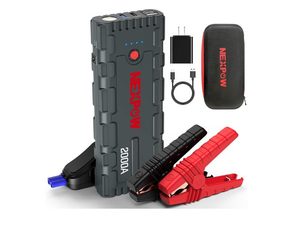 | NEXPOW 2000A Portable Car Jump Starter | Check Price |
1. NOCO Boost Plus GB40 1000A Jump Starter – Best Overall

The NOCO Boost Plus GB40 remains my first choice when compact size must be balanced with dependable construction and easy operation.
It delivers 1,000 amps of rated starting power and is intended for 12V batteries in gasoline engines up to 6.0 liters and diesel engines up to 3.0 liters. That covers a large portion of passenger cars, crossovers, motorcycles, lawn equipment, and many light trucks.
The GB40 is particularly appealing because NOCO does not rely solely on a big peak-amp number. Its UltraSafe system includes spark-proof connection technology and reverse-polarity protection, which can make the unit less intimidating for drivers who rarely work around batteries.
Key Features
- 1,000A rated starting output
- Supports up to 6.0L gasoline engines
- Supports up to 3.0L diesel engines
- Compact lithium-ion battery pack
- Spark-proof safety technology
- Reverse-polarity protection
- IP65-rated enclosure with ports closed
- Built-in 100-lumen LED flashlight
- USB device-charging capability
- Multiple emergency light modes
- Rugged rubberized housing
- Heavy-duty precision clamps
Detailed Review
The GB40’s physical design is one of its biggest advantages.
Instead of building the product around unnecessary screens, oversized cases, or an integrated air compressor, NOCO concentrates on the functions most drivers actually need from an emergency jump pack.
The unit itself is approximately 7.7 inches long and around 1.7 inches thick, making it easy to fit in a glove box, seat-back pocket, small trunk organizer, or emergency bag.
Its rubberized housing also feels more appropriate for automotive storage than glossy plastic units that become scratched quickly.
The clamps deserve special attention. Jump-starter performance is not just about battery capacity; the quality of the physical connection to the battery terminals matters. NOCO’s compact clamps are sturdy and can reach terminals in relatively confined engine compartments.
The GB40 can also function as an emergency USB power source for phones and other small electronics. The integrated flashlight includes several brightness and emergency signaling modes.
Its biggest limitation is charging technology. The GB40 is an older, established design, so its USB charging system is not as fast or modern as newer high-output USB-C jump starters.
That tradeoff is acceptable if your main purpose is keeping a dependable compact emergency starter in your car.
What I Like
- Excellent combination of portability and ruggedness
- Very easy for occasional users to operate
- Strong battery clamps
- Reverse-polarity and spark protection
- Compact enough for small cars
- IP65 protection with ports closed
- Established long-term product history
- Useful flashlight and power-bank functions
What I Do Not Like
- Only 1,000A compared with newer high-output competitors
- USB charging technology is relatively basic
- Carrying case is not always included
- Drivers with very large diesel engines need a stronger model
Verdict
The NOCO Boost Plus GB40 is my best overall compact car jump starter because it prioritizes the qualities that matter during an actual roadside emergency: dependable clamps, straightforward controls, safety protection, rugged construction, and genuinely compact dimensions.
2. GOOLOO GP2000 2000A Jump Starter – Best Power-to-Size Ratio
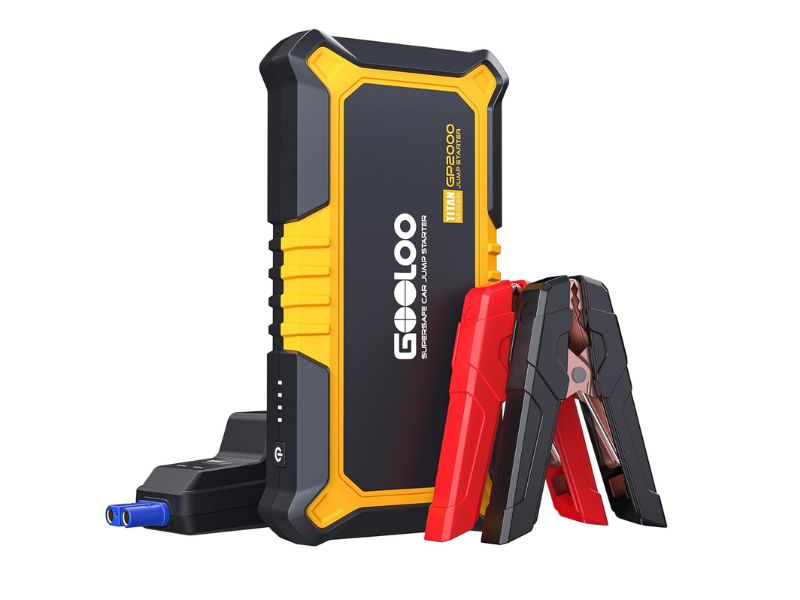
The GOOLOO GP2000 is an impressive alternative for buyers who want substantially more rated peak output without moving to a bulky professional jump box.
It is rated at 2,000A and is designed for 12V vehicles with gasoline engines up to approximately 8.0 liters and diesel engines up to 6.0 liters.
Despite that rating, the unit remains exceptionally portable.
Key Features
- 2,000A peak output
- Up to 8.0L gasoline engines
- Up to 6.0L diesel engines
- Approximately 1.2-pound body
- Compact 7.4 x 3.9 x 1.5-inch dimensions
- Multiple smart safety protections
- All-metal heavy-duty clamps
- Dual USB charging outputs
- Quick Charge capability
- Built-in emergency flashlight
- Normal, strobe, and SOS lighting
- Power-bank functionality
Detailed Review
The GP2000 is one of the best examples of why modern lithium jump starters have become so popular.
A conventional lead-acid jump box with comparable emergency usefulness can occupy a significant amount of trunk space. The GP2000 is closer in size to a large portable electronics power bank.
At roughly 7.4 inches long, it can fit into locations where traditional jump packs simply cannot.
Its 2,000A rating also gives it extra flexibility for larger vehicles. Most compact and midsize passenger cars do not require anything close to an 8.0L gasoline rating, but having additional available capacity can be useful when the battery is deeply discharged or environmental conditions are unfavorable.
GOOLOO includes multiple electronic protections covering problems such as reverse polarity, short circuits, excessive current, overheating, and overcharging.
The unit also functions as a portable USB charger. That secondary use can be valuable during extended roadside delays when a phone is nearly discharged.
A bright integrated LED provides another practical advantage at night.
The main compromise is that GOOLOO’s advertised ratings are more aggressive than NOCO’s conservative positioning. I would select it primarily because of its excellent combination of size and power rather than focusing only on the headline amp number.
What I Like
- Excellent output for such a compact device
- About 1.2 pounds
- Easily fits in a small vehicle
- Suitable for larger engines than many compact packs
- Heavy-duty clamps
- Multiple electronic safeguards
- USB power-bank function
- Strong emergency light
What I Do Not Like
- Large advertised peak numbers can be difficult to compare across brands
- Carrying all cables and accessories increases total storage size
- Battery condition still needs periodic checking during storage
Verdict
Choose the GOOLOO GP2000 when you want the strongest power-to-size balance in this comparison. It is particularly appealing for drivers who own SUVs or larger engines but do not want a bulky jump box.
3. AstroAI S8 1500A Car Battery Jump Starter – Best Ultra-Compact Pick

The AstroAI S8 is the model I would consider when compactness and minimum weight are at the top of your list.
The S8 provides up to 1,500A of peak output and is designed for gasoline engines up to 6.0 liters and diesel engines up to 3.0 liters.
That makes it a particularly good match for sedans, hatchbacks, compact SUVs, motorcycles, and other everyday 12V vehicles.
Key Features
- 1,500A peak output
- 10,000mAh battery capacity
- Supports up to 6.0L gasoline engines
- Supports up to 3.0L diesel engines
- Approximately 0.95-pound unit weight
- Compact lithium battery design
- Smart jumper cable system
- Built-in emergency flashlight
- Three flashlight modes
- USB device charging
- Passenger-car-friendly size
Detailed Review
The S8’s strongest advantage is straightforward: it is extremely easy to store.
At under roughly one pound for the unit itself, it adds very little weight to your emergency kit. Owners of compact cars can place it in a glove compartment, center-console area, under-seat organizer, or small trunk compartment.
Its 1,500A rating provides more theoretical output than the NOCO GB40 while still covering a similar practical vehicle range.
AstroAI rates the S8 for up to 6.0L gas and 3.0L diesel engines, which is plenty for most normal passenger vehicles.
It also includes intelligent battery-clamp circuitry intended to protect against common connection mistakes.
A built-in flashlight provides normal illumination as well as emergency signaling functions, while USB charging allows the internal lithium battery to serve as temporary backup power for electronics.
Compared with the NOCO, the housing and clamps feel oriented more toward value-conscious consumers rather than professional or semi-professional use.
That distinction is why the GB40 remains ahead of it in my ranking.
For someone driving a Honda Civic, Toyota Corolla, Hyundai Elantra, Mazda3, small crossover, or similar vehicle, however, paying for a substantially larger jump starter may be unnecessary.
What I Like
- Extremely compact and lightweight
- Excellent match for passenger cars
- 1,500A peak rating
- Simple controls
- Useful flashlight
- USB backup charging
- Easy to keep in the vehicle permanently
- Strong value for basic emergency preparedness
What I Do Not Like
- Less rugged than the NOCO GB40
- Not intended for very large diesel engines
- Small body provides less physical space for oversized clamps or batteries
- Needs periodic charging just like any lithium jump pack
Verdict
The AstroAI S8 is my favorite choice when the goal is maximum portability with enough power for an ordinary passenger car. It is one of the easiest models here to keep in a small vehicle without sacrificing valuable storage room.
4. AVAPOW A28 3000A Car Battery Jump Starter – Best for Larger Engines
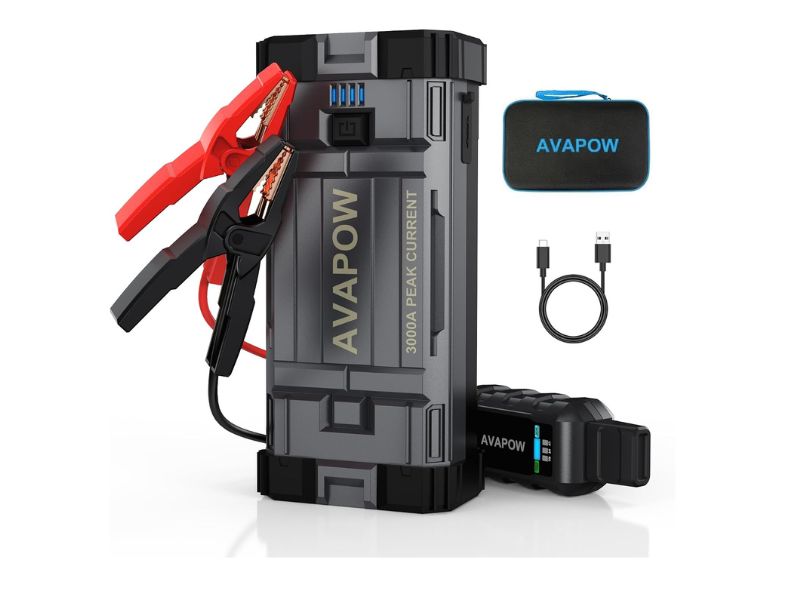
The AVAPOW A28 moves toward the high-power end of the compact jump-starter category while remaining much smaller than traditional lead-acid booster boxes.
It carries a 3,000A peak-current rating and is designed for gasoline and diesel engines up to approximately 8.0 liters.
That extra capacity makes it interesting for owners of larger SUVs, pickups, and vehicles that require greater starting current.
Key Features
- 3,000A peak current rating
- Up to 8.0L gasoline engines
- Up to 8.0L diesel engines
- Force-start function
- Smart jumper cable system
- Multiple safety protections
- Spark-protection circuitry
- Dual USB outputs
- Quick Charge 3.0 support
- USB-C connection
- Built-in 21-bulb LED light
- Flashlight, strobe, and SOS modes
- Carrying case included
Detailed Review
The A28 is not quite as minimalist as the AstroAI S8 or NOCO GB40, but it provides noticeably broader vehicle compatibility.
Its force-start mode is especially noteworthy.
Most smart lithium jump starters look for a minimum battery voltage before activating their output. If a vehicle battery is extremely discharged, the jump pack may not initially detect it.
AVAPOW provides an override function intended for these situations.
This capability should be used carefully because automatic safety systems exist for a reason. Always verify polarity before activating any manual or force-start mode.
The A28’s clamp module includes multiple electronic safeguards and warnings for improper connection.
It also incorporates more charging versatility than some older jump packs. Two USB outputs allow the pack to charge phones and similar devices, while one port supports QC3.0 output.
The integrated LED array offers ordinary illumination, strobe, and SOS operation.
Its larger capacity and accessory set mean the complete kit occupies more space than the smallest models here.
If you drive only a small four-cylinder sedan, this amount of capability may be unnecessary. For a V6, V8, pickup, or larger SUV, however, the additional reserve can be reassuring.
What I Like
- Strong 3,000A advertised peak output
- Broad gasoline and diesel compatibility
- Force-start function for deeply discharged batteries
- Smart clamp safety system
- Multiple USB charging options
- Powerful integrated light
- Carrying case included
- Useful for larger vehicles
What I Do Not Like
- Larger than the most minimalist compact options
- Force-start mode requires careful use
- More output than many small-car owners realistically need
- Less established than NOCO in the premium jump-starter market
Verdict
The AVAPOW A28 is the model I would choose when you need compact storage but own a larger-displacement vehicle. It provides considerably more rated starting capacity than basic passenger-car jump packs without becoming a full-size jump box.
5. NEXPOW 2000A Portable Car Jump Starter – Best Multi-Function Value
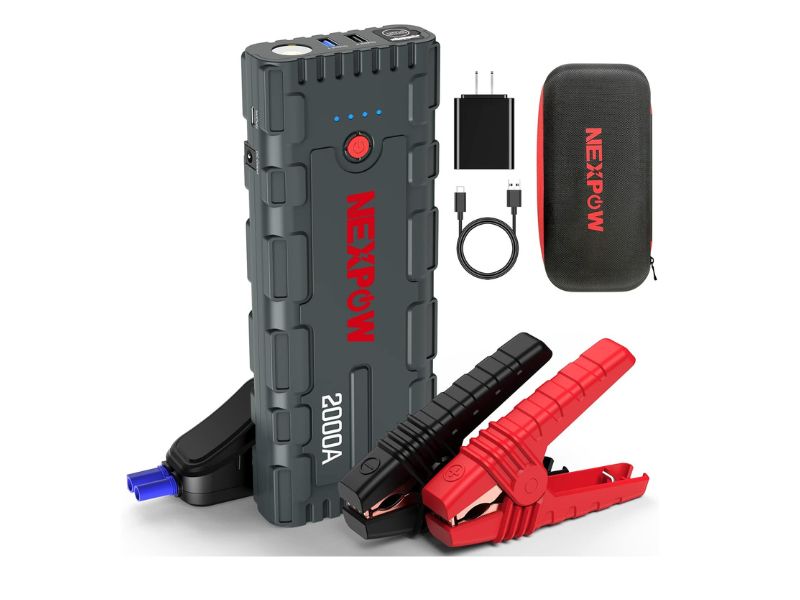
The NEXPOW 2000A rounds out this list with a useful combination of compact dimensions, substantial engine compatibility, USB charging, and emergency lighting.
Its 2,000A rating is designed to support gasoline engines up to approximately 7.0 liters and diesel engines up to 6.5 liters.
That places it between the small passenger-car-focused AstroAI S8 and the more powerful AVAPOW A28.
Key Features
- 2,000A peak output
- Supports up to 7.0L gasoline engines
- Supports up to 6.5L diesel engines
- Compact lithium battery pack
- Smart clamp protection
- USB Quick Charge 3.0
- Dual USB outputs
- Power-bank capability
- Built-in LED flashlight
- SOS emergency signal
- Suitable for cars, SUVs, motorcycles, and light trucks
Detailed Review
NEXPOW focuses heavily on versatility.
In addition to starting a dead 12V battery, the pack can function as an emergency USB charger and flashlight.
That multi-function approach is useful because a jump starter spends almost all of its life waiting for an emergency. Being able to use the stored energy for a phone or light increases its usefulness during road trips and power outages.
Its claimed engine compatibility is generous for a compact model. A 7.0L gasoline rating covers essentially every normal passenger car and many pickups.
The 6.5L diesel rating also extends the potential vehicle range beyond what basic 1,000A units offer.
As with other high-output budget jump starters, I would not judge the NEXPOW solely on the advertised peak-current figure.
Clamp quality, battery state of charge, temperature, battery condition, and starter requirements all influence whether a jump attempt succeeds.
Keep it charged and treat the published engine rating as a compatibility guide rather than a guarantee under every condition.
What I Like
- Strong capability for its size
- Wide engine compatibility
- Quick Charge USB output
- Useful emergency flashlight
- Compact storage
- Multi-purpose power bank
- Good balance between portability and output
What I Do Not Like
- Less premium housing than the NOCO GB40
- High peak-current figures are difficult to compare directly between manufacturers
- Requires routine charging checks during long-term vehicle storage
- Not as small as the AstroAI S8
Verdict
The NEXPOW 2000A offers a strong combination of starting power, USB charging, emergency lighting, and compact storage, making it a good multi-function value pick.
2. Compact Car Jump Starter Comparison Table
| Product | Peak Rating | Gas Engine Rating | Diesel Rating | Approx. Unit Weight | USB Power | Emergency Light | Best For |
| NOCO Boost Plus GB40 | 1,000A | Up to 6.0L | Up to 3.0L | 1.65 lb unit | Yes | 100-lumen, 7 modes | Best overall |
| GOOLOO GP2000 | 2,000A | Up to 8.0L | Up to 6.0L | About 1.2 lb | Dual USB | 400-lumen multi-mode | Power-to-size ratio |
| AstroAI S8 | 1,500A | Up to 6.0L | Up to 3.0L | About 0.95 lb | Yes | 3 modes | Small cars |
| AVAPOW A28 | 3,000A | Up to 8.0L | Up to 8.0L | Compact class | QC3.0 + USB | 3 modes | Larger engines |
| NEXPOW 2000A | 2,000A | Up to 7.0L | Up to 6.5L | Compact class | QC3.0 + USB | Multi-mode | Multi-function value |
The NOCO Boost Plus GB40 remains my primary recommendation because compactness alone does not make a good emergency jump starter. Its combination of rugged construction, strong clamps, proven safety features, and manageable dimensions matters more to me than simply chasing the highest advertised peak-current figure.
The GOOLOO GP2000 offers substantially greater advertised starting capacity while staying exceptionally light. AstroAI S8 wins when minimum size matters most, while AVAPOW A28 provides extra capability for larger engines. NEXPOW offers a useful middle ground with multiple emergency functions.
3. How to Choose a Compact Car Jump Starter
Match the Jump Starter to Your Engine
Engine size is one of the first specifications to check.
A compact four-cylinder gasoline car generally requires far less starting current than a large V8 pickup or diesel truck.
For typical passenger vehicles, a quality 1,000A to 1,500A lithium jump starter is often sufficient.
Larger vehicles may justify 2,000A or more.
Do not automatically buy the highest amp rating available. Larger battery packs can add weight, size, and cost without providing meaningful benefits for a small car.
Understand Peak Amps
Peak amps are useful for general comparison, but they should not be treated as an absolute measure of performance.
Manufacturers do not always test or advertise peak current in exactly the same way.
Real starting performance is influenced by:
- Battery pack voltage
- Internal battery chemistry
- Cable resistance
- Clamp quality
- Temperature
- Vehicle battery condition
- Engine displacement
- Starter-motor demand
This is one reason I rank the 1,000A NOCO ahead of several products advertising two or three times the peak amperage.
Consider Physical Size
For this category, size matters.
A compact jump starter should fit somewhere convenient enough that you will actually keep it inside the vehicle.
Good locations include:
- Glove compartment
- Under a seat
- Center-console storage
- Trunk organizer
- Spare-tire compartment
- Emergency-tool bag
Remember to measure the complete kit rather than just the lithium battery unit.
Battery clamps and a protective case can nearly double the amount of practical storage space required.
Pay Attention to Clamp Quality
The clamps transfer energy from the jump starter to the vehicle battery.
Look for sturdy springs, adequate cable thickness, good metal contact surfaces, and enough jaw opening to grip your battery terminals properly.
Small clamps can actually be beneficial in modern engine compartments where battery terminals are difficult to access.
However, they still need sufficient clamping pressure.
Prioritize Reverse-Polarity Protection
Connecting jumper cables backward can create a dangerous electrical situation.
Modern smart jump starters commonly include reverse-polarity detection, along with protections for short circuits, excessive current, overheating, and improper connections.
This is particularly important for drivers who may use the product only once every few years and are therefore unfamiliar with jump-starting procedures.
Look for a Manual Override Carefully
Some jump starters cannot automatically detect a battery when its voltage has fallen extremely low.
A manual override or force-start mode can bypass that detection.
This feature is useful, but it removes some automatic safety protection.
Only use it after confirming the positive clamp is correctly attached to the positive terminal and the negative clamp is correctly positioned according to the manufacturer’s instructions.
Check Cold-Weather Capability
Lithium batteries lose performance as temperatures drop.
This matters because dead vehicle batteries are especially common during winter.
If you live in a cold climate, choose a jump starter with a clearly specified operating-temperature range and keep the pack adequately charged.
Extremely cold jump starters may perform better after warming slightly inside the cabin.
Never expose a damaged lithium battery pack to excessive heat.
Consider USB Charging
Power-bank functionality is more useful than it initially appears.
A breakdown often creates two problems at once: the vehicle will not start and your phone may be running low.
USB output can provide temporary charging for:
- Smartphones
- Tablets
- GPS devices
- Action cameras
- Flashlights
- Other small electronics
USB-C and Quick Charge outputs are particularly convenient on newer products.
Emergency Lighting Matters
Nearly every compact jump starter now includes an LED light, but the implementation varies.
A good emergency light should offer:
- Normal illumination
- Strobe mode
- SOS signaling
The light can help you locate battery terminals at night, inspect an engine compartment, change a tire, or make yourself more visible beside the road.
Consider the Carrying Case
A protective case is valuable even when the jump starter itself is rugged.
It keeps:
- Clamps
- Charging cables
- Adapters
- Instructions
- The battery pack
together in one location.
That can make a significant difference during an emergency when you do not want to search through a cluttered trunk for a missing clamp cable.
4. Compact Jump Starter Safety Tips
Check Polarity Before Connecting
Identify the battery terminals carefully.
The positive terminal is marked “+” and commonly uses red identification.
The negative terminal is marked “-”.
Follow the instructions supplied with your jump starter because connection sequences and approved grounding locations can vary.
Keep the Pack Charged
A jump starter with a nearly empty internal battery is not useful during an emergency.
Check its charge periodically.
A practical routine is to inspect it every few months and recharge it according to the manufacturer’s instructions.
Also check it before:
- Long road trips
- Winter travel
- Extended vehicle storage
- Camping trips
- Severe-weather seasons
Do Not Leave a Damaged Lithium Pack in the Vehicle
Inspect the housing periodically.
Stop using a jump starter if you notice:
- Swelling
- Cracks
- Severe impact damage
- Melted areas
- Unusual odors
- Excessive heat
- Damaged charging ports
Lithium batteries should not be used after significant physical damage.
Avoid Extreme Vehicle Temperatures
Vehicle interiors can become extremely hot in direct summer sun.
Always follow the manufacturer’s storage-temperature limits.
Keeping the starter inside an insulated emergency bag and out of direct sunlight can reduce temperature extremes.
Disconnect After the Engine Starts
Once the vehicle is running, follow the manufacturer’s procedure for removing the jump starter.
Do not leave a portable lithium booster attached longer than necessary.
5. Who Should Carry a Compact Jump Starter?
A small lithium jump pack makes sense for nearly any driver, but it is especially useful for people who:
- Drive alone frequently
- Travel at night
- Own an older vehicle
- Make long road trips
- Park in isolated areas
- Experience cold winters
- Have limited trunk space
- Want to avoid relying entirely on roadside assistance
- Operate motorcycles, ATVs, or lawn equipment
- Have vehicles that sit unused for long periods
Unlike traditional jumper cables, a portable jump starter does not require a second vehicle.
That independence is its biggest advantage.
6. Frequently Asked Questions
1. What is the best compact car jump starter?
The NOCO Boost Plus GB40 is my best overall compact car jump starter.
It combines a genuinely small body with high-quality clamps, reverse-polarity protection, spark-resistant connection technology, rugged construction, and enough capacity for most passenger cars and many light trucks. GOOLOO GP2000 is the better choice when you need greater engine compatibility without adding much weight.
2. How many amps should a compact jump starter have?
Around 1,000 to 2,000 advertised peak amps covers many passenger-vehicle applications.
A small gasoline car generally requires less starting capacity than a large SUV or diesel pickup. Engine size, temperature, battery condition, and starter demand matter, so always follow the jump starter’s published vehicle compatibility rather than selecting only by the biggest amp number.
3. Is a 1,000A jump starter enough for a car?
Yes, a quality 1,000A unit can start many normal passenger vehicles.
For example, the NOCO GB40 is designed for gasoline engines up to 6.0L and diesels up to 3.0L. Most four- and six-cylinder passenger cars therefore fall comfortably within its intended application range.
4. Can I keep a lithium jump starter in my car?
Yes, provided you follow the manufacturer’s storage-temperature limits.
Vehicle interiors can become extremely hot during summer and very cold during winter. Store the unit away from direct sunlight, inspect it periodically, and never keep a swollen, cracked, or otherwise damaged lithium battery inside the vehicle.
5. How often should I charge my car jump starter?
Check its charge every few months and before important trips.
Lithium batteries have relatively low self-discharge, but they still lose stored energy over time. A unit that has sat untouched for a year may not have the same emergency capacity it had immediately after charging.
6. Will a jump starter work on a completely dead battery?
Many can, but extremely low battery voltage may require a manual override mode.
Smart jump starters may refuse to activate when they cannot detect sufficient voltage. Products with manual or force-start functions can sometimes override this condition, but doing so bypasses certain automatic safeguards and requires careful confirmation of polarity.
7. Can a portable jump starter damage a car?
Correctly used compatible jump starters are designed to minimize electrical risk.
Modern units commonly include reverse-polarity, short-circuit, overcurrent, and temperature protection. Nevertheless, always follow the manufacturer’s instructions, connect the clamps correctly, and use only a 12V starter on compatible 12V systems.
8. Is a compact jump starter better than jumper cables?
It is more independent because you do not need another vehicle.
Traditional jumper cables are inexpensive and do not require charging, but they depend on finding a working donor vehicle. A charged lithium jump starter lets you attempt a restart wherever you are.
The best emergency kit can contain both.
9. Can a compact jump starter charge my phone?
Most modern models also work as USB power banks.
NOCO, GOOLOO, AstroAI, AVAPOW, and NEXPOW all offer device-charging functionality in the models reviewed here. Charging your phone does use energy that could otherwise be available for vehicle starting, so preserve enough battery for emergencies.
10. How long does a portable jump starter last?
Several years is reasonable with proper charging, storage, and temperature management.
Lithium cells gradually lose capacity with age and charge cycles. Avoid excessive heat, deep long-term discharge, physical damage, and inappropriate chargers. Replace the unit if its battery swells or if starting performance declines significantly.
11. Can I use a jump starter on a diesel car?
Yes, if the starter is specifically rated for your diesel engine size.
Diesel engines generally require greater starting current than similarly sized gasoline engines. Check the manufacturer’s diesel displacement limit before purchasing.
12. What is the smallest jump starter in this list?
The AstroAI S8 is the lightest and most storage-friendly option here.
Its small lithium battery pack is particularly well suited to compact passenger cars where trunk and glove-box space is limited. GOOLOO GP2000 is another remarkably light choice while offering a higher advertised output rating.
7. Final Thoughts
The best compact car jump starter should be small enough that keeping it in your vehicle never feels inconvenient, but reliable enough that you trust it when the battery actually fails.
The NOCO Boost Plus GB40 is my primary recommendation. Its 1,000A rating may look modest next to newer competitors, but its excellent clamps, proven UltraSafe system, rugged IP65-rated construction, compact profile, and strong long-term reputation make it the most balanced choice for typical drivers.
The GOOLOO GP2000 is the better option when you want more advertised starting power while keeping weight extremely low. Its 2,000A output and larger-engine compatibility make it particularly attractive for SUVs and pickups.
For owners of compact cars and sedans, the AstroAI S8 offers excellent portability without excessive capacity or bulk. The AVAPOW A28 is better suited to larger engines, while the NEXPOW 2000A provides a strong mix of jump-starting capability, USB charging, and emergency features.
For a typical passenger car where reliability, safety, clamp quality, and compact storage matter more than chasing the largest amp rating, the NOCO Boost Plus GB40 remains my first pick.