Finding the best dpf regeneration tool is less about choosing the tool with the longest feature list and more about matching regeneration functions to your truck, engine, connector, and diagnostic needs. A capable scanner can reduce unnecessary shop visits, but the wrong coverage may leave a buyer unable to start a forced regeneration when it matters.
My first choice is ANCEL HD430 Heavy Duty Truck Scanner. Its 12V and 24V support, 6-pin, 9-pin, and OBDII connectors, full-system diagnostics, live data, and lifetime Wi-Fi updates make it a practical fit for many truck owners and small shops.
My second choice is NEXAS NL102P Heavy Duty Truck Scanner. It supports several regeneration procedures, multiple heavy-duty protocols, full-system scanning, OBD2 vehicles, oil reset functions, and battery monitoring in a straightforward handheld format.
My third choice is ANCEL X7HD 10.1” Heavy Duty Truck Scanner. ANCEL X7HD 10.1” Heavy Duty Truck Scanner 40+ Reset Bi-Directional takes third place because it offers a much broader professional feature set, including more than 40 reset functions, active tests, ECU coding, and a large tablet display. Its lower customer rating and more advanced operating scope make it better suited to technicians who can take advantage of those capabilities.
This guide compares the five selected scanners, explains who each one suits, and covers compatibility checks, safe regeneration preparation, setup, maintenance, common mistakes, and ownership considerations. The goal is to help you choose a tool that matches the vehicles you actually service rather than paying for functions your truck cannot use.
Best Dpf Regeneration Tool
I selected these products for their direct relevance to diesel particulate filter service, the breadth of their supported truck systems, the usefulness of their diagnostic functions, and the practical details supplied for each model. Customer-feedback volume and ratings were also considered where available, while the final order reflects the balance between coverage, regeneration capability, usability, limitations, and likely buyer value.
| # | Image | Product | Price on Amazon |
|---|---|---|---|
| 1 | 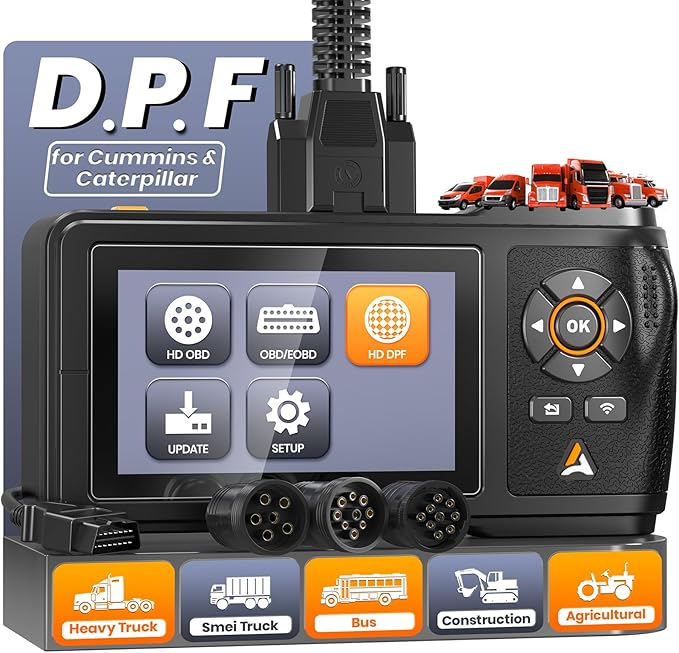 |
ANCEL HD430 Heavy Duty Truck Scanner | Check Price |
| 2 |  |
NEXAS NL102P Heavy Duty Truck Scanner | Check Price |
| 3 |  |
ANCEL X7HD 10.1” Heavy Duty Truck Scanner | Check Price |
| 4 |  |
ANCEL HD3400 Pro Heavy Duty Truck Scanner | Check Price |
| 5 |  |
ANCEL HD431 Heavy Duty Truck Scanner | Check Price |
ANCEL HD430 Heavy Duty Truck Scanner
The ANCEL HD430 earns the top position by offering a focused combination of DPF service and broad truck diagnostics. It supports both 12V and 24V vehicles and includes diesel 6-pin, 9-pin, and OBDII 16-pin connections, so it can serve more than one vehicle type in a mixed garage. Support for protocols such as J1939 and J1708 is especially relevant to older and current heavy-duty applications.
Its most important limitation is also its clearest buying condition: the listed DPF reset and regeneration support is specifically associated with Cummins and Caterpillar engines. The scanner can work with other diesel platforms, including Detroit and PACCAR, for broader diagnostic tasks, but buyers should not assume that every connected engine receives the same DPF service functions.
Beyond DPF work, the HD430 scans systems such as the engine, ABS, transmission, and fuel system. Live data, freeze-frame information, ECU details, code lookup, and code clearing can help an owner understand whether soot loading is the actual issue or merely one symptom of a larger fault. Its 4.3-inch screen, built-in memory, Wi-Fi updates, and three-year warranty add practical ownership value.
Pros
- Supports 12V and 24V heavy-duty vehicles with several connector types.
- Dedicated Cummins and Caterpillar DPF reset and regeneration capability.
- Full-system diagnostics, live data, and DTC lookup.
- Lifetime Wi-Fi updates and three-year warranty support.
Cons
- DPF functions are not presented as universal across all supported engines.
- The smaller screen is less spacious than a tablet-style scanner.
My Opinion
This is the strongest all-around pick for a buyer whose main vehicles use Cummins or Caterpillar engines and who also wants a dependable general truck scanner. Verify engine-specific regeneration coverage before ordering, particularly if the tool will be shared across a mixed fleet.
NEXAS NL102P Heavy Duty Truck Scanner
The NEXAS NL102P is a sensible second choice for owner-operators, mobile mechanics, and small fleets that need regeneration functions across a broad heavy-duty environment. It supports parking, driving, and onboard regeneration procedures on supported vehicles, while also offering DOC cleaning functions. That range can be useful when trucks experience different operating patterns or when a stationary regeneration is more practical than a road-based procedure.
Coverage is one of its biggest advantages. The NL102P is intended for most Class 4–8 trucks and includes 6-pin, 9-pin, and 16-pin connectors. Listed compatibility includes major makes such as Freightliner, Kenworth, Peterbilt, Volvo, Mack, and International, with engine-platform support mentioned for Cummins, Detroit, MaxxForce, Hino, and Isuzu applications. Still, “supported” does not mean every function works on every year and engine combination.
Its full-system approach goes beyond the DPF. The scanner can read and clear codes, display live data, access ECU information, and work with systems including transmission, ABS, drivetrain, suspension, and body control. Oil reset capability and battery-voltage monitoring are useful extras for routine maintenance, although buyers seeking advanced bidirectional testing or ECU coding may need a more specialized model.
Pros
- Supports several DPF regeneration procedures on compatible trucks.
- Broad Class 4–8 connector and vehicle coverage.
- Full-system diagnostics with live data.
- Includes oil reset and battery monitoring functions.
Cons
- Exact regeneration coverage depends on the truck and engine combination.
- It does not list the advanced active tests and ECU coding found on the X7HD.
My Opinion
The NL102P is a strong alternative when broad truck coverage matters more than advanced workshop controls. Before purchase, confirm the exact engine family and desired regeneration procedure with the seller or compatibility information, especially if the scanner will support several brands.
ANCEL X7HD 10.1” Heavy Duty Truck Scanner
The ANCEL X7HD is the most feature-rich option in this group. Its 10.1-inch Android tablet gives technicians more room for live-data graphs, system menus, and diagnostic reports than a compact handheld unit. A 6000mAh battery, Wi-Fi, Bluetooth, cameras, report printing, and remote support functions make it suitable for regular shop or fleet use rather than occasional code reading.
Its 40-plus reset and service functions cover DPF regeneration, oil reset, injector coding, ECU reset, electronic parking brake, ABS, SRS, suspension calibration, throttle reset, and other supported tasks. Bi-directional controls and active tests can command components such as injectors, ABS systems, and throttles, helping a technician determine whether a component responds before replacing parts. ECU coding and module matching add value after injector or module work.
That capability brings a learning curve and a compatibility responsibility. Functions vary by model, engine, and module, so a buyer should not treat the long function list as a guarantee for every truck. The product’s 3.6 rating is lower than the 4.1 and 4.2 ratings of several smaller scanners in this list, which is worth weighing if simple operation and predictable ownership matter more than advanced coverage.
Pros
- Large 10.1-inch display with live-data graphing.
- More than 40 listed reset and service functions.
- Bi-directional control, active tests, and ECU coding.
- Wide truck and OBD2 diagnostic coverage.
Cons
- Advanced functions may require more technical knowledge.
- Customer rating is lower than several simpler alternatives.
- Actual functions vary by vehicle and module.
My Opinion
The X7HD makes the most sense for a technician or fleet that will regularly use active tests, coding, and multiple reset functions. It is probably excessive for an owner who only needs occasional DPF service, and compatibility should be confirmed before relying on a specific coding or regeneration task.
ANCEL HD3400 Pro Heavy Duty Truck Scanner
The ANCEL HD3400 Pro is aimed at commercial truck service and gives buyers a useful mixture of regeneration, full-system diagnostics, and reporting tools. It supports DPF forced regeneration and reset on listed Cummins, PACCAR, Caterpillar, Detroit, HD Volvo, Mack, International, and MaxxForce applications. Its built-in CAN3 channel access can be helpful because the supplied information indicates that an extra CAN-3 adapter is not needed for supported work.
For daily troubleshooting, topology display, wiring diagrams, Pin Detect, and pre- and post-scan reports provide more structure than a basic code reader. These functions can help identify connector or wiring issues, document vehicle condition before service, and confirm what changed afterward. Free lifetime software updates and one-click updating also improve long-term value for a fleet or shop that wants to avoid annual update fees.
The compatibility warning here deserves careful attention. DPF regeneration may be unavailable on newer Detroit-powered trucks using UDS protocol, including some Freightliner Cascadia models. The scanner is not intended for light-duty Chevrolet or GMC Duramax vehicles or Ram pickups, and its wiring diagrams are for Cummins engines only. Those limitations make an application check essential.
Pros
- Broad listed DPF coverage across several heavy-duty engine families.
- CAN3 access without an additional adapter for supported applications.
- Topology, wiring, Pin Detect, and pre/post-scan tools.
- Free updates without annual subscription fees.
Cons
- Some newer Detroit UDS trucks may not support DPF regeneration.
- Not intended for common light-duty Duramax or Ram pickup applications.
- Wiring diagrams are limited to Cummins engines.
My Opinion
This is a compelling fleet-oriented option when its listed engine coverage matches the vehicles in the yard. Its diagnostic documentation tools are a meaningful advantage, but the Detroit UDS limitation means buyers should verify the exact truck year, engine, and protocol rather than relying only on the make name.
ANCEL HD431 Heavy Duty Truck Scanner
The ANCEL HD431 is a focused choice for trucks using PACCAR or Detroit engines. Its dedicated interface supports forced DPF regeneration on listed engines such as PACCAR PX-7, PX-9, MX-11, MX-13 and Detroit DD13, DD15, and DD16 platforms. That makes it particularly relevant to Freightliner, Western Star, Kenworth, Peterbilt, and related commercial applications.
Three connector types—diesel 6-pin, 9-pin, and OBDII 16-pin—give it useful reach across HDOBD and OBD2 vehicles. It can read and clear fault codes, show live data, and provide ECU information, so it remains useful when a DPF warning is accompanied by another engine or emissions fault. Quick Scan is intended for faster fault detection, while Complete Scan offers a deeper system check.
The compact 4.3-inch glare-resistant display and physical buttons should be easy to use in bright conditions or with work gloves. Lifetime Wi-Fi updates, three-year coverage, and 30-day returns add reassurance. However, the tool’s main strength is concentrated around Detroit and PACCAR rather than universal diesel coverage. Clearing a code also does not repair the underlying problem, so regeneration should only follow the correct diagnostic and safety steps.
Pros
- Focused Detroit and PACCAR DPF regeneration support.
- Supports 6-pin, 9-pin, and OBDII 16-pin connections.
- Physical controls and glare-resistant display suit roadside use.
- Lifetime updates and three-year coverage.
Cons
- Less suitable when the fleet centers on Cummins or Caterpillar.
- Compact display provides less room for data than the X7HD tablet.
- Code clearing does not resolve the cause of a fault.
My Opinion
The HD431 is a good targeted purchase for PACCAR and Detroit owners who want a standalone tool without phone pairing. It is not the best choice for a mixed-engine fleet unless its diagnostic and regeneration coverage has been confirmed for every major vehicle in that fleet.
How I Selected These DPF Tools
The selection began with direct DPF relevance, then expanded to connector support, voltage range, engine coverage, and the usefulness of related diagnostic functions. A scanner that can initiate regeneration but cannot help identify the reason for repeated soot loading is less useful than one that also provides live data, system codes, or post-service confirmation.
I also considered the likely buyer. A single owner-operator may prefer a compact tool with physical buttons and straightforward menus, while a repair shop may benefit more from active tests, ECU coding, topology views, and printed reports. Ratings and customer-feedback volume supplied additional context, but they were not treated as proof that every vehicle function will work identically.
Compatibility outranks feature count. Always match the scanner to the truck’s engine, model year, connector, and protocol before assuming that a listed DPF function will be available.
Long-term ownership details also affected the order. Lifetime updates, warranty coverage, multiple connectors, and practical screens can change the value of a scanner over several years. These details matter because a tool that is difficult to update or limited to one vehicle may cost more in downtime even when its initial purchase appears attractive.
How to Choose the Best DPF Regeneration Tool
The right purchase depends first on the trucks you service and only afterward on the scanner’s extra functions. A regeneration command is useful only when the tool communicates with the correct engine control system, and a broad vehicle list does not guarantee identical functions across every model year.
- Match the scanner to the exact engine family and truck year.
- Confirm whether the tool supports forced, parked, driving, or onboard regeneration.
- Check for the required 6-pin, 9-pin, OBDII, or other connector.
- Decide whether live data, active tests, coding, or reports justify a larger tool.
- Consider update costs, warranty coverage, screen design, and roadside durability.
Engine and protocol compatibility
Start with the engine, not simply the truck badge. A Freightliner, Kenworth, or International truck may be available with different engines and communication systems, and the supported DPF function can change between them. Protocol references such as J1939, J1708, J1587, and UDS are useful clues, but they are not a substitute for checking the exact application.
Regeneration functions versus code reading
Some scanners can read and clear DPF-related codes without being able to start a forced regeneration. Others support several procedures, including parked, driving, or onboard regeneration. If your main objective is clearing a soot-loading problem, confirm that the tool can perform the particular procedure your truck requires rather than assuming that “DPF service” covers all possibilities.
Choosing screen size and controls
A compact handheld scanner is easier to store in a cab and often works well for quick roadside checks. A tablet-style unit gives more room for graphs, reports, active-test menus, and multiple data points. Physical buttons may be preferable with work gloves, while a touch display can make complex menus easier to navigate once the user is familiar with it.
Updates, support, and ownership cost
Free lifetime updates can be valuable for a fleet because coverage and software behavior may change over time. Also check how support is provided, whether the device has a stated warranty, and whether a return period is available. A scanner with broad claims but unclear application support is a risk when downtime is expensive.
Check Compatibility Before Connecting
Before buying, record the truck’s make, model year, engine model, connector type, and any protocol information shown on existing service documents. If several trucks will share one scanner, create a simple compatibility list for each vehicle. This avoids discovering after purchase that regeneration works on one engine family but only code reading is available on another.
Pay special attention to stated exclusions. The HD3400 Pro, for example, warns about some newer Detroit UDS applications and does not target light-duty Duramax or Ram pickups. The HD430 emphasizes Cummins and Caterpillar DPF functions, while the HD431 concentrates on PACCAR and Detroit. Those distinctions are more important than a general claim of heavy-duty coverage.
Do not purchase based only on the truck manufacturer. Confirm the engine and supported service function for the exact vehicle before depending on the scanner for a time-sensitive regeneration.
Setup and First-Time Use
Begin by checking the scanner, cable, adapters, and screen for damage. Charge or power the unit as directed, connect it to a reliable Wi-Fi network when updates are available, and install the latest supported software before visiting a roadside vehicle. An update performed in advance is less stressful than trying to download software beside a disabled truck.
Next, identify the correct connector and turn off unnecessary electrical loads. Connect the scanner securely, switch on the ignition as instructed by the device, and allow it to identify the vehicle. Save or record existing fault codes and live-data information before clearing anything. This creates a useful baseline if the warning returns.
Read the on-screen conditions before starting a regeneration. The truck may need adequate fuel, correct coolant temperature, no critical engine faults, and a safe location. Never bypass a condition simply to force the process to begin; a regeneration request is not a substitute for repairing an injector, sensor, exhaust leak, or other underlying issue.
Using Regeneration Safely
Regeneration creates substantial exhaust heat. Park outdoors or in an approved, well-ventilated service area away from dry grass, paper, fuel, plastic, and other combustible materials. Keep people clear of the exhaust outlet, and do not place tools or covers near hot exhaust components.
Follow the truck manufacturer’s procedure and the scanner prompts. Monitor engine speed, coolant temperature, exhaust-related data, and warning messages when the tool provides those readings. A regeneration that stops repeatedly, refuses to start, or immediately triggers another fault deserves diagnosis rather than repeated commands.
Never assume that a successful regeneration means the filter is healthy. Ash accumulation, damaged filter material, sensor faults, fuel-system problems, and restricted exhaust components can continue to cause trouble. The scanner can support diagnosis, but it cannot make a mechanically damaged DPF function normally.
How to Use Live Data and Fault Codes
Read the codes before clearing them and note whether they are active, stored, or pending when the scanner provides that distinction. Live data can help show whether temperatures, pressure readings, and sensor values change as expected, although the correct range depends on the engine and operating condition.
Use freeze-frame information to understand what was happening when the fault appeared. If a DPF warning is accompanied by an engine, fuel, or sensor code, address the related fault first. Clearing codes may remove the warning temporarily, but it does not repair the condition that caused it.
After service, perform another scan when appropriate and save the result. Tools with pre- and post-scan reports are especially useful for shop records, fleet documentation, and showing whether a code returned after the repair.
Maintenance, Storage, and Longevity
Keep the scanner and cables in a dry protective case, especially if it normally stays in a truck cab. Avoid leaving the device in extreme heat or cold for long periods, and protect connectors from dirt, moisture, and bent pins. A damaged adapter can create communication problems that look like vehicle faults.
Wipe the display and housing with a soft, slightly damp cloth rather than applying solvent directly. Inspect the cable before each use, and replace or report a damaged lead instead of taping over a loose connector. Store adapters together and label them if several trucks use different connection points.
Connect the scanner to Wi-Fi periodically and install supported updates. Keep a note of the last successful update and the vehicles on which the tool has been confirmed to work. This small record can save time when the scanner is shared among drivers or technicians.
Troubleshooting a Failed Regeneration
A failed regeneration can result from several causes, including an unsupported vehicle function, an active engine fault, incorrect operating conditions, low battery voltage, a sensor problem, or a filter that is already too restricted. Start by saving the scanner’s codes and messages rather than repeatedly selecting the regeneration command.
- Confirm the connector is correct and fully seated.
- Check battery voltage and basic vehicle conditions.
- Look for active temperature, pressure, fuel, or engine faults.
- Verify that the scanner supports the exact engine and protocol.
- Stop if exhaust heat, smoke, or warning behavior appears abnormal.
If the tool reports that the function is unavailable, that may be a compatibility limitation rather than a defective scanner. Contacting technical support with the truck’s VIN, engine details, fault codes, and software version can produce a more useful answer than describing the issue only as “regen does not work.”
Common Mistakes to Avoid
Many DPF problems become more difficult when the owner treats regeneration as a universal reset button. A scanner can initiate a supported service procedure, but it cannot correct every cause of soot buildup or remove ash from a filter that needs professional cleaning.
- Do not assume a heavy-duty label guarantees every engine function.
- Do not clear codes before recording them.
- Do not run a forced regeneration near combustibles or indoors without proper ventilation.
- Do not repeat failed regeneration attempts without diagnosing the cause.
- Do not confuse code clearing with repair completion.
- Do not ignore engine-specific limitations, including UDS exclusions.
If the truck cannot satisfy the scanner’s regeneration conditions, find out why before overriding anything. The warning may be protecting the engine, exhaust system, or surrounding area.
FAQS About Best Dpf Regeneration Tool
What is the best dpf regeneration tool for a Cummins truck?
The ANCEL HD430 is the strongest listed choice for Cummins applications because its supplied information specifically identifies Cummins DPF reset and forced regeneration support. Confirm the truck’s engine and model year before purchase.
Can a DPF scanner force regeneration on every diesel truck?
No. Regeneration functions depend on the scanner, engine control system, model year, connector, and protocol. A tool may diagnose several brands while offering forced regeneration on only selected engines.
Is a 6-pin or 9-pin connector required for a heavy-duty DPF scanner?
It depends on the truck. Many heavy-duty scanners in this list support both 6-pin and 9-pin connections, while also offering OBDII 16-pin support. Check the vehicle before ordering.
Does clearing a DPF code fix the DPF problem?
No. Clearing a code only removes stored diagnostic information or a warning under certain conditions. The underlying sensor, exhaust, fuel, soot, ash, or engine problem still needs to be diagnosed and repaired.
Which scanner is best for Detroit and PACCAR regeneration?
The ANCEL HD431 is the most targeted option for Detroit and PACCAR engines in this selection. The HD3400 Pro also lists several Detroit and PACCAR applications, but buyers should check its stated UDS limitation for newer Detroit-powered trucks.
Is a tablet-style scanner better for DPF service?
Not automatically. The X7HD tablet provides more space for graphs, active tests, coding, and reports, while smaller handheld units can be easier to store and operate on the roadside. Choose based on the functions you will actually use.
Final Thoughts
The best dpf regeneration tool depends on exact engine compatibility, but the ANCEL HD430 Heavy Duty Truck Scanner DPF Reset is my overall first choice for Cummins and Caterpillar-focused buyers. The NEXAS NL102P Heavy Duty Truck Scanner is the practical broad-coverage alternative, while the ANCEL X7HD 10.1” Heavy Duty Truck Scanner is the advanced pick for technicians who need active tests and ECU coding. Confirm the vehicle application before ordering, and use regeneration as part of proper diagnosis rather than as a replacement for repair.