Finding the best full system car scanner is harder than choosing a basic check-engine reader. A useful tool should match your vehicle, reach more than the engine computer, explain fault codes clearly, and offer enough live data or service functions to justify its cost.
My first choice is OBDMATE Full Systems OBD2 Scanner Car Diagnostic Tool. Auto-VIN, I/M readiness, four-in-one graphing, battery-voltage testing, and support for more than 60 brands make it particularly approachable for home diagnosis.
My second choice is FOXWELL NT726 OBD2 Scanner Diagnostic Tool All System Bidirectional Scan. Its bidirectional tests, 12 resets, 22-plus system access, CAN-FD support, and FCA AutoAuth readiness give it capabilities that are closer to a serious workshop tool.
My third choice is ANCEL AD310 Classic Enhanced Universal OBD II Scanner Car Engine Fault Code. Its important limitation is that it does not provide the full ABS, SRS, and transmission coverage expected from a truly comprehensive scanner.
This comparison explains what each scanner can realistically do, where its coverage stops, and which type of owner should buy it. You will also find guidance on compatibility, service resets, bidirectional testing, setup, safe use, common mistakes, and long-term ownership.
Best Full System Car Scanner
I selected these products for their relevance to full-system vehicle diagnostics, the usefulness of their documented functions, compatibility information, and available customer-feedback evidence. The ranking also considers brand diversity and the practical difference between a basic code reader, a multi-system scanner, and a tool with active testing or reset functions.
| # | Image | Product | Price on Amazon |
|---|---|---|---|
| 1 |  |
OBDMATE Full Systems OBD2 Scanner Car Diagnostic Tool | Check Price |
| 2 |  |
FOXWELL NT726 OBD2 Scanner Diagnostic Tool All System Bidirectional Scan | Check Price |
| 3 |  |
ANCEL AD310 Classic Enhanced Universal OBD II Scanner Car Engine Fault Code | Check Price |
| 4 |  |
FOXWELL Car Scanner NT604 Elite OBD2 Scanner ABS SRS Transmission | Check Price |
| 5 | 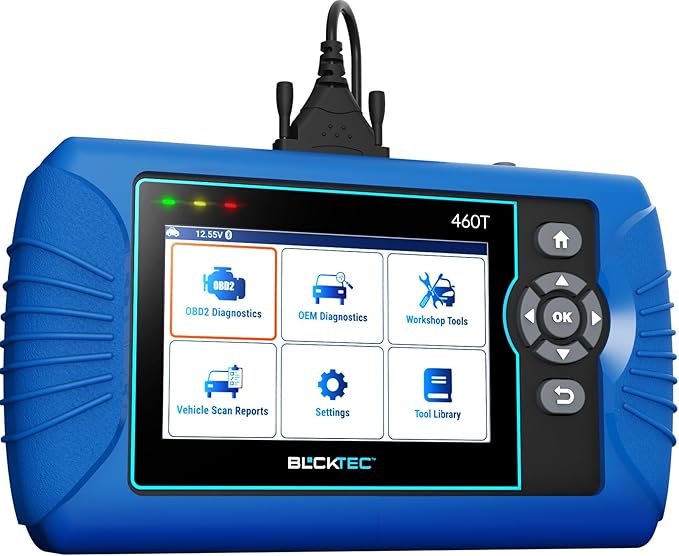 |
BLCKTEC 460T OBD2 Scanner Car Code Reader Engine ABS SRS Transmission Diagnostic | Check Price |
OBDMATE Full Systems OBD2 Scanner Car Diagnostic Tool
The OBDMATE OM970 is a strong all-around choice for a vehicle owner who wants more than a check-engine reader without immediately moving into expensive professional equipment. It scans engine, ABS, SRS, transmission, and other electronic modules, then lets you read or clear trouble codes and turn off warning lights after the underlying problem has been addressed.
Its Auto-VIN function reduces setup work, while the 3.5-inch screen and straightforward menus should be comfortable for beginners. Live readings such as RPM, fuel trims, automatic-transmission-fluid temperature, wheel speed, and battery voltage can make a fault easier to understand than a code alone. The four-in-one graph is also useful when you need to compare changing sensor values rather than looking at isolated numbers.
For emissions preparation, the one-click I/M readiness screen gives a simple visual indication of whether the vehicle’s monitors are ready for inspection. It also supports a DLC 16-pin test and battery-voltage check. The scanner covers more than 60 brands and 1,000 models, and the stated compatibility is 12-volt OBD2 vehicles from 1996 onward, although buyers should still confirm their specific model.
Pros
- Full-system access with live data and graphing.
- Auto-VIN, I/M readiness, and battery-voltage functions.
- No subscription and lifetime free software updates.
- Includes a silicone protective case and hard-shell storage case.
Cons
- Coverage and special functions can vary by vehicle.
- It does not offer the bidirectional testing depth of the FOXWELL NT726.
- The stated coverage is for 12-volt OBD2 vehicles, not older OBD1 vehicles.
My Opinion
This is the best-balanced option for most home mechanics who want broad system access, live information, and easy operation without recurring fees. Check compatibility before ordering, and use the included USB-C cable and storage case to keep the scanner updated and protected between uses.
FOXWELL NT726 OBD2 Scanner Diagnostic Tool All System Bidirectional Scan
The FOXWELL NT726 stands out when diagnosis needs to move beyond reading codes. Its bidirectional capability can command supported components such as ABS pumps, windows, coolant systems, and injectors, allowing an owner or technician to see whether a component responds. That can be valuable when a warning light points to a suspected actuator but does not prove that the part itself is defective.
It reaches more than 22 vehicle systems and supports a broad set of active tests, while the 12 maintenance functions cover tasks such as ABS bleeding, oil reset, electronic parking-brake reset, steering-angle calibration, DPF regeneration, TPMS reset, injector coding, throttle matching, battery registration, and transmission adaptation. These functions can save separate service visits, but availability depends on the vehicle and system.
The 5.5-inch touchscreen, glove-friendly operation, AutoVIN, built-in DTC lookup, live data, and I/M readiness checks make the interface more useful for repeated diagnostic work. Its support for more than 100 brands and 10,000-plus models is impressive, and FCA AutoAuth readiness is relevant for certain 2018-and-newer Chrysler, Jeep, Dodge, Fiat, and RAM vehicles when the required 12+8 adapter and access conditions apply. A one-year after-sales period is listed, along with lifetime updates, Wi-Fi report printing, 32GB storage, and PC export.
Pros
- Bidirectional testing adds active diagnosis beyond code reading.
- Includes 12 resets and maintenance functions.
- Large touchscreen, DTC lookup, data storage, and report export.
- Broad brand coverage with CAN-FD and FCA AutoAuth readiness.
Cons
- Advanced functions require careful vehicle-specific compatibility checks.
- Some FCA functions require a separate 12+8 adapter and authorization process.
- Its deeper feature set may be more than a casual owner needs.
My Opinion
Choose the NT726 if you want to test components, perform service procedures, or work on several makes. It ranks second because its extra capability brings more setup and compatibility considerations, but it is the more appropriate investment for an experienced DIYer or small garage.
ANCEL AD310 Classic Enhanced Universal OBD II Scanner Car Engine Fault Code
The ANCEL AD310 takes a deliberately narrow approach: it focuses on engine and emissions-related OBD2 diagnostics rather than attempting to cover every control module. That simplicity is its main attraction. A driver facing a check-engine light can connect the tool, read the code, look at available live data, and clear the code after repairs without navigating a large collection of advanced menus.
It supports the major OBD2 protocols, including KWP2000, J1850 VPW, ISO9141, J1850 PWM, and CAN. The thick 2.5-foot cable, compact 12-ounce body, and small footprint make it easy to keep in a vehicle, backpack, or home toolbox. Because it does not depend on Bluetooth pairing or a phone app, there are fewer connection steps and no concern about a separate device battery during a basic scan.
The trade-off is decisive for this category. The AD310 only diagnoses emission-related issues through an OBD2 interface. It cannot provide the ABS, SRS, or transmission-module access that many shoppers expect from a full-system scanner, and an OBD1 vehicle cannot be diagnosed simply by adding an OBD2 adapter. Buyers should treat it as a dependable basic code reader, not as a replacement for the other four tools.
Pros
- Compact, lightweight, and simple to operate.
- Supports all listed major OBD2 protocols.
- Reads and clears engine-emissions codes and displays live data.
- Compatible with many 1996-and-newer US vehicles and later EU or Asian vehicles.
Cons
- Does not scan ABS, SRS, transmission, or other non-emissions systems.
- Cannot diagnose OBD1 vehicles.
- It lacks the service resets and active tests found on higher-ranked options.
My Opinion
The AD310 is a sensible low-complexity choice for check-engine-light questions, travel, or a backup toolbox reader. It ranks third only because its limited scope does not meet the needs of buyers specifically seeking full-system coverage; confirm the vehicle uses the supported OBD2 interface before purchase.
FOXWELL Car Scanner NT604 Elite OBD2 Scanner ABS SRS Transmission
The FOXWELL NT604 Elite occupies the middle ground between a basic engine reader and a more advanced service scanner. It concentrates on four important areas: engine, ABS, SRS, and transmission. That makes it useful when a warning light is not related to emissions, particularly when the owner needs to identify an airbag, brake-control, or transmission fault before deciding what repair comes next.
AutoVIN can retrieve vehicle information without requiring manual VIN entry, and the scanner supports more than 60 brands across American, Asian, and European vehicles. Its I/M readiness menu helps with emissions-test preparation, while live data gives additional context around a code. The included solid protective case is a practical ownership advantage because wired scanners are often stored in toolboxes or moved between vehicles.
The most important limitation is the lack of service functions. This model does not support oil resets, battery registration, ABS bleeding, throttle-body relearn, or ABS relearn. It can therefore identify faults in its supported modules, but it should not be purchased with the expectation that it will complete maintenance procedures after the diagnosis. Compatibility remains vehicle-dependent, even within the listed brands.
Pros
- Accesses engine, ABS, SRS, and transmission systems.
- AutoVIN, live data, and I/M readiness are useful for routine ownership.
- Supports more than 60 worldwide vehicle brands.
- Includes a solid protective carrying case and lifetime updates.
Cons
- No oil reset, battery registration, ABS bleeding, or throttle relearn.
- Not a bidirectional component-testing tool.
- Actual module coverage depends on the specific vehicle.
My Opinion
The NT604 Elite is a good fit for someone who wants four-system access at a simpler level than the NT726. Buy it for diagnosis, not service resets, and verify the exact make, model, year, and module support before relying on it for a particular repair.
BLCKTEC 460T OBD2 Scanner Car Code Reader Engine ABS SRS Transmission Diagnostic
The BLCKTEC 460T is aimed at owners who want broad diagnostics plus a sizable collection of workshop-style resets. It can read and clear engine, transmission, ABS, and SRS codes, scan all supported systems, display live OBD2 and OEM data, and show freeze-frame information. That combination helps connect a stored code with the operating conditions present when the fault appeared.
Its service menu covers oil maintenance, ABS bleeding, electronic parking-brake reset, steering-angle recalibration, DPF reset, throttle-body relearn, battery initialization, TPMS relearn, transmission reset, fluid-change reset, and other listed procedures. AutoVIN, AutoScan, and AutoReLink are intended to reduce the number of manual steps. Pairing the scanner with the free RepairSolutions2 app adds access to a verified-fix database, parts information, maintenance schedules, technical service bulletins, warranty details, and recall information.
There are boundaries that matter. The scanner and app are limited to the United States and Canada, and the product information notes that not every function works on every vehicle. Stated compatibility covers OBD2-compliant vehicles sold and registered in those regions from 1996 onward, with most listed coverage through 2023 models. It also requires app pairing for some of its extra information, which may not appeal to buyers seeking a completely standalone tool.
Pros
- All-system scanning with live data and freeze-frame information.
- 12-plus service and reset functions.
- AutoVIN, AutoScan, AutoReLink, and lifetime updates.
- RepairSolutions2 adds repair and vehicle-information resources.
Cons
- Use is limited to the United States and Canada.
- Not every reset or function is available on every vehicle.
- Some added resources depend on the RepairSolutions2 app.
My Opinion
The 460T is a capable option for a home mechanic who values resets and repair information as much as code access. It ranks fifth because its regional restriction and app dependency narrow its audience, but it deserves consideration when the vehicle is supported and those service functions are genuinely useful.
How I Selected These Best Full System Car Scanner Options
The central question was not simply which device lists the most functions. I compared how each scanner handles system coverage, live data, service procedures, active tests, vehicle compatibility, update policy, ease of use, and limitations. Customer-feedback volume and ratings were also considered where supplied, but a large number of ratings does not automatically make a product suitable for a buyer who needs ABS or transmission access.
A full-system label does not guarantee identical coverage on every vehicle. Module access, reset functions, security gateways, and special tests can change by make, model, year, engine, and regional configuration.
The ranking gives first place to the OBDMATE because it balances broad coverage and beginner-friendly operation without a subscription. The NT726 follows because its capabilities are deeper but may be unnecessary for routine ownership. The ANCEL remains high for basic engine work despite its narrow coverage, while the NT604 and BLCKTEC serve more specific needs around four-system diagnosis and service functions.
Read the limitations before comparing feature counts. A scanner that clearly states what it cannot do is easier to match to a real repair than one chosen only for an impressive list of functions.
How to Choose the Best Full System Car Scanner
The right choice depends on the warning lights you expect to diagnose and the jobs you want to perform afterward. If your need is only a check-engine code, a basic reader may be enough. If you want to investigate airbag or brake faults, register a battery, bleed ABS, or activate components, you need broader and often vehicle-specific coverage.
- Confirm your exact vehicle, year, engine, region, and communication requirements.
- Separate code reading from service resets and bidirectional testing.
- Prioritize live data and freeze-frame information when diagnosing intermittent faults.
- Check whether updates are free, subscription-based, app-dependent, or limited by region.
- Choose a simple interface if the scanner will be used only occasionally.
System coverage versus service functions
Scanning a module means retrieving information from it. Resetting a service reminder or calibrating a component is a different task, and active testing is different again. The NT604 can reach four major systems but does not perform several maintenance procedures. The NT726 and BLCKTEC add many resets, while the AD310 remains focused on emissions-related engine information.
When bidirectional testing matters
Active testing can command a supported component so you can observe its response. This is helpful for narrowing down a suspected ABS pump, injector, window motor, or cooling-system component. It should not be treated as permission to activate an unfamiliar system without understanding the vehicle procedure. The NT726 is the clearest choice here, but availability still depends on the vehicle.
Ease of use and storage
A larger display can make graphs and live values easier to read, while a compact wired reader is convenient to carry. Cases matter more than they may seem: the OBDMATE, NT726, NT604, and other listed tools include protective storage options. Keep the cable from bending sharply and avoid leaving the scanner where heat, moisture, or loose tools can damage it.
Check Compatibility Before Buying
Start with the vehicle’s model year, market, engine, and the warning light you need to investigate. “Supports a brand” does not necessarily mean every module or reset is supported on every vehicle from that brand. Security gateways, proprietary connectors, diesel systems, and regional differences can affect the result.
For the OBDMATE, the stated range is more than 60 brands and 1,000 models among 12-volt vehicles from 1996 onward. The ANCEL supports OBD2 protocols and broad US, EU, and Asian vehicle coverage but not OBD1. The NT726 has broad brand and model claims, with FCA AutoAuth considerations. BLCKTEC’s tool and app are restricted to the United States and Canada.
Before ordering, use the seller’s compatibility process when available and ask specifically about the module or reset you need. Save the vehicle identification information and the exact warning-light description; those details make a compatibility question much more useful than asking whether a scanner works with a brand generally.
How to Set Up a Wired Scanner Safely
- Park on a stable surface, switch off accessories, and apply the parking brake.
- Locate the vehicle’s 16-pin diagnostic connector without forcing the plug.
- Connect the scanner before turning the ignition to the position required by the instructions.
- Allow AutoVIN or manual vehicle selection to finish before starting a full scan.
- Record stored and pending codes, freeze-frame data, and important live values.
- Investigate the cause before clearing codes or performing a reset.
Do not disconnect the scanner while an update, coding procedure, battery registration, or other active operation is running. A stable vehicle battery is especially important during longer scans and service procedures. If the tool reports a communication failure, check the connector, ignition position, vehicle compatibility, and power supply before assuming the scanner is defective.
How to Use Live Data More Effectively
Live data is most useful when you compare related readings under a known condition. For example, observe RPM and battery voltage at startup, compare fuel trims at idle and at a steady speed, or watch wheel-speed values while investigating an ABS concern. The goal is not to collect every available number; it is to connect a changing value with a specific symptom.
Freeze-frame data can show the conditions present when a code was stored. Write down the code and relevant values before clearing anything. A cleared code may remove useful diagnostic context, and turning off a warning light does not repair the problem or guarantee that it will stay off.
Using Resets and Special Functions Responsibly
Service functions can be convenient, but they are not universal shortcuts. An oil reset should follow an actual oil service, a battery registration should match the installed battery and vehicle procedure, and an ABS bleed should be performed only with the correct fluid, equipment, and safety steps. A DPF regeneration can create high temperatures and should be approached with particular caution.
Read the on-screen prompts and vehicle-specific instructions before activating a function. If the scanner lists a function but the vehicle does not respond as expected, stop rather than repeatedly commanding the system. An unavailable or failed function can indicate a compatibility limitation, a required adapter, a security authorization issue, or a vehicle fault.
Keeping a Car Scanner Reliable
Store the unit in its case, keep the connector clean, and coil the cable loosely rather than wrapping it tightly around the scanner. Do not use solvents or spray cleaner on the screen or connector. A soft, dry cloth is usually the safest cleaning choice, and the scanner should be kept away from water and excessive heat.
Install software updates according to the product instructions and keep the cable connected securely during the process. Lifetime updates are useful only when the device is updated periodically. If a scanner has internal storage or exports reports, remove unnecessary files when storage becomes crowded and keep important diagnostic notes somewhere else.
Common Mistakes to Avoid with a Full-System Scanner
Most scanner problems begin with a mismatch between what the owner expects and what the vehicle or tool can actually support. Avoid treating a code description as a final diagnosis, and do not clear warning lights merely to pass an inspection or hide an unresolved fault.
- Do not assume a brand-wide compatibility claim covers every module.
- Do not confuse reading a code with repairing the cause.
- Do not perform a reset without completing the related maintenance.
- Do not interrupt updates, coding, or active tests.
- Do not use an OBD2 tool on an OBD1 vehicle and expect an adapter to solve everything.
- Do not ignore battery voltage when communication errors occur.
FAQS About Best Full System Car Scanner
What makes the best full system car scanner different from a basic code reader?
A full-system scanner can access several control modules, such as engine, ABS, SRS, and transmission, rather than only reading emissions-related engine codes. Some models also provide live data, service resets, or bidirectional tests.
Can the ANCEL AD310 be considered a full-system scanner?
No. The AD310 is a useful OBD2 engine and emissions code reader, but the supplied information states that it does not diagnose ABS, SRS, transmission, or other non-emissions systems.
Which scanner is best for ABS and SRS diagnosis?
The OBDMATE, FOXWELL NT726, FOXWELL NT604, and BLCKTEC 460T list ABS and SRS access. The exact depth of coverage depends on the vehicle, so confirm the specific model and fault area before buying.
Is a bidirectional scanner worth choosing?
It can be worthwhile if you need to command supported components and verify their response. The FOXWELL NT726 is the strongest option in this comparison for active tests, but bidirectional functions are vehicle-dependent and should be used carefully.
Can a full-system car scanner reset every warning light?
No. A scanner may clear a stored code, but the warning can return if the fault remains. Service resets and module access also vary by vehicle, and some functions require authorization, a separate adapter, or a supported app.
Do these scanners work with older OBD1 vehicles?
The ANCEL AD310 specifically cannot diagnose OBD1 vehicles, even with an OBD2 adapter. The other products are described around OBD2 vehicles, so owners of older cars should confirm connector and protocol compatibility before purchase.
Final Thoughts
For most owners, the OBDMATE Full Systems OBD2 Scanner Car Diagnostic Tool is the best full system car scanner because it balances coverage, live data, ease of use, and no-subscription ownership. Choose the FOXWELL NT726 for bidirectional testing and advanced resets, or the ANCEL AD310 when simple engine-code diagnosis is all you need. The FOXWELL NT604 and BLCKTEC 460T remain worthwhile alternatives when four-system access or service functions match your vehicle and repair plans.