A dead battery, low tire, and lack of electrical power can turn one roadside problem into several. The best jump starter with air compressor and inverter combines three useful emergency tools in one unit, allowing you to start a vehicle, inflate a tire, and power compatible AC equipment without another car or wall outlet.
The inverter is what makes these units different from ordinary jump starter/compressor combinations. The Schumacher SJ1332, for example, combines jump-starting with a 150 PSI compressor and two 120V outlets, while the DEWALT DXAEPS14 increases available AC power to 500W.
My primary recommendation is the Schumacher SJ1332 1200A Portable Power Station. I would choose it for most drivers because its 1200A jump starter, 150 PSI compressor, 200W continuous/400W peak inverter, dual AC outlets, USB charging, and 12V outputs create the most balanced all-in-one package.
I would choose the Tyrell Chenergy 2200A Jump Starter with Air Compressor and Inverter when stronger advertised jump-start output and a higher-output inverter are the priorities. It is aimed at drivers who want one portable station for battery emergencies, tire inflation, AC equipment, and mobile-device power.
The DEWALT DXAEPS14 2000A Portable Power Station is the model I would choose when 500W AC inverter power and modern USB charging matter most. Its current U.S. listing specifies a 120 PSI compressor, 500W AC power, 15W USB-A, and 25W USB output alongside its 2000A jump-start rating.
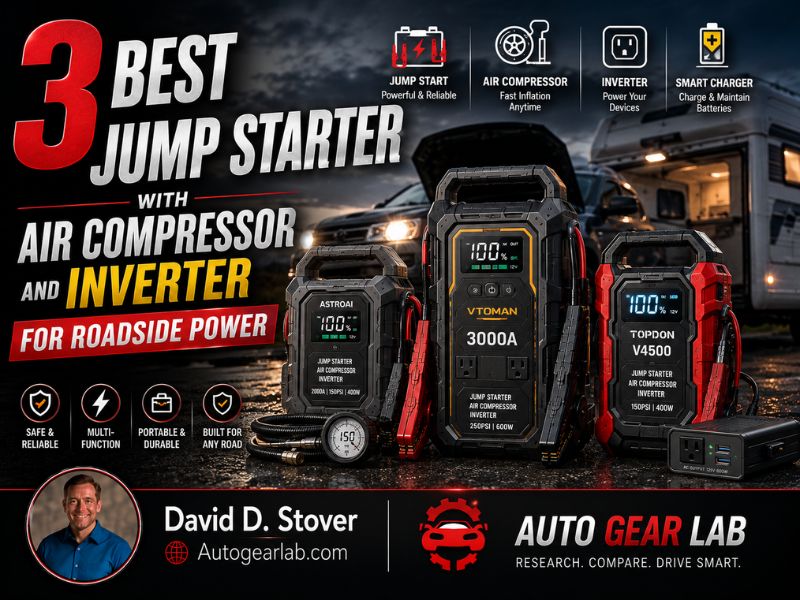
3 Jump Starters with Air Compressors and Inverters Reviewed
| Image | Product Name | Check Price |
|---|---|---|
Best Choice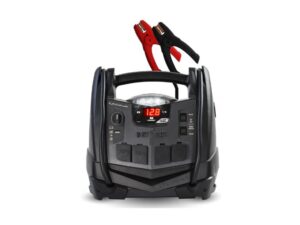 | Schumacher SJ1332 1200A Portable Power Stationv | Check Price |
Second Best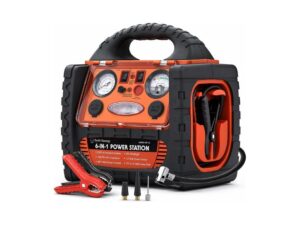 | Tyrell Chenergy 2200A Jump Starter with Air Compressor and Inverter | Check Price |
Third Choice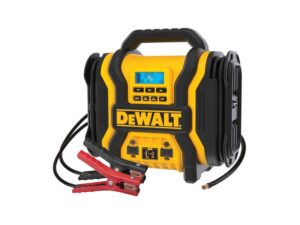 | DEWALT DXAEPS14 2000A Portable Power Station | Check Price |
These products are substantially larger than pocket-size lithium boosters because they combine an internal battery, jumper cables, compressor hardware, an inverter, and multiple power outputs.
The advantage is convenience: one unit can replace several separate roadside tools.
1. Schumacher SJ1332 1200A Portable Power Station
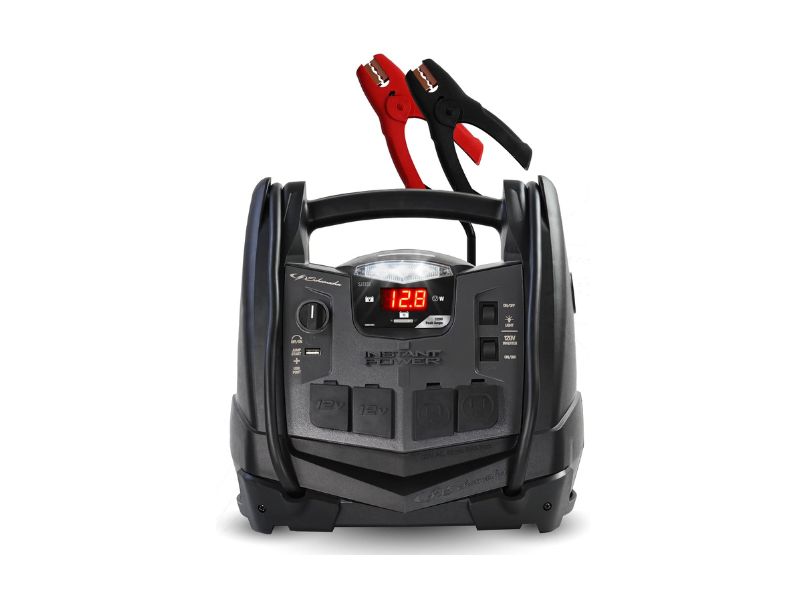
Key Features
- 1200 peak amps
- 150 PSI air compressor
- 200W continuous / 400W peak inverter
- Two 120V AC outlets
- Two 12V DC accessory outlets
- 2A USB charging
- Sealed AGM internal battery
- Digital battery-status display
- Built-in emergency light
The SJ1332 is my primary recommendation because it does all three major jobs competently without placing too much emphasis on one headline specification.
Schumacher describes it as a combined jump starter, AC/12V/USB power source, air compressor, and inflator. Its official specifications include 1200 peak starting amps, a 400 peak-watt converter, two 120V AC outlets, a 150 PSI compressor, USB charging, and a sealed AGM internal battery.
The inverter is especially useful, but its rating needs to be understood correctly.
The SJ1332 supplies approximately 200 continuous watts and 400 peak watts. Continuous output is the important number when deciding whether an appliance can run for more than a brief startup surge.
That makes the inverter suitable for many smaller loads such as laptop chargers, camera chargers, LED lighting, certain fans, and other modest electronics.
It is not suitable for most high-wattage heating appliances.
A space heater, microwave, electric kettle, hair dryer, hot plate, or large coffee maker can easily require several times the SJ1332’s continuous capacity.
The two AC outlets share the inverter’s available output. You should not assume that each outlet independently provides 200W.
The 150 PSI compressor is another strong feature. It gives the unit enough pressure capability for ordinary car tires while also supporting recreational inflation tasks. Schumacher also provides inflator/deflator functionality for items such as air mattresses and pool inflatables.
For tires, maximum PSI matters less than compressor usability.
Normal passenger-car tires typically operate far below 150 PSI. The important considerations are pressure monitoring, hose access, compressor heat, and duty cycle.
The SJ1332 includes thermal protection for the compressor. If the compressor becomes excessively hot, it can shut down until it cools sufficiently.
That protects the compressor, but it also means this is an emergency inflator rather than a shop compressor designed to fill large tires continuously all day.
The unit also provides two 12V DC outlets and a USB port.
Whenever an accessory can run directly from USB or 12V DC, I would use that output instead of the inverter. Converting internal DC battery energy to 120V AC and then back to DC through another charger wastes additional energy.
The sealed AGM battery contributes to the SJ1332’s larger size compared with lithium jump packs. The advantage is a traditional portable-power-station design that integrates well with the inverter and compressor.
The biggest limitation is portability. This is better suited to an SUV, pickup, RV, garage, or larger trunk than to someone who wants the smallest emergency kit possible.
What I Like
- Strong balance of jump-starting, inflation, and AC power
- 150 PSI compressor
- Two AC outlets
- Clear continuous and peak inverter ratings
- USB and 12V outputs
- Integrated charging system
What I Do Not Like
- Considerably bulkier than lithium-only jump starters
- 200W continuous inverter limits appliance choice
- AGM construction adds weight
The Schumacher SJ1332 is the model I would choose for most buyers. Its combination of 1200A starting capability, tire inflation, AC power, and accessory charging is more useful than simply chasing the highest peak-amp specification.
2. Tyrell Chenergy 2200A Jump Starter with Air Compressor and Inverter
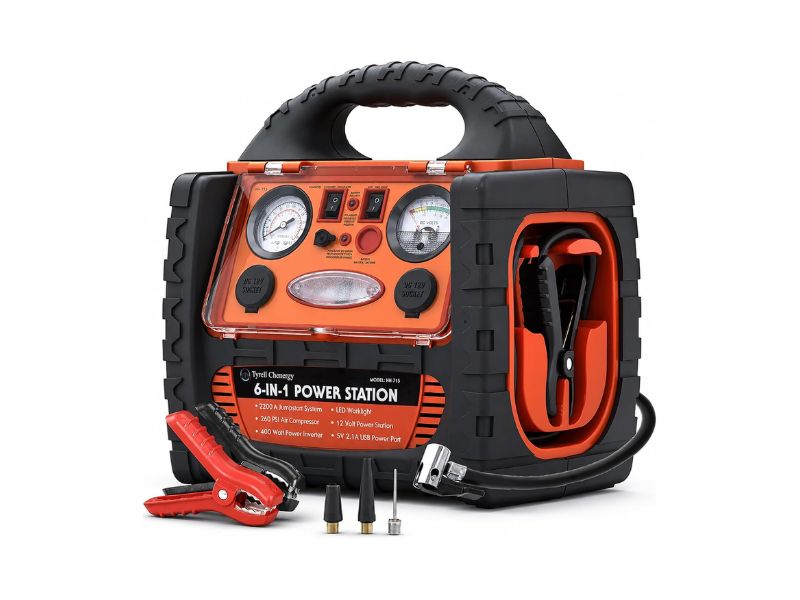
Key Features
- 2200A advertised jump-start output
- 12V vehicle applications
- Built-in power inverter
- Integrated air compressor
- AC power connection
- DC accessory power
- USB charging
- Portable power-station format
The Tyrell Chenergy is the alternative I would consider when stronger advertised starting capability and substantial inverter functionality matter more than choosing the most established automotive-power brand.
Its all-in-one design follows the same basic philosophy as the Schumacher: use one rechargeable power station to handle battery starts, tire inflation, electronic-device charging, and AC power.
The 2200A advertised output gives it considerable theoretical starting headroom for ordinary passenger vehicles and larger engines.
I would not interpret 2200A as automatically meaning it is almost twice as capable as the 1200A Schumacher.
Peak-current specifications are not necessarily measured using identical procedures across manufacturers. Battery architecture, clamp contact, cable resistance, temperature, and cranking duration also affect practical starting performance.
The inverter is the more interesting feature for this keyword.
AC output allows compatible household-style electronics to operate away from utility power, making the unit useful for:
- Road trips
- Camping
- Tailgating
- Power outages
- Mobile work
- Roadside emergencies
However, every connected device should be checked against the inverter’s actual continuous and surge limits.
Motor-driven equipment deserves particular caution because startup wattage can be much higher than running wattage.
A small refrigerator, pump, or power tool may appear to fall within the inverter’s normal wattage rating but briefly demand much more when its motor starts.
The integrated compressor means you do not need to carry a second tire inflator.
That is useful for slow leaks and seasonal pressure adjustments, although compressor use draws energy from the same internal battery needed for vehicle starting and inverter operation.
If both the tire and vehicle battery have problems, I would preserve enough charge to start the vehicle first.
USB output is preferable to AC for phone charging because it avoids unnecessary conversion losses.
The main weakness is documentation depth. I would rely carefully on the supplied product manual for exact inverter limits, compressor duty cycle, recharge procedure, and whether multiple major functions can be operated simultaneously.
What I Like
- Strong advertised jump-start output
- Inverter and compressor in one unit
- AC, DC, and USB power
- Useful camping and roadside versatility
- Good choice for multi-function emergency storage
What I Do Not Like
- Peak-current figures are difficult to compare directly across brands
- Less detailed technical documentation than Schumacher
- More cumbersome than a compact lithium booster
The Tyrell Chenergy is a strong option for a buyer who wants maximum all-in-one functionality and places substantial value on inverter power alongside jump-starting.
3. DEWALT DXAEPS14 2000A Portable Power Station
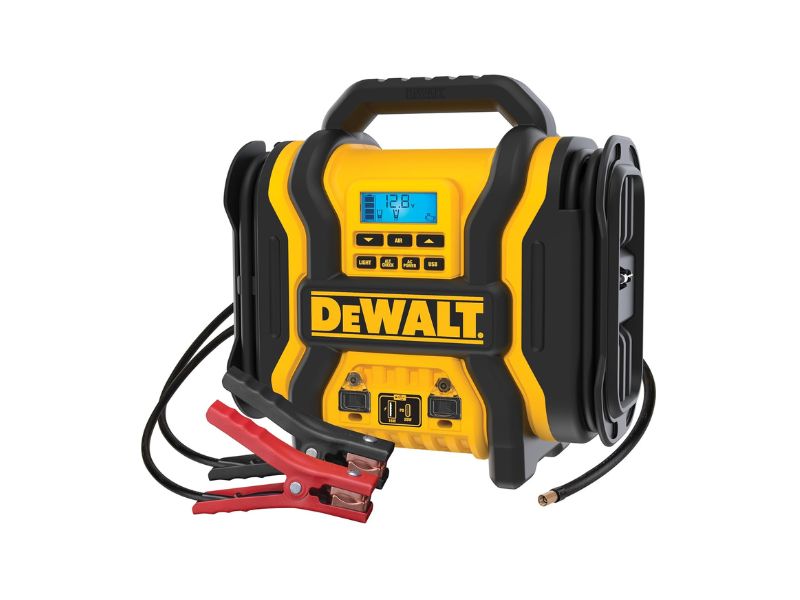
Key Features
- 2000 peak amps
- 500W AC inverter
- 120 PSI air compressor
- Digital inflation controls
- AUTOSTOP
- 15W USB-A output
- 25W USB output
- Reverse-polarity protection
- Portable power-station design
The DEWALT DXAEPS14 is the strongest choice of these three when the inverter is almost as important as the jump starter.
Its current Amazon listing specifies 2000A jump-starting, a 120 PSI compressor, and 500W AC power, giving it substantially more stated inverter capability than the Schumacher SJ1332.
That 500W rating expands the range of equipment that can potentially be powered.
Depending on the device’s actual electrical requirements, the DEWALT can be better suited to larger laptop adapters, lighting, small TVs, battery chargers, and other moderate loads.
It still is not a generator.
High-current heating appliances often exceed 500W, while motorized appliances can produce startup surges that go beyond their normal running consumption.
The 120 PSI compressor includes AUTOSTOP functionality. This allows the user to select a target tire pressure and have the compressor stop automatically when that pressure is reached.
For normal tire inflation, I consider AUTOSTOP more valuable than having an unusually high maximum PSI rating.
A passenger tire that needs approximately 35 PSI does not benefit much from a compressor capable of 150 PSI instead of 120 PSI. Accurate control and convenient shutoff matter more.
The DXAEPS14 also offers the strongest portable-device charging arrangement of these three.
Amazon specifies 15W USB-A and 25W USB power, making the DEWALT particularly appealing for modern phones, tablets, and other electronics.
Direct USB charging is also more energy-efficient than turning on the inverter solely to plug in a phone’s wall adapter.
Reverse-polarity protection adds another useful safety layer for the jump-start function.
That matters because a driver using an emergency power station only once every few years may be less familiar with correct clamp setup than a professional technician.
As with the other products, the major limitation is shared battery capacity.
The inverter, compressor, USB outputs, work lights, and jumper cables all depend on the same internal energy supply.
Running a 400W AC load for an extended period can consume far more stored energy than charging a phone.
What I Like
- 500W AC inverter
- 2000A advertised jump-start output
- Digital 120 PSI compressor
- AUTOSTOP tire inflation
- Modern USB charging
- Reverse-polarity protection
What I Do Not Like
- More capacity and bulk than many car owners need
- Heavy AC loads can drain the internal battery quickly
- Still cannot replace a large dedicated portable power station
The DEWALT DXAEPS14 is the model I would choose when AC power, USB charging, and automatic tire inflation carry nearly as much weight in the buying decision as jump-starting.
Jump Starter with Air Compressor and Inverter Comparison
| Product | Jump Output | Compressor | Inverter | AC Power | USB | Main Strength |
| Schumacher SJ1332 | 1200A | 150 PSI | 200W continuous / 400W peak | Dual 120V outlets | 2A USB | Best overall balance |
| Tyrell Chenergy | 2200A advertised | Integrated | Built-in inverter | AC output | USB | Strong multi-purpose capability |
| DEWALT DXAEPS14 | 2000A | 120 PSI AUTOSTOP | 500W | AC power | 15W USB-A + 25W USB | Strongest AC and USB setup |
The Schumacher SJ1332 offers the most balanced combination of the three functions, with a clearly specified 200W continuous/400W peak inverter and 150 PSI compressor.
The DEWALT provides greater stated AC capacity at 500W and adds more modern USB charging plus automatic tire-pressure control.
The Tyrell Chenergy fills the middle ground for buyers who want strong advertised jump output and an integrated multi-function power-station layout.
How to Choose the Best Jump Starter with Air Compressor and Inverter
Start With Inverter Continuous Wattage
The inverter deserves more attention than the largest number printed on the jump starter.
Continuous watts describe how much AC power the unit can sustain.
Peak or surge watts describe temporary output available for short startup loads.
The SJ1332 illustrates why the distinction matters: its inverter is rated for approximately 200W continuous and 400W peak.
A 300W appliance therefore should not be treated as compatible simply because the product description mentions 400W.
Check the Appliance Before Plugging It In
Look at the appliance label or power adapter.
Compare its wattage with the inverter’s continuous limit.
If the label lists amps rather than watts, power can generally be estimated from voltage multiplied by current for basic comparison, though AC equipment and power factor can make real behavior more complicated.
When uncertain, leave additional margin.
Remember That Two AC Outlets Share One Inverter
Two outlets do not double the available power.
If a 100W device and an 80W device are connected simultaneously to a 200W inverter, the combined demand is already approximately 180W before accounting for inverter losses.
That leaves very little operating margin.
Consider Startup Surge
Electric motors can require much more power for a fraction of a second when starting.
Common examples include:
- Refrigerators
- Pumps
- Fans
- Certain power tools
- Small compressors
Always check surge requirements before assuming the device will work from a compact inverter.
What Can a 200W Inverter Run?
A 200W inverter can be useful for many lower-power electronics.
Possible applications include compatible:
- Laptop chargers
- Camera chargers
- LED lights
- Small fans
- Battery chargers
- Small televisions
Always verify the actual device wattage.
A 200W inverter is generally not intended for appliances that create substantial heat.
What Can a 500W Inverter Run?
A 500W inverter provides more flexibility.
It can potentially handle larger chargers, electronics, lights, and certain low-power appliances that would exceed a 200W unit.
However, 500W is still modest compared with household circuits or full-size portable power stations.
A 1500W heater is still a 1500W appliance regardless of how many AC outlets the jump starter has.
High-Wattage Appliances to Avoid
Most compact jump-starter inverters are poor matches for:
- Space heaters
- Electric kettles
- Microwaves
- Hair dryers
- Toasters
- Hot plates
- Large coffee makers
These devices frequently require hundreds or thousands of watts.
A dedicated high-capacity power station or generator is a better category for those loads.
Compressor PSI Is Not Compressor Speed
A 150 PSI compressor is not automatically faster than a 120 PSI compressor.
Maximum pressure simply describes the highest pressure the compressor is designed to produce.
For normal tires, inflation speed depends more on airflow and compressor design.
I would also look for:
- Automatic shutoff
- Digital pressure control
- Hose length
- Thermal protection
- Duty cycle
- Storage for the hose
The DEWALT’s AUTOSTOP feature is particularly useful for ordinary tire maintenance.
Use the Door Placard for Tire Pressure
Do not inflate a car tire to the maximum PSI shown on the tire sidewall simply because the compressor can reach that pressure.
The recommended cold tire pressure is normally shown on the driver’s door-jamb placard or in the vehicle owner’s manual.
That is the pressure target I would use for routine inflation.
Consider Starting Capability Separately
A larger inverter does not necessarily mean a stronger jump starter.
The two systems serve different purposes.
The jumper circuit supplies a brief high-current burst to the starter motor.
The inverter converts stored DC battery energy into household-style AC power.
Evaluate both independently.
Do Not Compare Peak Amps Blindly
Advertised peak amperage is useful, but cross-brand comparisons are imperfect.
Actual starting performance also depends on:
- Internal battery condition
- Vehicle battery condition
- Ambient temperature
- Cable resistance
- Clamp contact
- Engine displacement
- Starter-motor condition
- Cranking duration
A lower-numbered jump starter with strong cables and healthy battery cells can outperform a poorly designed unit carrying a much larger marketing number.
Gasoline vs Diesel Starting
Diesel engines generally place higher demands on a starting system than similarly sized gasoline engines.
If the manufacturer publishes separate gasoline and diesel limits, use the correct rating.
The Schumacher SJ1332’s current listing and supporting documentation place it in a broad large-engine use category, including up to 8.0L gasoline and 6.0L diesel applications in the available documentation.
Direct USB Saves Energy
When charging a phone, use USB instead of turning on the inverter and connecting a wall charger.
The direct route is:
Internal DC battery → USB device
Using the inverter adds extra conversion:
Internal DC battery → 120V AC → phone charger’s DC output
Every conversion loses some energy as heat.
The DEWALT is particularly attractive here because its current listing includes dedicated higher-power USB outputs.
12V DC Can Also Be More Efficient Than AC
The same principle applies to 12V automotive accessories.
If a compatible cooler, inflator, or accessory can operate directly from a 12V outlet, using DC can avoid inverter losses.
The Schumacher SJ1332 includes two 12V accessory outlets in addition to its AC outlets and USB connection.
Preserve Battery Reserve for Starting
All the functions draw from the same internal energy supply.
Before you run:
- The inverter
- Compressor
- USB charging
- Work lights
- DC accessories
consider whether the vehicle itself also needs a jump.
Starting the car should usually come first.
Once the engine is running and the immediate emergency is solved, the remaining stored power can be used for other functions.
AGM vs Lithium Jump Starter Power Stations
Many larger inverter-equipped jump starters use sealed AGM lead-acid batteries.
The SJ1332 is one example.
AGM works well for these products because it can supply substantial current and integrate with power-station hardware.
Its disadvantages are weight and size.
Lithium technology offers much greater energy density, which is why compact jump starters can weigh only a few pounds.
If portability is the highest priority and you rarely need AC power, a separate lithium jump starter and compact inflator may make more sense.
Inverter Waveform Matters
Not every inverter produces the same quality of AC waveform.
The SJ1332 manual identifies its converter as a modified sine-wave design.
Modified sine wave works with many ordinary chargers and basic electronics, but some sensitive equipment, certain motors, audio systems, and specialized devices can behave poorly.
If you need to power sensitive electronics, verify whether the inverter produces pure sine wave output.
Do not assume it does unless the manufacturer explicitly states it.
How to Jump-Start a Vehicle Safely
1. Confirm the Vehicle Uses a Compatible 12V System
Do not connect a 12V-only power station across a true 24V electrical system.
2. Inspect the Battery
Do not attempt a jump if the battery is:
- Frozen
- Cracked
- Swollen
- Leaking
- Smoking
- Exceptionally hot
3. Turn Off the Inverter and Compressor
Preserve the internal battery for the jump-start operation.
4. Turn Off Vehicle Accessories
Switch off unnecessary lights, HVAC, audio, heated seats, and electronics.
5. Connect the Positive Clamp
Attach the red clamp to the approved positive battery terminal or remote positive jump point.
6. Connect the Negative Clamp
Use the negative terminal or chassis-ground location specified by the vehicle manufacturer.
7. Check for Reverse-Polarity Warnings
Correct any connection error before enabling jump-start power.
8. Attempt a Brief Start
Follow the jump starter’s stated maximum crank duration.
Do not hold the starter continuously.
9. Allow Cooling Between Attempts
High current creates heat in the jump starter, cables, clamps, and vehicle starter motor.
10. Disconnect According to the Instructions
Follow the jump starter and vehicle manuals.
11. Recharge the Power Station
Do not return it to storage partially depleted.
How to Use the Air Compressor
First determine the vehicle’s recommended cold tire pressure.
Connect the air hose firmly to the valve stem.
If the compressor provides digital pressure selection, set the target.
Start inflation.
Allow an automatic system such as the DEWALT’s AUTOSTOP to shut off at the selected pressure.
If the compressor becomes unusually hot or shuts down thermally, allow it to cool.
A tire that quickly loses pressure again needs repair. An inflator does not fix a puncture or damaged sidewall.
How to Use the Inverter Safely
Check the appliance’s wattage before connection.
Keep the inverter turned off while plugging in the device unless the manual instructs otherwise.
Turn the inverter on.
Monitor the power station for overload or temperature warnings.
Provide ventilation around the unit.
Never expose energized AC outlets to rain or standing water.
Turn the inverter off when finished.
Common Buying Mistakes
Buying by Peak Amps Alone
A larger jump-start number tells you little about inverter quality or compressor usability.
Confusing Peak and Continuous Inverter Watts
Continuous watts determine normal operating capability.
Buying by Compressor PSI Alone
Pressure capability and inflation speed are not the same thing.
Ignoring Automatic Shutoff
AUTOSTOP makes normal tire inflation substantially easier.
Using AC Power for Everything
USB and 12V DC outputs are often more energy-efficient.
Running High-Power Appliances
Compact inverters are not substitutes for household circuits or generators.
Using the Inverter Before Jump-Starting
Preserve enough battery reserve for the vehicle first.
Ignoring Inverter Waveform
Sensitive electronics may require pure sine-wave power.
Leaving the Unit Discharged
Recharge it after significant compressor, inverter, or jump-start use.
Frequently Asked Questions
What is the best jump starter with air compressor and inverter?
The Schumacher SJ1332 provides the best overall balance for most drivers.
It combines 1200A starting capability, a 150 PSI compressor, two AC outlets, a 200W continuous/400W peak inverter, USB charging, and 12V accessory power.
Which model has the strongest inverter?
The DEWALT DXAEPS14 has the highest stated AC output of these three at 500W.
Its current Amazon listing also combines that inverter with 2000A jump-starting, a 120 PSI compressor, and dedicated USB charging.
Can a jump starter inverter power a laptop?
Yes, when the charger’s power requirement stays below the inverter’s continuous rating.
Many ordinary laptop adapters fall within small-inverter limits, but high-performance laptops can require substantially more power.
Can a 200W inverter run a laptop?
Yes, many laptop chargers draw less than 200W.
Check the power adapter label rather than assuming compatibility. A high-powered gaming or workstation laptop may exceed the limit.
Can a 500W inverter run a refrigerator?
Possibly, but motor startup surge may exceed the inverter’s available capacity.
Small refrigerators can have relatively low running consumption but briefly demand much more power when the compressor starts.
Can a 500W inverter run a microwave?
Most microwaves require more power than a 500W inverter can provide.
The cooking-output rating on a microwave can also be lower than its actual electrical input, so check the appliance label.
Can it run a coffee maker?
Many standard coffee makers draw too much power for compact 200W–500W inverters.
Heating elements have high electrical demand, making a larger power station or generator more appropriate.
Can it run a TV?
Many small televisions can operate from a compatible inverter if their wattage stays within the limit.
Check the TV’s actual input rating and leave sufficient inverter margin.
Is 120 PSI enough for car tires?
Yes, 120 PSI is far above the normal pressure required by most passenger-car tires.
Use the vehicle manufacturer’s recommended cold pressure rather than the compressor’s maximum specification.
Is 150 PSI better than 120 PSI?
Not necessarily, because maximum pressure does not tell you inflation speed.
For car tires, airflow, thermal protection, hose design, and automatic shutoff are often more useful specifications.
What does AUTOSTOP mean on an air compressor?
AUTOSTOP allows the compressor to stop automatically at a selected pressure.
This reduces the need to repeatedly check the tire gauge and helps avoid accidental overinflation.
What is the difference between peak and continuous inverter watts?
Continuous watts are sustainable output; peak watts are available only briefly.
Size normal electrical loads according to continuous wattage and consider startup surge separately.
Can I use both inverter outlets simultaneously?
Yes, but their combined load must stay within the inverter’s total capacity.
Two outlets do not double the available power.
Can I charge my phone from these jump starters?
Yes, these power stations provide dedicated device-charging capability.
The DEWALT is especially useful for modern devices because its current listing includes 15W USB-A and 25W USB power.
Should I charge my phone through the AC inverter?
Use the built-in USB port instead whenever possible.
Direct USB charging generally wastes less battery energy because it avoids unnecessary DC-to-AC and AC-to-DC conversions.
Can I use the inverter and compressor at the same time?
I would avoid simultaneous high loads unless the manufacturer explicitly permits them.
Both functions place substantial demand on the same internal battery and can generate heat.
Can I jump-start while the inverter is running?
Turn the inverter and unnecessary accessories off before attempting the jump.
This preserves maximum battery reserve for starting and reduces competing electrical loads.
Is a jump starter with inverter better than a portable power station?
It is better when vehicle recovery is the priority; larger power stations are better for sustained AC loads.
A dedicated power station generally stores considerably more energy, while a jump starter is specifically designed to provide high-current vehicle starting assistance.
How often should I recharge the unit?
Recharge it after significant use and check its charge periodically during storage.
Also inspect it before winter, road trips, camping, towing, hurricane season, or extended vehicle storage.
Conclusion
The best jump starter with air compressor and inverter should handle all three jobs well instead of relying on one oversized marketing number. Starting capability, continuous AC wattage, compressor controls, output connections, battery capacity, and safety features all deserve consideration.
The Schumacher SJ1332 remains my primary recommendation. Its 1200A jump-start capability, 150 PSI compressor, dual AC outlets, USB and 12V power, and 200W continuous/400W peak inverter make it the most balanced option for normal roadside emergencies, camping, and occasional backup electricity.
The Tyrell Chenergy is the alternative I would consider when higher advertised starting power and a multi-purpose inverter setup are the priorities.
The DEWALT DXAEPS14 is the stronger choice when AC power and modern device charging matter most. Its current listing combines a 500W inverter with a 120 PSI compressor, 2000A jump-starting, and dedicated USB outputs.
For most drivers who want one emergency box for a dead battery, low tire, and temporary AC power, I would choose the Schumacher SJ1332.