On a jump starter, 3000A usually means the unit is rated to produce up to 3,000 peak amps of current for a very short period during starting. It does not mean the jump starter continuously sends 3,000 amps into your car, nor does it mean every 3000A model has identical real-world starting power.
The “A” stands for amperes, or amps, which measure electrical current. On most portable lithium jump starters, a large number such as 3000A is primarily a peak-output specification intended to indicate the unit’s ability to handle a high-current starting load.
The Simple Meaning of 3000A
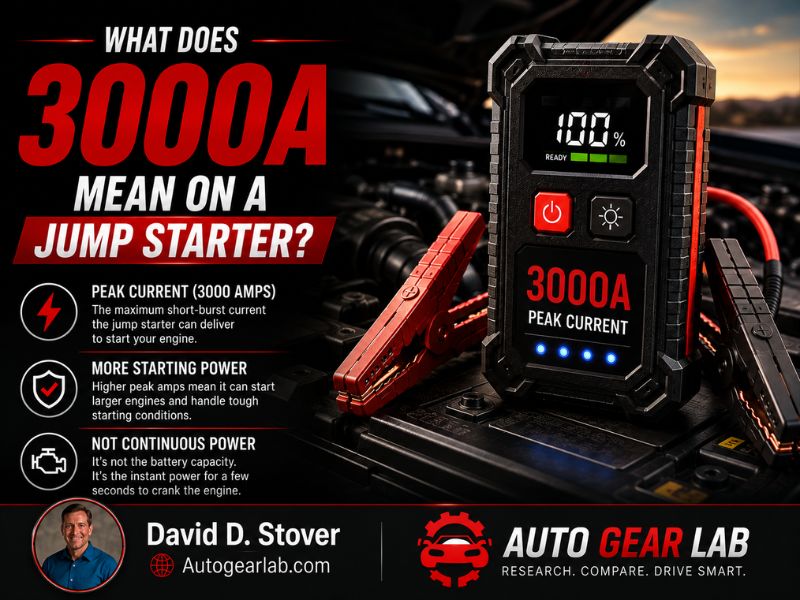
Think of 3000A as an indication of the jump starter’s short-duration current capability.
When an engine starts, the starter motor requires a large amount of current for a short time. A portable booster assists the vehicle battery by making additional current available.
A current NOCO GB150, for example, is marketed as a 3000A 12V jump starter and is rated by NOCO for gasoline engines up to 9.0L and diesel engines up to 7.0L. Schumacher’s current SL1653 also carries a 3000 peak amp rating and is specified for gasoline engines up to 10.0L and diesels up to 8.0L.
Those examples show that 3000A generally places a product in a high-output category, but they also show why you should not interpret the number as a universal engine-size rating.
3000A Usually Means Peak Amps
The most important word associated with 3000A is usually peak.
Peak amps represent a brief maximum-current capability rather than a sustained current that the device can deliver indefinitely.
Clore Automotive explains that peak amps are a very short-lived value and that there is no industry-agreed definition that makes one manufacturer’s peak-amp number automatically equivalent to another manufacturer’s rating.
That means:
3000A Brand A ≠ automatically the same real starting performance as 3000A Brand B.
The internal battery cells, electronics, cables, clamps, temperature, and measurement method can all affect real starting performance.
It Does Not Push 3,000 Amps Into Your Car
A common misunderstanding is that connecting a 3000A booster means the vehicle immediately receives 3,000 amps.
That is not how the starting circuit works.
The jump starter makes current available, while the starter motor draws current according to the electrical resistance and demands of the circuit.
A small four-cylinder engine therefore does not suddenly receive the same current as a large diesel simply because both are connected to the same 3000A booster.
This is why a correctly designed 12V 3000A jump starter can be used on a much smaller compatible 12V car without the 3000A rating itself being inherently excessive.
3000A Does Not Mean 3000 Cranking Amps
This distinction matters when comparing products.
Peak amps and cranking amps are different specifications.
Clore notes that its AGM jump starters may also be rated in Cranking Amps (CA), which use a defined test involving current delivered for 30 seconds at 32°F while maintaining a specified terminal voltage. Its lithium products use a separate Start Assist Amps (SAA) measurement designed around a much shorter starting interval.
A good real-world example comes from Clore’s JNC1224. In 12V mode, it is rated at 3,400 peak amps but 850 cranking amps. The two numbers describe different aspects of its performance.
So if a product says 3000A Peak, do not interpret that as 3000A CA.
Peak Amps vs. Cranking Performance
Here is a useful way to separate the terms:
| Rating | What It Tells You |
| Peak Amps | Brief maximum potential current |
| Cranking Amps | More sustained starting-current performance under a defined test |
| Start Assist Amps | Shorter-duration starting output used by some lithium jump starter manufacturers |
| Engine-Size Rating | Practical gasoline/diesel engine range stated by manufacturer |
| Watt-Hours (Wh) | How much energy the internal battery stores |
| Voltage | Which vehicle electrical system the unit is designed for |
For most drivers, the engine-size rating and correct voltage are easier and more useful buying criteria than trying to interpret peak amps in isolation.
Is 3000A a Lot for a Jump Starter?
Yes.
A genuine, properly engineered 3000A portable jump starter is a high-output unit compared with entry-level compact boosters.
NOCO currently rates its GB150 for engines up to 9.0L gasoline and 7.0L diesel, while Schumacher rates its 3000A SL1653 for engines up to 10.0L gasoline and 8.0L diesel.
That makes the 3000A class potentially suitable for applications such as large SUVs, gasoline pickups, V8 engines, many diesel trucks, boats, and RVs when the product’s individual specifications match the vehicle.
For an ordinary small gasoline car, however, that level of output is usually far more than the minimum required.
Does 3000A Tell You What Engine It Can Start?
Not by itself.
This is one of the most important limitations of the specification.
Two reputable 3000A-class products can have different published engine-size ratings. NOCO lists 9.0L gas/7.0L diesel for the GB150, while Schumacher lists 10.0L gas/8.0L diesel for its SL1653.
Therefore, do not make a rule such as:
“Every 3000A jump starter can start an 8.0L diesel.”
That conclusion is not supported simply by the amp number.
Instead, find the specific manufacturer’s maximum gasoline and diesel displacement ratings.
3000A Does Not Tell You the Battery Capacity Either
Peak current and stored energy are also different.
A jump starter can be rated at 3000A while having an internal battery capacity measured separately in watt-hours (Wh).
NOCO lists the GB150’s internal lithium-ion battery at 88Wh, while separately listing its peak current as 3000A.
These numbers answer different questions.
3000A: How much short-duration current can the unit potentially deliver?
88Wh: How much energy is stored in the internal battery?
A jump starter needs both adequate energy storage and the ability to release that energy at very high current.
What Does 12V 3000A Mean?
If a product says 12V 3000A, the two specifications describe different things.
12V identifies the electrical system it is designed to work with.
3000A describes its current capability.
For example, the NOCO GB150 is a 12V 3000A jump starter designed for compatible 12V vehicle batteries.
A 3000A rating does not mean the jump starter is suitable for a 24V truck.
Voltage compatibility must be correct first.
Professional multi-voltage jump packs make this distinction especially clear. Clore’s JNC1224 produces 3,400 peak amps at 12V but 1,700 peak amps at 24V, with separate cranking ratings for each operating voltage.
Why a 3000A Jump Starter May Still Fail to Start a Car
A large peak-current rating does not guarantee that every no-start situation can be solved.
The jump starter still needs sufficient charge, solid clamp contact, healthy internal battery cells, and a vehicle starting system capable of operating.
The vehicle’s battery condition matters too.
A discharged battery may simply need electrical assistance. A battery with serious internal damage is a different problem.
Similarly, a jump starter cannot correct a failed starter motor, poor electrical ground, ignition fault, fuel-delivery problem, immobilizer issue, or mechanical engine problem.
If the engine cranks strongly with a 3000A booster but does not start, additional amps are unlikely to be the solution.
Why Cable and Clamp Quality Still Matter
Thousands of available amps are useless if they cannot reach the starter circuit efficiently.
High-current starting depends on a low-resistance path from the jump starter to the vehicle.
Schumacher’s 3000A SL1653, for example, uses 4-gauge, 30-inch booster cables, reflecting the importance of cable construction in a high-output system.
Poor terminal contact, corrosion, weak clamps, or undersized conductors create voltage drop and heat.
This is one reason you should compare physical construction as well as the peak-current rating.
Does 3000A Mean More Jump Starts Per Charge?
Not necessarily.
Starts per charge depend on how much stored energy the booster has and how much energy each starting event consumes.
NOCO advertises its GB150 for up to 80 jump starts per charge under its stated conditions, but that specification is separate from the 3000A peak rating.
A large engine, cold temperature, deeply discharged battery, or repeated long cranking attempts will place more demand on a booster than a small gasoline engine that starts immediately.
So peak amps do not directly tell you how many starts you will get from one charge.
Is a Bigger A Number Always Better?
No.
If two products are otherwise comparable and their ratings are measured consistently, additional output can provide useful starting reserve.
But comparing unrelated brands purely by peak amps is unreliable because peak-current ratings lack a universal industry definition.
For example, choosing a questionable 4000A product solely because it advertises a larger number than a reputable 3000A booster may not result in better starting performance.
The better comparison includes:
Vehicle voltage → engine-size rating → gas or diesel rating → meaningful starting-current data → battery capacity → cable/clamp quality → safety protections.
That sequence gives you a much clearer picture of actual suitability.
What Should You Look for Besides 3000A?
A useful 3000A rating should be backed by detailed specifications.
First, confirm 12V or 24V compatibility.
Then check the maximum gasoline and diesel engine sizes.
Look for useful information about the internal battery, operating temperature, clamp construction, cable size, and protection features.
NOCO’s GB150, for example, combines its 3000A rating with an 88Wh internal battery, 12V operation, engine-size ratings, reverse-polarity protection, and spark-proof protection.
A manufacturer that publishes meaningful supporting specifications makes it easier to evaluate what the 3000A number really represents.
Frequently Asked Questions
What Does the A Mean on a Jump Starter?
The A means amperes, or amps, a unit of electrical current. A 3000A jump starter is being rated for a current capability of up to 3,000 amps according to the manufacturer’s specified measurement.
Does 3000A Mean 3000 Peak Amps?
Usually, yes, on portable lithium jump starters. Check the specification sheet because manufacturers may use different current-rating terminology.
Does a 3000A Jump Starter Constantly Produce 3000 Amps?
No. Peak current is a short-duration capability. The vehicle’s starting circuit draws current according to its requirements.
Is 3000A the Same as 3000 Cranking Amps?
No. Peak amps and cranking amps are different specifications. Clore, for example, publishes both peak and cranking ratings on certain professional jump starters.
Is 3000A Powerful Enough for a Truck?
Many quality 3000A units are designed for trucks. The NOCO GB150 is rated for up to 9.0L gasoline and 7.0L diesel engines, while Schumacher’s SL1653 is rated up to 10.0L gas and 8.0L diesel.
Can a 3000A Jump Starter Be Used on a Small Car?
Yes, if the voltage and vehicle compatibility are correct. The starter motor draws the current it requires; the full 3000A rating is not automatically forced into the vehicle.
Is 3000A Better Than 2000A?
It can provide additional potential current and engine capacity, but only when comparing meaningful specifications. A well-engineered 2000A product may still outperform a poorly designed product carrying a larger peak-amp claim.
Does Higher Peak Amps Mean More Battery Capacity?
No. Peak amps describe short-duration current capability, while Wh or Ah describe stored energy.
How Many Jump Starts Can a 3000A Unit Provide?
It depends on the internal battery and operating conditions. NOCO currently advertises up to 80 starts per charge for its GB150, but that is a product-specific claim rather than a universal feature of all 3000A boosters.
Should I Buy Based on Peak Amps?
No. Peak amps are useful as a broad indication of output, but engine-size compatibility, voltage, cranking performance, battery capacity, cables, clamps, and safety protections provide a more complete picture.
What Does 3000A Mean on a Jump Starter Overall?
When a jump starter says 3000A, it normally means the device has a manufacturer-rated peak current capability of up to 3,000 amps for a very short period during starting. It does not mean the unit continuously produces 3,000 amps, delivers 3,000 cranking amps, or automatically fits every large engine.
A reputable 3000A model can be extremely capable. Current products in this category are manufacturer-rated for gasoline engines around 9.0L–10.0L and diesels around 7.0L–8.0L, although those figures are specific to the individual products.
The most useful way to interpret the label is therefore:
3000A tells you the jump starter has high potential current output—not exactly how powerful it will be in every real starting situation.
Use the number as one part of the specification, then verify voltage, engine-size rating, gasoline or diesel compatibility, sustained starting capability, internal battery capacity, cable quality, and safety protections before deciding whether a jump starter is right for your vehicle.