If I had to choose one best vehicle jump starter for most drivers, I would start with the NOCO Boost GB40 12V 1000A UltraSafe Lithium Jump Starter. It combines compact size, straightforward safety features, proven popularity, and enough starting capability for most passenger vehicles.
For frequent use in a garage, fleet, workshop, or larger vehicle environment, I would choose the Clore Automotive Jump-N-Carry JNC660 1700 Peak Amp Jump Starter. Its professional-style battery, heavy-duty cables, and substantial clamps emphasize dependable starting performance rather than minimum weight.
Drivers who want considerably higher advertised peak output should consider the GOOLOO GP4000 4000A Supersafe Jump Starter. It supports large gas and diesel engines while retaining the compact convenience of a lithium jump pack.
Best Vehicle Jump Starter
1. NOCO Boost GB40 12V 1000A UltraSafe Lithium Jump Starter – Best Overall
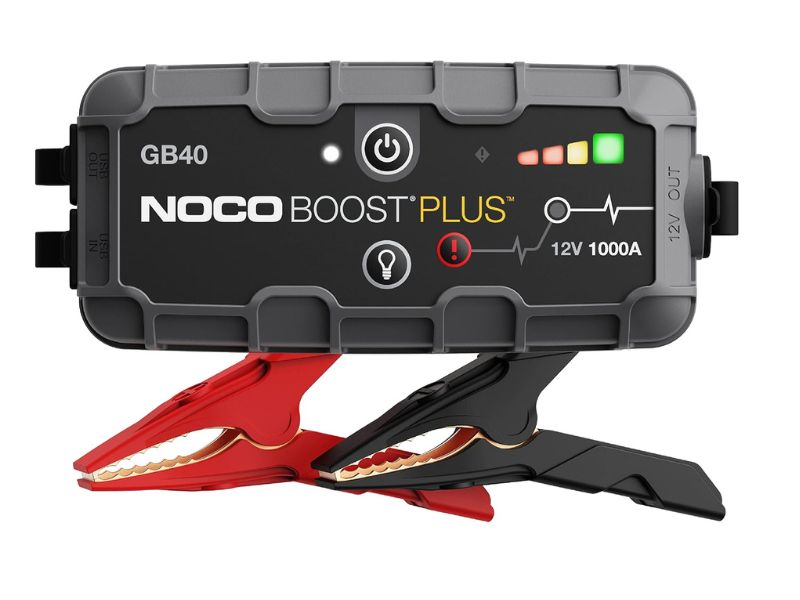
The NOCO GB40 is my top recommendation because it provides the combination most ordinary drivers actually need: sufficient starting power, compact dimensions, simple safety protections, and convenient storage.
Key Features
- 1,000A rated output
- Supports up to 6.0L gasoline and 3.0L diesel engines
- Lithium-ion battery design
- Spark-proof connection technology
- Reverse-polarity protection
- IP65-rated enclosure with ports closed
- Built-in LED flashlight
- USB power-bank function
- Approximately 2.4-pound weight
- Up to 20 jump starts per charge under suitable conditions
For a glove box, trunk, SUV cargo area, motorcycle case, or roadside emergency kit, its compact size is one of the biggest advantages.
The GB40 is designed for common 12-volt lead-acid batteries found in cars, SUVs, light trucks, motorcycles, boats, lawn equipment, and similar applications.
Safety is another reason I rank it first. Spark-proof technology and reverse-polarity protection reduce the risk associated with accidentally connecting the clamps incorrectly.
The GB40 also incorporates a manual-override function for batteries that are too deeply discharged for normal automatic detection. This feature is useful, but it should only be used after reading and understanding the instructions because normal safety protections may be affected during override operation.
The integrated 100-lumen flashlight offers multiple operating modes, including emergency functions. A USB output also allows the internal battery to serve as backup power for compatible portable electronics.
The biggest limitation is engine size. A 1,000A jump pack is excellent for typical passenger vehicles, but owners of large diesel trucks or unusually demanding engines should select a higher-capacity model.
What I Like
I particularly like the balance between portability and usable starting power. It is small enough to leave in a vehicle rather than becoming another bulky item that eventually gets removed from the trunk.
The mistake-resistant connection system is equally valuable for drivers who may use a jump starter only once or twice a year.
What I Do Not Like
Its 3.0L diesel rating makes it unsuitable for many larger diesel pickups.
The relatively short clamp leads can also feel restrictive when the battery or jump terminals are difficult to access.
Verdict
The NOCO GB40 is the strongest all-around choice for passenger cars, crossovers, motorcycles, SUVs, and many gasoline-powered trucks.
Best for: Most drivers wanting a compact, proven, easy-to-store emergency jump starter.
2. Clore Automotive 1700 Peak Amp Jump Starter – Best Professional-Duty Pick
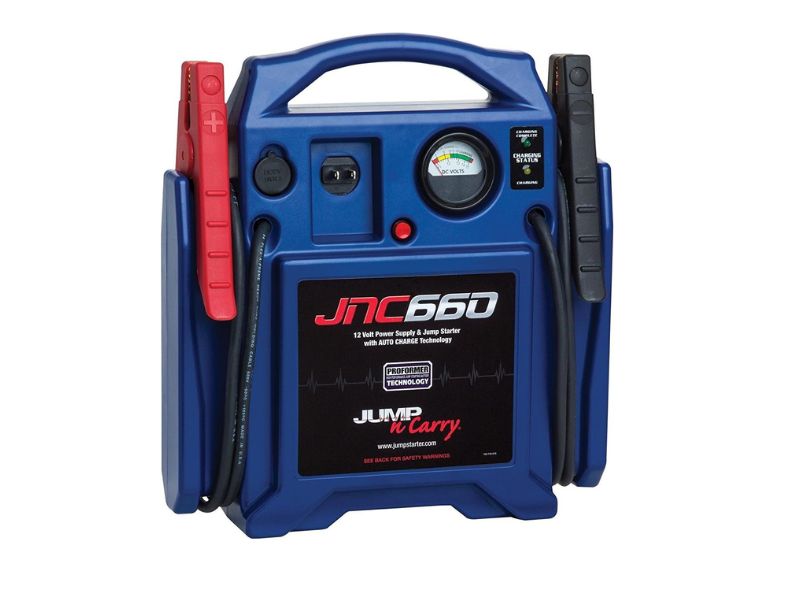
The Clore JNC660 is very different from modern pocket-sized lithium jump packs.
It is a professional-style 12V jump starter built around a substantial internal battery, long heavy-gauge cables, and industrial clamps.
Key Features
- 1,700 peak amps
- 425 cranking amps
- Clore PROFORMER battery technology
- 46-inch cable leads
- Heavy-duty #2 AWG cables
- Industrial-grade clamps
- Built-in automatic charger
- Analog voltmeter
- 12V DC accessory outlet
- Approximately 18-pound weight
One specification I particularly appreciate is the 425 cranking-amp rating.
Peak-amp claims can vary substantially between products and manufacturers. A defined cranking-amp specification gives serious buyers another useful performance reference.
The JNC660 also uses 46-inch #2 AWG cables, providing considerably more reach and conductor mass than the short leads commonly supplied with compact lithium jump packs.
That matters in workshops and larger engine compartments where battery access may be inconvenient.
The built-in automatic charging system is another advantage for garage use. The unit is designed so it can be maintained in a ready state instead of being forgotten in storage until an emergency occurs.
Its tradeoff is portability.
At approximately 18 pounds, nobody will mistake the JNC660 for a glove-box accessory. It works best when durability and repeated starting capability matter more than compact dimensions.
For repair shops, farms, dealerships, fleet operators, home garages, and drivers who prefer a traditional high-capacity jump box, that tradeoff can be worthwhile.
What I Like
The long heavy-gauge cables and industrial clamps are major advantages.
I also like having a real cranking-amp specification rather than evaluating the unit solely by an eye-catching peak number.
Its charging arrangement makes sense for a garage where the jump starter needs to remain ready for repeated use.
What I Do Not Like
The 18-pound weight makes it far less convenient to carry than lithium models.
It also occupies considerably more vehicle storage space.
Verdict
The JNC660 is the better choice when you prioritize dependable professional-style starting hardware over lightweight portability.
Best for: Garages, workshops, fleets, farms, and frequent jump-starting duties.
3. GOOLOO Supersafe Jump Starter – Best High-Power Lithium Pick
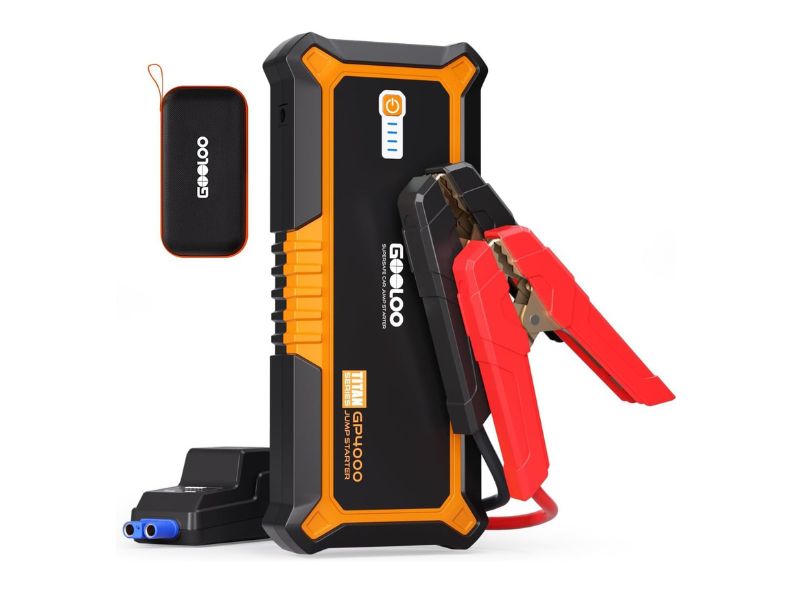
The GOOLOO GP4000 targets drivers who like the compact convenience of lithium technology but need greater claimed starting capability than entry-level jump packs provide.
Key Features
- 4,000A peak output
- Supports all gasoline engines and diesel engines up to 10.0L
- 12V vehicle compatibility
- Lithium battery construction
- Smart jumper cables
- Multiple safety protections
- USB charging outputs
- USB-C connectivity
- Built-in emergency flashlight
- Protective storage case
The headline figure is its 4,000A peak rating.
GOOLOO positions the GP4000 for cars, SUVs, trucks, RVs, tractors, boats, ATVs, and other 12V vehicles, including substantially larger engines than the NOCO GB40 is designed to handle.
Its ability to accommodate diesel engines up to 10.0 liters makes it particularly attractive to owners of pickups and other larger vehicles.
The GP4000 also functions as a portable power bank. USB connections can provide emergency charging for phones and other small electronics, while the integrated flashlight provides additional roadside usefulness.
Safety circuitry helps detect common connection problems, including incorrect polarity.
A manual boost function is also available for extremely discharged batteries. As with other jump starters, use such an override only according to the manufacturer’s directions.
The GP4000 is physically larger than ultra-compact starter packs, but it remains considerably easier to store and carry than traditional lead-acid jump boxes.
What I Like
The strongest advantage is large-engine compatibility in a portable lithium format.
It also offers useful secondary emergency functions, including USB charging and an LED light.
The included case makes it easier to keep the pack, cable assembly, and charging accessories organized.
What I Do Not Like
The high peak-amp figure should not be compared directly with another manufacturer’s rating without considering battery design, cranking performance, temperature, and battery condition.
It is also larger than necessary if you only drive a small four-cylinder gasoline car.
Verdict
The GOOLOO GP4000 is a strong option for drivers wanting considerably more engine capacity without carrying a traditional 18-pound booster box.
Best for: Large gasoline engines, diesel vehicles, trucks, SUVs, RVs, and high-output portable use.
Vehicle Jump Starter Comparison Table
| Product | Battery Type | Rated/Peak Output | Engine Compatibility | Weight Class | Safety Features | Main Advantage |
| NOCO Boost GB40 | Lithium-ion | 1,000A | Up to 6.0L gas / 3.0L diesel | Lightweight | Spark-proof, reverse polarity | Best overall balance |
| Clore JNC660 | Traditional jump-start battery | 1,700 peak / 425 cranking amps | Broad 12V professional use | Heavy | Heavy-duty professional design | Long cables and repeated-duty capability |
| GOOLOO GP4000 | Lithium | 4,000A peak | All gas / up to 10.0L diesel | Midweight portable | Smart cable protections | Large-engine capability |
The NOCO GB40 remains my first recommendation because most buyers do not require the largest possible amp rating. They need something dependable, compact, safe to connect, and easy to keep in the vehicle.
The Clore JNC660 moves in the opposite direction, sacrificing portability for heavy cables and professional-duty construction. The GOOLOO GP4000 sits between them by delivering high claimed output in a comparatively portable lithium design.
How I Chose These Vehicle Jump Starters
I prioritized relevance, buyer popularity, starting capability, safety, engine compatibility, and proven product history.
A portable jump starter is emergency equipment. An impressive feature list means very little if the device is awkward to connect or unsuitable for the engine it needs to start.
I therefore considered engine-size ratings alongside amperage.
I also gave significant weight to connection safety. Reverse-polarity detection and spark-resistant designs are particularly useful because many owners use their jump starter infrequently and may be operating it at night, in bad weather, or under stressful roadside conditions.
Cable quality and reach matter as well.
The Clore JNC660 demonstrates why peak output is not the only useful metric. Heavy #2 AWG leads and professional clamps provide a different type of value from a highly compact lithium battery.
Finally, I selected models serving different buyers rather than filling the list with three nearly identical lithium packs.
Buying Guide: How to Choose the Best Vehicle Jump Starter
Match the Jump Starter to Your Engine
Start with your vehicle’s engine displacement and fuel type.
Manufacturers commonly list maximum gasoline and diesel engine sizes.
Diesel engines generally require greater starting energy because of their higher compression ratios.
A compact jump starter capable of starting a 6.0L gasoline engine may only be rated for a much smaller diesel engine.
Never assume that a high amp number automatically means universal compatibility.
Understand Peak Amps
Peak amps are heavily promoted because the number is easy to compare visually.
Unfortunately, peak output is not standardized in the same practical way across every product.
Two units displaying dramatically different peak numbers may perform much closer together—or farther apart—than the numbers suggest.
Consider:
- Engine-size rating
- Battery energy capacity
- Clamp quality
- Cable size
- Cranking performance
- Low-temperature performance
- Battery condition
For professional products, a stated cranking-amp rating can provide particularly useful additional information.
Lithium vs. Traditional Jump Boxes
Modern lithium jump starters dominate the consumer market because they are small and light.
A lithium model can often fit easily in a trunk organizer, glove compartment, motorcycle luggage case, or emergency bag.
Traditional jump boxes are much larger but may provide advantages for repeated professional use.
Their substantial batteries, longer cables, and heavier clamps make them particularly appropriate in workshops, towing operations, farms, fleets, and dealerships.
For most ordinary car owners, I recommend lithium.
For frequent professional use, a larger conventional jump starter remains worth considering.
Check Gas and Diesel Ratings Separately
Do not look only at the gasoline rating.
If you own a diesel pickup, van, tractor, or RV, check the manufacturer’s maximum diesel displacement specifically.
The NOCO GB40, for example, targets significantly larger gasoline engines than diesel engines.
Drivers with large diesels should select a jump starter designed accordingly rather than assuming every 12V jump pack can start their vehicle.
Look for Reverse-Polarity Protection
Reverse polarity occurs when the positive and negative connections are attached incorrectly.
A quality consumer jump starter should make this mistake difficult to turn into a dangerous situation.
Smart cable systems commonly detect incorrect connections and prevent normal operation until they are corrected.
This feature is particularly valuable for drivers who rarely work around automotive batteries.
Spark Protection Matters
Battery connections can produce sparks.
A jump starter with spark-resistant or spark-proof connection technology provides an additional safety layer during hookup.
Safety circuitry should not replace correct procedure, but it can make occasional emergency use considerably more forgiving.
Consider Cable Length
Short cables help keep a lithium jump pack compact.
However, very short cables can become frustrating when a battery is recessed beneath covers or when positive and negative connection points are widely separated.
For ordinary engine bays, compact cables may be acceptable.
For professional work or difficult battery locations, longer leads such as those on the JNC660 can be a major advantage.
Think About Storage Size
A jump starter only helps if it is actually with you when the battery fails.
That is one reason compact lithium packs are so effective for ordinary drivers.
A small unit can remain permanently in the vehicle instead of being removed whenever cargo space is needed.
If you choose a larger unit, decide where it will be stored before buying it.
Look for a Flashlight
A built-in flashlight sounds minor until your battery dies in a dark parking area.
A quality light helps you:
- Identify the battery terminals
- Connect clamps correctly
- Inspect the engine bay
- Signal for assistance
- Handle other roadside emergencies
SOS or flashing emergency modes provide additional functionality.
USB Charging Can Be Valuable
Some jump starters function as portable power banks.
During a roadside emergency, maintaining enough phone charge to call for assistance or use navigation can be extremely important.
USB output should remain a secondary feature, however.
Do not choose a weak jump starter simply because it offers more charging ports.
Its primary responsibility is starting the vehicle.
How Much Jump Starter Power Do You Need?
A small four-cylinder gasoline car generally does not require an enormous jump pack.
Modern compact lithium starters offer enough power for a wide range of passenger vehicles.
V6 and V8 gasoline engines benefit from more reserve capacity, particularly during cold weather.
Large diesel engines require more attention because compression loads place greater demands on the starter system.
When uncertain, choose a unit whose manufacturer explicitly lists your engine size within its supported range rather than selecting solely according to a marketing amperage number.
Additional capacity can be useful, but excessive capacity adds cost, size, and weight that some drivers never need.
Best Jump Starter for Cars
For typical cars, I prefer a compact lithium model.
The NOCO GB40 is particularly well matched to normal passenger vehicles because its 6.0L gasoline rating covers far more engine displacement than most everyday cars require.
Its small size also encourages owners to keep it in the vehicle permanently.
A large professional booster may provide greater raw capability, but carrying an 18-pound unit for a small sedan is unnecessary for most people.
Best Jump Starter for Trucks
Truck requirements vary enormously.
A gasoline half-ton pickup and a heavy diesel truck do not place the same demands on a jump starter.
For larger gasoline engines or diesel pickups, the GOOLOO GP4000 offers more engine-size headroom than a compact entry-level jump starter.
Professional users who start multiple vehicles repeatedly may prefer the Clore JNC660 because of its long heavy-gauge cables and service-oriented construction.
Always verify the specific engine and electrical system before use.
Best Jump Starter for SUVs
Most gasoline SUVs fall comfortably within the capability of a quality compact lithium pack.
That makes the NOCO GB40 my preferred starting point for typical crossovers and SUVs.
Large diesel SUVs or exceptionally high-displacement engines may justify stepping up to a higher-output model.
The advantage of lithium is especially noticeable in an SUV because the jump starter can stay inside an emergency kit without occupying meaningful cargo space.
How to Safely Use a Vehicle Jump Starter
Always begin with the vehicle turned off and follow the instructions supplied with your particular jump starter.
Confirm that the jump starter is compatible with the vehicle’s battery voltage.
Most consumer units in this guide are intended for 12V automotive systems.
Identify the positive and negative connections carefully.
Connect the positive clamp to the appropriate positive battery terminal or designated positive jump point.
Follow the manufacturer’s directions for the negative connection because recommendations can differ depending on the vehicle and jump starter.
Confirm that the unit indicates a correct connection before attempting to start the engine.
Once the engine starts, disconnect the jump starter using the sequence specified in its instructions.
Do not allow the clamps to touch each other while energized.
If the vehicle repeatedly requires jump starting, diagnose the battery or charging system instead of treating the jump pack as a permanent solution.
What Is Manual Override?
Some smart lithium jump starters may not automatically recognize an extremely discharged battery.
Manual override forces the unit into a mode intended to provide starting power despite the unusually low detected battery voltage.
This capability can be valuable, but it requires extra caution.
On some devices, enabling override bypasses portions of the normal safety logic.
That means reverse-polarity or spark protection may not operate normally.
Use manual override only after confirming polarity and following the manufacturer’s procedure exactly.
How Often Should You Recharge a Jump Starter?
Do not assume a jump starter will remain fully charged forever simply because it is not being used.
Internal batteries gradually lose charge during storage.
Check the charge status regularly and recharge the unit according to the manufacturer’s recommendations.
A sensible habit is to inspect emergency equipment periodically—particularly before:
- Long road trips
- Winter weather
- Hurricane or storm season
- Extended vehicle storage
- Remote travel
Battery condition is also affected by temperature.
Extreme heat inside a parked vehicle can accelerate battery aging, while extreme cold reduces available starting performance.
Should You Keep a Jump Starter in Your Car?
For most drivers, yes.
A compact jump starter is one of the more useful pieces of roadside emergency equipment because it allows you to address a weak battery without relying on another vehicle.
However, storage temperature matters.
Vehicle interiors can become extremely hot in summer and extremely cold in winter.
Follow the manufacturer’s recommended storage-temperature range and inspect the device periodically.
Keep the unit protected inside its case so clamps cannot contact metal objects and ports remain protected from debris.
Jump Starter vs. Jumper Cables
Traditional jumper cables are inexpensive and never need charging.
Their major disadvantage is that they require a second working vehicle.
That can be inconvenient or impossible in an isolated parking area, garage, rural road, campground, or driveway where another vehicle cannot easily reach.
A portable jump starter provides its own energy source.
This makes it much more independent.
I still consider quality jumper cables useful emergency equipment, but a charged jump starter gives you substantially more flexibility.
Jump Starter vs. Battery Charger
A jump starter and battery charger perform different jobs.
A jump starter delivers a large burst of power to help crank the engine.
A battery charger slowly restores energy to the vehicle battery over time.
If a healthy battery has simply been discharged, a proper charger is usually the better tool when time permits.
The jump starter is designed for situations where you need the vehicle running immediately.
Neither product fixes a worn-out battery that can no longer hold a proper charge.
Common Jump Starter Mistakes
Buying Based Only on Peak Amps
Peak numbers are easy to market but do not tell the entire performance story.
Check engine ratings and practical specifications as well.
Forgetting to Recharge the Pack
The worst time to discover that a jump starter has discharged in storage is when the car will not start.
Inspect it periodically.
Ignoring Diesel Engine Ratings
Diesel starting demands differ substantially from gasoline engines.
Always check the separate diesel rating.
Connecting the Clamps Incorrectly
Confirm polarity before activating the unit.
Never assume that safety electronics eliminate the need for proper connection.
Using Manual Override Without Understanding It
Override modes may bypass normal protection functions.
Read the directions before using them.
Continuing to Jump a Failing Battery
If the vehicle repeatedly needs assistance, inspect the battery, alternator, connections, or electrical system.
A jump starter is emergency equipment—not a repair.
Frequently Asked Questions
What is the best vehicle jump starter?
The NOCO Boost GB40 is my best overall pick for most drivers.
It provides 1,000A of rated starting output in a small lithium package and supports gasoline engines up to 6.0L and diesel engines up to 3.0L. Its spark-proof design, reverse-polarity protection, built-in flashlight, and easy storage make it particularly practical for occasional roadside emergencies.
How many amps should a vehicle jump starter have?
Required output depends more on the engine than on one universal amp number.
Small gasoline engines require significantly less starting capability than large diesels. Instead of choosing the largest advertised number, verify that the manufacturer explicitly rates the jump starter for your engine’s displacement and fuel type. Cold weather and battery condition can also increase the required starting effort.
Is 1000 amps enough to jump-start a car?
Yes, a quality 1,000A jump starter is sufficient for many passenger cars.
The NOCO GB40, for example, is rated for gasoline engines up to 6.0L and diesels up to 3.0L. That covers a broad range of passenger vehicles. Large diesel trucks and other demanding engines may require a more capable unit.
Is a 4000A jump starter better than a 1000A model?
Not automatically, because peak-amp claims do not tell the whole story.
A higher-output model may support larger engines, but starting performance also depends on battery design, cable quality, temperature, voltage, internal resistance, and how each manufacturer measures output. Compare engine ratings and practical specifications rather than peak amperage alone.
What is the best jump starter for a diesel truck?
Choose a model explicitly rated for your diesel engine displacement.
The GOOLOO GP4000 supports diesel engines up to 10.0L according to its stated compatibility, making it better suited to large diesels than the NOCO GB40. Professional users may also appreciate the heavy cables and repeated-duty design of the Clore JNC660.
Can a jump starter damage a car?
Incorrect use can create risks, so correct voltage and polarity are essential.
Use only a jump starter compatible with the vehicle’s electrical system and follow its instructions. Smart protection systems reduce the chance of common mistakes, but they are not a substitute for correct procedure. Special care is required when using manual-override modes.
Can I leave a jump starter in my car?
Yes, provided its specified storage-temperature limits are respected.
Lithium batteries are sensitive to extreme heat and cold. A parked vehicle can experience temperatures far beyond comfortable ambient conditions. Keep the unit protected, inspect its charge periodically, and follow the manufacturer’s storage recommendations.
How long does a jump starter hold its charge?
Storage duration varies by battery chemistry, model, temperature, and battery age.
Do not depend on a jump starter remaining ready indefinitely. Check the battery-level indicator regularly and recharge according to the manufacturer’s recommendations. Establishing a periodic inspection routine is more reliable than trying to remember when the unit was last charged.
Can a jump starter charge a dead car battery?
A jump starter is designed primarily to crank the engine, not fully recharge the battery.
Once the engine is operating, the vehicle’s charging system may restore some battery energy if the battery and alternator are healthy. A dedicated battery charger is more appropriate when the goal is to recharge a discharged battery slowly and completely.
Does the engine need to run after a jump start?
Allowing the engine to run can help restore charge, but it may not solve the underlying problem.
If the battery discharged because lights were accidentally left on, running or driving the vehicle may help. If the battery is old, damaged, or the charging system has failed, the problem can return immediately after shutdown. Have repeated starting problems diagnosed.
Is lithium better than lead-acid for a jump starter?
Lithium is better for portability, while larger traditional designs suit frequent heavy-duty use.
Lithium jump packs offer an excellent power-to-size ratio and are easier to store inside a personal vehicle. Traditional professional jump boxes are heavier but can provide robust cables, larger clamps, and service-oriented durability for repeated use.
How long do portable jump starters last?
Service life depends on battery chemistry, charging habits, temperature, and usage frequency.
Lithium batteries gradually lose capacity with age and charge cycles. Excessive heat can accelerate degradation. Traditional internal jump-box batteries also require maintenance and eventually need replacement. Periodic testing is important because emergency equipment must work before you actually need it.
Can I use a vehicle jump starter on a motorcycle?
Many 12V jump starters can be used on compatible motorcycles.
Confirm the motorcycle uses the voltage and battery chemistry supported by the jump starter. Large automotive clamps can also be awkward around small motorcycle batteries, so make sure you can access the correct connection points without accidentally contacting surrounding metal.
What does reverse-polarity protection do?
It detects an incorrect positive-to-negative connection and helps prevent normal activation.
This is one of the most valuable safety features for occasional users. The jump starter may display an error light or audible warning until the clamps are corrected. Always verify polarity yourself even when automatic protection is present.
Why won’t my jump starter detect the battery?
The vehicle battery may be too deeply discharged for the smart circuitry to recognize normally.
Some jump starters provide a manual-override or boost mode for this situation. Because override may disable normal safety protections, it should only be used after confirming the connections and reading the specific manufacturer’s instructions.
Conclusion
Choosing the best vehicle jump starter is less about finding the largest advertised amp number and more about matching the device to your engine, storage needs, and expected frequency of use.
My primary recommendation is the NOCO Boost GB40 12V 1000A UltraSafe Lithium Jump Starter. It offers the strongest overall balance for ordinary drivers because it is compact, easy to store, simple to connect, and powerful enough for a broad range of passenger vehicles.
The Clore Automotive Jump-N-Carry JNC660 is the better option for users who prioritize professional-style cables, substantial clamps, and repeated garage or fleet use over portability.
For larger gasoline engines and diesels where greater engine-size capability is needed, the GOOLOO GP4000 4000A Supersafe Jump Starter provides considerably more stated capacity while remaining easier to carry than a traditional heavy jump box.
For most passenger-car owners, I would keep the NOCO GB40 charged and stored in the vehicle alongside a tire gauge, flashlight, first-aid kit, and other basic roadside emergency equipment.