To extend a trailer tongue, use a manufacturer-approved extension system, replace the existing tongue with a properly engineered longer assembly, or have a qualified trailer fabricator design and install an extension. The correct method depends on the trailer’s frame design, weight rating, intended use, and the additional length required.
A longer trailer tongue can provide more clearance between the tow vehicle and trailer during tight turns. It may also make reversing a short utility trailer easier and help keep a tow vehicle farther from the water when launching a boat.
However, extending a trailer tongue isn’t as simple as attaching an extra piece of steel. The modification changes how towing forces act on the frame and can affect tongue weight, hitch loading, safety chains, wiring, and trailer brakes.
An incorrectly designed extension can bend, crack, or separate during towing.
In this article, I explain how to extend a trailer tongue using fixed, removable, and telescoping designs, including the measurements and compatibility checks needed before installation. You’ll also learn how extensions affect structural strength, towing stability, brakes, and safety, along with the mistakes to avoid before taking a modified trailer onto the road.
How to Extend a Trailer Tongue Step by Step
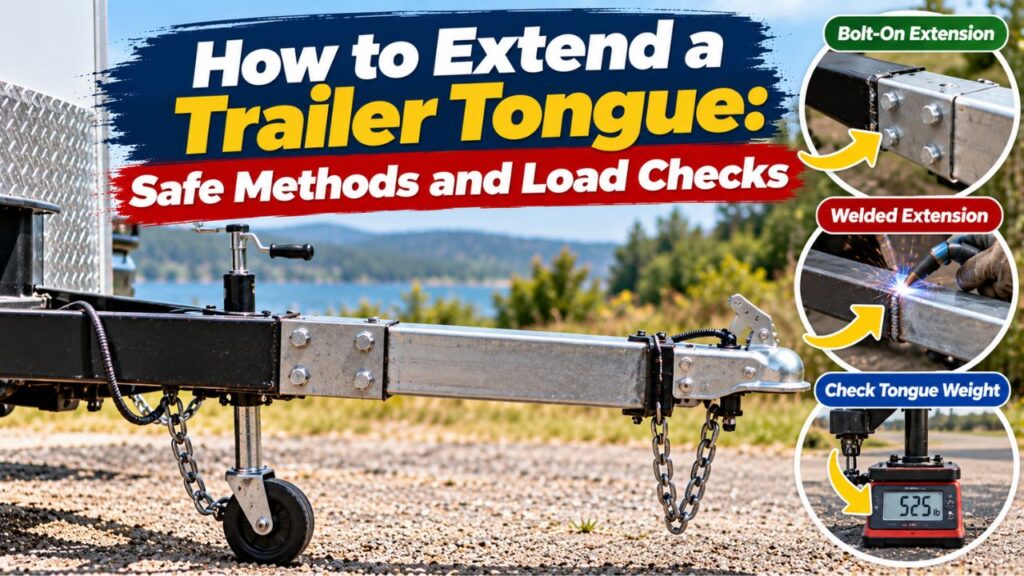
Extending an existing trailer tongue requires planning before any cutting, drilling, or welding begins.
The safest approach is to determine the required length, identify the frame construction, and choose an extension method approved for the trailer’s weight and intended use.
Step 1: Determine Why You Need a Longer Trailer Tongue
Start by identifying the problem you’re trying to solve.
Common reasons for extending a trailer tongue include:
- Increasing clearance between a tow vehicle and trailer during turns
- Making a short utility trailer easier to reverse
- Providing additional room for long cargo
- Improving clearance when launching or retrieving a boat
- Increasing the distance between the trailer and the tow vehicle’s rear bumper
- Changing trailer dimensions for a specific towing application
The purpose influences which extension design is appropriate.
For example, a boat trailer may benefit from a retractable tongue used temporarily at a launch ramp.
A utility trailer that requires extra length during highway travel needs a structure specifically rated for towing in that configuration.
A temporary launching extension shouldn’t automatically be considered suitable for highway use.
Step 2: Measure the Existing Trailer Tongue
Measure the existing tongue before selecting parts.
Record the following dimensions:
- Distance from the coupler center to the front of the trailer frame
- Tongue tube width and height
- Wall thickness
- Distance from the coupler to the axle or axle-group center
- Location of the tongue jack
- Position of safety chain attachments
- Brake actuator and wiring locations
- Available space for an extension connection
For a rectangular steel tongue, measure both outside dimensions and wall thickness.
Do not assume that two steel tubes with similar outside dimensions have the same strength.
Their structural properties depend on wall thickness, steel grade, cross-sectional shape, and overall length.
For A-frame trailers, inspect both angled tongue members and their connections to the main chassis.
Important: The tongue must be structurally sound before modification. Existing cracks, corrosion, bent sections, or damaged welds need professional evaluation.
Step 3: Decide How Much Additional Length You Need
Measure the extra clearance required rather than choosing an arbitrary extension length.
For example, a short utility trailer may need additional space between its front corners and the tow vehicle during sharp turns.
A boat trailer may need substantially more distance between the tow vehicle and trailer axle to reach deeper water at a shallow boat ramp.
Measure the actual clearance in the intended operating situation.
Consider how the extension affects:
- Overall trailer length
- Turning and backing clearance
- Storage space
- Tongue bending loads
- Hitch and axle weight distribution
- Electrical wiring length
- Brake-line routing
- Local trailer dimension requirements
There is no universal safe extension length.
A 12-inch modification may be appropriate for one engineered trailer design while an apparently similar modification may be unsuitable for another.
The permitted length must come from the trailer manufacturer or a qualified designer who can assess the structural loads.
Step 4: Choose the Appropriate Tongue Extension Method
There are several ways to increase the distance between the trailer frame and coupler.
| Extension Method | Main Application | Important Limitation |
| Manufacturer-approved replacement tongue | Permanent extension | Must match the trailer design and ratings |
| Engineered fixed extension | Permanent highway towing | Requires appropriate structural design and installation |
| Telescoping tongue | Adjustable length, often for boat launching | Extended-position towing must be specifically approved |
| Removable tongue extension | Temporary or specialized use | May be restricted to low-speed launching |
| Engineered bolt-on assembly | Compatible trailer frames | Requires approved attachment and hardware |
| Hitch receiver extension | Adds distance behind the tow vehicle | Does not extend the trailer tongue and may reduce hitch capacity |
For most existing trailers, a compatible factory replacement or professionally engineered modification is preferable to an improvised extension.
Step 5: Have the Extension Designed for the Trailer
The tongue transfers towing, braking, turning, and vertical loads between the tow vehicle and trailer frame.
Extending it changes the forces acting on that structure.
A qualified trailer fabricator or engineer should evaluate:
- Fully loaded trailer weight
- Tongue weight
- Steel section dimensions and grade
- Bending and torsional loads
- Attachment method
- Connection reinforcement
- Fatigue resistance
- Coupler rating
- Safety chain attachment points
- Braking and electrical systems
The design must account for road impacts and dynamic towing forces, not just the trailer’s weight while parked.
A tube that appears strong enough to support the tongue weight when stationary may not be adequate under repeated highway loading.
Step 6: Install the Approved Extension Assembly
The installation method depends on the approved design.
Some compatible trailer systems use bolted assemblies. Others require a replacement tongue or professionally welded components.
For a manufacturer-designed bolt-on system, follow the installation instructions for the exact trailer and extension model.
For a custom permanent extension, use a qualified fabricator experienced with load-bearing trailer structures.
The process may involve replacing the tongue member, installing engineered reinforcement, positioning the coupler, and verifying alignment.
Do not guess at steel thickness, bolt grades, weld dimensions, or attachment locations.
Incorrect holes or welds can weaken an otherwise sound trailer frame.
Step 7: Extend Wiring, Brakes, and Safety Equipment
A longer tongue may require changes to components connected to the coupler.
Check:
- Trailer light wiring
- Electrical grounding
- Safety chains
- Electric brake wiring
- Hydraulic brake lines
- Surge brake actuator placement
- Breakaway switch wiring and cable
- Tongue jack position
- Coupler mounting
All wiring and brake components must accommodate normal turning and suspension movement without stretching, rubbing, or becoming pinched.
Hydraulic brake modifications require particular care because incorrect routing, damaged lines, or trapped air can affect braking performance.
Step 8: Verify the Modified Trailer Before Towing
After installation, inspect the complete trailer.
Confirm that:
- The extension is approved for the intended loaded weight and operating configuration.
- The coupler and hitch components have suitable ratings.
- All structural connections are correctly installed.
- Safety chains are properly anchored.
- Trailer lights operate correctly.
- Brakes function as intended.
- Wiring and brake lines have adequate clearance.
- Tongue weight has been measured.
- The trailer remains within applicable weight and dimension limits.
Any required inspection or certification should be completed before highway towing.
A controlled low-speed check is useful after the mechanical inspection, but it doesn’t replace structural approval or proper load measurements.
How to Extend a Trailer Tongue Without Welding
A trailer tongue can sometimes be extended without welding, but only when the trailer and extension system support an appropriate bolted or removable connection.
Avoid treating a generic steel sleeve and several bolts as an automatically safe alternative.
Using a Manufacturer-Approved Bolt-On Extension
A compatible bolt-on assembly may provide additional tongue length without welding.
However, its installation must meet the manufacturer’s requirements for:
- Frame dimensions
- Wall thickness
- Trailer material
- Weight capacity
- Bolt type
- Connection position
- Maximum extension length
The complete assembly needs a verified load rating for the intended configuration.
A bolt-on component rated for a different trailer design shouldn’t be adapted using improvised spacers or mounting arrangements.
Using a Replaceable Tongue Assembly
Some trailers have a central tongue member that bolts into a connection bracket.
For these designs, the manufacturer may offer a longer compatible replacement.
Replacing the complete tongue member can avoid adding an unsupported splice.
However, the replacement still needs to match the trailer’s structural and connection requirements.
Don’t assume that installing a longer steel tube with the same outside dimensions preserves the original trailer rating.
Can a Fold-Away Coupler Hinge Extend a Trailer Tongue?
A fold-away coupler hinge is primarily intended to allow the tongue to fold for storage.
It isn’t automatically an approved tongue extension system.
For example, Fulton’s official Fold-Away Hinge Kit specifications identify compatibility requirements for steel tongue dimensions, material thickness, and product capacity.
A hinge that is safe in its specified configuration may not retain the same capacity when combined with an additional unsupported tongue section.
Using a folding hinge as part of a custom extension requires manufacturer approval for the complete arrangement.
How to Extend a Trailer Tongue With a Permanent Steel Extension
A permanent steel extension is intended to become part of the trailer’s towing structure.
It must withstand the loads created during acceleration, braking, cornering, and travel over uneven roads.
Replacing the Original Tongue With a Longer Tube
For some straight-tongue utility or boat trailers, a properly designed longer replacement member may be practical.
The replacement must provide adequate strength and connect correctly to the original frame.
The required steel size cannot be selected from length alone.
The design needs to account for the loaded trailer weight, tongue load, bending stresses, and how forces enter the main chassis.
A longer tube made from thinner or lower-strength steel may be weaker than the original shorter member.
Extending an A-Frame Trailer Tongue
An A-frame trailer uses two angled structural members connected to the main frame.
This arrangement distributes towing forces differently from a single straight tongue.
Extending an A-frame may require redesigning the angled members, coupler mounting, and reinforcement arrangement.
Simply attaching a long center tube beyond the original A-frame can introduce unfavorable loading at the connection.
A-frame modifications require particular attention to:
- Load paths through both tongue members
- Connection strength
- Side-to-side stiffness
- Vertical bending
- Frame reinforcement
- Coupler alignment
For travel trailers and other heavy A-frame designs, consult the trailer manufacturer or a qualified trailer engineer before making changes.
Why Professional Welding Matters
Welding a trailer tongue involves more than joining two visible steel surfaces.
Poorly positioned welds can create stress concentrations, while inadequate penetration or incorrect welding procedures can weaken structural connections.
The fabricator also needs to consider the steel material and any corrosion-resistant coating.
Galvanized steel requires suitable precautions because welding can produce hazardous zinc-containing fumes and damage the protective coating.
After fabrication, exposed steel needs appropriate corrosion protection.
Safety Note: Don’t attempt structural tongue welding without a design suitable for the trailer and the necessary professional fabrication capability.
How to Install a Telescoping Trailer Tongue Extension
A telescoping tongue uses a sliding member that moves within a compatible structural receiver.
This allows the tongue length to change without permanently increasing the trailer’s overall length.
It is particularly useful for certain boat trailers.
How a Telescoping Tongue Works
A typical engineered telescoping assembly contains:
- An outer structural receiver
- An inner sliding tongue
- Approved locking pins or fasteners
- Reinforced connection points
- A coupler at the forward end
- Supporting hardware and safety equipment
The sliding member extends to an approved position and is secured by the designed locking mechanism.
The system must have adequate engagement between its members.
The required overlap, pin arrangement, and operating capacity must be established by the manufacturer or designer.
Extending a Factory Telescoping Tongue
If your trailer already has a factory telescoping system, use its manual.
A general preparation sequence is:
- Position the trailer on firm, level ground.
- Chock the trailer wheels.
- Support the tongue as instructed by the manufacturer.
- Check that wiring and brake components can accommodate extension.
- Release the designated locking mechanism.
- Extend the tongue using the manufacturer’s approved procedure.
- Secure all required locking pins and retainers.
- Inspect the assembly before moving the trailer.
Some systems allow controlled extension while connected to the tow vehicle. Others require unhitching or additional support.
Never assume that a procedure for one trailer applies to another.
Do not pull locking pins while the assembly is under uncontrolled load or while the trailer is positioned on a steep ramp.
Can You Tow With a Telescoping Tongue Fully Extended?
Only if the manufacturer explicitly approves towing in that position.
Some telescoping tongues are designed for highway use at specified extension lengths.
Others are intended only for temporary launching and retrieval operations.
The difference is important because low-speed ramp movement doesn’t impose the same repeated dynamic loads as highway towing.
If the manufacturer’s instructions require the tongue to be retracted before road travel, follow that requirement.
How to Extend a Boat Trailer Tongue for Launching
A longer tongue can help keep the tow vehicle farther from the water at shallow boat ramps.
This is particularly useful for trailers carrying boats that sit high above the trailer frame.
Why Boat Trailers Need Extra Tongue Length
At a shallow ramp, the trailer may need to travel farther into the water before the boat begins floating.
A short tongue can force the tow vehicle close to the waterline.
An appropriately designed extension increases the distance between the tow vehicle and trailer.
However, it doesn’t change the ramp slope or eliminate hazards such as slippery surfaces, underwater drop-offs, and unstable ground.
Using a Temporary Launching Extension
A removable launch extension may be suitable for low-speed use when specifically designed for the trailer.
Before using one, verify its:
- Intended operating speed
- Load capacity
- Permitted extension length
- Coupler arrangement
- Structural attachment method
- Locking system
- Wheel support requirements, if applicable
Follow the manufacturer’s procedure at a safe staging area.
Avoid making tongue adjustments while the trailer is partly submerged or positioned on an uncontrolled incline.
Retract the Extension Before Road Travel When Required
After launching or retrieving the boat, return the system to its highway-approved position.
Check that the locking pins, wiring, brake lines, and coupler are correctly secured.
A launch-only extension must not be used for normal road towing unless its manufacturer expressly permits that application.
How Much Can You Safely Extend a Trailer Tongue?
There is no universal maximum extension length that applies to all trailers.
The safe limit depends on the trailer’s structure, weight, and manufacturer-approved design.
What Determines Maximum Tongue Extension Length?
The important variables include:
- Original tongue length
- Trailer GVWR
- Actual loaded trailer weight
- Tongue weight
- Structural member dimensions
- Steel grade and wall thickness
- Connection strength
- Frame reinforcement
- Intended towing speed and conditions
- Coupler and hitch ratings
Increasing tongue length generally changes bending stresses and how forces are transferred through the frame.
Therefore, a fixed 12-, 24-, or 36-inch extension cannot be declared safe without evaluating the particular trailer.
Does a Longer Tongue Need Thicker Steel?
It may.
Longer structural members can experience greater bending demands and different deflection characteristics.
However, simply choosing a thicker tube doesn’t guarantee adequate strength.
The connection to the existing trailer may remain the weakest point.
The design needs to evaluate the tongue and its attachment as a complete structural system.
Does Extending the Tongue Change Trailer GVWR?
Extending the tongue doesn’t automatically increase the trailer’s GVWR.
The original rating is established for a particular trailer configuration.
A structural modification may require the manufacturer or an authorized engineer to reassess the permissible loaded weight.
Don’t assume the original GVWR remains valid for an unapproved custom extension.
Also remember that added extension hardware increases the trailer’s empty weight, reducing available cargo capacity when GVWR remains unchanged.
How Does Extending a Trailer Tongue Affect Tongue Weight?
A longer tongue can change the downward force measured at the trailer coupler.
The effect depends on the trailer’s geometry, load position, and additional weight introduced by the extension.
Why Tongue Weight May Decrease
When the axle position and existing load distribution remain unchanged, moving the coupler farther forward increases the distance between the axle and hitch.
For the same existing load moment about the axle, that greater distance generally produces a lower static force at the coupler.
However, the extension itself adds weight.
Depending on its mass and location, that additional weight can offset part of the reduction.
Therefore, don’t assume that every extension produces the same percentage change.
Check the Correct Tongue Weight Range
Many conventional bumper-pull trailers are designed for approximately 10–15% of their loaded weight on the tongue.
For example, Ford’s official F-150 trailer loading guidance identifies that range for the covered towing configuration.
However, some boat trailers use different manufacturer-specified ranges.
Follow the requirements for your particular trailer and tow vehicle.
For illustration:
| Loaded Trailer Weight | 10% Tongue Weight | 15% Tongue Weight |
| 1,000 lb. | 100 lb. | 150 lb. |
| 2,000 lb. | 200 lb. | 300 lb. |
| 3,000 lb. | 300 lb. | 450 lb. |
| 4,000 lb. | 400 lb. | 600 lb. |
| 5,000 lb. | 500 lb. | 750 lb. |
These calculations illustrate a conventional 10–15% range. They are not appropriate targets for every trailer.
Measure the actual tongue weight after modifying the frame.
Can You Correct Tongue Weight by Moving Cargo?
Properly securing cargo farther forward generally increases tongue weight.
Moving suitable cargo rearward generally decreases it.
However, cargo placement must also remain within the trailer’s loading limits.
Don’t place unsecured ballast at the front of the trailer simply to compensate for a poorly designed extension.
If the modified trailer cannot achieve safe tongue weight while properly loaded, its design needs further evaluation.
Does Extending a Trailer Tongue Make Backing Easier?
A longer tongue can make a short trailer respond more gradually to steering movements while reversing.
This may make it easier to control trailers that otherwise turn sharply during small steering corrections.
Why Short Trailers React Quickly
A short distance between the hitch and axle allows the trailer to change direction rapidly while reversing.
Small tow vehicle steering movements may produce a noticeable change in trailer angle.
This can make a compact utility trailer more challenging for inexperienced drivers.
How Additional Tongue Length Changes Handling
Increasing the hitch-to-axle distance generally makes trailer articulation develop more slowly during reversing.
However, a longer tongue also increases the total combination length and changes its turning envelope.
You may need more room to maneuver around obstacles.
Improved backing response doesn’t guarantee greater stability during highway towing.
The trailer still needs proper tongue weight, alignment, tires, suspension, and structural strength.
Does a Longer Tongue Prevent Jackknifing?
No.
Additional length may provide more clearance between the tow vehicle and trailer during turns, but jackknifing remains possible.
The amount of clearance depends on trailer width, tongue length, hitch position, and tow vehicle geometry.
Don’t rely on estimated clearance.
Verify that the combination can turn without the trailer contacting the bumper, tailgate, spare tire, or other vehicle components.
Trailer Tongue Extension vs. Hitch Receiver Extension
A trailer tongue extension and a hitch receiver extension are not interchangeable.
They change different parts of the towing system.
| Feature | Trailer Tongue Extension | Hitch Receiver Extension |
| Installed on | Trailer frame or tongue | Tow vehicle hitch receiver |
| Main purpose | Increase trailer tongue length | Move hitch ball farther behind vehicle |
| Structural effect | Changes trailer frame loading | Changes hitch receiver loading |
| Tongue weight effect | May change measured coupler load | Increases leverage on the receiver |
| Installation | Requires approved trailer design | Requires compatible, rated hitch hardware |
| Highway use | Only when approved for road towing | Only within manufacturer-rated limits |
Why a Receiver Extension Can Reduce Towing Capacity
A receiver extension moves the hitch ball farther away from the tow vehicle’s receiver.
This increases leverage on the receiver.
As a result, receiver extension manufacturers commonly specify reduced towing or tongue weight ratings.
The exact reduction depends on the extension, receiver, and towing configuration.
Don’t assume that a hitch extension preserves the original hitch capacity.
Which Extension Method Should You Choose?
If the main goal is temporary additional clearance during boat launching, a specifically designed launching extension may be appropriate.
For permanent changes to trailer length, evaluate a manufacturer-approved tongue modification.
A receiver extension may solve certain clearance problems, but only when its reduced capacity remains sufficient for the towing combination.
What Parts May Need Modification When Extending a Trailer Tongue?
The main tongue member is only one component of the towing system.
Several nearby parts may need replacement or repositioning.
Trailer Coupler
The coupler must match the hitch ball and have an adequate weight rating.
It must also be compatible with the new tongue dimensions and mounting method.
Use the manufacturer’s approved mounting procedure.
Don’t drill additional coupler holes or relocate mounting points unless permitted by the applicable instructions.
Safety Chains
Safety chains must remain long enough for normal turning without dragging or becoming excessively loose.
Their attachment points must be suitable for the modified tongue arrangement.
A longer tongue may require replacement chains or different mounting positions.
Avoid using unrated chain extensions or ordinary hardware-store connectors.
Trailer Light Wiring
The wiring harness may need additional length to reach the tow vehicle.
Route wires so they are protected from sharp edges, moving components, water exposure, and excessive tension.
Maintain reliable electrical grounding.
After installation, test brake lights, turn signals, running lights, and other required lighting functions.
Trailer Brake Lines
Trailers with surge brakes may have hydraulic lines running through or alongside the tongue.
Extending or replacing the tongue may require changes to their routing.
The brake actuator must remain correctly positioned, and the hydraulic system must operate as designed.
Hydraulic brake modifications should be handled by a qualified technician using appropriate components and bleeding procedures.
Breakaway System
Trailers equipped with breakaway brakes need an appropriate breakaway cable arrangement.
The cable must remain correctly connected and function as intended after the tongue modification.
Do not extend or relocate the cable without checking the brake system manufacturer’s instructions.
Trailer Tongue Jack
A longer tongue may require moving the jack.
Make sure the jack is rated for the expected load and can support the trailer safely during coupling and uncoupling.
Its mounting location must not interfere with turning, towing, or any telescoping mechanism.
Common Trailer Tongue Extension Mistakes to Avoid
Several shortcuts can compromise the safety of an otherwise serviceable trailer.
Welding an Unrated Steel Tube to the Existing Tongue
Attaching a random piece of steel to the front of the trailer doesn’t establish that the connection can handle towing forces.
Steel size, material properties, joint design, and weld quality all matter.
The extension should be designed and installed for the actual trailer loads.
Using Ordinary Bolts or Improvised Sleeves
An extension secured with unsuitable bolts, clamps, or a loosely fitting sleeve may move or fail under load.
The connection must be designed for repeated towing forces, including braking and turning loads.
Don’t rely on a connection merely because it feels rigid while the trailer is parked.
Ignoring Existing Frame Corrosion
A new extension can’t compensate for severely corroded frame members.
Rust near structural connections can reduce the material’s effective thickness and strength.
Inspect the frame before planning the modification.
Repair or replace damaged structural components as appropriate.
Extending the Tongue Without Rechecking Tongue Weight
Changing tongue length can affect the force at the coupler.
Insufficient tongue weight may contribute to trailer sway.
Measure the actual loaded tongue weight rather than assuming the original balance remains unchanged.
Forgetting Brake and Wiring Clearance
A longer tongue may require additional wiring and brake-line length.
Stretched cables or hydraulic lines can fail during turning or suspension movement.
Inspect these components throughout the trailer’s permitted articulation range.
Using a Launch-Only Extension on the Highway
A temporary extension designed for maneuvering at a boat ramp may not withstand highway loads.
Never assume that a removable or telescoping extension is road-rated unless its manufacturer explicitly approves the intended use.
Ignoring State Trailer Length Requirements
Trailer length and equipment rules can vary by state and trailer type.
Check the requirements that apply to your trailer’s registration, dimensions, and operating jurisdiction.
A modification may also affect inspection, insurance, or manufacturer warranty conditions.
How Much Does It Cost to Extend a Trailer Tongue?
The cost depends on the extension method, required materials, and complexity of the trailer.
A compatible factory component may require less fabrication than a custom structural modification.
A trailer with hydraulic surge brakes may also involve more labor than a simple unbraked utility trailer.
Factors That Affect Extension Cost
The main cost drivers include:
- Required extension length
- Steel section size and material grade
- Manufacturer-approved parts
- Welding or fabrication labor
- Structural reinforcement
- Corrosion protection
- Coupler replacement
- Safety chain modifications
- Wiring extensions
- Brake-line work
- Inspection or certification requirements
Actual costs vary substantially by location and design.
Request an itemized quote from a trailer repair or fabrication shop before buying materials.
Is Extending the Tongue Cheaper Than Replacing the Trailer?
For a sound trailer requiring a modest, approved modification, extension may be economically reasonable.
However, a trailer with serious corrosion, damaged structural members, or incompatible braking components may require extensive work.
Compare the cost of a safe modification with the price of a suitable replacement trailer.
The cheapest fabrication quote isn’t necessarily the best option if it excludes structural evaluation or necessary brake-system work.
When Should You Avoid Extending a Trailer Tongue?
Not every trailer is a good candidate for modification.
Avoid proceeding without professional evaluation when:
- The main frame is bent or badly corroded.
- The tongue has existing structural cracks.
- The manufacturer prohibits tongue modifications.
- The trailer has a complex integrated A-frame.
- The required extension is substantial relative to the original design.
- The trailer is already near its weight capacity.
- Braking components cannot be safely relocated.
- No approved extension design is available.
- The modified trailer would exceed applicable length limits.
Heavy travel trailers, equipment trailers, and other high-capacity designs deserve particular attention because their tongue structures can carry significant dynamic loads.
For these trailers, manufacturer consultation and qualified engineering are generally preferable to custom fabrication based on appearance or experience alone.
How to Inspect an Extended Trailer Tongue Before Road Use
A completed extension should be inspected as part of the entire towing system.
Check Structural Connections
Inspect the modified tongue for:
- Cracks
- Visible distortion
- Inadequate clearance
- Loose fasteners
- Corrosion
- Damaged protective coatings
- Misalignment
- Unexpected movement at joints
Have the qualified installer verify any specified fastener torque, weld inspection requirements, or manufacturer procedures.
Check the Coupler and Hitch
Confirm that the coupler matches the hitch ball.
Check the coupler latch, safety chains, and any required breakaway equipment.
Verify that the trailer is connected at the intended towing height.
A longer tongue doesn’t remove the need for proper hitch alignment and rating compatibility.
Weigh the Loaded Trailer
Measure the fully loaded trailer weight and tongue weight.
Verify that the trailer, tow vehicle, hitch, and coupler remain within their applicable ratings.
Also confirm that the trailer axle and tires aren’t overloaded.
Check Brakes and Lights
Test the lighting system before departure.
For trailers equipped with brakes, verify correct operation according to the brake manufacturer’s instructions.
Inspect brake hoses, cables, and wiring for clearance around the extension.
Complete the Required Safety Verification
A newly modified tongue may need professional inspection before road use.
After approval, conduct an initial controlled towing check in a suitable location.
Watch for unexpected trailer movement, abnormal noise, brake problems, or contact between the tow vehicle and trailer.
Stop immediately if anything appears incorrect.
A short test drive cannot prove structural adequacy. Proper design and inspection must come first.
Conclusion
Understanding how to extend a trailer tongue begins with determining the additional length required and selecting a modification method that preserves the trailer’s structural integrity.
Manufacturer-approved replacement tongues and engineered extension systems are preferable to improvised tubing, welding, or bolt-on connections.
For boat trailers, a purpose-built telescoping or removable extension may provide useful launching clearance. For permanent highway towing, the complete tongue assembly must be rated and approved for the extended configuration.
Any modification can affect tongue weight, frame loading, coupler position, safety chains, wiring, and brakes.
The most reliable approach is to measure the trailer, obtain an appropriate design, use qualified installation, and verify the modified towing system before road travel.
Never sacrifice structural strength or towing capacity simply to gain a few extra inches of tongue length.
FAQs About How to Extend a Trailer Tongue
Can You Extend a Trailer Tongue by 2 Feet?
Yes, a trailer tongue can sometimes be extended by 2 feet when the trailer design and manufacturer-approved modification allow it.
However, 2 feet isn’t a universally safe extension length. The required structural strength depends on the loaded weight, frame design, connection method, and intended towing conditions.
Can I Extend a Trailer Tongue Without Welding?
Yes. Some trailers support manufacturer-approved bolt-on replacement tongues or engineered telescoping systems.
However, an improvised bolted connection isn’t automatically safe. The assembly must be suitable for the trailer and its intended load.
Does Extending a Trailer Tongue Reduce Tongue Weight?
It can. Moving the coupler farther forward while keeping the original load and axle position unchanged generally reduces the existing load’s downward force at the hitch.
However, the added weight of the extension can affect the result. Measure the actual tongue weight after modification.
Can I Use a Hitch Extension Instead of Extending the Trailer Tongue?
Sometimes, but a hitch receiver extension changes the towing forces acting on the tow vehicle’s receiver.
Many receiver extensions reduce the available towing and tongue weight ratings.
Use one only when the extension and towing combination are specifically rated for the intended loads.
Can You Extend an A-Frame Trailer Tongue?
Yes, certain A-frame trailer tongues can be redesigned or replaced with approved longer assemblies.
However, the angled frame members distribute loads through the chassis. Extending them requires appropriate structural design, not simply adding a longer center tube.
Can I Tow on the Highway With a Telescoping Trailer Tongue?
Only if the system is specifically approved for highway towing at the selected extension length.
Some telescoping tongues are intended for boat launching only and must be retracted before road travel.
Follow the manufacturer’s operating restrictions.
Does a Longer Trailer Tongue Make Reversing Easier?
A longer hitch-to-axle distance can make a short trailer respond more gradually during reversing.
However, the combination also requires more maneuvering space, and additional length doesn’t prevent jackknifing or compensate for improper tongue weight.
Do I Need to Extend Trailer Brake Lines When Lengthening the Tongue?
Possibly. Trailers with hydraulic surge brakes or other systems routed through the tongue may require new or repositioned brake components.
The brake system must remain compatible with the modified tongue and function correctly. Have the work performed and tested by a qualified technician when hydraulic components are affected.