To measure trailer tongue length, measure horizontally from the center of the trailer’s ball coupler to the front wall or designated front reference point of the trailer body. To measure tongue height, park the trailer on level ground, level its frame, and measure vertically from the ground to the bottom of the coupler. These measurements help determine trailer dimensions, turning clearance, and the correct hitch setup.
Although both measurements involve the trailer tongue, they describe different dimensions. Tongue length is a horizontal measurement, while tongue height identifies the vertical position of the trailer’s coupling point.
Using the wrong reference point can produce inaccurate dimensions. For example, measuring from the tip of the coupler instead of its center changes the reported length. Measuring coupler height while the trailer sits nose-high or nose-low can also lead to an unsuitable hitch adjustment.
Different trailer designs may require slightly different measurement methods.
In this article, I cover how to measure tongue length and height step by step, identify the correct reference points, calculate hitch rise or drop, and check trailer alignment. I also explain measurements for A-frame, utility, boat, and travel trailers, along with common errors to avoid.
How to Measure Trailer Tongue Length and Height: Key Measurements
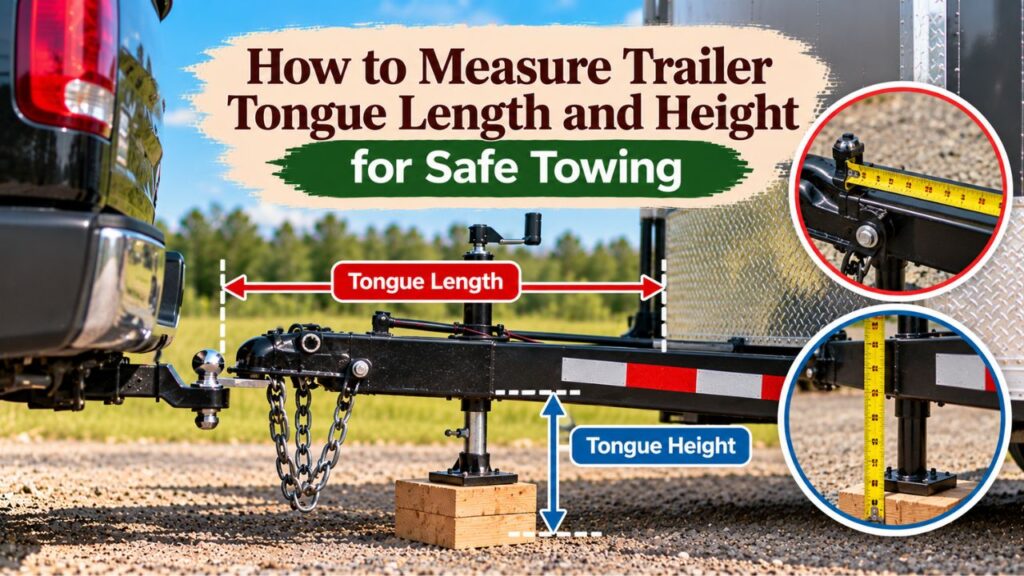
Before measuring, identify the trailer components involved.
The trailer tongue is the structural section extending forward from the trailer body or frame toward the towing vehicle.
The coupler is the connection component at the front of a conventional trailer. It fits over the hitch ball mounted on the tow vehicle.
Tongue length and tongue height describe different aspects of this assembly.
| Measurement | Starting Point | Ending Point | Main Purpose |
| Tongue length | Center of ball coupler | Trailer front wall or specified body reference | Dimensions and turning clearance |
| Coupler height | Level ground | Bottom of trailer coupler | Hitch-height adjustment |
| Hitch receiver height | Level ground | Top inside edge of receiver opening | Determining ball mount rise or drop |
| Hitching point length | Center of coupler | Center of axle or axle group | Trailer geometry and electronic setup |
| Overall trailer length | Front coupling reference or physical front extremity | Rear-most trailer point | Storage, parking, and clearance |
The exact reference points may differ according to the manufacturer and intended measurement.
For example, some electronic trailering systems request dimensions that are different from those needed to order a trailer cover or modify a frame.
Always identify the purpose of the measurement before starting.
What Tools Do You Need?
Most trailer tongue measurements can be completed with basic tools:
- Measuring tape
- Carpenter’s level or suitable digital level
- Wheel chocks
- Pencil and notepad
- Straightedge or carpenter’s square
- Small marking tape
- Helper for longer measurements
A tape measure marked in inches and feet is sufficient for most utility and travel trailers.
For tongue height, a rigid measuring tape or ruler is useful because the measurement must be taken vertically.
A helper can hold the tape at the correct reference point while you read the measurement.
How to Measure Trailer Tongue Length Step by Step
Trailer tongue length is generally measured along the trailer’s longitudinal centerline.
For many conventional enclosed trailers, the measurement runs from the center of the coupler to the front wall of the trailer body.
The following process helps establish that distance accurately.
Step 1: Park the Trailer on Level Ground
Choose a firm, reasonably level surface.
Position the trailer so you can access the coupler and front section without obstacles.
Set the parking brake on the tow vehicle if the trailer is attached, and chock the trailer wheels before working around it.
For a disconnected trailer, make sure the tongue is supported by its properly rated jack.
Measuring on level ground makes it easier to keep the tape aligned horizontally.
Step 2: Find the Center of the Trailer Coupler
Locate the ball socket underneath the coupler.
The measurement reference is the center of the ball’s normal seated position within the coupler, not the front tip of the metal housing.
On many conventional couplers, this point is near the center of the rounded socket.
Mark its approximate position on the upper surface using removable tape if that makes measuring easier.
For an A-frame tongue, do not assume the point where the two frame rails meet is the same as the center of the coupler.
The coupler may extend forward beyond the frame junction.
Step 3: Identify the Front of the Trailer Body
Find the correct rearward reference point for the measurement.
For a conventional cargo trailer with a flat front wall, use the front wall.
For a trailer with a tapered front, some vehicle manufacturers specify the corner where the tapered section meets the full-width sidewall.
The GMC/Chevrolet Silverado owner’s manual trailer-dimension instructions define trailer tongue length for the relevant trailering feature as the distance from the center of the coupler to the trailer’s front wall.
This definition is useful for identifying the proper measurement points on an enclosed trailer.
For an open utility trailer without a front wall, the front edge of the cargo deck or another specified structural reference may be used, depending on the purpose.
Do not substitute an arbitrary point when entering a measurement required by a vehicle’s electronic towing system.
Step 4: Measure Horizontally Between the Points
Extend the measuring tape from the center of the coupler toward the designated trailer-front reference.
Keep the tape straight and parallel to the trailer’s longitudinal centerline.
Avoid following the diagonal A-frame rails.
The distance along a sloping or angled structural member is not necessarily the same as the horizontal tongue length.
If the trailer has obstructions such as a tongue jack or battery box, use a straightedge or mark the reference points and measure the horizontal distance beside the frame.
For example:
- Coupler center to front wall: 42 inches
- Convert to feet: 42 ÷ 12 = 3.5 feet
The measured tongue length is 42 inches, or 3 feet 6 inches.
This is an example, not a standard required tongue length.
Step 5: Record and Verify the Length
Write down the result and identify the reference points used.
For example:
Tongue Length: 42 inches — Coupler center to front wall
Repeat the measurement to check for errors.
If the trailer has a tapered body or unusual front structure, document exactly where the measurement ends.
This makes the result useful when discussing clearance, trailer accessories, or electronic towing features.
How to Measure Trailer Tongue Height Step by Step
Trailer tongue height is usually determined by measuring the coupler’s position above the ground with the trailer level.
This is particularly important when selecting a ball mount for a conventional bumper-pull trailer.
Step 1: Position the Trailer on a Level Surface
Park the trailer on firm, level pavement if possible.
Chock the wheels securely.
If the trailer is disconnected, support the tongue using its properly rated jack.
Do not place yourself underneath the coupler or frame while adjusting the jack.
The trailer should be in the intended towing configuration, with appropriate tires and a representative load when selecting the final hitch setup.
Step 2: Level the Trailer Frame
Place a level on a suitable straight section of the trailer frame, oriented from front to rear.
Raise or lower the tongue jack until the trailer reaches its intended level towing attitude.
For many conventional trailers, this means the main frame is approximately parallel with the ground.
Do not judge the trailer’s level position only by looking at the tongue.
Some tongues have an upward or downward angle relative to the main trailer frame.
Use the trailer manufacturer’s intended leveling reference when available.
Step 3: Locate the Bottom of the Coupler
Identify the lower edge of the coupler at the ball socket.
This is the reference used in common hitch rise-and-drop measurement procedures.
Do not measure to the bottom of the tongue jack, the underside of an A-frame rail, or the highest point of the coupler housing.
Those measurements describe different parts of the assembly.
Step 4: Measure Vertically From the Ground
Place the measuring tape vertically beneath the coupler.
Measure from the ground directly below the coupler to its specified lower reference point.
For example, suppose the distance is 18 inches.
Record:
Trailer Coupler Height: 18 inches — Ground to bottom of coupler, trailer level
Keep the tape vertical rather than following an angled line from the trailer jack.
Step 5: Repeat the Measurement
Check that the trailer remains level.
Measure again to confirm the height.
If the ground is uneven beneath the coupler, relocate the trailer to a more suitable measuring surface.
A small measuring error can affect the ball mount selection, particularly when the trailer and tow vehicle have substantially different ride heights.
How to Measure Tow Vehicle Hitch Height
After measuring the trailer coupler, determine the height of the tow vehicle’s receiver.
These measurements are used together to estimate the required ball mount rise or drop.
Measure From the Ground to the Receiver Opening
Park the tow vehicle on level ground.
Position it in a representative towing condition, including the usual passenger and cargo load when practical.
Locate the rear hitch receiver.
Measure vertically from the ground to the top inside edge of the receiver opening.
For example:
Tow vehicle receiver height = 22 inches
Trailer coupler height = 18 inches
The difference is 4 inches.
According to CURT’s official adjustable trailer hitch measurement guide, measuring the top inside edge of the receiver and the bottom of the level trailer coupler provides the starting dimensions used to determine hitch rise or drop.
Calculate the Required Hitch Drop
Use the following formula:
Height Difference = Receiver Height − Coupler Height
Example:
22 − 18 = 4 inches
Because the vehicle’s receiver is higher than the trailer coupler, a ball mount providing an appropriate drop is needed.
This is a starting estimate for selecting a suitable mount.
The final fit depends on the ball mount’s actual geometry, the hitch ball, the vehicle’s loaded suspension position, and any manufacturer-specific setup requirements.
Calculate the Required Hitch Rise
If the receiver is lower than the trailer coupler, the towing setup may require a rise ball mount.
For example:
- Receiver height: 16 inches
- Coupler height: 20 inches
- Difference: 4 inches
The trailer requires a ball mount with an appropriate rise rather than a drop.
Not every ball mount is approved for installation in both orientations.
Use the manufacturer’s instructions and rated configuration.
Hitch Height Comparison Examples
| Receiver Height | Coupler Height | Initial Requirement |
| 22 inches | 18 inches | Approximately 4-inch drop |
| 20 inches | 17 inches | Approximately 3-inch drop |
| 18 inches | 18 inches | Approximately level |
| 16 inches | 20 inches | Approximately 4-inch rise |
| 24 inches | 18 inches | Approximately 6-inch drop |
These values illustrate the receiver-to-coupler measurement difference. They are not guarantees that a ball mount with the same advertised drop or rise will provide the exact final coupling height.
How to Check Trailer Tongue Height After Hitching
The first height measurement helps select the appropriate equipment.
However, the final towing setup must be checked after the trailer is attached.
Connect the Trailer Properly
Use a hitch ball that matches the coupler’s specified diameter.
Confirm that the ball mount, receiver, coupler, and associated hardware have sufficient weight ratings.
Lower the coupler onto the hitch ball and secure the locking mechanism according to its instructions.
Connect the safety chains, electrical plug, and breakaway cable where applicable.
Retract the trailer jack completely before moving the combination.
Check the Trailer’s Towing Attitude
With the trailer attached, stand beside the combination and examine the trailer’s position.
The trailer should meet its manufacturer’s intended towing attitude, generally close to level for a conventional bumper-pull design.
A trailer sitting substantially nose-high or nose-low may need a different ball mount configuration.
Use the frame level or suitable measurements to confirm the result.
Do not rely only on visual judgment.
Account for Tow Vehicle Suspension Compression
The rear suspension of the tow vehicle may compress when the trailer’s tongue weight is applied.
This can lower the effective hitch ball height after coupling.
For that reason, measuring the unloaded vehicle provides only an initial reference.
Some weight distribution hitch manufacturers use special setup measurements and account for suspension compression differently.
Follow the instructions for the exact hitch system rather than applying a universal correction.
Recheck After Loading
Cargo placement can affect tongue weight and suspension compression.
If the trailer or tow vehicle is loaded differently after the initial measurements, inspect the trailer’s level position again.
Make adjustments only within the towing equipment’s approved configurations.
A level appearance does not prove that tongue weight, axle loads, or towing capacity are within their limits.
Those limits require separate checks.
How to Measure Tongue Length on Different Trailer Types
The general measurement method is similar across conventional trailers, but the shape of the front structure affects the reference points.
A-Frame Trailer Tongue
An A-frame tongue consists of two angled structural members that converge toward the coupler.
This arrangement is common on travel trailers and utility trailers.
For the tongue-length measurement:
- Locate the center of the coupler socket.
- Identify the front wall or required front-body reference.
- Measure along the trailer’s longitudinal centerline.
- Record the horizontal distance.
Do not measure along one diagonal frame member and report that as tongue length.
The diagonal rail length is a separate structural measurement.
Straight-Tongue Utility Trailer
A straight-tongue trailer uses a central beam extending forward from the trailer frame.
For an open utility trailer, measure from the coupler center to the front deck edge or the reference specified for your intended purpose.
If the trailer has a front bulkhead or toolbox, distinguish the actual trailer body from accessories mounted ahead of it.
For turning clearance, those accessories must also be considered because they may contact the tow vehicle during sharp turns.
Boat Trailer Tongue
Boat trailers often have long central tongues and adjustable components.
Measure from the coupler center to the designated trailer frame or body reference appropriate for the task.
Boat trailers may not have a flat front wall, so there is no single body-front reference that applies to every design.
If measuring for an accessory, manufacturer specification, or frame modification, use the exact points required for that purpose.
The boat’s bow, winch stand, and other projecting equipment may affect turning clearance independently of the tongue length.
For height, level the trailer according to the trailer manufacturer’s instructions and measure the coupler at the specified point.
Travel Trailer Tongue
A conventional travel trailer commonly has an A-frame supporting the coupler and accessories.
For a flat-front travel trailer, measure from the coupler center to the front wall.
If the body is tapered or rounded, follow the reference-point instructions for the intended measurement.
Propane cylinders, battery boxes, and tongue-mounted storage may project into the available turning space.
When measuring for tow-vehicle clearance, record those protrusions separately.
For coupler height, follow the same basic procedure: level the frame and measure vertically from the ground to the prescribed coupler reference.
Trailer Tongue Length vs. Hitching Point Length
Tongue length and hitching point length are sometimes confused because both measurements begin at the coupler.
However, they end at different locations.
Trailer Tongue Length
For a conventional enclosed trailer, tongue length is commonly the horizontal distance from the coupler center to the front wall of the trailer body.
This helps describe the space between the coupling point and the main body.
It is useful for evaluating front-body clearance and certain electronic towing features.
Hitching Point Length
Hitching point length generally measures from the coupler center to the axle reference point.
On a single-axle trailer, this is typically the centerline of the axle.
For tandem-axle trailers, the required reference may be the middle of the axle group.
This measurement describes more of the trailer’s geometry than tongue length alone.
Example of the Difference
Consider a conventional trailer with the following dimensions:
- Coupler center to front wall: 42 inches
- Coupler center to axle-group center: 150 inches
- Coupler center to rear of trailer: 240 inches
The measurements would be:
| Dimension | Measurement |
| Trailer tongue length | 42 inches |
| Hitching point length | 150 inches |
| Coupler-to-rear trailer length | 240 inches |
These are illustrative dimensions, not specifications for a particular trailer.
The distinction is especially important when entering trailer dimensions into a vehicle’s camera or towing-assistance system.
Why Trailer Tongue Length Matters for Towing
Tongue length affects more than the trailer’s overall dimensions.
It influences the geometry between the tow vehicle and trailer, including how much room is available during turns.
Turning Clearance
The distance between the coupler and the trailer’s front corners affects how closely the trailer can approach the rear of the tow vehicle during a turn.
A short tongue may provide limited clearance, particularly with a wide trailer body.
A longer tongue may increase clearance in some combinations.
However, actual clearance depends on trailer width, body shape, tow vehicle dimensions, and hitch position.
Tongue length alone cannot establish a safe maximum turning angle.
Backing and Maneuvering
A trailer’s response while backing depends on the distance between the hitching point and axle group.
Tongue length contributes to the overall geometry but is not the only factor.
The trailer’s wheelbase, axle position, and articulation angle also affect how quickly its direction changes.
Two trailers with identical coupler-to-front-wall tongue lengths can behave differently if their axle positions differ.
Tongue Weight Distribution
The trailer’s coupling location and axle position affect how the total load is shared between the hitch and trailer axles.
However, a longer tongue does not automatically produce a fixed increase or decrease in tongue weight.
The result depends on how the modification changes the trailer’s geometry, structural weight, and center of gravity.
Changing tongue length requires more than measuring and cutting a steel beam.
It can affect frame stresses, turning geometry, and other towing requirements.
Structural modifications should be evaluated by the trailer manufacturer or a qualified trailer engineering professional.
Common Trailer Tongue Length and Height Measurement Mistakes
Small mistakes can produce misleading dimensions and incorrect hitch choices.
Measuring From the Tip Instead of the Coupler Center
The front tip of the coupler is not the same as its coupling center.
Measuring from the tip adds an unintended amount to the reported length.
Locate the normal hitch ball center and use it consistently.
Measuring Along the A-Frame Rail
An A-frame rail extends diagonally from the trailer body toward the coupler.
Its physical length is different from the trailer’s centerline projection.
For conventional tongue-length measurements, use the required horizontal centerline distance.
Measuring Height While the Trailer Is Tilted
A trailer that is nose-high or nose-low does not provide its normal level coupler height.
Adjust the tongue jack to the manufacturer’s intended level reference before measuring.
Measuring From the Wrong Coupler Surface
The top and bottom of a coupler produce different height readings.
The appropriate reference depends on the hitch installation instructions.
For a common ball mount rise-and-drop calculation, measuring from the ground to the bottom of the coupler is a standard method.
Some weight distribution systems specify measurements to the top of the coupler instead.
Do not mix these methods or compare heights taken from different reference surfaces without accounting for the difference.
Assuming All Trailers Need the Same Hitch Height
There is no universal coupler height suitable for every trailer.
Frame design, tire size, suspension, and towing configuration affect the height.
Measure the actual trailer rather than relying on a general number.
Forgetting Cargo and Suspension Changes
The trailer’s coupling height can change after loading and attaching it to the tow vehicle.
A ball mount selected using an unloaded setup may not produce the intended towing attitude.
Check the complete combination after loading.
How to Record Trailer Tongue Measurements Correctly
Keeping a simple measurement record can save time when selecting towing components or setting up trailering features.
For example:
| Measurement | Example Result |
| Trailer tongue length | 42 inches |
| Tongue length reference | Coupler center to front wall |
| Coupler height | 18 inches |
| Coupler height reference | Ground to bottom of coupler |
| Tow vehicle receiver height | 22 inches |
| Initial calculated drop | 4 inches |
| Coupler type | Conventional ball coupler |
| Trailer condition | Level and disconnected |
Record the trailer’s loading condition, especially when the measurements will be used to select towing equipment.
If a vehicle’s electronic trailering feature requests different reference points, follow that system’s instructions rather than substituting the figures from this example.
Conclusion
Understanding how to measure trailer tongue length and height starts with choosing the correct reference points and taking measurements on level ground.
For most conventional enclosed trailers, tongue length is measured horizontally from the coupler center to the front wall. Coupler height is commonly measured vertically from the ground to the bottom of the coupler with the trailer level.
After measuring, compare the trailer coupler height with the tow vehicle’s receiver height to estimate the necessary hitch rise or drop.
The final setup must also account for ball mount geometry, suspension compression, and manufacturer instructions.
Always distinguish tongue length from axle-to-coupler length and overall trailer length.
Accurate measurements help avoid unsuitable hitch adjustments and provide reliable information for trailer clearance, equipment selection, and towing-system setup.
FAQs About How to Measure Trailer Tongue Length and Height
Where Do You Start Measuring Trailer Tongue Length?
For a conventional enclosed trailer, start at the center of the coupler’s hitch ball socket. Measure horizontally toward the trailer’s front wall or other manufacturer-specified reference point. Do not start at the front tip of the coupler housing.
What Is the Correct Trailer Tongue Height?
There is no universal tongue height for all trailers. The correct height is the coupler position that allows the trailer to maintain its manufacturer’s intended towing attitude when connected to the tow vehicle. Measure the level trailer first, then select suitable hitch equipment.
Do You Measure Trailer Tongue Height to the Top or Bottom of the Coupler?
For common ball mount rise-and-drop measurements, use the bottom of the coupler. However, some weight distribution hitch instructions specify the top of the coupler. Follow the reference points required by your particular hitch system.
Is Trailer Tongue Length Included in Overall Trailer Length?
Tongue length contributes to the total length occupied by a conventional trailer, but the reported overall length depends on the measurement definition. A full physical-length measurement generally includes the tongue and coupler, while body-only measurements exclude them. Check the specification when measuring for storage, covers, or parking.
Can You Measure Trailer Tongue Height While It Is Hitched?
Yes, you can measure the connected coupler’s height to inspect the actual towing setup. However, to establish the trailer’s independent level coupler height for ball mount selection, the trailer is generally disconnected, securely supported, and leveled before measurement.
Does a Longer Trailer Tongue Make Towing Safer?
Not automatically. A longer tongue may provide more turning clearance in certain combinations, but it also changes the trailer’s geometry and structural loading. Safe towing depends on the complete trailer design, suitable tongue weight, correct hitch equipment, and proper cargo distribution.
How Do You Measure the Tongue on a Tandem-Axle Trailer?
Measure the conventional tongue length from the coupler center to the specified front-body reference, just as with a single-axle trailer. If measuring hitching point length instead, use the axle-group reference required by the manufacturer, commonly the midpoint between the two axle centerlines.