A corded tire inflator remains one of the most dependable ways to keep car tires properly inflated. Rechargeable pumps are convenient, but a corded inflator does not depend on remembering to recharge an internal battery. Connect it to your vehicle’s 12V outlet, directly to the battery, or—on dual-power models—to a household outlet, and you have a consistent power source whenever tire pressure needs attention.
That reliability is particularly important for a compressor that spends most of its life in a trunk. Tire-pressure problems have a habit of appearing at inconvenient times. If a pump has been sitting unused for six months, a corded model can still be ready to work as long as a suitable power source is available.
For most drivers, my top recommendation is the AstroAI AIRUN H Tire Inflator. It combines compact dimensions, simple 12V operation, digital pressure control, automatic shutoff, an LED light, and enough cable length for routine passenger-car use. Its enormous ownership history also gives buyers far more real-world feedback to examine than most newer inflators.
The EPAuto 12V DC Portable Air Compressor Pump is my second choice. It follows a similarly practical formula but adds thermal protection and a straightforward console-style design that works particularly well as a permanent trunk inflator.
For buyers who want something more versatile at home, the TEROMAS AC/DC Tire Inflator and AVID POWER AC/DC Tire Inflator can run from both vehicle and household power. That means you can use a wall outlet in the garage for regular tire maintenance and still retain 12V capability for travel.
Drivers of pickups, larger SUVs, RVs, and vehicles with higher-volume tires should look closely at the GSPSCN Heavy Duty Tire Inflator or VIAIR 88P Portable Compressor. These connect directly to the vehicle battery and are designed around stronger airflow and longer-reach hoses rather than miniature dimensions.
The best choice therefore depends on what you drive, where you expect to use the inflator, and whether portability, speed, automatic pressure control, household AC power, or large-tire capability matters most.
Why Choose a Corded Tire Inflator?
There is a reason corded compressors continue to sell even as cordless tire pumps become increasingly common.
A rechargeable pump introduces a second maintenance requirement: you have to maintain the pump itself. Lithium-ion batteries gradually discharge during storage, and extreme temperature exposure inside a vehicle can affect battery performance. If you check and recharge your roadside equipment regularly, that may not be a problem. Many drivers, however, put an emergency compressor in the trunk and forget about it.
A corded inflator is simpler.
A 12V tire inflator gets electricity from the vehicle. An AC/DC model can also use household electricity. A heavy-duty compressor may connect straight to the battery using alligator clamps.
There is no internal battery capacity to ration during a long inflation session, either. As long as you respect the compressor’s duty cycle and electrical requirements, a corded model can be more appropriate for repeated pressure corrections.
That does not automatically make every corded pump better than every cordless pump. Cord length, hose length, airflow, gauge accuracy, thermal management, and build quality still matter. The cord also reduces mobility compared with a handheld rechargeable pump.
But for dependable tire maintenance and emergency storage, corded models remain difficult to beat.
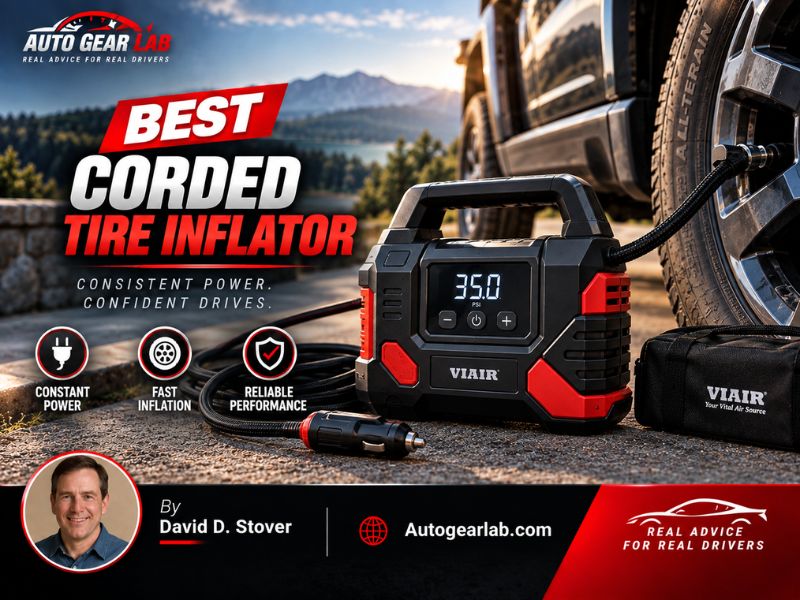
Best Corded Tire Inflator
| Image | Product Name | Check Price |
|---|---|---|
Best Choice | AstroAI AIRUN H Tire Inflator | Check Price |
Second Best | EPAuto 12V DC Portable Air Compressor Pump | Check Price |
Third Choice | FORTEM Tire Inflator Portable Air Compressor | Check Price |
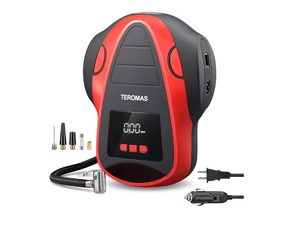 | TEROMAS AC/DC Tire Inflator | Check Price |
 | AVID POWER AC/DC Tire Inflator | Check Price |
 | GSPSCN Heavy Duty Double Cylinder Tire Inflator | Check Price |
 | Slime 40050 12V Tire Inflator | Check Price |
 | VIAIR 88P Portable Compressor Kit | |
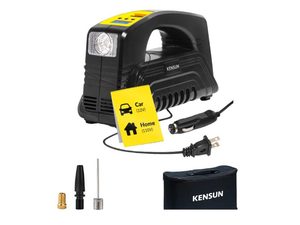 | Kensun AC/DC Digital Tire Inflator | Check Price |
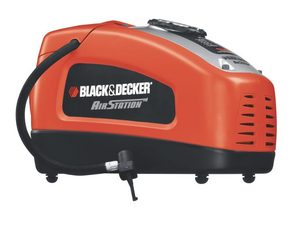 | BLACK+DECKER ASI300 Air Station Inflator | Check Price |
1. AstroAI AIRUN H Tire Inflator — Best Corded Tire Inflator Overall

Key Features
- 12V DC vehicle-powered operation
- Approximately 9.8-foot power cord
- Up to 100 PSI maximum pressure
- Approximately 35 L/min airflow
- Digital pressure display
- Programmable target pressure
- Automatic shutoff
- PSI, BAR, KPA, and KG/CM² pressure units
- Integrated LED work light
- Multiple inflation adapters
- Compact trunk-friendly construction
The AstroAI AIRUN H is the corded tire inflator I would recommend first to the average car owner because it focuses on the features that matter during everyday tire maintenance rather than trying to become an oversized multi-purpose compressor.
The unit plugs into a standard 12V vehicle outlet. That means there is no internal battery to keep charged and no proprietary battery pack to replace several years down the road.
Once connected to a tire, the digital display shows pressure and allows a target PSI to be programmed. The compressor then runs until the selected pressure is reached and stops automatically.
That auto-stop system is one of the biggest reasons to choose a modern digital inflator over an inexpensive analog pump. If all four tires need a few pounds of air, you can work around the vehicle using the same target pressure without constantly stopping the motor to read a small gauge.
The AIRUN H’s approximately 9.8-foot power cord also gives it practical reach around sedans, hatchbacks, crossovers, and many conventional SUVs. Cable reach sounds like a minor specification until you are trying to stretch a compressor from a center-console outlet to a rear wheel.
Its compact body is another advantage. A roadside compressor provides little value if it is so bulky that you eventually remove it from the car to make space. The AstroAI can remain stored with a jack, jumper cables, or other emergency equipment without consuming a large portion of the trunk.
The built-in LED light is helpful at night. It is not a replacement for a proper flashlight or headlamp, but it makes locating and connecting to a valve stem easier in a dark driveway or roadside environment.
A 100 PSI rating is plenty for ordinary passenger vehicles. What matters more is that this model is intended for relatively modest automotive tires rather than commercial truck, RV, or oversized off-road use. Users with large-volume tires should look at the GSPSCN or VIAIR later in this guide.
Recent independent coverage still identifies the AIRUN H as one of the most established corded options, with well over 100,000 ratings and a long ownership history.
What I Like
The strongest point is simplicity. Connect it to 12V power, set the required pressure, attach the hose, and let the automatic shutoff handle the final PSI.
I also like the combination of low weight, useful cable length, digital controls, and permanent vehicle-powered operation.
For a compressor that may sit in the trunk for months between uses, avoiding a rechargeable battery is a meaningful reliability advantage.
What I Do Not Like
This is not the model I would choose for large truck tires.
It also remains physically tethered to the vehicle, so the experience is less convenient than walking around with a cordless pump.
Like virtually every small piston inflator, the compressor and hose can become warm during extended operation. The manufacturer’s operating and cooling instructions should be followed.
Verdict
The AstroAI AIRUN H is the best corded tire inflator for most passenger-car owners.
It is affordable, compact, easy to understand, and supported by an unusually large amount of long-term user feedback. If you want one 12V compressor to leave in the trunk for regular pressure maintenance and unexpected low-tire warnings, this is my starting point.
2. EPAuto 12V DC Portable Air Compressor Pump — Best Proven 12V Alternative

Key Features
- 12V DC accessory-outlet power
- Up to approximately 100 PSI
- Digital pressure display
- Programmable target PSI
- Automatic shutoff
- Multiple pressure units
- LED flashlight
- Overheat protection
- Approximately 120–180W input range depending on configuration
- Compact carry-friendly housing
- Inflation adapters included
EPAuto is another long-established name in the compact 12V category, and its portable compressor is particularly appealing if you want straightforward controls without depending on an internal battery.
The compressor plugs directly into the vehicle’s accessory outlet and is intended primarily for ordinary cars, bicycles, motorcycles, sedans, and midsize SUVs. EPAuto specifically cautions that this style of unit is not intended for heavy-duty truck tires.
The digital system allows you to select the target pressure before inflation. When that pressure is reached, the compressor shuts itself off.
That sounds similar to the AstroAI—and it is. These two products compete for essentially the same buyer. Both make much more sense as passenger-car emergency pumps than as high-volume off-road compressors.
One useful EPAuto feature is thermal protection. Small compressors create considerable heat because the motor and piston are packed into a small enclosure. Overheat protection adds another safeguard, although it should never be treated as permission to ignore the recommended duty cycle.
EPAuto also gives you several pressure units, which helps if a motorcycle, bicycle, or other piece of equipment specifies pressure in BAR or KPA.
The integrated light is useful during nighttime inflation, and the console-style housing makes the controls easy to access when the pump is placed on the ground.
Owner-feedback analysis consistently highlights the automatic shutoff and generally straightforward operation as major strengths, although some users report variation in gauge accuracy and long-term reliability.
What I Like
I like that the EPAuto is designed around reliable vehicle power rather than battery convenience.
The digital preset system saves time when all four tires need adjustment, while thermal protection provides useful reassurance during longer inflation cycles.
Its controls are also simple enough that someone who rarely uses automotive tools should be able to understand the process quickly.
What I Do Not Like
Large truck tires are outside its ideal operating range.
The power cord still determines where the compressor can be placed, and some users may prefer a faster compressor for recovering a tire from very low pressure.
As with any built-in gauge, I recommend occasionally comparing it with a trusted independent tire-pressure gauge.
Verdict
The EPAuto 12V DC Portable Air Compressor is an excellent alternative to the AstroAI.
If your priority is keeping an established, easy-to-operate digital compressor in a sedan, crossover, or family vehicle, it deserves serious consideration.
3. FORTEM Tire Inflator Portable Air Compressor — Best Compact Digital Value

Key Features
- 12V DC corded power
- Up to 150 PSI advertised maximum
- Digital pressure gauge
- Preset target pressure
- Automatic shutoff
- Integrated LED flashlight
- Approximately 14 feet of combined reach depending on configuration
- Multiple inflation nozzles
- Carrying case
- Compact housing
- Available in different configurations and colors
FORTEM has built an unusually large ownership base for a small digital inflator, and the appeal is easy to understand: the pump delivers the convenience features buyers expect without requiring a large housing.
The standard corded version connects to the vehicle’s 12V outlet. You select the desired PSI on the digital display, connect the air hose, and begin inflation. Once the target is reached, the compressor stops automatically.
FORTEM rates the model up to 150 PSI, although that specification should be kept in perspective. Most passenger-car tires operate at a fraction of that pressure, and high maximum PSI does not automatically mean the pump moves a large quantity of air.
The real value comes from its compact size, pressure preset, LED light, and carrying case.
The case is especially worthwhile for an emergency compressor. Power cords, hoses, ball needles, and tapered inflation nozzles have a tendency to end up scattered throughout a trunk. Keeping the entire set together makes the inflator more useful when it is actually needed.
The bright digital display is easier to interpret than a small analog gauge, particularly in poor lighting.
Another advantage is reach. FORTEM advertises long combined cable reach on its corded models, which reduces the chance of having to reposition a vehicle simply to reach a rear tire.
Current listing snapshots show an unusually large review base for this model family, with approximately 37,000-plus ratings on one established configuration.
What I Like
The FORTEM does a very good job of combining small size with genuinely useful convenience features.
I particularly like the carrying case, auto shutoff, and large digital display.
It is also straightforward enough to serve as a family emergency tool without requiring much explanation.
What I Do Not Like
The advertised maximum PSI can create unrealistic expectations. This is still a compact 12V compressor rather than a high-output workshop machine.
Frequent inflation of oversized truck or off-road tires is better handled by a heavier-duty model.
The plastic enclosure also does not feel as substantial as the metal-heavy GSPSCN or VIAIR designs.
Verdict
The FORTEM is one of the best choices if you want a compact digital corded tire inflator with excellent storage organization.
It is especially suitable for commuters and families who want automatic pressure control without spending heavily on a professional-grade compressor.
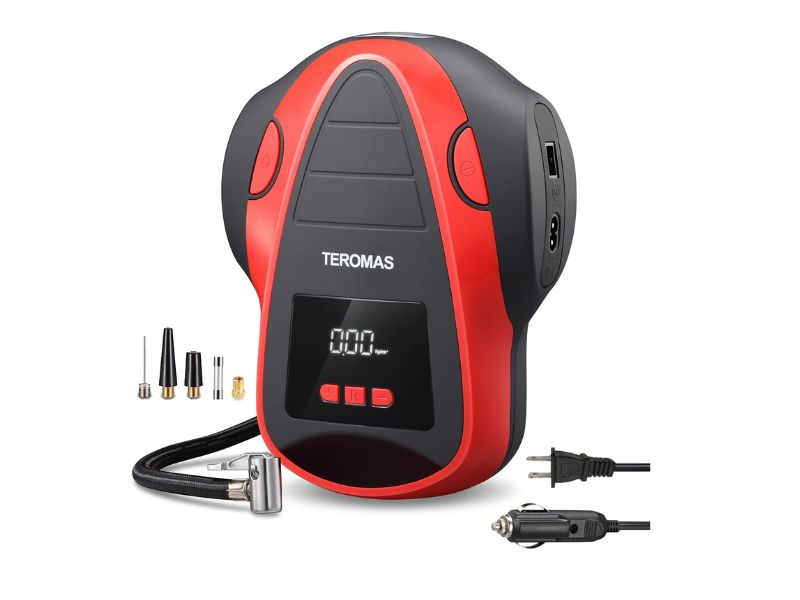
4. TEROMAS AC/DC Tire Inflator — Best Corded Inflator for Home and Car
Key Features
- 12V DC vehicle plug
- 110/120V AC household plug
- Up to 150 PSI
- Approximately 17 L/min rated airflow on the established model
- Digital pressure gauge
- Automatic shutoff
- Multiple pressure units
- LED light
- Compact approximately 2.6-pound body
- Carrying bag
- Additional inflation adapters
TEROMAS is one of my favorite choices for drivers who specifically want a corded tire inflator that works both at home and on the road.
A 12V-only pump is logical for emergencies because your vehicle becomes the power source. But when you are simply checking pressure in the garage, plugging directly into a household outlet can be more convenient.
TEROMAS provides both options.
The AC cable can be connected to standard household power, while the separate 12V cable allows the pump to travel with the vehicle.
This dual-power approach eliminates the biggest weakness of an AC-only compressor: once you leave the driveway, you are not dependent on finding a wall outlet.
The digital pressure system allows the target pressure to be preset. The compressor automatically stops after reaching that setting, which is useful when correcting several tires to the same PSI.
The unit is rated up to 150 PSI and weighs roughly 2.6 pounds, keeping it considerably more portable than many AC/DC console inflators.
A carrying bag is included, which matters because dual-power models naturally have more cables to organize.
The integrated LED light improves emergency usability, while several adapters extend functionality to bicycle tires, balls, and smaller inflatables.
Independent product data currently shows roughly 19,000-plus ratings on the established TMS-3015 listing, making it one of the most extensively reviewed AC/DC pumps in the category.
What I Like
The AC/DC design is the main attraction.
For regular maintenance, household power is convenient. For travel, 12V operation remains available.
I also like that TEROMAS manages to offer two power systems without turning the compressor into an oversized garage tool.
Automatic shutoff and a backlit digital display further improve everyday usability.
What I Do Not Like
Airflow is modest compared with heavy-duty dual-cylinder compressors.
That means it is better suited to normal passenger tires than large pickup or RV tires.
Cable storage is also less elegant than the completely self-contained designs offered by some competitors.
Verdict
Choose the TEROMAS AC/DC Tire Inflator if you want one compressor for both the garage and the trunk.
Its combination of household power, vehicle power, digital controls, automatic shutoff, compact size, and strong review history makes it one of the most balanced corded choices available.
5. AVID POWER AC/DC Tire Inflator — Best Multi-Purpose Corded Inflator

Key Features
- 12V DC vehicle power
- 110/120V AC household power
- Approximately 30 L/min high-pressure airflow
- Dual-motor design
- High-pressure tire inflation
- High-volume inflation
- High-volume deflation
- Digital pressure gauge
- Automatic shutoff
- LED light
- Approximately 9.8-foot DC cord
- Approximately 9-foot AC cord
- Multiple nozzles
The AVID POWER AC/DC inflator is larger than TEROMAS, but the additional size gives it one major advantage: it is designed to handle both high-pressure and high-volume inflation.
Those are two different jobs.
A car tire needs relatively high pressure but not an enormous volume of air. An air mattress needs a large quantity of air at very low pressure.
AVID POWER uses separate systems so the compressor can serve both purposes more efficiently.
For vehicle tires, use the high-pressure hose and digital pressure controls. The compressor can be programmed to stop at the desired pressure.
For mattresses, pool inflatables, or similar objects, the high-volume side moves more air. It can also reverse the process and help remove air during packing.
The power system is equally versatile.
At home, the compressor can run from an AC outlet. On the road, its long 12V cable lets it operate from the vehicle.
That makes it particularly appealing for families, campers, and road-trip users who want a single inflation tool rather than separate pumps for automotive and recreational equipment.
The main body is heavier and bulkier than the AstroAI, FORTEM, or TEROMAS. But if it lives in a garage or larger vehicle, that tradeoff may be worthwhile.
The established ACAP322B configuration has accumulated more than 12,000 ratings, and product documentation lists dual AC/DC operation, auto shutoff, high-volume functionality, and roughly 30 L/min airflow.
What I Like
Versatility is outstanding.
You get household power, vehicle power, tire inflation, large-inflatable inflation, and deflation in a single machine.
The longer power cords also help when moving around vehicles or working in a garage.
I also prefer a dedicated high-volume mode if the compressor will regularly be used for camping gear or air mattresses.
What I Do Not Like
The unit takes up considerably more storage space than a minimalist 12V pump.
There are also more hoses, cables, and operating modes to manage.
If your only goal is topping up car tires twice a year, you may be paying for capabilities you will rarely use.
Verdict
The AVID POWER AC/DC Tire Inflator is the most useful multi-purpose corded model in this guide.
It is particularly well suited to households that want one machine for cars, bicycles, sports equipment, air mattresses, camping gear, and roadside emergencies.
6. GSPSCN Heavy Duty Double Cylinder Tire Inflator — Best Corded Tire Inflator for Trucks and SUVs

Key Features
- 12V DC operation
- Direct vehicle-battery connection available
- Dual-cylinder compressor
- Up to 150 PSI
- Approximately 70 L/min airflow
- Approximately 240W motor
- Metal and ABS construction
- Long extension air hose
- Battery clamps
- Multiple inflation adapters
- Carrying bag
- Suitable for cars, SUVs, pickups, vans, campers, and larger tires
The GSPSCN represents a major step up from compact 12V cigarette-lighter inflators.
Instead of prioritizing minimum size, it uses dual cylinders and much stronger airflow to deal with larger tires.
The published airflow figure is approximately 70 L/min—roughly double what many small single-cylinder passenger-car inflators advertise.
That difference becomes more meaningful as tire volume increases.
If you own a pickup, full-size SUV, van, camper, or vehicle fitted with larger off-road tires, filling a tire with a small 17–30 L/min compressor can become frustrating. The GSPSCN’s higher airflow reduces the amount of time the motor has to run.
The unit also includes battery clamps, which are important because higher-output compressors can draw more current than a standard accessory socket is designed to provide.
Direct battery connection provides a stronger electrical path, although users must carefully follow the manufacturer’s connection procedure and electrical-safety instructions.
The compressor uses a metal-heavy body and weighs roughly six pounds. It is therefore much less discreet in a trunk than the AstroAI or TEROMAS.
But the heavier construction is part of the appeal for large-tire users.
The included long hose improves reach around pickups and RVs, and the storage bag keeps the compressor, clamps, adapters, and hose together.
Current product data lists approximately 70 L/min airflow, 240W power, 150 PSI capability, and more than 11,000 ratings for the established silver model.
What I Like
The biggest advantage is airflow.
For truck and SUV owners, moving 70 L/min is much more meaningful than simply advertising an enormous maximum PSI number.
I also like the direct battery connection, dual-cylinder design, long hose, and sturdier construction.
What I Do Not Like
This is significantly bulkier than a passenger-car inflator.
It also lacks the polished digital auto-stop experience offered by the AstroAI, FORTEM, or TEROMAS.
Direct battery clamps require a little more setup and care than plugging into a 12V accessory socket.
Verdict
The GSPSCN is the best value-oriented corded tire inflator here for larger tires.
If you drive a pickup, larger SUV, camper, or off-road vehicle and prioritize airflow over compact dimensions, it makes far more sense than a miniature 12V pump.
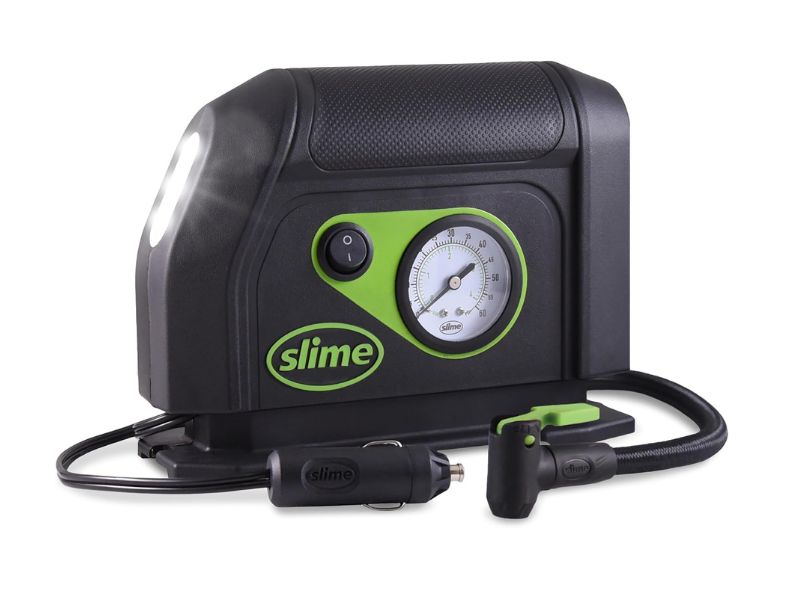
7. Slime 40050 12V Tire Inflator — Best Simple Analog Corded Inflator
Key Features
- 12V accessory-outlet power
- Analog pressure gauge
- Approximately 10-foot power cord
- Approximately 2-foot air hose
- Built-in LED light
- Compact design
- Inflation adapters
- Approximately 8-minute standard-tire inflation claim
- No rechargeable battery
- Straightforward on/off operation
Not every driver needs a programmable LCD screen.
The Slime 40050 is for buyers who prefer an uncomplicated compressor: plug it in, connect it to the tire, turn it on, and monitor pressure on the dial.
That simplicity has some advantages.
There are fewer electronic controls to learn, and there is no menu system to navigate in an emergency.
The compressor uses ordinary 12V vehicle power and includes a long electrical cord, allowing it to reach around many passenger vehicles.
An LED light is integrated into the housing for nighttime use.
Slime rates the pump to inflate a standard mid-sized car tire in approximately eight minutes. That is not especially fast compared with larger compressors, but it is acceptable for an emergency-oriented compact pump.
The analog gauge is both a strength and weakness.
Some buyers prefer a physical dial because it remains immediately understandable and does not rely on digital electronics. Others will miss the ability to enter a target PSI and let the pump stop by itself.
With this model, you remain responsible for watching the pressure.
For maximum accuracy, I would use a separate quality tire gauge to confirm pressure after inflation.
One major reason the Slime remains relevant is the sheer amount of long-term consumer feedback accumulated over years. Depending on listing variation, current rating snapshots show several thousand to roughly ten thousand ratings.
What I Like
The simple analog design is refreshing if you do not want another electronic gadget.
It is compact, inexpensive, vehicle-powered, and equipped with enough cord for ordinary emergency use.
The integrated light and adapter storage also make sense for a trunk kit.
What I Do Not Like
There is no automatic shutoff.
The analog gauge is less precise and less convenient than a good digital preset system.
Inflation speed is modest, and this compressor is intended for passenger vehicles rather than large truck tires.
Verdict
The Slime 40050 is a good choice for buyers who value simplicity above automation.
It is not the most sophisticated inflator in this comparison, but it provides dependable basic functionality in an inexpensive and highly portable package.
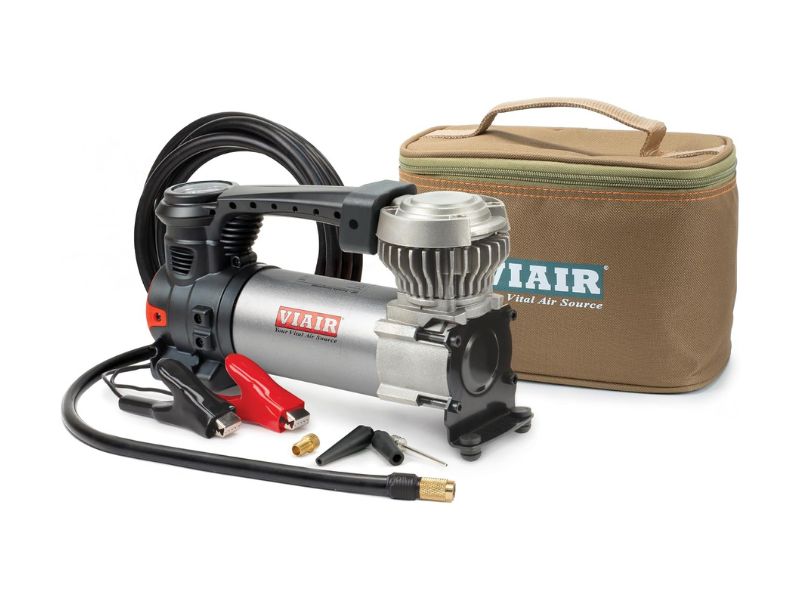
8. VIAIR 88P Portable Compressor Kit — Best Premium Direct-Battery Corded Inflator
Key Features
- 12V direct-to-battery operation
- Heavy-duty alligator clamps
- Up to 120 PSI
- Designed for tires up to approximately 33 inches
- Approximately 1.47 CFM airflow
- 10-foot power cord
- 16-foot air hose
- Solid brass tire chuck
- Analog pressure gauge
- Approximately 4.75-pound weight
- Compact metal compressor body
VIAIR has a strong reputation among off-road and automotive enthusiasts, and the 88P shows why.
This compressor does not try to compete with tiny digital pumps on features. Instead, it prioritizes airflow, reach, durability, and larger-tire compatibility.
Power comes directly from the vehicle battery using alligator clamps.
That eliminates the current limitations associated with many interior 12V accessory outlets and makes the unit better suited to a stronger compressor motor.
The 88P is rated for tires up to approximately 33 inches, putting it in a different class from most passenger-car pumps. VIAIR specifies a long 16-foot air hose and roughly 10-foot power cord, providing enough combined reach for pickups, SUVs, and off-road vehicles.
The pressure gauge is analog rather than digital, so you do not get programmable automatic shutoff on the traditional version.
That makes the inflation process more hands-on. You monitor the gauge and turn the compressor off manually when the desired pressure is reached.
Some drivers will see that as a disadvantage.
Others—particularly off-road users frequently airing tires down and back up—may care more about a dependable compressor platform and long hose than automatic presets.
Build quality is another reason to consider the VIAIR. The pump feels more like dedicated automotive equipment than a lightweight emergency accessory.
Recent automotive testing guides continue to recommend the 88P for larger tires and note an ownership base of roughly 8,000 ratings.
What I Like
The VIAIR’s biggest strengths are build quality, hose reach, and larger-tire suitability.
The battery-clamp power arrangement is appropriate for a stronger compressor, and the long hose makes moving around large vehicles much easier.
It is also compact considering the performance class.
What I Do Not Like
There is no automatic shutoff on the traditional analog model.
Direct battery connection is slightly less convenient than plugging into an interior accessory socket.
The price is also significantly higher than basic passenger-car inflators.
Verdict
The VIAIR 88P is one of the best premium corded tire inflators for SUVs, pickups, and off-road vehicles.
If you value durability and larger-tire performance more than digital features, this is one of the strongest choices on the list.
9. Kensun AC/DC Digital Tire Inflator — Best Traditional AC/DC Garage Inflator

Key Features
- 12V DC vehicle operation
- 110V AC household operation
- Approximately 30 L/min airflow
- Digital pressure gauge
- Preset pressure function
- Automatic shutoff
- Approximately 120W power
- Around 5-pound weight
- Carrying bag
- Multiple inflation accessories
- Two-year manufacturer warranty listed for the established model
Kensun is one of the older names in the AC/DC tire-inflator category, and its design reflects a traditional approach to portable garage equipment.
The compressor can be plugged into a standard household outlet or powered from a vehicle’s 12V connection.
That gives it the same fundamental advantage as TEROMAS and AVID POWER: you can perform normal maintenance at home without depending on the vehicle outlet, while still keeping the pump useful during a road trip.
The digital model supports preset pressure and automatic shutoff.
Once the desired PSI has been entered, the compressor stops at the target instead of requiring continuous manual supervision.
Rated airflow is around 30 L/min, putting it in a reasonable range for passenger-car tire maintenance.
The body weighs approximately five pounds, so it feels more substantial than TEROMAS but remains portable enough to keep in a vehicle.
A carrying bag helps organize the separate AC and DC cords.
The established digital model has accumulated roughly 3,300 ratings and lists a two-year manufacturer warranty.
One thing I particularly like about Kensun is that its role is easy to understand.
It is not trying to be an ultra-miniature pump, a cordless power tool, or an off-road compressor. It is a basic dual-power inflator designed for regular household and automotive use.
What I Like
I like having both AC and DC power in a conventional, easy-to-store package.
Automatic shutoff and the digital pressure setting make it more convenient than older analog garage compressors.
The included carrying bag is also helpful because two power cords create more storage clutter than a single 12V cable.
What I Do Not Like
At around five pounds, it is heavier than some newer AC/DC designs.
Its airflow is adequate rather than exceptional.
The hose and cable arrangement is also less refined than the most modern compact inflators.
Verdict
The Kensun AC/DC Digital Tire Inflator is a good traditional choice for garage and vehicle use.
It is best suited to someone who wants straightforward household and 12V power without moving into a bulky high-output compressor.
10. BLACK+DECKER ASI300 Air Station Inflator — Best Classic Dual-Power Corded Inflator

Key Features
- 120V AC household power
- 12V DC vehicle power
- Automatic shutoff
- Pressure-setting system
- Standard tire nozzle
- Ball needle
- Inflation adapters
- Around 5.3-pound weight
- Corded electric operation
- Two-year warranty on established documentation
The BLACK+DECKER ASI300 is an older design than most of the digital inflators in this article, but that is not necessarily a reason to ignore it.
Its biggest advantage is dual corded power.
You can run the compressor from a household AC outlet in the garage or connect it to the vehicle’s 12V system while traveling.
There is no rechargeable battery to maintain.
The ASI300 also includes an automatic shutoff system, which allows pressure to be selected before inflation. Once the target has been reached, the compressor stops.
The main body is console-shaped and weighs a little over five pounds. That makes it bulkier than the AstroAI but still manageable for garage shelves, trunk compartments, and recreational use.
BLACK+DECKER includes adapters for tires, balls, and other inflatables.
The model has been available for many years and has accumulated approximately 3,200 ratings on established product listings. Product documentation also identifies both 120V and 12V power, automatic shutoff, and a two-year warranty.
Its age means it lacks some of the polished features found on newer digital pumps.
The interface is more utilitarian, and the housing occupies more space than compact modern designs.
But if you want a recognizable, traditional dual-power compressor for the garage, the ASI300 still solves the basic problem effectively.
What I Like
The dual AC/DC power arrangement is practical.
I also like that the compressor avoids dependence on batteries and provides automatic pressure shutoff despite its relatively old design.
It is a sensible garage tool for routine tire pressure maintenance.
What I Do Not Like
The design is bulkier than modern 12V pumps.
It is also less attractive for drivers who want a bright digital screen, integrated emergency lighting, or very compact trunk storage.
Large truck and RV tires still require a stronger compressor.
Verdict
The BLACK+DECKER ASI300 remains a worthwhile classic corded inflator for home and automotive maintenance.
It is not my first choice for a compact emergency kit, but the AC/DC flexibility and established design give it a useful place in this top ten.
Corded Tire Inflator Comparison Table
| Product | Power Source | Max Pressure | Auto Shutoff | Gauge | Approx. Airflow | Best For |
| AstroAI AIRUN H | 12V DC | 100 PSI | Yes | Digital | ~35 L/min | Best overall |
| EPAuto 12V DC | 12V DC | ~100 PSI | Yes | Digital | ~30 L/min class | Reliable trunk use |
| FORTEM Tire Inflator | 12V DC | 150 PSI | Yes | Digital | Passenger-car class | Compact digital value |
| TEROMAS AC/DC | 12V DC / 110-120V AC | 150 PSI | Yes | Digital | ~17 L/min | Home and car use |
| AVID POWER AC/DC | 12V DC / 110-120V AC | High-pressure mode | Yes | Digital | ~30 L/min | Tires and inflatables |
| GSPSCN Heavy Duty | 12V / battery clamps | 150 PSI | No | Analog | ~70 L/min | Trucks and SUVs |
| Slime 40050 | 12V DC | Passenger-tire range | No | Analog | Compact class | Simple emergency use |
| VIAIR 88P | Direct 12V battery clamps | 120 PSI | No | Analog | ~1.47 CFM | Off-road and large tires |
| Kensun AC/DC Digital | 12V DC / 110V AC | Passenger-tire range | Yes | Digital | ~30 L/min | Garage maintenance |
| BLACK+DECKER ASI300 | 12V DC / 120V AC | Automotive range | Yes | Preset gauge | — | Classic dual-power use |
How I Chose the Best Corded Tire Inflators
1. Real-World Ownership History
For an emergency tool, long-term ownership feedback matters.
A compressor may look impressive during an unboxing video yet develop overheating, gauge, hose, or motor problems after months of use.
Products with large review histories give buyers more information about recurring strengths and weaknesses.
That does not mean the most-reviewed product is automatically the best. Popularity can be influenced by price, age, promotions, and distribution.
I therefore used review volume primarily to determine the order of established products while still evaluating whether each inflator remains appropriate for the keyword and its intended vehicle type.
2. Power Reliability
The defining characteristic of this guide is corded operation.
I looked for three main types:
12V accessory-outlet inflators are convenient for ordinary passenger cars. Plug them into the vehicle, route the cable to the tire, and inflate.
AC/DC inflators provide both household and vehicle power. These are particularly useful for people who maintain tires regularly in a garage but still want roadside capability.
Direct-battery inflators connect to the vehicle battery using clamps. They are normally used when the compressor draws more current than an accessory socket can safely provide.
Each design has advantages.
3. Inflation Speed and Airflow
Maximum PSI is one of the most misunderstood tire-inflator specifications.
A compressor rated to 150 PSI is not necessarily faster than one rated to 100 PSI.
PSI describes pressure capability. Airflow describes how much air the compressor can move.
For normal car tires, an enormous maximum pressure is rarely necessary. Most passenger vehicles use recommended cold pressures somewhere in the general 30–40 PSI range, although the exact specification varies by vehicle.
A compressor with stronger airflow can therefore be more useful than one with a higher theoretical PSI limit.
This becomes especially important for truck and off-road tires because larger tires contain substantially more air.
4. Automatic Shutoff
For most drivers, automatic shutoff is one of the most useful convenience features available.
You set the required pressure, start inflation, and the compressor stops when that value is reached.
This helps when correcting multiple tires and reduces the need to repeatedly stop the pump to check pressure manually.
It does not eliminate the value of a good standalone tire gauge. Built-in sensors can vary slightly, and periodically verifying accuracy is sensible.
5. Hose and Cord Reach
A powerful compressor is frustrating if the cord cannot reach the rear tire.
Reach depends on both electrical cord length and air-hose length.
Compact cars are relatively easy. Full-size SUVs, pickups, vans, and RVs create a more demanding geometry.
Direct-battery compressors frequently compensate with longer air hoses because the electrical connection remains near the engine bay.
When comparing inflators, think about where the power outlet or battery is located and which tire is furthest away.
6. Duty Cycle and Heat Management
Compressing air produces heat.
Small compressors have limited surface area and cooling capacity, which means many cannot run continuously for long periods.
The manufacturer may specify a maximum operating period followed by required cooling time.
That is known as the duty cycle.
Topping a tire from 31 to 35 PSI may take only a short time. Recovering a large tire from nearly flat can run the compressor much longer.
Ignoring the duty cycle can shorten motor life or trigger thermal protection.
7. Gauge Usability
I generally prefer a digital pressure gauge for typical motorists.
Digital displays are easy to read and make preset automatic shutoff possible.
Analog gauges are still perfectly usable, particularly on rugged compressors like the VIAIR, but they require more active monitoring.
Regardless of gauge type, accuracy matters more than appearance.
I recommend occasionally comparing the compressor’s reading with a separate tire gauge you trust.
Corded vs. Cordless Tire Inflators
The right power system depends largely on how you intend to store and use the compressor.
Advantages of Corded Tire Inflators
The primary advantage is power availability.
A 12V compressor has access to power whenever the vehicle can supply it.
There is no internal battery slowly discharging during six months of trunk storage.
Corded compressors are also well suited to repeated maintenance because you are not consuming a limited rechargeable battery.
Dual-power AC/DC models add another benefit: convenient home operation.
Disadvantages of Corded Tire Inflators
The cord restricts movement.
You have to route it around doors, wheels, and the body of the vehicle.
Cord length can also become a limitation on large vehicles.
A corded compressor cannot be casually carried across a parking lot to another vehicle unless a compatible power source is nearby.
Advantages of Cordless Inflators
Cordless units are extremely convenient.
Pick up the pump, walk to the wheel, connect the hose, and start.
There is no electrical cable running through the vehicle.
They are particularly attractive for motorcycles and bicycles.
Disadvantages of Cordless Inflators
Battery state is the major concern.
If the pump is intended primarily for emergencies, you need to remember to check and recharge it.
Very hot or cold vehicle interiors can also affect rechargeable batteries.
For that reason, I still consider a quality corded compressor one of the safest choices for a roadside kit that may receive little attention.
12V Plug-In vs. Direct Battery Clamps
Both are technically corded 12V systems, but they behave differently.
12V Accessory Plug
A cigarette-lighter-style accessory plug is the easiest option.
Simply plug the compressor into the socket and begin inflation according to the manufacturer’s instructions.
The electrical circuit is protected by a fuse and has a limited current capacity.
That limitation is why compact passenger-car inflators commonly use this connection.
Direct Battery Clamps
Higher-output compressors may draw 15, 20, or more amps.
Rather than sending that current through an interior accessory circuit, they connect directly to the battery.
This provides a stronger electrical path but requires correct polarity and careful handling.
Battery-clamp compressors are frequently better suited to pickups, RVs, and off-road tires.
Always follow the manufacturer’s exact connection procedure.
AC/DC Corded Inflators: Are They Worth It?
For garage users, yes.
Imagine you want to check tire pressure once a month.
With a 12V-only compressor, you must access the vehicle outlet each time.
With an AC/DC inflator, you can plug into a garage outlet, work around the car, and then put the compressor back on the shelf.
When traveling, the 12V cable provides the backup.
Models such as TEROMAS, AVID POWER, Kensun, and BLACK+DECKER are therefore particularly attractive to buyers who want one device to serve both roles.
The downside is additional bulk.
Two power cords require storage space, and AC/DC electronics usually make the housing larger than a minimalist 12V-only pump.
What PSI Should a Tire Inflator Have?
For ordinary car tires, maximum PSI is rarely the limiting factor.
A pump capable of 100 PSI already exceeds the normal operating pressure of most passenger vehicles by a wide margin.
Some bicycle tires require higher pressures, which can make a 120–150 PSI capability more useful.
Commercial, RV, and specialty tires can also have very different requirements.
But when shopping for a car inflator, do not assume:
150 PSI = faster than 100 PSI.
That conclusion is incorrect.
Airflow, motor power, cylinder size, tire volume, starting pressure, hose restriction, and duty cycle all influence inflation time.
How Much Airflow Do You Need?
Airflow is often expressed in liters per minute (L/min) or cubic feet per minute (CFM).
For occasional passenger-car top-offs, a compact 20–35 L/min inflator can be completely adequate.
For large SUV or pickup tires, stronger airflow can save considerable time.
A 70 L/min dual-cylinder compressor is moving roughly twice as much air as a 35 L/min unit under comparable conditions, although actual flow changes with pressure and compressor design.
Off-roaders who deliberately lower tire pressure for trail driving should pay particular attention to airflow because they may need to inflate all four large tires by 15–20 PSI before returning to pavement.
What Is a Tire Inflator Duty Cycle?
Duty cycle describes how long a compressor can safely operate before cooling.
For example, a manufacturer might allow a compressor to run for a certain number of minutes and then require several minutes of rest.
Smaller compressors usually have shorter duty cycles than heavy-duty systems.
This matters because heat is one of the biggest enemies of compact compressor motors.
A model that works perfectly for adding four PSI to one car tire may overheat if asked to inflate four large truck tires from very low pressure without a break.
Always read the operating instructions before the first emergency.
How Accurate Are Built-In Tire Inflator Gauges?
Quality digital inflators can be reasonably accurate, but no inexpensive built-in gauge should be treated as an unquestionable laboratory reference.
Manufacturing tolerances, temperature, sensor calibration, hose pressure, and valve connection can create small differences.
The simplest solution is to keep a separate trusted pressure gauge in the vehicle.
Compare the compressor’s reading with that gauge periodically.
If the inflator consistently reads one PSI high or low, you can account for the difference during routine maintenance.
Large or inconsistent discrepancies are a reason to stop trusting the built-in gauge.
Why Proper Tire Pressure Matters
Maintaining correct tire pressure supports several aspects of vehicle performance.
An underinflated tire flexes more as it rotates.
That additional flex generates heat and increases rolling resistance.
Underinflation can also affect steering response and contribute to uneven tread wear.
Overinflation creates different problems, including a firmer ride and altered tire contact characteristics.
The correct pressure is determined by the vehicle manufacturer, not by the inflator and not simply by the maximum pressure written on the tire sidewall.
Look for the vehicle tire-information placard, normally located in the driver’s door or door-jamb area.
Cold Tire Pressure vs. Hot Tire Pressure
Tire pressure rises as tires warm up.
Driving creates heat through tire flexing and road friction, which increases the pressure of the air inside.
That is why manufacturers typically specify pressure when the tires are cold.
For accurate routine maintenance, check pressure before substantial driving or after the vehicle has been parked long enough for tire temperature to stabilize.
During a roadside emergency, circumstances may require adding air to a warm tire.
In that situation, restore the tire to a safe condition and recheck pressure cold later.
Can a Corded Tire Inflator Fill a Completely Flat Tire?
Sometimes.
A compressor can add air only if the tire and wheel are physically capable of holding it.
If the tire has a small puncture but remains seated properly on the wheel, a sufficiently powerful inflator may restore pressure temporarily.
If the bead has separated from the rim, the sidewall is severely damaged, the valve has failed, or the puncture is extremely large, the pump may not solve the problem.
A completely flat tire also requires substantially more work than a routine top-off.
That is where airflow and duty cycle become important.
Small 12V pumps are at their best when correcting low pressure.
Heavy-duty compressors are more appropriate when large tires need substantial recovery.
Can a Corded Tire Inflator Be Used on SUVs?
Yes, but SUV tires vary enormously.
A compact crossover may use tires only slightly larger than those on a sedan.
A full-size body-on-frame SUV may use much larger all-terrain tires.
The AstroAI, EPAuto, FORTEM, TEROMAS, and similar models are reasonable for routine pressure maintenance on many ordinary SUVs.
For large truck-based SUVs, especially those fitted with oversized tires, I would choose GSPSCN or VIAIR.
Best Corded Tire Inflator for Trucks
For pickups and larger truck tires, airflow becomes the priority.
The GSPSCN Heavy Duty Double Cylinder Inflator is my value choice because its approximately 70 L/min output is substantially stronger than typical compact car pumps.
The VIAIR 88P is my premium alternative because it combines strong construction, direct battery connection, a long hose, and official suitability for tires up to around 33 inches.
Truck owners should check both required tire pressure and tire volume.
A compressor may technically reach 80 PSI but still take an impractically long time to move enough air into a large tire.
Best Corded Tire Inflator for Home Use
For garage use, I prefer a model with AC power.
The TEROMAS AC/DC offers the best balance of compact size and dual-power convenience.
The AVID POWER AC/DC is better when you also want high-volume inflation for air mattresses and recreational equipment.
Kensun provides a more traditional alternative.
The BLACK+DECKER ASI300 also remains useful if you prefer a classic console-style compressor.
Best Corded Tire Inflator for Roadside Emergencies
For a normal passenger car, I would choose the AstroAI AIRUN H.
It is small enough to leave permanently in the trunk and does not contain a rechargeable battery that needs periodic charging.
Automatic shutoff reduces the amount of attention required beside the road.
The LED light is useful after dark, while the approximately 9.8-foot cord provides sensible reach.
EPAuto is a very close second choice.
Best Corded Tire Inflator for Off-Road Use
For regular off-road air-down and air-up cycles, I would bypass miniature passenger-car pumps.
The VIAIR 88P is the better overall choice for moderate off-road setups because it is built for tires up to approximately 33 inches.
GSPSCN provides stronger advertised airflow at a lower price and can be an excellent value.
Serious off-road drivers running very large tires may eventually want an even higher-capacity dedicated onboard or portable compressor.
Tire Inflator Safety Tips
A tire inflator is easy to use, but several basic precautions matter.
Use the Correct Power Source
Never connect a 12V inflator to a higher-voltage electrical system unless the manufacturer explicitly permits it.
Check Outlet Current Limits
A high-draw compressor may exceed the rating of a vehicle accessory socket.
Use the power connection specified by the manufacturer.
Keep Cables Clear
Do not route electrical cords across hot exhaust components, moving engine parts, sharp edges, or traffic areas.
Avoid Water
Do not operate ordinary electrical inflators while they are standing in water.
Respect Cooling Periods
If the compressor becomes hot or reaches its maximum recommended operating period, stop and allow it to cool.
Handle the Hose Carefully
High-pressure hoses and fittings can become surprisingly hot during extended inflation.
Do Not Overinflate
Use the vehicle manufacturer’s recommended pressure rather than guessing.
Inspect the Tire
If a tire has visible sidewall damage, exposed cords, severe cracking, a bulge, or rapid pressure loss, inflating it does not necessarily make it safe.
Frequently Asked Questions
What is the best corded tire inflator?
The AstroAI AIRUN H is my best overall corded tire inflator for most passenger vehicles.
It provides a good combination of 12V reliability, digital pressure control, automatic shutoff, LED lighting, compact storage, useful cable reach, and an exceptionally large ownership history.
For large truck or off-road tires, I would choose GSPSCN or VIAIR instead.
What is the best 12V corded tire inflator?
For ordinary cars, the AstroAI AIRUN H and EPAuto are my first two choices.
Both are designed around simple vehicle power and automatic pressure control.
FORTEM is another strong option if you want a carrying case and compact digital controls.
What is the best AC corded tire inflator?
TEROMAS is my preferred compact AC/DC option.
It can run from household power in the garage and 12V power in the vehicle.
AVID POWER is the better choice when you need both tire inflation and high-volume operation for items such as mattresses.
Are corded tire inflators better than cordless?
Neither type is universally better.
Corded models are better for long-term emergency storage because they do not rely on a rechargeable internal battery.
Cordless pumps are more convenient because you can move freely around the vehicle.
If reliability after months of storage matters most, corded operation has a significant advantage.
Can I leave a corded tire inflator in my car?
Yes.
A compact 12V inflator is one of the easiest emergency tools to keep permanently in a vehicle.
Store it somewhere dry and secured so the compressor does not move around during driving.
Extreme temperature exposure can still affect plastics, hoses, electronics, and seals over many years, so inspect the equipment periodically.
Is 100 PSI enough for a car tire inflator?
Yes.
For ordinary passenger vehicles, 100 PSI is far beyond the normal operating pressure.
A higher maximum PSI rating does not necessarily provide faster inflation.
Focus on airflow, duty cycle, reliability, hose reach, and gauge quality.
Is 150 PSI better than 100 PSI?
Not automatically.
Maximum PSI indicates pressure capability, not inflation speed.
If both compressors are filling a car tire to 35 PSI, the model with stronger useful airflow may finish sooner even if its maximum pressure rating is lower.
What is the fastest corded tire inflator?
Among the models reviewed here, the GSPSCN stands out for its approximately 70 L/min advertised airflow.
VIAIR is another strong choice for larger tires.
For ordinary passenger-car maintenance, inflation time differences may be less important than automatic shutoff and ease of storage.
Which corded tire inflator is best for an SUV?
For a normal crossover or midsize SUV, AstroAI, EPAuto, FORTEM, TEROMAS, or AVID POWER can work well for routine pressure corrections.
For a large truck-based SUV or oversized tires, GSPSCN or VIAIR is more appropriate.
Which corded tire inflator is best for a truck?
The GSPSCN Heavy Duty Double Cylinder Inflator is my best value truck option.
The VIAIR 88P is my premium recommendation for tires up to approximately 33 inches.
Both use stronger direct vehicle-power arrangements than typical miniature passenger-car pumps.
Can I plug a 12V tire inflator into a wall outlet?
Not directly unless the inflator is specifically designed for AC power or you use a properly specified power converter that meets the manufacturer’s electrical requirements.
The easiest solution is to purchase an AC/DC compressor such as TEROMAS, AVID POWER, Kensun, or BLACK+DECKER.
What does AC/DC mean on a tire inflator?
It means the compressor supports two electrical power sources.
AC generally refers to household wall power.
DC generally refers to the vehicle’s 12V electrical system.
Dual-power compressors can therefore be useful both at home and during travel.
Should the engine be running when using a 12V tire inflator?
Follow the instructions supplied with the specific compressor and your vehicle.
Some manufacturers recommend operating the vehicle while inflating so the electrical system maintains voltage and the starter battery is not unnecessarily discharged.
Other products may specify a different procedure.
Do not assume one method applies to every compressor.
Can a tire inflator drain the car battery?
Yes, particularly if a compressor is operated for a long time while the engine is off.
The amount of battery drain depends on compressor current draw, operating time, battery capacity, battery condition, temperature, and vehicle electrical design.
Follow the manufacturer’s power instructions.
Can a corded tire inflator repair a puncture?
No.
It adds air but does not repair the hole.
A slow puncture may allow you to restore enough pressure to reach a safe repair location, but rapid air loss requires proper tire repair or replacement.
How often should I check tire pressure?
Checking approximately once per month and before long trips is a sensible general habit.
You should also check pressure after major temperature changes or whenever the tire-pressure monitoring system indicates a problem.
Does cold weather reduce tire pressure?
Yes.
As air temperature falls, tire pressure normally decreases.
That is one reason low-pressure warnings often appear during the first cold period of the season.
Do not simply ignore the warning because the temperature changed—check the tires and adjust them to the vehicle manufacturer’s cold-pressure recommendation.
How accurate is automatic shutoff?
A good automatic shutoff system can be very convenient, but sensor accuracy varies.
When you first buy an inflator, compare its final reading with a trusted independent pressure gauge.
If the two readings remain close, you can use the automatic system with greater confidence.
Can I use a tire inflator for bicycle tires?
Many models include bicycle adapters and have more than enough pressure capability for ordinary bicycle tires.
High-pressure road-bike tires require extra care because small-volume tires can increase in pressure rapidly.
Use the correct valve adapter and never exceed the tire or rim manufacturer’s pressure limits.
Can a tire inflator pump up an air mattress?
Some can, but a dedicated high-volume mode is much better.
AVID POWER is particularly suitable because it has separate high-pressure and high-volume systems.
A small tire compressor may technically inflate an air mattress but take a long time because it is optimized for pressure rather than volume.
Can I use a corded tire inflator on an RV?
For topping up smaller RV or trailer tires, some heavy-duty compressors may be suitable.
Large RV tires can require substantial airflow and relatively high pressures.
Check the compressor’s pressure rating, duty cycle, airflow, electrical requirements, and supported tire sizes before relying on it.
GSPSCN and higher-capacity VIAIR models are much more logical starting points than a tiny passenger-car pump.
Do I still need a tire-pressure gauge?
I recommend keeping one.
Even if your compressor has an integrated digital gauge, a separate gauge gives you an independent way to verify pressure.
It is inexpensive redundancy for an important vehicle-safety measurement.
Final Verdict
The AstroAI AIRUN H Tire Inflator is my best corded tire inflator for most drivers because it delivers the right combination of dependable 12V power, automatic shutoff, digital pressure control, practical cable reach, LED lighting, and compact storage.
The EPAuto 12V DC Portable Air Compressor is a similarly strong choice for drivers who want an established vehicle-powered inflator with simple controls and thermal protection.
The FORTEM Tire Inflator stands out for compact digital convenience and organized storage.
For buyers who want household power as well as vehicle power, the TEROMAS AC/DC Tire Inflator offers the best balance of portability and versatility, while the AVID POWER AC/DC is better for multi-purpose inflation and deflation.
Drivers with pickups, larger SUVs, campers, and off-road tires should move toward higher-output equipment. The GSPSCN Heavy Duty Double Cylinder Inflator provides excellent airflow for the money, while the VIAIR 88P is the stronger premium choice for buyers who value proven automotive build quality and long hose reach.
The Slime, Kensun, and BLACK+DECKER models each fill more specific roles for buyers who want analog simplicity, traditional AC/DC operation, or a classic garage-style inflator.
The most important thing is to match the compressor to your tire size and intended use. For a compact passenger car, convenience and automatic pressure control matter most. For a truck or off-road vehicle, airflow, electrical capacity, hose reach, and duty cycle become increasingly important.
Choose accordingly, keep the compressor accessible, and check that it works before the day you actually need it beside the road.