Choosing the best leveling kit for GMC Sierra 1500 requires more than deciding whether you want a 2-inch or 2.5-inch lift.
The Sierra 1500 has gone through several suspension generations, and GMC has also offered specialized configurations such as Denali with electronically controlled damping and AT4 with a factory-raised off-road suspension.
A spacer that works correctly on a standard 2018 Sierra may therefore be completely wrong for a 2021 AT4 or a newer Denali.
For most compatible 2007–2018 standard-suspension trucks, my primary recommendation is the Rough Country 1307 2-Inch Leveling Kit. A 2-inch front level is a practical height for a daily-driven Sierra because it reduces factory rake without forcing the suspension as far from its original operating position as a more aggressive 2.5- or 3-inch setup.
I would consider the MotoFab CH-2LM 2-Inch Front Leveling Kit for owners who prefer a billet-aluminum spacer and want a similarly moderate front lift.
The MotoFab CH-2.5 2.5-Inch Front Leveling Kit is more appropriate when the truck has enough measured rake to justify an additional half inch and the goal is a more completely level appearance.
The most important rule in this guide is simple: do not buy a Sierra 1500 leveling kit by truck name alone. Verify the model year, old-body or new-body configuration where applicable, 2WD or 4WD drivetrain, lower control arm type, Denali suspension, MagneRide or Adaptive Ride equipment, AT4 status, and any existing suspension modifications.
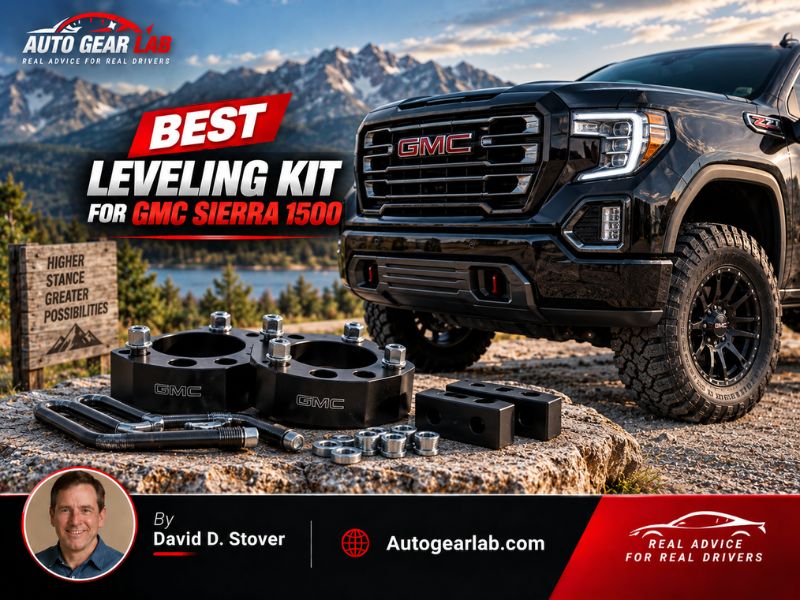
A well-selected leveling kit can improve stance, create useful front tire clearance, and make a stock Sierra look substantially more proportional. A poorly matched kit can create alignment problems, excessive ball-joint or CV angles, unwanted reverse rake, tire rubbing, or compatibility problems with electronic suspension systems.
10 Best Leveling Kit for GMC Sierra 1500
| Image | Product Name | Check Price |
|---|---|---|
Best Choice | Rough Country 1307 2-Inch Leveling Kit | Check Price |
Second Best | MotoFab CH-2LM 2-Inch Front Leveling Kit | Check Price |
Third Choice | MotoFab CH-2.5 2.5-Inch Front Leveling Kit | Check Price |
 | Dynofit 2-Inch Front Leveling Kit | Check Price |
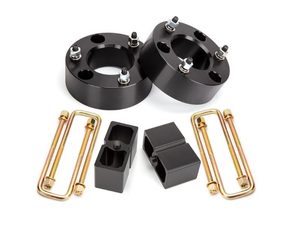 | Dynofit 3-Inch Front and 2-Inch Rear Full Leveling Lift Kit | Check Price |
 | Richeer 2-Inch Front Leveling Lift Kit | Check Price |
 | MZS 2-Inch Front Leveling Kit | Check Price |
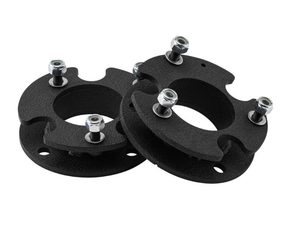 | Supreme Suspensions 2.5-Inch Front Leveling Kit | Check Price |
 | KSP 2.5-Inch Front Leveling Kit | Check Price |
 | 3-Inch Front and 2-Inch Rear Full Leveling Lift Kit | Check Price |
1. Rough Country 1307 2-Inch Leveling Kit
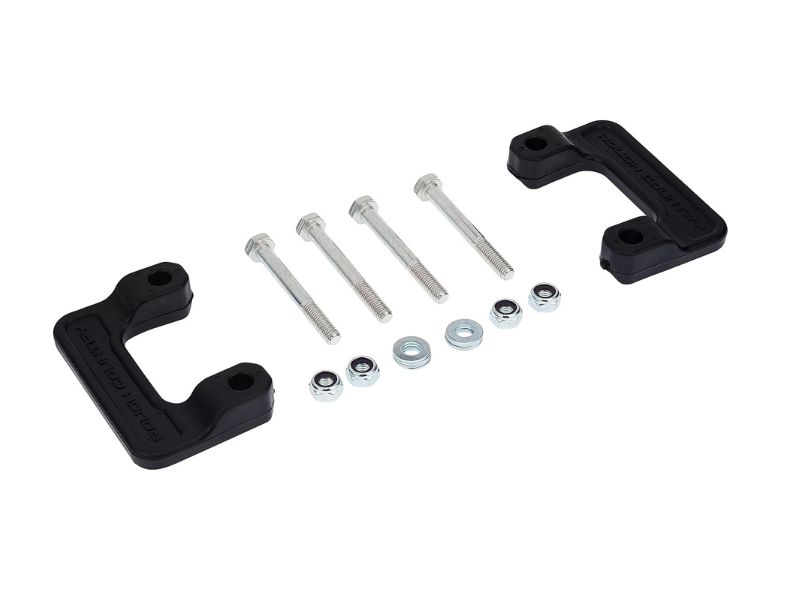
Key Features
- Approximately 2 inches of front lift
- Designed for compatible 2007–2018 GMC Sierra 1500 applications
- Works with selected 2WD, 4WD, and appropriate AWD configurations
- Bolt-on front leveling design
- Factory strut assembly remains intact during normal installation
- Designed to reduce factory front-to-rear rake
- Compatible with factory control arms on supported applications
- Not intended for every Denali or electronically controlled suspension configuration
The Rough Country 1307 earns the first position because it combines a sensible 2-inch lift height with broad coverage of the earlier Sierra 1500 generations that make up a large portion of the used-truck market.
Two inches is also the height I generally prefer for a multipurpose pickup.
GMC intentionally builds factory rake into the Sierra, meaning the rear sits higher than the front when the truck is empty. This is not a styling mistake. The higher rear allows the suspension to compress under bed cargo or trailer tongue weight without immediately giving the truck a nose-high stance.
A 2-inch front level removes much of that rake while often preserving a small amount of rear-high attitude. For a truck that still tows, hauls, commutes, and travels long distances, that is usually more functional than chasing a perfectly level empty stance.
The kit works by repositioning the front suspension through a spacer arrangement rather than replacing the complete spring and damper system. The factory strut and coil spring remain important parts of the ride.
This helps preserve the original spring characteristics, although it is important to understand that a spacer does not leave suspension geometry unchanged.
Raising the front alters the resting position of the upper and lower control arms, ball joints, steering tie rods, and struts. On a 4WD Sierra, it also changes CV axle angle.
At approximately 2 inches, these changes are generally less aggressive than those produced by a 2.5- or 3-inch spacer.
That is one of the strongest reasons I prefer this height.
The installation is also relatively straightforward compared with a system that requires completely rebuilding the front strut. You still have to safely raise the truck and release suspension components to create working room, so this is real suspension work rather than a cosmetic bolt-on accessory.
Compatibility is the biggest limitation.
A standard 2007–2013 Sierra 1500 and a 2014–2018 Sierra Denali with Magnetic Ride Control should not automatically receive the same leveling hardware. Specialized dampers and sensors need products engineered around those systems.
The 2019 model year also marks an important transition to the next-generation Sierra platform, so this older-generation kit should not be assumed to fit a 2019 new-body truck.
Tire clearance improves after leveling, but tire diameter alone never tells the whole story. Wheel width, positive or negative offset, backspacing, tire section width, liner clearance, suspension position, and steering angle all affect whether a larger tire rubs.
What I Like
- Moderate 2-inch height works well for multipurpose trucks.
- Covers many popular 2007–2018 standard Sierra 1500 configurations.
- Retains the factory spring and strut assembly.
- Less aggressive suspension-angle change than taller spacer systems.
What I Do Not Like
- Not a universal solution for 2014–2018 Denali/MagneRide trucks.
- Does not fit the new-generation 2019+ Sierra platform.
- Larger tire clearance still depends heavily on wheel specifications.
Verdict
The Rough Country 1307 remains my primary recommendation for a compatible 2007–2018 Sierra 1500. I prefer its 2-inch height for owners who want a noticeably better stance while retaining a practical amount of factory functionality for everyday driving, hauling, and occasional towing.
2. MotoFab CH-2LM 2-Inch Front Leveling Kit

Key Features
- 2-inch front leveling height
- Billet-aluminum construction
- Black protective finish
- Designed for compatible Sierra 1500 and related GM half-ton applications
- Bolt-on spacer design
- Retains factory spring characteristics
- Does not require a taller replacement coil spring
- Suitable for buyers prioritizing a moderate stance change
The MotoFab CH-2LM competes closely with the Rough Country kit because it targets the same useful 2-inch leveling range while using a substantial billet-aluminum spacer.
Aluminum is a sensible leveling-spacer material because it combines rigidity with useful corrosion resistance. That does not make the entire front suspension immune to corrosion—the surrounding bolts, control arms, strut mounts, and steering components are still exposed—but the spacer itself is well suited to underbody use.
Again, the most important advantage is the height.
A 2-inch front increase can transform the appearance of a Sierra without making it look artificially nose-high. Factory wheels often look better because the wheel opening becomes visually more balanced around the tire, and a moderate increase can help accommodate slightly larger tire packages.
I also prefer two inches when the owner tows.
Suppose your Sierra sits approximately 2.75 inches higher at the rear when empty. A nominal 2-inch front level may leave roughly three-quarters of an inch of rake before accounting for real-world suspension variation.
When trailer tongue weight compresses the rear springs, the truck then has some room to settle toward level.
If you remove all 2.75 inches of rake while the truck is unloaded, the same trailer can make the rear appear lower than the front.
Ride quality is another commonly misunderstood issue.
A spacer does not necessarily change the coil spring’s spring rate, because the original coil is retained. However, the suspension now operates around a different static position. Available droop, control-arm angle, CV position, and alignment all change.
So I would not say a leveling kit has “zero effect” on suspension behavior.
With healthy factory components and a sensible 2-inch height, the changes are usually easier to manage than with an aggressive spacer.
I would inspect existing struts before installation. A leveling kit cannot restore damping to a worn strut. If the truck already bounces excessively, leaks fluid, or feels poorly controlled, replacing or upgrading the dampers may be more sensible than installing a spacer over worn components.
What I Like
- Billet-aluminum construction.
- Moderate 2-inch height suits daily-driven Sierra 1500s.
- Retains factory springs and basic ride characteristics.
- Good choice when long-term spacer corrosion resistance matters.
What I Do Not Like
- Exact compatibility still depends on model year and suspension configuration.
- Does not fix worn factory struts.
- Alignment remains necessary after installation.
Verdict
I would choose the MotoFab CH-2LM when I want the practical geometry of a 2-inch level with billet-aluminum construction. It is especially appealing for a standard Sierra where the owner wants improved stance without maximizing front lift.
3. MotoFab CH-2.5 2.5-Inch Front Leveling Kit
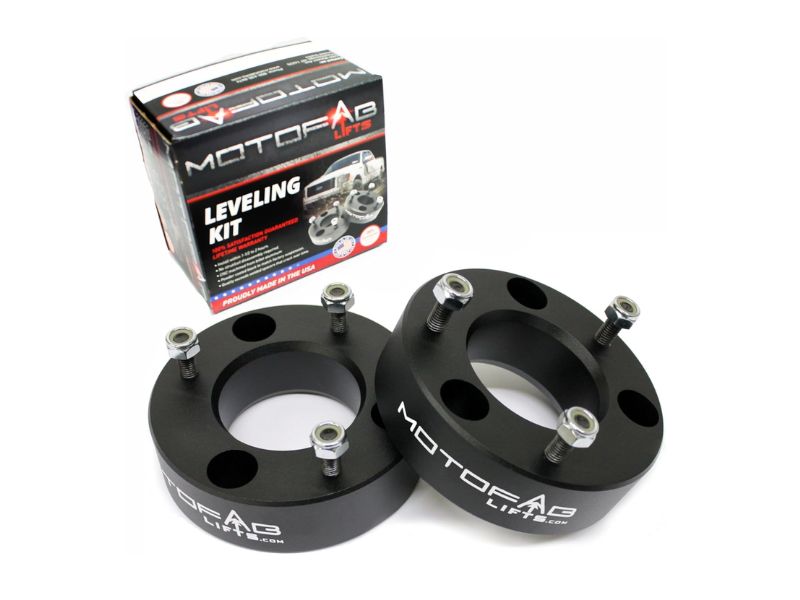
Key Features
- Approximately 2.5 inches of front lift
- Billet-aluminum spacer construction
- Black protective finish
- Intended for compatible standard Sierra 1500 applications
- Retains the original strut and coil spring
- Designed to remove more factory rake than a 2-inch kit
- Useful for trucks with substantial measured front-to-rear height difference
- Special trims and electronic suspension packages require separate fitment verification
The MotoFab CH-2.5 is where I begin to separate appearance-focused buyers from owners who still want to retain significant factory rake.
An extra half inch does not sound dramatic, but 2.5 inches can make the truck noticeably closer to level.
For the right Sierra, that looks excellent.
For the wrong Sierra, it can remove too much rake.
Measure before buying.
Park the truck on flat ground with normal tire pressure and typical permanent equipment installed. Measure vertically from the center of the wheel hub to the fender lip at both front and rear.
Hub-to-fender measurement is preferable to measuring from the ground because tire diameter and tread wear do not influence the result.
If your rear measurement is 2.75 or 3 inches greater than the front, a 2.5-inch level may still leave a useful amount of rake.
If the difference is only 1.75 or 2 inches, a 2.5-inch front lift may result in reverse rake.
At this height, suspension geometry deserves closer inspection.
The upper ball joint operates at a different resting angle. The control arm sits farther down in its travel. On 4WD models, CV axles run at a steeper angle.
Many street trucks can operate with a moderate 2.5-inch level when the kit is correctly applied, but I would pay more attention to alignment range and upper control arm position than I would with a 2-inch kit.
An aftermarket upper control arm may be worth considering when the final geometry leaves the factory ball joint near an undesirable operating position, particularly for trucks that see substantial off-road articulation.
This kit can also help with larger tire packages, but the same warning applies: lift height cannot compensate for every wheel-offset choice.
A wide tire pushed far outward follows a different steering arc than a stock-offset tire. Rubbing may occur at the liner, bumper, frame-side components, or other locations even when the truck appears to have plenty of vertical fender clearance.
What I Like
- 2.5-inch height creates a stronger visual level.
- Billet-aluminum spacer construction.
- Retains the factory spring and strut.
- Appropriate for trucks with enough measured factory rake.
What I Do Not Like
- More geometry-sensitive than a 2-inch level.
- Can remove too much rake from trucks used for frequent towing.
- Special trims require careful compatibility checks.
Verdict
The MotoFab CH-2.5 is my preferred choice among these first three when the owner specifically wants a more completely level street-truck stance. I would measure factory rake before choosing it and stay with the 2-inch version when towing and hauling are more important than achieving a perfectly level empty appearance.
4. Dynofit 2-Inch Front Leveling Kit
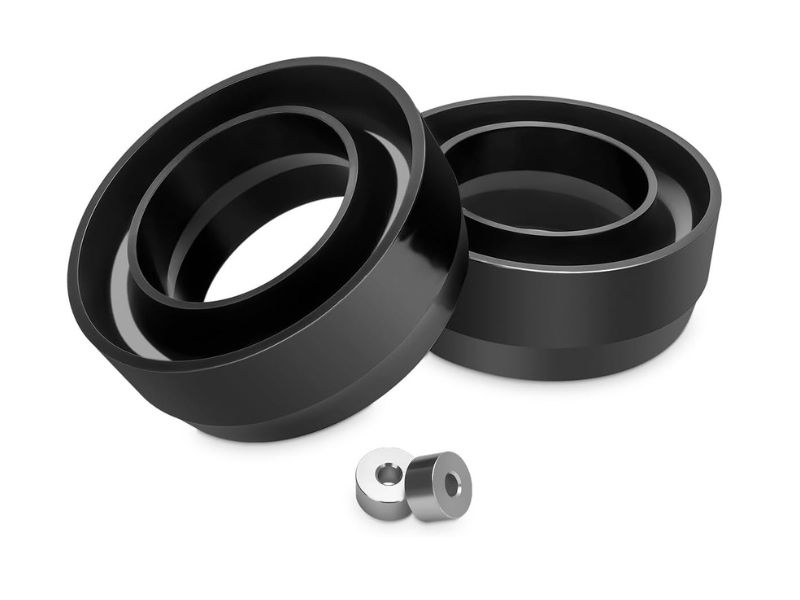
Key Features
- Approximately 2 inches of front lift
- Broad standard Sierra 1500 model-year coverage
- Compatible with selected 2WD and 4WD configurations
- CNC-machined billet-aluminum spacers
- Black anodized finish
- Bolt-on strut-spacer format
- Designed to retain factory-style ride characteristics
- AT4 and other specialized suspension configurations are excluded
The Dynofit 2-inch kit is particularly useful in a pillar guide because its listed application coverage extends across multiple Sierra generations while still maintaining a moderate lift height.
That broad range should not be mistaken for universal fitment.
AT4 models, specialized damping systems, and certain suspension configurations need separate hardware. When a product description says it covers a wide span of model years, I still verify the actual suspension on the truck before ordering.
The spacers are CNC-machined from billet aluminum and use a black anodized finish. Both features make sense in an area exposed to water, dirt, road salt, and temperature cycles.
The 2-inch height is also well judged for owners who want to improve stance without moving into an aggressive level.
One technical point worth understanding is that spacer thickness is not necessarily equal to lift height.
Owners sometimes receive a leveling kit, measure the spacer, and assume it is incorrectly manufactured because it is physically thinner than the advertised vehicle lift.
The front suspension has a motion ratio. The strut mounting point and wheel do not necessarily move one inch for every one inch of spacer thickness. A physically thinner spacer can therefore produce approximately two inches of change at the wheel opening.
I also like this type of product for owners who plan a moderate tire increase but do not want to modify the truck extensively.
Still, a leveling kit should not be treated as a substitute for a complete lift when the goal is a very large tire.
If you need several additional inches of suspension clearance, corrected geometry, and full articulation with a substantially oversized tire, a complete suspension lift may be a better engineering solution.
What I Like
- Two-inch height suits multipurpose trucks.
- CNC billet-aluminum construction.
- Broad standard Sierra application range.
- Anodized finish adds corrosion resistance.
What I Do Not Like
- AT4 and specialized suspension packages require different solutions.
- Broad advertised fitment still requires vehicle-specific verification.
- Does not guarantee clearance for aggressive wheel and tire packages.
Verdict
The Dynofit 2-inch kit is a strong choice for owners who want a simple, conservative front level across a broad range of standard Sierra 1500 configurations. I prefer it over taller options when preserving useful suspension geometry and towing rake matters.
5. Dynofit 3-Inch Front and 2-Inch Rear Full Leveling Lift Kit

Key Features
- Approximately 3 inches of front lift
- Approximately 2 inches of rear lift
- Includes front strut spacers
- Includes rear lift blocks
- Includes extended rear U-bolts
- Intended for compatible Sierra 1500 2WD and 4WD trucks
- Changes total truck height rather than only raising the front
- More aggressive than a conventional front-only leveling kit
This Dynofit package is different from the first four products.
A conventional leveling kit raises primarily the front to reduce factory rake. This package raises the front approximately 3 inches and the rear approximately 2 inches.
That makes it closer to a compact suspension-lift package with a one-inch front-to-rear leveling difference.
Why include it?
Because some Sierra owners want more overall ground clearance while still reducing rake, and this type of system serves that buyer better than a front-only spacer.
The rear blocks sit between the axle and leaf springs, while the extended U-bolts secure the revised stack. The front spacers raise the independent front suspension.
The result is a truck that sits higher overall rather than simply lifting its nose.
This has advantages when the owner wants a taller stance but does not want to eliminate rear height.
The disadvantages are equally important.
A 3-inch front increase is aggressive for the original front suspension geometry. Upper-control-arm position, ball-joint articulation, CV axle angle on 4WD models, alignment range, and droop travel become much more important.
I would inspect all of these after installation.
The rear installation also deserves proper torque procedures because U-bolts are structural suspension fasteners. They locate and clamp the axle to the leaf spring assembly.
Do not treat U-bolt installation like installing a cosmetic accessory.
For a work truck or frequent tow vehicle, raising the rear can preserve some visual rake, but the kit does not increase payload or towing ratings.
The springs, axle ratings, tires, brakes, frame, and certified weight limits remain the governing factors.
What I Like
- Raises both ends rather than creating an extreme front-only stance.
- Retains a small front-to-rear leveling difference.
- Includes rear blocks and corresponding U-bolts.
- Better suited to owners wanting overall truck height rather than only cosmetic leveling.
What I Do Not Like
- Three inches of front lift deserves close geometry inspection.
- Installation is more involved than a front-only spacer.
- It should not be confused with a complete geometry-correcting large suspension lift.
Verdict
I would choose this Dynofit kit only when the goal is to raise the entire Sierra while reducing some rake. For a simple daily-driver level, one of the 2-inch front-only kits is the more conservative solution.
6. Richeer 2-Inch Front Leveling Lift Kit
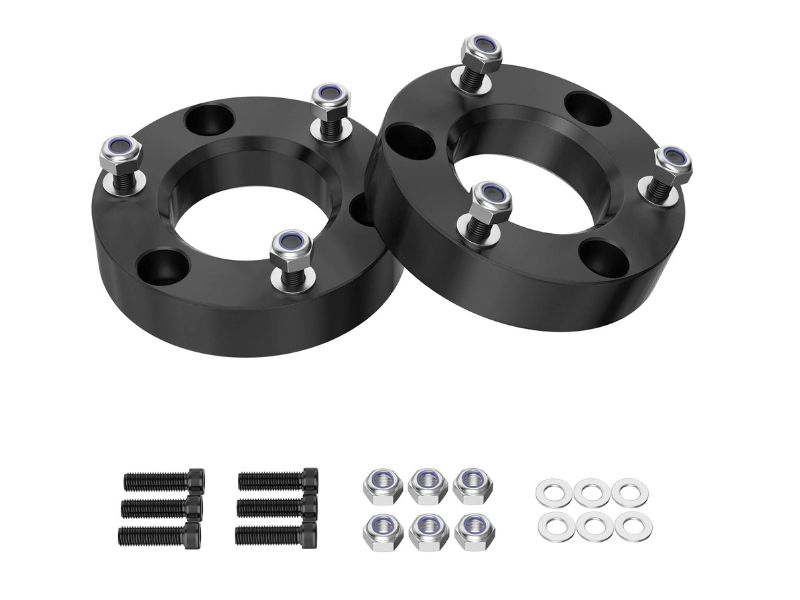
Key Features
- Approximately 2-inch front lift
- Aluminum spacer construction
- Designed for compatible Sierra 1500 applications
- Works with selected 2WD and 4WD trucks
- Front-only leveling design
- Intended to reduce factory rake
- Retains original spring-and-strut system
- Model-specific exclusions should be verified
The Richeer 2-inch kit follows the formula that works well for most standard Sierra owners: a modest front lift, aluminum spacer construction, and no attempt to turn a daily-driven half-ton into a heavily lifted truck.
Two inches provides enough height to change the truck’s appearance immediately.
It also gives the front tires more breathing room around the wheel opening, which can be useful when moving from a conservative factory tire to a slightly larger all-terrain.
But “more clearance” should not be translated into a guaranteed tire size.
Consider two 33-inch-class tires.
One may be 10.5 inches wide on a factory-offset wheel. Another may be 12.5 inches wide on a wheel with substantially less positive offset.
Their overall diameters may be similar, yet their clearance during steering can be completely different.
This is why good Sierra fitment advice always considers tire width, wheel offset, backspacing, and actual measured dimensions.
For an older truck, I would also inspect suspension wear before installation.
Ball joints, control-arm bushings, tie-rod ends, wheel bearings, CV boots, sway-bar links, and struts should be in serviceable condition.
Adding a leveling kit to worn components does not fix them. It can make existing wear more noticeable because the components now operate in a different part of their travel.
After installation, alignment should be considered mandatory rather than optional.
What I Like
- Sensible 2-inch front height.
- Aluminum construction.
- Suitable for many standard 2WD and 4WD applications.
- Straightforward solution for reducing factory rake.
What I Do Not Like
- Compatibility must be checked carefully on newer and premium suspension packages.
- Does not correct worn factory suspension.
- Tire clearance remains wheel-dependent.
Verdict
The Richeer 2-inch kit is a practical option when the truck has conventional suspension and the owner wants a mild, functional level. I prefer this height for daily driving over a 3-inch front-only spacer.
7. MZS 2-Inch Front Leveling Kit

Key Features
- Approximately 2 inches of front lift
- Billet-aluminum construction
- Precision-machined spacer design
- Intended for trucks with specified factory steel lower control arms
- Compatible with selected Sierra 1500 2WD and 4WD configurations
- Front-only leveling approach
- Important exclusions for newer 4WD and specialized suspension packages
- Alignment recommended after installation
The MZS 2-inch kit illustrates why reading the complete fitment requirements matters.
The headline model range can appear very broad, but the actual suspension requirements are much narrower.
This kit is intended for vehicles with specified factory steel front lower control arms, and exclusions apply to several newer, special-trim, and electronic-suspension configurations.
That is not a weakness if your truck matches the requirements. It simply means you should verify what is physically installed underneath the Sierra instead of selecting a kit from the model name alone.
The two-inch height itself is excellent for a general-purpose truck.
It improves the stance, adds some useful front clearance, and avoids the more aggressive suspension angles associated with taller levels.
The billet-aluminum spacer is also a sensible construction choice.
Where I would be particularly cautious is the 2019+ generation.
A Sierra that happens to share the same badge and engine displacement with an earlier truck can have different control-arm material, geometry, suspension package, and damper technology.
Likewise, AT4 and MagneRide-equipped trucks should never be treated as standard suspension applications.
This product is therefore best for a buyer who is willing to verify the lower control arms and suspension package before ordering.
What I Like
- Moderate 2-inch height.
- Billet-aluminum spacer construction.
- Clear use case when the truck has the specified steel control arms.
- Preserves more rake than a taller front level.
What I Do Not Like
- Fitment restrictions are more important than the broad model-range headline suggests.
- Not appropriate for AT4 or MagneRide applications.
- Certain newer-body 4WD configurations are excluded.
Verdict
The MZS kit can be a good value when the truck matches its specific suspension requirements. I would not buy it without confirming lower-control-arm material and special suspension equipment first.
8. Supreme Suspensions 2.5-Inch Front Leveling Kit

Key Features
- Approximately 2.5 inches of front lift
- High-strength steel spacer construction
- Designed for compatible Sierra 1500 applications
- Front strut-spacer format
- Intended to create a near-level stance
- Retains factory front springs
- Includes mounting hardware
- Special suspension packages require separate fitment verification
The Supreme Suspensions kit returns to the 2.5-inch category, but its steel construction differentiates it from the billet-aluminum products.
Steel is not inherently inferior for a leveling spacer.
A properly engineered steel component can handle substantial loads. The main consideration in an exposed suspension location is corrosion protection, particularly for trucks driven in areas where road salt and liquid brine are used extensively.
Inspect the spacer and surrounding hardware periodically.
At 2.5 inches, I would also measure the Sierra’s rake carefully.
The perfect empty-truck appearance is subjective. Some owners want the fender heights virtually identical. Others prefer the rear to remain half an inch or an inch higher.
For a truck that tows regularly, I prefer the second approach.
When a trailer puts several hundred pounds of tongue weight on the hitch, the rear suspension compresses. A truck that already sits perfectly level can quickly become rear-low.
A level also changes headlight aim.
Raising the front rotates the entire truck body slightly, so headlights may point higher. After installation and alignment, checking headlight aim is a sensible final step.
This is especially relevant when moving from roughly 2 inches to 2.5 inches.
What I Like
- Provides a strong near-level appearance.
- Heavy-duty steel spacer construction.
- Retains original front spring system.
- Appropriate for trucks with substantial measured factory rake.
What I Do Not Like
- Steel components deserve corrosion inspection in salt-belt climates.
- 2.5 inches may remove too much rake for frequent towing.
- Premium and electronically controlled suspension packages need separate verification.
Verdict
I would choose the Supreme Suspensions 2.5-inch kit for a standard Sierra with enough measured rake to use the full height. A 2-inch option remains my preference when towing and preserving conservative suspension angles are bigger priorities.
9. KSP 2.5-Inch Front Leveling Kit

Key Features
- Approximately 2.5-inch front lift
- 6061-T6 aluminum construction
- CNC-machined spacer design
- High-strength mounting studs
- Broad standard Sierra 1500 application range
- Compatible with selected 2WD and 4WD trucks
- AT4, AT4X, MagneRide, Auto-Ride, and self-leveling configurations excluded
- Control-arm geometry deserves attention at this lift height
The KSP kit combines a popular 2.5-inch height with 6061-T6 aluminum, a material commonly used in automotive and structural applications where strength, machinability, and corrosion resistance are useful.
Its broad model-year range is attractive, but the exclusion list matters even more.
This is a standard-suspension product. Electronic self-leveling systems, MagneRide-style applications, and factory-raised AT4/AT4X trucks need different solutions.
KSP also makes an important point with this height: a 2.5-inch spacer should be considered alongside the geometry of the upper control arms.
As the front suspension is raised, the upper control arm sits closer to its downward-travel position. The ball joint therefore operates at a different angle.
For a street truck with moderate use, the factory arm may still work acceptably when the application is approved and alignment is achievable.
For off-road articulation, however, an upgraded upper control arm designed around lifted geometry can be worthwhile.
The same is true for 4WD CV axles.
A CV joint is designed to operate through an angular range, but more static angle means less of that range remains in certain directions.
Inspect boots regularly, especially after off-road driving.
What I Like
- 6061-T6 aluminum construction.
- Strong 2.5-inch visual change.
- Broad standard-truck compatibility.
- Useful choice for owners willing to evaluate UCA and CV geometry.
What I Do Not Like
- Explicitly unsuitable for several premium and off-road suspension packages.
- More geometry-sensitive than a 2-inch level.
- Can create excessive unloaded leveling for frequent tow vehicles.
Verdict
The KSP 2.5-inch kit is best for a standard-suspension Sierra where the owner wants a more aggressive stance and has verified control-arm and suspension compatibility. I would choose a 2-inch system when minimizing geometry change is the priority.
10. 3-Inch Front and 2-Inch Rear Full Leveling Lift Kit

Key Features
- Approximately 3 inches of front lift
- Approximately 2 inches of rear lift
- Designed for compatible 6-lug Sierra 1500 applications
- Includes front strut spacers
- Includes rear lift blocks
- Includes extended U-bolts
- Suitable for selected 2WD and 4WD trucks
- Creates a taller overall stance
The final kit is another front-and-rear system rather than a traditional front-only level.
The 3-inch front and 2-inch rear combination produces approximately one inch more lift in front than rear, so the truck becomes taller overall while still reducing some of the factory rake.
This approach can make sense when additional overall height is the goal.
It is less appropriate when the buyer simply wants to remove the stock nose-down appearance.
Again, three inches at the front is a substantial change.
I would inspect upper-control-arm and ball-joint angles carefully. On a 4WD truck, CV axle position matters as well.
The rear blocks require attention to U-bolt installation and torque. Because the axle is secured to the leaf spring through these fasteners, proper installation is safety-critical.
This type of kit can also affect entry height, step-in height, hitch height, headlight aim, and the visual relationship between body and wheels.
It does not increase the truck’s legal load-carrying capacity.
If your primary goal is simply a clean factory-like level, one of the 2-inch front kits is easier to justify. If the goal is a taller truck with both ends raised, this format becomes more relevant.
What I Like
- Raises the entire truck rather than only the front.
- Maintains some front-to-rear lift difference.
- Includes rear blocks and extended U-bolts.
- Useful for owners seeking more overall height.
What I Do Not Like
- Less relevant to buyers wanting a simple front level.
- Three-inch front lift requires closer geometry inspection.
- Special trims and electronic suspension systems need careful verification.
Verdict
I would reserve this configuration for owners specifically wanting increased height at both ends. For the typical Sierra 1500 owner searching for a leveling kit, a 2- to 2.5-inch front-only solution is usually simpler and more functional.
GMC Sierra 1500 Leveling Kit Comparison
| Product | Lift Height | Configuration | Main Material | Typical Fitment Scope | 2WD/4WD | Best Use | Major Fitment Concern | Main Limitation |
| Rough Country 1307 | 2 in front | Front level | Durable spacer construction | 2007–2018 standard Sierra 1500 | Selected both | Daily driving and multipurpose use | Denali/MagneRide and generation change | Not for new-body 2019+ |
| MotoFab CH-2LM | 2 in front | Front level | Billet aluminum | Compatible standard Sierra applications | Selected both | Moderate factory-like level | Exact suspension configuration | Does not repair worn struts |
| MotoFab CH-2.5 | 2.5 in front | Front level | Billet aluminum | Compatible standard Sierra applications | Selected both | Near-level street stance | Premium/off-road suspension packages | Less towing rake |
| Dynofit 2-Inch | 2 in front | Front level | Billet aluminum | Broad standard Sierra range | Selected both | Conservative cross-generation level | AT4 and special suspension exclusions | Tire fitment still wheel-dependent |
| Dynofit 3F/2R | 3 in front / 2 in rear | Front and rear lift | Aluminum/steel hardware | Compatible standard trucks | Selected both | Taller overall stance | Front suspension geometry | More involved installation |
| Richeer 2-Inch | 2 in front | Front level | Aluminum | Compatible standard Sierra range | Selected both | Daily-driver level | Trim and suspension verification | No electronic-suspension correction |
| MZS 2-Inch | 2 in front | Front level | Billet aluminum | Specific steel-control-arm trucks | Selected both | Correctly matched standard trucks | Lower control arm and trim exclusions | Narrower real-world compatibility |
| Supreme Suspensions 2.5-Inch | 2.5 in front | Front level | Steel | Compatible Sierra applications | Selected both | Near-level appearance | Electronic suspension packages | More rake removed |
| KSP 2.5-Inch | 2.5 in front | Front level | 6061-T6 aluminum | Broad standard Sierra range | Selected both | Appearance-focused street trucks | AT4/AT4X/self-leveling excluded | Greater UCA/CV angle |
| 3F/2R Full Leveling Lift Kit | 3 in front / 2 in rear | Front and rear lift | Mixed construction | Compatible 6-lug standard applications | Selected both | Overall ride-height increase | Special trims and geometry | Not a simple front level |
The products above intentionally cover more than one Sierra generation because the main keyword spans many model years. That does not mean every kit fits every truck. Year-specific compatibility is the first filter; lift height comes second.
How to Choose the Best Leveling Kit for GMC Sierra 1500
Start With Your Exact Model Year
The Sierra 1500 has changed substantially since 2007.
Do not select suspension hardware simply because the package says “Sierra 1500.”
At minimum, verify:
- Model year
- Standard or previous-generation body where applicable
- 2WD or 4WD
- Lower control arm type
- Denali suspension
- MagneRide or Adaptive Ride Control
- AT4 or AT4X package
- Existing suspension modifications
- Factory or aftermarket struts
- Wheel and tire setup
This process prevents most major leveling-kit mistakes.
2-Inch vs 2.5-Inch vs 3-Inch Sierra Leveling Kit
2-Inch Level
For most standard Sierra 1500 trucks, 2 inches is my preferred starting point.
It offers a visible stance improvement while usually leaving some useful factory rake.
This height makes sense for:
- Daily commuting
- Highway use
- Occasional towing
- Bed cargo
- Mild off-road travel
- Moderate tire upgrades
- Owners who value conservative suspension geometry
2.5-Inch Level
A 2.5-inch front level is more appearance-focused.
It works best when actual measurements show at least 2.5 inches of rear-over-front rake.
The extra half inch can make the truck look substantially more level, but it also reduces rear-high reserve for towing and slightly increases front-end operating angles.
3-Inch Front Level
Three inches is aggressive for a factory independent front suspension.
At this point I would specifically evaluate:
- Upper control arm angle
- Ball-joint articulation
- Droop travel
- CV axle angle
- Tie-rod position
- Alignment range
- Brake hose and ABS wire routing
If you genuinely need several inches of clearance for large tires, consider whether a complete suspension lift is a better solution.
How to Measure Factory Rake
Park the Sierra on level pavement with normal tire pressure and normal permanent equipment.
Measure from the center of the front wheel hub to the fender lip.
Repeat at the rear.
Example:
Front: 22.0 inches
Rear: 24.5 inches
The difference is approximately 2.5 inches of rake.
A 2-inch level would theoretically leave some rake.
A 2.5-inch level would theoretically place the truck near level.
Real results can vary because springs, accessories, cab configuration, fuel load, manufacturing tolerances, and suspension wear affect ride height.
Why Spacer Thickness Does Not Equal Lift Height
A 2-inch leveling kit does not necessarily contain a spacer that physically measures 2 inches thick.
The suspension has a motion ratio.
Because the strut mounting point and wheel travel through different arcs and distances, a thinner spacer can create a larger increase at the fender.
Judge the product by its designed vehicle lift height, not only by measuring the spacer itself.
Best Leveling Kit for 2011 GMC Sierra 1500
For a standard 2011 GMC Sierra 1500, the 2007–2013 generation-specific products are the most straightforward choices.
The Rough Country 1307 2-inch kit is the option I would start with for a conventional suspension truck because the height is moderate and the application falls squarely inside its intended generation.
A MotoFab 2-inch setup is another practical route.
A 2.5-inch level makes sense only after measuring the actual rake.
If the truck is now more than a decade old, inspect the struts, control-arm bushings, ball joints, tie rods, wheel bearings, CV boots, and sway-bar links before adding a level. Suspension condition matters as much as spacer quality on an older Sierra.
Best Leveling Kit for 2014 GMC Sierra 1500
The best leveling kit for 2014 GMC Sierra 1500 depends heavily on trim.
The redesigned 2014 truck uses the newer K2-generation platform. Standard suspension trucks have many spacer options, including 2-inch Rough Country, MotoFab, Dynofit, and similar designs.
However, a 2014 Denali equipped with Magnetic Ride Control requires special attention.
Do not install a standard conventional-strut spacer merely because another 2014 Sierra uses it.
For a standard SLE, SLT, or appropriately equipped Z71 truck, I prefer around 2 inches for everyday use.
Best Leveling Kit for 2015 GMC Sierra 1500
For the best leveling kit for 2015 GMC Sierra 1500, a 2-inch front spacer remains my preferred all-around setup.
It provides enough front height for a clearly improved stance while maintaining more functional rake than a 2.5-inch system.
If the truck is a standard-suspension model and the owner wants a near-level appearance rather than towing-oriented rake, the MotoFab CH-2.5 becomes more attractive.
Denali/MagneRide trucks again need a suspension-specific solution.
Best Leveling Kit for 2016 GMC Sierra 1500
The best leveling kit for 2016 GMC Sierra 1500 follows much the same logic as 2014 and 2015.
I would use a compatible 2-inch kit for a multipurpose standard truck.
Choose 2.5 inches when:
- Measured rake supports it
- The truck is primarily street driven
- Heavy trailer use is limited
- Upper-control-arm and alignment geometry remain acceptable
Z71 does not automatically mean a standard aftermarket product fits every configuration, so verify the actual suspension before ordering.
Best Leveling Kit for 2017 GMC Sierra 1500
For the best leveling kit for 2017 GMC Sierra 1500, I would still prioritize a moderate 2-inch system for the broadest use.
The truck can gain a more proportional stance while keeping some rear-high attitude.
If larger tires are part of the plan, choose the wheel offset at the same time as the leveling kit. A poor offset choice can cause more rubbing than an additional half inch of tire diameter.
Denali owners should confirm whether the truck uses electronically controlled dampers before selecting hardware.
Best Leveling Kit for 2018 GMC Sierra 1500
The best leveling kit for 2018 GMC Sierra 1500 depends on whether the truck is standard suspension or Denali/MagneRide.
For a conventional 2WD or 4WD truck, the Rough Country 1307 remains one of the most straightforward 2-inch choices in this list.
MotoFab’s 2- and 2.5-inch options are relevant alternatives.
For Denali with Magnetic Ride Control, use a system specifically engineered for that suspension. Standard spacer advice should not be copied from an SLE or SLT build.
Best Leveling Kit for 2019 GMC Sierra 1500
The best leveling kit for 2019 GMC Sierra 1500 requires unusually careful identification because 2019 is a transition year.
The new-generation Sierra 1500 uses a different platform from the 2018 truck.
Do not order a 2007–2018 kit simply because the vehicle registration says 2019.
Confirm whether you have the new-generation truck and then use hardware specifically listed for that suspension.
This is also the period when AT4 becomes especially relevant.
An AT4 already has factory-raised off-road suspension, so standard-truck leveling recommendations do not transfer directly.
Best Leveling Kit for 2020 GMC Sierra 1500
For the best leveling kit for 2020 GMC Sierra 1500, I prefer approximately 2 inches on a standard new-generation truck when the goal is daily driving, modest larger tires, and retaining usable rake.
Verify whether the truck has adaptive or premium electronic suspension.
AT4 models need AT4-specific hardware because their starting ride height and suspension geometry differ from a standard Elevation, SLE, or SLT truck.
Wheel offset is particularly important on this generation if larger all-terrain tires are planned.
Best Leveling Kit for 2021 GMC Sierra 1500
The best leveling kit for 2021 GMC Sierra 1500 depends on trim before anything else.
A standard suspension truck can use a generation-compatible front level, and approximately 2 inches remains a practical height.
A Denali with electronic damping and an AT4 are separate cases.
Do not disable or mechanically compromise electronically controlled suspension just to install a generic spacer.
Compatibility with sensors, dampers, suspension travel, and driver-assistance calibration should be considered on newer trucks.
Best Leveling Kit for 2021 GMC Sierra 1500 AT4
The best leveling kit for 2021 GMC Sierra 1500 AT4 is not the same product I would use on a standard 2021 Sierra.
The AT4 already comes with approximately a 2-inch factory suspension lift and off-road-oriented suspension hardware.
Adding a standard 2- or 2.5-inch Sierra spacer on top of that setup can create excessive front geometry and is excluded by many conventional leveling-kit manufacturers.
Use an AT4-specific leveling system designed around the factory lift and appropriate upper-control-arm geometry.
For this truck, I prefer a modest additional level rather than stacking aggressive standard-truck spacers.
The AT4’s factory suspension is part of its off-road capability, so preserving usable travel and joint angles matters more than chasing maximum front height.
Best Leveling Kit for 2022 GMC Sierra 1500
The best leveling kit for 2022 GMC Sierra 1500 again depends on standard suspension, Denali equipment, or AT4 configuration.
For a standard truck, a generation-correct 2-inch level gives the best balance for most drivers.
Newer trucks have more electronic systems than earlier Sierras, so ride-height modifications should also be considered alongside alignment, steering calibration, cameras, and driver-assistance systems when applicable.
AT4 and AT4X trucks should receive purpose-built solutions.
Best Leveling Kit for 2024 GMC Sierra 1500
For the best leveling kit for 2024 GMC Sierra 1500, exact trim identification is essential.
A standard Elevation, SLE, or SLT does not necessarily use the same hardware as AT4, AT4X, or a Denali equipped with advanced damping.
If the truck has a conventional suspension and the product explicitly covers the 2024 platform, I still prefer approximately 2 inches for a daily-driver build.
For AT4, remember that the truck begins with a factory-raised suspension. AT4X adds even more specialized off-road hardware, so generic leveling-spacer assumptions are particularly inappropriate.
Standard Sierra vs Denali vs AT4
Standard Sierra
A conventional Sierra 1500 is generally the simplest vehicle to level.
A correctly designed 2-inch front spacer can reduce rake without requiring major suspension changes.
Denali
Denali trucks may use MagneRide, Adaptive Ride Control, or other premium damping technology, depending on year.
These systems use electronically controlled components that standard spacers may not accommodate correctly.
Always verify the actual RPO equipment and product compatibility.
AT4
AT4 begins with an off-road suspension and factory lift.
Its control-arm and CV geometry are already positioned differently from a standard truck.
Use AT4-specific products.
AT4X
AT4X uses even more specialized off-road suspension hardware.
Do not assume that an AT4 leveling solution automatically fits AT4X.
2WD vs 4WD Sierra Leveling Kits
Some leveling kits fit both drivetrains, but 4WD adds an important variable: front CV axles.
The axle connects the front differential to the wheel hub through constant-velocity joints.
Increasing front ride height makes the axle operate at a steeper static angle.
A moderate level is commonly used successfully, but increased angle can place more demand on CV joints and boots.
A 2WD truck avoids that specific concern but still experiences changes to ball-joint, control-arm, steering, and alignment geometry.
Do You Need Upper Control Arms?
Not every Sierra needs upgraded upper control arms (UCAs) after leveling.
A moderate 2-inch street setup on an approved application may retain acceptable factory UCA geometry.
As lift approaches 2.5 or 3 inches, I inspect the ball-joint position more carefully.
Aftermarket UCAs can offer:
- Revised ball-joint angle
- Better droop clearance
- Increased alignment range
- Stronger joints
- Better clearance for off-road articulation
They are particularly worth considering on aggressive 4WD builds.
Does a Sierra Need an Alignment After Leveling?
Yes. A front-end alignment should be treated as part of the installation.
Changing ride height affects camber, caster, and toe.
Camber affects how upright the tire sits.
Caster influences straight-line stability and steering return.
Toe describes whether the tires point slightly inward or outward relative to one another.
Incorrect toe can wear expensive tires quickly even when the steering wheel looks reasonably straight.
Install the final leveling components and wheel/tire combination, then align the finished truck.
What Tire Size Fits a Leveled GMC Sierra 1500?
There is no universal answer because Sierra generations and wheel specifications vary.
A moderate level often creates useful room for 33-inch-class tires, but actual fitment depends on:
- Tire diameter
- Tire width
- Wheel diameter
- Wheel width
- Offset
- Backspacing
- Suspension package
- Fender liner
- Bumper clearance
- Steering lock
- Suspension compression
A 33-inch tire that is relatively narrow on a factory-offset wheel can fit more easily than a 33-inch tire that is 12.5 inches wide on an aggressively offset wheel.
Can a Leveled Sierra 1500 Run 35s?
Some builds can, but a leveling kit alone does not guarantee 35-inch tire clearance.
Wide 35s can contact liners, suspension components, bumper areas, or other structures at steering lock.
If 35-inch tires are the primary goal and you want full clearance under compression without extensive trimming, compare a proper suspension lift with a front-only leveling kit.
Do not keep increasing spacer height solely to make an oversized tire fit.
Wheel Offset and Backspacing
Wheel offset describes the relationship between the wheel centerline and mounting surface.
More positive offset generally keeps the wheel farther inward.
Lower positive, zero, or negative offset moves it outward.
Backspacing describes how far the inner wheel edge sits from the mounting surface.
These dimensions directly affect tire clearance.
Moving the wheel outward may create a wider, more aggressive stance, but it also changes the tire’s steering arc and increases the possibility of liner or bumper contact.
Does a Leveling Kit Affect Ride Quality?
A simple spacer retains the original spring, so the spring rate does not automatically change.
But ride quality involves more than spring rate.
Leveling changes:
- Static suspension position
- Droop travel
- Ball-joint angle
- Control-arm position
- CV axle angle on 4WD models
- Strut position
- Alignment
A modest 2-inch spacer on healthy suspension can retain very comfortable road behavior.
Large, heavy all-terrain tires may have a more obvious effect on ride than the spacer itself.
Leveling Kit vs Adjustable Struts
A spacer is not the only way to level a Sierra.
Adjustable replacement struts can raise the front through a revised spring perch or strut design.
This can make sense when the original dampers already need replacement.
Advantages may include:
- New damping components
- Several ride-height settings
- No separate top spacer
- Opportunity to refresh aging suspension
The disadvantage is higher initial cost.
If your factory struts are healthy, a spacer is economical. If they are already worn, replacing them while changing ride height can be more efficient.
Leveling Kit vs Coilovers
Coilovers replace the front spring-and-damper assembly with a performance-oriented system.
They can provide:
- Adjustable ride height
- Improved damping
- Better off-road control
- More tuning flexibility
They also cost considerably more.
For appearance and modest tire clearance, a spacer is usually sufficient.
For performance-oriented suspension tuning, coilovers are the more capable solution.
Leveling Kit vs Full Suspension Lift
A leveling kit mainly addresses front rake.
A full suspension lift may include:
- Crossmembers
- Knuckles
- Differential relocation
- Control-arm modifications
- Rear blocks or springs
- Longer shocks
- Steering-related hardware
The purpose is to raise the truck substantially while managing suspension geometry.
If you only want a slightly taller front stance, a leveling kit is simpler.
If you want several inches of overall lift and large tires, a complete system is usually more appropriate.
Does a Leveling Kit Affect Towing?
A leveling kit does not increase towing capacity.
It changes ride height, not the truck’s certified structural ratings.
A front-only level can also make rear squat more visible.
Imagine a Sierra that sits perfectly level while empty. Add a trailer with meaningful tongue weight, and the rear compresses below the front.
That does not automatically mean the truck is overloaded, but it demonstrates why I like retaining some factory rake on working trucks.
Always stay within the truck’s specified:
- Payload
- GVWR
- GAWR
- GCWR
- Trailer rating
- Tire load ratings
Does a Leveling Kit Increase Payload?
No.
A leveling spacer does not increase payload capacity.
Neither does installing larger rear blocks, helper springs, or air-assist bags automatically change the certified payload rating.
Those components may affect how the truck carries a load, but they do not rewrite its official weight limits.
Leveling Kits for Snow and Rust-Belt States
Trucks in Michigan, Ohio, Pennsylvania, New York, Wisconsin, Minnesota, New England, and other salt-heavy areas deserve extra corrosion inspection.
Road treatments attack more than the leveling spacer.
Inspect:
- Strut hardware
- Control arms
- Tie-rod threads
- Sway-bar links
- Brake-line brackets
- U-bolts
- Frame mounting points
- Wheel hubs
An aluminum spacer may remain clean while the surrounding factory hardware deteriorates.
Wash road salt from the underbody periodically and inspect critical hardware.
Sierra Leveling Kits in Hot and Off-Road Regions
Heat, sand, and dust create a different maintenance environment in Texas, Arizona, Nevada, Southern California, and similar climates.
Pay attention to:
- CV boots
- Ball-joint boots
- Shock seals
- Bushings
- Tie-rod boots
Off-road use also cycles the suspension through more travel than highway driving.
A setup that never approaches full droop on pavement can regularly reach it on rough trails, making control-arm and ball-joint geometry more important.
Installation Overview
Exact instructions vary by product and model year, but a typical front spacer installation involves:
- Park the Sierra on a flat, stable surface.
- Secure the rear wheels.
- Raise the front using approved lifting points.
- Support the truck with properly rated jack stands.
- Remove the front wheels.
- Disconnect or reposition required suspension components.
- Protect brake hoses and ABS wiring from tension.
- Release the front strut assembly as required.
- Install the leveling spacer in the specified orientation.
- Reassemble the suspension using correct torque procedures.
- Reinstall and properly torque the wheels.
- Lower the truck and settle the suspension.
- Check steering from lock to lock.
- Inspect tire, hose, wire, and suspension clearance.
- Complete a professional alignment.
Never work underneath a truck supported only by a hydraulic floor jack.
Do You Need a Spring Compressor?
Many spacer kits are designed so the assembled front strut does not need to be separated.
In those cases, a coil-spring compressor is typically unnecessary for installing the spacer itself.
If your specific product or strut replacement procedure requires separating the spring from the damper, use a proper compressor and safe procedure.
A compressed coil spring stores significant energy and should never be improvised with unsafe tools.
What to Inspect After Installation
Once the truck is back on the ground, inspect:
- Strut mounts
- Spacer orientation
- Ball-joint boots
- Brake hoses
- ABS wiring
- CV boots
- Control-arm clearance
- Sway-bar components
- Tire clearance
Drive slowly at first.
Listen for clunks, rubbing, binding, or unusual steering behavior.
After the required initial service interval, recheck the leveling-kit hardware according to the product instructions.
Headlight Aim After Leveling
Raising the front changes the body angle of the truck.
This can point headlights higher than before.
After leveling and completing the final alignment, check headlight aim.
Correct adjustment improves your own nighttime visibility without creating unnecessary glare for oncoming traffic.
Driver-Assistance and Electronic Suspension Considerations
Newer Sierra 1500 trucks may use cameras, radar, steering-angle data, adaptive dampers, or other electronically controlled systems.
Ride-height changes can affect the assumptions under which some of these systems operate.
Follow the appropriate service information for calibration after suspension or alignment work when required.
This is another reason modern Denali, AT4, and other advanced configurations deserve more care than an older conventional-suspension Sierra.
Common GMC Sierra 1500 Leveling Kit Mistakes
Buying by Model Name Instead of Exact Suspension
“Sierra 1500” covers many different suspension configurations.
Verify the truck, not just the badge.
Ignoring Denali Electronic Suspension
A standard spacer may not work correctly with MagneRide or Adaptive Ride systems.
Installing a Standard Kit on an AT4
AT4 already has factory lift and different geometry.
Use AT4-specific hardware.
Choosing Height Before Measuring
Measure factory rake before deciding between 2 and 2.5 inches.
Assuming the Tallest Kit Is Better
More lift means greater changes to suspension angles.
Use the minimum height that achieves the desired result.
Skipping Alignment
This can lead to steering issues and rapid tire wear.
Assuming All 33s or 35s Fit
Wheel offset and tire width are often as important as diameter.
Leveling Worn Suspension
A spacer does not fix bad struts, ball joints, tie rods, bushings, or bearings.
Forgetting Towing Rake
A perfectly level empty truck can become rear-low when trailer tongue weight is applied.
Stacking Multiple Leveling Components
Do not combine spacers, adjustable struts, and other lift components without calculating the total lift and checking suspension geometry.
Frequently Asked Questions
What is the best leveling kit for GMC Sierra 1500?
A quality 2-inch front kit is the most balanced option for many standard Sierra 1500 trucks.
For compatible 2007–2018 standard trucks, the Rough Country 1307 is my primary recommendation. MotoFab’s 2-inch kit is a strong billet-aluminum alternative. Newer Sierras require generation-specific fitment, while Denali electronic suspension and AT4 factory-lift trucks need specialized systems rather than ordinary standard-truck spacers.
Is a 2-inch leveling kit enough for a GMC Sierra 1500?
Yes, two inches provides a noticeable stance improvement on many Sierra 1500 configurations.
A 2-inch kit removes much of the stock rake while normally preserving more useful rear height than a 2.5- or 3-inch setup. This makes it particularly suitable for daily driving, occasional towing, bed cargo, and moderate tire upgrades. Measure your truck first because factory rake varies with year, trim, drivetrain, springs, and equipment.
Should I get a 2-inch or 2.5-inch leveling kit?
Choose 2 inches for balanced function and 2.5 inches for a more completely level appearance.
I prefer two inches on multipurpose trucks because it keeps more factory rake and places the front suspension closer to original geometry. A 2.5-inch kit makes sense when the truck has at least that much measured rake and appearance is a higher priority than retaining rear-high stance for towing.
Is a 3-inch leveling kit too much for a Sierra 1500?
Three inches is aggressive enough that suspension geometry should be evaluated carefully.
Upper-control-arm and ball-joint angles become more significant, and 4WD CV axles operate at steeper angles. Off-road droop travel also deserves attention. For owners who need several inches of clearance for significantly larger tires, a properly engineered suspension lift may be preferable to maximizing a front spacer.
Do I need upper control arms with a 2-inch leveling kit?
Not always; many approved 2-inch street setups retain the original upper control arms.
The final decision depends on the generation, ball-joint angle, available droop, alignment range, and intended use. At 2.5 to 3 inches, or on trucks used aggressively off road, aftermarket UCAs become more worthwhile because they can improve joint angle and suspension travel.
Does a leveling kit affect Sierra 1500 ride quality?
A moderate spacer can retain much of the factory ride, although suspension position still changes.
The original spring is normally retained, so spring rate does not automatically become stiffer. However, droop travel, control-arm position, alignment, ball-joint angle, and 4WD CV geometry change. Large, heavy all-terrain tires may alter ride comfort more noticeably than a small spacer.
Does my Sierra need an alignment after leveling?
Yes, alignment should be considered a required part of the leveling process.
Ride-height changes affect camber, caster, and toe. Incorrect toe can wear tires very quickly even if the truck appears to drive straight. Install the final suspension components and wheel/tire package first, then align the completed truck to appropriate specifications.
Can I fit 33-inch tires after leveling my Sierra?
Many Sierra setups can accommodate 33-inch-class tires, but exact fitment depends on more than lift height.
Tire width, real measured diameter, wheel width, offset, backspacing, liners, bumper clearance, and suspension generation all matter. A narrower tire on a conservative wheel is easier to clear than a wide 12.5-inch tire pushed outward by an aggressive offset.
Can I put 35-inch tires on a leveled Sierra 1500?
Some combinations can fit 35s, but a basic leveling kit does not guarantee rub-free clearance.
Wide 35-inch tires may contact inner liners, suspension components, bumper areas, or other structures. Wheel offset is especially important. If full compression and steering clearance with 35s is essential, a complete suspension lift may be a more appropriate solution.
Can I level a GMC Sierra 1500 Denali?
Yes, but electronic-suspension Denali trucks need a kit designed for their specific damping system.
MagneRide and later adaptive systems should not automatically receive a conventional standard-truck spacer. Verify model year, RPO equipment, dampers, sensors, and product compatibility before modifying ride height.
Can I level a GMC Sierra 1500 AT4?
Yes, but the AT4 requires an AT4-specific solution because it already has a factory lift.
The AT4 suspension begins at a different ride height from a standard Sierra and uses off-road-oriented hardware. Many ordinary leveling kits explicitly exclude AT4 applications. Adding a generic spacer can create excessive suspension angles, so use a purpose-built system designed around the factory lift.
Does a leveling kit hurt CV axles?
A front level increases CV axle angle on 4WD trucks, but moderate approved lifts are commonly used successfully.
The important factors are total lift height, joint operating angle, suspension travel, and condition of the CV boots and joints. Inspect for torn boots, grease leakage, clicking, or vibration. Aggressive front lift places more angular demand on the joints than a conservative 2-inch setup.
Does leveling a Sierra affect towing?
It does not increase towing capacity and can make rear squat more noticeable.
Trailer tongue weight compresses the rear suspension. If a truck is perfectly level while empty, it may sit rear-low after the trailer is attached. Owners who tow frequently should consider retaining some factory rake and remain within all payload, axle, and trailer ratings.
Does a leveling kit increase payload?
No, changing ride height does not change the truck’s certified payload rating.
Payload is determined by the complete vehicle configuration and certified weight limits. Leveling spacers, rear blocks, helper springs, or air-assist devices can alter stance or load support characteristics but do not increase the legal GVWR, GAWR, or tire capacity.
Can I install a Sierra leveling kit myself?
Experienced DIY mechanics can install many spacer kits, but correct suspension and lifting procedures are essential.
The job normally requires lifting and securely supporting the truck, removing wheels, releasing suspension components, protecting brake hoses and wiring, and correctly torquing structural fasteners. If you are unfamiliar with front suspension work, professional installation is the safer option. An alignment is still required afterward.
Does leveling void the truck’s warranty?
A suspension modification does not automatically eliminate every warranty, but related failures may receive additional scrutiny.
Coverage depends on the vehicle, modification, warranty terms, and whether the modification contributed to the problem. On newer trucks with electronic damping, cameras, steering systems, or other integrated technology, using correctly engineered parts and following required calibration procedures becomes especially important.
Should I replace my struts when installing a leveling kit?
Replace them when they are worn; a spacer alone does not restore damping performance.
If the struts are dry, controlled, and otherwise serviceable, a spacer can reuse them. If they leak, bounce excessively, or already need replacement, consider height-adjustable replacement struts or another complete front suspension option so you do not pay for similar labor twice.
Why is my leveling spacer thinner than the advertised lift?
Suspension motion ratio allows a physically thinner spacer to create a larger change at the wheel.
The wheel and strut mounting points do not move one-to-one through the suspension’s travel. Therefore, measuring a spacer and finding that it is less than two inches thick does not mean a correctly designed two-inch leveling kit cannot raise the truck approximately two inches.
Conclusion
Selecting the best leveling kit for GMC Sierra 1500 starts with exact vehicle identification rather than lift height alone. Sierra generations, standard and electronic suspension systems, drivetrain, lower control arms, AT4 factory lift, wheel specifications, and towing needs all affect the correct choice.
The Rough Country 1307 2-Inch Leveling Kit remains my primary recommendation for compatible 2007–2018 standard-suspension trucks. Its 2-inch height provides the balance I prefer for a multipurpose Sierra: a noticeably improved stance without unnecessarily maximizing front suspension angles.
The MotoFab CH-2LM provides a similar 2-inch result with billet-aluminum construction, while the MotoFab CH-2.5 better suits standard trucks with enough measured rake for a more aggressive near-level stance. For newer standard Sierras, choose one of the generation-compatible products in the list only after checking suspension-package exclusions.
Denali and AT4 trucks deserve special attention. Electronic damping requires compatible hardware, while AT4 already has a factory-raised off-road suspension and should not be treated like a standard Sierra.
For most conventional daily-driven Sierra 1500s, I would measure the truck first, choose a correctly fitted 2-inch front level, select the wheel and tire package conservatively, complete a professional alignment, and retain some rear rake when regular towing or hauling remains part of the truck’s job.