To extend a boat trailer tongue, use a manufacturer-approved longer tongue assembly, install a properly designed telescoping extension, or add a removable extension rated for the trailer’s intended use. The safest method depends on whether you need extra length for highway towing, additional clearance during turns, or launching a boat at a shallow ramp.
Many boat owners consider extending the tongue because the trailer cannot reach deep enough water without bringing the tow vehicle dangerously close to the shoreline. A longer tongue creates more distance between the vehicle and trailer, which can make launching and retrieving easier.
However, the trailer tongue is a structural component that transfers towing, braking, and turning forces between the boat trailer and tow vehicle. Extending it incorrectly can weaken the frame, change tongue weight, damage brake lines, or increase the risk of trailer separation.
A removable launch extension is not necessarily suitable for highway towing, and a permanent extension requires proper structural design.
In this article, I explain the different tongue extension methods, how to determine the required length, essential materials, installation considerations, brake and wiring adjustments, tongue-weight changes, and safety checks before towing or launching.
How to Extend Boat Trailer Tongue Safely
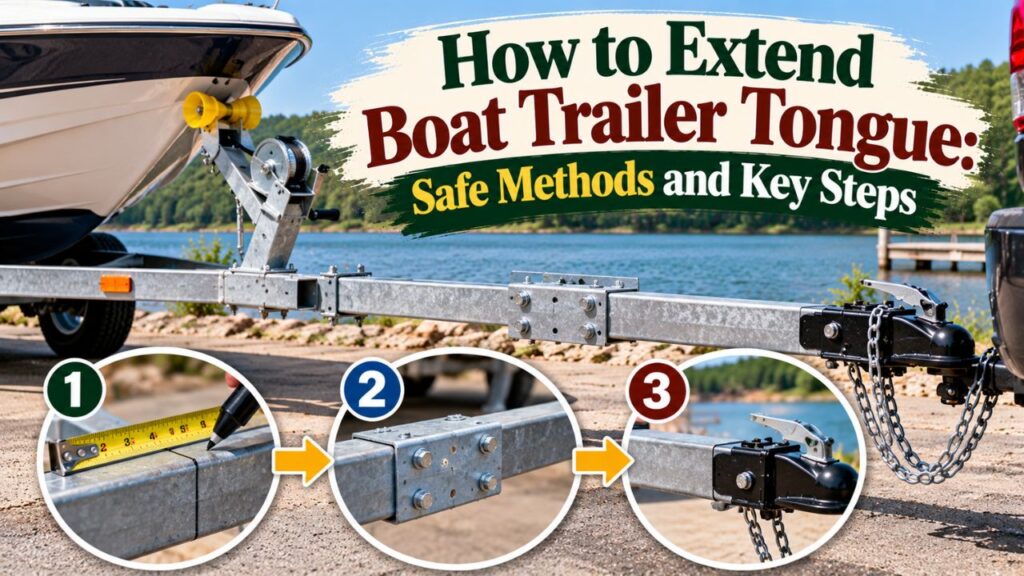
There are three main ways to increase the distance between the boat trailer and the tow vehicle.
The appropriate method depends on the trailer’s original construction and how the additional length will be used.
1. Install a Permanent Longer Trailer Tongue
A permanent extension replaces or modifies the existing tongue so the hitch coupler sits farther forward.
This approach is useful when the trailer needs additional length during ordinary highway towing.
It may help provide more clearance between the boat and tow vehicle during turning, particularly when the boat extends forward of the trailer frame.
However, extending a tongue changes the structural loading and leverage acting on the trailer.
A properly designed modification may require:
- A longer, appropriately sized structural steel tongue
- Reinforcement at the frame connection
- Suitable mounting hardware or professionally designed welds
- A correctly rated hitch coupler
- Repositioned safety chains
- Additional electrical wiring
- Brake-system modifications when applicable
- Corrosion protection for exposed metal
The correct material dimensions and connection design must be determined for the actual trailer.
A longer piece of square tubing should not simply be welded onto the end of an existing tongue without evaluating its structural capacity.
For a road-going trailer, obtain approval from the manufacturer or a qualified trailer fabrication professional before modifying the load-bearing structure.
2. Install a Telescoping Trailer Tongue Extension
A telescoping tongue uses one structural tube that slides within another.
This allows the tongue to extend when additional length is needed and retract when it is no longer required.
It is particularly useful for boat trailers that need to reach farther down a launch ramp.
A properly designed system includes:
- An inner sliding tongue member
- A compatible outer structural receiver
- Engineered overlap between the members
- Rated locking pins or another approved locking mechanism
- Suitable structural supports and connections
- Provisions for wiring and brake components
- A positive method of securing the tongue in its intended positions
The extension must remain adequately supported when fully extended.
As more material slides out, the forces acting on the remaining supported section change. Excessive extension can increase bending and connection stresses.
Important: A telescoping tongue rated for ramp use is not automatically approved for highway towing while extended. Follow the specific system’s loading and operating limits.
3. Use a Removable Boat Trailer Tongue Extension
A removable extension is an additional structural member that attaches to a suitable receiver or mounting assembly on the trailer.
The extension provides a second hitch connection farther forward.
This design can be useful for launching boats at shallow ramps while keeping the tow vehicle farther from the water.
Many removable systems are intended only for controlled, low-speed movement at launch facilities.
The original coupler and normal towing configuration are restored before highway travel.
This method may require less permanent modification than replacing the entire tongue, but the receiver, extension bar, mounting points, and coupler must all be rated for the expected forces.
A removable extension should never be treated as safe simply because its tubing appears thick or its hitch pin fits.
Boat Trailer Tongue Extension Methods Compared
Choosing the right approach before buying materials can prevent unnecessary fabrication work.
| Extension method | Main purpose | Highway towing | Installation complexity |
| Longer fixed tongue | Permanent additional clearance | Only when engineered and approved | Moderate to high |
| Telescoping tongue | Adjustable length for launching | Depends on the approved configuration | High |
| Removable extension | Additional reach at boat ramps | Generally launch-only unless specifically rated | Moderate to high |
| Manufacturer-specific replacement kit | Compatible trailer modification | According to kit specifications | Varies |
| Tow vehicle hitch extender | Moves the hitch point rearward | Only within the extender’s rated limits | Usually straightforward |
| Fold-away tongue hinge | Reduces storage length when folded | Towed only in the properly locked operating position | Moderate |
Can You Use a Fold-Away Tongue Hinge to Make a Trailer Longer?
A fold-away hinge is primarily designed to make a trailer shorter for storage.
It allows a section near the coupler to fold sideways when the trailer is parked.
The hinge itself does not add usable length.
Some properly engineered trailer modifications may combine a longer tongue section with a compatible hinge system, but hinge ratings depend on the geometry and length of the section ahead of the pivot.
A fold-away hinge must never be operated in its folded position during towing.
Is a Hitch Extender the Same as a Trailer Tongue Extension?
No. A hitch extender attaches to the tow vehicle’s receiver, while a tongue extension modifies or adds length to the trailer side of the connection.
A receiver hitch extender moves the hitch ball farther behind the tow vehicle.
This increases leverage on the vehicle’s receiver and can reduce its permitted towing or tongue-weight capacity.
According to CURT’s official hitch extender guide, extender length and the resulting leverage must be considered when determining allowable towing loads.
A hitch extender is not automatically an acceptable substitute for a properly designed boat trailer tongue extension.
Always check the specific extender’s ratings and the tow vehicle manufacturer’s instructions.
How Long Should a Boat Trailer Tongue Extension Be?
The appropriate extension length depends on the problem you are trying to solve.
For launching, the goal is to move the trailer far enough into the water without placing the tow vehicle on a submerged or unstable section of the ramp.
For highway towing, the goal may be to provide adequate clearance between the boat and vehicle while maintaining the trailer’s required structural strength and weight distribution.
There is no universal extension length suitable for every boat trailer.
Measure the Existing Trailer Tongue
Before choosing an extension, measure the current trailer.
Record the following:
- Distance from the hitch ball center to the trailer’s main front frame connection.
- Existing tongue tube width and height.
- Tongue wall thickness, where it can be accurately determined.
- Position of the bow stop and winch post.
- Distance from the boat’s bow to the tow vehicle.
- Distance between the trailer’s axle group and hitch ball.
- Location of the tongue jack, brake actuator, and safety-chain mounts.
These measurements help identify the available mounting space and possible interference points.
Also record the trailer’s GVWR, actual loaded weight, and existing tongue weight.
Calculate the Extra Reach Needed at a Boat Ramp
For launching, determine how much farther the trailer must move down the ramp while the tow vehicle remains in a safe position.
A simple measurement at the launch site is often more useful than selecting an arbitrary extension length.
Consider the ramp’s slope, water depth, trailer height, and the distance between the boat’s hull and the water.
For example, assume a ramp has an approximately 10% grade.
That means the surface changes about 1 foot vertically over 10 feet horizontally.
If the boat needs an additional 6 inches of water depth:
6 inches = 0.5 feet
Estimated additional horizontal travel:
0.5 ÷ 0.10 = 5 feet
A 5-foot increase in trailer position would theoretically provide approximately 6 inches of additional depth on a uniform 10% slope.
This is only a geometry example. Actual ramps may change slope, have underwater drop-offs, or contain uneven surfaces.
The extension must still be structurally approved for the required length and load.
Account for Turning Clearance
A longer tongue changes the distance between the trailer and the tow vehicle.
It can provide more physical clearance for a boat that projects forward toward the vehicle.
However, it also changes how the trailer follows the tow vehicle during turns and reversing.
Before approving a permanent extension, check:
- Clearance during sharp turns
- Trailer movement when reversing
- Boat bow and vehicle contact points
- Hitch and frame articulation
- Ground clearance on uneven roads
- Legal overall length requirements
A longer tongue should solve the original clearance problem without creating new handling or structural problems.
Materials Needed to Extend a Boat Trailer Tongue
The exact materials depend on the selected extension system.
A manufacturer-approved kit should include or specify most of the required structural components.
For a professionally designed custom extension, the component list may include the following.
| Component | Purpose |
| Structural steel tubing | Forms the longer tongue or sliding extension |
| Receiver or sleeve assembly | Supports the extension connection |
| Rated locking pins | Secures removable or telescoping sections |
| Reinforcement components | Supports the connection where required |
| Compatible hitch coupler | Connects the trailer to the tow vehicle |
| Rated structural fasteners | Secures approved bolted connections |
| Safety chains and anchors | Provides secondary trailer retention |
| Electrical harness extension | Maintains trailer lighting |
| Approved flexible brake components | Accommodates movement where necessary |
| Corrosion protection | Protects exposed steel from rust |
Choosing the Correct Steel Tubing
Trailer tongues commonly use structural steel tubing with square or rectangular cross sections.
However, outside dimensions alone do not establish load capacity.
The design must consider:
- Steel grade
- Wall thickness
- Unsupported length
- Vertical and lateral bending
- Torsional loading
- Connection strength
- Tongue weight
- Trailer weight
- Dynamic forces from braking and road movement
For example, two tubes with identical outside dimensions may have substantially different strengths if their wall thicknesses or material grades differ.
Do not assume that a commonly available 2×2-inch or 3×3-inch steel tube is suitable for a particular boat trailer.
Have the required section and connection details specified for the actual load.
Selecting Hitch Pins and Fasteners
A telescoping or removable extension requires a locking system capable of supporting the forces involved.
Ordinary unmarked pins or general-purpose bolts should not be substituted for engineered connection hardware.
The correct pin diameter, material, number of pins, hole locations, and retention method depend on the design.
Avoid drilling additional holes into the existing trailer tongue unless the manufacturer or qualified designer has approved their locations.
Holes can weaken highly stressed sections of tubing.
Protecting Steel Against Corrosion
Boat trailers are exposed to moisture and sometimes saltwater.
Newly cut, drilled, or welded steel can lose its original protective coating.
After fabrication, exposed surfaces need a suitable corrosion-protection treatment.
For galvanized trailer structures, the repair method must be compatible with the original coating and operating environment.
Welding galvanized steel also creates hazardous fumes and requires appropriate professional controls.
Do not perform structural welding without the necessary training, equipment, and approved procedure.
How to Install a Boat Trailer Tongue Extension Step by Step
The following process explains the general workflow for installing a properly engineered extension system.
It does not replace model-specific instructions or provide universal welding, tubing, fastener, or torque specifications.
Step 1: Identify the Trailer’s Tongue Construction
Inspect the trailer’s front structure.
Boat trailers commonly use either a straight tongue or an A-frame arrangement.
A straight tongue has a central structural member extending toward the coupler.
An A-frame has angled members that converge near the hitch connection.
Some trailers combine these designs.
Identify how the tongue connects to the main chassis and whether that connection is bolted, welded, or integrated into the frame.
Also inspect for rust, cracking, deformation, and previous repairs.
A damaged tongue should be repaired or replaced according to an approved design before installing an extension.
Step 2: Confirm the Extension System Is Compatible
Contact the trailer manufacturer or an experienced trailer fabrication specialist.
Provide the trailer model, GVWR, loaded weight, tongue measurements, and intended extension length.
Ask whether an approved replacement tongue, telescoping assembly, or removable extension is available.
For example, Yakima’s official RackandRoll tongue extension kit adds 3 feet to compatible RackandRoll trailers for carrying longer boats such as kayaks.
This illustrates how a manufacturer can provide a trailer-specific extension with defined compatibility.
However, the Yakima kit is not a universal extension for heavier conventional powerboat trailers.
Choose an extension designed and rated for your specific trailer rather than copying the dimensions of a product intended for another trailer.
Step 3: Secure the Trailer Before Working
Park the trailer on firm, level ground.
Chock the wheels securely.
Make sure the boat is properly positioned and secured.
Before removing any tongue components, provide the necessary support for the trailer’s front end.
A suitable trailer stand or lifting equipment must be rated for the load and used according to its instructions.
Do not rely on an unstable jack, loose blocks, or an unsupported tongue.
If the work requires cutting or replacing a structural member, the trailer should be supported according to a professional repair plan.
Step 4: Prepare the Approved Mounting Connection
The connection method depends on the extension design.
For a manufacturer-approved bolt-on assembly, use the specified mounting locations, hardware, and installation sequence.
For a custom permanent tongue, a qualified fabricator must determine the reinforcement, mounting, and joining requirements.
For a telescoping system, the sliding members must fit correctly and retain sufficient structural engagement throughout the approved travel range.
The extension should not bind, twist, or move excessively within its supports.
Do not remove original frame bracing or alter the location of structural crossmembers without approval.
Step 5: Install the Tongue Extension
Install the approved components according to the applicable instructions.
For a telescoping design, the process generally involves positioning the sliding tongue within its support assembly and engaging the specified locking mechanism.
For a removable launch extension, the extension is secured to its approved receiver or mounting structure.
For a fixed extension, the permanent structural assembly is completed according to the approved fabrication design.
The completed connection must resist the expected vertical, horizontal, and twisting forces.
Do not assume that inserting a steel tube into another tube creates a safe towing connection without a properly engineered locking and support system.
Step 6: Check the Coupler and Safety Chains
The extended assembly needs a compatible, appropriately rated coupler.
Verify the hitch ball size and the coupler’s gross trailer weight rating.
Safety chains must also be properly rated and attached to approved structural points.
An extension may require longer chains or a revised attachment arrangement.
The chains need enough length for normal turning but should not drag on the ground.
When required by the trailer configuration, cross the chains beneath the tongue to help support the coupler if the primary connection separates.
Do not simply attach longer chains using unrated hooks or hardware.
Step 7: Modify the Wiring and Brake Connections
Check the trailer’s electrical harness.
An extended tongue may require additional wire length so the trailer lights remain connected through the entire operating range.
Secure the harness to prevent:
- Pinching between sliding members
- Chafing against sharp metal edges
- Contact with moving suspension parts
- Excessive tension during turning
- Loose wiring dragging on the ground
If the trailer has surge brakes or another trailer braking system, extending the tongue becomes more complicated.
Hydraulic brake lines may require an appropriately designed flexible section, different routing, or another approved modification.
Do not stretch, kink, or disconnect hydraulic lines without proper brake-system service procedures.
Brake actuators and breakaway devices must continue operating correctly.
Brake-system modifications should be performed and tested by a qualified trailer technician.
Step 8: Check the Completed Assembly
After installation, inspect every connection.
Verify that:
- Structural hardware is installed and secured correctly.
- Locking pins are fully engaged.
- Coupler and safety chains are properly attached.
- Wiring is protected.
- Brake components operate correctly.
- The extension does not interfere with the tongue jack.
- The boat remains properly supported.
- The trailer sits at the intended towing height.
- The tongue has no abnormal movement or visible deformation.
A professionally modified trailer should also be inspected under the applicable load conditions.
Do not begin road towing or boat launching until the system has been verified for its intended use.
Step 9: Measure the New Tongue Weight
Changing tongue length or adding structural components may change the vertical force at the hitch.
Measure the actual tongue weight with the boat and trailer fully loaded.
The measured value must fall within the range required by the trailer manufacturer and remain within the tow vehicle’s limits.
Do not assume the tongue-weight percentage remains unchanged after modification.
Step 10: Test the Trailer Under Controlled Conditions
Perform the initial functional checks in a safe, open area.
Start with a stationary inspection.
Check lighting, coupler engagement, steering clearance, and brake operation.
If the extension is approved for road towing, conduct a controlled low-speed test after the appropriate professional inspection.
Watch for unusual movement, noise, or changes in handling.
A ramp-only extension should be tested only within its approved operating conditions, not on public roads.
How to Use an Extended Boat Trailer Tongue at a Boat Ramp
A tongue extension can reduce the need to back the tow vehicle into the water.
However, launch ramps introduce additional hazards, including steep grades, slippery surfaces, and submerged drop-offs.
The operating procedure depends on whether the trailer has a built-in telescoping tongue or a removable launch extension.
Prepare the Trailer Before Reaching the Ramp
Stop in a designated preparation area away from active ramp traffic.
Inspect the extension and check the required locking components.
Confirm that the boat is secured and ready for launching.
If the design requires changing tongue length, perform the change on firm, level ground according to the manufacturer’s procedure.
Do not disconnect the trailer or remove locking pins while the assembly is unsupported or positioned on a slope.
Extend and Secure the Tongue
For an approved telescoping design, move the sliding section only as directed by the manufacturer.
Some systems allow controlled extension while remaining connected to the tow vehicle.
Others require a different procedure.
Never assume the tow vehicle can safely pull the inner tongue outward unless that method is specifically permitted.
After extension, verify all locking pins, retainers, and safety devices.
For removable systems, confirm that the original and extended coupler arrangements are secured as designed.
Back the Trailer Into the Water Slowly
Once the extension is fully secured, approach the ramp at low speed.
Keep the tow vehicle on firm, stable ground.
Maintain a clear view of the trailer and use a spotter when necessary.
Avoid sudden steering movements.
Do not continue backing if the trailer wheels approach an underwater drop-off or the tow vehicle loses traction.
The goal is to place the boat in sufficient water while keeping the vehicle away from hazardous ramp conditions.
Retrieve the Boat and Restore the Towing Configuration
After loading the boat, move the trailer to a safe, level staging area.
Secure the boat to the trailer before handling the extension.
Retract or remove the extension according to its instructions.
Confirm that the normal highway towing configuration is fully restored.
Before leaving, inspect the coupler, safety chains, breakaway device, wiring, brakes, and boat tie-downs.
Never leave a ramp-only extension in use for ordinary road travel.
Does Extending a Boat Trailer Tongue Change Tongue Weight?
Yes, extending the tongue can change the measured tongue weight.
The actual effect depends on the trailer’s geometry, the added extension weight, and the locations of the boat and axles.
How Tongue Length Affects Weight Distribution
The tongue supports part of the boat-and-trailer combination through the hitch ball.
When the hitch connection moves farther from the axles, the leverage relationship changes.
For the same original trailer load and axle position, moving the hitch point forward generally reduces the vertical hitch reaction before accounting for the additional extension’s own weight.
However, adding a heavy structural extension also changes the total weight and center of gravity.
For that reason, calculating the final tongue weight from length alone may be inaccurate.
The correct approach is to measure it after the modification.
Why Incorrect Tongue Weight Is Dangerous
Too little tongue weight can contribute to trailer sway and fishtailing.
Excessive tongue weight can overload the tow vehicle’s hitch or rear axle and negatively affect steering and braking.
Boat trailer manufacturers specify different tongue-weight requirements.
Some designs use relatively low percentages, while others require higher values.
Follow the specific trailer and tow vehicle requirements rather than applying a universal percentage.
Should You Move the Boat After Extending the Tongue?
Not automatically.
Changing the boat’s position may affect tongue weight, but it can also compromise hull support.
The transom, bunks, rollers, bow stop, and winch post must remain correctly positioned.
If the modified trailer has incorrect tongue weight, have the complete setup evaluated before adjusting boat or axle position.
Can You Extend a Boat Trailer Tongue With Welding?
Yes, a steel trailer tongue can sometimes be lengthened through a professionally designed and welded modification.
However, welding is not automatically the best approach.
The tongue is subjected to repeated loads from acceleration, braking, road bumps, and turning.
An incorrectly designed welded joint can become a stress concentration and may eventually crack.
Why Welding a Longer Tube Requires Structural Planning
Simply welding an extension onto the existing tongue does not guarantee adequate strength.
The repair or modification must account for:
- Original tongue material
- Added length
- Load direction
- Bending stresses
- Weld joint design
- Reinforcement requirements
- Existing frame connections
- Corrosion protection
These requirements vary with the trailer’s construction.
For example, a straight tongue connected to a central crossmember may need a different reinforcement strategy than an A-frame trailer.
A qualified fabricator should determine the proper joint design and welding procedure.
Is Bolting Better Than Welding?
Neither method is universally better.
A properly engineered bolted connection can be strong and serviceable.
A properly engineered welded connection can also provide suitable structural performance.
The correct method depends on the trailer’s design and the approved extension system.
An improvised bolted sleeve is not automatically safer than an improvised welded joint.
For a DIY installation, a manufacturer-approved bolt-on kit is generally preferable to designing an untested structural connection.
How Much Does It Cost to Extend a Boat Trailer Tongue?
The cost depends on the method, trailer size, materials, and required professional work.
A simple compatible replacement assembly may be less expensive than a completely custom telescoping system.
However, extensive fabrication or brake-system modifications can increase the project cost.
| Extension method | Main cost factors |
| Manufacturer-specific tongue kit | Kit, shipping, and installation |
| Removable launch extension | Receiver, structural member, coupler, and fabrication |
| Telescoping extension | Sliding members, supports, locking system, and brake modifications |
| Permanent longer tongue | Structural materials, welding or mounting, and reinforcement |
| Receiver hitch extender | Rated product and potentially reduced towing capacity |
Why Custom Extensions Cost More
A custom design may require more than simply purchasing additional tubing.
Costs can include engineering assessment, structural fabrication, corrosion protection, electrical work, and brake-system changes.
Testing and inspection may also be necessary before the modified trailer can be used safely.
For a larger boat trailer, these expenses can make a manufacturer-approved replacement or a properly designed different trailer more economical.
Can You Build a Cheap DIY Extension?
It may be possible to reduce labor costs by installing a manufacturer-approved bolt-on kit yourself, provided the instructions permit DIY installation and you have the required equipment.
However, fabricating a load-bearing extension from miscellaneous steel and hardware solely to reduce cost can create unacceptable risks.
A cheaper extension that damages the trailer or fails during towing is not a worthwhile saving.
When comparing options, consider the entire installed cost and the approved load capacity.
Common Boat Trailer Tongue Extension Mistakes
Several mistakes can affect structural strength, braking, and towing stability.
Using Undersized Steel Tubing
The outside dimensions of a steel tube do not indicate whether it is strong enough for the trailer.
Wall thickness, steel grade, unsupported length, and connection design all matter.
Use specified structural components rather than choosing tubing by appearance.
Extending the Tongue Too Far
Increasing length without considering structural loading can place excessive stress on the connection.
A telescoping extension also needs adequate overlap between its sliding members.
Never extend farther than the system’s approved limit.
Using Unrated Hitch Pins
Ordinary pins and hardware may not be designed for trailer loads.
Use the locking components specified for the extension system.
Do not enlarge pin holes or substitute different hardware without authorization.
Forgetting Brake Lines
Trailer brakes can become damaged or inoperative if hydraulic lines are stretched, kinked, or incorrectly modified.
Surge brake actuators require particular attention because they are commonly integrated into the tongue and coupler assembly.
Verify brake compatibility before beginning structural work.
Ignoring Safety-Chain Length
A longer tongue changes the distance between the trailer’s chain anchors and the tow vehicle.
Chains that are too short may prevent turning.
Chains that are excessively long may drag or fail to provide the intended secondary support.
Use appropriately rated chains and approved anchor points.
Assuming a Launch Extension Is Safe on the Highway
Some removable extensions are intended only for slow movement at boat ramps.
They may not have the structural capacity or fatigue resistance required for road travel.
Use the extension only within its approved operating conditions.
Failing to Recheck Tongue Weight
A modification that changes hitch geometry can affect trailer balance.
Measure the loaded tongue weight after completing an approved extension.
The trailer must remain within its specified tongue-weight range and all applicable ratings.
When Should You Avoid Extending a Boat Trailer Tongue?
Not every trailer is a suitable candidate for modification.
A different trailer or another launch location may be the safer solution.
Avoid an extension project without further professional evaluation when:
- The tongue has extensive corrosion or cracking.
- The original frame has been repaired improperly.
- The trailer’s manufacturer prohibits structural modification.
- The extension would overload the hitch or frame.
- The brake system cannot be modified safely.
- The required length exceeds an approved extension’s capacity.
- The trailer is already poorly balanced.
- The additional length would violate applicable road restrictions.
- The intended modification cannot be properly inspected or verified.
A replacement trailer with the required tongue length may be more practical than rebuilding a deteriorated or unsuitable frame.
How to Maintain an Extended Boat Trailer Tongue
A tongue extension adds connections and components that require regular inspection.
Marine environments can accelerate corrosion, especially where saltwater enters tubing or locking mechanisms.
Inspect the Structural Connections
Before each use, check for:
- Loose mounting hardware
- Damaged or missing locking pins
- Elongated pin holes
- Cracked welds
- Bent structural members
- Rust around joints
- Excessive movement between sliding sections
A telescoping mechanism should move as intended without binding or uncontrolled looseness.
Do not continue using the extension if structural damage is suspected.
Rinse and Protect Metal Components
After exposure to saltwater, rinse accessible metal components with fresh water.
Allow water to drain from the assembly.
Inspect protective coatings and repair damaged areas using products appropriate for the trailer’s material.
Avoid applying lubricants that attract abrasive sand or interfere with specified friction or locking components.
Use only lubricants approved by the extension manufacturer.
Check Wiring and Brakes
Inspect electrical wiring for chafing, corrosion, and loose connections.
Test trailer lighting before road travel.
Check brake lines for leaks, damage, or restricted movement.
If the extension uses a sliding section, make sure no wiring or hoses become trapped while it retracts.
Recheck the Extension After Launching
Water and ramp debris can affect locking mechanisms.
After retrieving the boat, inspect the connection and restore the approved towing configuration.
Check that every locking pin and retainer is fully engaged.
A final walkaround before leaving the launch site can catch problems before the trailer reaches the road.
Conclusion
Understanding how to extend boat trailer tongue safely begins with identifying whether additional length is needed for boat launching or ordinary highway towing.
A manufacturer-approved longer tongue is often the most suitable option for a permanent change. A properly designed telescoping or removable extension can provide additional reach at shallow launch ramps without permanently increasing the trailer’s normal towing length.
However, all methods must account for structural strength, hitch ratings, tongue weight, braking components, electrical wiring, and safety chains.
For a compatible trailer with an approved bolt-on extension, installation may be manageable with appropriate tools and careful adherence to the instructions.
For custom welding, structural modifications, or trailers with complex braking systems, professional fabrication and inspection are the better choice.
The safest extension is one that provides the needed clearance without compromising the trailer’s original stability or load-carrying capacity.
FAQs About How to Extend Boat Trailer Tongue
Can You Extend a Boat Trailer Tongue Without Welding?
Yes. Some trailers can use manufacturer-approved bolt-on extensions or removable tongue assemblies without welding.
However, the components must be designed and rated for the trailer. Simply bolting an extra piece of tubing onto the existing tongue is not automatically safe.
How Far Can You Extend a Boat Trailer Tongue?
There is no universal maximum extension length.
The allowable distance depends on the trailer’s frame design, loaded weight, tubing dimensions, connection strength, and intended operating conditions.
Use the extension length approved by the manufacturer or qualified designer.
Can You Tow a Boat Trailer With the Tongue Fully Extended?
Only if the extension system is specifically approved for towing in that position.
Many launch-only extensions must be retracted or removed before highway travel.
A system suitable for low-speed ramp movement may not be strong enough for normal road loads.
Does Extending a Boat Trailer Tongue Reduce Tongue Weight?
It can. Moving the coupler farther forward changes the leverage between the axles and hitch connection.
However, the added weight of the extension and any other modifications also affect the final result.
Always measure tongue weight after modifying the trailer.
Can You Use a Hitch Extender Instead of Extending the Trailer Tongue?
Sometimes, but only when the tow vehicle, receiver, extender, and trailer combination are specifically rated for the intended towing load.
Hitch extenders increase leverage on the vehicle’s receiver and may reduce allowable towing capacity.
For substantial additional launch reach, a properly designed trailer-side extension is often more appropriate.
Can You Extend a Boat Trailer Tongue With Surge Brakes?
Yes, some approved extension designs can accommodate hydraulic surge brakes.
However, the brake actuator and hydraulic lines must continue functioning through the intended range of tongue movement.
Specialized flexible hydraulic components or another approved arrangement may be necessary.
Have a qualified technician evaluate and test the brake system.
Is a Telescoping Boat Trailer Tongue Safe?
A properly engineered, rated, installed, and maintained telescoping tongue can be safe within its approved operating conditions.
The design must provide sufficient structural engagement, reliable locking, appropriate load capacity, and compatible brake and electrical connections.
An improvised telescoping extension without verified structural capacity should not be used for towing or launching.
Will Extending a Boat Trailer Tongue Make Reversing Easier?
A longer tongue generally makes a trailer respond more gradually to steering input while reversing.
This can give the driver more time to make corrections.
However, it also changes the turning path and requires additional space for maneuvering.
The benefit depends on the trailer’s geometry and the available area.
Is It Better to Extend the Trailer Tongue or Buy a Longer Trailer?
Extending the tongue may be reasonable when the existing trailer is structurally sound and a compatible approved modification is available.
A replacement trailer may be preferable when the existing frame is damaged, the required extension is unusually long, or the modification would require extensive structural and braking work.
Compare the total cost, safety, and suitability of both options before proceeding.