For many light- and medium-duty utility trailer designs, 2×3-inch rectangular steel tubing or 3×3-inch square steel tubing with a 1/8-inch to 3/16-inch nominal wall thickness are common sizes to evaluate. However, neither size has a universal trailer weight rating. The correct tubing must be selected based on the trailer’s loaded weight, tongue length, structural layout, material grade, and connection strength.
A trailer tongue carries more than the downward weight of the hitch. It also experiences bending, twisting, braking forces, and repeated impacts from uneven roads. Tubing that appears strong enough while the trailer is parked may not withstand those forces during towing.
The difference between 2×2, 2×3, and 3×3 tubing can be substantial, particularly when wall thickness and unsupported length change. A straight tongue also carries loads differently from an A-frame design.
In this article, I cover common trailer tongue tubing dimensions, steel thicknesses, square versus rectangular tubing, and the factors that determine structural strength. I also explain how trailer weight, tongue length, bracing, welding, and coupler compatibility affect tubing selection, along with important mistakes to avoid when building or replacing a tongue.
What Size Tubing for Trailer Tongue: Common Steel Dimensions
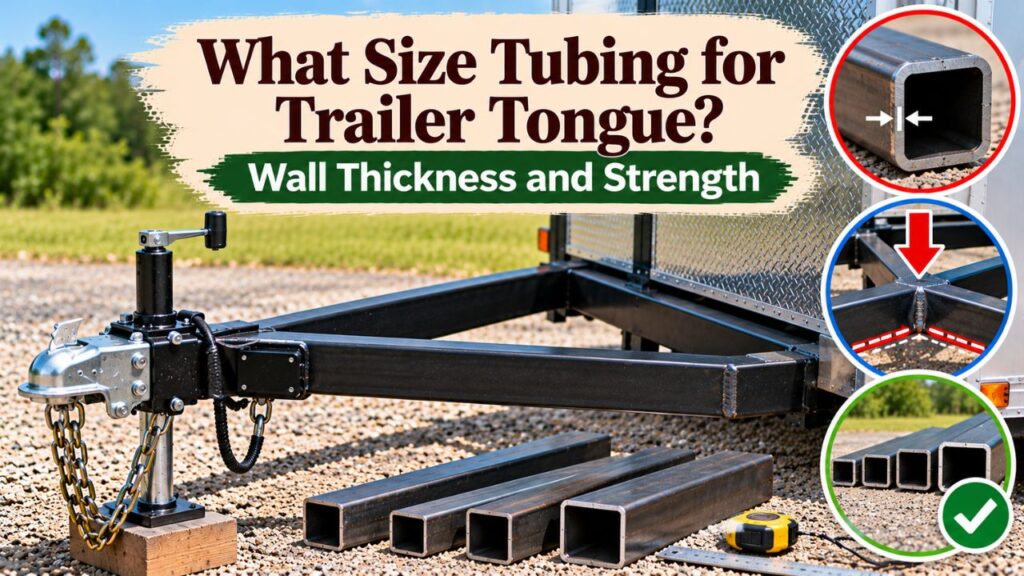
Square and rectangular structural steel tubing are commonly considered for trailer tongue construction.
The correct choice depends on more than the trailer’s advertised gross vehicle weight rating (GVWR). Two trailers with identical GVWRs may require different tongue structures because of their length, geometry, and loading conditions.
The following table compares tubing sizes that may be considered during trailer design.
| Tubing Size | Wall Thickness | Design Considerations |
| 2×2 inches | 1/8 inch | Compact section requiring careful load and length evaluation |
| 2×3 inches | 1/8 inch | Rectangular profile with greater depth in one direction |
| 2×3 inches | 3/16 inch | Thicker rectangular section for designs needing additional strength |
| 3×3 inches | 3/16 inch | Square profile with equal outside dimensions |
| 2×4 inches | 3/16 inch | Deeper rectangular profile for higher bending stiffness |
| 3×3 inches | 1/4 inch | Heavy-wall square section requiring appropriate frame connections |
These are examples of structural tubing dimensions, not approved tubing specifications for particular trailer capacities. A professional structural evaluation is necessary before assigning a safe loaded trailer weight to any of them.
Is 2×2 Tubing Strong Enough for a Trailer Tongue?
Two-inch square tubing may be suitable for certain very lightweight trailer designs when its strength and connection details have been verified.
However, 2×2 tubing has relatively limited bending stiffness compared with larger structural sections of similar wall thickness.
Its suitability depends on:
- Maximum loaded trailer weight.
- Expected tongue weight.
- Unsupported tongue length.
- Steel grade.
- Wall thickness.
- Frame attachment method.
- Additional structural bracing.
A short, adequately reinforced tongue on a compact trailer places different demands on the material than a long, unsupported tongue on a heavier trailer.
Don’t assume 2×2 tubing is adequate for a 3,500-pound trailer solely because the steel has a 1/8-inch or thicker wall.
Is 2×3 Tubing Good for a Trailer Tongue?
Two-by-three-inch rectangular tubing is a practical structural profile to evaluate for utility trailer construction.
Its rectangular shape provides greater depth in one direction.
When the 3-inch dimension is oriented vertically, the tube generally resists vertical bending more effectively than the same section installed with its 2-inch dimension vertical.
However, the tubing’s final suitability also depends on its wall thickness, steel properties, length, and support.
A 2×3 tube with a 1/8-inch wall and one with a 3/16-inch wall have different structural capacities.
They shouldn’t be treated as interchangeable.
Is 3×3 Square Tubing Strong Enough for a Trailer Tongue?
Three-inch square tubing is another commonly considered option for utility trailer tongues.
It provides equal external dimensions in the vertical and horizontal directions.
A 3×3 section generally offers greater bending stiffness than a smaller 2×2 section of comparable material and wall thickness.
However, increasing the tube size also increases material weight and may affect coupler compatibility.
A 3×3 tube with a 3/16-inch wall isn’t automatically suitable for a specific trailer GVWR without proper structural checks.
When Is 2×4 Rectangular Tubing Appropriate?
Two-by-four-inch rectangular tubing may be considered when a design requires greater vertical section depth.
With its 4-inch dimension installed vertically, it can provide substantial bending stiffness relative to a shallower section of comparable material and wall thickness.
However, the larger tube must still be supported by appropriate frame connections.
A stronger tongue section doesn’t compensate for weak welds or inadequate chassis support.
Square vs. Rectangular Tubing for a Trailer Tongue
Square and rectangular tubing have different structural properties.
The better choice depends on the loads the tongue must resist and the way it connects to the trailer chassis.
Square Steel Tubing
Square tubing has equal outside height and width.
Examples include:
- 2×2 inches.
- 2.5×2.5 inches.
- 3×3 inches.
- 4×4 inches.
Its symmetrical shape provides the same bending properties about either principal axis.
This may simplify some fabrication arrangements.
However, its suitability still depends on the actual wall thickness and structural design.
Rectangular Steel Tubing
Rectangular tubing has different outside height and width.
Common examples include:
- 2×3 inches.
- 2×4 inches.
- 3×4 inches.
Rectangular tubing can be efficient when the designer needs greater bending resistance in one direction.
For conventional vertical loading, positioning the deeper side vertically is often advantageous.
For example, 2×3 tubing installed with the 3-inch dimension vertical generally provides more vertical bending stiffness than the same tube installed with the 2-inch dimension vertical.
However, vertical bending isn’t the only load a trailer tongue experiences.
Side loading, twisting, braking, and the tongue’s frame connections must also be considered.
Which Tubing Shape Is Better?
Neither shape is universally better.
| Feature | Square Tubing | Rectangular Tubing |
| Cross-section | Equal height and width | Different height and width |
| Vertical bending resistance | Depends on section size | Can favor vertical bending when installed deep-side vertical |
| Lateral bending resistance | Symmetrical section properties | Depends on orientation |
| Fabrication | Convenient for certain straight-tongue designs | Common in straight and A-frame designs |
| Structural efficiency | Depends on loading | Can favor a dominant bending direction |
| Coupler fit | Must match coupler | Must match coupler |
The best tubing shape is the one that meets the calculated loads and fits the complete tongue and frame design.
What Wall Thickness Should Trailer Tongue Tubing Have?
Wall thickness is one of the most important specifications when selecting trailer tongue tubing.
The outside dimensions describe the tube’s overall shape, while its wall thickness determines how much material is present in the section.
Thicker walls generally provide additional strength and resistance to local deformation, but they also increase weight and cost.
Common Trailer Tongue Tubing Wall Thicknesses
| Nominal Wall Thickness | Decimal Inches | Millimeters |
| 1/8 inch | 0.125 | 3.18 mm |
| 3/16 inch | 0.1875 | 4.76 mm |
| 1/4 inch | 0.250 | 6.35 mm |
Steel tubing is also sold using decimal thickness specifications, such as 0.120 or 0.188 inches.
These numbers are close to familiar fractional sizes but aren’t always identical.
Material specifications and manufacturing tolerances can affect the actual wall thickness.
Is 1/8-Inch Wall Tubing Enough?
A nominal 1/8-inch wall may be appropriate for certain engineered lightweight trailer tongues.
However, it isn’t a universal minimum specification for utility trailers.
A short, braced A-frame assembly and a long, unsupported straight tongue can place very different demands on the same material.
For a road-going trailer, the tubing must resist repeated dynamic loading in addition to static tongue weight.
Don’t select a 1/8-inch wall based only on an estimate of how much weight the trailer will carry.
Is 3/16-Inch Tubing Better for Trailer Tongues?
A 3/16-inch wall provides more steel than a 1/8-inch wall with the same outside dimensions.
This can improve strength and stiffness in a properly designed structure.
However, additional thickness doesn’t automatically correct poor geometry, excessive unsupported length, or weak connections.
For example, changing to a thicker tube while keeping an inadequate frame connection may simply transfer the highest stresses into the connection.
The entire assembly must be evaluated.
When Is 1/4-Inch Wall Tubing Necessary?
A 1/4-inch wall may be considered for applications requiring greater section strength, depending on the design.
However, using unnecessarily heavy tubing can increase trailer weight without solving the actual structural problem.
A properly designed A-frame using suitable sections may perform better than an oversized but poorly supported straight tongue.
The right thickness should come from a structural assessment rather than the assumption that heavier steel is always safer.
What Type of Steel Should You Use for Trailer Tongue Tubing?
The steel’s material specification matters as much as its dimensions.
A tube’s outside size and wall thickness don’t tell you its complete mechanical properties.
ASTM A500 Structural Steel Tubing
ASTM A500 is a specification for cold-formed carbon steel structural tubing, including square and rectangular hollow sections.
It is widely used in structural applications.
According to the Steel Tube Institute’s ASTM A500 technical guidance, ASTM A500 Grade C structural tubing has a specified minimum yield strength of 50,000 psi.
The institute also explains that nominal wall thickness and manufacturing tolerances must be considered during structural calculations.
This means a tube’s catalog dimensions alone shouldn’t be treated as its exact structural capacity.
A steel grade’s yield strength also doesn’t establish a trailer’s safe towing capacity.
The completed assembly must still be designed for its loads and connections.
Structural Tubing vs. Mechanical Tubing
Steel suppliers may offer structural hollow sections and mechanical tubing with similar outside dimensions.
However, these products can have different specifications and manufacturing requirements.
Don’t assume that any square tube sold by a hardware store has verified structural properties.
Ask the supplier for:
- Steel specification.
- Material grade.
- Nominal outside dimensions.
- Nominal wall thickness.
- Available certification or material documentation.
For a custom trailer tongue, selecting material with known properties makes reliable engineering calculations possible.
Can You Use Galvanized Steel Tubing?
Galvanized steel has a protective zinc coating that helps resist corrosion.
It can be useful in trailer applications, particularly where moisture exposure is common.
However, welding galvanized steel presents additional hazards because heating the coating produces potentially harmful fumes.
A qualified fabricator must follow appropriate coating-removal, ventilation, welding, and corrosion-protection procedures.
The coating doesn’t determine whether the underlying tubing is structurally adequate.
Straight Tongue vs. A-Frame Tongue Tubing
The tongue design strongly affects how loads move through the trailer chassis.
Two tongues made from the same tubing may have different capacities because of their geometry and attachments.
Tubing for a Straight Trailer Tongue
A straight tongue generally uses a central structural member extending forward from the trailer frame.
This design is used on some small utility trailers, boat trailers, and specialized equipment trailers.
A central tongue must resist the forces transmitted through the hitch.
The region where the tongue joins the trailer frame can experience significant bending and fatigue stresses.
According to TrailerSauce’s technical guide to trailer tongue design, straight tongues experience substantial vertical loading near the chassis connection. The guide also discusses extending the tongue into the chassis and using suitable bracing to strengthen the connection.
For a straight-tongue design, the critical considerations include:
- Tubing dimensions and grade.
- Unsupported forward length.
- Connection to the main chassis.
- Vertical and lateral stiffness.
- Reinforcement and bracing.
- Fatigue resistance.
A tube that appears sufficiently strong in isolation may still be unsuitable if its connection to the frame is weak.
Tubing for an A-Frame Trailer Tongue
An A-frame tongue uses two structural members that converge toward the hitch coupler.
The members extend rearward and connect to the trailer’s main frame.
This arrangement can transfer loads into both sides of the chassis.
A-frame tongues are common on utility trailers, cargo trailers, and travel trailers.
The final tubing size depends on the angle of the members, their length, cross-sectional properties, and connections.
An A-frame design can provide useful structural advantages, but it still requires proper engineering and fabrication.
Which Design Is Better for a Heavy Trailer?
A suitably engineered A-frame is frequently a practical choice for trailers carrying larger loads because it distributes forces through multiple structural members.
However, some heavy trailers use specialized straight or reinforced tongue arrangements.
There is no reliable rule that a particular A-frame made from 2×3 tubing can carry a specified weight without evaluating the structure.
The complete design determines capacity.
How Trailer Weight Affects Tubing Size
Trailer GVWR is an important starting point, but it isn’t enough to select tubing safely.
The tongue must resist several kinds of forces generated during towing.
Gross Vehicle Weight Rating
Gross vehicle weight rating (GVWR) is the maximum permitted loaded weight established for the trailer.
It includes the trailer’s own weight and its cargo.
For example, a trailer rated for 3,500 pounds may carry different amounts of cargo depending on how much the empty trailer weighs.
The tongue structure should be designed for the trailer’s rated operating conditions, not merely the lightest expected load.
Trailer Tongue Weight
Tongue weight is the downward force transferred from the trailer coupler to the tow vehicle’s hitch.
For many conventional ball-hitch trailers, a typical target is approximately 10%–15% of the actual loaded trailer weight, subject to manufacturer guidance.
For example:
| Loaded Trailer Weight | 10% Tongue Weight | 15% Tongue Weight |
| 1,000 lbs | 100 lbs | 150 lbs |
| 2,000 lbs | 200 lbs | 300 lbs |
| 3,000 lbs | 300 lbs | 450 lbs |
| 3,500 lbs | 350 lbs | 525 lbs |
| 5,000 lbs | 500 lbs | 750 lbs |
| 7,000 lbs | 700 lbs | 1,050 lbs |
These figures describe possible loaded tongue forces, not tubing ratings.
A trailer tongue must be evaluated for more than the static downward force.
Dynamic Loading During Towing
When a trailer travels over bumps, dips, or uneven pavement, the forces acting on its tongue change.
Braking and acceleration also produce longitudinal loads.
Turning and uneven road surfaces can introduce lateral and twisting forces.
Repeated loading can contribute to metal fatigue.
A safe design needs to account for these operating conditions rather than using static tongue weight as the only design load.
How Trailer Tongue Length Changes Tubing Requirements
Longer tongues generally place greater bending demands on the structure when other conditions remain comparable.
This is particularly important for straight tongues with relatively long unsupported sections.
Why Longer Tongues Need More Attention
A simplified cantilever calculation illustrates the effect of length:
Bending moment = Applied force × Distance
For example, consider a hypothetical 300-pound vertical force acting 4 feet from a fixed support.
300 × 4 = 1,200 pound-feet of bending moment.
If the distance increases to 5 feet:
300 × 5 = 1,500 pound-feet.
In this simplified example, increasing the length by 25% increases the bending moment by 25%.
However, a real trailer tongue isn’t necessarily a simple cantilever. An A-frame distributes loads differently, and the real structure experiences dynamic and multidirectional forces.
These calculations illustrate leverage only. They are not sufficient to size or certify a trailer tongue.
Do Longer Trailer Tongues Need Bracing?
Longer tongues may require additional bracing, larger structural members, or a redesigned connection.
The correct solution depends on:
- Tongue length.
- Frame geometry.
- Tubing section properties.
- Loaded trailer weight.
- Expected road conditions.
- Coupler arrangement.
- Existing structural supports.
Adding thicker tubing is not always the most efficient solution.
A properly designed brace may improve stiffness by creating a stronger load path.
However, poorly placed braces can introduce high stresses at their attachment points.
Does a 5-Foot Trailer Tongue Need Larger Tubing?
Possibly.
A 5-foot tongue on a lightweight, appropriately braced trailer may have different requirements from a 5-foot tongue on a heavily loaded utility trailer.
The length alone doesn’t establish the required tubing size.
Evaluate the entire structure and the loads it must carry.
How to Choose Tubing for a 3,500-Pound Utility Trailer
A 3,500-pound GVWR utility trailer is a useful example because this rating is common among single-axle trailers.
However, a single tubing size cannot be approved based only on the 3,500-pound rating.
Calculate the Expected Loading
If the loaded trailer weighs 3,500 pounds and follows a 10%–15% tongue weight guideline, the static downward tongue load might fall between 350 and 525 pounds.
This does not include all the forces the tongue experiences during driving.
The actual load and required distribution depend on the trailer design.
Determine the Tongue Arrangement
Identify whether the trailer will use:
- A straight central tongue.
- An A-frame tongue.
- A composite or reinforced tongue.
- A tilting or folding tongue.
Each design has different structural demands.
For example, an A-frame with two members extending into the chassis must be assessed as an assembly.
It shouldn’t be compared directly with a single tube using only wall thickness.
Evaluate Candidate Steel Sections
For a conventional steel utility trailer, a designer might compare options such as:
- 2×3-inch rectangular structural tubing.
- 3×3-inch square structural tubing.
- Other sections selected from engineering calculations.
The comparison must consider material grade, wall thickness, bending strength, stiffness, fatigue, connection details, and weight.
Choosing 3/16-inch wall tubing instead of 1/8-inch wall tubing increases material thickness, but that alone doesn’t establish adequate capacity.
Verify the Completed Design
Before fabrication, a qualified trailer designer or engineer should verify that the tongue and its connections meet the intended rated loads.
The completed trailer must also use compatible rated components.
Don’t assign a 3,500-pound capacity to a homemade trailer simply because it uses an axle or coupler labeled for 3,500 pounds.
What Size Tubing Works for Boat Trailer Tongues?
Boat trailers often require a different tongue arrangement from general-purpose utility trailers.
Many use long central or reinforced tongues to provide clearance for the boat’s bow and winch assembly.
The tongue may also be exposed to water and corrosive conditions.
Straight Tubing on Boat Trailers
Some boat trailers use rectangular structural tubing as the central tongue member.
The appropriate dimensions depend on:
- Loaded boat and trailer weight.
- Length of the tongue.
- Location of the winch stand.
- Frame reinforcement.
- Axle arrangement.
- Launching conditions.
- Required coupler capacity.
The winch stand can apply additional forces to the structure during loading and transport.
Those forces must be considered in the design.
Telescoping Boat Trailer Tongues
Some boat trailers use sliding or telescoping tongue sections to provide additional length during launching.
The inner and outer tubes must fit correctly while maintaining adequate structural strength.
The locking system must also withstand the applicable forces.
A telescoping tongue requires more than choosing two tubes that slide together.
Its safe operation depends on overlap, connections, locking hardware, and manufacturer-approved operating positions.
Don’t assume that a boat trailer’s extended launching position is rated for normal highway travel.
Corrosion Protection for Boat Trailer Tongues
Saltwater and repeated water exposure can accelerate corrosion.
Corrosion inside hollow steel tubing may reduce wall thickness without being visible from the outside.
Inspect drainage openings, welds, connections, and areas where water can become trapped.
Follow appropriate corrosion-protection practices for the steel and coating system.
Trailer Tongue Tubing and Hitch Coupler Compatibility
A structurally suitable tube still needs to work with the selected hitch coupler.
Couplers are manufactured for specific tongue shapes, mounting arrangements, and weight ratings.
Straight Tongue Couplers
Straight tongue couplers may be designed for particular channel widths.
For example, some are intended to fit a 2-inch-wide trailer tongue, while others are designed for larger mounting sections.
Always check the actual mounting dimensions.
A coupler designed for a 2-inch tongue shouldn’t be assumed compatible with a 3-inch-wide tube.
Adapters or modifications need to be specifically approved or engineered.
A-Frame Couplers
A-frame couplers are designed to connect with a particular tongue geometry.
Their mounting angle, attachment area, and structural requirements depend on the coupler model.
Choose the coupler and frame arrangement together.
Don’t force a coupler to fit a different A-frame angle without approved modifications.
Match Every Component’s Capacity
Check the ratings of:
- Trailer tongue structure.
- Coupler.
- Hitch ball.
- Ball mount.
- Receiver hitch.
- Safety chain assemblies.
- Other required towing components.
The trailer’s usable capacity cannot exceed the lowest applicable rating.
A heavy-duty coupler doesn’t increase the structural strength of undersized tubing.
Welding and Reinforcing Trailer Tongue Tubing
The strength of the tube-to-frame connection can be as important as the tubing itself.
Trailer tongues experience repeated forces, which makes fatigue resistance a major consideration.
Welding at the Frame Connection
Welding should be performed according to the applicable material and connection requirements.
A structurally reliable weld depends on more than its visible size.
Relevant factors include:
- Steel grade and condition.
- Joint geometry.
- Weld process.
- Filler metal compatibility.
- Required weld size.
- Heat input.
- Connection design.
- Inspection and quality control.
An oversized weld doesn’t necessarily strengthen a poorly designed joint.
Improper welding can introduce defects, distortion, or stress concentrations.
For road-going trailer tongue construction, qualified fabrication and appropriate inspection are strongly recommended.
Using Gussets and Braces
Gussets can help reinforce connections and distribute forces.
However, their placement matters.
A reinforcement plate installed incorrectly may create an abrupt stiffness change, concentrating stress near its end.
The same concern applies to sleeves and additional welded tubing.
Bracing should follow an engineered load path rather than being added wherever space is available.
Avoid Unapproved Drilling and Cutting
Drilling large holes through structural tubing reduces its net cross-sectional area and can create local stress concentrations.
This is particularly concerning near high-stress frame connections.
Avoid cutting openings for wiring, access, or bolts without checking the structural consequences.
Use the attachment and routing details approved for the design.
How to Check Existing Trailer Tongue Tubing Before Replacing It
If you’re repairing an older trailer, determine the condition of the current structure before selecting replacement tubing.
A damaged tongue may indicate a larger issue involving loading, frame geometry, or fatigue.
Measure the Existing Tubing
Record:
- Outside width.
- Outside height.
- Wall thickness where it can be measured accurately.
- Tongue length.
- Connection and bracing configuration.
- Coupler dimensions.
A caliper can help measure accessible dimensions.
However, rust, coatings, and manufacturing tolerances can affect measurements.
Don’t assume the existing tube is the correct size merely because it was previously installed.
Inspect for Cracks and Deformation
Check the tongue for:
- Visible cracks.
- Bent or twisted sections.
- Deformed corners.
- Rust perforation.
- Loose connections.
- Damaged welds.
- Movement near frame attachments.
Pay particular attention to the front crossmember and other areas where structural members connect.
Cracks near welds can indicate fatigue or excessive stress.
A trailer with a cracked or visibly deformed tongue should not be towed until it has been properly evaluated and repaired.
Check for Internal Corrosion
Hollow steel tubing can corrode internally when moisture enters and remains trapped.
The exterior may appear serviceable even when internal wall thickness has been reduced.
If internal deterioration is suspected, arrange a proper inspection.
Simply welding reinforcement over heavily corroded tubing may conceal damage without restoring adequate strength.
Common Trailer Tongue Tubing Mistakes to Avoid
Choosing Tubing Based Only on Outside Dimensions
Two tubes with identical outside dimensions can have different wall thicknesses and material grades.
For example, 2×3-inch tubing with a 1/8-inch wall is not structurally equivalent to the same outside dimensions with a 3/16-inch wall.
Compare complete material specifications.
Assuming Thicker Tubing Always Solves the Problem
Thicker steel may improve certain strength characteristics, but it doesn’t eliminate poorly designed connections or excessive unsupported length.
A complete structural assessment is necessary.
Using Unknown or Nonstructural Tubing
Tubing with an unknown grade or no reliable material documentation makes strength verification difficult.
Avoid substituting electrical conduit, thin decorative tubing, or unidentified scrap metal for specified structural members.
Ignoring Dynamic Loads
A tongue that supports the trailer while stationary may still fail under repeated road impacts.
Design calculations need to account for the intended towing conditions.
Selecting a Coupler Before Checking Fit
A coupler must fit the tongue design and meet the required load rating.
Don’t assume all 2-inch-ball couplers fit the same tongue size.
The ball diameter and tongue mounting dimensions are separate specifications.
Extending Tubing Without Evaluating the Frame
Adding length increases structural demands and may change the trailer’s geometry.
A simple butt-welded extension without proper engineering should not be assumed safe.
Copying Another Trailer’s Steel Dimensions
Two trailers can look similar while having different frame layouts, axle positions, steel grades, and load capacities.
Copying a tube size without understanding the original design may lead to an unsuitable result.
How to Select the Correct Tubing Before Building or Repairing a Tongue
A reliable selection process begins with the trailer’s intended use and rated loads.
Use the following checklist before purchasing structural steel.
- Identify the trailer GVWR. Determine the maximum rated loaded weight that the tongue assembly must support.
- Determine the tongue weight requirements. Consider the trailer manufacturer’s specified range and the fully loaded configuration.
- Measure the proposed tongue length. Include the unsupported distance and necessary clearance from the towing vehicle.
- Choose the structural configuration. Decide whether the application requires a straight, A-frame, or specialized tongue design.
- Select steel with verified material properties. Check the specification, grade, dimensions, and nominal wall thickness.
- Evaluate bending, lateral, torsional, and fatigue loads. Have the tube sections and connections checked for the intended operating conditions.
- Verify coupler and hitch compatibility. Confirm mounting dimensions and all component ratings.
- Plan corrosion protection. Consider the environment, especially if the trailer will be exposed to saltwater or repeated wet conditions.
- Use qualified fabrication. Ensure welding and other structural connections meet the design requirements.
- Inspect and verify the completed assembly. Check dimensions, connections, component ratings, and loading before road use.
For an existing manufactured trailer, the safest starting point is the original manufacturer’s tongue specification.
For a custom trailer, structural calculations and professional review should establish the tubing dimensions rather than choosing a section by appearance or an informal load estimate.
Conclusion
Determining what size tubing for trailer tongue construction requires considering the complete trailer rather than choosing steel by outside dimensions alone.
Common tubing profiles include 2×3-inch rectangular steel and 3×3-inch square steel, with nominal wall thicknesses such as 1/8 inch and 3/16 inch appearing in various trailer designs. Larger or thicker sections may be needed depending on the application.
However, no tubing dimension has a universal safe trailer weight capacity.
Tongue length, GVWR, steel grade, straight versus A-frame construction, weld quality, bracing, and coupler compatibility all influence the finished structure.
For a replacement tongue, follow the trailer manufacturer’s specification where available. For a new design, use verified structural material and have the complete tongue assembly evaluated for the intended loading conditions.
The safest choice is a properly engineered tongue that meets the trailer’s requirements without unnecessary material weight or unsupported assumptions.
FAQs About What Size Tubing for Trailer Tongue
Can I Use 2×2 Square Tubing for a Utility Trailer Tongue?
Possibly, but only when a structural evaluation confirms that the tubing and its connections can safely support the intended loads.
Two-by-two-inch tubing may be considered for some compact lightweight trailer designs.
It should not be assumed suitable for a particular GVWR without verifying wall thickness, material grade, length, and bracing.
Is 2×3 Tubing Stronger Than 2×2 Tubing?
With the same steel grade and wall thickness, 2×3 tubing generally offers greater bending stiffness in at least one direction than 2×2 tubing.
The advantage depends on the orientation of the rectangular section.
However, the complete tongue’s strength also depends on its connections, unsupported length, and structural arrangement.
Is 1/8-Inch Wall Tubing Thick Enough for a Trailer Tongue?
A nominal 1/8-inch wall may be suitable for certain properly engineered lightweight trailer tongues.
However, it isn’t an automatically approved wall thickness for all utility trailers.
The correct specification must be determined from the expected structural loads and design.
Is 3/16-Inch Steel Tubing Better Than 1/8-Inch for a Trailer Tongue?
A 3/16-inch wall contains more steel than a 1/8-inch wall with the same outside dimensions.
This generally increases the section’s strength and stiffness.
However, the thicker tubing also weighs more and doesn’t compensate for inadequate structural connections or poor frame design.
Can I Use Round Tubing for a Trailer Tongue?
Round structural tubing can be used in certain engineered trailer structures.
However, square and rectangular tubing are often more convenient for attaching flat mounting plates, couplers, and frame connections.
Round tubing requires connection details suited to its shape and expected loads.
It shouldn’t be substituted for square tubing without a suitable design evaluation.
What Size Tubing Should I Use for a 3,500-Pound Trailer?
There is no single tubing size that is automatically suitable for every 3,500-pound trailer.
Sections such as 2×3-inch rectangular or 3×3-inch square tubing may be evaluated, but their suitability depends on wall thickness, material grade, tongue geometry, and structural connections.
Use the manufacturer’s specifications or a verified engineering design before selecting the final size.
Can I Weld a Larger Tube Over an Existing Trailer Tongue?
A reinforcement sleeve may be part of an engineered repair, but simply welding a larger tube over an existing tongue doesn’t guarantee a safe result.
The original tube may contain cracks, corrosion, or other damage.
Sleeve length, fit, weld placement, stiffness changes, and load transfer all require consideration.
Have a qualified trailer fabricator or engineer evaluate the repair before towing.