A 300 amp jump starter may be enough for a small gasoline engine, motorcycle, ATV, or a vehicle with a battery that is only moderately discharged, but 300 peak amps is relatively low for many modern cars. However, if “300 amps” refers to cranking amps or Start Assist Amps rather than peak amps, the unit may be considerably more capable.
That distinction is the most important part of deciding whether a 300 amp jump starter is enough. A product advertised as 300 peak amps is very different from a professional-quality unit rated at 300 Start Assist Amps (SAA) or similar sustained starting output.
First, Find Out What the 300-Amp Rating Actually Means
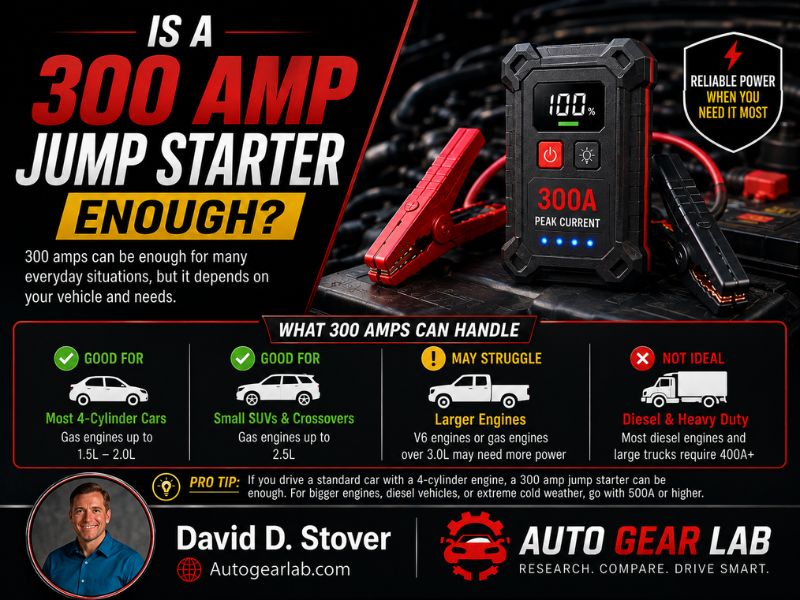
Do not judge the jump starter until you know what kind of amperage the manufacturer is quoting.
Portable boosters may use terms such as peak amps, cranking amps, cold cranking amps, or Start Assist Amps. These numbers are not interchangeable.
Peak amps describe a very short maximum-current output. Because peak-current claims are not standardized consistently across all jump starter manufacturers, the number alone can be difficult to use for direct product comparisons.
A good example shows why this matters. Clore Automotive’s JNC305 is described as a 1,000A peak / 300 Start Assist Amp lithium jump starter. Despite the 300 SAA figure, Clore rates that unit for most passenger vehicles with engines up to approximately 6.0L gasoline and 3.0L diesel.
So saying “300 amps is too weak” without knowing how those amps are measured can be misleading.
On the other hand, if a small older jump starter advertises only 300 peak amps, it is at the low end compared with current compact lithium boosters. For perspective, NOCO’s entry-level GB20 is rated at 500 peak amps and is intended for gasoline engines up to 4.0L.
Is 300 Peak Amps Enough for a Car?
Sometimes, but it does not provide much reserve.
A small gasoline car with a healthy starter and a battery that is only somewhat discharged may start successfully from a genuine 300 peak amp booster. Conditions have to be favorable, though.
If the vehicle has a larger engine, the battery is deeply discharged, temperatures are below freezing, or the starter motor draws unusually high current, a low-output booster may struggle.
This makes 300 peak amps more appropriate for lighter starting applications than as a universal emergency solution for modern passenger vehicles.
A driver with a compact four-cylinder car might get acceptable results. Someone with an SUV, V6, V8, or diesel vehicle should generally look for a jump starter whose manufacturer explicitly rates it for that engine.
300 Peak Amps vs. 300 Cranking Amps
This difference can completely change the answer.
A jump starter rated for 300 cranking or start-assist amps may be capable of delivering useful current for longer than a product whose only claim is 300 peak amps.
Consider these two hypothetical labels:
Jump Starter A: 300 Peak Amps
Jump Starter B: 1,000 Peak Amps / 300 Start Assist Amps
Those are not equivalent products.
Jump Starter B may be substantially stronger even though both contain the number “300” somewhere in their specifications.
Professional charger/engine-starter equipment provides another useful example. Schumacher sells 300A engine-start chargers designed for larger vehicles, including SUVs and trucks. These are large AC-powered machines rather than small battery-powered jump packs, demonstrating again that the type of 300A rating and device design matter enormously.
The lesson is simple: always read the specification beside the number.
Where a 300A Jump Starter Makes the Most Sense
A lower-output portable booster is easiest to justify for small-displacement gasoline engines and powersports equipment.
Here is a practical way to look at it:
| Application | 300 Peak Amps |
| Motorcycle | Often adequate if compatible |
| ATV/UTV | Often adequate depending on engine |
| Lawn equipment | Often adequate |
| Small gasoline car | May work under favorable conditions |
| Midsize sedan | Marginal without a verified engine rating |
| V6 SUV | Usually better to choose more reserve |
| V8 truck | Generally look for a stronger unit |
| Diesel engine | 300 peak amps is usually not an ideal target |
| Severe winter starting | Additional capacity is preferable |
This table assumes 300 peak amps. A unit rated at 300 meaningful cranking or Start Assist Amps may belong in an entirely different performance category.
Is 300 Amps Enough for a 4-Cylinder Engine?
It can be, but engine displacement is more useful than cylinder count alone.
A small 1.5L gasoline four-cylinder requires different starting power from a larger engine, particularly when temperature and battery condition are considered.
If you already own a 300 peak amp jump starter, it may successfully start a small gasoline engine when the battery is weak rather than completely discharged.
If you are buying a new jump starter, however, there is little reason to choose solely by a 300A label when modern compact units are available with substantially more starting reserve.
A model with a clearly published maximum engine-size rating gives you a much better basis for deciding whether it will work.
What About a V6 or V8?
A 300 peak amp jump starter becomes less attractive as engine demand increases.
A V6 may require significantly more current than a small four-cylinder vehicle, especially if the battery is deeply discharged.
Large gasoline V8 engines can be more demanding again.
Could a 300A product start one? Possibly, depending on what the 300A figure represents and how much help the vehicle’s battery is still providing.
Would a small 300 peak amp booster be the recommended emergency tool for a large V8? Usually not.
For larger engines, choose a unit with a manufacturer-stated gasoline engine displacement rating that comfortably covers the vehicle.
Is a 300 Amp Jump Starter Enough for Diesel?
If you mean 300 peak amps, it is generally not the rating you would target for a diesel vehicle.
Diesel engines typically create higher starting demands because of their higher compression ratios and other characteristics of cold starting.
Manufacturers therefore commonly publish lower maximum diesel displacement ratings than gasoline ratings for the same jump starter.
Even a current 500 peak amp NOCO GB20 is specified for gasoline engines up to 4.0L without a corresponding diesel rating, while higher-output products are offered for more demanding applications.
Again, however, 300 Start Assist Amps is different. Clore’s JNC305 combines 300 SAA with a 1,000A peak rating and is specified for diesel engines up to 3.0L.
Always determine what “300 amps” actually describes.
Battery Condition Can Decide Whether 300A Works
A jump starter rarely works alone.
When you connect it to a vehicle with a weak battery, the vehicle battery may still contribute some energy to the starter motor.
If the battery is only slightly discharged, a modest jump starter may provide enough additional current to get the engine running.
If the battery voltage is extremely low, the booster has to work much harder.
A battery with an internal short, damaged cell, severe deterioration, or poor terminal connection can create an even more difficult situation. In those cases, increasing connection time or making repeated attempts may not help.
This is one reason a 300A booster might start the same car successfully one day but struggle under more severe battery conditions later.
Cold Weather Makes 300 Amps Less Comfortable
Cold starting is one of the strongest arguments for choosing additional capacity.
At low temperatures, the vehicle battery produces less effective starting power while the engine generally becomes harder to crank.
The portable jump starter’s own internal battery may also produce less output when cold.
That combination reduces your safety margin.
If a 300 peak amp jump starter barely handles your engine under mild conditions, it may disappoint you on a freezing morning—the exact situation when you are most likely to need it.
For cold climates, choosing a booster that comfortably exceeds the engine requirement is preferable to operating at the edge of its capacity.
Does a 300A Booster Damage a Car Because It Has Too Many Amps?
For a small vehicle, 300 amps is not inherently “too much.”
The starter system draws the current it requires. A compatible jump starter does not simply force its entire advertised amp rating into the vehicle.
The critical compatibility factor is voltage.
For a normal 12V vehicle, use a compatible 12V jump starter and follow the manufacturer’s connection instructions.
Having additional available current is generally useful. Applying the wrong system voltage is the more serious compatibility problem.
What Matters More Than the Amp Number?
A reliable jump starter is a complete electrical system, not simply a battery with a large number printed on it.
The battery cells, BMS, cables, clamp contact, electrical resistance, temperature protection, and output electronics all affect performance.
A well-designed unit with meaningful published ratings may perform better than a cheap product advertising an impressive peak figure without explaining its test method.
Cable construction matters because high starting current has to reach the vehicle. Poor clamps or undersized connections create voltage drop and heat.
Safety electronics matter as well. Modern quality boosters may provide reverse-polarity, short-circuit, over-voltage, overheat, and over-crank protection. Clore lists these protections on its 300 Start Assist Amp JNC305, for example.
For emergency equipment, reliability and protection are more valuable than chasing one specification.
If You Already Have a 300A Jump Starter, Should You Replace It?
Not automatically.
If it reliably starts your small gasoline vehicle, holds its charge, and remains physically sound, there is no reason to discard it simply because newer products advertise larger numbers.
Instead, test it before relying on it.
Fully charge the unit, inspect the clamps and cables, and confirm that it can start the intended vehicle under safe conditions.
Pay attention if starting performance has declined.
Rechargeable batteries age, and an older 300A jump starter may have much less usable capacity than when new.
Replacement becomes more sensible if the unit can no longer reliably start your engine, quickly loses its stored charge, overheats, has damaged cables, or shows battery swelling or case deformation.
If You’re Buying New, Is 300A Worth Choosing?
This is different from deciding whether an existing 300A unit still works.
When shopping today, a 300 peak amp model provides relatively little future flexibility. A stronger compact jump starter can give you additional reserve for colder weather, a more deeply discharged battery, or a larger vehicle you may need to assist.
Current entry-level lithium examples already reach around 500 peak amps, with higher-output models widely used for ordinary passenger vehicles.
That does not mean everyone needs 2,000 or 3,000 amps.
It means that if 300A is merely a peak rating, there are stronger options that provide more comfortable emergency margin.
If the unit instead provides 300 cranking or Start Assist Amps backed by a meaningful engine-size specification, judge it by that verified performance.
Frequently Asked Questions
Is 300 Amps Enough to Jump-Start a Car?
It can be enough for a small gasoline car under favorable conditions, particularly if the vehicle battery still has some charge. A 300 peak amp booster provides limited reserve for larger engines, severe cold, or deeply discharged batteries.
Is 300 Amps Enough for a 4-Cylinder Car?
Possibly. Small four-cylinder gasoline engines are among the more realistic automotive applications for a modest booster, but verify the engine displacement and manufacturer rating rather than using cylinder count alone.
Can 300 Amps Start a V6?
A 300 peak amp jump starter may be marginal for many V6 applications. If 300A refers to a true cranking or Start Assist rating on a stronger unit, its capability may be substantially higher.
Can a 300 Amp Jump Starter Start a V8?
A small 300 peak amp booster is not the ideal choice for a large V8. Choose a jump starter specifically rated for the engine’s displacement.
Is 300 Amps Enough for a Diesel?
Usually not if you are talking about only 300 peak amps. Diesel engines generally benefit from considerably more starting reserve. However, a professionally specified 300 Start Assist Amp unit can be much stronger than a 300 peak amp product.
What Is the Difference Between Peak Amps and Cranking Amps?
Peak amps represent brief maximum output, while cranking-type ratings describe more useful sustained starting performance under defined or manufacturer-specific conditions. The figures should not be treated as equivalent.
Is 500 Amps Better Than 300 Amps?
If both ratings are measured comparably, 500A gives more potential starting reserve. A current 500A NOCO unit, for example, is rated for gasoline engines up to 4.0L.
Will a 300A Jump Starter Work on a Completely Dead Battery?
Possibly, but deeply discharged batteries demand more from a booster, and some smart jump starters will not activate automatically below their battery-detection threshold. A physically failed battery may not respond successfully to jump starting at all.
Can a 300 Amp Jump Starter Damage a Small Car?
Not simply because it is rated at 300A. Use a booster with the correct vehicle voltage and polarity, and follow the vehicle and jump starter manufacturer’s instructions.
How Do I Know If My 300A Jump Starter Is Powerful Enough?
Look for the manufacturer’s maximum gasoline and diesel engine-size ratings. If those specifications comfortably cover your vehicle, they are more useful than making a decision from the 300A number alone.
Is a 300 Amp Jump Starter Enough Overall?
A 300 amp jump starter can be enough, but the answer depends heavily on whether that number means peak amps or a more meaningful starting-current rating. A device offering only 300 peak amps is best suited to lighter applications and may provide limited reserve for modern passenger vehicles, larger engines, diesels, or cold-weather starts.
Do not dismiss every 300A rating as weak, though. A current professional-quality jump starter can combine 300 Start Assist Amps with a much higher peak rating and be specified for passenger vehicles with surprisingly large engines.
If you already own a 300A booster and it reliably starts your small gasoline vehicle, it may be perfectly adequate. If you are buying a new unit for general automotive emergency use, choose based on verified engine-size compatibility, battery voltage, gasoline or diesel requirements, cold-weather reserve, clamp quality, and safety protections rather than the 300A figure alone.
The key takeaway is simple: 300 peak amps is modest; 300 cranking or Start Assist Amps can represent a much stronger jump starter.