This Tire Size Comparison Calculator compares two tire sizes side by side to show their differences in overall diameter, section width, estimated ground clearance, and revolutions per mile. Enter your current tire size and a replacement tire size to calculate the percentage difference and see how changing tires may affect your speedometer reading.
Whether you’re replacing worn tires, upgrading to wider tires, changing wheel sizes, or researching alternative tire dimensions, comparing the complete tire measurements can help you understand the potential effects before purchasing. The calculator supports common metric tire sizes, including examples such as 205/55R16, 225/65R17, and 285/70R17.
The results include a scaled visual comparison and an estimated actual speed when the speedometer indicates 60 mph. These calculations use nominal tire dimensions rather than measurements from specific tire models, so they cannot guarantee vehicle fitment or speedometer accuracy.
Below the calculator, I explain how to enter tire sizes, interpret the comparison results, calculate diameter and width differences, understand speedometer and ride-height changes, and check important wheel compatibility, load-rating, and safety requirements.
AUTO GEAR LAB TOOLS FREE CALCULATOR
Tire Size Comparison Calculator
Compare two tire sizes side by side, including diameter and speedometer difference.
Enter your details
Your results
A matching outside diameter does not guarantee physical clearance, load rating or fitment.
How to Use My Tire Size Comparison Calculator
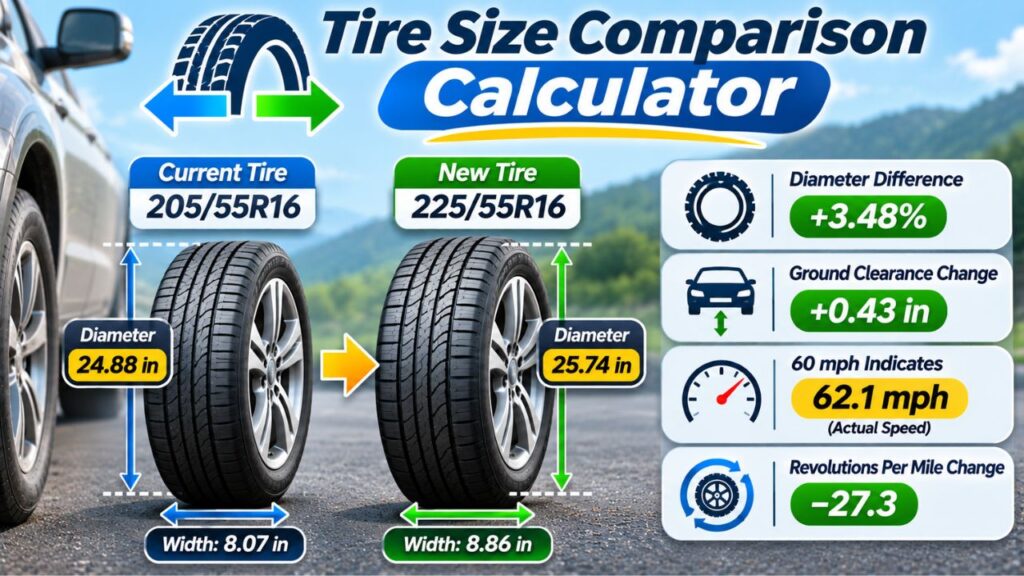
My Tire Size Comparison Calculator helps you compare your existing tire dimensions with those of a replacement tire.
You only need to enter two tire sizes. The calculator automatically calculates the differences and displays a visual comparison.
Step 1: Enter Your Current Tire Size
Find the Current Tire Size field.
Enter the size of the tire currently installed on your vehicle.
For example:
205/55R16
This is the calculator’s default current tire size.
The three main measurements are:
- 205: Nominal section width in millimeters
- 55: Sidewall aspect ratio expressed as a percentage
- 16: Wheel diameter in inches
The letter R identifies radial construction.
You can usually find the tire size printed on the tire sidewall.
If you’re researching a replacement for your vehicle’s original equipment tires, check the tire information placard, normally located around the driver’s door opening, or consult the owner’s manual.
The current installed tire size and the manufacturer’s recommended tire size are not always identical.
Step 2: Enter Your New Tire Size
Find the New Tire Size field.
Enter the replacement tire size you want to compare.
For example:
225/55R16
This is the calculator’s default new tire size.
Although both example tires use a 16-inch wheel diameter and 55% aspect ratio, their section widths are different.
The replacement tire is nominally 20 mm wider.
Because its sidewall height is calculated as a percentage of width, the replacement also has a greater overall diameter.
Step 3: Click Calculate
After entering both tire sizes, click Calculate.
The calculator automatically compares their nominal dimensions.
For the default example:
| Input | Tire Size |
|---|---|
| Current tire | 205/55R16 |
| New tire | 225/55R16 |
The calculator displays a visual comparison and the main results.
Step 4: Review the Overall Diameter Difference
The main result is Overall Diameter Difference.
For the example above, the result is:
+3.48%
This means the replacement tire’s theoretical outside diameter is approximately 3.48% larger than the original tire’s diameter.
A positive percentage indicates a larger diameter.
A negative percentage indicates a smaller diameter.
The calculation does not determine whether the replacement tire is appropriate for your vehicle.
Step 5: Review the Visual Tire Comparison
The calculator displays two tire illustrations beside each other.
One represents the current tire.
The other represents the replacement tire.
The tire graphics are scaled according to their calculated overall diameters.
This makes it easier to visualize the difference between the two sizes.
However, the illustration is a simplified side view. It does not accurately depict tire tread width, shoulder shape, fender clearance, or the appearance of a specific tire model.
Step 6: Compare the Tire Diameter and Width Results
The calculator displays the nominal outside diameter and section width of both tires.
For the default example:
| Measurement | Current Tire | New Tire |
|---|---|---|
| Tire size | 205/55R16 | 225/55R16 |
| Overall diameter | 24.88 inches | 25.74 inches |
| Section width | 8.07 inches | 8.86 inches |
The new tire is approximately:
- 0.87 inches taller in overall diameter
- 0.79 inches wider in nominal section width
These are dimensional differences, not measured vehicle clearances.
Step 7: Check the Ground-Clearance Change
The calculator estimates the change in axle height caused by the difference in tire radius.
For the default example:
Estimated Ground-Clearance Change: +0.43 inches
This means the larger tire theoretically raises the axle centerline by approximately 0.43 inches, assuming the tire’s effective radius changes by the calculated amount.
Actual vehicle clearance may differ because of tire deflection, loading, inflation pressure, and suspension conditions.
Step 8: Check the Revolutions Per Mile Difference
The calculator also estimates how the number of tire revolutions per mile changes.
For the default comparison:
Revolutions Per Mile Change: -27.3
This means the new tire is estimated to rotate approximately 27 fewer times per mile than the original tire using the calculator’s nominal circumference formula.
Larger tires generally require fewer revolutions to travel a given distance.
These are theoretical geometric values, not manufacturer-measured rolling revolutions.
Step 9: Understand the 60 MPH Speedometer Example
The calculator also displays an estimated actual speed when the dashboard indicates 60 mph.
For the default example:
Indicated Speed: 60 mph
Estimated Actual Speed: 62.1 mph
This occurs because the larger tire travels farther per revolution.
The estimate assumes the speedometer was accurate with the original tire size and that no recalibration has occurred.
Important: The comparison calculator does not have an adjustable speed input. Its 60 mph example is automatic. For a custom speed reading, use my separate Tire Size Speedometer Calculator.
How Does My Tire Size Comparison Calculator Work?
The calculator uses standard metric tire geometry formulas to estimate tire dimensions and compare them.
It calculates the sidewall height, overall diameter, nominal circumference, and theoretical revolutions per mile of each tire.
It then determines the percentage change, estimated axle-height difference, and speedometer effect.
Formula 1: Calculate Tire Sidewall Height
The aspect ratio expresses sidewall height as a percentage of the nominal section width.
Sidewall Height (mm) = Tire Width (mm) × Aspect Ratio ÷ 100
For a 205/55R16 tire:
Sidewall Height = 205 × 55 ÷ 100
Sidewall Height = 112.75 mm
For a 225/55R16 tire:
Sidewall Height = 225 × 55 ÷ 100
Sidewall Height = 123.75 mm
The replacement tire has a nominal sidewall approximately 11 mm taller.
Formula 2: Calculate Overall Tire Diameter
The overall diameter includes the wheel diameter and two sidewall heights.
Tire Diameter (inches) = Wheel Diameter + [2 × Sidewall Height (mm) ÷ 25.4]
The conversion factor is:
1 inch = 25.4 millimeters
For the current tire:
Diameter = 16 + (2 × 112.75 ÷ 25.4)
Current Diameter = 24.88 inches
For the new tire:
Diameter = 16 + (2 × 123.75 ÷ 25.4)
New Diameter = 25.74 inches
The actual calculations retain greater numerical precision than the rounded display values.
Formula 3: Calculate Diameter Difference
Diameter Difference (inches) = New Diameter − Current Diameter
Using unrounded measurements:
25.7441 − 24.8780 = 0.8661 inches
Diameter Difference ≈ +0.87 inches
The positive result means the replacement tire is larger.
Formula 4: Calculate Tire Diameter Percentage Difference
The percentage difference is calculated using:
Diameter Difference (%) = [(New Diameter ÷ Current Diameter) − 1] × 100
For the example:
Diameter Difference = [(25.7441 ÷ 24.8780) − 1] × 100
Diameter Difference = +3.48%
This is the main comparison percentage displayed by the calculator.
Formula 5: Calculate Tire Section Width Difference
Metric tire section width is already stated in millimeters.
Width Difference (mm) = New Width − Current Width
For 205/55R16 vs. 225/55R16:
225 − 205 = 20 mm
Convert the difference into inches:
20 ÷ 25.4 = 0.79 inches
Although the calculator displays both widths, it does not provide a separate width-difference card. You can subtract the displayed measurements to obtain the difference.
Formula 6: Calculate Tire Circumference
The theoretical circumference is:
Circumference (inches) = π × Overall Diameter (inches)
For 205/55R16:
Circumference ≈ 3.14159 × 24.8780
Current Circumference ≈ 78.16 inches
For 225/55R16:
Circumference ≈ 3.14159 × 25.7441
New Circumference ≈ 80.88 inches
These are ideal geometric circumferences.
They are not necessarily equal to the effective distance a real loaded tire travels during each revolution.
Formula 7: Calculate Revolutions Per Mile
There are 63,360 inches in one mile.
The theoretical formula is:
Revolutions Per Mile = 63,360 ÷ Tire Circumference (inches)
For the current tire:
63,360 ÷ 78.1564 ≈ 810.7
For the new tire:
63,360 ÷ 80.8775 ≈ 783.4
The difference is:
783.4 − 810.7 ≈ -27.3 revolutions per mile
The calculator displays the change rather than two separate revolutions-per-mile results.
Formula 8: Calculate Estimated Ground-Clearance Change
When tire diameter changes, the nominal radius changes by half the diameter difference.
Estimated Axle-Height Change = (New Diameter − Current Diameter) ÷ 2
For the example:
(25.7441 − 24.8780) ÷ 2 = 0.4331 inches
Estimated Change = +0.43 inches
This describes the theoretical difference in axle height, not the exact clearance underneath every component of the vehicle.
Formula 9: Calculate Estimated Actual Speed
The calculator estimates the speedometer effect using:
Estimated Actual Speed = Indicated Speed × (New Diameter ÷ Current Diameter)
For an indicated speed of 60 mph:
Actual Speed = 60 × (25.7441 ÷ 24.8780)
Estimated Actual Speed = 62.1 mph
The calculation assumes the original speedometer was accurate and that the tire-size calibration remains unchanged.
Tire Size Comparison Example: 205/55R16 vs. 225/55R16
This is the default comparison in my calculator.
Both tires use the same nominal wheel diameter, but the new tire has a greater section width and sidewall height.
| Measurement | 205/55R16 | 225/55R16 | Difference |
|---|---|---|---|
| Section width | 205 mm | 225 mm | +20 mm |
| Sidewall height | 4.44 in | 4.87 in | +0.43 in |
| Overall diameter | 24.88 in | 25.74 in | +0.87 in |
| Circumference | 78.16 in | 80.88 in | +2.72 in |
| Calculated revs/mile | 810.7 | 783.4 | -27.3 |
| Diameter percentage | — | — | +3.48% |
| Estimated axle-height change | — | — | +0.43 in |
What Does This Comparison Mean?
The replacement tire is wider and taller.
Because its nominal circumference is greater, it rotates fewer times over a mile.
If the vehicle retains its original speedometer calibration, actual speed may be higher than the indicated speed.
The tire also extends farther above and below the wheel centerline.
However, this comparison does not determine whether the tire will fit under the fender, clear the suspension, or work with the existing wheel width.
The complete wheel-and-tire setup must be checked before installation.
How to Read Tire Sizes Before Comparing Them
Understanding tire-size markings helps prevent incorrect comparisons.
Consider:
225/65R17 102H
This marking contains dimensional and performance-related information.
Tire Width: 225
The number 225 represents the nominal section width in millimeters.
It is not the exact width of the tread contacting the road.
Aspect Ratio: 65
The number 65 indicates that the nominal sidewall height is 65% of the section width.
For this tire:
225 × 0.65 = 146.25 mm
Tire Construction: R
The letter R indicates radial construction.
Radial construction is common on modern passenger-car and light-truck tires.
Wheel Diameter: 17
The number 17 represents the required nominal wheel diameter in inches.
The tire must be installed on a compatible 17-inch wheel.
Load Index: 102
The load index identifies a standardized tire load-capacity category.
It is not included in the calculator’s dimension formulas.
However, it is essential when evaluating replacement tires.
Speed Rating: H
The speed-rating symbol identifies the tire’s assigned speed capability under specified conditions.
The replacement tire must satisfy the vehicle manufacturer’s requirements.
My calculator evaluates the dimensional portion of the tire marking. It does not verify load index, speed rating, or other performance specifications.
Which Tire Size Formats Does My Calculator Support?
The current plugin is designed for common metric tire-size notation.
Examples include:
- 205/55R16
- 215/60R16
- 225/45R17
- 235/65R17
- 265/70R17
- 285/70R17
The parser also recognizes supported P-metric and LT-metric prefixes.
The supported dimensional ranges are:
| Measurement | Supported Range |
|---|---|
| Section width | 125–445 mm |
| Aspect ratio | 20–90% |
| Wheel diameter | 10–26 inches |
The calculator accepts supported R and ZR radial designations.
Can I Enter P-Metric Tire Sizes?
Yes.
For example:
P205/55R16
The calculator uses the nominal dimensional values.
It does not interpret the additional passenger-tire load requirements.
Can I Enter LT-Metric Tire Sizes?
Yes, in supported formats.
For example:
LT285/70R17
The calculator estimates its nominal geometry.
It does not calculate light-truck load ranges, maximum permitted load, or inflation requirements.
Can I Enter Load Index and Speed Rating?
Use the tire’s dimensional designation without the load index or speed-rating suffix.
For example, enter:
225/65R17
Instead of the full marking:
225/65R17 102H
Does It Support Flotation Tire Sizes?
Not directly.
Flotation-style sizes such as 33×12.50R17 use a different numbering system.
For those dimensions, use my separate Tire Size Conversion Calculator or manufacturer-provided measurements.
The comparison calculator is not a complete tire-size database.
Larger vs. Smaller Tire Size: What’s the Difference?
The most important difference for speedometer calculations is the change in rolling circumference.
However, diameter, width, wheel compatibility, and load capacity also matter.
Larger Tires
A larger nominal tire diameter generally means:
- Greater theoretical distance traveled per revolution
- Fewer geometric revolutions per mile
- Higher estimated actual speed at the same indicated speed
- Increased nominal axle height
- Potential changes in vehicle clearance and gearing
These are general effects.
Larger tires may also increase tire mass and rotational inertia, depending on the product.
That can influence acceleration, braking, and vehicle response.
Smaller Tires
A smaller nominal tire diameter generally means:
- Less theoretical distance traveled per revolution
- More geometric revolutions per mile
- Lower estimated actual speed at the same indicated speed
- Reduced nominal axle height
- Potential changes in gearing and vehicle clearance
A smaller tire is not automatically lighter or more efficient.
The tire’s construction, compound, tread pattern, and dimensions also affect performance.
Does a Wider Tire Always Have a Larger Diameter?
No.
Section width is only one part of the tire-size calculation.
A wider tire with a lower aspect ratio may have a similar or even smaller overall diameter.
For example, a 235/40R18 tire is wider than a 225/45R17 tire, but their nominal diameters are relatively close.
This is why comparing complete tire designations is more useful than comparing section width alone.
Tire Size Comparison Chart: Common Replacement Examples
The following examples show how changing tire dimensions affects nominal outside diameter.
| Current Tire | New Tire | Original Diameter | New Diameter | Diameter Difference |
|---|---|---|---|---|
| 205/55R16 | 225/55R16 | 24.88 in | 25.74 in | +3.48% |
| 225/45R17 | 235/40R18 | 24.97 in | 25.40 in | +1.72% |
| 265/70R17 | 285/70R17 | 31.61 in | 32.71 in | +3.49% |
These are geometric comparisons, not recommended fitment combinations.
Example: 225/45R17 vs. 235/40R18
The original tire has a nominal diameter of approximately 24.97 inches.
The replacement has a nominal diameter of approximately 25.40 inches.
The difference is about +1.72%.
At 60 mph indicated, the theoretical actual speed would be approximately 61.0 mph.
This example demonstrates how a larger wheel diameter and lower tire aspect ratio can produce a relatively modest change in overall tire diameter.
Example: 265/70R17 vs. 285/70R17
The original tire diameter is approximately 31.61 inches.
The replacement is approximately 32.71 inches.
The diameter increase is about +3.49%.
The replacement also has a nominal section width that is 20 mm greater.
This may affect inner and outer tire clearance, depending on the wheel width and offset.
A truck or SUV using this combination should be checked for compatibility with its suspension, fenders, steering geometry, and load requirements.
How Does Tire Size Affect Speedometer Accuracy?
A vehicle’s speedometer estimates road speed using signals associated with vehicle or wheel rotation.
Changing tire rolling circumference can alter the relationship between rotational speed and actual road speed.
Bigger Tires and Speedometer Error
A larger tire generally covers more distance per revolution.
If the original calibration remains unchanged, the speedometer may indicate less than the actual road speed.
For example, if the replacement tire has a 3% greater effective rolling circumference:
60 × 1.03 = 61.8 mph
The speedometer may show 60 mph when the vehicle is traveling approximately 61.8 mph.
Smaller Tires and Speedometer Error
A smaller tire generally covers less distance per revolution.
With unchanged calibration, actual speed may be lower than indicated speed.
For example, if the effective rolling circumference decreases by 2%:
60 × 0.98 = 58.8 mph
The speedometer may display 60 mph when actual speed is approximately 58.8 mph.
Is the Speedometer Difference Exact?
No.
My calculator estimates speed differences using theoretical tire diameters.
Actual rolling circumference depends on tire design, load, inflation pressure, tread condition, and other factors.
The result also assumes the speedometer was originally accurate.
For a more detailed calculation using custom indicated speeds, use my Tire Size Speedometer Calculator.
Does Changing Tire Size Affect Odometer Readings?
It can.
An odometer commonly uses rotational information and vehicle calibration to estimate distance traveled.
If the effective tire rolling circumference changes, the distance recorded may also change.
Larger Tires and Odometer Readings
When larger tires are installed without recalibration, the vehicle may travel farther than the odometer indicates.
For example, using the default tire diameter ratio:
100 indicated miles × 1.034816 ≈ 103.48 actual miles
This is a simplified theoretical estimate.
Smaller Tires and Odometer Readings
With smaller tires, the odometer may record more distance than the vehicle actually travels.
This can affect trip records and fuel economy calculations.
Does the Comparison Calculator Display Odometer Correction?
No.
The current calculator does not include a separate odometer correction result.
The formula above explains the possible relationship under an unchanged shared calibration.
Actual vehicle speedometer and odometer systems may not respond identically.
How Does Tire Size Affect Ground Clearance?
Changing overall tire diameter changes the nominal tire radius.
A larger tire can raise the axle centerline, while a smaller tire can lower it.
Example: Increasing Tire Diameter by 2 Inches
Suppose a replacement tire has an overall diameter exactly 2 inches larger than the original.
The theoretical radius increase is:
2 ÷ 2 = 1 inch
The axle centerline may sit approximately 1 inch higher.
This does not mean every component underneath the vehicle gains exactly 1 inch of clearance.
Ground Clearance vs. Vehicle Lift
A suspension lift and a tire-diameter increase are different modifications.
Larger tires can increase nominal axle height.
A suspension lift changes the vehicle’s suspension or body position relative to its wheels, depending on the design.
The effects on actual ground clearance differ.
Why Actual Clearance Can Be Different
The calculator does not account for:
- Loaded tire deflection
- Tire inflation pressure
- Vehicle weight
- Suspension compression
- Tire wear
- Manufacturer-specific rolling dimensions
The displayed ground-clearance change should be interpreted as an approximate geometric axle-height change.
How Does Tire Size Affect Revolutions Per Mile?
Revolutions per mile describe how many times a tire rotates over one mile of travel.
A larger circumference generally produces fewer revolutions per mile.
A smaller circumference generally produces more.
However, measured tire revolutions per mile are affected by more than unloaded tire diameter.
Tire Rack explains in its technical guide to tire specifications that real rolling measurements are influenced by tire deflection, construction, and contact with the road.
Calculated vs. Measured Revolutions Per Mile
The calculator uses:
63,360 ÷ nominal circumference
This is a mathematical approximation.
A manufacturer’s published revolutions-per-mile value may be based on testing or more detailed engineering calculations.
Therefore, the calculated value should not be treated as an exact rolling specification.
Why Revolutions Per Mile Matter
Changes in revolutions per mile can affect:
- Speedometer calibration
- Odometer calibration
- Effective gearing
- Engine speed at a given road speed
- Some drivetrain operating characteristics
The effect depends on the vehicle’s mechanical design and electronic control systems.
Tire Size Comparison for Plus Sizing
Plus sizing involves changing wheel and tire dimensions while attempting to retain suitable overall tire diameter and vehicle compatibility.
It is often associated with aftermarket wheel upgrades.
What Is Plus One Sizing?
Plus One typically means increasing the wheel diameter by one inch.
For example:
17-inch wheel → 18-inch wheel
The replacement tire generally uses a lower sidewall profile to keep overall diameter relatively close to the original.
What Is Plus Two Sizing?
Plus Two refers to increasing the wheel diameter by two inches.
For example:
17-inch wheel → 19-inch wheel
The tire’s width and aspect ratio must be selected carefully.
A larger wheel does not automatically mean a larger overall tire diameter.
What Is Plus Zero Sizing?
Plus Zero generally involves using a wider tire while retaining the same wheel diameter.
The new tire may have a lower aspect ratio to maintain a similar overall diameter.
Does Plus Sizing Improve Handling?
A properly selected and installed wheel-and-tire package may change steering response, sidewall behavior, and handling characteristics.
However, larger wheels or wider tires do not automatically improve every aspect of vehicle performance.
Wheel weight, tire compound, construction, suspension setup, and road conditions also matter.
Michelin’s guide to tire upgrades and plus sizing discusses Plus One, Plus Two, and Plus Zero approaches and explains why vehicle manufacturer restrictions should be checked.
My Tire Size Comparison Calculator helps compare dimensions, but it does not confirm whether a particular plus-size package is approved.
How Much Tire Diameter Difference Is Acceptable?
You may encounter a general recommendation to keep replacement tire diameter within approximately 3% of the original.
This can be useful as an initial comparison guideline.
However, the 3% guideline is not a universal safety standard or a guarantee of proper fitment.
Some vehicles require a much closer match.
Other vehicles may support manufacturer-approved alternative tire sizes.
Is a 3% Difference Always Safe?
No.
A replacement tire may be close in overall diameter but still be unsuitable because of:
- Excessive section width
- Insufficient load capacity
- Incorrect speed rating
- Incompatible wheel width
- Incorrect wheel diameter
- Inadequate fender clearance
- Interference with suspension components
- AWD drivetrain requirements
What If the Difference Is Greater Than 3%?
A larger difference warrants careful evaluation.
The replacement might affect speedometer calibration, effective gearing, and available vehicle clearance.
That does not automatically mean every such tire is unsuitable.
A qualified tire specialist should verify whether the size is approved or otherwise suitable for the vehicle.
Is Zero Diameter Difference Always Best?
An identical theoretical diameter can minimize one source of speedometer change.
However, the replacement tire must still meet all other dimensional, performance, and safety requirements.
A matching diameter alone is not enough.
Tire Size Comparison and Wheel Compatibility
Before buying a new tire size, verify that it can be installed on the intended wheel.
Wheel Diameter Must Match
The tire’s nominal rim diameter must match the wheel’s bead-seat diameter.
For example:
225/45R17 requires a compatible 17-inch wheel.
A tire intended for a 17-inch rim cannot be mounted on an 18-inch rim merely because its overall diameter is similar.
Approved Wheel Width
Every tire has an approved rim width range.
A replacement tire may be too wide or too narrow for your existing wheels.
Check the specific tire manufacturer’s specifications.
Wheel Offset
Wheel offset affects where the wheel sits relative to the hub.
Changing wheel width or offset can alter inner suspension clearance and outer fender position.
This calculator does not evaluate wheel offset.
For that purpose, use my separate Wheel Offset Calculator.
Tire Section Width vs. Actual Tire Clearance
The calculator derives nominal section width from the tire-size code.
Actual mounted width can vary depending on tire design and measuring rim width.
Two different tire models bearing the same size marking may not have identical physical dimensions.
Will Wider Tires Rub the Fender or Suspension?
Possibly, but width alone does not determine clearance.
Tire rubbing depends on the complete wheel-and-tire assembly and vehicle geometry.
Inner Suspension Clearance
A wider tire may move closer to:
- Struts
- Springs
- Control arms
- Steering components
- Inner wheel-well liners
The actual effect depends on wheel width, offset, tire profile, and suspension design.
Outer Fender Clearance
A wider or taller tire may approach the wheel arch or fender.
Interference may occur during steering, suspension compression, or heavy loading.
Tire Diameter and Wheel-Well Clearance
A taller tire can reduce the available clearance above the tread.
The difference may become more significant when the suspension compresses.
Why the Calculator Cannot Confirm Rubbing
The calculator does not know the vehicle’s:
- Fender dimensions
- Suspension geometry
- Steering clearance
- Brake package
- Wheel offset
- Existing inner and outer gaps
A physical fitment check or verified vehicle-specific tire fitment information is required.
Tire Size Changes and Vehicle Performance
Changing tire dimensions can affect more than appearance.
The magnitude and direction of the effects depend on the tire and vehicle combination.
Acceleration
Larger tires can change effective gearing.
A larger rolling circumference means the vehicle travels farther for each wheel revolution.
This can reduce wheel torque multiplication under otherwise similar conditions.
Actual acceleration also depends on tire weight, engine output, transmission behavior, and traction.
Braking
Tire construction, grip, diameter, and weight can influence braking behavior.
Installing tires outside the manufacturer’s requirements may affect braking performance.
Fuel Economy
Tire-size changes can affect fuel economy through rolling resistance, rotational mass, gearing, and aerodynamic characteristics.
A larger tire is not automatically less efficient in every application, but significant changes may alter fuel consumption.
Steering Response
Different tire widths, sidewall heights, and constructions can change steering feel.
Wider tires do not automatically deliver better steering performance under every condition.
Ride Comfort
A lower-profile tire generally has a shorter sidewall.
That can change the tire’s contribution to ride comfort and impact absorption.
Actual ride characteristics depend on the tire construction, inflation, suspension, and road surface.
Vehicle Safety Systems
Michelin notes that changes in tire and wheel dimensions can affect systems involving braking, traction control, stability control, and speedometer readings.
This is another reason to verify replacement sizes against manufacturer requirements.
Tire Size Comparison for AWD and 4WD Vehicles
All-wheel-drive and four-wheel-drive vehicles may have specific tire-matching requirements.
Some systems are sensitive to differences in rolling circumference between tires.
Why Matching Tire Sizes Matters
Different rolling circumferences cause tires to rotate at different rates over the same road distance.
Some AWD systems can interpret these differences in ways that place additional demands on drivetrain components.
Can You Install Different Tire Sizes on the Front and Rear?
Only when the vehicle manufacturer approves the specific configuration.
Some performance vehicles are designed with staggered tire sizes.
However, staggered setups should not be introduced to vehicles that require matching rolling circumferences without manufacturer approval.
Does Tire Tread Depth Matter?
Yes.
Two tires with identical size markings may have different effective rolling characteristics when one is substantially more worn.
Some AWD vehicles have strict requirements concerning tread-depth differences.
Check the owner’s manual and tire manufacturer recommendations before mixing new and worn tires.
Can You Replace Only Two Tires?
That depends on the vehicle, tire condition, and manufacturer requirements.
If replacing fewer than four tires, follow the applicable tire and vehicle guidance.
Do not assume that a matching nominal size is sufficient for every AWD application.
How to Verify Tire Size Before Purchasing Replacements
The calculator is useful for comparing dimensions, but a complete replacement decision requires several checks.
Check the Vehicle Tire Placard
The tire placard usually provides the recommended original tire size and cold inflation pressure.
It is commonly located near the driver’s door opening.
Read the Owner’s Manual
The owner’s manual may list approved tire sizes or specific requirements for different wheel packages.
Check Tire Manufacturer Specifications
Verify the exact tire model’s:
- Overall diameter
- Section width
- Approved rim width range
- Load index or load capacity
- Speed rating
- Inflation requirements
- Published revolutions per mile, if available
Confirm Clearance
Check that the new tire-and-wheel assembly has sufficient clearance around the suspension, brakes, steering components, and bodywork.
Evaluate Calibration
If the new tire has a meaningfully different rolling circumference, check whether speedometer or odometer recalibration is needed.
Use Manufacturer-Approved Sizes
The National Highway Traffic Safety Administration’s tire safety guidance recommends replacing tires with the original size or another size recommended by the vehicle manufacturer.
The agency also emphasizes appropriate tire maintenance, inflation, and replacement practices.
A mathematically similar tire size is not automatically a safe replacement.
Why Actual Tire Dimensions May Differ From Calculator Results
The calculator uses nominal size specifications.
The actual tire mounted on a wheel may differ from the theoretical dimensions.
Manufacturing Differences
Tire manufacturers use different tread patterns, casing constructions, and sidewall designs.
These differences can affect measured dimensions.
Measuring Rim Width
Tire section width is typically measured on a specified rim width.
Changing the mounting wheel width within an approved range can affect the tire’s measured section width.
Tire Inflation
Inflation pressure affects how the tire supports load and its contact with the road.
Use the vehicle manufacturer’s specified cold inflation pressures unless the applicable tire-and-vehicle service procedure requires an approved adjustment.
Vehicle Load
A tire deflects under load.
Its loaded rolling radius may differ from half its unloaded outside diameter.
Tread Wear
As tread wears, tire dimensions and effective rolling circumference change.
Actual Tire Revolutions Per Mile
Published revolutions-per-mile figures may differ from the simplified calculation based on nominal circumference.
If precise rolling measurements matter, consult the tire manufacturer’s product specifications.
Common Tire Size Comparison Calculator Mistakes
Using the Wrong Current Tire Size
Make sure the first input represents the tire you’re actually comparing against.
If the vehicle has previously been modified, the current tire may differ from the original equipment size.
Confusing Tire Width With Overall Diameter
The first number in a metric tire size identifies nominal section width, not overall diameter.
Ignoring the Aspect Ratio
A change in aspect ratio can substantially affect tire diameter.
Two tires with the same width may have very different sidewall heights.
Assuming Wider Tires Are Always Taller
Wider tires can have smaller, equal, or larger overall diameters depending on their aspect ratio and rim diameter.
Entering an Unsupported Tire Format
The calculator expects supported metric tire-size notation.
Flotation sizes and full markings containing unsupported suffixes may produce an error.
Treating Nominal Dimensions as Exact Measurements
Real tire dimensions vary by manufacturer and model.
Use the exact tire’s technical specifications when fitment margins are small.
Assuming a 3% Difference Guarantees Fitment
The 3% guideline does not confirm wheel compatibility, tire loading, or physical clearance.
Ignoring Load Index and Speed Rating
A similarly sized tire may not meet the vehicle’s load or speed requirements.
Ignoring Wheel Width and Offset
Wheel specifications affect where the tire sits and whether it clears surrounding components.
Assuming the Visual Comparison Shows Actual Fitment
The tire illustration is a scaled geometric visualization, not a vehicle-specific installation preview.
Confusing Calculated and Measured Revolutions Per Mile
The plugin uses nominal circumference to estimate revolutions per mile.
Actual rolling measurements may differ.
Forgetting AWD Tire-Matching Requirements
Some drivetrains require closely matched tire rolling circumferences.
Check the vehicle manufacturer’s instructions.
Tire Replacement Safety Checklist
Before purchasing or installing a different tire size, confirm:
- Current tire size has been identified correctly.
- Replacement tire size has been entered correctly.
- Overall diameter difference has been reviewed.
- Section width difference has been reviewed.
- Estimated speedometer effect has been considered.
- Tire manufacturer’s actual dimensions have been checked.
- Replacement size is approved or verified for the vehicle.
- Load index and load capacity meet requirements.
- Speed rating is appropriate.
- Wheel diameter matches the tire.
- Wheel width is within the approved range.
- Wheel offset and center-bore compatibility are appropriate.
- Suspension and fender clearance are sufficient.
- Brake clearance is verified.
- Tire inflation requirements are understood.
- AWD or 4WD tire-matching requirements are satisfied.
- Installation and balancing will be performed correctly.
If any part of the fitment is uncertain, consult a qualified tire specialist before driving on the replacement tires.
Conclusion
The Tire Size Comparison Calculator provides a convenient way to compare two metric tire sizes and understand their nominal dimensional differences before changing tires.
By entering your current and replacement tire sizes, you can quickly see the overall diameter difference, section widths, estimated axle-height change, theoretical revolutions-per-mile difference, and possible effect on a 60 mph speedometer reading.
The visual comparison also makes it easier to understand how much larger or smaller the replacement tire is.
However, tire dimensions alone cannot establish whether a replacement is safe or compatible with your vehicle. Actual tire measurements, approved wheel widths, load ratings, speed ratings, suspension clearance, and drivetrain requirements must also be considered.
Use the calculator as an initial comparison tool, then verify the complete tire-and-wheel combination against reliable manufacturer specifications before purchasing or installing replacement tires.
Tire Size Comparison Calculator FAQs
How Do I Compare Two Tire Sizes?
Enter the current tire size and replacement tire size into the calculator. It compares their nominal overall diameters and section widths, estimates the percentage difference, and shows possible changes in axle height, revolutions per mile, and speedometer readings.
What Is the Difference Between 205/55R16 and 225/55R16?
The 225/55R16 tire is nominally 20 mm wider and approximately 0.87 inches taller in overall diameter. Its diameter is about 3.48% larger than that of the 205/55R16.
How Do I Calculate Tire Diameter Difference?
Calculate the overall diameter of each tire, then subtract the current diameter from the replacement diameter.
To find the percentage difference, divide the new diameter by the current diameter, subtract one, and multiply by 100.
Does a Wider Tire Always Have a Bigger Diameter?
No. Overall diameter depends on tire width, aspect ratio, and wheel diameter. A wider tire with a lower aspect ratio may have a similar or smaller overall diameter.
What Happens if My New Tires Are 3% Larger?
If the new tires have exactly 3% greater effective rolling circumference, actual speed may be approximately 3% higher than indicated speed when the original calibration remains unchanged. Theoretical axle height may also increase. Actual effects depend on tire measurements and vehicle conditions.
Is a 3% Tire Size Difference Safe?
Not automatically. Three percent is a general preliminary comparison guideline, not a universal fitment or safety rule. Vehicle-specific specifications must be followed.
How Do Bigger Tires Affect Speedometer Readings?
Larger tires generally travel farther per revolution. With unchanged calibration, actual road speed may exceed the speed displayed by the speedometer.
Do Smaller Tires Make the Speedometer Read Faster?
Generally, yes. Smaller tires travel less distance per revolution, so indicated speed may be higher than actual speed when calibration remains unchanged.
Does Changing Tire Size Affect Ground Clearance?
It can. An increase in tire diameter theoretically raises axle height by half the diameter difference. Actual ground clearance depends on tire loading, inflation, and vehicle geometry.
Does Changing Tire Size Affect Fuel Economy?
It can. Tire size changes may affect effective gearing, rolling resistance, tire weight, and recorded mileage. The direction and magnitude of the effect depend on the specific tire and vehicle.
What Is Tire Plus Sizing?
Plus sizing generally involves increasing wheel diameter and using a tire with a lower-profile sidewall to maintain a suitable overall tire diameter. The combination must still meet vehicle and tire manufacturer requirements.
Can I Use Different Tire Sizes on the Same Vehicle?
Only when the configuration is approved for the vehicle. Some vehicles use manufacturer-designed staggered sizes, while others require matching tire dimensions across all wheels.
Can I Compare Truck Tire Sizes?
Yes. The calculator accepts supported metric and LT-metric tire dimensions. It does not directly accept flotation sizes such as 35×12.50R17 or verify truck-specific load requirements.
Does the Calculator Work for AWD Vehicles?
It can compare dimensions, but it does not confirm AWD compatibility. Follow the vehicle manufacturer’s requirements for tire size and rolling-circumference matching.
Does the Calculator Show Tire Circumference?
It uses nominal circumference internally to calculate theoretical revolutions per mile, but the current comparison result does not display both circumference measurements as separate result cards.
Does the Calculator Show Revolutions Per Mile?
It displays the change in theoretical revolutions per mile between the two tires. It does not show separate manufacturer-measured rolling values.
Can I Compare Tire Sizes Without Knowing My Car Model?
Yes. The calculator only requires two supported tire-size designations. However, checking whether the replacement fits safely requires vehicle-specific information.
Will a Tire With the Same Diameter Always Fit?
No. The tire could be too wide, have an incompatible load rating, require a different rim width, or interfere with suspension or body components.
Can I Use the Calculator for Winter Tires?
Yes. You can compare the dimensions of a proposed winter tire with your current tire. However, the replacement must meet vehicle requirements, including appropriate load capacity, wheel compatibility, and winter driving needs.
Can Changing Tire Size Affect ABS or Traction Control?
Potentially. Significant rolling-circumference changes or mismatched tire sizes can affect vehicle systems that rely on wheel-speed information.
Does the Calculator Check Wheel Offset?
No. It compares tire dimensions. Use a dedicated Wheel Offset Calculator to estimate how changing wheel width and offset affects inner and outer wheel positions.
How Accurate Is My Tire Size Comparison Calculator?
The calculations are mathematically accurate for the nominal dimensions entered, subject to rounding. Actual tire dimensions, loaded rolling circumference, speedometer behavior, and physical fitment may differ from the calculated estimates.