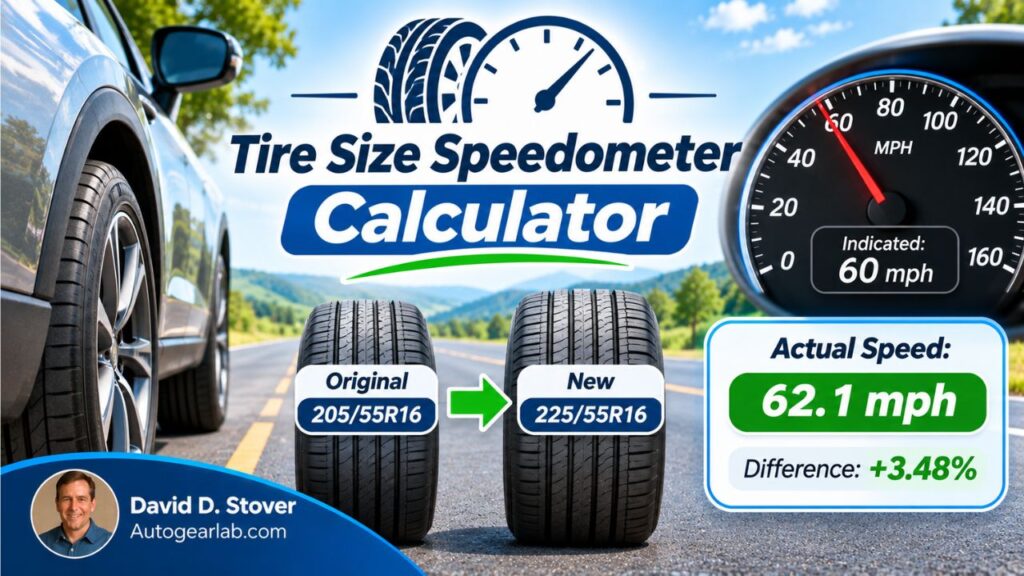
This Tire Size Speedometer Calculator estimates your actual driving speed after changing from your original tire size to a different size. Enter your original and new tire sizes, the speed displayed on your vehicle’s speedometer, and your preferred speed unit to calculate the estimated actual road speed and percentage difference.
Changing tire diameter affects how far a vehicle travels during each tire revolution. A larger tire generally travels farther per revolution, potentially causing the speedometer to show a lower speed than the vehicle’s actual speed. A smaller tire has the opposite effect. This matters when installing aftermarket wheels, upgrading to larger truck tires, choosing replacement tire sizes, or maintaining accurate mileage records.
My calculator supports common metric tire sizes such as 205/55R16 and 225/65R17. It displays estimated actual speed, percentage difference, original and new tire diameters, and corrected readings at several common speeds.
Below the calculator, I explain how to enter your tire sizes, calculate speedometer error, understand tire diameter and rolling circumference, compare different tire sizes, and identify when recalibration or additional fitment checks may be necessary.
AUTO GEAR LAB TOOLS FREE CALCULATOR
Tire Size Speedometer Calculator
Estimate the speedometer difference after changing tire size.
Enter your details
Your results
Assumes the speedometer was accurate with the original tire and tire dimensions match nominal sizing.
How to Use My Tire Size Speedometer Calculator
My Tire Size Speedometer Calculator compares the nominal outside diameter of your original tires with the diameter of your replacement tires.
It then estimates how the difference affects the relationship between your speedometer reading and actual road speed.
You need four inputs:
- Original tire size
- New tire size
- Speedometer reading
- Speed unit
The calculator does not require your vehicle’s make, model, year, or trim.
Step 1: Enter Your Original Tire Size
Find the Original Tire Size field.
Enter the tire size your vehicle’s speedometer was originally calibrated to use.
For example:
205/55R16
This is the calculator’s default original tire size.
The tire size contains three main measurements:
- 205: Nominal tire section width in millimeters
- 55: Sidewall aspect ratio
- R16: Radial construction and 16-inch wheel diameter
You can usually find the original equipment tire size on the driver’s door-jamb tire placard or in the owner’s manual.
If your vehicle currently has aftermarket tires, do not automatically assume their size matches the speedometer’s original calibration.
Use the tire size associated with the existing speedometer calibration whenever possible.
Step 2: Enter Your New Tire Size
Find the New Tire Size field.
Enter the replacement tire size you’re considering.
For example:
225/55R16
This is the calculator’s default replacement tire size.
The new tire has:
- 225 mm nominal section width
- 55% aspect ratio
- 16-inch wheel diameter
Although both tires fit 16-inch-diameter wheels, their overall diameters are different.
The calculator uses those dimensions to estimate the speedometer change.
You can also compare different wheel diameters, such as changing from a 16-inch wheel to a 17-inch wheel, provided the tire sizes use a supported metric format.
Step 3: Enter Your Speedometer Reading
Locate the Speedometer Reading field.
Enter the speed displayed on your vehicle’s dashboard.
For example:
60
If your dashboard speedometer shows 60 mph, enter 60.
The calculator uses this indicated speed to estimate the actual speed after the tire size change.
It accepts speed readings from 1 to 250, with decimal inputs supported.
Use a realistic value relevant to your intended comparison.
Step 4: Select Your Speed Unit
In the Speed Unit field, select one of the available options:
- Miles per hour (mph)
- Kilometers per hour (km/h)
Select mph if your speedometer is displaying miles per hour.
Select km/h if your speedometer uses kilometers per hour.
The calculation method is the same for both units because the formula uses a diameter ratio.
However, the output uses your selected speed unit.
Step 5: Click Calculate
After entering your values, click Calculate.
For the default example:
| Calculator Input | Value |
|---|---|
| Original tire size | 205/55R16 |
| New tire size | 225/55R16 |
| Speedometer reading | 60 |
| Speed unit | mph |
The calculator produces approximately:
| Result | Value |
|---|---|
| Estimated Actual Speed | 62.1 mph |
| Speed difference | +3.48% |
| Actual speed at indicated 30 mph | 31.0 mph |
| Actual speed at indicated 60 mph | 62.1 mph |
| Actual speed at indicated 70 mph | 72.4 mph |
| Original tire diameter | 24.88 inches |
| New tire diameter | 25.74 inches |
The values are estimates based on nominal tire dimensions.
Step 6: Understand Your Actual Speed Result
The primary result is Estimated Actual Speed.
For example:
Speedometer Reading: 60 mph
Estimated Actual Speed: 62.1 mph
This means the vehicle may be traveling approximately 2.1 mph faster than the dashboard indicates.
The calculation assumes the speedometer was accurate with the original tire size.
If the speedometer already had an error before changing tires, the calculator does not account for that existing difference.
Step 7: Check the Speed Difference Percentage
The calculator also shows the percentage change.
For the default example:
Speed Difference: +3.48%
A positive percentage means the new tire’s nominal diameter is larger than the original tire’s diameter.
Under the calculator’s assumptions, actual speed becomes higher than indicated speed.
A negative percentage means the new tire’s nominal diameter is smaller.
In that situation, actual speed becomes lower than indicated speed.
Step 8: Compare Different Speedometer Readings
The calculator automatically shows estimated actual speeds when the speedometer displays:
- 30 mph or km/h
- 60 mph or km/h
- 70 mph or km/h
These reference readings help illustrate how the same percentage difference affects road speed at different speeds.
For example, a 3.48% difference produces a larger absolute speed difference at 70 mph than at 30 mph.
The comparison is calculated mathematically rather than measured from a moving vehicle.
How Does My Tire Size Speedometer Calculator Work?
The calculator uses tire diameter ratio calculations to estimate the difference between indicated speed and actual road speed.
It first calculates the nominal outside diameters of the original and replacement tires.
Then it divides the new diameter by the original diameter.
Finally, it multiplies the speedometer reading by that ratio.
Formula 1: Calculate Tire Sidewall Height
The first calculation determines the nominal tire sidewall height.
Sidewall Height (mm) = Tire Width (mm) × Aspect Ratio ÷ 100
For a 205/55R16 tire:
Sidewall height = 205 × 55 ÷ 100
Sidewall Height = 112.75 mm
This is the nominal height of one tire sidewall.
Formula 2: Calculate Overall Tire Diameter
The calculator then determines the tire’s theoretical outside diameter.
Tire Diameter (inches) = Wheel Diameter (inches) + [2 × Sidewall Height (mm) ÷ 25.4]
The number 25.4 converts millimeters into inches.
The sidewall height is multiplied by two because the tire has sidewall height above and below the wheel’s diameter.
For the original tire, 205/55R16:
Tire diameter = 16 + (2 × 112.75 ÷ 25.4)
Original Tire Diameter = 24.88 inches
For the replacement tire, 225/55R16:
Sidewall height = 225 × 55 ÷ 100 = 123.75 mm
Tire diameter = 16 + (2 × 123.75 ÷ 25.4)
New Tire Diameter = 25.74 inches
The new tire is approximately 0.87 inches larger in nominal overall diameter.
These are calculated dimensions, not guaranteed physical measurements. Tire Rack’s tire dimension calculation guide explains how section width, aspect ratio, and wheel diameter are used to calculate theoretical tire dimensions.
Formula 3: Calculate the Tire Diameter Ratio
The next step compares the two diameters.
Tire Diameter Ratio = New Tire Diameter ÷ Original Tire Diameter
Using the calculated values before rounding:
Diameter ratio = 25.7441 ÷ 24.8780
Diameter Ratio ≈ 1.034816
This means the new tire’s nominal diameter is approximately 3.48% larger.
Formula 4: Calculate Actual Speed
The main speedometer correction formula is:
Actual Speed = Indicated Speed × (New Tire Diameter ÷ Original Tire Diameter)
For an indicated speed of 60 mph:
Actual speed = 60 × 1.034816
Actual Speed = 62.09 mph
The calculator rounds the primary speed result to one decimal place.
Therefore, the display shows approximately 62.1 mph.
Formula 5: Calculate Speed Difference Percentage
The percentage formula is:
Speed Difference (%) = [(New Tire Diameter ÷ Original Tire Diameter) − 1] × 100
Using the default example:
Speed difference = (1.034816 − 1) × 100
Speed Difference = +3.48%
The positive result indicates a larger nominal tire diameter and a higher estimated actual speed at the same indicated reading.
Formula 6: Calculate Speed Difference in MPH
You can calculate the actual difference in speed by subtracting the indicated reading from the estimated actual speed.
Speed Difference (mph) = Actual Speed − Indicated Speed
For the default example:
62.09 − 60 = 2.09 mph
This means the estimated actual speed is approximately 2.09 mph higher than the dashboard reading.
Tire Size Speedometer Calculation Examples
The following examples demonstrate how different replacement tire sizes affect speedometer estimates.
All examples assume the speedometer was accurate with the original tire size and use nominal tire dimensions.
Example 1: Changing From 205/55R16 to 225/55R16
Original tire diameter: 24.88 inches
New tire diameter: 25.74 inches
Diameter difference: approximately +3.48%
| Indicated Speed | Estimated Actual Speed |
|---|---|
| 20 mph | 20.7 mph |
| 30 mph | 31.0 mph |
| 40 mph | 41.4 mph |
| 50 mph | 51.7 mph |
| 60 mph | 62.1 mph |
| 70 mph | 72.4 mph |
The replacement tire has a larger nominal diameter.
Therefore, it travels farther per revolution, and actual road speed is estimated to be higher than indicated.
Example 2: Changing From 205/55R16 to 195/55R16
Original diameter: approximately 24.88 inches
New diameter: approximately 24.44 inches
Diameter difference: approximately -1.74%
At an indicated 60 mph:
Actual speed = 60 × (24.44 ÷ 24.88)
Estimated Actual Speed ≈ 59.0 mph
The smaller tire travels less distance per revolution.
The speedometer therefore indicates a slightly higher speed than the calculated actual road speed.
Example 3: Changing From 205/55R16 to 225/45R17
Original diameter: approximately 24.88 inches
New diameter: approximately 24.97 inches
Diameter difference: approximately +0.38%
At an indicated 60 mph:
Estimated Actual Speed ≈ 60.2 mph
This example illustrates how a larger wheel diameter can be combined with a lower-profile tire to maintain a similar overall tire diameter.
However, similar diameters do not guarantee safe fitment.
Tire Size Speedometer Comparison Chart
| Original Tire | New Tire | Diameter Difference | Actual Speed at Indicated 60 mph |
|---|---|---|---|
| 205/55R16 | 225/55R16 | +3.48% | 62.1 mph |
| 205/55R16 | 195/55R16 | -1.74% | 59.0 mph |
| 205/55R16 | 225/45R17 | +0.38% | 60.2 mph |
| 205/55R16 | 205/50R16 | -3.24% | 58.1 mph |
| 225/65R17 | 245/65R17 | +3.59% | 62.2 mph |
These are theoretical comparisons, not vehicle-specific replacement recommendations.
Why Does Changing Tire Size Affect the Speedometer?
A vehicle’s speedometer estimates road speed using information from the vehicle’s speed-sensing system.
Depending on the vehicle, this may involve wheel-speed sensors, transmission-related measurements, electronic control modules, and calibration settings.
The displayed speed depends on how rotational movement is interpreted.
Larger Tires Travel Farther Per Revolution
A tire with a larger rolling circumference generally covers more road distance during each revolution.
If the speed-sensing system continues using calibration values associated with smaller original tires, it may underestimate the distance traveled per rotation.
As a result, the vehicle can travel faster than the speedometer indicates.
Smaller Tires Travel Less Distance Per Revolution
A smaller tire generally covers less road distance per rotation.
When the original calibration remains unchanged, the vehicle may need more tire revolutions to travel the same distance.
The speedometer can consequently indicate a higher speed than the vehicle’s actual speed.
Why the Diameter Ratio Matters
Tire circumference is approximately proportional to outside diameter.
Because circumference is calculated as:
Circumference = π × Diameter
The theoretical ratio between two tire circumferences is equal to their diameter ratio.
That relationship allows the calculator to estimate speedometer changes using the two nominal diameters.
Larger Tires vs. Smaller Tires: Speedometer Difference
The direction of the speedometer change depends primarily on how the replacement tire’s rolling circumference compares with the original.
| Tire Change | General Effect |
|---|---|
| Larger outside diameter | Actual speed tends to exceed indicated speed |
| Smaller outside diameter | Actual speed tends to be below indicated speed |
| Similar outside diameter | Smaller theoretical speedometer change |
| Same size, different tire model | Actual rolling measurements may still differ |
Do Bigger Tires Make Your Speedometer Read Slower?
Generally, yes, when the vehicle retains its original tire-size calibration.
For example, after switching to larger tires, the dashboard might indicate 60 mph while the vehicle is actually traveling around 62 mph.
The exact difference depends on the rolling-circumference change, not simply the tire’s advertised width.
Do Smaller Tires Make Your Speedometer Read Faster?
Generally, yes.
The dashboard may indicate 60 mph while actual road speed is slightly lower.
This occurs because the smaller tire travels less distance during each revolution.
Does Wider Tire Size Always Mean Larger Diameter?
No.
A wider tire does not necessarily have a larger overall diameter.
For example, changing from 205/55R16 to 225/45R17 increases nominal tire width but keeps the overall diameter relatively close.
Tire diameter depends on three measurements working together:
- Section width
- Aspect ratio
- Wheel diameter
This is why the calculator evaluates the complete size rather than comparing width alone.
How to Read Tire Sizes Before Calculating Speedometer Error
A metric tire size contains several pieces of information.
Consider:
225/55R17
Tire Width: 225
The first number represents the nominal section width in millimeters.
In this example, the tire is nominally 225 mm wide.
It does not directly describe the width of the tread contacting the road.
Aspect Ratio: 55
The second number represents the sidewall height as a percentage of nominal section width.
A 55 aspect ratio means:
225 × 0.55 = 123.75 mm
The sidewall is approximately 123.75 mm high.
Tire Construction: R
The letter R indicates radial tire construction.
Radial tires are commonly used on modern passenger vehicles.
Wheel Diameter: 17
The final number indicates the required nominal wheel diameter in inches.
A tire designated R17 requires a compatible 17-inch-diameter wheel.
What About Load Index and Speed Rating?
A complete tire marking may include additional information, such as:
225/55R17 97V
The number 97 is a load index, and V is a speed-rating symbol.
My calculator uses the dimensional portion:
225/55R17
It does not calculate tire dimensions from the load index or speed-rating suffix.
It also does not verify whether the load index or speed rating is appropriate for your vehicle.
Supported Tire Size Formats and Calculator Limitations
The current calculator accepts supported metric tire sizes in a format similar to:
- 205/55R16
- 225/45R17
- 235/65R17
- 265/70R17
- 285/70R17
Its supported nominal dimensional ranges are:
| Measurement | Supported Range |
|---|---|
| Tire section width | 125–445 mm |
| Aspect ratio | 20–90 |
| Wheel diameter | 10–26 inches |
The calculator also recognizes certain P-metric and LT-metric prefixes.
It does not support every tire naming system.
Can I Enter a Tire Size With a Load Index?
The dimensional input should exclude the load index and speed-rating suffix.
For example, use:
225/55R17
Instead of:
225/55R17 97V
Does It Support Flotation Tire Sizes?
The current speedometer calculator is intended for metric tire-size notation.
Flotation-style sizes such as 33×12.50R17 are not supported directly in this field.
Those sizes should be evaluated using suitable manufacturer measurements or a calculator specifically designed for flotation tire dimensions.
Does It Support Motorcycle Tire Sizes?
Some motorcycle tire sizes use metric-style notation, but motorcycle tire dimensions, profiles, and rolling characteristics may differ substantially from passenger-car tire assumptions.
This calculator should not be treated as a motorcycle-specific tire fitment or speedometer calibration tool.
Tire Diameter vs. Rolling Circumference vs. Revolutions Per Mile
These measurements are related but are not interchangeable.
Overall Tire Diameter
Overall diameter measures the outside dimension of the inflated tire through its center.
The calculator estimates nominal overall diameter from the tire size designation.
Tire Circumference
The nominal circumference is:
Tire Circumference = π × Overall Diameter
For example, a theoretical 25-inch-diameter tire has a circumference of approximately:
25 × 3.14159 = 78.54 inches
This is the circumference of an ideal circular tire.
Revolutions Per Mile
Revolutions per mile describes how many times a tire rotates while covering one mile.
The simple geometric estimate is:
Revolutions Per Mile = 63,360 ÷ Nominal Circumference in Inches
However, real tires deform under vehicle weight.
Their loaded rolling circumference can differ from the circumference calculated using unloaded outside diameter.
Tread construction, tire pressure, inflation conditions, wheel width, and operating loads can influence actual rolling behavior.
Tire Rack’s explanation of tire revolutions per mile describes why real tire revolution measurements cannot be determined perfectly from nominal outside diameter alone.
Important: My calculator uses nominal tire diameters. It does not measure actual loaded rolling circumference or manufacturer-tested revolutions per mile.
How Accurate Is the Tire Size Speedometer Calculator?
The calculator accurately performs its mathematical formulas using the tire-size values entered.
However, the estimated actual speed is not necessarily identical to a real-world speed measurement.
Tire Dimensions Are Nominal
The tire-size designation provides nominal geometry.
Actual physical dimensions can vary between manufacturers and tire models.
Two tires with the same printed size may have different measured overall diameters or revolutions per mile.
Tire Wear Changes Effective Diameter
As tread wears down, the tire’s effective rolling characteristics can change.
A worn tire generally has a smaller effective rolling radius than the same tire when new.
The difference may become relevant when precise speedometer or drivetrain calibration is required.
Inflation Pressure and Vehicle Load Matter
Tire inflation and load can affect rolling characteristics.
These factors are not included in the calculator’s nominal-diameter formula.
Original Speedometer Calibration May Already Have an Error
The calculator assumes the vehicle’s speedometer was accurate with the original tire size.
Some speedometers intentionally display a slightly higher speed than actual road speed, depending on their design and applicable requirements.
Other vehicles may have calibration differences due to previous modifications.
The calculation estimates the effect of the tire-size change; it does not independently determine the original speedometer’s accuracy.
Manufacturer Specifications Are More Reliable for Precise Fitment
If precise rolling circumference matters, consult the actual tire manufacturer’s specifications and vehicle service information.
For an exact road-speed assessment, a properly conducted calibration or verification procedure may be necessary.
How to Check Speedometer Accuracy After Changing Tires
A calculator provides an initial estimate, but you may want to verify the actual speedometer behavior after a tire change.
Using GPS Speed Measurements
A suitable GPS-based speed measurement can provide an independent comparison with the vehicle’s displayed speed.
However, GPS speed readings can be affected by signal quality, receiver performance, tunnels, obstructed sky, and other conditions.
Avoid using a handheld phone or interacting with a speed-measurement app while driving.
If a comparison is necessary, have a passenger monitor an appropriate device or arrange a professional test.
Using a Professional Speedometer Calibration Service
A qualified technician may be able to verify speedometer accuracy using vehicle-specific diagnostic or calibration equipment.
This may be particularly useful after substantial tire-size changes.
The available method depends on the vehicle.
Can You Check Speed Using Highway Mile Markers?
Distance and time measurements can provide an approximate average speed over a known route.
However, road-marker distances and human timing introduce uncertainty.
Do not attempt a timing procedure that distracts the driver.
A professional calibration or appropriately conducted independent measurement is preferable when accuracy matters.
Does Tire Size Change Affect the Odometer?
It can.
Many vehicles calculate distance traveled using rotational information associated with the drivetrain or wheels.
Changing tire rolling circumference may therefore affect odometer readings as well as the displayed speed.
Larger Tires and Odometer Readings
With larger tires and unchanged calibration, the vehicle may travel farther than the odometer indicates.
For example, if the new tire’s effective rolling circumference is approximately 3% larger, the vehicle may cover roughly 103 miles while recording about 100 miles.
Smaller Tires and Odometer Readings
With smaller tires, the vehicle may travel less distance than the odometer indicates.
This can result in the odometer accumulating mileage faster than the actual road distance.
Odometer Correction Formula
Under a simplified shared-calibration assumption:
Estimated Actual Distance = Indicated Distance × (New Diameter ÷ Original Diameter)
For the default tire example:
Indicated distance = 100 miles
Diameter ratio = 1.034816
Actual distance = 100 × 1.034816
Estimated Actual Distance = 103.48 miles
The current plugin does not display odometer correction as a separate result.
This formula is provided for explanation.
Important: Speedometer and odometer processing are not identical in every vehicle. The formula is a simplified estimate, not a guarantee of the actual odometer error.
Can Odometer Error Affect MPG Calculations?
Yes.
Fuel economy is calculated using distance and fuel consumed.
If the recorded distance is inaccurate, the calculated miles per gallon may also be inaccurate.
For example, an odometer that underreports distance can make calculated MPG appear lower than the actual value.
This is especially relevant after changing tire sizes without confirming calibration.
Does Tire Size Affect Speedometer Accuracy in Trucks and SUVs?
Yes.
The same basic relationship between tire rolling circumference and road speed applies to cars, trucks, and SUVs.
However, trucks and off-road vehicles may have additional fitment considerations.
Larger All-Terrain and Mud-Terrain Tires
Installing larger all-terrain or mud-terrain tires can change effective gearing and rolling circumference.
A larger tire may reduce indicated speed relative to actual road speed when the original calibration remains unchanged.
The effect depends on the actual rolling dimensions of the new tire.
Tire Upgrades on Pickup Trucks
A pickup truck upgraded to substantially taller tires may experience changes in:
- Speedometer readings
- Odometer accuracy
- Effective gearing
- Acceleration behavior
- Braking performance
- Available suspension clearance
- Fuel consumption
A speedometer calculation only addresses one part of the modification.
Do Lift Kits Correct Speedometer Errors?
No.
A suspension lift does not directly change the speedometer’s tire calibration.
If larger tires are installed with the lift, a separate calibration review may be required.
Are 33-Inch and 35-Inch Tires Always Exactly Those Diameters?
No.
Flotation-style tire names are nominal designations.
Actual measured overall diameter and loaded rolling circumference may vary between tire models.
For accurate comparisons, consult the tire manufacturer’s specifications.
Does Tire Size Affect ABS, Traction Control, and Stability Control?
Potentially, yes.
Modern vehicles use wheel-speed information for several safety-related functions.
Depending on the system, tire rolling-circumference differences can influence how those systems interpret vehicle movement.
Anti-Lock Braking System (ABS)
ABS monitors wheel behavior during braking.
Significant tire-size changes or inconsistent rolling circumferences can interfere with the assumptions used by the vehicle’s control system.
Traction Control
Traction control systems may compare wheel speeds to identify possible wheel slip.
A substantial mismatch in tire rolling circumference can affect those comparisons.
Electronic Stability Control
Stability control systems use information from multiple sensors, including wheel-speed data.
Changing tire dimensions outside the manufacturer’s approved range may affect system behavior.
All-Wheel Drive and Four-Wheel Drive
Some AWD and 4WD systems are sensitive to differences in tire rolling circumference between wheels.
Mixing tires of significantly different sizes or wear conditions may cause drivetrain problems.
Follow the vehicle manufacturer’s requirements concerning matching tire sizes, models, tread depths, and rolling circumferences.
Do not assume that installing different tire sizes is acceptable simply because the speedometer difference is small.
How Much Tire Size Difference Is Acceptable?
There is no single tire diameter percentage that guarantees safe fitment for every vehicle.
You may encounter recommendations to stay within approximately 3% of the original tire diameter.
That can be a useful preliminary screening guideline, but 3% is not a universal legal limit or guaranteed safe fitment threshold.
Some vehicles require much tighter dimensional compatibility.
Others may have manufacturer-approved alternate tire sizes.
Why a Small Diameter Difference May Still Be Unsuitable
A replacement tire can have nearly the same overall diameter but still be inappropriate because of:
- Excessive tire width
- Insufficient load capacity
- Incompatible speed rating
- Incorrect wheel diameter
- Unapproved rim width
- Insufficient suspension clearance
- Brake or body interference
- Vehicle-specific drivetrain requirements
How to Confirm an Approved Replacement Tire Size
Start with the vehicle’s tire placard and owner’s manual.
The National Highway Traffic Safety Administration’s tire safety guidance recommends selecting the original tire size or another size approved by the vehicle manufacturer.
It also emphasizes checking the vehicle’s specified tire pressure and other safety requirements.
A tire dealer or qualified technician can help verify an appropriate replacement.
How to Minimize Speedometer Error When Changing Tire Sizes
If you’re considering aftermarket wheels or tires, minimizing unwanted changes in rolling circumference is often an important goal.
Compare Overall Tire Diameter
Use the calculator to compare the original and replacement tire diameters.
A smaller nominal diameter difference generally produces a smaller estimated speedometer change.
However, that does not independently establish fitment.
Consider Tire Plus Sizing
Plus sizing generally involves increasing the wheel diameter while selecting a tire with a shorter sidewall to maintain a similar overall tire diameter.
For example, moving from a 16-inch wheel to a 17-inch wheel does not automatically increase overall tire diameter.
The aspect ratio and section width can be selected to produce a similar nominal outside diameter.
Only use combinations approved for the vehicle and wheel.
Check Manufacturer-Approved Alternate Sizes
Some vehicle manufacturers provide multiple approved wheel-and-tire sizes for different trims or equipment packages.
Those specifications can be a useful starting point.
However, a size approved for one trim is not automatically approved for another.
Verify the Tire’s Load Index and Speed Rating
A similar outside diameter does not mean the tire meets the vehicle’s load and speed requirements.
Confirm all applicable tire specifications.
Ask About Speedometer Recalibration
If a larger tire-size change is necessary, ask a qualified technician whether vehicle-specific speedometer recalibration is supported.
The procedure may involve diagnostic software, calibration settings, or approved hardware.
Do not assume that all vehicles support an aftermarket calibration tool.
How to Recalibrate a Speedometer After Changing Tire Size
Speedometer recalibration changes the relationship between the vehicle’s measured rotational information and its displayed speed.
The appropriate procedure depends on the vehicle’s electronics and manufacturer specifications.
Dealer or Manufacturer-Approved Calibration
Some vehicles support approved calibration procedures for specified alternate wheel-and-tire packages.
A dealer or qualified repair facility can determine whether the vehicle supports such adjustments.
Diagnostic or Programming Tools
Certain vehicles may support tire-size-related configuration changes through compatible diagnostic software.
However, modifying electronic vehicle settings without proper knowledge can cause incorrect instrument readings or interfere with other systems.
Use equipment and procedures appropriate for the exact vehicle.
Aftermarket Calibration Devices
Some aftermarket products are marketed for correcting speedometer readings after tire or gearing modifications.
Their compatibility and functionality vary.
Before purchasing, verify that the device supports the exact vehicle and modification.
Avoid products that make unsupported claims about universal compatibility.
Verify the Result After Calibration
After recalibration, verify speedometer accuracy using an appropriate method.
Also confirm whether the odometer and relevant vehicle systems are operating correctly.
The calculator estimates the required speed correction; it does not perform electronic speedometer recalibration.
Common Tire Size Speedometer Calculator Mistakes
Using the Wrong Original Tire Size
The original input should represent the tire size associated with the existing speedometer calibration.
Using the wrong baseline can produce misleading results.
Comparing Tire Width Instead of Diameter
A wider tire is not necessarily taller.
Overall diameter depends on width, aspect ratio, and rim diameter.
Forgetting the Aspect Ratio
Two tires with the same section width can have substantially different diameters when their aspect ratios differ.
Confusing Wheel Diameter With Tire Diameter
A 17-inch wheel does not mean the complete tire has a 17-inch outside diameter.
The tire sidewalls add to the overall diameter.
Entering a Full Size With Unsupported Suffixes
The current input accepts supported metric size notation.
Use the dimensional part, such as 225/55R17, rather than adding load index and speed-rating information.
Assuming the Original Speedometer Was Perfectly Accurate
The tool estimates the relative change caused by the replacement size.
It does not determine pre-existing speedometer error.
Assuming Nominal Tire Size Equals Actual Rolling Diameter
Real-world tire behavior depends on construction, inflation, load, and other operating conditions.
Nominal dimensions are not the same as measured rolling circumference.
Treating a Small Percentage Difference as Fitment Approval
Even a replacement tire with nearly identical diameter may be unsuitable because of width, load capacity, or physical clearance.
Ignoring Odometer Accuracy
Changing tire rolling circumference can affect recorded mileage as well as indicated speed.
Mixing Tire Sizes on AWD Vehicles
Some AWD systems require closely matched tires.
Follow manufacturer specifications rather than relying only on the calculator’s speedometer result.
Tire Size and Speedometer Safety Checklist
Before installing tires with a different size designation, verify the following:
- Original equipment tire size is confirmed.
- New tire size is entered correctly.
- Speedometer percentage difference has been reviewed.
- Tire manufacturer dimensions have been checked.
- Replacement tire size is approved or verified for the vehicle.
- Tire load capacity meets vehicle requirements.
- Tire speed rating is appropriate.
- Wheel diameter and approved rim width are compatible.
- Suspension, brake, and fender clearance are sufficient.
- AWD or 4WD tire-matching requirements are satisfied.
- Tire pressure follows the vehicle manufacturer’s specifications.
- Speedometer and odometer calibration needs have been evaluated.
- A qualified installer has verified any uncertain fitment details.
A speedometer calculation is a planning tool, not a substitute for vehicle-specific tire selection and safety inspection.
Tire Size Speedometer Calculator FAQs
How Does Tire Size Affect Speedometer Accuracy?
Changing tire rolling circumference changes the distance traveled during each revolution. If the vehicle keeps its original calibration, a larger tire generally makes actual speed higher than indicated speed, while a smaller tire generally makes actual speed lower.
How Do I Calculate Speedometer Error After Changing Tires?
Divide the new tire diameter by the original tire diameter, subtract 1, and multiply by 100. The result is the estimated percentage change in actual speed relative to indicated speed, assuming the original speedometer was accurate.
Do Bigger Tires Make Your Speedometer Read Slower?
Generally, yes. Larger tires cover more distance per revolution. With unchanged calibration, your speedometer may display a lower speed than your actual road speed.
Do Smaller Tires Make Your Speedometer Read Faster?
Generally, yes. Smaller tires travel less distance per revolution, so the indicated speed may exceed actual road speed when the original calibration remains unchanged.
How Much Will 3% Larger Tires Affect My Speedometer?
If the new tires have exactly 3% greater effective rolling circumference, an indicated 60 mph corresponds to approximately 61.8 mph actual speed, assuming the original calibration was accurate.
Does Changing Tire Width Affect Speedometer Accuracy?
It can, but width alone does not determine the effect. A different width combined with a different aspect ratio may produce a similar, larger, or smaller overall diameter.
Does Changing From 16-Inch to 17-Inch Wheels Affect the Speedometer?
Not necessarily. If the overall tire rolling circumference remains nearly unchanged, the speedometer difference may be small. The wheel diameter alone is not enough to determine the result.
Is a 3% Tire Diameter Difference Safe?
Not automatically. Three percent is sometimes used as a preliminary comparison guideline, but vehicle-specific tire, wheel, drivetrain, and safety requirements determine acceptable replacements.
Does Changing Tire Size Affect Odometer Readings?
It can. If the vehicle uses an unchanged rotational calibration to calculate mileage, larger tires may cause distance to be underreported and smaller tires may cause it to be overreported.
Can I Check Tire Size Speedometer Error in KM/H?
Yes. Select kilometers per hour in the calculator. The same diameter ratio is used, and the estimated actual speed is displayed in km/h.
Does This Calculator Work for Trucks?
Yes, for supported metric tire sizes. It can estimate speedometer differences for cars, trucks, and SUVs, but it does not verify the replacement tire’s suitability for the vehicle.
Can I Use 33-Inch or 35-Inch Tire Sizes?
The current tool accepts supported metric size formats, not direct flotation-style inputs such as 33×12.50R17. Use manufacturer-measured tire dimensions or a suitable specialized calculator when comparing flotation sizes.
Does Tire Pressure Affect Speedometer Accuracy?
Tire pressure can affect the tire’s loaded rolling characteristics. The calculator uses nominal size dimensions and does not directly account for inflation-pressure variations.
Does Tire Tread Wear Affect Speedometer Readings?
It can. Tread wear changes effective tire dimensions and rolling behavior. The effect is not included in the calculator’s nominal diameter estimates.
Do I Need to Recalibrate My Speedometer After Changing Tires?
It depends on the size change, existing calibration accuracy, vehicle design, and manufacturer requirements. Significant errors should be evaluated by a qualified technician.
Can GPS Measure Actual Speed?
A suitable GPS receiver can provide an independent speed estimate under appropriate conditions. However, GPS measurements have limitations, and drivers should not interact with devices while moving.
Can Different Tire Sizes Affect ABS and Traction Control?
Yes. Significant rolling-circumference changes or mismatched tires can affect systems that rely on wheel-speed data. Follow vehicle manufacturer requirements.
Does the Calculator Tell Me if New Tires Will Fit?
No. It compares nominal diameters and estimates speedometer differences. It does not check load ratings, tire width clearance, brake clearance, rim compatibility, or vehicle-specific approval.
What Happens if the Original and New Tire Diameters Are the Same?
The calculator will show approximately 0% theoretical speed difference. Actual rolling circumference may still vary between tire models, so matching nominal diameters does not guarantee identical real-world speed readings.
How Accurate Is My Tire Size Speedometer Calculator?
The mathematical calculation is accurate for the nominal tire dimensions entered, subject to rounding. Real-world accuracy depends on tire construction, wear, inflation, load, actual rolling circumference, and the vehicle’s existing calibration.
Conclusion
The Tire Size Speedometer Calculator provides a practical way to estimate how changing tire sizes can affect the relationship between your dashboard speedometer reading and actual road speed.
By entering the original and replacement tire sizes, you can compare their nominal overall diameters, calculate the percentage difference, and estimate actual speed in either mph or km/h.
Larger tires generally increase the distance traveled per revolution, potentially causing the speedometer to read lower than actual speed. Smaller tires generally produce the opposite effect.
For reliable planning, compare the complete tire dimensions rather than section width or wheel diameter alone. Remember that actual rolling circumference can differ from theoretical dimensions because of tire construction, inflation, load, and wear.
Before changing tire sizes, verify tire load capacity, speed rating, wheel compatibility, suspension clearance, drivetrain requirements, and manufacturer recommendations. If the change creates a meaningful speedometer difference, consider professional verification and recalibration.
Used alongside those checks, my calculator can help you understand tire-size changes and make more informed decisions about replacement tires and aftermarket wheel setups.