This Tire Size Conversion Calculator converts metric tire sizes into inches and estimates metric dimensions from flotation-style tire measurements. Enter a metric size such as 285/70R17 to calculate its overall diameter, section width, sidewall height, and circumference in inches, or enter flotation dimensions such as 33×12.50R17 to generate an approximate metric-size description.
The calculator is useful when comparing metric and inch-based tire sizing systems, researching replacement tires, or understanding measurements before changing wheels. It can help drivers of cars, trucks, SUVs, and off-road vehicles interpret tire dimensions without manually converting millimeters, aspect ratios, and wheel diameters.
Unlike a vehicle-specific tire fitment tool, this calculator works entirely from the dimensions you provide. Converted measurements are theoretical, and an estimated metric code is not necessarily an available or approved replacement tire.
Below the calculator, I explain how to use both conversion modes, calculate tire dimensions using the correct formulas, read metric and flotation markings, compare common tire sizes, and identify the compatibility and safety checks needed before purchasing replacement tires.
AUTO GEAR LAB TOOLS FREE CALCULATOR
Tire Size Conversion Calculator
Convert metric tire dimensions to inches or estimate metric equivalents of flotation sizes.
Enter your details
Your results
Metric and flotation sizing do not map exactly. Check actual manufacturer specifications before buying.
How to Use My Tire Size Conversion Calculator
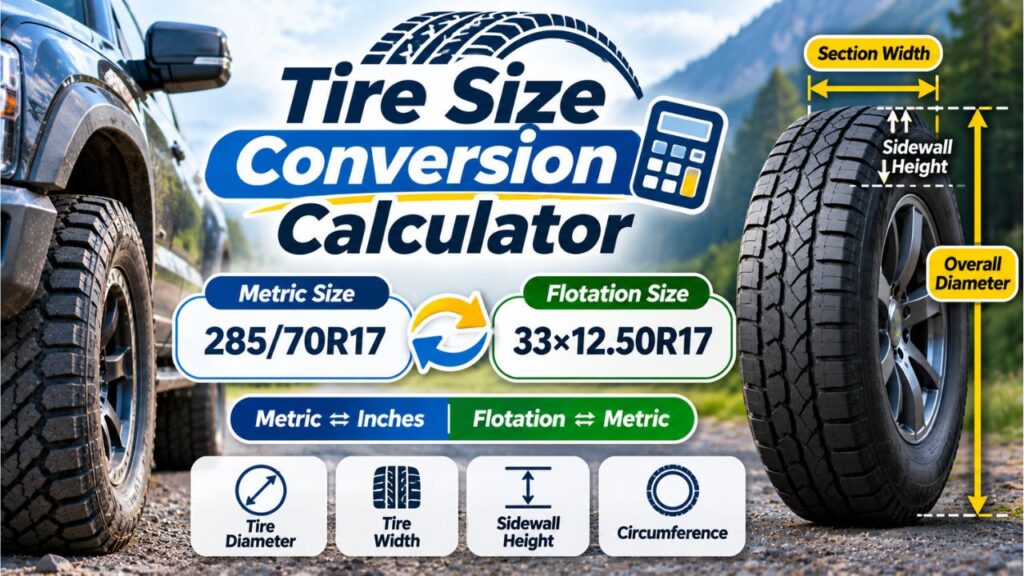
My Tire Size Conversion Calculator supports two different tire-size conversion methods:
- Metric → Inches: Converts a metric tire designation into nominal dimensions measured in inches.
- Flotation → Approx. Metric: Converts inch-based flotation dimensions into a mathematical metric-size estimate.
Both modes use the dimensions entered by the user. Neither requires a vehicle identification number, year, make, model, or external tire database.
Step 1: Select Your Conversion Direction
Find the Conversion Direction dropdown at the top of the calculator.
Choose one of the available options.
Metric → Inches
Select this option when you have a metric tire size such as:
- 205/55R16
- 225/65R17
- 265/75R16
- 285/70R17
- 275/60R20
The calculator determines the tire’s nominal dimensions in inches.
Flotation → Approx. Metric
Select this option when you know a tire’s flotation measurements, such as:
- 31×10.50R15
- 33×12.50R17
- 35×12.50R20
- 37×12.50R17
In this mode, you enter the overall diameter, section width, and rim diameter separately.
The calculator then estimates the corresponding metric dimensions.
Step 2: Enter Your Metric Tire Size
If you selected Metric → Inches, find the Metric Tire Size field.
Enter your tire size in the following format:
285/70R17
This is the calculator’s default example.
The size contains three main measurements:
- 285 = nominal tire section width in millimeters
- 70 = sidewall aspect ratio expressed as a percentage
- 17 = wheel diameter in inches
The letter R indicates radial tire construction.
Enter the tire dimensions exactly as they appear on the tire sidewall, excluding any additional load index and speed-rating suffix.
For example, if your tire is marked LT285/70R17 121/118S, the dimensional portion is LT285/70R17.
The calculator recognizes common P-metric and LT-metric prefixes in its supported format.
Step 3: Click Calculate to Convert Metric Tires Into Inches
After entering the tire size, click Calculate.
For the default 285/70R17 example, the calculator displays:
Nominal Size in Inches: 32.71 × 11.22 R17
The result represents:
- Overall tire diameter: 32.71 inches
- Nominal section width: 11.22 inches
- Wheel diameter: 17 inches
The calculator also displays the following measurements.
| Measurement | Calculated Result |
|---|---|
| Overall diameter | 32.71 inches |
| Section width | 11.22 inches |
| Sidewall height | 7.85 inches |
| Tire circumference | 102.76 inches |
| Wheel diameter | 17 inches |
The calculator includes a simple tire illustration to help visualize the dimensions.
Important: The result is an inch-based description of the metric tire’s nominal geometry. It is not a manufacturer’s flotation tire designation or proof that an exactly matching flotation tire is available.
Step 4: Select Flotation to Approximate Metric
To convert in the opposite direction, return to the Conversion Direction dropdown.
Select:
Flotation → Approx. Metric
The calculator displays three input fields:
- Overall Tire Diameter
- Section Width
- Rim Diameter
All three values are entered in inches.
Step 5: Enter Your Flotation Tire Dimensions
Suppose you want to convert:
33×12.50R17
Enter:
| Input Field | Value |
|---|---|
| Overall Tire Diameter | 33 inches |
| Section Width | 12.5 inches |
| Rim Diameter | 17 inches |
These are the calculator’s default flotation-mode values.
A 33×12.50R17 size describes a nominal tire that is:
- 33 inches in overall diameter
- 12.50 inches in section width
- Designed for a 17-inch wheel
The calculator uses these values to calculate metric section width and aspect ratio.
Step 6: Calculate the Approximate Metric Size
Click Calculate.
For the default flotation example, the calculator produces:
Approximate Metric Geometry: 320/65R17
The detailed results are:
| Measurement | Calculated Value |
|---|---|
| Section width | 317.5 mm |
| Sidewall height | 203.2 mm |
| Calculated aspect ratio | 64.0% |
| Entered outside diameter | 33.00 inches |
| Rounded metric-size description | 320/65R17 |
The calculator rounds the calculated width to the nearest 5 mm and the aspect ratio to the nearest 5 percentage points.
This rounding explains why the displayed metric code does not preserve the original dimensions exactly.
For example, the suggested 320/65R17 geometry produces a theoretical diameter of approximately 33.38 inches, rather than exactly 33 inches.
The suggested code is mathematical only. It does not confirm that 320/65R17 is manufactured, commercially available, approved for a particular rim, or interchangeable with 33×12.50R17.
Step 7: Review the Results Before Choosing Tires
After completing a conversion, review the measurements carefully.
The results can help you understand differences between sizing systems.
However, converting dimensions does not verify:
- Tire load capacity
- Approved rim width
- Speed rating
- Vehicle fitment
- Suspension clearance
- Brake clearance
- Actual loaded rolling circumference
- Manufacturer-approved tire sizes
Use the calculator to interpret tire dimensions, then consult the actual tire manufacturer’s specifications before selecting a replacement.
How Does My Tire Size Conversion Calculator Work?
The calculator uses mathematical formulas based on the numbers contained in metric and flotation tire-size designations.
Metric tire sizes express section width in millimeters, sidewall height as an aspect ratio, and wheel diameter in inches.
Flotation tire sizes express overall diameter, section width, and wheel diameter directly in inches.
Because these systems describe different properties, converting between them requires different formulas.
Metric Tire Size to Inches Formula
The Metric → Inches mode uses four primary calculations.
Formula 1: Convert Tire Width From Millimeters to Inches
The first number in a metric tire size represents nominal section width.
To convert that width into inches:
Section Width (inches) = Section Width (mm) ÷ 25.4
For a 285/70R17 tire:
285 ÷ 25.4 = 11.2205
Section Width = 11.22 inches
The result represents nominal section width, not tread width.
Actual section width may differ depending on tire construction and the measuring wheel.
Formula 2: Calculate Tire Sidewall Height
The second number in a metric size is the aspect ratio.
It expresses sidewall height as a percentage of section width.
Sidewall Height (mm) = Section Width (mm) × Aspect Ratio ÷ 100
For 285/70R17:
285 × 70 ÷ 100 = 199.5 mm
Convert that measurement into inches:
199.5 ÷ 25.4 = 7.8543 inches
Sidewall Height = 7.85 inches
Formula 3: Calculate Overall Tire Diameter
A tire’s theoretical diameter consists of the wheel diameter plus the height of two sidewalls.
Overall Diameter (inches) = Rim Diameter + [2 × Sidewall Height (mm) ÷ 25.4]
For 285/70R17:
Overall diameter = 17 + (2 × 199.5 ÷ 25.4)
Overall diameter = 17 + 15.7087
Overall Diameter = 32.71 inches
This calculation assumes nominal tire geometry.
The actual measured diameter can differ from the calculated result.
Formula 4: Calculate Tire Circumference
Circumference is the distance around an ideal circular tire.
Tire Circumference = π × Overall Tire Diameter
Using π ≈ 3.14159:
Circumference = 3.14159 × 32.7087
Circumference = 102.76 inches
This is a theoretical circumference based on nominal diameter.
It is not necessarily the same as the tire’s effective loaded rolling circumference.
Tire Rack’s technical guide to calculating tire dimensions explains these relationships and why actual tire measurements can differ from calculated nominal values.
Flotation Tire Size to Metric Formula
The flotation conversion mode starts with overall tire diameter, section width, and rim diameter in inches.
It then calculates metric width, sidewall height, and aspect ratio.
Formula 1: Convert Flotation Width to Millimeters
Section Width (mm) = Section Width (inches) × 25.4
For a 33×12.50R17 tire:
12.50 × 25.4 = 317.5 mm
Calculated Section Width = 317.5 mm
Formula 2: Calculate Sidewall Height
A flotation tire’s nominal overall diameter includes the wheel diameter and two sidewalls.
Therefore:
Sidewall Height (inches) = (Overall Tire Diameter − Rim Diameter) ÷ 2
For 33×12.50R17:
(33 − 17) ÷ 2 = 8 inches
Convert to millimeters:
8 × 25.4 = 203.2 mm
Calculated Sidewall Height = 203.2 mm
Formula 3: Calculate the Metric Aspect Ratio
The aspect ratio is the sidewall height divided by section width, expressed as a percentage.
Aspect Ratio (%) = (Sidewall Height ÷ Section Width) × 100
Using the calculated metric values:
Aspect ratio = 203.2 ÷ 317.5 × 100
Calculated Aspect Ratio = 64.0%
Formula 4: Generate a Rounded Metric Description
The calculator uses the following rounding approach:
- Calculated section width is rounded to the nearest 5 mm.
- Calculated aspect ratio is rounded to the nearest 5 percentage points.
- Rim diameter remains unchanged.
For 33×12.50R17:
Calculated width = 317.5 mm
Rounded width = 320 mm
Calculated aspect ratio = 64%
Rounded aspect ratio = 65%
The resulting mathematical description is:
320/65R17
The calculator does not search a database of manufactured tires to determine whether this code exists.
A replacement tire must be selected from actual available products using manufacturer-published dimensions and fitment requirements.
What Is Tire Size Conversion?
Tire size conversion is the process of expressing tire dimensions in another measurement system or size notation.
The two common systems addressed by this calculator are metric tire sizing and flotation tire sizing.
Metric sizing is widely used for passenger vehicles, light trucks, and SUVs.
Flotation sizing is often used for certain light-truck, off-road, and specialty tires.
Although both systems describe tire dimensions, their labeling conventions differ.
Metric Tire Sizing
A metric tire designation might look like:
265/75R16
Its measurements are:
- 265 mm nominal section width
- 75% sidewall aspect ratio
- 16-inch wheel diameter
The overall tire diameter must be calculated.
Flotation Tire Sizing
A flotation designation might look like:
33×12.50R17
Its measurements are:
- 33-inch nominal overall diameter
- 12.50-inch nominal section width
- 17-inch wheel diameter
The aspect ratio is not stated directly.
Metric vs. Flotation Tire Size Comparison
| Measurement | Metric Size | Flotation Size |
|---|---|---|
| Example | 285/70R17 | 33×12.50R17 |
| First number | Section width | Overall diameter |
| Second number | Aspect ratio | Section width |
| Width unit | Millimeters | Inches |
| Aspect ratio | Stated | Not stated |
| Wheel diameter | Inches | Inches |
| Typical applications | Passenger cars, SUVs, trucks | Off-road and light-truck applications |
The different order of measurements is an important reason drivers use tire size conversion tools.
How to Read a Metric Tire Size
Consider the example:
P265/70R17 113T
Each section provides information about the tire.
P — Passenger-Metric Designation
The P prefix indicates a P-metric tire designation.
P-metric tires are commonly associated with passenger-vehicle applications.
Not every metric tire uses a P prefix.
265 — Nominal Section Width
The number 265 indicates a nominal section width of 265 millimeters.
This is measured across the tire’s section under standardized conditions.
It does not mean the tread is exactly 265 mm wide.
70 — Aspect Ratio
The number 70 describes sidewall height as 70% of nominal section width.
For a 265 mm tire:
265 × 0.70 = 185.5 mm
R — Radial Construction
The letter R indicates radial tire construction.
This is the common construction type for modern passenger-car and light-truck tires.
17 — Wheel Diameter
The number 17 indicates the required nominal wheel diameter in inches.
A 17-inch tire must be mounted on a compatible 17-inch wheel.
113 — Load Index
The load index identifies a standardized load-capacity category.
It is not part of the dimensional calculations performed by this tool.
T — Speed Rating
The speed-rating symbol indicates the tire’s assigned speed capability under specified conditions.
The calculator does not evaluate speed ratings.
A suitable replacement tire must meet the applicable vehicle and tire requirements.
What Is an LT-Metric Tire Size?
LT stands for Light Truck.
An LT-metric size may look like:
LT285/70R17
The dimensional portion uses the same basic section-width, aspect-ratio, and rim-diameter format.
However, LT-metric tires may have different construction, load-range classifications, and inflation requirements from P-metric tires.
For example, P285/70R17 and LT285/70R17 have similar nominal dimensional descriptions, but that does not make them equivalent in load capacity or operating requirements.
Can the Calculator Convert LT-Metric Sizes?
Yes, the metric conversion mode accepts common LT-prefixed metric tire dimensions in its supported format.
It calculates nominal geometric measurements.
It does not interpret load range, load index, load-inflation tables, or vehicle suitability.
Is LT-Metric the Same as Flotation Sizing?
No.
LT-metric sizing uses metric section width and aspect ratio.
Flotation sizing uses overall diameter and section width in inches.
Both can be found on certain light-truck tires, but their designation systems differ.
What Is a Flotation Tire Size?
A flotation tire size describes the tire using nominal dimensions in inches.
For example:
35×12.50R20
This indicates:
- Approximately 35-inch nominal overall diameter
- Approximately 12.50-inch nominal section width
- 20-inch nominal wheel diameter
Flotation sizing is common in discussions of larger truck tires, off-road tire upgrades, and certain specialty tire applications.
The sizing system is convenient when drivers want to compare tire height directly.
What Does 33×12.50R17 Mean?
It describes a nominal 33-inch-diameter tire with a 12.50-inch section width designed for a 17-inch rim.
Its mathematical metric dimensions are:
- Width: 317.5 mm
- Sidewall height: 203.2 mm
- Aspect ratio: 64.0%
These numbers are not necessarily an available production metric tire size.
What Does 35×12.50R20 Mean?
It describes a nominal 35-inch overall diameter, 12.50-inch section width, and 20-inch wheel diameter.
Its calculated metric dimensions are:
- Width: 317.5 mm
- Sidewall height: 190.5 mm
- Aspect ratio: 60.0%
My calculator generates the rounded mathematical description 320/60R20.
That code should not be assumed commercially available or vehicle-compatible.
Why Are They Called Flotation Tires?
The term is commonly associated with tires intended for use on softer terrain where tire footprint characteristics can help distribute load.
However, actual flotation and off-road performance depend on tire design, inflation pressure, tread, terrain, vehicle weight, and other factors.
A large flotation-size designation alone does not establish off-road performance.
Metric Tire Size Conversion Chart: Millimeters to Inches
The following table shows calculated dimensions for common metric tire sizes.
| Metric Tire Size | Diameter (in) | Width (in) | Sidewall (in) |
|---|---|---|---|
| 225/65R17 | 28.52 | 8.86 | 5.76 |
| 265/75R16 | 31.65 | 10.43 | 7.82 |
| 275/60R20 | 32.99 | 10.83 | 6.50 |
| 285/70R17 | 32.71 | 11.22 | 7.85 |
| 315/70R17 | 34.36 | 12.40 | 8.68 |
These measurements are derived from nominal size formulas.
They are not manufacturer-certified dimensions for every tire bearing the corresponding size designation.
For example, 285/70R17 produces an estimated overall diameter of 32.71 inches, so drivers may loosely describe it as a 33-inch tire.
However, its nominal section width is approximately 11.22 inches rather than 12.50 inches.
That difference matters when comparing it with 33×12.50R17 flotation tires.
Flotation to Metric Conversion Chart
The following examples illustrate how the calculator derives rounded metric descriptions from flotation dimensions.
| Flotation Dimensions | Calculated Width | Calculated Aspect Ratio | Rounded Calculator Description |
|---|---|---|---|
| 31×10.50R15 | 266.7 mm | 76.2% | 265/75R15 |
| 33×12.50R17 | 317.5 mm | 64.0% | 320/65R17 |
| 35×12.50R20 | 317.5 mm | 60.0% | 320/60R20 |
| 37×12.50R17 | 317.5 mm | 80.0% | 320/80R17 |
These are mathematical conversions, not verified commercially available tire sizes or approved equivalents.
Actual tire products may use different nominal widths or aspect ratios while having reasonably similar overall dimensions.
For a broader comparison of real LT-metric and flotation tire designations, see Tire Rack’s light-truck tire diameter comparison guide.
Is 285/70R17 the Same as a 33-Inch Tire?
A 285/70R17 tire has a theoretical overall diameter of approximately 32.71 inches.
That is close to the nominal 33-inch diameter associated with a flotation tire labeled 33 inches tall.
However, similar outside diameter does not mean the tires are identical.
A 285/70R17 has a calculated nominal section width of approximately 11.22 inches.
A 33×12.50R17 flotation tire has a nominal width of 12.50 inches.
The difference is approximately 1.28 inches in nominal section width.
That difference can affect:
- Required wheel width
- Fender clearance
- Suspension clearance
- Tire load specifications
- Steering behavior
- Available space inside the wheel well
The two tire descriptions should not be treated as directly interchangeable without reviewing product and vehicle specifications.
Why Metric and Flotation Tire Sizes Don’t Match Exactly
There are several reasons why converting between sizing systems may not produce a perfect equivalent.
Different Nominal Size Conventions
Metric sizes commonly use standardized width and aspect-ratio increments.
Flotation sizes specify nominal overall diameter and width directly.
These systems do not always produce matching dimension combinations.
Rounding Differences
The calculator rounds flotation-derived width and aspect ratio to convenient metric increments.
That changes the theoretical dimensions of the suggested code.
Tire Manufacturer Variations
Two tires with the same nominal size may have different measured dimensions because of tread construction, casing design, and other manufacturing characteristics.
Measuring Rim Width
A tire’s measured section width depends partly on the width of the rim used during standardized measurement.
The same tire may measure differently when installed on another approved wheel width.
Actual Rolling Circumference
A tire’s effective rolling circumference under load can differ from the theoretical circumference obtained using π × unloaded diameter.
This matters when comparing tire-size changes that could affect speedometer readings or drivetrains.
Product Availability
The mathematically closest metric dimensions may not be offered by any manufacturer.
An actual replacement must be selected from available, properly rated tire products.
How to Find a Real Metric Replacement for a Flotation Tire
The calculator provides a starting point for tire research, but selecting a real tire requires additional checks.
Start With the Flotation Dimensions
Record the original tire’s:
- Nominal overall diameter
- Nominal section width
- Rim diameter
For example:
33×12.50R17
Calculate the Metric Geometry
Use the Flotation → Approx. Metric mode.
For the example, the calculator returns:
- 317.5 mm calculated section width
- 64.0% calculated aspect ratio
- 320/65R17 mathematical description
Search Actual Manufacturer Tire Specifications
Next, look at tire models available for the same rim diameter with reasonably similar overall dimensions.
Do not restrict your search only to the rounded code.
Manufactured tire sizes may have slightly different width and aspect-ratio combinations that produce a closer overall diameter.
Compare Actual Dimensions
Review each tire’s technical specifications, including:
- Measured overall diameter
- Measured section width
- Approved rim width range
- Published revolutions per mile
- Load capacity
- Speed rating
Verify Vehicle Compatibility
Check that the selected tire meets the vehicle manufacturer’s requirements.
The size must be suitable for the vehicle, not merely similar to the original tire geometrically.
Tire Diameter vs. Tire Width vs. Sidewall Height
These three measurements describe different tire dimensions.
Understanding them makes conversions more useful.
Tire Diameter
Overall diameter is the nominal distance across an inflated tire through its center.
It affects the approximate rolling circumference and the space required inside the wheel well.
Tire Section Width
Section width describes the nominal distance between the tire’s sidewalls.
It does not necessarily equal tread width or contact-patch width.
Sidewall Height
Sidewall height is the distance between the wheel’s bead-seat area and the tire’s outer tread surface in the nominal geometric model.
For metric tires, it is calculated from section width and aspect ratio.
Why These Measurements Should Be Compared Separately
Two tires can have similar diameters but substantially different widths.
Similarly, two tires with identical section widths can have different diameters because their aspect ratios or wheel diameters differ.
This is why tire conversion requires more than converting the first number in a size designation.
Does Tire Size Conversion Affect Speedometer Accuracy?
The mathematical conversion itself does not affect a vehicle.
However, installing tires with different effective rolling circumferences can change the relationship between wheel rotation and road speed.
Larger Overall Tire Diameter
A larger tire generally travels farther per revolution.
With unchanged calibration, actual speed may be higher than the speedometer indicates.
Smaller Overall Tire Diameter
A smaller tire generally travels less distance per revolution.
With unchanged calibration, actual speed may be lower than the indicated speed.
Speedometer Difference Formula
A simplified estimate uses:
Actual Speed = Indicated Speed × (New Tire Diameter ÷ Original Tire Diameter)
This assumes that the original speedometer was accurate and that nominal tire diameter is a suitable approximation of rolling behavior.
Actual tire rolling circumference may differ from the nominal calculation.
Does the Conversion Calculator Show Speedometer Error?
No.
The current Tire Size Conversion Calculator displays tire dimensions and approximate metric geometry.
It does not provide a dedicated speedometer-error comparison between two tire sizes.
For that purpose, use the separate Tire Size Speedometer Calculator.
Does Tire Size Conversion Affect Revolutions Per Mile?
Tire revolutions per mile describe how many rotations a tire makes while traveling one mile.
The nominal mathematical estimate is:
Revolutions Per Mile = 63,360 ÷ Tire Circumference (inches)
For a nominal circumference of 100 inches:
63,360 ÷ 100 = 633.6 revolutions per mile
However, actual measured revolutions per mile depend on the tire’s loaded rolling behavior.
The tire deforms during contact with the road, so an unloaded geometric circumference does not always produce the manufacturer’s published revolution figure.
The current conversion calculator displays circumference in metric-to-inch mode but does not include revolutions per mile as a separate result.
If precise revolutions-per-mile information matters, consult the tire manufacturer’s published specifications.
How Tire Size Conversion Affects Wheel Compatibility
A converted tire size may describe similar overall dimensions, but the actual tire must still match the wheel.
Wheel Diameter
The tire’s required rim diameter must match the wheel’s nominal bead-seat diameter.
For example, an R17 tire must be installed on a compatible 17-inch wheel.
A similar overall tire diameter does not make a 17-inch tire compatible with an 18-inch rim.
Approved Rim Width
Tire manufacturers specify acceptable rim width ranges for their products.
The section width of a tire alone does not determine whether it can be mounted safely on a particular wheel.
Wheel Offset
Wheel offset changes the position of the wheel relative to the mounting hub.
Even a tire with a similar overall diameter may create fitment problems if its width or the replacement wheel’s offset differs.
Brake and Suspension Clearance
A replacement tire and wheel must provide sufficient space around brake, steering, suspension, and body components.
The conversion calculator does not evaluate those clearances.
Load and Speed Requirements
Replacement tires must meet the vehicle’s applicable load and speed requirements.
Metric and flotation dimensions do not independently establish load equivalence.
P-Metric vs. LT-Metric vs. Flotation Tire Sizes
These designations may appear similar but can describe tires intended for different applications.
P-Metric Tires
P-metric tires use a passenger-tire designation with a P prefix.
They are commonly found on passenger vehicles and some light-duty applications.
LT-Metric Tires
LT-metric tires use a metric dimensional format with a Light Truck designation.
Their load and inflation specifications may differ from passenger tires.
Flotation Tires
Flotation tire sizes express nominal overall diameter, section width, and rim diameter in inches.
They are often associated with particular light-truck and off-road applications.
Why the Distinction Matters
Two tires can have similar dimensions without having equivalent:
- Load ranges
- Load capacities
- Inflation requirements
- Speed ratings
- Construction characteristics
- Intended vehicle applications
Never choose a replacement based solely on the dimensions produced by a conversion.
Can You Convert Any Tire Size to Metric?
Not with a single universal formula.
The current calculator supports common metric and inch-based flotation sizing systems.
Other sizing systems may use different conventions.
Examples include:
- Older numeric passenger-tire sizes
- Older alphanumeric tire sizes
- Certain agricultural tire sizes
- Motorcycle-specific tire designations
- Specialty trailer tires
- Industrial and equipment tire sizes
Some of these require separate conversion tables, load information, or specialized standards.
For example, older tire sizes may encode aspect ratio or load characteristics differently from modern metric sizes.
This calculator is not intended to convert every historical or specialized tire designation.
Tire Size Conversion Calculator Input Limits
The plugin includes validation rules to prevent unsupported or implausible inputs.
Metric to Inches Mode
The supported metric size parser accepts:
| Measurement | Supported Range |
|---|---|
| Section width | 125–445 mm |
| Aspect ratio | 20–90% |
| Wheel diameter | 10–26 inches |
It recognizes common metric formatting with an R or ZR radial designation, including supported P and LT prefixes.
For example:
285/70R17
Use the dimensional designation without the load index or speed-rating suffix.
Flotation to Approximate Metric Mode
The flotation inputs support:
| Measurement | Supported Range |
|---|---|
| Overall tire diameter | 15–55 inches |
| Section width | 4–20 inches |
| Rim diameter | 8–26 inches |
The entered overall tire diameter must be greater than the rim diameter.
The calculated aspect ratio must fall within the tool’s plausible supported range of 20–110%.
The input fields use decimal increments for measurement entry.
Important: The flotation mode’s generated rounded metric description is not checked against an actual tire catalog. It also may not fall within the metric input mode’s supported size limits.
How Accurate Is My Tire Size Conversion Calculator?
The mathematical formulas are accurate for the entered nominal dimensions, subject to normal display rounding.
However, mathematical accuracy and physical tire accuracy are different.
Nominal Dimensions Are Not Measured Dimensions
A tire designation describes a standardized nominal size.
It does not guarantee that every manufacturer produces exactly the same physical diameter or section width.
Tire Width Depends on the Measuring Rim
Actual section width can vary with the wheel width used during measurement.
A tire mounted on a different approved rim width may have a different measured section width.
Tire Diameter Can Differ by Model
Tread depth, construction, and tire design can affect measured outside diameter.
Rolling Circumference Is Different From Ideal Circumference
The calculator uses the mathematical circumference of an ideal circle.
A real tire bends and deforms while rolling under vehicle load.
Rounding Can Change Suggested Metric Geometry
For flotation conversions, rounding width and aspect ratio changes the nominal dimensions represented by the resulting description.
The Calculator Does Not Verify Availability
A suggested metric size may not exist as an actual production tire.
For these reasons, treat the calculator as a dimensional reference rather than a complete replacement-tire selection system.
Common Tire Size Conversion Mistakes
Confusing Overall Diameter With Rim Diameter
A 17-inch wheel does not mean the complete tire has a 17-inch diameter.
The tire sidewalls add to the overall diameter.
Treating Aspect Ratio as Sidewall Height in Millimeters
The aspect ratio is a percentage of section width.
It is not a direct millimeter measurement.
Confusing Section Width With Tread Width
Section width measures the nominal width across the tire sidewalls.
Tread width is a separate measurement.
Assuming a 33-Inch Tire Is Always Exactly 33 Inches Tall
Flotation tire designations are nominal.
Actual measured diameter can vary by tire model.
Treating a Rounded Metric Code as an Available Tire
The calculator does not maintain a database of tire models.
A rounded result such as 320/65R17 should not be assumed to be an available replacement.
Comparing Different Rim Diameters
A tire for a 17-inch rim cannot be installed on an 18-inch rim simply because the overall tire diameters are similar.
Ignoring Load Index and Load Range
Dimensional similarity does not confirm equal load capacity.
Always verify vehicle and tire load requirements.
Assuming Metric and Flotation Sizes Are Interchangeable
Two size descriptions can produce similar theoretical dimensions but still differ in physical size, load capability, and intended application.
Ignoring Vehicle Clearance
Wider or taller tires may interfere with fenders, suspension parts, steering components, or other equipment.
Ignoring Tire Manufacturer Specifications
Nominal calculations are useful for research, but actual product measurements and approved applications take priority.
Tire Replacement and Fitment Safety Checklist
Before choosing a replacement tire based on converted dimensions, verify the following:
- Original tire size is correct.
- Converted tire measurements have been reviewed.
- Actual replacement tire size is commercially available.
- Tire manufacturer specifications have been checked.
- Wheel diameter matches the tire.
- Wheel width is within the tire’s approved rim width range.
- Tire load capacity meets the vehicle’s requirements.
- Speed rating is appropriate.
- Tire inflation requirements are understood.
- Wheel offset and wheel clearance are suitable.
- Brake and suspension clearance is sufficient.
- AWD or 4WD tire-matching requirements are satisfied.
- Potential speedometer and odometer effects have been evaluated.
- The replacement complies with vehicle manufacturer specifications.
The National Highway Traffic Safety Administration’s tire safety guidance recommends consulting the owner’s manual and vehicle tire placard for the correct tire size and seeking qualified assistance when replacement sizing is uncertain.
A calculated dimensional match is not proof of safe tire fitment.
Tire Size Conversion Calculator FAQs
How Do I Convert Metric Tire Sizes to Inches?
Convert metric section width to inches by dividing by 25.4. Calculate sidewall height using width multiplied by aspect ratio, then add twice the sidewall height to the rim diameter to determine nominal overall tire diameter.
What Is 285/70R17 in Inches?
A 285/70R17 tire has a calculated nominal diameter of approximately 32.71 inches, section width of 11.22 inches, and sidewall height of 7.85 inches. It fits a compatible 17-inch-diameter wheel.
What Is 265/75R16 in Inches?
A 265/75R16 tire has a theoretical diameter of approximately 31.65 inches, nominal width of 10.43 inches, and sidewall height of 7.82 inches.
What Is 275/60R20 in Inches?
A 275/60R20 tire has a calculated overall diameter of approximately 32.99 inches, nominal width of 10.83 inches, and sidewall height of 6.50 inches.
Is 285/70R17 a 33-Inch Tire?
It is close in nominal diameter. The calculated height is approximately 32.71 inches, but its nominal width is about 11.22 inches. It is not dimensionally identical to every flotation tire labeled 33 inches.
What Does 33×12.50R17 Mean?
It describes a flotation tire with a nominal 33-inch overall diameter, 12.50-inch section width, and 17-inch rim diameter.
What Is the Metric Equivalent of 33×12.50R17?
Its mathematical dimensions are approximately 317.5 mm wide with a 64% aspect ratio on a 17-inch rim. My calculator rounds this to 320/65R17, but that is not a verified commercially available or approved replacement size.
How Do I Convert 35×12.50R20 to Metric?
Convert 12.50 inches to 317.5 mm. Calculate the sidewall as (35 − 20) ÷ 2 = 7.5 inches, or 190.5 mm. The aspect ratio is 60%. The calculator’s rounded mathematical description is 320/60R20.
Is a 33-Inch Tire the Same as a 285 Tire?
No. The number 33 commonly refers to nominal overall diameter in inches, while 285 describes nominal section width in millimeters. The complete tire size is required for comparison.
Can I Convert LT-Metric Tires?
Yes. The calculator recognizes supported LT-prefixed metric tire dimensions. However, it does not determine load range, load index, or vehicle compatibility.
Does the Calculator Support P-Metric Tire Sizes?
Yes. It accepts common supported P-metric dimensional formats. The results describe nominal geometry rather than tire load or performance characteristics.
What Is the Difference Between Metric and Flotation Tires?
Metric tire sizes specify section width in millimeters, sidewall aspect ratio, and wheel diameter. Flotation sizes specify nominal overall diameter, section width, and wheel diameter in inches.
Can I Convert Tire Width From Millimeters to Inches?
Yes. Divide the width in millimeters by 25.4. For example, 285 mm equals approximately 11.22 inches.
How Do I Calculate Tire Sidewall Height?
Multiply metric section width by the aspect ratio and divide by 100. For example, a 285/70 tire has a nominal sidewall height of 199.5 mm.
Does the Calculator Show Tire Circumference?
Yes. In Metric → Inches mode, it calculates the theoretical circumference from the nominal overall diameter.
Does the Calculator Show Revolutions Per Mile?
No. The current conversion tool does not display revolutions per mile as a dedicated result. This measurement can be estimated mathematically, but actual rolling revolutions may differ.
Does the Calculator Convert Flotation Tires to Real Available Metric Sizes?
No. It generates rounded mathematical descriptions. It does not search a verified catalog of available metric tire sizes.
Can I Use the Calculator for Truck Tires?
Yes. It can calculate dimensions for supported LT-metric and flotation-style tire sizes commonly associated with trucks. The results do not verify truck-specific tire load capacity or fitment.
Can I Use the Calculator for Motorcycle Tires?
The calculator is intended for common passenger-car and light-truck metric and flotation geometries. Motorcycle sizing and fitment may follow different conventions, so a motorcycle-specific reference is preferable.
Does Tire Size Conversion Change Speedometer Accuracy?
Converting a size on paper does not affect the vehicle. Installing tires with a different rolling circumference may affect speedometer and odometer readings if the original calibration remains unchanged.
Is the Closest Tire Diameter Always the Best Replacement?
No. Tire width, approved rim width, load capacity, speed rating, vehicle clearance, and manufacturer requirements must also be considered.
Can I Use a Converted Tire Size Without Checking My Vehicle?
No. A mathematical conversion does not confirm safe fitment. Always verify the replacement against your vehicle and tire manufacturer specifications.
How Accurate Is My Tire Size Conversion Calculator?
The dimensional formulas are mathematically accurate for nominal inputs, subject to rounding. Actual tire measurements and commercially available sizes may differ.
Conclusion
The Tire Size Conversion Calculator provides a practical way to understand metric and flotation tire dimensions without performing manual conversions.
Its Metric → Inches mode calculates nominal overall diameter, section width, sidewall height, and circumference from a metric tire designation. Its Flotation → Approx. Metric mode estimates metric geometry from an inch-based tire diameter, section width, and rim diameter.
The most important distinction is that a converted measurement is not necessarily an equivalent replacement tire. Mathematical suggestions may differ from commercially available sizes, and actual dimensions can vary between tire manufacturers and models.
For reliable tire selection, use the calculator to understand the dimensions, then confirm the actual product specifications, load and speed requirements, approved rim width, wheel compatibility, and vehicle clearances.
When used alongside those checks, the calculator can make metric-to-inch tire conversions easier and help you compare tire sizes more accurately before buying new tires or changing your wheel setup.